
高中英语必修二《Unit 4 wildlife_protection》全英文说课稿
《Unit 4 wildlife_protection》说课稿Good morning, professors, it’s my great pleasure to be here sharing my lessons with you. The content of the lesson is Senior English for China Student’s Book 2 Unit 4 Wildlife protection. I’ll begin the lesson from the following five parts, the teaching material, the teaching methods, the studying methods, the teaching procedure and blackboard design. First, let me talk about the teaching material.Firstly,let me introduce the teaching material. This unit is to introduce to us the importance of wildlife protection. The reading passage is the center of this unit. It is made up of 3 paragraphs, that is, why we need wildlife protection, a good example of wildlife protection and what we can get from wildlife protection. The text is the most important teaching material in this lesson, which extends the main topic “wildlife protection” and contains most of the vocabulary and grammar points that students should learn in this unit.Secondly, I want to tell something about the students. Although the students have the basic abilities of listening, speaking, reading, and writing, they still need many opportunities to practice what they have learned, to express their ideas, feelings, and experience and to develop their autonomous learning ability and cooperative learning abilityThirdly, I’d like to talk about teaching aims and demands1 Knowledge aims:(1)to help students to understand and master the words, phrases and sentence patterns.(2)to know some basic information about the endangered animals and wildlife situation and protection.2 Ability aims:(1) To improve the students’ organizing and using skills of English as thesecond language(2) To understand the main idea, to scan for the needed information and tograsp the details3 Emotional aims:(1) Help students understand the importance of the wildlife protection andmake them be more active in the helping wildlife.(2) Develop students’ sense of cooperative learningFourthly, teaching key points is1. To help the students get a general idea of the whole passage, and somedetailed information and language points as well.2. To understand the importance of wildlife protection and then do something for wildlifeTeaching difficult points is1.The students use their own words to express their own ideas.2.the usage of present progressive passive voiceAccording to the analysis above, I’ll try to use the following theories to make students the real master of the class while the teacher myself the director.a. Communicative Language TeachingLanguage is used for communication. It’s learner-centered and emphasizes communication and real-life situations.b. Task-based Language TeachingA task resembles activities which our students or other people carry out in everyday life, Learners should be given opportunities to reflect on what they have learned and how well they are doing.c. Computer Assisted Language TeachingLanguage learning needs a context, which can help the learners to understand the language and then can product comprehensible output, so computer has the advantages to make the materials attractive.Part 3 Learning MethodsTask-based, self-dependent and cooperative learningPart 4 Teaching ProcedureStep One Lead-in“Interest is the best teacher.” Therefore, at the very beginning of the class, I should spark the students’ mind to focus on the centre topic “the importance of wildlife protection”I’ll show them some beautiful pictures of wild animals, such as lions, Tibet antelopes, monkeys and so on. Ask them what they know about those animals. The answers must relate to their present situation, such as die out, dangerous, decrease and so on.After this, the students will be eager to something about the endangered wildlife and this is the very time to naturally lead the class into Step 2Step 2 Reading for information: skimming and scanningIn this step, I use Task-based Language Teaching method, which can give students a clear and specific purpose while skimming and scanning the context.Task 1 General ideaThe students will be asked to just glance at the title and the pictures of the passage, and then guess what they will read in the text. And they’ll be divided into groups of four to have a discussion.The purpose is to inspire the students to read actively, not passively. In addition, the task is to develop the students’ reading skill by making prediction and to encourage the students to express their thoughts in English and cooperate with each other.Task 2 Main idea of each paragraphCooperative learning can raise the students’ interest and create an atmosphere of achievement. Based on this theory, I divide the whole class into 3 groups to skim the whole text and get the main idea of each paragraph.Step 3 Reading for comprehensionThe purpose of reading is to get the correct and useful information. Students should not only have a high speed of reading but also have a correct understanding of details. Therefore the following practices on Page 27 can help check the situation.Step 4 Solving difficult language problems through readingIt’s important for language learners to learn important rules of grammar and use these rules to solve problems in reality. In the previous process of reading, the students must come across some difficult language obstacles, so it’s necessary for us to discuss and explain. This period of time belongs to students. They can ask any questions they come across in the process of learning. I’ll explain the questions and difficulties. The purpose of this is improving the students “questioning spirit” and dealing with the difficulties.Step 5 ConsolidationLanguage is learnt by communicating. It is my job to create an atmosphere for students to use the language. Here I design 2 activities1Role readThe text is concentrated on the conversation between Daisy and Tibet antelope, elephant and monkey. Role read is a good chance to practice English in a cooperative learning atmosphere.2 DiscussionDuring making discussion, the students will deepen their understanding of the severe situation of wildlife and the importance of wildlife protection.1. Why is it important to protect wildlife?2. What must be done if wildlife protection is to succeed?Step 6 HomeworkAsk the students to write down their opinions about what they should do to protect the wild animals.The assignment enables the students to search various information resources, which can widen their view and continue to inspire their enthusiasm of learning.Part 5 Blackboard designUnit 4 Wildlife protectionTopic Sentences:1. Why we need wildlife protection2. A good example of wildlife protection3. What we can get from wildlife protectionDiscussion:1. Why is it important to protect the wildlife?2. What must be done if wildlife protection is to succeed?In my opinion, the blackboard design can reflect the teacher’s ability of mastering the text and leading the students to master the text easily.In this text, the design is not easy to write. I write the topic sentences on the blackboard, in order to tell the students that this is of the importance in this class. The discussion is of the difficulty.I want to make the design inductive, instructive and artistic.。
高中英语 unit4 wildlife protection课件 新人教版必修2
Human beings
Live in harmony
Rain forest
Animals
No protection! No animals! No earth! No human beings!
Tibet Farmers used to_h__u_n_t
Sad
them.
They were_a_n_e_nd_a_n_gered species
_G__o__v_e_r__n__m___e_n___t_offered help.
Zimbabwe
The tour companies had to__p_a_y__ to visit or hunt.
Comprehending
1. At first, the flying carpet flew to Hebei in
F China.
2. Farmers always like to hunt elephants in
F Zimbabwe.
3. Daisy would like to help the wildlife as the
Animals made the world around us so wonderful.
So we should try our best to protect our animals ,protect their living environment. Let them live happily and play happily!
3.They are very valuable in science and medicine.
unit 4 wildlife protection 课文翻译
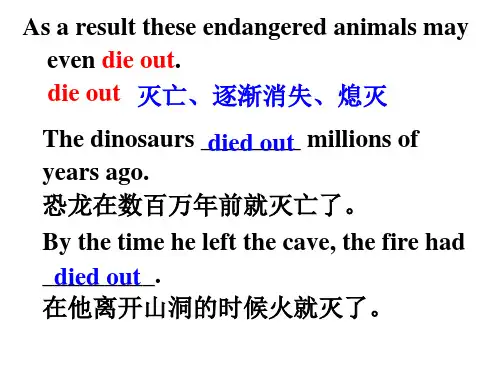
endangered wildlife
Tibet
wool endangered
antelopes
Para 1: the antelope --Tibet
1.How does the antelope feel?
Sad.
2.Why has the antelope become an endangered species ?
e.g. He gave her an expensive ___ fur coat for her birthday. 他送给她一件昂贵的毛皮衣服作 为生日礼物。
skin, leather & fur
skin: 最常用词,指人的皮肤或动物的皮,
也可指水果、植物和种子等的外皮。 leather: 通常指经过加工的熟皮,可用于 制作各种皮革制品。 fur: 现多指猫、兔等动物软毛皮,也指 其它动物的毛皮。
D 3) Many customs have gradually____ A.die out B. die of C. die from D. die away A. die out B. die of C. die from D. die away B 4) The poor woman ________ hunger.
The dinosaurs ________ died out millions of years ago. 恐龙在数百万年前就灭亡了。 By the time he left the cave, the fire had _________. died out 在他离开山洞的时候火"We' re being killed for the wool beneath our stomachs. Our fur is being used to make sweaters for people like you. As a result, we are now an endangered species.“ 它说:“为了取得我们肚皮底下的羊 毛,我们正在被屠杀.我们的毛被用来为像 你一样的人们制作毛衣.因此,我们现在濒 临灭绝了.”
人教版高中英语必修二m2unit4_wildlife_protection

1
Why we need wildlife
protection
What we can get from
2
wildlife protection
A good example of wildlife
3&4 protection
summary
Animals
Where What did she find? How
made a lot of money for the farmers.
Daisy: So you _a_r_e__i_n_c_r__e_a_s_i_n_g(increase) in
number now. Glad to hear that. It shows the
_i_m_p__o_r_t_a_n_c__e_(important) of wildlife protection.
_y_o_u__r_s_e_l_f__.
Mcrounobntiaktien_yo_s:v_aI_e__frpi__no__d_wm_ae_ymr_bf_io_luld_ilp_ye_td_oe_(ippnrosoewtceetcrwt) mhdirecuh_fg_ra_on_md___ mosquitoes. You see, the drug _a_f__f_e_c_t_s( affect)
2.What animals did she come across?
a Tibetan antelope an elephant in Zimbabwe a monkey in a rainforest
1.Why has the antelope in Tibet become an endangered species?
人教版高中英语 必修二 Unit4 Wildlife protection Warming up a
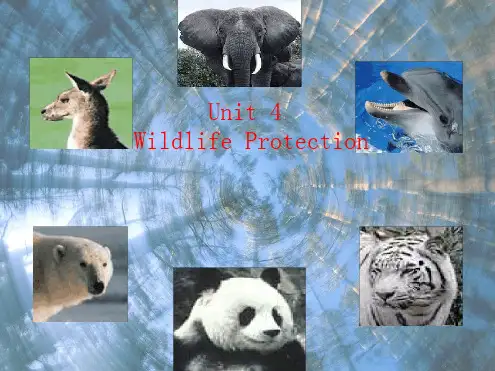
Can you tell me the names of the animals in English?
Lend your ears to us! Enjoy our performance!
panda 熊猫
milu deer
麋鹿
antelope
EXX1anБайду номын сангаас 2
2.自由展示,体现各组 亮丽风采
合作探究 6+3分钟
内容:重点讨论:
1. find out which sentence is the main idea of the text. 2.Divide the whole passage into three parts, and give
wildlife protection .
Careful reading
Read the passage carefully and finish the following activity.
Task1. True or false.
1.Daisy' s sweater is made of sheep fur F( ) 2.The antelope has been protected by far.( F) 3.The elephant used to be well protected . ( F )
1.This passage is mainly about:
Daisy' s dream . In her dream, she met an antelope , an elephant , and a monkey . Through this dream, she had learned how to help wildlife .
(完整版)人教版高一英语必修二Unit4Wildlifeprotection课文对译

(完整版)人教版高一英语必修二Unit4Wildlifeprotection课文对译Unit 4 Wildlife protectionHOW DAISY LEARNED TO HELP WILDLIFE戴西如何学会了保护野生动植物Daisy had always longed to help endangered species of wildlife.Daisy常常渴望去帮助濒临灭绝的种类的野生动物。
One day she woke up and found a flying carpet by her bed. "Where do you一天她醒来发现一个正在飞行的飞毯在她床边。
want to go?" it asked. Daisy responded immediately. "I'd like to see some “你想去哪里?”它问。
Daisy立刻回答它。
endangered wildlife," she said. "Please take me to a distant land where I can “我想去看那些濒危灭绝的动物,”她说。
“请带我去那个我可以find the animal that gave fur to make this sweater." At once the carpet flew找到供给皮毛去制造这件毛衣的动物的一个遥远的地方。
”away and took her to Tibet. There Daisy saw an antelope looking sad. It said,飞毯立刻带她飞去了西藏。
在那里Daisy看到了一支看起来很伤心的羚羊。
"We're being killed for the wool beneath our stomachs. Our fur is being used to它说,“我们被杀是为了我们肚子下的毛。
人教版高中英语必修二课件:Unit4WildlifeProtection

Task2: Read the passage and decide whether the statement are true or false.
Daisy saw many antelopes in Tibet.
Daisy’s sweater was made of sheep wool.
The elephant used to be well protected in Zimbabwe.
How Daisy learned to help wildlife?
The passage is mainly about ____.
Task1: Read the passage and underline phrases or sentences which you don’t understand.
wild animal
wildlife: animals or plants which live or grow in natural conditions.
Let’s enjoy some pictures of some endangered animals. Talk about them with your partner.
This is a real story in Daisy’s life. Answer: FFFF
Role playing
Divide the whole class into 3 groups to make up dialogues talking about how Daisy learned to help wildlife.
milu deer
South China tiger
panda
人教版高一英语 必修二 Unit4 Wildlife protection 单词[有音标]
△ Daisy /'dez/ n.戴茜(女名) △ species /'spi:i:z/ n. 种类;物种 carpet /'kɑ:pt/ n. 地毯 responsibility n.责任 respond /r'spnd/ vi. 回答;响应;做出反应 distance n.距离 distant /'dstnt/ adj. 远的;远处的 fur /f:/ n. 毛皮;毛;软毛 △ antelope /'æntlp/ n. 羚羊 △ Zimbabwe /zm'ba:bwe/ n.津巴布韦 relief /r'li:f/ n. (痛苦或忧虑的)减轻或解除;减轻痛苦 的事物 in relief 如释重负;松了口气 laugh v.笑 laughter /'lɑ:ft/ n. 笑;笑声 burst into laughter 突然笑起来;大声笑了出来 mercy /'m:s/ n. 仁慈;宽恕;怜悯 certain /'s:tn/ adj. 确定的;某一;一定 certainly adv. importance /m'pɔ:tns/ n. 重要(性)important 重要的
△ WWF (World Wildlife Fund) 世界野生生物基金会 rub /rb/ vt. 擦;摩擦 protect … from 保护……不受……(危害) mosquito /m'ski:t/ n. 蚊子 △ millipede /'mlpi:d/ n.(=millepede)千足虫 insect /'nsekt/ n. 昆虫 contain /kn'ten/ vt. 包含;容纳;容忍 powerful /'pafl/ adj. 强大的;有力的 affect /'fekt/ vt. 影响;感动;侵袭 effect n.影响,效果 attention /'tenn/ n. 注意;关注;注意力 pay attention to 注意 appreciate /'pri:et/ vt. 鉴赏;感激;意识到 succeed /sək'si:d/ vi. 成功 vt. 接替;继任 success n.成功 △Indonesia /ndəu'ni: ; -z/ n.印度尼西亚 △ rhino /'ran/ n. 犀牛 secure /s'kj/ adj. 安全的;可靠的 ≈safe adj.安全的
高中英语必修2Unit 4
6.Wouldn’t it be a wonderful world if all nations lived
with
one another?
【答案】1.burst into laughter 2.in danger 3.died out 4.paid attention to 5.in relief 6.in peace
concluded that these belonged to the wolf.
【答案】1.succeeded 2.employs 3.harms 4.security 5.reserves 6.has decreased 7.containers 8.affects 9.appreciated 10.inspected
1.
v. 打猎;猎取;搜寻 n. 狩猎;搜寻
2.
n. 保护→
vt. 保护→
adj. 保护的;
防护的
3.
v. 减少;(使)变小;变少 n. 减少→
adj. 减少的;
渐减的
4.
n. 损失;遗失;丧失→
vt. 遗失;错过;损失→
adj.失去的;遗失的
5.
vi. 回答;响应;做出反应→
n. 回答;反应;回应
6.
n. 仁慈;宽恕;怜悯→
adj. 仁慈的;慈悲的;宽容
的→
adj. 残忍的
7.
n.重要(性)→
adj.重要的;重大的→
adv.重要地
8.
vt. 包含;容纳;容忍→
n. 容器
9.
vt. 影响;感动;侵袭→
n. 喜爱;感情
10.
vt. 鉴赏;感激;意识到→
n. 鉴赏;感激→
人教版高中英语 必修二 Unit4 《Wildlife protection ---Reading》
longerh_u_n__te_d_them.That’s because the _g_o_v_e_r_n_m_e_n_t_decided to help and the farmers
3. How did she feel in each place?
Animal an antelope
Where How Tibet sorry
an elephant Zimbabwe happy
a monkey rainforest amazed
Task 2: Listening
I. Decide whether each of the following statements is T or F.
Para.1 1. Animal: Tibetan Antelope 2. What is happening to them?
They are being hunted for the fur under their stomachs. 3. Result: Numbers are decreasing rapidly. 4. Main idea: Why we need _w_il_d_li_fe__p_ro_t_e_c_tio_n_._
The monkey also told her “No rainforest,
no_a_n_i_m__a_ls_and no_d_r_u_g_s_.” Although finally everything began to d__is_a_p_p_e_a_r_, she had _le_a_r_n_e_d_so much!elepantkangaroo
高中英语人教新课标版必修二Unit 4 Wildlife protection reading课件
Homework: writing
Suppose you are Daisy. What would you say on the Internet to call on people to protect wildlife according to your experience.
Animals are our friends
Skimming
Fill in the table
Animal she Places she
met
went
First visit antelope
Tibet
Second visit elephant Zimbabwe
Third visit monkey Rainforest
Paragraph
1 2 3&4
new drug.
Fill in the form based on the text
Animals Where
What did she find?
How
Tibet
antelope being killed for f_u_r
They were __e_n_d_a_n_g_e_r_ed
Sad
Farmers used to_h_u_n_t elephant.
D. mosquitos help protect moneys from millipede insects .
4. It can be inferred from the text that next Daisy would __________.
A. go and buy a flying carpet B. work with WWF to help wildlife C. laugh over what she had experienced D. cry because she could not make her