
Welcome to the unit模块六第四单元教案
Welcome to the Unit
Teaching aims:
1.Encourage students to participate in a discussion about how they feel about these
people in need and what they can do to help them.
2.Encourage students to talk about some international organizations that can help
people to live a better life.
3.Get Ss to know the functions of some famous international organizations.
4.By talking about the posters and discussing, students’ spoken English can be
practised and ideas shared in the group.
Teaching focus & difficulties:
1.Make sure that students have the basic knowledge about the disasters (caused by
nature and we human beings) and their effects on our lives .
2.Make sure that students have the basic knowledge about some famous national
and international organizations.
3.Make sure that each student can hold their own opinions on how to help people
around the world.
Procedure:
Step 1 Brainstorming
1.Disasters, caused both by nature and mankind, strike different areas and regions
every year. It’s very difficult to predict when and where they w ill take place.
Could you think of some disasters that impressed you deeply?
2.Show some photos about some disasters and ask what effect these disasters will
have on people’s daily lives?
Proper answers: many people will become homeless
Many children will have no schools to attend
Many people will suffer from hunger
Many people will die from diseases
people still live in poverty
Children have no school to attend
Step 2 Discussion
1) If one of your friends met with difficulty in doing his homework, what would you do? If he was ill? Or unhappy?
2) When flood happened in Hubei in 1998, what did people of other areas do to help? (Have the students discuss the questions and then express their ideas.)
2. Talk about Tsunami in the Indian Ocean
1) Do you know what happened in the Indian Ocean in Dec.2004?
2) Pictures of the Tsunami in the Indian Ocean.
Did you do something to help? What did you do? Why?
3) Pictures of China’s help: donation, medical team
Do you think it right for China to do so? Why?
(When a country meets some difficulties, the other countries should help people there to overcome them, so that we can live peacefully together; International aid is very important for countries in need of help.)
Step 3 Picture talking
Picture 1
1.Show pictures of the UN peace-keeping force on the screen.
2.Questions:
1) Who are they?
2) How can they help people across the world?
3) Have you dreamed of being a soldier? Why or why not?
Picture 2
1. Show pictures of poor African people on the screen.
2. Questions:
1) What happened in this picture?
(The little boy was too weak to support his head because of hunger, there’s a hawk not far away, which seemed to be waiting for its dinner.)
2) Are there any poor people like them in China? Where are they? What can we do for them?
Picture 3
1.Show pictures of flood on the screen.
2.Questions:
1) What are they doing?
2) What difficulties will people face if a flood happens?
3) How can people solve the problems?
Picture 4
1.Show pictures of agriculture on the screen.
2.Questions:
1) Is agriculture important? Why?
2) What are the important things for agriculture?
Picture 5
1.Show a picture of doctors who are helping people in need in the countryside for
free.
2.Questions:
1)What are the doctors doing? Where are they?
2) What do they do to help?
Picture 6
1.Show a picture of a poor family.
2.Questions:
1) Describe the family in the picture, what are the differences between your life
and theirs?
2) How can they change their life? Do you have any good ideas?
Step 4 quiz
Look at the following and tell what organization you know it stand for?
Step 5 Discussion
1.What organizations do you know of that can help with the situations in the pictures?
2.Have you ever helped people in need? What did you do to help them?
Step 6 Homework
1.Do relevant exercises in Assessment Book.
2.Finish the reading Exs on P128 in Workbook.
3.Preview reading.。
7 A Unit 6 Welcome to the unit教案

Unit 6 Food and lifestyle
累计课时
1
课时及课题
Period 1 Welcome to the unit
课型
新授
教学目标
1.To learn new vocabulary about food: hamburger, carrot ,watermelon, lemon, pork, beef. Chocolate, sweet
Step 6 Homework
Write a small passage about what food do you and your friends like/love and what food do you and they dislike.
板书设计
Unit6 Food and lifestyle
教学准备及手段
Multi-media, cards
教学过程
二次备课
Step 1 Warm-up activity
1. Greeting
2. Warming up game
Step 2 Presentation
1. Lead-in ( Cartoon shows)
2. New words learning( carrot, hamburger, beef, pork, watermelon, lemon, sweet, chocolate)
1.To learn the names offood and talk about the food someone likes or dislikes.
2.To learn how to express one’s likes or dislikes.
7B英语教案Unit6 Welcome to the unit

67 Ask students to read out the instructions they formed.
Talk to students
Encourage stronger classes to do the task in Part A without further pre-teaching of keywords. For weaker classes, you may need to review the names of the animals and check whether they know how to pronounce them.
设计
思想
Present the instructions
课前教师准备
Someexercise
课前学生准备
Preview the lesson.
教学进程
教师活动
学生活动
ቤተ መጻሕፍቲ ባይዱ修改意见
Part A
Teaching procedures
1.Talk to students about the purpose of instructions.Give them a few examples using classroom situations.Write some instructions on the board.Then ask them about the situations when we use them.Ask stronger classes to create a list of different instructions and then write the different situations as titles above it, e.g.,
一Welcome to the unit说课稿 高中英语 模块四 (1)
英语说课稿一Welcome to the unit(江苏高中英语模块四Unit1-3)Unit 1 Advertisement (Welcome to the unit)Good morning, teachers! My name is ***and I am No.5. It is my great honor to have an opportunity to talk about some of my teaching ideas. My topic is Welcome to the unit taken from Unit 1, Advertisement. My teaching plan will include four parts. They are my understanding of this lesson, my teaching theories ,methods and aids, teaching steps and blackboard design.Part 1 My understanding of this lesson:The analysis of the teaching material:This is the first period of this unit. The topic of this unit is Advertisements. Welcome to the unit gives a chance for students to understand advertisements better in their daily life, helps students to realize the difference between these two types of advertisement, and practice students’ oral English through this topic. The topic is close to students’ life so it is easy to stimulate their interest in learning.Teaching aims:Knowledge aim: Make students to understand the main idea of the four advertisements on the book.Ability aim: Ask students to describe the four advertisements in their own words to improve their speaking ability.Emotional aim: Make students aware of the social functions of advertisements and realize two different types of advertisements.Teaching important and difficult points:It is important for students to describe advertisements and tell their difference.It is difficult for students to understand the social functions of different advertisements. Something about the students :The students have known something about advertisements in their daily life but they do not often talk about advertisements in English.Part 2 My teaching theories, methods and aids.I will make students the real masters in class while the teacher acts as director and let the students receive some moral education in this lesson.I will take the student-centered teaching method .I will use a projector , a type recorder ,multimedia and the blackboard as teaching aids in my class. Part 3 Teaching stepsStep 1 GreetingsGreet the whole class.Step 2 Warming upI will show an interesting commercial video to my students. Therefore, the video will offer students a relaxing atmosphere and stimulate students’ interests in English learning.Step 3 Lead inI will ask my students two questions:Do you like advertisements or not?Where can you find advertisements?My purpose of this step is to increase the students’ interest of advertisements.Step 4 SpeakingI will ask students to open their books to Page1, let the students have a look at these four pictures and discuss them in groups of four and try to answer the three questions On Page 1:Which advertisements make you want to buy a product or service ? Why?Which advertisements make you think about social problems? Why?Do you believe that advertisements tell the complete truth? Why or why not?My purpose of this step is to help students understand advertisements better and know the difference between two different types of advertisements.Step 5 ListeningI will let students listen to the tape about some advertisements and then write down their products.computers apartments swimming suitsMy purpose of this step is to improve students’ listening ability in this class.Step 6 ConsolidationI will ask some students to tell me about the advantages and disadvantages of advertisements and retell the difference between two types of advertisements.By this step, I want to know if my students get an better idea about advertisements through this class.Step 7 HomeworkI will ask my students to design an advertisement in English by themselves and discuss them in groups.By this step, I want to improve their imagination and the ability of their writing.Part 4 Blackboard designOn the left of the blackboard, I’ll write down some language points ; in the middle are some suggested answers and on the right are some speaking skills.That’s all, thank you!Unit 2 Sports events (Welcome to the unit)Good morning, teachers! My name is *** and I am No.5. It is my great honor to have an opportunity to talk about some of my teaching ideas. My topic is Welcome to the unit taken from Unit 2, Sports events. My teaching plan will include four parts. They are my understanding of this lesson, my teaching theories ,methods and aids, teaching steps and blackboard design.Part 1 My understanding of this lesson:The analysis of the teaching material:This is the first period of this unit. The topic of this unit is Sports events.Welcome to the unit gives a chance for students to understand sports better in their daily life, helps students to realize the difference between different sports, and practice students’ oral English through this topic. The topic is close to students’ life so it is easy to stimulate their interest in learning.Teaching aims:Knowledge aim: Make students to understand the main idea of the six pictures of sports on the book.Ability aim: Ask students to describe the six sports in their own words to improve their speaking ability.Emotional aim:Help students understand the benefits of sports and become more interested in them.Teaching important and difficult points:It is important for students to describe sports .It is difficult for students to understand the social functions of sports.Something about the students :The students have known something about sports in their daily life but they do not often talk about sports in English.Part 2 My teaching theories, methods and aids.I will make students the real masters in class while the teacher acts as director .I will take the student-centered teaching method .I will use a projector , a type recorder ,multimedia and the blackboard as teaching aids in my class. Part 3 Teaching stepsStep 1 GreetingsGreet the whole class.Step 2 RevisionI will help students to review some key points in the last class.Step 3 Lead inI will show an interesting sports video to my students. Therefore, the video will offer students a relaxing atmosphere and stimulate students’ interests in En glish learning.Step 4 SpeakingI will ask students to open their books to Page 21, let the students have a look at these six pictures and discuss them in groups of four and try to answer the three questions On Page 21:Why do you think sport is so popular?How often do you play sport? What sports do you usually play?What is your favorite sport? Why?My purpose of this step is to help students understand sports better and know the benefits and social functions of sports.Step 5 ListeningI will let students listen to the tape about some sports and then write down their names. basketball table tennis track and fieldMy purpose of this step is to improve students’ listening ability in this class.Step 6 ConsolidationI will ask some students to tell me about several benefits of sports.By this step, I want to know if my students get an better idea about sports through this class.Step 7 HomeworkI will ask my students to write a passage about their favorite sport in English and discuss them in groups.By this step, I want to improve the ability of their writing and speaking.Part 4 Blackboard designOn the left of the blackboard, I’ll write down some language points ; in the middle are some suggested answers and on the right are some speaking skills.That’s all, thank you!Unit 3 Tomorrow’s world (Welcome to the unit)Good morning, teachers! My name is ***and I am No.5. It is my great honor to have an opportunity to talk about some of my teaching ideas. My topic is Welcome to the unit taken from Unit 3, Tomorrow’s world. My teaching plan will include four parts. They are my understanding of this lesson, my teaching theories, methods and aids, teaching steps and blackboard design.Part 1 My understanding of this lesson:The analysis of the teaching material:This is the first period of this unit. The topic of this unit is Tomorrow’s world. Welcome to the unit gives a chance for students to understand tomorrow’s world better in their daily life, and practice students’ oral English through this topic. The topic is close to students’ life so it is easy to stimulate their interest in learning.Teaching aims:Knowledge aim: Make students to understand the main idea of the four pictures on the book. Ability aim: Ask students to describe the four pictures in their own words to improve their speaking ability.Emotional aim:Help students imagine the world in the future and become more interested in them. Teaching important and difficult points:It is important for students to describe and understand the pictures on the books.It is difficult for students to imagine the world in the future by themselves.Something about the students :The students have read some fictions or watched some films about the world in the future but they do not often talk about the world in the future in English.Part 2 My teaching theories, methods and aids.I will make students the real masters in class while the teacher acts as director .I will take the student-centered teaching method .I will use a projector , a type recorder ,multimedia and the blackboard as teaching aids in my class. Part 3 Teaching stepsStep 1 GreetingsGreet the whole class.Step 2 RevisionI will help students to review some key points in the last class.Step 3 Lead inI will show an interesting video about the world in the future to my students. Therefore, the video will offer students a relaxing atmosphere and stimulate students’ interests in English learning. Step 4 SpeakingI will ask students to open their books to Page 41, let the students have a look at these four pictures and discuss them in groups of four and try to answer the three questions On Page 41:Do you think the Moon could be a tourist destination in the future?What jobs do you think robots could do in the future?What developments in science and technology would you like to see happen in the future?My purpose of this step is to help students to get an better idea about the world in the future . Step 5 ListeningI will let students listen to the tape about some events that may be possible in the future and then ask students to discuss them. They can use the following expressions:amazing fantastic marvelousMy purpose of this step is to improve students’ listening ability in this class.Step 6 ConsolidationI will ask some students to tell me about some possible events in the future.By this step, I want to know if my students get an better idea about the future world through this class.Step 7 HomeworkI will ask my students to write a passage about the world in the future according to their own imagination in English and discuss them in groups.By this step, I want to improve the ability of their writing and speaking.Part 4 Blackboard designOn the left of the blackboard, I’ll write down some language points ; in the middle are some suggested answers and on the right are some speaking skills.That’s all, thank you!。
牛津英语模块六第四单元WelcometotheUnit精品教案1
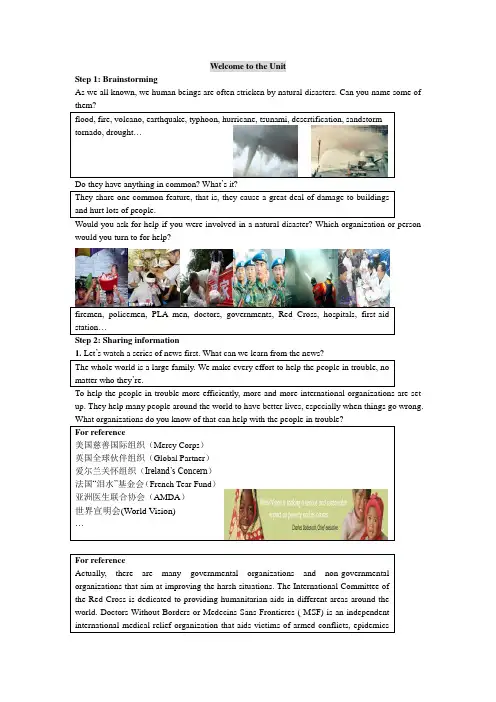
Welcome to the UnitStep 1: BrainstormingAs we all known, we human beings are often stricken by natural disasters. Can you name some ofWould you ask for help if you were involved in a natural disaster? Which organization or person would you turn to for help?Step 2: Sharing informationTo help the people in trouble more efficiently, more and more international organizations are set up. They help many people around the world to have better lives, especially when things go wrong.2. Look at the six pictures at page 49, these pictures present situations where people need international aid. Let’s have a discussion about them.Picture 1Can you guess from the caption what the main tasks of peacekeepingsoldiers are?Do you think these soldiers play an important role in maintaining the world peace?Do you think this kind of job is very demanding, challengingand risky? Why or why not?When you grow up, would you like to do this kind of job if you had the chance? Why or why not?Picture 2What can you see in the picture?How can we help them?Picture 3What can you see in the picture?What can you see in the picture?Picture 5What is the doctor in the picture doing?Apart from the problems listed above, people in poverty are stillfacing many other difficulties. Can you name some of them?Do you think children can receive good education and good medical care in poor areas?Can their daily necessities be guaranteed? If not, what will happen?Step 4: Homework1.Collect more information about international organizations helping people in need.Prepare the Reading part.。
苏教牛津译林高中英语模块6_Unit4_Welcome_to_the_unit参考教案
选修6 Unit4 Welcome to the unit参考教案Teaching goalsEncourage the students to share their experience of helping others in their daily life and let them know the importance of helping others.Teaching methodsIndividual work,and group workTeaching aidsMultimediaTeaching procedure and waysStep 1 Lead- inIn this procedure, encourage the students to share their experience of helping others in their daily life.T: Hello! Boys and girls!S: Hello! Mr/ Mrs/ Miss…T: At the beginning of the class, I’d like to tell you a story. One day, I went to visit a friend of mine. But , a thick mist got me lost. Luckily, someone helped me find the right place. That really comforted me. Actually, every day, we help others and receive help from others. Would you like to share your experiences?The students can talk about this from the following aspects:In different places: at home, in public, on the bus, on their way to… in the school…Various people: children, old man, pregnant woman, disabled man, people suffering mental problems, strangers:Talk about the relevant events in the books, newspapers…they have read and heard of, for example, 10 most influential personnel in China.The students can also talk about the help they received from others.All these aims at making the students get familiar with the topic.S1: When seeing a running child suddenly fall to the ground, I helped him out.S2: On a bus, I always give my seat to the old.S3: I lent my pen to my classmate who had left his/hers home.…T: Great! You’re ready to help others at any time and in any place. It is your kindness that makes our society much better. However, many things cannot be settled down only by yourself / on individual level. For example, the earthquake happened in Pakistan in Oct. 2005; the tsunami in Indian Ocean in Dec. 2004; terrorist attack in the United States on September 11, 2001.And what happened in these disasters? Work in groups and make a discussion.Before the students talk about these things, shows the following clues:The death tollBuilding damagesMental handicap to the Americans and even people around the world…Step 2 SpeakingAsk the students to talk about the pictures on page 49T: Now, let’s look at these pictures on page 49. Have you ever seen these situations? S: Yes!T: Where did you see them?S: Mainly on TV/ in newspapers/ in real life.T: Do you know what they talk about?S: They talk about peacekeeping, famine, flooding, agriculture (or irrigation), medical care, and poverty separately.T: Well done! Now, discuss these pictures in groups of four, and you can discuss in this way:What you can see in the picture;What the problems are;What caused these;How you feel about that;What organizations you know can help with the situations.Show the chart while the students are discussingSample answersAfter a few minutes, ask the students to report their discussion results.T: Who would like to talk about picture 1?S: Let me have a try. They’re two special soldiers. I usually s ee them on TV. When there are wars, or fighting in some countries, they will be sent there to keep peace. I think these special soldiers are brave and they contribute a lot to the peace and safety of the people who suffer from wars and conflicts.T: You’ve done a really great job! And can you tell us, by whom, the special soldiers are sent to keep the peace?S1: The nations that have special soldiers.S2: I don’t think so. I think it’s the UN.T: Yes. You’re right! They are sent through the UN. And we’ll le arn more about that inthe following classes. Picture 2, who wants to have a try?S: People in the picture are very thin, and painful because of a shortage of food. They suffer from famine. I’m sorry for them. Their most basic need cannot be fulfilled, to say nothing of education or entertainment. I think we shouldn’t waste food any more. By watching TV and reading newspapers, I know that our country often loans money to these countries and also give them aid. And the UN may have the relevant organization.T: Great! How about picture 3?S: From the picture we can see that this area was flooded. Typhoon or heavy rain has caused it. Houses there must have been destroyed. What is worse, many diseases will spread. In my opinion, people should be warned earlier, and doctors should be sent to deal with the possible diseases. And the WHO, the Red Cross, and the UN can help with the situation in the future.T: Excellent! How about picture 4?S: Water is pumped into the farmland. The crops grow well. So I think the field may suffer from drought or it is difficult to farm. Irrigation improvement here is necessary. Agriculture experts are also needed. I think the UN should have such an organization to help with this.T: Very good! What about picture 5?S: A doctor is looking at an X-ray under a lamp. He must help patients with bone problems in some poor areas. I think WHO and the Red Cross can do this.T: Well done! How about picture 6?S: People in small areas still live in poverty. Most of them cannot receive education as we do now, and can not play as we can. We have to cherish what we own today.T: That’ it! And what organization do you think can help with this?S: I think the UN can help them.T: OK! Most of you have mentioned the UN. From that we can say that the UN can help solve many problems, and plays a very important role in the international stage, right?S: Yes.Step 3 Summary and homeworkT: Today, we have talked about the 6 situations in this part, and learned that some countries around the world suffer from wars, natural disasters, famine, illness and poverty. And some of you have talked about your feelings. And you have known that these situations should be solved internationally, that is countries should help each other. You also mentioned some organizations that can deal with these situations, such as the UN,the Red Cross, the WHO. In the following periods, we’ll learn more about the UN. So, after class, you had better read books and surf the internet to collect some useful information about the UN. OK, class is over. Goodbye, boys and girls.。
牛津译林版高中英语模块6 Unit 4 welcome 教学设计
Unit 4 welcome 教学设计1. International aid helps many people around the world to have better lives, especially when things go wrong. (P49)cf: especially, specially, particularlyespecially相当于in particular做“特别地”specially相当于on purpose 做“专门地、特意地”particula rly=especially指“特别、尤其”, especially指用于正式问题, particularly既可用于正式问题, 也可用于日常口语, 常可通用。
especiallyadv. very much; particularly;尤其, 特别地I love the country, especially in spring.I dare not go there, especially when you won't go with me.We are very busy especially when we have visitors on Sundays.They invited her to speak especially because of her experience in inner cities.People, especially teenagers, don't seem so polite these days.This is a especially good wine.It has been especially hot this summer"'Do you like chocolate?' 'Not, especially.'"particularlyadv. especially, or more than usual:We're particularly interested to hear from people who speak two or more European languages.I didn't particularly want to go, but I had to.I'm particularly fond of pop music.Speciallyadv. for a particular reason: 专程地、专门地(为了特别的目的)extremely or particularly:I chose this specially for your new house.I came here specially to see you.I made it specially for your birthday.The book is specially for foreign learners of English.go wronggo link-v. [L only + adj.] going, went, goneto become:成为, 变得The idea of going grey doesn't bother me, but I'd hate to go bald.Her father's going senile/blind/deaf.If anything goes wrong, you can call our emergency hotline free of charge.After 12 years of Republican presidents, the US went Democratic in 1992.2. Let’s look at these pictures and discuss the situations with a partner.(P49)situationn. [C] 1) the set of things that are happening and the conditions that exist at a particular time and place: 形势, 状况the economic/political situationHer news put me in a difficult situation."Would you get involved in a fight?" "It would depend on the situation."I'll worry about it if/when/as the situation arises (= if/when/as it happens).2)FORMAL the position of sth., especially a town, building, etc.: 地理位置The house's situation in the river valley is perfect.situate[vt. usually + adv. or prep.] to put in a particular position:使位于, 使坐落于They plan to situate the bus stop at the corner of the road.To understand this issue, it must first be situated in its context.situatedadj. [after verb] in a particular position: 坐落在……的;处于…….的The school is situated near to the station.[+ to infinitive] With this new product, we are well situated to beat (= we have a good chance of beating) our competitors.How are you situated for time (= How much time do you have)?3. When there is a shortage of food, there is a famine.(P49)shortagen. [C] when there is not enough of sth.: 缺少, 短缺There's a shortage of food and shelter in the refugee camps.The long hot summer has led to serious water shortages.short adj. lacking: 缺少的to be short of space/timeWe’re a bit short of coffee . I must get some more.The bill comes to £85, but we’re £15 short.I’m a little short (=I do not have much money)this week- could you lend me ten dollars?。
牛津译林版高中英语模块6 Unit 4 welcome 教学设计
Unit 4 welcome 教学设计1. International aid helps many people around the world to have better lives, especially when things go wrong. (P49)cf: especially, specially, particularlyespecially相当于in particular做“特别地”specially相当于on purpose 做“专门地、特意地”particula rly=especially指“特别、尤其”, especially指用于正式问题, particularly既可用于正式问题, 也可用于日常口语, 常可通用。
especiallyadv. very much; particularly;尤其, 特别地I love the country, especially in spring.I dare not go there, especially when you won't go with me.We are very busy especially when we have visitors on Sundays.They invited her to speak especially because of her experience in inner cities.People, especially teenagers, don't seem so polite these days.This is a especially good wine.It has been especially hot this summer"'Do you like chocolate?' 'Not, especially.'"particularlyadv. especially, or more than usual:We're particularly interested to hear from people who speak two or more European languages.I didn't particularly want to go, but I had to.I'm particularly fond of pop music.Speciallyadv. for a particular reason: 专程地、专门地(为了特别的目的)extremely or particularly:I chose this specially for your new house.I came here specially to see you.I made it specially for your birthday.The book is specially for foreign learners of English.go wronggo link-v. [L only + adj.] going, went, goneto become:成为, 变得The idea of going grey doesn't bother me, but I'd hate to go bald.Her father's going senile/blind/deaf.If anything goes wrong, you can call our emergency hotline free of charge.After 12 years of Republican presidents, the US went Democratic in 1992.2. Let’s look at these pictures and discuss the situations with a partner.(P49)situationn. [C] 1) the set of things that are happening and the conditions that exist at a particular time and place: 形势, 状况the economic/political situationHer news put me in a difficult situation."Would you get involved in a fight?" "It would depend on the situation."。
9AUnit6Welcome to the unit 教案
Do you know something about the things about detective stories? etc.
Step2.welcome to the unit
Explain the context.
This is a detective’s report. Everyone wants to make sure who the murder is , so let the Ss read the profiles of every suspect in Part A
Discuss in groups of four and guess who the murder is.
Ask some students to stand up to say who the murderisand give out the reason, sent the best drawer to draw out the murder on the blackboard
Point out the phrases:
dress sb / dress up
go missing
Step 5Homework
Talk about the topic of this unit and guess some vocabulary
Learn about some famous detectives in the world
2. What is he really looking for?
Play the tape for the Ss to catch the answers.
《牛津高中英语》模块六Unit-4的教学设计与反思
《牛津高中英语》模块六Unit 4的教学设计与反思芮元林南京市江宁区教学研究室一、引言高中英语新课改强调从学生的学习兴趣、生活经验和认知水平出发,采用“任务型”的教学途径,让学生在体验、实践、参与和交流互动中发展综合语言运用能力。
新课程标准增加了情感因素、学习策略以及文化意识和跨文化交际能力等方面要求,将以人为本的教育观念、培养学生的终生学习能力、培养学生健全的人格以及技能发展能力提到了教育成功的核心。
因此,在设计教学的过程中,如何才能更好地体现新课程理念、培养学生的思维能力、激发学生的学习热情,显然成为高中英语教学中教师所面临的一个重要的、必须解决的问题。
笔者以在“教学实践周”活动中的一节“下水课”为例,对该课所设计的教学过程进行了案例分析,阐述在新课改形势下,如何运用“信息技术与课程整合”的理念,让高中英语课堂教学焕发“新课程、新理念”的光彩。
二、教学设计理念1. 运用任务型语言教学模式,训练培养学生对语言的综合运用,实现目标,感受成功,教学进度整体把握,教学形式不拘一格。
2. 课堂以学生为主体,以任务为主线,重视体验参与,教师起到“设计者、研究者、促进者、协调者”的作用。
3. 在教学中,突出交际性,注重读写的实用性,并进行情感和策略调整,以形成积极的学习态度,促进语言实际运用能力的提高。
4. 正视个体差异,倡导过程激励,以多层次、多角度、多主体的结果与过程并重的评价方式激励进步。
三、教材及学情分析(一)课程内容本课教材选取的是《牛津高中英语》Module 6 Unit 4 Helping peoplearound the world中Welcome to the unit 部分和Word power部分的整合,教材内容主要讲述当今世界存在的一些社会现象,如战争、饥荒、贫穷、自然灾害及环境污染等,并由此教育我们要帮助这些正处在困难中的人群,同时了解一些国内外的组织,如联合国的名称、构成及功能等。
Book6U3教案课时1Welcometotheunit
牛津高中英语教学设计教材:牛津高中英语(模块六)高二上学期文档内容:教学设计—教案单元:Unit 3 Understanding each other板块:Welcome to the unit作者:丁荷花Thoughts on the design:本节课是以说和读为主的单元热身课,用一课时的时间来激活学生与单元话题(文化差异)有关的已有知识以便导入课文教学。
运用图画以及与图画有关的提示语,激发学生对话题的兴趣,引导学生运用已有知识进行相关话题的讨论。
由于课本上的信息量不大,学生对各国的文化差异并不是很了解,所以通过阅读短文来增加信息量,为下一步的学习做好充分的热身准备,从而调动学习的积极性。
同时要注重德育教育,引导学生学会尊重文化差异。
Teaching aims:After learning this part, the students will be able to:1.have a general understanding of a different way of greeting each other by people fromdifferent countries;2.know some different customs that are different in different parts of the world;3.express their opinions about the possible problems that may be caused by the differences;4.learn some new words and phrases and language points.Teaching procedures:Step 1 lead in (PPT4-5)As we all know, different countries have different cultures and customs. Look at the Quiz on the screen please, let’s know more about cultural differences in different countries.1) In Western countries, it’s unusual to give ti ps. (No)2) Westerners tend to avoid using13. (Yes)3) Nodding your head up and down always means yes. (No)4) Usually, one should never give a clock as a gift in China. (Yes)5) Never point to anything with your foot in Vietnam(越南). (Yes)6) You can pass something to an older person with one hand in Korea. (No)7) In Canada, it’s OK to arrive early if you are invited to someone’s house?(No) [Explanation]本环节先从单元话题入手,让学生从简单的QUIZ中了解各国在日常生活中有哪些基本的文化差异,不至于在以后与外国人打交道产生误解,造成尴尬的局面。