
冀教版八年级英语 Lesson37 Let's learn geography精品课件
1. have / has been to 到过某地,已回 have / has gone to 去了某地去,未回 have / has been in + sp. 一段时间待在某地 针对练习: eg1:他去过美国三次。 He has been to America three times. eg2:他已经去了加拿大。 He has gone to Canada. eg3: 我已经在伦敦待了两年了。 I’ve been in London for two years.
What can we learn in geography class?
Rivers
Oceans
mountains
We learn about rivers, mountains and oceans
2)We have learned about the population of the world. 1.How large/ What is the population of China? 2.The city has a population of 20000. = The population of the city is 20000. 3. The population of China is larger than that of Japan.
Antarctica [æn'tɑːktɪkə]
南极洲
My father has travelled a lot . He has been to every continent except ____________. Antarctica
New Words
population abroad Japan Japanese Antarctica island Pacific n. 人口 adv. 到国外;在国外 日本 n. 日语;日本人 adj. 日语的; 日本人的 n. 南极洲 n. 岛屿 太平洋(的)
中考链接: is getting 1.The population of the world ___ larger and larger. 2.China is a country with a ______ large population. (多) small 3.Japan is a country with a _____ population. (少) of two million. 4.Our city has a population ___ What’s the population ___ of Beijing?
You may choose one task
• Task I Pairwork • A: Have you ever been to ____? • B: ____. • A: What language do they speak? • B: _____. • A:.... Task II Report Describe a place you have been to. 1. Where have you been? 2. How do you like that place ? 3. What language do people speak?
• Task I Pairwork 提示词 • A: Have you ever been Country : America、 to Japan? Australia, England , • B: Yes, I have./ No, I France and so on. haven’t. Language: English • A: What language do French they speak? • B: They speak Japanese.
Unit 7 Know our world Lesson 37 Let’s learn Geography!
New words
population 人口 island 岛屿 Pacific 太平洋(的) abroad 出国,在国外 Japanese 日语,日本人(的)
population 1. A: Which country has the largest___________? B: China, of course. island 2. A: Is Taiwan an ________? Pacific B: Yes. It is in the ______. abroad so I won’t see 3. Mr. Wang has gone ________, him this week. Japanese 4. The people in Japan speak __________.
Task II Report Describe a place you have been to. 1. Where have you been? 2. How do you like that place ? 3. What language do people speak?
Eg: I like geography. So I like travelling very much. I have been to Beijing. There are many places of interest in Beijing . They are the Great Wall, the Palace Museum , the Bird’s Nest and Tian’anmen Square. They are beautiful . They speak Chinese . I love Beijing.
Read the lesson and write true (T) or false (F).
Danny
1. Brian wants to visit Japan someday. (F) 2. Jenny has never been to any Asian countries. (F) 3. Brian’s father has travelled to several different continents. (T) Jenny 4. Danny’s mother has a friend in Antarctica. (F)
Homework
• 1. Finish the exercise . • 2. Better your dialogue or report. • 3. Search for more information of a foreign country. • 4.Preview next lesson.
Summary: population 人口,为集合名词,常被看作 一个整体,无复数形式。谓语动词用单数。 注: ①提问人口多少: How large/what is the population of sp. ②表示某国某城市有多少人口句型: sp.+has a population of+数词 或者 the population of+ sp. is +数词 ③修饰人口多少:large、small
Pacific
Read in roles
1.4
2.5
3.6
1) Recently, we have learned about the population of the world. 2) Have you ever been abroad, Danny? 3) Jenny and I have been to China twice. 4) Have you been to any other countries in Asia? 5) Have you visited any other countries? 6) He has been to every continent except Antarctica. 7) She has gone to visit her friend.
Which countries have they been to? Listen and tick the country that each person has visited.
Jenny
(√) China
( ) the UK
( ) Japan ( ) Canada
Danny (√) Chiቤተ መጻሕፍቲ ባይዱa Brian (√) the U.S.
Fill in the blanks.
1) Recently, we have ____ _______ learned about the population of the world. 2) Have ____ ____ ____ been ____ abroad, Danny? you ever have been to China twice. 3) Jenny and I _____ ____ ___ Have you ____ been to any other countries in Asia? 4) _____ 5) Have _____ you ______ visitedany other countries? 6) He ____ has _____ been___ toevery continent except Antarctica. has ____ gone to visit her friend. 7) She ____ ____
冀教版英语八年级下册Unit 7 Lesson 37 Let’s Learn Geography. 教学设计

八年级英语下册(河北教育出版社)Unit7:Know our World!Lesson 37: Let’s Learn Geography! 教学设计教材分析本单元主要通过对世界上几个主要国家、大洲、大洋的基本人文概况,及其所处的不同地理位置知识的学习,帮助学生了解地理学科的重要性。
学生将会探究涉及到与此主题相关的概念、词汇和句型,学会如何描述包括文化、人口、语言、国家或地区的实际位置、气候和自然风景在内的不同地理特征。
本单元旨在用英语这个“工具”学习世界地理知识,对部分学生的听、说和读的能力具有一定的挑战性。
本课是第七单元的第一课、与其它5课内容相比较,更具有基础性,是第七单元的导入课。
采用对话体的形式,通过了解“你”是否去过或者去了两个有代表性的国家(中国和日本)、一个大洋(太平洋)和一个洲(南极洲),他们的位置(location)如何,中日两国的人口熟多熟少(large or small), 使学生对世界地理有了概括性的了解,对激发学生学习热情、学好其它5课内容将会起到画龙点睛的作用。
语法重点是现在完成时态。
“去过”和“去了”是现在完成时态的两个特例,是对已学知识的进一步延伸。
学情分析八年级学生具备了一定的思考能力,具有较强的好奇心和求知欲,模仿能力很强。
八年级是学生分化比较严重的阶段,英语学习能力和水平参差不齐。
部分学生对英语学习的兴趣,随着英语知识的增加,在逐渐地减退。
针对这些特点,课堂上老师应该尽量对学生的表现进行肯定或者鼓励,回答问题及小组展示也应该差异化对待,想方设法减少掉队学生人数;注重培养学习英语的兴趣,营造学英语的氛围;鼓励学生开口说英语,给学生运用所学知识进行创造和表达的机会,让学生在参与课堂活动中体验成功的喜悦。
通过实施本课课堂教学活动,让学生在掌握本课内容的同时,进一步了解学习英语的一些基本方法和技巧,也为本单元后续课文的学习奠定好基础。
教学目标知识与技能目标:1.能够掌握课标要求的“四会”词汇:population, abroad, Japan,Japanese, island.2.能够学会提问、回答某个国家的人口,学会表达人口数量的多与少。
冀教版八年级下册英语 Unit7 Lesson 37 Let’s Learn Geography课件

—No, Jane is _____C____ taller than Claire.
A. little
B. more
C. a little
题组专训•突破考点
7. Michael has read _____B____ grammar books, but I am
sorry to say that he has learned _________ from them.
题组专训•突破考点
13. The girl can’t wait _____C____ her grandmother.
A. to watch
B. for watching
C. to see
D. for seeing
课后巩固•拓展延伸
一、单项选择
1. Everyone passed the exam ____A___ him. So he was sad.
课后巩固•拓展延伸
9. It’s fun _t_o__sw__im___ (swim) in the lake in summer. 10. __R_e_c_e_n_tl_y_ (recent), we have learned about geography.
课后巩固•拓展延伸
三、连词成句 11. abroad, ever, have, you, been ____H_a_v_e__y_o_u_e_v_e_r_b_e_e_n__a_b_r_o_a_d_____?
【2021·上海奉贤区期中】
A. few; a little
B. a few; little
C. few; little
D. a few; a little
题组专训•突破考点
冀教版英语八年级下册Unit 7 Lesson 37 Let’s Learn Geography.
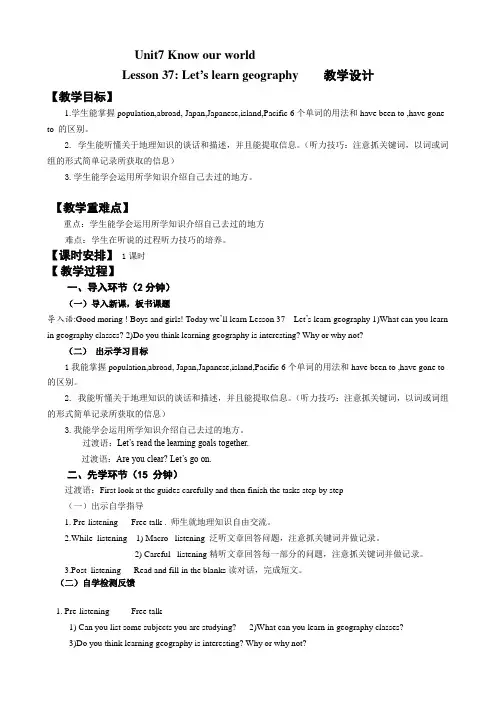
Unit7 Know our worldLesson 37: Let’s learn geography 教学设计【教学目标】1.学生能掌握population,abroad, Japan,Japanese,island,Pacific 6个单词的用法和have been to ,have gone to 的区别。
2. 学生能听懂关于地理知识的谈话和描述,并且能提取信息。
(听力技巧:注意抓关键词,以词或词组的形式简单记录所获取的信息)3.学生能学会运用所学知识介绍自己去过的地方。
【教学重难点】重点:学生能学会运用所学知识介绍自己去过的地方难点:学生在听说的过程听力技巧的培养。
【课时安排】 1课时【教学过程】一、导入环节(2分钟)(一)导入新课,板书课题导入语:Good moring ! Boys and girls! Today we’ll learn Lesson 37 Let’s learn geography 1)What can you learn in geography classes? 2)Do you think learning geography is interesting? Why or why not?(二)出示学习目标1我能掌握population,abroad, Japan,Japanese,island,Pacific 6个单词的用法和have been to ,have gone to 的区别。
2. 我能听懂关于地理知识的谈话和描述,并且能提取信息。
(听力技巧:注意抓关键词,以词或词组的形式简单记录所获取的信息)3.我能学会运用所学知识介绍自己去过的地方。
过渡语:Let’s read the learning goals together.过渡语:Are you clear? Let’s go on.二、先学环节(15 分钟)过渡语:First look at the guides carefully and then finish the tasks step by step(一)出示自学指导1. Pre-listening Free talk . 师生就地理知识自由交流。
冀教版英语八年级下册Unit7:Lesson37Let’sLearnGeography教学设计

4.教师对学生的表现进行点评,及时纠正错误,给予鼓励和指导。
(五)总结归纳
1.教师引导学生回顾本节课所学的主要地理词汇、语法知识以及地理实践技能。
2.学生分享自己在课堂上的收获和感受,提出疑问,教师进行解答。
3.教师强调情感态度与价值观的培养,提醒学生关注地球环境,珍惜自然资源。
4.教师播放一段关于世界地理的短视频,激发学生的兴趣,为新课的学习做好铺垫。
(二)讲授新知
1.教师引入本节课的主要词汇和短语,如:continent, ocean, mountain, river, lake, island, compass, map, latitude, longitude, equator, prime meridian等,通过图片和实物展示,帮助学生理解和记忆。
冀教版英语八年级下册Unit7:Lesson37Let’sLearnGeography教学设计
一、教学目标
(一)知识与技能
1.掌握本课的主要词汇和短语,如:geography, continent, ocean, mountain, river, lake, island, compass, map, latitude, longitude, equator, prime meridian等,并能在实际情境中正确运用。
二、学情分析
八年级下册的学生已经具备了一定的英语基础,掌握了基本的语法、词汇和句型,但在实际应用中仍需加强。在此基础上,他们对地理知识有初步的了解,但大部分学生对地理概念的理解还不够深入,尤其对世界地理的认识较为模糊。因此,在本章节的教学中,教师应关注以下几点:
1.学生对英语词汇的掌握程度,特别是地理类词汇,如continent、ocean、mountain等。在教学过程中,教师应注重词汇的拓展和运用,帮助学生巩固记忆。
冀教版英语八年级下册Unit 7:Lesson 37 Let’s Learn Geography.

Unit 7 Know Our WorldLesson 37 Let’s Learn Geography!Learning aims:1. Talk about the countries.2. Be proud of one’s country.Learning important points:1. Talk about the geography.2. Learn something about the foreign countries.Learning difficult countries:What languages do they speak in other countries?Learning tools:audiotape, flashcards, a globeLearning steps:Step 1. Look at the globe. Point to our country. Ask the students the questions:1. What country are you in?2. What language do we speak?3. Have you been abroad?4. Has anyone in your family been abroad? Where has he been? When? Step 2. Talking aboutWhat’s your favourite subject?What is geography?Do you like geography?Step 3. ListeningListen to the tape and answer the following questions:1. Has Danny been abroad?2. What language do they speak in Japan?3. How long has Brain’s father been in Africa?4. Where’s Jenny’s mother’ pen pal from?Step 4. ReadingRead and check the answers.1. Read the text in roles.2. Let some students act the dialogue out.Step 5. Discuss the details in groups:1. Where would Danny love to go?2. What countries has Brian been to?3. Does Danny speak Chinese?4. Where is Brian from?5. Can you explain the meaning of “pen pal”?Step 6. SummaryLesson 38 The World Is a Big Place!Learning aims:1. Master the new words and expressions: planet; billion; total; increase; Indian; Atlantic; Arctic2. Learn more about the world’s geography.3. Master the words and expressions of the continents and oceans in English.Learning important points:1. The words and expressions in this lesson.2. Know about the world’s physical features.Learning difficult points:Some geography features in the world.Learning aids:audiotape, flashcards, a map of the worldLearning steps:Step 1. Talk about the question:1. Where do you live?2. Do you like to live here? Why?Step 2. Come to “THINK ABOUT IT”Which part of the world do you live in?What do you know about the place where you live?Step 3. Listening taskListen and answer the following questions:1. How many people are there in the world?2. Where do all the people live?3. How big are the world’s oceans?4. How many deserts does the world have?5. What’s the world’s biggest island?6. What’s the world’s longest river?Step 4. ListeningListen to the tape again and ask the students to imitate after it.Step 5. ReadingRead the text again and talk about the details about the text.How many deserts does the world have? What are they? Which is the second largest desert in the world?What’s the world’s longest river? What is the second longest river? What is the third longest river?What are the physical features of them?Step 6. HomeworkListen and read the text again.Finish off your exercise book.Write something about the world’s geography.Lesson 39 Ring Up or Call?Learning aims:1. Master words and expressions: ring, ring up, What does…mean?2. Learn to make a telephone call in English.3. Know about the following culture.Learning important points:1. How to make a telephone call.2. What does “ring up”mean in the U. K.?3. How to make a telephone call?Learning tools:audiotape, flashcards, a telephoneLearning steps:Step 1. ReviewStep 2. AskingAsk the students if they have previewed the lesson. Let the students ask questions about the lesson.Work in pairs. Ask and answer questions about this lesson.They can ask like this:1. What does “Ring up” mean in Canada?2. Is Li Ming at home?Step 3. ListeningStep 4. ReadingRead the text and check the answers.First let the students read the text silently. Then read it in roles. After a while, ask some students to come to the front and act the dialogue out.Step 5. Explain the main expressions in this text. Make up sentences with “May I speak to…?”“This is…speaking.”“Who’s that’s?”Step 6. HomeworkMake up a telephone dialogue. You want to help each other with your English homework.What questions are you having trouble with?Lesson 40 Body LanguageLearning aims:1. Use the Internet and the tools to search the information.2. Create the students interests in learning English.Learning important points:1. Learn the geographical features of Asia.2. Name the main countries in Asia. What are in the main cities in the countries?Learning difficult points:Some words and expressions are too difficult for the students.Learning tools:audiotape, flashcards, a map of the worldLearning steps:Step 1. Leading-inStep 2. Come to “Think About It”What do you know about body language?Do you use body language? When and where?Step 3. ListeningStep 4. PracticeStep 5. SummaryLesson 41 A Class of the WorldLearning aims:1. Know more about the world’s geography.2. Compare the physical features with the Asian physical features.Learning important points:1. Learn about the physical features of Europe.2. Know about the customs and habits in Europe.Learning tools:audiotape, flashcards, picturesLearning steps:Step 1. RevisionReview the countries and the languages. Let some students make a list on the blackboard. Step 2. Listening taskStep 3. ReadingRead and check the answers. First read silently. Then read it loudly in class. The teacher walks around the classroom to see if the students need some help.Step 4. Read the text again. Then discuss the questions in listening task. Discuss the details with the students to see if they have some questions to ask.Step 5. PracticeStep 6. HomeworkCompare Asia and Europe and fill in the chartLesson 42 North AmericaLearning aims:1. Will/ Would/ Could you please…?2. Learn about the rhythm of the foreign songs.3. Know more about the world’s geography.Learning important points:1. Travel around the world.2. How to look up words in a dictionary.3. The way we travel around the world.Learning difficult points:Some words and expressions are too difficult for the students.Learning tools:audiotape, flashcards, a map of the worldLearning steps:Step 1.Warming UpDo you want to travel around the world?If you travel to the east from China, where will you get?Let’s travel around the world!Step 2. Let’s Do ItMake up a dialogue with a partner. Suppose you want to visit a foreign country, but you don’t know which country to go to or how to get there. What can you do when you get there? You need help!Step 3. ListeningStep 4. ReadingRead the new words for the students. Then let them read after the teacher for several times.Now ask them if they have some words that are new to them. Let them talk about the words and guess the meanings together.Step 5. PracticeStep 6. Homework1. Finish off the exercises in activity book.2. Go on the next reading in the student book.。
冀教版八年级下lesson37Let's_Learn_Geography1

ListeningL37.mp3
What countries have they been to?Listen and tick the country that each person has visited .
Jenny Danny ( ) China √ ( √ )China ( )the U.K. ( )Japan
(中国是一个人口众多的国家。)
2. Jenny and I have been to China twice.
She has gone to visit her. a. dam's father ______to the USA before. A. went B.goes C. has gone D.has been b.---- Where is Jack ? ---- He ____ to the park. A.went B.goes C.has gone D.has been have /has been to 表示"_________________" 去过某地,已经返回 have/has gone to 表示" __________________ " 去了某地或在去某地的路上
单项选择
1. --- _____ D the population of your home town? ----About 30 thousand. A. How is B. how much C. What are D. What is 2. The population of the city ____ A about three million. A.is B. be C.are D.have 3. I live in _____ , but couldn't speak ____. C A.Japan;Japan B. Japanese;Japanese C.Japan; Japanese D. Japanese;Japan 4. Mary's father ____to D the USA before. A.went B.goes C.has gone D.has been
冀教版英语八年级下册Unit7Lesson37Let'sLearnGeography教学设计
例如:“A: Have you ever been to the Great Wall?
B: Yes, I have. It's an amazing sight. The Great Wall stretches over 21,196 kilometers from east to west of China. It was built for military defense purposes in ancient times.
冀教版英语八年级下册Unit7Lesson37Let'sLearnGeography教学设计
一、教学目标
(一)知识与技能
本节课是冀教版英语八年级下册Unit7Lesson37“Let's Learn Geography”,通过本节课的学习,学生应掌握以下知识与技能:
1.能够熟练掌握并运用与地理相关的词汇,如:continent(大陆)、ocean(海洋)、mountain(山脉)、plain(平原)、lake(湖泊)等。
3.学生回答问题后,教师简要介绍本节课将要学习的内容,即地理词汇和描述地理位置、地理特征的表达方式。
(二)讲授新知,500字
1.教师呈现新课的词汇卡片,引导学生学习新词汇,如continent、ocean、mountain、plain、lake等,并让学生跟读、模仿。
2.教师通过实例,讲解一般现在时在描述地理位置和地理特征中的应用,如:“The Pacific Ocean is the largest ocean in the world.”
4.增进学生对世界各国地理的了解,培养学生的国际视野,提高学生的跨文化交际能力。
冀教初中英语八年级下册Lesson 37 Let's Learn Geography!课件
Homework
• 1. Finish the exercise . • 2. Better your dialogue or report. • 3. Search for more information of a
foreign country. • 4.Preview next lesson.
感谢聆听
A. What's B. How many is C. How much is 5. --Which city has___population, Shanghai,
Hong kong or Qingdao? A. the smaller B. the least C. the most D. the
• Many countries have rules about what you should and shouldn’t wear. In Muslim countries, women should wear long blouses and skirts .In Korea, you should take off your shoes when entering a house. Remember to place them neatly together where you came in.
You may choose one task
• Task I Pairwork • A: Have you ever
been to ____? • B: ___. • A: What language do
they speak? • B: _____. • A:....
Task II Dialogue Describe a place you have been to. 1. Where have you been? 2. How do you like that place ? 3. What language do people speak?
冀教版英语八年级下册Unit 7Lesson37 Let’s Learn Geography. 课件
Unit7 Know Our World
Lesson37 Let’s Learn Geography
Asia Pacific
太平洋,太平洋的
Antarctica
China has the largest population.
China
Japan
Chinese
Japanese
Taiwan is an island.
A:Have you been to any other cities in China? B:Yes,I have been to___/ No, I haven’t.
A:Have you been abroad? B:Yes, I have been abroad /No, I haven’t been abroad.
The population of_C_h_in_a_is larger than_Ja_p_a_n.
I have been to Shijiazhuang seven times.
A:Have you ever been to__(Shijiazhuang)? B:Yes,I have/ No, I haven’t
1.A:Which country has the largest po_p_u_l_a_ti_o_n ? B:China,of course. 2.A:Is Taiwan an i_s_la_n_d_?
B:Yes.It is in the Pacific. 3.A: I like all fruits e_x_c_e_p_t bananas.
there? B: People there speak______. A: Do you know some places of
Unit7 Lesson 37 Let’s learn geography课件 冀教版英语八年级
Australia
By Anne
By Anne
one day表示“总有一天,将来一天”时,相当于someday, 常用于一般将 来时态,表示“某一天”时,常用于过去时态。
Your dream will come true one day.(将来) someday
One day his mother was ill.(过去)
By Anne
New words
population/pɒpjʊˈleɪʃən/ abroad/əˈbrɔːd/ Japan/dʒə’pæn/ Japanese/ˌdʒæpəˈniːz/
Antarctica/æn'tɑ:ktikə/ island/ˈaɪlənd/ Pacific/pəˋsɪfɪk/
By Anne
By Anne
Where is Tom?
China
Tom has gone to Japan. Tom has been to Japan
Japan
By Anne
He has gone to…. He has been to…
America
The U.K.
China
Brazil
AntarcticaJΒιβλιοθήκη paneseJapanese
Fuji Mountain
American(s) English
the Statue of Liberty
Englishman(men) English
Big Ben
French
French
Eiffel Tower
Canadian(s)
English/French Niagara Falls
3.表示人口的“多”或“少”, 不用“much”或“little”, 而用"large"或"small".