
动词时态
Verb Tense
英语一共有多少种时态?
一 般 完 成 进 行 完成进行
现在
现在一般时 do
现在完成时 have done
现在进行时 is/am/are doing
现在完成进行时 have been doing
过去
过去一般时 did
过去完成时 had done
过去进行时 was/were doing
一般将来时
• 一、用法 • 一般将来时表示将来发生的事。常与tomorrow, next year等时间状语连用。 • 二、构成 • 通常有以下七种方式表示将来,注意它们各自 的区别。 • ■由 will 加动词原形构成,当主语是第一人称 时,也可以用 shall 加动词原形。如: • Call me this evening. I’ll be at home. 今晚给我 打电话,我会在家。 • I’ll (shall/will) do a better job next time. 下次我 要干得好些。
• ■一般现在时表示目前的情况或状态。如: • I am a teacher. 我是教师。 • Peter writes good Chinese but does not speak well. 彼得汉语写得不错,讲的可不行。 • ■以here, there等开始的倒装句,表示动作正在 进行。如: • Here comes the bus. = The bus is coming. 车来 了。 • There goes the bell. = The bell is ringing. 铃响了。
• 注意:已有迹象表明将 注意:
要发生的事,只能用 am/is/are going to+动词 原形。如: • Look at the dark clouds; it’s going to rain. 看那乌 云,快要下雨了。
• ■be to加动词原形,仅用于表 示正式的公务安排、公告指示、 义务、禁止等。如: • You’re to deliver these flowers before 10. 你在10点钟之前把这 些花送去。 • You are to (=should) report to the police. 你应该报警的。 • You’re not to (=mustn’t) tell him anything about our plans. 你不 要把我们的计划透露给他。
• ■表示主语过去的特征或性格。如: • At that time she was very good at English. 那 时她英语学得很好。 • ■用在状语从句中表示过去将来。如: • He said he would wait until they came back. • ■一般过去时有时可以表示现在,多与 want, hope, wonder, think, intend 等动词连用,使语 气更委婉。如: • I wondered if you could help me. 不知你能不能 帮我一下。 • 有时用一般过去时也是时态一致的需要。如: • I didn’t know you were here. 没想到你在这里。
• ■am/is/are going to 加动 词原形,表示主语的意图 或打算将来做的事。如: • What are you going to do tomorrow? 你打算明天做 什么呢? • The play is going to be produced next month. 这 出戏下月开播。
一般过去时
• • • • • • • • • • • 一、构成方法 一般过去时用动词的过去式构成,即在动词原形后加ed ed。 一般过去时用动词的过去式构成,即在动词原形后加ed。 二、用法说明 表示在过去某个时间所发生的动作或所处的状态。常与yesterday, ■表示在过去某个时间所发生的动作或所处的状态。常与 last week, just now, a moment ago, the other day等连用。如: 等连用。 等连用 He was here just now. 他刚才还在这里。 他刚才还在这里。 What did you do yesterday? 你昨天做了什么事? 你昨天做了什么事? 在过去一段时间内的经常性或习惯性动作。 ■在过去一段时间内的经常性或习惯性动作。如: We often played together as we were young. 我们小时候常在一 起玩。 起玩。 表示过去经常发生的动作还可用used to 和would。如: 注:表示过去经常发生的动作还可用 。 He used to smoke a lot, but he doesn’t now. 他过去经常抽烟,但 他过去经常抽烟, 现在不抽了。 现在不抽了。 Whenever we were in trouble, he would help us. 每当我们遇到困 他都会帮助我们。 难,他都会帮助我们。
Need
• 一般现在时(The simple present tense) • 一般过去时(The simple past tense) • 一般将来时(The simple future tense) • 现在完成时(The present perfect tense) • 过去完成时(The past perfect tense) • 将来完成时(The future perfect tense)
一般现在时
• 一、如何理解 • 一般现在时是英语所有时态中用得最普通的一 种时态,它主要表示经常性或习惯性发生的动 作或存在的状态。如: • We get up at six every day. 我们每天6点起床。 • I often do exercise and I am very healthy. 我经 常搞锻炼,身体很好。 • 第一句说每天都是6点钟起床,这显然是一个习 惯性的动作;第二句说经常搞锻炼,这则是一 个经常性的动作,由于经常锻炼,所以身体很 好,这里所说的身体好就是由于经常锻炼而保 持的一种经常性的状态。
Master
• 现在进行时(The present continuous tense) • 过去进行时(The past continuous tense) • 将来进行时(The future continuous tense) • 过去将来时(The past future tense) • 现在完成进行时(The present perfect continuous tense) • 过去完成进行时(The past perfect continuous tense)
• 注意: 注意:
• 1. 表示一系列的动作,尽管有先后,都用一般 过去时,最后两个动词之间用and连结。如: • He opened the door, rushed out and then disappeared. 他打开门,冲了出去,然后就消 失了。 • 2. 注意在语境中理解“我刚才/原来还不……”。 如: • —Your phone number again? I didn’t quite catch it. —It’s 2566666. 请再说一次你的电话 号码,好吗?我刚才没听清楚。是2566666。
过去完成进行时 had been doing 将来完成进行时 will have been doing
将来将来一般时 wiFra bibliotekl do将来完成时 will have done
将来进行时 will be doing
过去将来
过去将来完成进 过去将来一般时 过去将来完成时 过去将来进行时 行时 would do would have done would be doing would have been doing
• ■在下列情况下表示将来:
• • • • • • • • • • • • • 1. 在状语从句中用一般现在时代替一般将来时。如: I will give it to him as soon as I see him. 我一看见他就交给他。 He will come if you invite him. 如果你请他,他会来的。 Suppose he doesn’t agree,what shall we do?假如他不同意,那怎么办? I shall do as I please. 我高兴怎么做就怎么做。 He will continue the work no matter what happens. 不管发生什么情况他都要 继续这项工作。 2. 在the more…the more …(越……越……) 句型中,前者通常用一般现在 时代替一般将来时,因为前者相当于条件状语从句。如: The harder you study, the better results you will get. 你学习越努力, 成绩就会越好。 3. 在make sure (certain) , see to it, mind, care, matter后的宾语从句的谓语动 词用一般现在时代替一般将来时。如: See to it that you are not late again. 注意别再迟到了 4. 表示按计划或时间表示将要发生的动作,通常有表示将来的时间状语。如: The plane takes off at 11:30 and arrives in Shanghai at l:20. 飞机十一点半起 飞,一点二十分抵达上海。 注:只限于少数动词能这样用,如 begin, start, , end, finish, stop, go, come, leave, sail, arrive, return, close, open 等。
• 二、构成与用法
• ■一般现在时表示经常性或习惯性的动作,常与表示频 度的时间状语every day, usually, always, often, sometimes等连用。如: • I go to school at 7 every morning. 每天早上我七点去 上学。 • ■一般现在时表示客观存在及普遍真理。如: • Summer follows spring. 春天之后是夏天。 • The sun rises in the east. 太阳从东方升起。 • 注意:此种用法即使出现在过去的语境中,仍用一般现 在时。如: • I learned that the earth goes around the sun when I was in primary school. 我在小学就学过地球是围绕太 阳转的。 • ■一般现在时表示格言或警句。如: • Pride goes before a fall. 骄者必败。
动词的八种时态
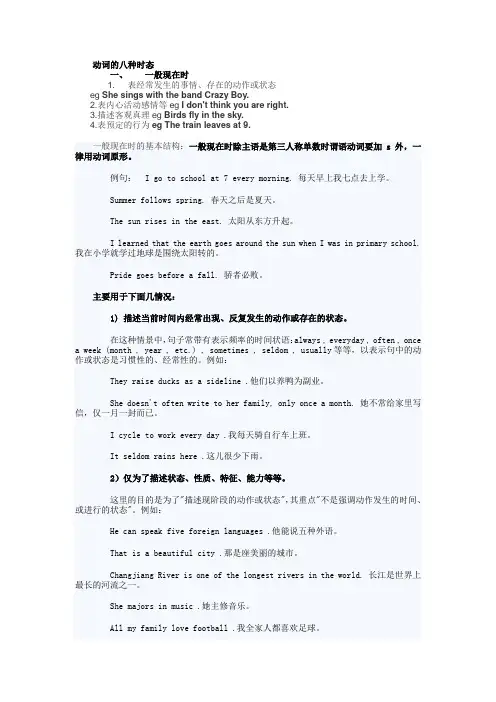
动词的八种时态一、一般现在时1. 表经常发生的事情、存在的动作或状态eg She sings with the band Crazy Boy.2.表内心活动感情等eg I don't think you are right.3.描述客观真理eg Birds fly in the sky.4.表预定的行为eg The train leaves at 9.一般现在时的基本结构:一般现在时除主语是第三人称单数时谓语动词要加s外,一律用动词原形。
例句:I go to school at 7 every morning. 每天早上我七点去上学。
Summer follows spring. 春天之后是夏天。
The sun rises in the east. 太阳从东方升起。
I learned that the earth goes around the sun when I was in primary school. 我在小学就学过地球是围绕太阳转的。
Pride goes before a fall. 骄者必败。
主要用于下面几情况:1) 描述当前时间内经常出现、反复发生的动作或存在的状态。
在这种情景中,句子常带有表示频率的时间状语:always , everyday , often , once a week (month , year , etc.) , sometimes , seldom , usually等等,以表示句中的动作或状态是习惯性的、经常性的。
例如:They raise ducks as a sideline .他们以养鸭为副业。
She doesn't often write to her family, only once a month. 她不常给家里写信,仅一月一封而已。
I cycle to work every day .我每天骑自行车上班。
It seldom rains here .这儿很少下雨。
英语动词时态总结
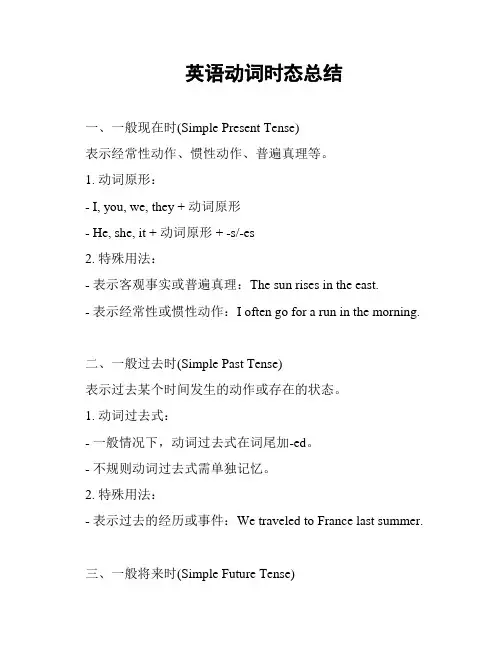
英语动词时态总结一、一般现在时(Simple Present Tense)表示经常性动作、惯性动作、普遍真理等。
1. 动词原形:- I, you, we, they + 动词原形- He, she, it + 动词原形 + -s/-es2. 特殊用法:- 表示客观事实或普遍真理:The sun rises in the east.- 表示经常性或惯性动作:I often go for a run in the morning.二、一般过去时(Simple Past Tense)表示过去某个时间发生的动作或存在的状态。
1. 动词过去式:- 一般情况下,动词过去式在词尾加-ed。
- 不规则动词过去式需单独记忆。
2. 特殊用法:- 表示过去的经历或事件:We traveled to France last summer.三、一般将来时(Simple Future Tense)表示将来发生的动作或存在的状态。
1. will/shall + 动词原形:- I, you, he, she, it, we, they + will + 动词原形- I, we + shall + 动词原形2. 特殊用法:- 表示决定、承诺、意愿等:I will help you with your homework.四、现在进行时(Present Continuous Tense)表示现在正在进行的动作。
1. be(am/is/are) + 动词-ing:- I + am + 动词-ing- He, she, it + is + 动词-ing- You, we, they + are + 动词-ing2. 特殊用法:- 表示现在进行的动作:I am studying for the exam.五、过去进行时(Past Continuous Tense)表示过去某个时间正在进行的动作。
1. was/were + 动词-ing:- I, he, she, it + was + 动词-ing- You, we, they + were + 动词-ing2. 特殊用法:- 表示过去正在进行的动作:She was watching TV when I arrived.六、将来进行时(Future Continuous Tense)表示将来某个时间正在进行的动作。
动词的时态

动词时态一、一般现在时am/is/are does意义:1、经常做(usually; sometimes ; often;);2、时间或条件状语从句中(if /unless/when/once/as soon as),从句用一般现在时,主句用将来时;eg: If it rains , we will not go to the park.;I will return this book to you as soon as I finish it二、一般过去是:was/ were; did ; used to do ;would do意义:1、过去发生的或过去经常做的(in 1980/yesterday/the other day前几天);过去相继发生的动作;eg Yesterday evening I opened the door, put down my bag and found that my computer was stolen.; Lucy used to exercise every day when she was at college.三、一般将来时:will be /will do /be going to do / be to do/ be about to do 意义:将要发生的动作(in the future/ tomorrow/soon很快);现在相信、认为会发生什么(believe相信/expect期望/suppose认为)eg: I will finish my homework soon,;We believe China will become one of the most powerful countries in the world.It it said that the building is to be completed in August next year.四过去将来时would do was/were to do意义:过去认为将会发生什么I thought she would marry Tom, but she didn’t.五现在完成时have/ has done意义:1、一个动作刚刚完成或一个动作好久没有发生了(already/ in the past few years/since/till now/for 3 years/up to now);Nancy has been away from her hometown for 5 years.Is there my letter? I haven’t heard from her for a long time2、过去的动作对现在造成了影响;Who has parked his car outside my door, it is bloking my way.3、第几次做什么,或已经做..几次了;(it is the first/ third time that I have …/ I have done….twice)It is my first time that I have visitied his home.六过去完成时had done意义:1、过去发生的两个动作,有先后之分,较早发生的动作用过去完成时;He didn’t arrive until the game had began2、过去本打算或期望做...而未能实现(hope/want/expect/suppose)Lucy had expected that Tom would come but he didn’t.3、出现by the end of /by the time +过去的一个时间到….时间为止By the end of last year, another new gymnasium had been completed.七将来完成时will have done意义:从现在到将来一段时间才能完成的动作关键词:by the end of /by the time +将来的时间The writer will have completed his novel by the end of 2015八现在进行时(is/ are doing )意义:1、正在做或目前阶段都在做的事;(now/look!listen)2、表达赞美或厌烦的情绪(always/constantly/)eg: Why are you angry? ----Tom is always laughing at me九过去进行时was /were doing意义:1、过去的某个时间点发生的事情;The telephone was ringing when I opened the door.2、过去一直在做;all the time/ all the afternoon.What did you do yesterday. ----we were discussing the problem all the afternoon yesterday.3、表达赞美或厌烦十将来进行时will be doing意义:将来的某个时间点在做的事情then (那时)Lucy , l et’s go to the movie tomorrow 7pm?Oh , sorry , I will be helping my mother do housework then.十一现在完成进行时(have been doing)意义:从过去到现在一直都在做Why are you so tired?I have been painting all day long today.。
动词时态详解

动词时态详解动词时态是指动词表示的动作或状态所发生的时间。
在英语中,有多种不同的时态,每种时态都有其独特的用法和含义。
以下是对一些常见动词时态的详细解释:1. 现在时态 (Present Tense)- 一般现在时 (Simple Present): 用于表达经常性的动作、客观事实、普遍真理等。
- 现在进行时 (Present Continuous): 用于表示正在进行的动作。
- 现在完成时 (Present Perfect): 用于表示过去发生的动作与现在的关系,强调结果或经验。
- 现在完成进行时 (Present Perfect Continuous): 用于表示过去开始并一直持续到现在的动作。
2. 过去时态 (Past Tense)- 一般过去时 (Simple Past): 用于表达过去发生的动作或状态。
- 过去进行时 (Past Continuous): 用于表示过去某一时刻正在进行的动作。
- 过去完成时 (Past Perfect): 用于表示过去某一动作或状态在另一过去时间点之前发生。
- 过去完成进行时 (Past Perfect Continuous): 用于表示过去某一时间点之前已开始并持续到另一时间点的动作。
3. 将来时态 (Future Tense)- 一般将来时(Simple Future): 用于表示将来发生的动作或状态。
- 将来进行时 (Future Continuous): 用于表示将来某一时刻正在进行的动作。
- 将来完成时 (Future Perfect): 用于表示将来某一时间点之前已经完成的动作。
- 将来完成进行时 (Future Perfect Continuous): 用于表示将来某一时间点之前已开始并持续到另一时间点的动作。
以上是关于常见动词时态的简要说明。
对于每种时态,还有其他细节和规则需要进一步了解和掌握。
在使用动词时态时,确保根据具体语境和需要选择合适的时态,以便准确地表达你的意思。
动词的12种时态
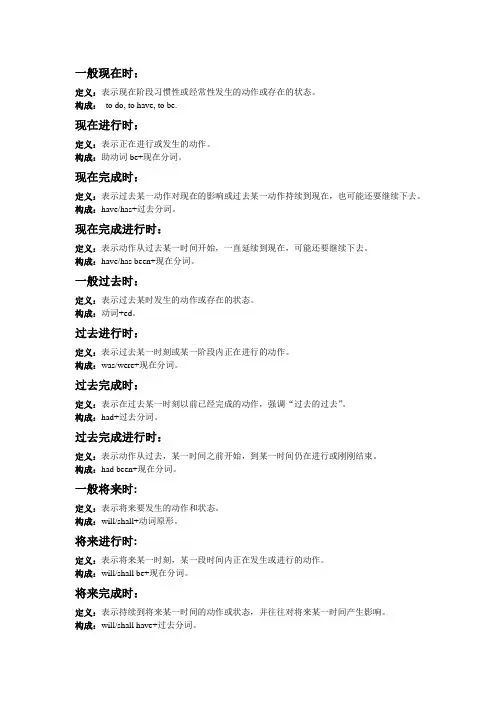
定义:表示现在阶段习惯性或经常性发生的动作或存在的状态。
构成:to do, to have, to be.现在进行时:定义:表示正在进行或发生的动作。
构成:助动词be+现在分词。
现在完成时:定义:表示过去某一动作对现在的影响或过去某一动作持续到现在,也可能还要继续下去。
构成:have/has+过去分词。
现在完成进行时:定义:表示动作从过去某一时间开始,一直延续到现在,可能还要继续下去。
构成:have/has been+现在分词。
一般过去时:定义:表示过去某时发生的动作或存在的状态。
构成:动词+ed。
过去进行时:定义:表示过去某一时刻或某一阶段内正在进行的动作。
构成:was/were+现在分词。
过去完成时:定义:表示在过去某一时刻以前已经完成的动作,强调“过去的过去”。
构成:had+过去分词。
过去完成进行时:定义:表示动作从过去,某一时间之前开始,到某一时间仍在进行或刚刚结束。
构成:had been+现在分词。
一般将来时:定义:表示将来要发生的动作和状态。
构成:will/shall+动词原形。
将来进行时:定义:表示将来某一时刻,某一段时间内正在发生或进行的动作。
构成:will/shall be+现在分词。
将来完成时:定义:表示持续到将来某一时间的动作或状态,并往往对将来某一时间产生影响。
构成:will/shall have+过去分词。
定义:表示对过去某一时间而言将要发生的动作或状态。
构成:would+动词原形。
动词的八种时态

Work hard ,and you will be the best !=If you work hard ,you will be the best !动词的八种时态1. 一般现在时:2.一般过去时:3. 现在进行时:4. 过去进行时:5 现在完成时:6. 过去完成时:7. 一般将来时:8.过去将来时:5 现在完成时■概念1.过去发生或已经完成的动作对现在造成的影响或结果。
时间状语(already,yet,before,ever,never, just,once,twice,these days)■比较I have read the book .■I read the book yesterday .《此用法用终止性动词》2.从过去已经开始,持续到现在的动作或状态。
时间状语:(recently, since①时间点②接用一般过去式的句子,for…,in the past few years,so far .)基本结构:have/has + done否定形式:have/has + not +d one.一般疑问句:have或has。
He has taught us English for 5 years .He has lived in the city since he came to China.《此用法用延续性动词》终止性动词变延续性动词1.die —be dead2. leave—be away (from)3. open—be open4. finish/end—be over5. close—be closed6. begin/start—be on7. buy—have8. borrow—keep9. come/go/arrive/move/reach—be in/at10. join—be a member of / be in11.become---be■用所给动词的适当形式填空1.I have a book .(否定句)I ----------a book .2.I have already read a book。
七种常用动词时态
用现在进行时表示将来:通常是短暂性动词或表示位置 转移的动词(come,go,leave,return,arrive,begin,start)。
5、It’s getting hotter and hotter.
表示渐变的动词用于进行时表示一个逐渐变化的过程。
二、一般过去时 结构:主语 + was / were + 表语 主语 + did + 其他
用法: 1、The train arrived ten minutes ago. 2、He was a newspaper boy in the 1930s. 3、I used to go to school early. 4、Mother said Father didn’t like smoked food (熏制食品). 5、It is high time that we discussed the problem now.
用法: 1、The train arrived ten minutes ago. 表示过去特定时间发生的动作。 2、He was a newspaper boy in the 1930s. 表示过去特定时间所处的状态。 3、I used to go to school early. 表示过去一段时间经常性或习惯性动作。 4、 Mother said Father didn’t like smoked
七、过去完成时 结构:主语 + had + done (动词过去分词)
用法: 1、(1)She had visited China twice before she came last year. (2)When I woke up, it had already stopped raining. 2、By the middle of last month, they had lived in Beijing for five years. 3、He said that he had shared the cake with his friends. 4、I had hoped that nothing would get worse. 5、They had hardly finished writing the article when the bell rang. No sonner had he stolen the purse than he was caught by the policeman.
12种常用动词时态
12种常用动词时态1.一般现在时:应用: 表示现在经常或反复发生的动作或存在的状态.表示主语的特征,性格,能力等.表示不受时间限制的事实或普遍真理.在时间和条件状语从句中表示将来的动作..表示时间表中安排或计划好的将来动作.常用时间状语:often, always,usually,sometimes,every day,oncea week 等构成: 动词原形;第三人称单数在动词后加s 以s ,x, sh, ch, o 结尾的动词在末尾加es; 以辅音字母+y 结尾的,把 y 变成 i + es.2.一般过去时应用:表示过去时间里发生的动作或存在的状态.表示过去经常或反复发生的动作.常用时间状语: yesterday, a few days ago, last week 等以及由when 引导的过去时间状语从句.构成:规则动词的过去式在动词末尾加ed, 辅音字母+y 结尾的动词,把y 变成i +ed 末尾只有一个辅音字母的重读闭音节词,双写这个辅音字母再加ed. 如: stop ---stopped, plan ---planned,beg—begged, permit—permitted, control –controlled 等.3.一般将来时应用:将来发生的动作或状况.常用时间状语: tomorrow, next week, in a few days 等构成:1.) will + v 原形; ( I, we ) shall + v 原形2.) be ( am, is, are ) going to + v 原形 (最近打算做或可能发生的事.)3.) be ( am,is, are ) + to do sth ( 必须或计划要进行的事)4.) be ( am, is are ) about to do sth. ( 即将做某事)5.) 某些位置转移的动词的现在进行时表将来 (come ,go arrive, leave, fly, start 等.)6.)一般现在时 (见上)4.过去将来时过去某一时间内将要发生的动作或存在的状态,常用在宾语从句中.构成: would + v 原形; was/ were going to do sth was / wereto do sth was/ were about to do sth 等.5.现在进行时此时此刻或目前这一段时间正在进行的动作. 构成: be ( am, is are )+ving (现在分词)常用时间状语: now, at present, at this moment 等, 如果与always, constantly 连用,表示说话者的情绪:赞扬,批评,不满,遗憾等. Eg: He always gets up late. (客观事实) He is always getting up late. ( 批评)注意:某些动词不用进行时,如: like, hate, love, believe, think,want, smell (闻起来), taste (尝起来), sound (听起来),feel (感到), have (有), belong (属于),hear,(听见) see(看见) 等.6.过去进行时过去某一时刻或某阶段正在进行的动作.可用时间状语或上下文暗示. 构成: be ( was , were ) + ving7.将来进行时在将来某一时间正在发生的动作或按计划在未来将要进行的动作. 构成: will be + ving 第一人称可用 shall be + ving8.现在完成时构成: have / has + 过去分词应用: 过去开始,但持续到现在的动作或状态,通常用延续性动词.常用时间状语有: for + 一段时间, since…; so far (到目前为止); up to now, until now; in the past / last + 一段时间;过去发生的动作,但对现在仍留下某种后果和影响,常与非延续性动词,如 begin, give,go, meet , see 等连用,并带有不确定的时间状语,如: already, yet, once, twice, ever, just, never 等. It / this is the first / second…time (that ) 主 + has / have+ 过去分词. 区分 : have been : 去过(已归) have gone 去 (还未归)9.过去完成时构成: had + 过去分词应用: 过去的过去, 在过去某个时间或动作前已经发生的动作,可能刚停止,也可能还在继续. 过去未曾实现的希望,打算或意图.常与 hope, intend, mean, expect,等连用. 如. I had hoped to attend the meeting but I was too busy.10.将来完成时在将来某个时间前已经完成的动作构成: will have + 过去分词 ; 常用时间状语 by + 将来时间11.现在完成进行时从过去某一时间开始的动作一直延续到现在,可能刚刚结束也可能还要继续.即: (从过去到现在) 一直….常与延续动词连用.并常伴有表示时间长度的状语如: since …, these days, all the morning 等.构成: have / has been + ving12.过去完成进行时过去的过去一直在进行的动作,可能刚停止,也可能还在继续. 构成: had been + ving时态呼应宾语从句,主句的谓语是过去时,宾语从句的谓语也要用过去时, 一般现在变一般过去,一般过去变过去完成,一般将来变过去将来.真理,格言除外,从句中有绝对的过去时间状语,如in 1997,从句只用一般过去时.。
动词的四种时态
动词的四种时态动词的四种时态 时态是⼀种动词形式,不同的时态⽤以表⽰不同的时间与⽅式。
它是表⽰⾏为、动作、状态在各种时间条件下的动词形式,在英语中有16种时态。
以下是⼩编为⼤家整理的动词的四种时态相关内容,仅供参考,希望能够帮助⼤家。
动词的四种时态1 (1)⼀般现在时: ⼀般现在时的构成 1. be动词:主语+be(am, is, are)+其它。
如: I am a boy. 我是⼀个男孩。
2. ⾏为动词:主语+⾏为动词(+其它)。
如: We study English. 我们学习英语。
当主语为第三⼈称单数(he, she, it)时,要在动词后加"-s"或"-es"。
如:Mary likes Chinese.玛丽喜欢汉语。
动词+s的变化规则 1.⼀般情况下,直接加-s,如:cook-cooks, milk-milks 2.以s. x. sh. ch. o结尾,加-es,如:guess-guesses, wash-washes, watch-watches, go-goes 3.以“辅⾳字母+y”结尾,变y为i, 再加-es,如:study-studies (2)⼀般过去时: 动词过去式详解动词的过去式的构成规则有: A、规则动词 ①⼀般直接在动词的后⾯加ed:如 worked , learned , cleaned , visited ②以e结尾的动词直接加d:如 lived , danced , used ③以辅⾳字母加y结尾的动词要改y为i再加ed(此类动词较少)如 study – studied carry – carried worry – worried (注意play、stay不是辅⾳字母加y,所以不属于此类) ④双写最后⼀个字母(此类动词较少)如 stopped B、不规则动词(此类词并⽆规则,须熟记)⼩学阶段要记住以下动词的原形和过去式:sing – sang , eat – ate , see – saw , have – had , do – did , go – went , take – took , buy – bought , get – got , read – read ,fly – flew , am/is – was , are – were , say – said , leave – left , swim – swam , tell – told , draw – drew , come – came , lose – lost , find – found , drink – drank , hurt – hurt , feel – felt (3)⼀般将来时: 基本结构: ①be going to + do; ②will+ do. be going to = will I am going to go swimming tomorrow(明天). = I will go swimming tomorrow. (4)现在进⾏时: am,is,are+动词现在分词 动词现在分词详解动词的ing形式的构成规则: ①⼀般的直接在后⾯加上ing , 如doing , going , working , singing , eating ②以e 结尾的动词,要先去e再加ing ,如having , writing ③双写最后⼀个字母的(此类动词极少)有:running , swimming , sitting , getting 动词的四种时态2 ⼀般现在时 主要⽤来表⽰⼈、事物的现在状况和特点;表⽰经常或习惯性的动作,句⼦中常有often, always, from time to time 等时间状语;表⽰客观规律和永恒真理等。
动词时态-常用9种
常用9种动词时态一般现在时,一般过去时,一般将来时,现在进行时,过去进行时,将来进行时;现在完成时,过去完成时,过去将来时;一、一般现在时1.概念:经常、反复发生的动作或行为及现在的某种状况。
2.时间状语:Always, usually, often, sometimes, every week (day, year, month…), once a week(day, year, month…), on Sundays,3.基本结构:动词原形(如主语为第三人称单数,动词上要改为第三人称单数形式)4.否定形式:主语+am/is/are +not+其他; 此时态的谓语动词若为行为动词,则在其前加don't, 如主语为第三人称单数,则用doesn't,同时还原行为动词。
5.一般疑问句:把be动词放于句首;用助动词do提问,如主语为第三人称单数,则用does,同时,还原行为动词。
6.例句:It seldom snows here.这里很少下雪。
He is always ready to help others.他总是乐于帮助别人。
Action speaks louder than words.事实胜于雄辩。
二、一般过去时1.概念:过去某个时间里发生的动作或状态;过去习惯性、经常性的动作、行为。
2.时间状语:ago, yesterday, the day before yesterday, last week, last(year, night, month…), in 1989, just now, at the age of 5, one day, long long ago, onceupon a time, etc.3.基本结构:主语+动词或be的过去时+名词4.否定形式:主语+was/were +not+其他;在行为动词前加didn't,同时还原行为动词。
5.一般疑问句:was或were放于句首;用助动词do的过去式did 提问,同时还原行为动词。