
人教版七年级英语上册全册教案
人教版七年级英语上册全册教案人教新目标英语七年级上教学计划一学生情况分析(学生62人,其中男生:36人,女生:26 人)1.学习水平不均有的学生对小学英语比较重视,学得很好;但有的学生或学校不重视,学得很不好,还有几个甚至完全没有学过。
有的学生笔试不错,但语音、语调、书写都有待加强。
因此,整个班级的英语水平很不平衡,给日常教学带来诸多的不便,提高了难度。
2.学习习惯不好学生刚刚从小学进入初中,处于一个衔接的阶段,学习任务加重,学习的习惯不是很好,没有形成一定的适合自己的方法,都有待改善。
总之,既要避免好生吃不饱的现象,又要努力把目前英语有欠缺的学生拉上去,激发他们的兴趣和信心,赶上中上的水平学生。
在今后的教学中应该注重培养、激发兴趣,教给学生学习的方法,从学生的学习兴趣、学习能力、生活经验和认知水平出发,倡导体验、实践、参与与交流的学习方式和任务型的教学途径,发展学生的综合语言运用能力,使语言的学习过程成为学生形成积极的情感态度、主动思维和大胆实践、提高跨文化意识和形成学生自主学习能力的过程,这是新课标和新目标英语的要求。
教学措施和辅助二课时总安排总共100课时:授课课时复习课时测试课时机动课时三.教材总体目标、单元要求及重难点The goal:The goal of Gake language a step-by-gat builds confidence and lead-ended activities where students can actively relate learningal livGo For It! 是以《英语课程标准》为依据,以学生的英语语言综合运用能力为目标。
不仅以语言知识、语言技能为重点,而且更注重学生的学习策略、情感态度和文化意识。
教学内容的处理和取舍灵活开放,只要教师从学生的实际水平和语言能力出发,任何教学内容的调整或取舍,任何教学步骤的安排都是可行的。
“Iglast to do the group w…It dependachers’ knowledgudents actual language ability…”(David Nunan);提倡教师结合学生实际,充分利用学生、教师本身和环境中一切可以利用的资源,丰富教学内容,创造运用英语的机会,注意多渠道开发教学资源。
“Don’t use juxtbook. Anything in real life thaand approprialesson can be used as teaching resources.”(David Nunan);提倡任务型语言教学,教学进度整体把握,教学形式不拘一格;课堂以学生为主体,以任务为主线,重视体验参与,课后访谈调查,读写扎记,重视语言运用;正视个体差异,倡导过程激励,以多层次、多角度、多主体的结果与过程并重的评价方式激励进步。
Tach unit:TopicFuucturesU 1Making new friendsIntroduce yourselfGleAsk for and give telumbersPbeWhat quPveadjectives:my,youU2ThinglaIdwDemonstratives:this, thatWhat quand Yes/No quHow do you spell pen?U3The familyIntroduce peopleIdleDemonstratives:ubuns:I/No quPlural nouns U4Things around the houseTalk about wgs areWhere quand Yes/No quP: on,in,undubuns:U5Spending time wdsAsk and answer quabout owake suggestionsPav/Noquand short answers: let’sAdjectives of qualU6FoodTalk about likes and dislikesPl/No quand short answAffirmative and negative staUgAsk abouTalk about clothingThaDemonstratives:this,thaHow much quUDatesTalk about datesWhen quPve “s”How old are you?UviesTalk abouake plansPwa/No quand short answers:Adjectives of qualU10Joining a clubTalk about abilitiesModal verb ca/No quand short answers: Affirmative and negative staWhat quU11Daily routinesTalk about daily rouAsk about and say timesWhen quWha?AdverbquU 12School subjectsTalk abouGive reasonsWhat quWhy quWho quAdjectives of qual四、教材分析新目标任务型教学的特色理念:《新目标英语》是以任务为基础的语言教学,在教材的设计上,遵循了自然言语、情境真实性、语言形式为交流功能性服务、层层深入阶梯型发展语言能力、在做中学等最新教学原则和理念,注重引导学生体会文化差异,培养学生自主学习能力,完全符合教育部的《义务教育阶段英语课程标准》的要求。
本教材的教学理念:“知识用于行动”,强调“语言应用”,培养“创新、实践能力”,发展“学习策略”。
人教社《新目标英语》教材的几大特色:A. 图文并茂。
一幅副充满情趣,幽默生动的画面,令你眼睛一亮。
它不仅版面设计充满新意,而且在内容和结构方面更富有创意更具时代感,更有现代气息,更加贴近学生的生活。
学生一拿到课本后都爱不释手,迫不及待地翻阅。
B. 实用性强。
每个单元的选材都来源于学生的学习和生活。
紧紧地与学生的年龄特征、认知结构、生活经验联系在一起。
如第一册的十四个话题:认识新朋友、教室里的物品、家庭成员、食品、购物、电影、参加社团、生活习惯、学习科目、国家与语言。
第二册的十二个话题:邻居、动物、足球、职业、周末活动、音乐、人物性格与外貌、天气、节日、度假与休闲、流行文化、规章制度与日常生活。
由于这些都是学生熟悉的话题,生活中经常碰到的事情,所以学生容易接受,学习热情自然也高。
使教学活动由“要我学”转变为“我要学”。
C.注重交际。
针对中国学生学英语普遍存在的“聋哑病”,教材设计了大量的听说读写材料。
每个单元都有语言活动,且内容不同,形式多样,学生对这些活动充满兴趣,所以大家都能情绪高昂地参加pair work, group work, games等活动。
学生们充满了自信,开心地练习说英语,教室里常常充满了欢歌笑语。
同学们都喜欢上英语课,他们能为学以致用而感到兴奋,同时也体验到了学习语言的快乐。
D.词汇量大。
第一册有词汇700个左右,第二册约450个,第三册约450个,第四册约400个,第五册约500个,合计2500个。
这一点正好达到《英语课程标准》5级的要求。
大大丰富了学生的词汇量,让学生能更好地表达自己的所思所想。
同时也要求学生必须采取有效的记忆单词的方法,就会事半功倍,否则难以适应教材的要求。
这时学生特别需要教师的指导 .。
《新目标英语》的教材设计原则a.言语、情境真实性原则 (The aule)任务的设计要提供给学习者明确、真实的语言信息。
语言情境、语言形式等要符合交际的功能和规律。
使学习者在一种自然、真实或模拟真实的情境中体会语言、掌握语言的应用。
b.形式-功能性原则 (The form-fule)任务的设计注重语言形式和语言功能的结合。
形式-功能性原则,旨在使学习者掌握语言形式的同时,培养其自我把握语言功能的能力;每一阶段任务的设计都具有一定的导入性,学生在学习语言形式的基础上,通过系列任务的训练,能够自己进行推理和演绎,从而理解语言的功能,并在交际中进行真实运用。
阶梯型任务原则 (The task dependle)学习单元中任务的设计由简到繁,由易到难,层层深入,并形成由初级任务到高级任务并由高级任务涵盖初级任务的循环。
在语言技能方面,遵循先听、读,后说、写的设计顺序,使教学阶梯式地层层递进。
d. 在做中学原则 (Learning by doing)自始至终引导学生通过完成具体的任务活动来学习语言,让学生为了特定的学习目的去实施特定的语言行动,通过完成特定的交际任务来获得和积累相应的学习经验。
五、教学具体措施及辅助活动1.利用直观教具和教学辅助媒体,激发兴趣,增加容量,整体优化课堂教学。
2.每日进行单词竞赛。
3.学唱英文歌。
4.坚持值日生报告。
5.开展多种游戏和竞赛活动。
六、教学进度表Week 1Starter U时Week 2Starter Unit 2 Starter Unit 35课时 Week 3Unit 16课时Week 4Unit 26课时Week 5Unit 36课时Week 6Revision6课时Week 7Unit46课时Week8Unit 56课时Week 9U时Week 10 Rev时Wddle examination6课时Week 12U时Week 13U时Week 14 U时Week 15Unit 10 6课时Week 16U时Week 17Unit 12 6课时Week 18Revision6课时Week 19 Revision6课时Week 20 Final examination。
人教版初一英语上册教案15篇
人教版初一英语上册教案15篇人教版初一英语上册教案【篇1】教学年级:七年级课程名称:Unit 3 Why do you like koalas?教材版本:人民教育出版社授课时间:40分钟(一)学生分析:1.本班学生对学习英语较感兴趣,能积极参加各种调查、采访、表演等实践活动。
2.学生学习动机明确,学习态度积极主动,能主动与他人合作,相互帮助,共同完成学习任务,遇到问题敢于主动向老师和同学请教,能大胆用英语交流。
(二)教材分析:本课时的内容是义务教育课程标准实验教科书英语新目标“Go for it!”七年级的《Unit 3 Why do you like koalas?》第一课时,主要话题是学习动物名称,并讨论喜好某种动物的原因。
通过话题的讨论喜欢动物的原因,增强了动物名称的词汇量,还增强课堂学习趣味性。
(三)教学目标语言知识目标1.学习有关动物的名词:tiger elephant koala dolphin panda lion penguin giraffe2.学习并运用品质的.形容词:cute smart shy ugly clever beautiful friendly quiet lazy来描述动物.3.掌握下列句型Why do you like…?. Because they’re….使学生熟练表达喜好并陈述原因。
语言能力目标1.学生能熟练谈论自己喜爱的动物并给出理由。
2.学生的口语和书面表达能力得到提高。
3.培养学生主动参与语言实践活动的能力,在游戏和小组竞赛中培养学生乐于表达、勇于展示自我的能力,从而树立学习英语的信心,获取成功的喜悦。
情感目标1.通过学习要培养学生自觉保护动物的意识。
2.培养学生积极参与,发扬团队合作的精神和竞争意识。
(四)教学策略1、教学方法Task-based, Language Teaching,途径:Guesing game, group work, pair work, survey, Internet teaching.2、教学辅助手段采用多媒体电脑投影图片,充分利用网络教材资源,扩大学生的知识面,激发学生的兴趣和求知欲。
人教版七年级英语上册教案全套
S: Good morning, I’m Jacky Cheng.
T: Nice to meet you, Jacky.
S: Nice to meet you, too. Bill.
Encourage the students to care what kind of English they can find in the street or in the other ways. Show the students some CDs and ask them if they know what it is. Repeat with the other things. And add some more things such as DVD and KFC. Train the students to care the things happening around them, such as: ID means identification card. OK means all right. Then get them to finish the exercise on the screen. Go on doing the above step to ask them to list more about the abbreviation. (See the powerpoint)
S2:Nice to meet you.too.
Call out several pairs of students to give their performance.Praise their efforts as much as possible.Help the slower students with patience.
人教版初中英语七年级上全册教案

人教版(新目标)初中英语七年级上全册教案(共117页)--本页仅作为文档封面,使用时请直接删除即可----内页可以根据需求调整合适字体及大小--人教版(新目标)初中七上Starter Unit 1 Good morning!教案Period One教学目标:1. 学会打招呼的用语:Hello! / Good morning! / Good afternoon! / Good evening!2. 识别和掌握八个人名: Alice, Bob, Cindy, Dale, Eric, Frank, Grace, Helen教学重点、难点:1.词汇:Alice, Bob, Cindy, Dale, Eric, Frank, Grace, Helen2.句型:Hello! Good morning!教学过程:Step 1. Warming-up1. 课前—上课铃响教师就播放Good morning歌曲。
2. 师生初次见面,教师通过自我介绍和问候学生,让学生放轻松,消除与教师间的陌生感,开始亲近教师。
教师自我介绍并用Hello! / Good morning! 问候学生。
帮助学生用Hello! / Good morning! 作回应。
Step 2. Play a game.绝大多数学生都会背诵26个字母表,因此学生参与这个游戏会相当积极。
通过这个游戏首先可以锻炼他们迅速反应的能力;以英语名字作为奖励(老师提前准备好很多的英文名字),也使学生较有新鲜感,让他们自己选择自己的名字,使他们会更容易记住自己的名字。
Play the game like this: Teacher says a letter, for example C, then let the Students tell the letters which is before and after C. The one who says B, D first is the winner. The winner can get a chance to choose an English name first.Step 3. Presentation1.用预先制作的图片或挂图介绍八个人物和姓名。
2024-2024年学年秋季学期人教版pep初中七年级英语上册教案全册
2024-2024年学年秋季学期人教版pep初中七年级英语上册教案全册一、教学目标1.让学生掌握基本的英语语音、词汇和语法知识。
2.培养学生的英语听说读写能力。
3.激发学生对英语学习的兴趣,提高学生的综合素质。
二、教学内容1.语音:字母、音标、语音规则2.词汇:基本词汇、常用短语3.语法:一般现在时、一般过去时、一般将来时4.课文:Unit1-Unit85.听力:与课文相关的听力材料6.口语:日常交流、情景对话7.阅读:课文阅读、课外阅读8.写作:句子、段落、小作文三、教学重点与难点1.教学重点:基本语音、词汇、语法知识的掌握听说读写能力的培养课文的熟练阅读和背诵2.教学难点:音标发音的准确性语法规则的灵活运用课外阅读的理解与分析四、教学进度安排1.第一周:Unit11.1Greetingsandintroductions 1.2Numbersandages1.3Colors2.第二周:Unit22.1Schoolsubjects2.2Classroomobjects2.3Dlyroutines3.第三周:Unit33.1Foodanddrink3.2Describingfood3.3Makingrequests4.第四周:Unit44.1Familymembers4.2Describingpeople4.3Talkingaboutfamily5.第五周:Unit55.1Time5.2Daysoftheweek5.3Activities6.第六周:Unit66.1Weather6.2Clothing6.3Describingtheweather7.第七周:Unit77.1Inthelibrary7.2Intheclassroom7.3Inthesupermarket8.第八周:Unit88.1Sports8.2Describingsports8.3Talkingaboutsports五、教学方法1.采用任务型教学法,让学生在实际语境中学习英语。
七年级英语上册人教版全册教案
七年级英语上册人教版全册教案第一章:引言1.1 教学背景1.1.1 分析学生情况:针对七年级学生,英语学习处于基础阶段,需要引导学生逐步适应英语学习。
1.1.2 教材内容:人教版七年级英语上册,以话题为主线,培养学生的基本语言能力。
1.1.3 教学目标:激发学生学习兴趣,建立良好的学习习惯,为后续学习打下基础。
第二章:知识点讲解2.1 语音知识2.1.1 发音规则:介绍长元音、短元音、辅音等发音规则。
2.1.2 语音练习:通过听力练习,让学生辨别单词的正确发音。
2.1.3 语音应用:引导学生运用语音知识正确拼读单词和句子。
2.2 词汇知识2.2.1 单词构成:分析单词的词根、前缀、后缀等构成部分。
2.2.2 词汇练习:通过词汇游戏、练习册等途径,巩固单词记忆。
2.2.3 词汇应用:让学生在实际语境中运用词汇,提高运用能力。
2.3 语法知识2.3.1 基本句型:介绍主谓宾、主谓表等基本句型。
2.3.2 语法规则:讲解时态、语态、比较级、最高级等语法规则。
2.3.3 语法练习:通过填空、改错等形式的练习,巩固语法知识。
第三章:教学内容3.1 课本内容3.1.1 每课主题:根据课本内容,提炼每课的主题。
3.1.2 对话分析:分析对话内容,讲解重点词汇和句型。
3.1.3 课文理解:引导学生理解课文,提高阅读能力。
3.2 拓展内容3.2.1 相关话题:针对课本内容,拓展相关话题。
3.2.2 听力练习:选择合适的听力材料,提高学生听力水平。
3.2.3 口语表达:组织口语交流活动,提高学生口语表达能力。
第四章:教学目标4.1 知识目标4.1.1 掌握基本的语音、词汇和语法知识。
4.1.2 能够听懂、说出一日常用语。
4.1.3 理解课本内容,具备一定的阅读和写作能力。
4.2 能力目标4.2.1 提高学生的听、说、读、写四项基本技能。
4.2.2 培养学生的语言运用能力和团队协作能力。
4.2.3 培养学生的跨文化交际意识。
人教版七年级上册英语全英教案
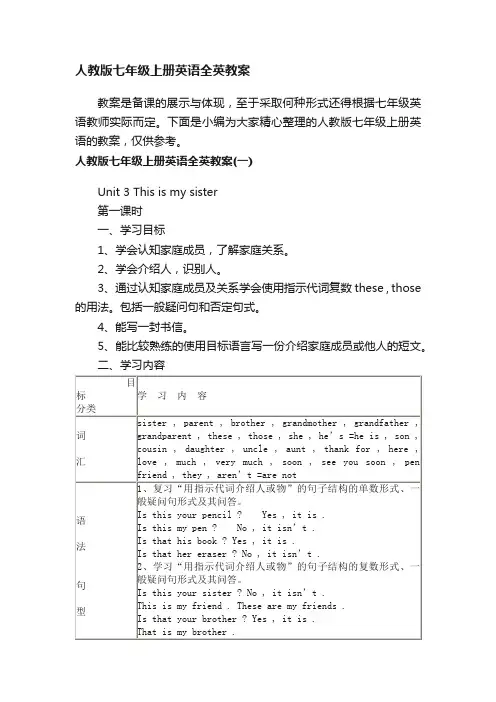
人教版七年级上册英语全英教案教案是备课的展示与体现,至于采取何种形式还得根据七年级英语教师实际而定。
下面是小编为大家精心整理的人教版七年级上册英语的教案,仅供参考。
人教版七年级上册英语全英教案(一)Unit 3 This is my sister第一课时一、学习目标1、学会认知家庭成员,了解家庭关系。
2、学会介绍人,识别人。
3、通过认知家庭成员及关系学会使用指示代词复数these , those 的用法。
包括一般疑问句和否定句式。
4、能写一封书信。
5、能比较熟练的使用目标语言写一份介绍家庭成员或他人的短文。
二、学习内容三、朗读单词1. sister n. 姐;妹2. parent n. 父或母3. brother n. 兄;弟4. grandmother n. 祖母;外祖母5. grandfather n. 祖父;外祖父6. grandparent n. 祖父/ 母;外祖父/母7. these pron . & adj.这些8. those pron . & adj.那些9. she pron .她10. he’s =he is11. son n.儿子12. cousin n.堂(表)兄弟;堂(表)姐妹13. daughter n. 女儿14. uncle n.叔;伯;舅;姨父;姑夫15. aunt n. 姨母;姑母;伯母;婶母16. thank for为……而感谢17. here adv.在这里;向这里18. love v.爱;热爱19. much adv. 很;非常20. very much 很;非常21. soon adv.不久22. see you soon ,再见。
23. pen friend 笔友24. they pron. 他(她;它)们25. aren’t =are not四、任务示范Show the Ss some pictures , point at the pictures and tell them like this :This is my father / mother / brother / sister ……That’s my sister / grandmother / grandfather ……Then ask the Ss to bring their families’ pictures and introduce people in this way .五、布置作业1、请同学们反复朗读单词,并自查能记住多少单词。
人教版英语七年级上册全册教案
人教版七年级英语上册全册教案Unit 1 My name’s Gina第一课时教案示例教学目标1.学会询问周围新同学的姓名,并且将自己刚认识的好朋友介绍给全体同学2.通过学生制作名卡或桌卡来提高学生学习英语的兴趣,体现英语的实用性3.通过以上任务活动,掌握形容词性物主代词的用法及其与人称代词的主格的区别,并且在第一节课让学生对英语的学习产生兴趣。
4.德育目标:热爱班集体,团结同学。
教学重点和难点1.形容词性物主代词的用法2.在任务活动中掌握you和your,he和his, she和her 的用法3.重点句型(斜体字为扩展句子):Hi / Hello! Good morning / afternoon / evening.How are you? Fine, thank you! / Very well / So-so /All right.What’s your name? My name is …/ I’m …What’s his/ her name? His/Her name is …课前准备1.学生课前准备:利用网络查阅中英文姓名及初次见面时各国或各地风俗,礼仪体会它们的不同之处;准备硬纸片和水彩笔;用英文介绍自己的姓、名。
2.教学器材:录音机、电脑、图片。
3.教学课件:中英文名字展示片。
教学设计Tasks Students’ activities Teacher’s activities1. Game: ask and answer the question: What’s your name? Students make a self-introduction and pass the sentences one by one. At first, teacher makes a self-introduction.2.Two students act out how to greet people. Act out the greeting forms they are familiar with or they find on net. Show the students the pictures of other countries’customs with computer.3. See who can make the most friends and get the most information. Then report their results with his or hers. Move around to make friends with the ones they are interested in. Make the students move around to make friends with others.4. Design and make their name cards . Design and make their name cards in groups. Ask them to design their name cards and see which group is the best.教学过程设计任务一:结识新朋友。
新人教版七年级英语上册全册教案
新人教版七年级英语上册全册教案Unit 1 My name is Gina.1.Topic话题:Making new friends2.功能目标:1)Introduce yourself使学生学会用英语介绍自己。
2)Greet people使学生学会用英语和别人打招呼。
3)Ask for and give telephone numbers 询问和给出电话号码3.文化目标:1)让学生初步体会用英语和别人交流的感受,培养学生学习英语的兴趣。
2)通过对英文名字的介绍,对比中西方表达名字的不同,了解中西方文化的差异。
3)通过对西方一些成功人士英文名字的介绍,使学生了解成功是由不懈的努力和艰苦的奋斗得来的。
4)通过介绍英文名字的由来,使学生产生对西方文化的好奇及兴趣。
4.认知目标:1)词汇:clock, hello, hi, and, question, answer, look, first name, last name2) 语法项目:一般现在时be的用法以特殊疑问词what开头的问句形容词性物主代词my, your, his, herWhat‘s=What is I‘m=I am My name‘s=My name is3) Language goals语言目标:What‘s your name?My name is Gina.I‘m Gina. Nice to meet you.What‘s your telephone number? It‘s….Period oneI.教材分析:这是课本的第一部分,题目是My mane is Gina. 有很多学生第一次学习接触英语,为了调动他们的积极性,不产畏难情绪,尽量简单的处理教材。
Language topic: What‘s your name?My name is Gina.Language strategies: Talk about the namesMain vocabulary: name is, meet, his, first name, last name, answer, boy , girl.II.语言结构: present tense to be, what questions, Possessive adj. my, your, his, her. 。
全新人教版七年级英语上册全英文教案(全册 全英文p)
全新人教版七年级英语上册全英文教案(全册全英文全新人教版七年级英语上册全英文教案(全册全英文共132页)Starter Unit 1Good morning!Period 1 (1a~2e)Teaching important points【教学重点】1.Key words & phrases:good,morning,hi,hello,HB,CD,BBC2.Key sentences:Good morning!Teaching difficult points【教学难点】Grasp the letters Aa-Hh and learn to recognize the English names.Teaching aids【教具】a computer and some cardsTeaching procedures and ways【教学过程及方法】★Step Ⅰ Revision and lead-in复习导入Greet the students and lead in the new lesson.T:Good morning,everyone!My name is…I am your English teacher.You can call me Miss/Ms./Mr. …(Walking to a boy)What's your name?Boy:My name is Li Tao.T:Good morning,Li Tao.Boy:Good morning,Ms./Mr. …(Help the student to respond correctly if necessary.)The teacher writes “Good morning,Li Tao.”on the blackboard.★Step Ⅱ Self-studying and guiding自学指导Self-study guide 1:Self-study the new words and English names:good,morning,hi,hello,Alice,Bob,Cindy,Dale,Eric,Frank,Grace,Helen.Learn to pronounce them according to the phonetic symbols(音标).And you can listen to the tapes to help you pronounce them correctly or ask others for help.Self-study guide 2:Try reading the sentences in 1a and try to tell boys' names from girls' names.Self-study guide 3:Self-study 2c and learn to write the eight letters.Questions for thinking:1.Do you know how to greet people in the morning?2.Do you know how to write the eight letters Aa,Bb,Cc,Dd,Ee,Ff,Gg,Hh?The teacher walks around the classroom to watch and help the students study while the students are self-studying.Time for questions:Discuss the writing of the eight letters.★Step Ⅲ Check up检查核对Check up 1:Words teaching:Ask a few students to read the new words and help them correct the mistakes in pronunciation if necessary.Check up 2:Ask some students to make a conversation with their partner and see if they can respond correctly.And ask students to fill in the blanks:Boys' names:________________________________________________________________________ Girls' names:________________________________________________________________________Check up 3:Write the small letters for these big letters:A____B____C____D____E____F____G____H____★Step Ⅳ Cooperative inquiry合作探究1.Listening (1b)Play the recording of 1a,students listen and repeat.2.Pair workPractice the conversations in the picture and then greet your partner.(1c)Sample:A:Good morning,Zhang Wen!/Hello,Zhang Wen!B:Good morning,Li Yan!/Hello,Li Yan!3.Act outAsk some pairs of students to act out their dialogs in front of the class.4.Finish 2a and 2b.5.Discussion (2e)Talk about what these letters HB,CD,BBC mean.★Step Ⅴ Practice练习Write the missing big letter or small letter for each pair.(2d)★Step Ⅵ Test测试Choose the best answer.()1.书写英文字母时,占三格的是________。
2024人教版七年级上册英语教案
2024人教版七年级上册英语教案1. Course InformationTextbook: 2024 People’s Education Press 7th Grade Book 1.Unit: Unit 1-Unit X adjust based on the textbook.Class Duration: 45 minutes.2. Learning Objectivesa. Language Objectives:Learn and use key vocabulary and sentence structures from the unit.Engage in basic daily conversations.b. Skill Objectives:Improve listening, speaking, reading, and writing skills.Understand and use key sentence patterns from the text.c. Emotional Objectives:Foster interest and confidence in learning English.Enhance teamwork and communication skills.3. Lesson ContentText: Dialogues, short texts, and stories from the unit.Vocabulary: New words and phrases from the unit.Grammar: Key grammar points from the unit.Functional Sentences: Core sentences and expressions from the unit.4. Teaching Stepsa. Introduction (5 minutes)Use images, videos, or questions to introduce the lesson theme.Engage students and outline the learning objectives.b. New Content (15 minutes)Vocabulary: Introduce and explain new words, focusing on pronunciation, spelling, and meaning.Grammar: Explain key grammar points with examples.Sentence Patterns: Demonstrate core sentence structures and practice.c. Text Learning (10 minutes)Read the text aloud and discuss its content.Engage in group discussions or role-plays to practice dialogues.d. Practice (10 minutes)Complete related exercises such as fill-in-the-blanks, matching, and multiple-choice questions.Use group activities or games to reinforce vocabulary and sentence structures.f. Summary and Homework (5 minutes)Review the lesson’s content and address any student questions.Assign homework, such as vocabulary practice, writing tasks, or reading assignments.5. Homework AssignmentsVocabulary Practice: Complete exercises from the textbook.Writing Task: Write a short paragraph using the new vocabulary and sentence structures.Listening Exercise: Listen to recordings and complete related comprehension questions.6. AssessmentOral Evaluation: Assess student participation and performance in class.Written Evaluation: Evaluate homework and exercise accuracy.7. ReflectionReflect on the effectiveness of the lesson based on student feedback and observation.Note areas for improvement for future lessons.。