
人教版新目标七年级英语上册Unit 1集体备课教案设计
集体备课教案
集体备课教案
集体备课教案
5. 教学1e。
再听录音,补全1d中的电话号码。
6. 教学1f。
做游戏:先询问同学们的电话号码,并写在纸上,装入袋中,然后任取一张纸条,找出号码的主人。
参考案例:
(1)A: What’s your telephone number?
B: It’s 5876275.
(2)A: Is this your telephone number?
B: Yes, it is. /No, it isn’t.
7. 教师展示班上多个同学的电话号码。
让学生猜电话号码的主人是谁。
eg: A: Is this your/her/his telephone number?
B: Yes, it is. /No, my/her/his telephone number is …
III. 【语法提要】
1. telephone number
telephone number相当于phone number, 意为“电话号码”。
例句: His telephone/phone number is 7208283. 他的电话号码是7208283。
注意:Telephone可以缩写为Tel. 。
例如:Tel. : 3235056电话:3235056
2. 电话号码的读法。
在英、美等国家,人们通常将座机电话号码分为两部分,在朗读时“0”大多读作字母o的发音。
“0”作为单个数字时,则往往读作zero。
例如: 257-8901 读作:two five seven eight nine o one
IV.(1. His telephone number is 515-6879. (对画线部分提问)
What is his telephone number?
(A )2. —What’s her phone number?
—_______.
A. It’s 732-4351.
B. It’s
***********.
C. Yes, I am.
D. I’m 254730. Homework
师引导学生课后完成本课时对应练习,并预习下一课时内容。
集体备课教案
集体备课教案。
人教版新目标七年级上Unit1教案
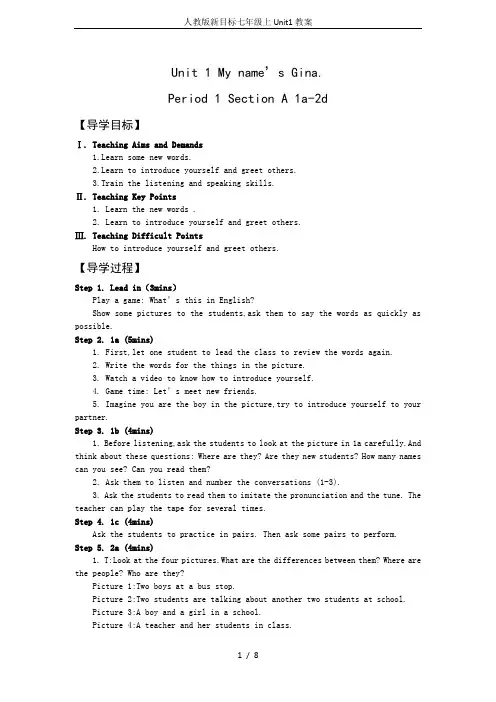
Unit 1 My name’s Gina.Period 1 Section A 1a-2d【导学目标】Ⅰ. Teaching Aims and Demands1.Learn some new words.2.Learn to introduce yourself and greet others.3.Train the listening and speaking skills.Ⅱ. Teaching Key Points1. Learn the new words .2. Learn to introduce yourself and greet others.Ⅲ. Teaching Difficult PointsHow to introduce yourself and greet others.【导学过程】Step 1. Lead in(3mins)Play a game: What’s this in English?Show some pictures to the students,ask them to say the words as quickly as possible.Step 2. 1a (5mins)1. First,let one student to lead the class to review the words again.2. Write the words for the things in the picture.3. Watch a video to know how to introduce yourself.4. Game time: Let’s meet new friends.5. Imagine you are the boy in the picture,try to introduce yourself to your partner.Step 3. 1b (4mins)1. Before listening,ask the students to look at the picture in 1a carefully.And think about these questions: Where are they? Are they new students? How many names can you see? Can you read them?2. Ask them to listen and number the conversations (1-3).3. Ask the students to read them to imitate the pronunciation and the tune. The teacher can play the tape for several times.Step 4. 1c (4mins)Ask the students to practice in pairs. Then ask some pairs to perform. Step 5. 2a (4mins)1. T:Look at the four pictures.What are the differences between them? Where are the people? Who are they?Picture 1:Two boys at a bus stop.Picture 2:Two students are talking about another two students at school.Picture 3:A boy and a girl in a school.Picture 4:A teacher and her students in class.2. Listen for the first time,get the main idea.3. Then listen and number the pictures (1-4).4. Ask one student to check the answers.And try to say the reason.Step 6. 2b (5mins)1. First,read the instruction in 2b.Let the students know this time they should listen for specific information--the names.2. Read the names.3. Then listen and circle the names they hear.Check the answers.4. Listen again,and try to answer these questions:(1) What are the two boys’ names in Picture 1? Are they Eric and Mike?(2) Is Alice in Picture 3?/What’s the girl’s name in Picture 3?(3) Is the boy’s name Eric?(4) Are the boy and girl in Picture 2 the same as the two children in Picture 3?(5) What’s the teacher’s name? How many students are there in her class? Step 7. 2c (6mins)1. Look at the pictures and practice the key sentences:What’s his/her name?His/Her name is ….2. Play a memory game.3. Recite the key sentences through a chant.4. Pair work:introduce yourself and your friend.Step 8. 2d (7mins)1. Listen to the tape and think about two question:How many people are there in the conversation? Who are they?2. Ask the students to read the conversation by themselves and then answer the questions.3. Follow the tape.Students read the conversation in roles. (They can change their roles.)4. Call some students to perform for the whole class.Step 9. Summary (2mins)Let the students summarize what they’ve learnt according to the clues. Step 10. Exercises (5mins)【探究归纳】1.What's your name? 你叫什么名字?(1)这是一个由what引导的特殊疑问句,是询问别人姓名的常用语,回答时常用“My name is….”或“I'm….”或者直接说出名字。
2024版人教七年级上册Unit1 单元整体教学设计
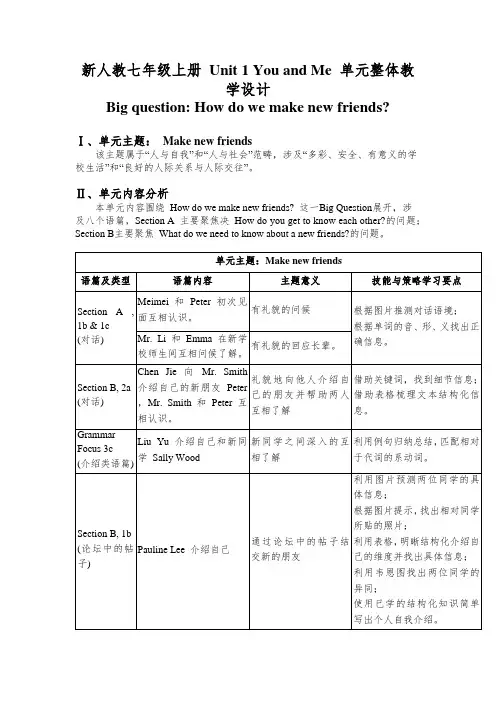
新人教七年级上册Unit 1 You and Me 单元整体教学设计Big question: How do we make new friends?Ⅰ、单元主题:Make new friends该主题属于“人与自我”和“人与社会”范畴,涉及“多彩、安全、有意义的学校生活”和“良好的人际关系与人际交往”。
Ⅱ、单元内容分析本单元内容围绕How do we make new friends? 这一Big Question展开,涉及八个语篇,Section A 主要聚焦决How do you get to know each other?的问题;Section B主要聚焦What do we need to know about a new friends?的问题。
Reading PlusMake New Friends at Home(建议类语篇) 给学生在学校交朋友提出一些建议交朋友要友善、礼貌和真诚利用序数词对文章进行分层。
Project, 3b (介绍类语篇) Andre Kalu自我介绍敢于自我介绍,结交新朋友根据问题链引导,罗列出自我介绍的思路;能够使用第三人称对文章进行转述。
Ⅲ、单元内容思维导图单元学习目标单元教学目标语篇本单元学习后,学生能够:1.在语境中,问候同学和老师,介绍自己的朋友,并通过简单的自我介绍,与不认识人互相了解。
1.对话Section A ,1b&c (第1课时听说课)2.使用基本的语音知识(包括发/i:/, /i/, /e/和/æ/音的字母及字母组合)以及朗读基本知识(包括连读和语调),有礼貌地介绍朋友与他人认识。
2.对话Section B, 2a(第2课时听说&语音课)3.总结归纳be动词和代词的匹配并正确使用be动词介绍自己和他人。
3.介绍类语篇Grammar Focus 3c (第3课时语法课)。
七年级英语unit 1教学设计人教版新目标
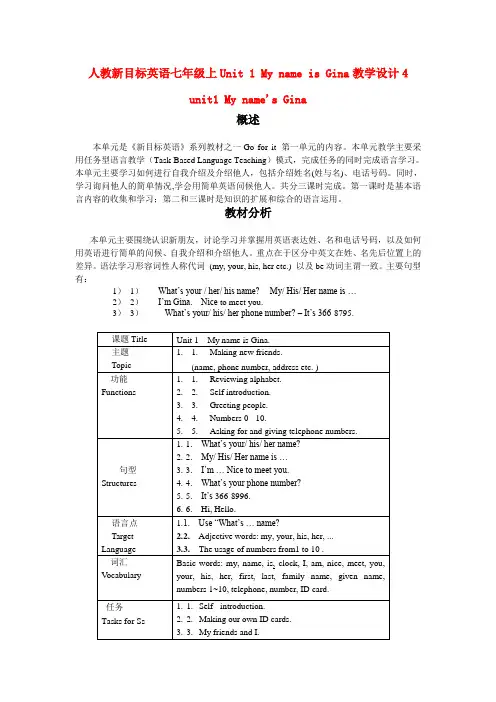
人教新目标英语七年级上Unit 1 My name is Gina教学设计4unit1 My name's Gina概述本单元是《新目标英语》系列教材之一Go for it第一单元的内容。
本单元教学主要采用任务型语言教学(Task-Based Language Teaching)模式,完成任务的同时完成语言学习。
本单元主要学习如何进行自我介绍及介绍他人,包括介绍姓名(姓与名)、电话号码。
同时,学习询问他人的简单情况,学会用简单英语问候他人。
共分三课时完成。
第一课时是基本语言内容的收集和学习;第二和三课时是知识的扩展和综合的语言运用。
教材分析本单元主要围绕认识新朋友,讨论学习并掌握用英语表达姓、名和电话号码,以及如何用英语进行简单的问候、自我介绍和介绍他人。
重点在于区分中英文在姓、名先后位置上的差异。
语法学习形容词性人称代词(my, your, his, her etc.) 以及be动词主谓一致。
主要句型有:1)1)-- What’s your / her/ his name? -- My/ His/ Her name is …2)2)-- I’m Gina. Nice to meet you.3)3)-- What’s your/ his/ her phone number? –It’s 366-8795.单元教学设计流程教学目标1.学会询问周围新同学的姓名,并且将自己刚认识的好朋友介绍给全体同学2.通过学生制作名卡或桌卡来提高学生学习英语的兴趣,体现英语的实用性3.通过以上任务活动,掌握形容词性物主代词的用法及其与人称代词的主格的区别,并且在第一节课让学生对英语的学习产生兴趣。
4.德育目标:热爱班集体,团结同学。
教学重点和难点1.形容词性物主代词的用法2.在任务活动中掌握you和your,he和his, she和her 的用法3.重点句型(斜体字为扩展句子):Hi / Hello! Good morning / afternoon / evening.How are you? Fine, thank you! / Very well / So-so /All right.What’s your name? My name is … / I’m …What’s his/ her name? His/Her name is …课前准备1.学生课前准备:利用网络查阅中英文姓名及初次见面时各国或各地风俗,礼仪体会它们的不同之处;准备硬纸片和水彩笔;用英文介绍自己的姓、名。
人教版新目标七年级英语上册Unit1集体备课教案设计
人教版新目标七年级英语上册Unit1集体备课教案设计集体备课教案集体备课教案集体备课教案5. 教学1e。
再听录音,补全1d中的电话号码。
6. 教学1f。
做游戏:先询问同学们的电话号码,并写在纸上,装入袋中,然后任取一张纸条,找出号码的主人。
参考案例:(1)A: What’s your telephone number?B: It’s 5876275.(2)A: Is this your telephone number?B: Yes, it is. /No, it isn’t.7. 教师展示班上多个同学的电话号码。
让学生猜电话号码的主人是谁。
eg: A: Is this your/her/his telephone number?B: Yes, it is. /No, my/her/his telephone number is …III. 【语法提要】1. telephone numbertelephone number相当于phone number, 意为“电话号码”。
例句: His telephone/phone number is 7208283. 他的电话号码是7208283。
注意:Telephone可以缩写为T el. 。
例如:Tel. : 3235056电话:32350562. 电话号码的读法。
在英、美等国家,人们通常将座机电话号码分为两部分,在朗读时“0”大多读作字母o的发音。
“0”作为单个数字时,则往往读作zero。
例如: 257-8901 读作:two five seven eight nine o oneIV.(1. His telephone number is 515-6879. (对画线部分提问)What is his telephone number?(A )2. —What’s her phone number?—_______.A. It’s 732-4351.B. It’s***********.C. Yes, I am.D. I’m 254730. Homework师引导学生课后完成本课时对应练习,并预习下一课时内容。
人教版新目标七年级英语上册Unit1Myname'sGinaSectionB(2a2c)优秀教学案例
1.利用多媒体展示不同国家的名字,引发学生对名字的好奇心,激发学习兴趣。
2.设计各种真实情境,如介绍新朋友、填写个人信息等,让学生在实际情境中运用目标句型。
3.利用图片、卡片等教具,帮助学生直观地理解单词和句型的意义。
4.创造轻松、愉快的学习氛围,使学生在真实的语言环境中自然地学习和使用英语。
2.学生能够在小组活动中,学会相互尊重,相互帮助,培养良好的团队合作精神。
3.学生能够通过与外国朋友交流,了解不同文化,拓宽视野,培养跨文化交际意识。
4.学生能够在学习过程中,培养积极向上的学习态度,树立正确的学习观念。
5.学生能够通过学习英语,提高自己的综合素质,为未来的学习和发展打下坚实基础。
三、教学策略
(二)问题导向
1.引导学生提出问题,激发学生思考,培养学生的提问能力。
2.设计各种任务型活动,让学生在完成任务的过程中,自然地运用目标句型。
3.通过问答、讨论等形式,引导学生主动参与课堂,提高学生的思维能力。
4.鼓励学生发表自己的观点,培养学生的创新意识和批判性思维。
(三)小组合作
1.将学生分成小组,鼓励学生在小组内进行合作学习,共同完成任务。
5.关注学生个体差异:教师注重关注每一个学生的个体差异,鼓励他们积极参与课堂活动,充分调动他们的学习积极性。对于学习有困难的学生,教师耐心辅导,给予他们更多的关爱和鼓励,让他们在英语学习中获得成就感。同时,教师注重培养学生的团队合作精神,让他们在小组活动中学会相互尊重、相互帮助,共同提高。
2.设计各种小组活动,如角色扮演、小组讨论等,培养学生的团队合作能力。
3.引导学生相互尊重、相互帮助,培养良好的团队合作精神。
4.给予每个小组充分的展示机会,鼓励学生大胆表达自己的观点。
人教版新目标七年级英语上册集体备课教案设计
人教版七年级英语上册Starter Unit 1集体备课教案人教版七年级英语上册Starter Unit 2集体备课教案集体备课教案Ⅰ.1. 教师利用多媒体展示物体的数量,引导学生表达:eg: five pens, six bags等。
2. T: What’s your telephone number?S: It’s…Ⅱ. 【完成教材1a~1f的教学任务】1. 教学1a。
教师放录音,学生跟读。
然后教师把0-9数字的顺序打乱,比一比看谁最快用英语说出数字,完成1a。
2. 教学1b。
听录音,写出电话号码。
3. 教学1c。
学生相互询问对方电话号码,制作一个电话册。
看谁在规定时间内询问电话号码最多。
4. 教学1d。
听录音,将名字和电话号码配对。
5. 教学1e。
再听录音,补全1d中的电话号码。
6. 教学1f。
做游戏:先询问同学们的电话号码,并写在纸上,装入袋中,然后任取一张纸条,找出号码的主人。
参考案例:(1)A: What’s your telephone number?B: It’s 5876275.(2)A: Is this your telephone number?B: Yes, it is. /No, it isn’t.7. 教师展示班上多个同学的电话号码。
让学生猜电话号码的主人是谁。
eg: A: Is this your/her/his telephone number?B: Yes, it is. /No, my/her/his telephone number is …III. 【语法提要】1. telephone numbertelephone number相当于phone number, 意为“电话号码”。
例句: His telephone/phone number is 7208283. 他的电话号码是7208283。
注意:Telephone可以缩写为Tel. 。
例如:Tel. : 3235056电话:32350562. 电话号码的读法。
人教新目标七年级英语上册Unit1Myname’sGina.SectionB1(2a2c)教学设计
5.巩固拓展:通过课后作业和拓展活动,帮助学生巩固所学知识,提高实际语言运用能力。
实施策略:布置富有挑战性的课后作业,如编写对话、录制视频等,鼓励学生将所学知识运用到实际生活中。
6.个性化辅导:关注每个学生的个体差异,给予个性化的辅导和指导。
5.预习下一课:提前预习下一节课的内容,为新课的学习做好准备。
作业布置原则:
1.针对性:作业内容要紧密结合本节课的教学目标,确保学生通过作业巩学生,设计不同难度的作业,使每个学生都能在原有基础上得到提高。
3.实践性:注重作业的实践性,让学生在实际操作中提高语言运用能力。
4.趣味性:作业形式要多样化,增加趣味性,激发学生的学习兴趣。
5.适度性:控制作业量,确保学生能在合理的时间内完成,避免过重的学习负担。
教师应在作业批改过程中,认真检查学生的完成情况,及时给予评价和反馈,鼓励学生持续进步。同时,关注学生的个性化需求,调整教学策略,提高教学质量。
3.学生能够听懂并准确回答关于个人信息的询问,如“What's your name?”, “Where do you go to school?”等。
4.学生能够在真实的语境中运用所学知识进行自我介绍,提高口语表达能力。
(二)过程与方法
1.通过小组合作的方式,让学生互相介绍个人信息,提高学生的听说能力和团队协作能力。
3.教学内容:学生在小组内运用所学词汇和语法,进行真实语境的交流,如:“What's your name?”, “Where do you go to school?”等。
(四)课堂练习
1.教学活动:教师设计各种课堂练习,如填空、选择、改错等,巩固学生对新知识的掌握。
人教新目标英语七年级上册Unit1SectionA教学设计
2.重点:提高学生的听说能力,使其能够理解并参与简单的日常英语对话。
难点:学生在听力练习中,对英语语速、语调的适应能力,以及对话中隐含信息的理解和推断。
(二)教学设想
1.创设情境:通过模拟真实的生活场景,如学校、家庭等,让学生在实际语境中进行角色扮演,增强他们对英语的实际应用能力。同时,利用多媒体教学资源,如英语歌曲、动画片等,提高学生的学习兴趣。
2.教学句型:教师利用PPT展示本节课的重点句型,如“I'm ...”,“How are you?”等,并引导学生进行角色扮演,进行实际对话练习。在此过程中,教师注意纠正学生的发音和语法错误。
(三)学生小组讨论
1.教师将学生分成若干小组,每组讨论一个问题,如“如何用英语问候他人”、“如何用英语进行自我介绍”等。小组成员轮流发言,其他成员认真倾听,互相学习。
五、作业布置
为了巩固本节课的学习内容,提高学生的英语应用能力,特布置以下作业:
1.词汇巩固:请学生将本节课学习的重点词汇,如“hello”,“goodbye”,“good morning”等,每个词汇写五遍,并尝试用这些词汇造句。家长签名确认,以加强对词汇的记忆。
2.对话练习:学生与家长或朋友进行英语对话,至少包含问候、自我介绍和询问对方状况三个部分,并录音。教师将随机抽查学生的录音作业,以检查学生的实际应用能力。
2.利用多媒体教学手段,如PPT、视频等,丰富课堂教学内容,激发学生学习兴趣。
3.通过小组合作、角色扮演等活动,培养学生的合作意识和团队精神,提高学生的英语交际能力。
4.结合生活实际,引导学生发现生活中的英语,使英语学习与生活紧密结合,提高学生的学习兴趣和积极性。
人教新目标七年级英语上册正式篇Unit1教学设计
人教版新目标七年级英语上册Unit1 My name’s Gina.教学设计Period 1 Section A 1a-2d【导学目标】Ⅰ. Teaching Aims and Demands1.Learn some new words.2.Learn to introduce yourself and greet others.3.Train the listening and speaking skills.Ⅱ. Teaching Key Points1. Learn the new words .2. Learn to introduce yourself and greet others.Ⅲ. Teaching Difficult PointsHow to introduce yourself and greet others.【导学过程】Step 1. Lead in(3mins)Play a game: What’s this in English?Show some pictures to the students,ask them to say the words as quickly as possible.Step 2. 1a (5mins)1. First,let one student to lead the class to review the words again.2. Write the words for the things in the picture.3. Watch a video to know how to introduce yourself.4. Game time: Let’s meet new friends.5. Imagine you are the boy in the picture,try to introduce yourself to your partner.Step 3. 1b (4mins)1. Before listening,ask the students to look at the picture in 1a carefully.And think about these questions: Where are they? Are they new students? How many names can you see? Can you read them?2. Ask them to listen and number the conversations (1-3).3. Ask the students to read them to imitate the pronunciation and the tune. The teacher can play the tape for several times.Step 4. 1c (4mins)Ask the students to practice in pairs. Then ask some pairs to perform. Step 5. 2a (4mins)1. T:Look at the four pictures.What are the differences between them? Where are the people? Who are they?Picture 1:Two boys at a bus stop.Picture 2:Two students are talking about another two students at school.Picture 3:A boy and a girl in a school.Picture 4:A teacher and her students in class.2. Listen for the first time,get the main idea.3. Then listen and number the pictures (1-4).4. Ask one student to check the answers.And try to say the reason.Step 6. 2b (5mins)1. First,read the instruction in 2b.Let the students know this time they should listen for specific information--the names.2. Read the names.3. Then listen and circle the names they hear.Check the answers.4. Listen again,and try to answer these questions:(1) What are the two boys’ names in Picture 1? Are they Eric and Mike?(2) Is Alice in Picture 3?/What’s the girl’s name in Picture 3?(3) Is the boy’s name Eric?(4) Are the boy and girl in Picture 2 the same as the two children in Picture 3?(5) What’s the teacher’s name? How many students are there in her class? Step 7. 2c (6mins)1. Look at the pictures and practice the key sentences:What’s his/her name?His/Her name is ….2. Play a memory game.3. Recite the key sentences through a chant.4. Pair work:introduce yourself and your friend.Step 8. 2d (7mins)1. Listen to the tape and think about two question:How many people are there in the conversation? Who are they?2. Ask the students to read the conversation by themselves and then answer the questions.3. Follow the tape.Students read the conversation in roles. (They can change their roles.)4. Call some students to perform for the whole class.Step 9. Summary (2mins)Let the students summarize what they’ve learnt according to the clues. Step 10. Exercises (5mins)【探究归纳】1.What's your name? 你叫什么名字?(1)这是一个由what引导的特殊疑问句,是询问别人姓名的常用语,回答时常用“My name is….”或“I'm….”或者直接说出名字。
英语人教版七年级上册Unit 1 教学设计及反思
第一课时教学设计及教学反思教材分析新目标七年级上七年级新目标英语上unit 1 my name’s gina!课时数4(本单元用4课时,这是第一课时)学情分析本单元的主题是熟识新伙伴,同时引导学生采用practicing, listening for specific information和role playing的学习策略,学习一些新词汇,掌握一些重点句型,在小组合作学习的过程中,进一步促进学生之间的相互了解。
教学目标知识与能力采用practicing, listening for specific information和role playing的学习策略,使学生学会打招呼和介绍自己、询问他人姓名的基本句型what's your/his/her name?my/his/her name is…。
”培养学生结交新朋友的能力。
过程与方法采用practicing, listening for specific information和role playing的学习策略,利用教学图片或制作多媒体课件展开课堂pair work; group work的口语交际活动,询问他人姓名、查询电话号码,了解有关姓名的文化知识并制作个性名片。
情感态度价值观该部分学习内容贴近学生的生活,谈论的主题是结交新朋友,进一步促进学生之间的相互了解,使学生在轻松、愉快的学习氛围中熟识新伙伴,增进友谊。
教学重点和难点重点和难点:学生学会打招呼和介绍自己、询问他人姓名的基本句型what's your/his/her name?my/his/her name is…。
”教学过程教学环节教师活动预设学生行为设计意图第一教学环节:1.利用插图或实物卡片让学生找出在预备篇中所学的单词,然后教师引导学习打招呼和介绍自己、询问他人姓名的基本句型“what’s your/his/her name? my/his/her name is…2.让学生听对话,练习对话并模仿对话,结识班级的其他同学。