
仁爱版九年级英语上册unit1 topic3 Section B
九年级英语导学案
主备人:王艳艳备课组长:教研组长:
Unit 1 Topic3 Section B
学习目标:
1.继续学习for和since与现在完成时的连用及区别;
2.学会现在完成时中短暂性动词向延续性形式的转换。
导学过程:
Ⅰ. Learn the following words by yourself.
n.计划,方案,节目训练,培训
秘书俱乐部工程师,设计师
v.完成(困难的事);能解决(问题)
n.创伤,伤口v.伤害
Ⅱ. Listen and read 1a carefully. Finish 1b &1c. Find out the following key phrases.
1.给某人出示某物
2.成百上千人
3.重返工作
4.过上正常的生活
5.在困难时,有需要
6.选定合适的方法
7.得到医疗救助
8.给他们提供帮助
9.为了/
10.有信心,自我感觉良好
11.陷入困境
12.搭载,(开车)接人
13.帮助某人摆脱困境
Ⅲ.Translate the following sentences by yourself.
1.Since it started, it has helped hundreds of people return to work and live a normal
life.
2.Well, once they find people in need, they decide on suitable ways to offer them
help.
3.I think it is important for these people to feel good about themselves.
4.The world has changed for the better.
Ⅳ. Grammar focus.
1.The program also provides them with job training so that they can find jobs again.
provide sb. with sth. =provide sth. for sb.给某人提供某物
e.g. Please the poor people some food and clothes.
学校给学生提供了食物。
=
2. He has been away from the army for twelve years because of a leg wound.
现在完成时中,当句子中有表示一段时间的时间状语(for, since)时,短暂性动词要转换成相对应的延续性形式。
常见动词有:buy—have, borrow—keep, come—be, die—be dead, leave—be away (from),join—be in等。
e.g.这本书我借了三天了。
吴鹏加入英语俱乐部一个月了。
课堂练习
( )1.—Oh, you’re late again. The film for twenty minutes.
—What a pity!
A. has begun
B. began
C. has been on
D. will begin
( )2. I must go home now. I have been away from home .
A. since 9 o’clock
B. for two hours ago
C. at 9 o’clock
3. (Though/Until/Before/Once) you get lost, please call me.
4. There (be) great changes in Luoyang Since 2009.
5. He (过着平静的生活)since he retired.
6. As there was no time left, they decided (set) off at once.
7. Jack often (惹麻烦). His parents are worried.
8. I’ll (接你) at five.
9. Whemever I meet difficulties, he always (帮我摆脱困境)。
仁爱英语九年级上册Unit-1-Topic-3-Section-B

5.His grandparents have been dead __fo__r __ several years.
6. It’s five years _s_in_c_e___ we met last time.
seven years because of a leg wound. 3. He has been in Beijing _s_in__c_e_ 2003. 4. He has been a member of Helpers’ Club
_s_i_n_c_e__ 2004. 5. He has had a house _s_in__c_e_ 2005. 6. He has kept the car ___fo_r__ one year.
• 无家可归的人 homeless people
• 数以百计的
hundreds of
• 重返工作岗位 return to work
• 过着正常的生活 live a normal life
• 有困难 的人 people in need
• 在某事上做决定 decide on
• 医疗
medical treatment
1992 His father died in 1992. His father has been dead for many years.
2002 He left the army because of a leg wound in 2002. He has been away from the army for twelve years because of a leg wound.
仁爱版九年级英语上册Unit1 Topic3课件(共78张PPT)
months. 5. Tom has kept a book _s_i_n_c_e_ 5:00 a.m.
2 Listen to the passage and fill in the blanks with the
• 1 How do you like (doing) sth.?=What do you think of ...?
• 你认为……怎么样 • e.g. How do you like the weather in Beijing? • 你认为北京的天气怎么样? • =What do you think of the weather in Beijing? • How do you like playing basketball now? • 你认为现在打篮球怎么样?= • What do youthink of playing basketball now?
1.I have lived in Beijing __f_o_r__ three years. _s_in_c_e__2011.
2. He has waited for Tom _s_i_n_c_e_ two hours ago. __fo_r___ two hours.
3. We have learned chemistry _fo_r_ one month. s_in_c_e_ the new term
了)。只用于一般过去时。
• e.g. He used to be a quiet boy. • 他过去是个不太爱说话的男孩。 • be used to do sth.被用于做某事
仁爱九年级英语上册UnitTopic3SectionB

C. come D. arrived
3. Hurry up! The play _____ for ten minutes.
A. has begun
B. had begun
C. has been on
D. began
4. My parents _____ Shandong for ten years.
5. He _b_o__u_g_h_t_ (buy) a house in 2005. He __h_a_s__h_a_d__ (have) a house since 2005.
6. He _b_o_r_r_o_w__e_d_ (borrow) the car in 2009. He _h_a__s_k_e_p__t _ (keep) the car for four years.
D. has left the university
(视频p19-1a)
What is the article about?
homeless people
people in need
We can provide them with something they need. = We can provide something they
Choose the best answer.
1. His father ______ the Party since 1978.
A. joined
B. has joined
C. was
D. has been in
2. —How long have you _____ here?
—About two months. A. been B. gone
-------------------------------------------------------------------------------------
仁爱版英语九年级上册 Unit1_Topic3_SectionB_精品学案

Unit1 Topic3 SectionB 精品学案学习目标:1.掌握本课的重点词汇和短语,继续学习现在完成时(短暂性动词与延续性动词的转换)。
2.能正确运用现在完成时谈论有关社会服务的话题重点:能在具体语境中,将短暂性动词转换成延续性动词,正确使用一般过去时和现在完成时。
难点:能通过本课所学,正确运用现在完成时对日常活动进行描述。
课前预习:1.阅读1a、2 和3a找出下列单词和短语并熟读,背熟它们:Program_________manage________training________secretary______helper________club____ engineer______ wound_______ homeless_______treatment__________ immediately______helper ________homeless people________live a normal life_________ decide on sth._________medical treatment____________provide sth. for sb./ provide sb. with sth.______________feel good about themselves_______________. in need__________2.Find out these key sentences and translate them into Chinese:(1) Once they find people in need, they decide on suitable ways to help them.(2)The program also provides them with houses.3.Read 1a carefully again and finish 1b and 1c.4.Read 2 by yourselves and finish the task.5.Read 3a and try to understand the grammar.学习指导:1). homeless people = people in need如:We can provide them with something they need.= We can provide something they need for the m.2). decide on+ n./ doing sth. =decide to do sth. 决定要做某事。
仁爱版九年级英语上册U1T3SA优质教案
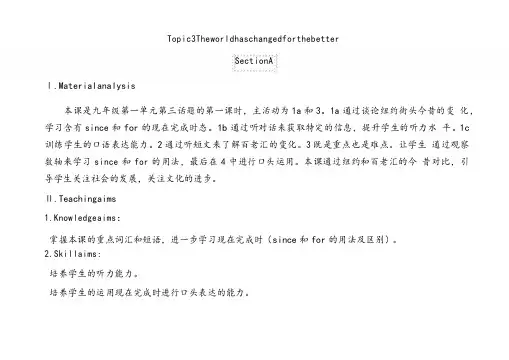
Topic3TheworldhaschangedforthebetterSectionAⅠ.Materialanalysis本课是九年级第一单元第三话题的第一课时,主活动为1a和3。
1a通过谈论纽约街头今昔的变化,学习含有since和for的现在完成时态。
1b通过听对话来获取特定的信息,提升学生的听力水平。
1c 训练学生的口语表达能力。
2通过听短文来了解百老汇的变化。
3既是重点也是难点。
让学生通过观察数轴来学习since和for的用法,最后在4中进行口头运用。
本课通过纽约和百老汇的今昔对比,引导学生关注社会的发展,关注文化的进步。
Ⅱ.Teachingaims1.Knowledgeaims:掌握本课的重点词汇和短语,进一步学习现在完成时(since和for的用法及区别)。
2.Skillaims:培养学生的听力能力。
培养学生的运用现在完成时进行口头表达的能力。
能通过整合对话内容,提升综合语言运用能力,为语言输出做好准备。
3.Emotionalaims:(optional)引导学生了解各国城市的变化,关注社会文明的进步,为建设更好的家园而努力学习。
4.Cultureawareness:(optional)通过纽约街头今昔的对比,引导学生关注不同的国家、城市的发展和社会文明进步。
Ⅲ.Thekeypointsanddifficultpoints1.Keypoints:Wordsandphrases:block,artist,visitor,industry,chemistry,term,get/beusedto,usedtobe…,a samatteroffact,millionsof,standfor…Sentences:YouhavebeeninNewYorkforalongtime.…butthecityhasimprovedalotsinceIcamehereafewdaysago.Grammar:PresentPerfect(since和for的用法)2.Difficultpoints:通过具体语境,区别短语get/beusedto(doing)sth.和usedtodosth.的用法。
Unit1+Topic+3+课文详解课件2023-2024学年仁爱版九年级英语上册

Section B
• Maria: What are you reading, Jane? be动词+V.ing (现在进行时)
• Jane: I’m reading a newspaper from Canada. Martin showed me an interesting article.
街区
事实上=in fact
wonderful place to live. Near our block, there are beautiful parks, good schools,
famous museums and excellent restaurants. And you can go to plays, concerts and
Lesson Three
Topic3 A-B
Words and passages
单词认读
背诵词汇
背诵词汇
词汇 1. with the money 2. so that 3. so...that... 4. in fact/as a matter of fact 5. come for a visit 6. in need 7. decide on sth. 8. provide sth. for sb./provide sb. with sth. 9. feel good about... 10. lend sth. to sb/lend sb. sth.
It is about a program that helps homeless people. show sb.sth.= show sth. to sb.
定语从句:从句充当形容词,修饰前面的program
给某人展示某物
最新仁爱版英语九年级上册Unit1 Topic3 SectionB知识点
Unit1 Topic3 SectionB1.出示某物给某人show sb sth=show sth to sb 带领某人参观···show sb around炫耀,卖弄show off出现,露面show up=turn up2.无家可归的人homeless people数百的hundreds of重返工作return to work3.过正常的生活live/have a normal life4.①设法做成某事(结果一定成功)manage to do sth.②尽力做某事(结果不一定成功)try to do sth.5.一旦once (引导时间状语从句)6.since(引导时间状语从句,主现从过)7.in+名词①在需要时in need②在困境中in trouble③在危险中in danger④好健康in good health⑤好心情in a good mood8.①选定某物decide on sth②决定做某事decide to do sth③做决定make a decision9.为某人提供某物offer sb sth=offer sth to sbprovide sb with sth=provide sth for sb10.医疗medical treatment11.为了,以便于so that=in order that (后都跟从句)为了做某事in order to do sth.12.自我感觉良好feel good about oneself13.为···改变change for14.在许多方面in many waysP20:1.for,since,how long 现完,延续性动词,be词组均为延续性动词非延动----延动die--be deadleave--be away (from)come--be injoin--be in/ be a member ofbuy--haveborrow--keepbegin/start--be onclose--be closedopen--be openfall ill--be illmarry--be married2.陷入困境get in trouble3.拾起;接某人pick up4.处于救援氛围中in a helpful mood5.帮助某人走出困境help sb out。
Unit 1 Topic 3 Section B 公开课教学设计(九年级英语上册仁爱版)
Unit 1 The Changing WorldTopic 3 The world has changed for the better.Section B教学设计一、教学目标1. 能根据已学语音、音标及发音规则,正确朗读下列词汇并在实际的对话操练中加以应用:program, homeless, manage, treatment, training, immediately, secretary, helper, club, engineer, wound2. 继续学习现在完成时(短暂性动词与延续性动词的转换)。
3. 能够正确朗读句子,注意句子中的重读、弱读、连读以及停顿。
4. 能听懂有关社会问题和社会服务的对话,并能从中提取相关信息,做出正确判断。
5. 能正确运用现在完成时谈论有关社会服务的话题。
6. 通过整合对话内容,提升综合语言运用能力。
7. 关注社会问题,关注社会服务工程,培养乐于助人的良好品德和爱国意识。
二、教学重点及难点重点:1. 能根据已学语音、音标及发音规则,正确朗读下列词汇并在实际的对话操练中加以应用:program, homeless, manage, treatment, training, immediately, secretary, helper, club, engineer, wound2. 继续学习现在完成时(短暂性动词与延续性动词的转换)。
难点:1. 能在具体语境中,将短暂性动词转换成延续性动词,正确使用一般过去时和现在完成时。
2. 能通过本课所学,正确运用现在完成时对日常活动进行描述。
三、教学准备教师:教学课件;家乡变化的图片;多媒体设备学生:课前预习四、教学过程Step 1 Warming-upWork in groups. One student say a sentence with “have done”. The others add time adverbial with “for” or with “since”, and go on practicing.【设计意图】通过句子接龙的活动,活跃课堂气氛,在复习的同时为后面学习短暂性动词转换为延续性动词提供语境,做好铺垫。
仁爱英语九年级上册Unit1-Unit2课文翻译
精心整理仁爱英语九年级上册Unit1-Unit2课文翻译Unit1Thechangingworld变化中的世界Topic1Ourcountryhasdevelopedrapidly我国发展迅速SectionA1a:(Afteralongholiday,Kangkangishappytoseehisfriends.)(长假过后,康康很高兴会见到他的朋友们。
)Hi,Jane!Didyouhaveagoodsummerholiday?你好,简,你暑假过得愉快吗?Yes.Whataboutyou?是的,你呢?Notbad.Rita,youhavejustcomebackfromyourhometown.Howwasyourtrip?不错。
丽塔,你刚从家乡回来,你的旅行怎么样?Great!IwenttomanyplacesnearmyhomeinIndia.Greatchangeshavetakenplacethereandmyhome townhasbecomemoreandmorebeautiful.Wherehaveyoubeen,Jane?好极了!在印度,我去了我家附近的很多地方。
那里发生了很大的变化,而且我的家乡变得越来越美丽了。
简,你去哪里了?IhavebeentoMountHuangwithmyparents.It'sabeautifulplace.Butthereweresomanypeopleth atIcouldn'tfindagoodplacetotakephotos.Andwherehaveyoubeen,Kangkang?我和我的父母去过黄山,那是一个美丽的地方。
但是那里人太多了,我都找不到一个好的地方拍照。
康康,那你去哪里了?IhavebeentoanEnglishsummerschooltoimprovemyEnglish.Bytheway,where'sMaria?为了提高我的英语水平,我去了一所英语暑期学校。
仁爱英语九年级上册Unit3-Topic1-SectionB课件(共21张PPT)
Practice
1b Work alone
Match the words with the explanations
a. a person who translates one language into
1. similar
b. another orally
2. conversation b. almost the same but not exactly the same
3. language
c. a problem, worry or difficulty
4. pack
d. to be able to be done or probably happen
e. a talk between two or more people
5. possible
f. to put things into bags, boxes, etc. for taan who understands their country’s language and
culture.
(录音)
Project
Finish 2b Work alone
Cuba
Great Britain Japan
Spanish
Australia
China
Chinese
many problems/ cause/ large population
bedroom/clean/Li Tao letters/deliver/postman Fuwa/love/people
Homework
1. Make a dialogue according to 1a. 2. Do the exercises on the English