
译林版英语九年级下册第三单元 Task
Period 5 Task & Selfassessment
(2)regret也可用作名词,意为“遗憾;抱歉;懊悔”。当表示“遗 憾的事”时,为可数名词。 What is your greatest regret?你最大的遗憾是什么? One of my regrets in life is that I am not a famous writer. 我人生的遗憾之一就是,我不是一位著名的作家。
Period 5 Task & Selfassessment
[拓展] expect的其他用法:expect to do sth 期待做某事;expect+ that从句 期待/预计…… You can't expect to learn a foreign language in a few months. 你不能指望在几个月内学会一门外语。 Many people were expecting that the peace talks would break down. 许多人预料和平谈判会破裂。
Period 5 Task & Selfassessment
[拓展] regret to do sth与regret doing sth regret to do sth 对要做的事感到遗憾(事情未做)。 regret doing sth 对做过的事感到遗憾、后悔(事情已做)。
I regret to tell you that you are wrong. 我很遗憾地告诉你,你错了。 I regret drinking the cup of milk. 我后悔喝了这杯牛奶。
Period 5 Task & Selfassessment
活学活用
(1)根据汉语意思完成句子 ①我非常后悔说了那些话。 I deeply __r_e_gr_e_t _w_h_a_t I_s_a_id____. ②他后悔提起了它。 He __re_g_r_et_te_d_h_a_v_in_g_m__en_t_io_n_e_d___ it.
Period 5 Task & Selfassessment
句型透视
●1 How long do you expect your robot's batteries to last? 你期望你的机器人的电池持续多长时间?
[探究] expect sb/sth to do sth意为“期盼某人/某物做某事”。 We expect him to get through to the finals. 我们期待他进入决赛。
5. 至多 ____a_t_m_o_st____
Pe持续一周 _la_s_t _fo_r_o_n_e_w_e_ek_ 短 7. 至少 ____a_t_le_a_st____ 语 互 8.始终,一直 __a_l_l _th_e_t_im_e___ 译 9.达到标准 __u_p_to__st_a_nd_a_r_d_
Unit 3 Robots
Period 5 Task & Selfassessment
Unit 3 Robots
Period 5 Task & Selfassessment
课前自主预习 课堂互动探究
Period 5 Task & Selfassessment
课前自主预习
1.质量 n.__q_u_a_lit_y__ 单 2.满意的,满足的 adj.__s_at_is_f_ie_d_ 词 →满足;使……满意 vt.__s_a_ti_sf_y__ 闯 3.产品,成果 n._p_r_o_d_u_ct__ 关
14.expect sb to do sth _期__待_某__人_做__某__事_
Period 5 Task & Selfassessment
短 15.be unhappy with __对__…__…_不__满___ 语 16.look forward to doing sth ___盼_望__做_某__事___ 互 17.send sth to sb _把_某__物__寄_给__某_人__ 译
Period 5 Task & Selfassessment
Period 5 Task & Selfassessment
[拓展] completely的形容词形式为complete,意为“完整的; 完 全的;彻底的”。 _c_o_m_p_le_t_e_也可作动词,意为“___完__成___”。 We will certainly set up a complete, modern industry system. 我们会建立一个完整的现代化工业体系。 The work will be completed in a few days. 这项工作会在几天之内完成。
→过去式 _r_eg_r_e_tt_ed__ →过去分词 __re_g_r_et_te_d_
Period 5 Task & Selfassessment
1. 对……感到满意 _b_e_s_a_ti_sf_ie_d_w_i_th_ 短 2. 根本不…… ___n_ot_…__at_a_l_l __ 语 互 3. 首先 ___f_ir_s_t o_f_a_ll___ 译 4. 收到……的来信 ___h_ea_r_f_r_om____
→生产;产量 n._p_ro_d_u_c_ti_on_ →生产 vt.& vi.__pr_o_d_u_ce__
Period 5 Task & Selfassessment
4.完全地 adv._co_m_p_l_et_e_ly_ 单 →完全的;彻底的 adj._c_o_m_p_l_et_e_ 词 →完成 vt._c_o_m_p_le_t_e _ 闯 5.后悔;遗憾 vt. & vi.__r_e_g_re_t__ 关
3.一个好的机器人应该只需每六个月检查一次。 A good robot should only __n_e_e_d_c_h_ec_k_in_g_e_v_e_ry__6_m_o_n_th_s__.
Period 5 Task & Selfassessment
4. 我不知道它怎么了。 句 I do not know ____w_h_at_i_s_w_r_on_g__w_it_h_it___. 型 5. 我后悔买了这样一个机器人。 在 I __r_eg_r_e_t _ha_v_in_g__bo_u_g_h_t__ a robot like this. 线
18.return sth to sb _把__某_物__归__还_给__某_人__
Period 5 Task & Selfassessment
1.你认为你的机器人应当多长时间检查一次? 句 __H_o_w__of_t_en___ do you think your robot _s_h_ou_l_d_b_e_c_h_ec_k_e_d_? 型 2. 我对它一点儿也不满意。 在 I am __n_o_t _sa_t_is_fi_ed__w_it_h_ it ___a_t_a_ll___. 线
Period 5 Task & Selfassessment
●3 regret vt.& vi.后悔;遗憾 [观察] I regret having bought a robot like this. 我后悔买了这样一个机器人。 [探究] (1)regret用作动词,意为“后悔;遗憾”,其过去式、过去 分词、现在分词分别为_r_e_g_re_t_te_d_,_r_e_g_re_t_te_d_, _r_e_gr_e_tt_in_g_。
Period 5 Task & Selfassessment
活学活用
用括号内所给单词的适当形式填空 2018•无锡 —You look absentminded. ____A_re___ you __ex_p_e_ct_in_g_ (expect) someone? —Yes. My efriend is coming over. We've never seen each other before.
10.完全停止工作 __s_to_p_w_o_r_k_in_g_c_o_m_p_l_et_e_ly_
Period 5 Task & Selfassessment
短 11. regret doing sth __后_悔__做__了_某__事__ 语 12. get my money back ___拿_回__我__的_钱___ 互 13.give it a try ____试_一__下_它____ 译
6.你只需要把电池放进去,它就能工作。 You will only need ___to__pu_t_t_h_e_b_a_tt_er_ie_s_i_n_to__m_a_k_e_it_w_o_r_k____.
Period 5 Task & Selfassessment
句 7. 当您对它不满意时,欢迎您告知我们。 型 You are welcome to let us know w_h_e_n_e_ve_r_y_o_u_a_r_e _n_ot_s_a_ti_sf_ie_d_w_i_th__it. 在 8.我们期待尽快收到您的来信。 线
Period 5 Task & Selfassessment
[探究] satisfied作形容词,意为“满意的,满足的”, be satisfied with意为“____对_…__…__感_到__满__意____”,在此短语中主语为 人。其同义词组为be pleased with和be happy with。 His parents are very satisfied with him. 他的父母对他很满意。
Period 5 Task & Selfassessment
(2)单项选择
九年级英语下译林unit3知识点
九年级英语下译林unit3知识点Unit 3 Knowledge Points in Yilin English Textbook for Ninth GradersIntroductionIn the ninth grade English curriculum, students explore various themes and topics to enhance their language skills. Unit 3 of the Yilin English textbook covers a range of knowledge points that help students strengthen their understanding and application of the English language. This article will delve into the key knowledge points in Unit 3, providing insights and examples.Vocabulary ExpansionOne of the fundamental aspects of language learning is vocabulary. Unit 3 introduces students to a host of new words, increasing their vocabulary repertoire. Some key words include "mysterious," "traditional," "beliefs," "customs," and "superstitious." Understanding these words not only aids in comprehension but also allows students to express themselves more precisely.Idioms and PhrasesIn addition to expanding vocabulary, Unit 3 provides students with a glimpse into the world of idioms and phrases. This figurative language adds flair to one's spoken and written English. Some idioms covered in this unit are "the ball is in your court," "cross that bridge when you come to it," and "let the cat out of the bag." By understanding and using these idioms appropriately, students can enhance their communication skills and fluency.Grammar FocusUnit 3 of the Yilin English textbook places emphasis on certain grammar points, which are crucial for forming grammatically correct sentences and conveying meaning accurately. Some key grammar points covered in this unit include the usage of "used to" and "be/get used to," the present perfect tense, modal verbs to express prohibition or permission, and the passive voice. By mastering these grammar concepts, students can construct more sophisticated and nuanced sentences.Listening SkillsListening skills form an integral part of language acquisition. Unit 3 offers various listening activities to enhance students' ability to comprehend spoken English. These activities may include listening for specific information, understanding conversations, and following instructions. By attentively listening to native speakers, students can improve their pronunciation, vocabulary, and overall comprehension abilities.Reading ComprehensionUnit 3 provides students with engaging reading materials that allow them to practice their comprehension skills while expanding their knowledge on different topics. The texts cover a range of themes, such as cultural customs, historical events, and personal anecdotes. By analyzing and understanding the texts, students develop their reading strategies, such as skimming, scanning, and inference.Speaking ActivitiesSpeaking activities in Unit 3 encourage students to communicate in English both individually and in groups. These activities aim to improve students' fluency, pronunciation, and overall confidence in using English for communication. Some activities may involve givingshort presentations, participating in debates, or discussing thought-provoking topics. Through these activities, students develop their critical thinking skills and practice expressing their opinions effectively.Writing TasksUnit 3 also provides opportunities for students to hone their writing skills. Writing tasks may include composing formal letters, personal narratives, persuasive essays, or descriptive passages. These tasks not only improve students' written expression but also foster their creativity and organization of ideas. By practicing these writing tasks, students learn to effectively structure their thoughts and convey their messages to different audiences.ConclusionUnit 3 of the Yilin English textbook for ninth graders encompasses a wide range of knowledge points, including vocabulary expansion, idioms and phrases, grammar focus, listening skills, reading comprehension, speaking activities, and writing tasks. By engaging with these knowledge points, students can enhance their language skills holistically. The various activities and exercises in this unit promoteactive learning and provide opportunities for students to apply their knowledge in meaningful and practical ways.。
译林版九年级下册unit3知识点
译林版九年级下册unit3知识点Unit 3: EnvironmentIntroduction:In the ninth grade, students are introduced to various topics that not only expand their knowledge but also cultivate critical thinking skills. One such topic is the environment, which is the focus of Unit 3 in the textbook series "Translation Forest". This unit aims to educate students about the importance of protecting the environment and sustainable living. Through engaging content and thought-provoking discussions, students will develop a deeper understanding of the impact of human activities on the planet and learn about potential solutions to address environmental challenges.Understanding Climate Change:Climate change has become one of the most pressing issues of our time. The first section of Unit 3 delves into the causes and consequences of climate change. Students will explore the role of greenhouse gases, such as carbon dioxide and methane, in trapping heat and altering the Earth's climate. They will also learn about theconsequences of global warming, including rising sea levels, extreme weather events, and the endangerment of countless animal species. By understanding these key concepts, students will gain awareness of the urgent need for action to mitigate climate change.Sustainable Development:To combat climate change and preserve the environment, sustainable development is crucial. The next section of Unit 3 focuses on sustainable living practices that can help achieve a balance between economic growth and environmental protection. Students will discover the concept of the "three R's" – reduce, reuse, and recycle – as effective strategies to minimize waste and conserve resources. Additionally, they will learn about renewable energy sources such as solar and wind power, as well as the importance of energy conservation in combating climate change.Preserving Biodiversity:Biodiversity refers to the variety of plant and animal species on Earth, and it is vital for maintaining ecosystem stability. The third section of Unit 3 explores the causes of biodiversity loss and its dire consequences. Students will explore how deforestation, overfishing,and pollution are threatening the delicate balance of ecosystems. They will also delve into the significance of preserving biodiversity for human well-being, including the provision of food, medicine, and other ecosystem services. By recognizing the importance of biodiversity, students will be motivated to protect and restore it.Environmental Activism:The final section of Unit 3 highlights the power of activism in driving change. Students will learn about influential environmental activists from around the world who have dedicated themselves to protecting the Earth and inspiring global action. They will explore various methods of environmental activism, including grassroots movements, lobbying, and awareness campaigns. Through case studies and discussions, students will recognize that collective action can lead to significant positive outcomes for the environment.Conclusion:Unit 3 of the ninth-grade textbook series "Translation Forest" offers a comprehensive and in-depth exploration of environment-related topics. By understanding climate change, sustainable development, biodiversity, and environmental activism, students will gain theknowledge and awareness required to become responsible global citizens. This unit not only provides valuable information but also encourages students to think critically, fostering a sense of stewardship towards the Earth and inspiring them to take action to protect the environment. By equipping students with the necessary tools, education plays a pivotal role in shaping a sustainable and greener future.。
九年级英语(牛津译林)下册复习导学案:Unit3 Task
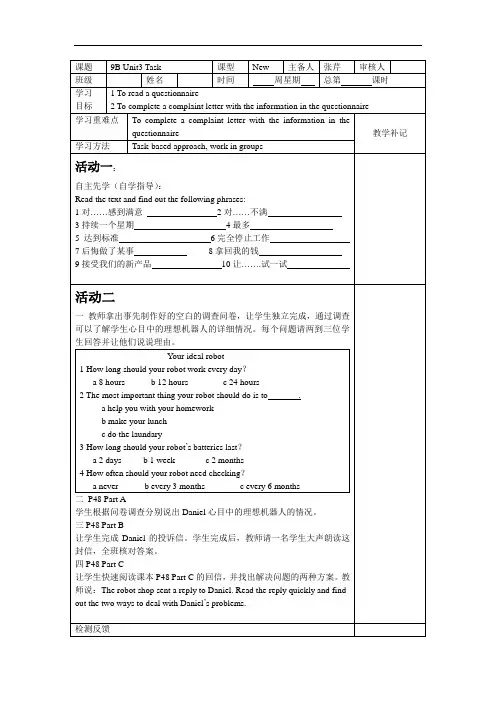
2 The most important thing your robo help you with your homework
b make your lunch
c do the laundary
3 How long should your robot’s batteries last?
3. I meant to help him .However, he didn’t. __________(接受) my offer.
4. He made some mistakes in his English test paper. His teacher was not very__________(满意) with him.
7后悔做了某事____8拿回我的钱
9接受我们的新产品10让…….试一试_______
活动二
一教师拿出事先制作好的空白的调查问卷,让学生独立完成,通过调查可以了解学生心目中的理想机器人的详细情况。每个问题请两到三位学生回答并让他们说说理由。
Your ideal robot
1 How long should your robot work every day?
5达到标准_____6完全停止工作
7后悔做了某事____8拿回我的钱
9接受我们的新产品10让…….试一试_______
自主反思
6. Please remind me(hand) in my homework after class.
7. Tom was noticed(pick) up the waste paper on the playground.
8. I think it(comfort) to live in such a big house with a swimming pool.
Unit 3 task 课时教案2020-2021学年牛津译林版九年级英语下册
Junior Three English Group
Master and backup
学科
英语
主备时间
总10课时
Coach
执教时间
执教班级
Subject
9B Unit3Robotstask
Step 2:询问学生是否同意Daniel的回答。如果学生不同意,请他们证明自己的回答是正确的我不同意Daniel在问题X上的观点,因为……
Step 3: Ask students to read the letter on their own.
Step 4:让学生描述Daniel的感受,并告诉他们他们可以使用第31页问卷中的信息完成这些信件。
According to what they have learned, students can complete an essay by themselves.
第8教时
teaching
1.阅读并理解问卷
2.使用问卷中的信息来完成投诉信。
3.写投Байду номын сангаас信。
the goal
填写自我评估表
Focus
difficulty
二次备课
Teaching aids
教
学
过
程
教
学
过
程
Part A: The robot exhibition
Step 1:请学生阅读问卷的七个不同部分。如果学生有任何问题,请他们举手。
Step 5:鼓励学生自己完成这封信。完成后,大声朗读整封信。
Step 6:让学生使用他们在T31页上为扩展活动完成的问卷作为完成C部分自己的投诉信的基础。提醒学生在写投诉信时,他们应该保持正式的风格。虽然他们可以把投诉信说清楚,但他们应该礼貌。
unit3 Task课时教案2020-2021学年牛津译林版九年级英语下册
2020-2021学年牛津译林版九年级英语下册Unit 3 RobotsTaskI. Teaching objectives and learning objectives※At the end of this course today, students should be able to master the following knowledge points:1.※This lesson needs to focus on the following knowledge points, and fill in the complaint letter according to the questionnaire;2. ※This lesson needs to focus on the following knowledge points, write a complaint about your robot or reply to a complaint letter.II. Teaching content1. ※This lesson requires learning and mastering new vocabulary: satisfaction, completeness, regret, product, quality, satisfaction, first, at most, lasting at least two months, reaching the standard, refunding2. ※This lesson requires learning and mastering the new structure:[※Structure ※] How long do you expect the battery of the robot to last?[※Structure ※] How often do you think your robot should be inspected?[※Structure※] I am not satisfied at all.[※Structure ※] A good robot should only need to be checked every six months.III. The focus of the course and the difficulty of forecasting※This lesson needs to focus on the following difficulties, write a letter to complain about your robot or reply to the complaint letter.IV. Teaching proceduresStep 1 import1. RevisionT: Next, the teacher will ask questions and students will answer. The teacher asks the whole class to review the knowledge points just mentioned. The robot can do a lot for us. What benefits can Mr. Jiang's robot bring him? [Note: Please think carefully and complete this content as required] S: In the morning, he can make breakfast for him, iron his suit, prepare his lunch box, do all the housework when he goes to work, go shopping in the supermarket, the teacher asks the whole class to review the knowledge points just mentioned and prepare for him A delicious dinner, tidy up after dinner.2. Your ideal robotT: If you have a robot, the teacher will ask questions and the students will answer. What would you look for in it? The teacher asks the whole class to review the knowledge points just mentioned. This is a questionnaire for you. Discuss and complete it with your partner.[Design intent: through the review of the content learned in the reading part, to guide students todevelop their own thinking on this basis, and to prepare for the completion of the questionnaire task. 】Step 2 Statement-Daniel's Complaint Letter1. Understand Daniel's ideal robotT: Please read Daniel's answer carefully. Next, the teacher will ask questions and the students will answer. What is his ideal robot?S: The teacher asked the whole class to review the knowledge points just mentioned. Daniel's robot battery should last for 2 months.His robot should work 24 hours a day.Daniel wants his robot to help him with his homework.He thinks his robot should be checked every 6 months.[Design intent: Through the reading of the content of the answer, on the one hand, to prepare for the completion of the task of the complaint letter, but also to cultivate students' expression skills and prepare for writing. 】2. Fill in the complaint letterT: Daniel's robot stopped working recently. The teacher asked all the students in the class to review the knowledge points they just talked about. Then the teacher asked the students to answer. He decided to write a complaint letter to the store. Alright students, let’s move on to the next link. Let’s help Daniel complete this letter based on the questionnaire above.3. Understand the complaint letterTask 1: Fill out the formT: The customer service department of the robot shop received a letter from Daniel. The teacher asks the whole class to review the knowledge points just mentioned. They need to fill in the form before sending the letter to the manager. Can you fill in the form for them?[Design intent: to train students' fast reading ability through the task of filling in the form. At the same time, students at all levels can also participate in the enthusiasm of participating in activities through simple and in-depth problem design. 】Task 2: Alright, students, let’s go to the next link now, read car efullyT: The manager is reading Daniel's letter carefully. The teacher asks the whole class to review the knowledge points just mentioned and try to find out what is wrong with Daniel's robot. Let us helpT: Next, the teacher will ask questions and the students will answer. The teacher asks the whole class to review the knowledge points just mentioned. How does Daniel plan to deal with this problem?S: He regrets buying the robot and wants to get his money back.[Design intent: By completing the task of the form, sorting and sorting the information obtained, while completing the task, it also has a deeper understanding of the author of the complaint letter. 】Task 3: How to write a complaint letterT: Working in groups, the teacher asks the whole class to review the knowledge points just mentioned, and first draw some useful expressions in Daniel's letter. Next, the teacher will ask questions and the students will answer. What information should be included in the complaint letter? The teacher asks the whole class to review the knowledge points just mentioned, assuming that you are also not satisfied with your robot. Discuss with your group members.First, you can tell the customer service department what you are dissatisfied with, when to buy it and what you think about it.Alright, students, we are now going to the next link. Secondly, you can carefully distinguish the difference between the ideal robot and the real robot. The teacher asks all the students in the class to review the knowledge points just mentioned and let them know why you are dissatisfied with the robot is very important.The teacher asks the whole class to review the knowledge points just mentioned. Finally, you can tell them how you plan to deal with it.[Design intent: by summarizing and sorting out the framework of the thesis, to help students further understand the writing requirements of related letters, to complete the task of writing text writing tasks to complete scanning faults. 】Step 3 Presentation——Response from the robot shop1. Read the responseT: After the robot shop received Daniel's letter, the manager sent a letter back to Daniel. Read this letter with Daniel. Next, the teacher asked questions and the students answered. How many ways did the manager provide to solve Daniel's problem?Health: Two. The teacher asked all the students in the class to review the knowledge points just mentioned. Daniel can accept a new robot or get his money back.2. Help Daniel make decisionsT: What should Daniel do with robots? The teacher asks the whole class to review the knowledge points just mentioned. Can you give him some suggestions? Work in groups and tell me your decision and reasons. Alright, students, we are now going to the next link, you can give as many reasons as possible.Daniel should accept a new robot because __________________________.Daniel should get his money back because __________________________.3. How to write a replyT: Mark some useful expressions in the response.T: Here are some suggestions for you. The teacher asked the whole class to review the knowledge points just mentioned. When we receive the complaint letter, we should reply immediately. More importantly, we should pay attention to our words when explaining something. Most importantly, we should find a solution to the problem.[Design intent: through reading the letter, guide the discussion, and analyze the content of the reply letter. At the same time, the summarization of students with the response structure also lays a solid foundation for the task's achievement support. 】※Through this class, I deeply feel that the children really like various forms of classroom teaching, and the follow-up should be based on the teaching concepts in the new curriculum standard, and continue to innovate and explore.Step 4 writingT: Today we learned how to write a complaint letter and reply. Susan bought a cell phone last week. However, it has some problems. Next, the teacher will ask questions and the students will answer. She intends to write a complaint letter to the store. Can you write a letter for her?Susan has a mobile phone model, NKZ3, but she encountered some problems in using it and found that the characteristics of the mobile phone and the store are not written on the same person. Please complain to the store with Susan's letter. Key points include:1. The teacher asks the whole class to review the knowledge points just mentioned. The battery can only be used for one day at most; Susan believes that wisdom should be used best.2. The teacher asks all students in the class to review the knowledge points they just talked about. They cannot take photos, receive text messages, or search on the Internet; they have a commitment...3. The teacher asked the whole class to review the knowledge points just mentioned. The quality of the mobile phone is not up to the standard and the mobile phone system often fails.4. Susan's request... (two points)※Create a harmonious classroom atmosphere. Cultivate students' enthusiasm to speak English.V. Homework1. Today I learned the key knowledge points of this course and reviewed the different ways of writing complaint letters and replying.2. Today, I learned the key knowledge points of this course and helped the manager write back to Huishan.3. Please preview the relevant knowledge points of the next lesson.。
Unit3 task课时教案2020-2021学年牛津译林版九年级英语下册

牛津译林版九年级英语下册9B Unit 3 Robots(第八课时task)一、T eaching Aims1. 能说说优缺点2. 能够画出轮廓3. 能够写一篇关于网上冲浪的新文章二、K ey and difficult points1. 学会写好作文2. 掌握英语写作中注重过程的方法三、T eaching Aids多媒体四、T eaching ProcedureStep1: Lead-in1. Talk about Mr Jiang’s robotT-Ss : Who’s the first p erson to own a robot in Sunshine Town?他为什么要买机器人?拥有机器人有什么好处?拥有机器人有什么缺点?他最后是怎么对付机器人的?2. Help the students to analyze the structure of this article(1). beginning(2). main body (advantages and disadvantages)(3). ending (suggestions /influence/opinions)Step2: Pre-reading1、说说网上冲浪的利与弊(这节课我们要写一篇关于上网的文章。
你喜欢上网聊天吗?你喜欢玩电脑游戏吗?但我认为上网有好处也有坏处)2. 请学生谈谈网上冲浪的优点和缺点。
3.让学生完成一张桌子4. 举个例子,谈谈如何写好文章Step3: while-writingGive Ss enough time to write their articles on the paperStep4: Post-Writing1. 向全班展示分数的等级,并告诉他们什么是好的写作。
2. 与伙伴一起改变,尝试改正一些错误。
3. 分享部分学生的作文,全班批改。
Step 5: AppreciationTo present the sample version on it, students enjoy it.Step 6: HomeworkTo improve their composition again after classReflection after classAs a writing class for Main Task, this is undoubtedly not a good class. But this class left a deep impression on me. The new curriculum encourages students to "actively participate, try to discover, democratic dialogue, and cooperative inquiry." I don't know when, I found that students often deliberately or unintentionally jumped out of the framework designed before the class, giving me some unprepared accidents, making me a little confused. It is this "accident" that makes the classroom full of vitality. In the face of "accidents", we are maintaining our authority in a daze of actions, and are we missing every opportunity to teach? Or is it to capture the students' "light flashes" in the pro-and-talk conversation, and have an unexpected surprise? Although the teaching task was not completed in this class, I did not have time for the students to finish the composition and comment on the composition. But the design of my class still got the approval of the students, and the passion they showed made me unexpected.Looking back on this class, I think the following points are quite effective.1. Adopt cooperative and interactive mode to stimulate students' enthusiasm forparticipation.2. Design activity task scenarios to give full play to students' creative ability.3. Pay attention to the content generated in the classroom and protect the enthusiasm of students.Open teaching design plays a fundamental role in the generation of classroom resources. If the teacher is pursuing the standard answer, the only answer, then there will be no opportunity to show the students' personalized experience and creative thinking. The classroom is the place where students grow up, where students’ personalities and ideas bloom. Teachers, as the help, guide and collaborator of studen ts’ learning, must truly establish the idea of equality for all students and stimulate everyone’s desire for new ideas. Only by providing students with the opportunity to speak and giving them a successful experience can they give the vitality of English education and teaching, and allow teachers and students to share the charm of English classrooms.。
牛津译林版英语九下《Unit 3 Asia》(Main task)
There are lots of interesting things to do in South Korea. Olympic Park is where the 1988 Seoul Olympic Games were held. Gyeongbokgung Palace is also a wonderful place to visit. It is the biggest and most beautiful palace in Seoul. Lotte World is an exciting theme park. I think your students will like it. South Korea is also a good place to go shopping. There are hundreds of shops in Myeongdong Shopping District. You and your students will surely find something you want there. You can also spend a day in Bears Town Ski Resort. It is a good place to go skiing.
Homework:
1. Read the article on P53. 2. Finish the composition.
1. What is South Korea’s capital city? Souel. 2. What language do most people in South Korea speak? Korean. 3. How can we go to South Korea? By air. 4. Can you name some tourist attractions in South Korea?
译林版英语九年级下册第三单元-Task课件
Period 5 Task & Selfassessment
15.be unhappy with 对…_____…不满_______
短 语 16.look forward to doing sth __ _ _ _ __ 互 17.send sth to sb _ _ _ _ _ 译
Period 5 Task & Selfassessment
[探究] satisfied作形容词,意为“满意的,满足的” , be satisfied with意为“____________对…___…感___ 满 此短语中主语为人。其同 义词组为be pleased with和be happy with。 His parents are very satisfied with him. 他的父母对他很满意。
Period 5 Task & Selfassessment
句型透视
●1 How long do you expect your robot's batteries to last? 你期望你的机器人的电池持续多长时间?
[探究] expect sb/sth to do sth意为“期盼某人/某物做某事”。 We expect him to get through to the finals. 我们期待他进入决赛。
We lo__o_k_forwar_____d_to____h_ear_i_n__g_ቤተ መጻሕፍቲ ባይዱfr om_ you soon.
Period 5 Task & Selfassessment
课堂互动探究
词汇点睛
●1 satisfied adj.满意的,满足的 [观察] I am not satisfied with it at all. 我对它一点儿也不满意。
Unit 3 Task 学案-2021-2022学年九年级英语牛津译林版下册
九年级下册Unit 3 Task 学案 主备: 审核: 日期:2022.1.22学校:___________ 班级:___________ 姓名:____________ 家长签字:____________【课前导学】词组翻译.请试着在课文中找出这些词组1. 达到标准2. 期待某人做某事3. 一封投诉信4. 后悔做某事5. 需要检修6. 这个机器人的质量7. 拿回我的钱 8. 完全停止工作9. 持续一个星期 10. 接受我们的新产品【课堂学习】Step 1. Pre-writing1. Guessing game2. Free talkStep 2.While-writing1. Millie is writing a complaint letter. Let’s read through the first half of her outline. Read aboutthe story, then answer some questions.2. Clear structureOrganize our ideas clearly.3. Discussion:Remind students to think about them with who, what, where, when 和how and pay attentionto the tips in Part C.4. Useful expressions:Underline beautiful words, phrases or sentence patterns in the article.5. Understanding what to write and how to write6. Writing (Teachers offer some help if necessary)a complaint letter Editing(1) Self-editing32字写作评价标准:段落分明(1) 要点齐全(5) 时态恰当(2) 结构正确(2)句式多样(1) 过渡自然(1) 观点合理(2) 书写规范(1)(2) Peer-editing (Pair work/ Group work)Help your deskmate to correct in red and give him/ her some advice. 给你同学的建议:Post-writingEvaluating1. Give some suggestions on how to improve writing skills.2. Pay attention to using some more beautiful sentence structures and proper transitions.需改进的词、句:互评分______ 自评分______【课后拓展】一、词汇运用1. --- When will your work be finished ________________ (complete)? --- Maybe tomorrow.2. --- What are you doing? --- I’m writing a ________________ (complain) letter.3. I was still sleeping when the fire broke out, and then it ________________ (spread) quickly.4. You may look up the word in the dictionar y if you are ______________ (sure) of its meaning.5. The singer was _______________ (know) to peo ple at first, but now he has become famous.6. Education makes a great difference to a countr y’s _______________ (develop).7. He was ______________ (happy) than last week because he failed the maths exam.★8. You’ll only need to put the batteries in ______________ (make) the model car work.★9. Millie doesn’t know if he should have his clothes _______________ (iron) at once.★10. The _______________ (advantage) of the new machine is that it costs much.11. We had no _____________ (choose) but to do what we were asked to do.12. My grandmother is 92 and has become very ______________ (forget) and confused.13. Fruit and gold are important _______________ (产物,产品) of South Africa.14. The quality of the washing machine is not up to _______________. (标准)15. I really ______________ (遗憾) losing such a good chance for the job.16. Parents should leave ________________ (私人的) space for their children.17. You are welcome to let us know ________________ (无论何时) you aren’t satisfied with it.18. We need to check these machines carefully to make sure that they all have high______________ (质量).19. If your radio doesn’t work., you’d better change new ______________ (电池).20. He isn’t _______________ ([ˈsætɪsfaɪ]) with what his friends said to him.二、单项选择( ) 1. At first I regretted _______ them to stay, but we soon became great friends.A. to inviteB. invitedC. to have invitedD. inviting( ) 2. Miss Zhao is very helpful. She often helps us _______ we are in trouble.A. whateverB. whereverC. wheneverD. however( ) 3. --- It’s a pity that I can only stay here for two days _______.--- Why not stay for another day? I know you have three days off.A. at firstB. at lastC. at leastD. at most( ) 4. --- Have you solved your problems?--- I’ve kept on thinking about that matter _______, but I hav e no idea yet now.A. at timesB. some timesC. at a timeD. all the time( ) 5. Give your child a _______ and you will find he has grown up. He can solve the problem by himself.A. giftB. tryC. questionD. prize( ) 6. There _______ a talk show on CCTV-3 at 8:00 this evening.A. are going to beB. is going to haveC. will haveD. is going to be ( ) 7. A robot show _______ in our city. How _______ is!A. will be held; exciting a newsB. will take place; an exciting newsC. will take place; exciting the newsD. will hold; an exciting news( ) 8. The machine does not work well, so we must have it _______ tomorrow.A. repairedB. repairC. be repairedD. to be repaired( ) 9. The robot caused a lot of trouble, but Mr. Jiang did not know _______ it.A. what should he do withB. how to deal withC. how he should do withD. what to deal with( ) 10. The price of this computer is a little _______. I can’t afford it.A. highB. lowC. expensiveD. cheap( ) 11. --- Alex, did you find our old school last week?--- Yes, but with much difficulty, for it has _______ changed over these years.A. completelyB. neverC. hardlyD. partly( ) 12. Lucy didn’t finish her homework yesterday. _______, she was punished by the teacher.A. Even thoughB. HoweverC. In order thatD. As a result★( ) 13. The girl ______ on the ground _____ to me that she had _____ the wallet on the desk.A. lying; lay; laidB. lying; lied; laidC. lie; lied; layD. lay; lied; lain ( ) 14. He is a person who likes to complain ________ his work _______ others.A. to; onB.to; aboutC. about; toD. about; on ( ) 15. --- Lucy, I don’t like math at all. What about you? --- Oh, I don’t like it _______.A. tooB. neitherC. eitherD. also三、句子翻译,词数不限1. 我们都盼望有一个像这样的机器人。
牛津译林版英语九年级下册Unit3 Study skills精品课件
British English and American English
-mme / -m -ll- / l
-gue / -g -our / -or -re / -er
Spelling British programme travelling dialogue colour theatre
American program traveling dialog
American English
/kɑr/ /təmeto/ /dæns/ /kænt/
Spelling
theatre centre colour humour
favourite jeweller (珠宝商)
traveller kilogramme
programme(节目)
theater center color humor favorite jeweler
_I_f_h_e_g_o_e_s__tr_a_v_e_li_n_g_, _th_e__ro_b_o_t_c_a_n__h_e_lp_________ _l_o_o_k_a_f_te_r_h_i_s_m__o_th_e_r_. ______________________
5 It is a pity that the robot never goes to see a film with him.
English
American English
pronunciation (发音)
Grammar (语法)
spelling vocabulary
(拼写)
(词汇)
Pronunciation
British English
car tomato dance