
新人教版小学三年级英语第三单元单元备课
4.能够在图片的帮助下理解故事内容,拓展动物词汇,理解猩猩和猴子的区别,在教师的帮助下表演故事。
2.能够在语境中理解Come here. It has…的语用功能,并在图片或动作等帮助下,使用It has…描述动物的身体部位。
3.能够朗读对话并能进行角色表演。
4.通过图片和教师讲解能够发挥想象力创造出属于自己的“怪物”,并简单描述其特点。
第五
课时
词汇课
B Let’s learn/Let’s do
2.能够在教师提供的语境中运用这四个词来描述动物外形特征。
3.能够在图片的帮助下听懂指令并做出相应的动作。
第三
课时
字母语音课
Let’s spellபைடு நூலகம்
语音:
Listen and write
听音写字母
1.能够通过听例词发音,观察例词结构中共有的字母,知道字母i在单词中发音。
2.能够在教师的引导下说出例词由哪些音构成。
3.能够朗读对话,并能进行角色表演。
4.能够自己简笔画出常见小动物,并运用学到的语言结构描述自己的作品。
第二
课时
词汇课
A Let’s learn/Let’s do
词汇:thin, fat, tall, short
句型:It’s fat/…
1.能够听、说、认读thin, fat, tall, short四个形容词。注意告知学生它们是两对反义词。
第三单元单元备课
课时
课型
主要教学内容
教学要求
第一
课时
会话课
A Let’s talk/Draw and say
词汇:giraffe, tall, short, fat, so
句型:It’s tall/short/fat.
1.能够在图片和教师的帮助下理解对话大意。
2.能够在语境中理解It’s tall/ short/ fat.的语用功能,并在图片或动作等帮助下,使用It’s + adj.描述动物的外形特征。
3.能够在之前练习的基础上根据给出几个独立的音试着拼出单词。
4.能够在四线三格中正确书写单词,注意到字母间距。
第四
课时
会话课
B Let’s talk/Make a monster
词汇:come here,
children, long,
short, big, small
句型:It has…
1.能够在图片和教师的帮助下理解对话大意。
词汇:short, long, small,
big
句型:It has…
1.能够听、说、认读short, long, small, big等单词。注意告知学生它们是两对反义词,引导学生发现short的两重意义:“短”和“矮”。
2.能够在语境中运用这些单词描述动物外形特点。如果有时间可以复习第一单元的he,she,从而拓展到人的外貌描述: He/She is tall. He/She has big eyes.
3.能够在图片的帮助下听懂指令并做出相应的动作。
第六
课时
综合技能活动课
Start to read
Let’s check
Let’s sing
Story time
1.能够在图片和语境的帮助下认读句子,并且能够以文段中的句子为范本,和同伴一起尝试编造简单的谜语。(Start to read)
2.检测部分要求学生能够熟练地听、说本单元对话部分的主要句型,能听、说、认读词汇部分的所有单词。
人教版小学三年级英语第三单元教案设计
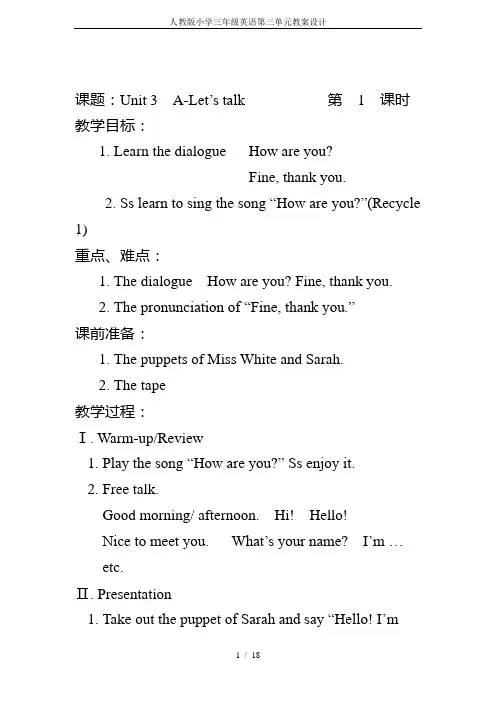
课题:Unit 3 A-Let’s talk 第 1 课时教学目标:1. Learn the dialogue How are you?Fine, thank you.2. Ss learn to sing the song “How are you?”(Recycle 1)重点、难点:1.The dialogue How are you? Fine, thank you.2.The pronunciation of “Fine, thank you.”课前准备:1.The puppets of Miss White and Sarah.2.The tape教学过程:Ⅰ. Warm-up/Review1.Play the song “How are you?” Ss enjoy it.2.Free talk.Good morning/ afternoon. Hi! Hello!Nice to meet you. What’s your name? I’m …etc.Ⅱ. Presentation1.Take out the puppet of Sarah and say “Hello! I’mSarah.”Then greet to the Ss.2.Show Ss the puppet of Miss White. T plays the tworoles and introduces the dialogue “How are you?Fine, thank you.”Sarah: Good morning, Miss White. How are you?Miss White: Fine, thank you.3. Model the sentences again. Ss repeat.Ⅲ. Practice1.Chain Game: Ss ask and answer one by one.A: How are you?B: Fine, thank you. How are you?C: Fine, thank you. …2.Play the game: Clap hands.S1 says “How are you?” and then clap hands withS2.S2 answers “Fine, thank you.”Ⅳ. Presentation1.Hang up the picture of the text. Point to Miss GreenandMr. Black. Ask them “Who’s there?” Teach them their names“Miss Green” and “Mr. Black”.2.Ask Ss to look at the picture and make dialogues ingroups.3.Play the tape, Ss listen.4.Have Ss open their books. Play the tape again, Sslisten and repeat.Ⅴ. Practice1.Ss practice the dialogue in groups and then act out.2.Learn to sing the song “How are you?”板书设计:课后小节:课题:Unit 3 A Let’s learn 第 2 课时教学目标:1.Productive language:blue, green, yellow, red, purple.2.TPR commands.Sho w me your…3. Learn to sing “Who Is Wearing Yellow Today?”重点、难点:1.The words about colors.2.TPR commands.3.The song “Who Is Wearing Yellow Today?”课前准备:1.Crayons (blue, green, red, yellow, purple)2.The tape3.CAI教学过程:Ⅰ. Warm-up/Review1.Play the song “How are you?” Ss sing with the tape.2.Ss greet each other using the dialogue “How areyou?Fine, thank you.”Ⅱ. Presentation1.Show Miss Green on the screen and introduce “MissGreen is wearing green. She has a green book.”Name the word “green”, Ss repeat.2.Give t hem the command “Show me your greencrayon.” Ss do the action. Then “Show me yourgreen pen.” Practice with the other school things. the word again. Ss repeat. the phrases with the color. E.g. A green book.5.Teach the other 4 colors with the same way.e.g. Sarah is wearing yellow. She has a yellowpen.Mike is wearing red. He has a red pencil.Zip is wearing blue. She has a blue ruler.Zoom is wearing purple. He has a purple bag.6. Have Ss open their books. Play the tape, Ss listen,point and repeat the words.Ⅲ. Practice1.Find the colors: Say a color at random. Ask Ss tofind out the things with the color.2.Guess the colors: Put the school things in a big box.Ask a S to take one and hold it in hands. The othersguess the color.3.Have Ss open their books. Play the tape, Ss listenand point to the pictures. Then have Ss close thebooks, play the tape, Ss listen and do the actions. 4.Give the commands at random, Ss do the actions.Then volunteers give the commands, the others dothe actions.5.Play the song “Who Is Wearing Yellow Today?”Point to the Ss wearing the color while singing.Then teach them to sing.板书设计:课后小节:课题:Unit 3 C Story time 第 3 课时教学目标:1. Review the colors by painting the clown.2. Ss understand the story.重点、难点:1.The colors.2.The words in the story: flower(s), one, wow, look. 课前准备:1.Four blank pictures of the clown.2.The crayons and paper.3.The tape.教学过程:Ⅰ. Warm-up/Review1.Play the song “Who Is Wearing Yellow Today?” Sssing by groups and clap hands.2.Free talk.Ⅱ. Presentation1.Learn the words and phrases in the story.a.Show Ss a piece of paper with a flower on it.b.Give the command “Show me your red crayon.”Ss do the action. Ask the fastest S to come infront of the Bb. Give the command “Color it red.”And point to the flower. Have the S color it.c.Do the same with the other colors. Then completedrawing the flower. Name the word “flower”, Ssrepeat.d.Show them different color flowers to practice theword.e.Give them the command “Let’s draw and paint.”Have Ss draw and paint different color flowers.f.Attach the pictures of flowers on the Bb.Introduce “A blue flower. A red one. A yellowone. Wow! Flowers!2.Have Ss open their books. Play the tape, Ss listen tothe story.3.Play the tape again. Ss listen and repeat.4.Encourage the Ss to act out.Ⅲ. PracticeLet’s paint1.Have Ss open their books to p.26 and look at thepicture of the clown.2.Say the commands on the right. Ss color. Ask 4 Ss topaint on the Bb.3.Show their pictures. Lead Ss to describe.板书设计:课后小节:课题:Unit 3 B-Let’s talk 第 4 课时教学目标:1. Learn the dialogue: How are you?I’m fine, thank you.Very well, thanks.2. Learn the phrases: Let’s paint. Great/OK!重点、难点:1.The dialogue: How are you?I’m fine, thank you./Very well, thanks.2.The pronunciation of “Very well”课前准备:1.A board and crayons.2.The tape教学过程:Ⅰ. Warm-up/Review1.Word race: Divide the class into two groups. Showthem word cards or pictures and ask Ss to name the word. The group which told the most words in 10seconds wins the game.2.Sing the song “How are you?”3.Free talk.How are you? Good morning/ afternoon! Hello! Ⅱ. Presentation1.T: Hello! Good morning/ afternoon! How are you?S1: Fine, thank you. How are you?T: I’m fine, thank you.2.Do the same with “Very well, thanks.”3.Model the two sentences. Ss repeat.Ⅲ. Practice1.Let’s play:S1: How are you?S2: Fine, thank you. How are you?S3: I’m fine, thank you. How are you?S4: Very well, thanks. How are you?…2. Whisper: Give the first S of each group a piece ofpaper with a word or a phrase they learnt. The firstS reads it and whisper it to the second S and so on.The group which is the fastest and tells the right one wins the game.Ⅳ. Presentation1. Act the dialogue with a S. Using the board and thepaintbrush to introduce “Let’s paint! Great!”2.Have Ss open their books. Play the tape again, Sslisten and repeat.Ⅴ. PracticeSs practice the dialogue in groups and then act out. 板书设计:课后小节:课题:Unit 3 B-Let’s learn 第 5 课时教学目标:1.Productive language:black, white, orange, pink, brown2.TPR commands:Black, black. Stand up. Pink, pink. Sit down.3. Let’s check.重点、难点:1.The color words: black, white, orange, pink,brown2.TPR commands.课前准备:1.Word cards of color.2.Ten different color flowers.3.The tape教学过程:Ⅰ. Warm-up/Review1.Free talk.How are you? I’m fine, thank you. / Very well,thanks.2. Ss make dialogues in groups and then act out.Ⅱ. PresentationLet’s learn1.Review the colors using the real things. E.g. ShowSs a blue pencil, have Ss tell “a blue pencil”.Then show Ss a white eraser, introduce the newcolor “white”. Do the same with the other words(pink, orange, brown, black).2.Hold up the word cards and name the words one byone. Ss listen and repeat.3.Have Ss open their books. Play the tape. Ss listen,point and repeat the words.4.Draw a smiling face beside the color the teacherlikes. And say “I like …” Ss learn to say thesentence. Make more examples.Ⅲ. Practice1.Show and saya.Show Ss a color flower, e.g. red and say “a redflower”. Have Ss choose the flower they like andrepeat.b.Say the color words at random. Ss show the colorflowers.2.Guessing Game:a.Put the five flowers (the new colors) into a box.Take one in hands and let them guess the colorand tell out the word or phrase.b.Show them the flower. The Ss guessing right mayattach the flower on their chest.c.Go on the game.d.Give the command “Black, black. Stand up.”Attach a black flower on the chest and do theaction. Ask the Ss who have the same colorflowers to repeat the action.e.Do the same with the other commands.Ⅳ. AssessmentLet’s check. Ss listen and choose A or B. Then check 板书设计:课后小节:课题:Unit 3 B-Let’s chant C-Culture Let’s sing 第6 课时教学目标:1. Learn to chant to review the colors.2. Ss learn to sing the song “Color Song”(C)重点、难点:1.The chant and the song.2.The sentences: I can see a rainbow. How aboutyou?I can sing a rainbow.课前准备:1.A red ball.2.Some national flags.3.Ten different color flowers.4.A picture of Halloween.5.The tape教学过程:Ⅰ. Warm-up/Review1. Free talk.Good morning/ afternoon. Hi! Hello!Nice to meet you. What’s your name? I’m …How are you? Fine, thank you. Very well thanks.etc.2. Review the colors using “I like …”Ⅱ. PresentationCulture1.Show Ss the picture of Halloween and say “I likeHalloween. And Ha lloween is from England.” Show Ss the English flag and say “Look at my flag. It’s an English flag.” Name “flag”. Ss repeat.2.Introduce the color of the flag “It’s red, white andblue.”Have Ss tell the colors of their flags.Ⅲ. Practice1.Let’s chanta.Introdu ce the word “ball” according to theJapanese flag.b.Play the tape. Ss listen to the chant.c.Ss learn to chant.2.Let’s singa.Sing and point to the ribbons of the rainbow.b.Play the tape. Ss learn to sing the song.3.The main picturea.Review the colors. Say a color quickly. Ss findout the color in the picture.b.Review the dialogues. Have Ss make dialogues ingroups.板书设计:课后小节:。
Unit 3 Look at me (教案)人教PEP版英语三年级上册
教案:Unit 3 Look at me一、教学目标通过本单元的学习,让学生能够辨认并积累描述人物外貌和特征的词汇,掌握简单的句型“Look, …!”以及学习人物介绍的方式。
二、教学内容1.外貌和特征词汇的学习2.句型“Look, …!”的学习3.人物介绍的学习三、教学过程1. 热身活动教师和学生一起做动作,出示图片,让学生模仿并说出动作。
例如:跳、拍手、转身、做鬼脸等。
2. 单词学习1.出示外貌和特征的图片,让学生说出对应的单词并敲击看图说单词。
2.教师朗读单词,让学生跟读多遍。
3. 句型学习1.出示图片,教师模仿表情,并用句型“Look, …!”进行描述。
学生跟读多遍。
2.学生两两模仿句型进行互相描述。
3.让学生演示表情,让其他同学用句型进行描述。
4. 人物介绍学习1.教师出示图片,用英文介绍自己,并让学生模仿进行自我介绍。
例如:“My name is Lily. I have long hair and big eyes. Look, this is me!”2.学生模仿教师介绍自己,互相进行交流。
四、课堂练习教师出示多张图片,让学生用句型“Look, …!”进行描述,例如:“Look, he has short hair and a big nose.”五、课堂总结教师引导学生总结本课所学习的知识,梳理复习重要词汇和句型。
六、课后作业要求学生练习用英文进行自我介绍,并用句型“Look, …!”进行描述自己的外貌和特征。
七、教学反思课堂进行得比较顺利,学生能够积极参与课堂活动。
但是课堂时间较短,没有太多时间进行课堂练习,建议加强课后作业的辅导和跟踪。
【精选】人教pep版三年级上册英语第三单元Unit3《Lookatme!》优秀教案

【精选】人教pep版三年级上册英语第三单元Unit3《Lookatme!》优秀教案【精选】人教pep版三年级上册英语第三单元Unit3《Look at me!》优秀教案【单元整体分析】本单元是义务教育人教版(pep)小学英语教科书三年级上册第三单元。
单元主题为Look at me!(看看我)。
本单元学生会学习到五官及身体部位类的词汇及相关表达,并学习如何有礼貌地询问别人的近况并进行回答。
主情景图呈现了一个表演舞台,孩子们在台下观看小丑们的表演。
小丑们或者台下的师生问好,呈现本单元要学习的句式:How are you?及其回答。
或者向台下的学生展示自己夸张的五官,来介绍自己的身体部位。
本单元共分A、B、C三部分。
A部分共三页,分三课时。
第一课时为情景对话和练习部分。
Chen Jie在上学的路上向小鸟问好,并与Mike互相询问近况,引出本单元的重点句式How are you? I’m find, thank you. 接下来的Let’s play 环节中,学生会听到一首How are you的歌曲。
需要边唱边拍手做动作。
在唱与玩中练习本课时重点句式。
第二课时的Let’s learn部分学习五官类单词:ear, eye, nose, mouth, face。
并使用学生学习过的This is...句式来介绍自己的五官。
之后通过Let’s do里Open your... Close your... Touch your... 的指令,来使学生操练新授单词。
在第三课时Letters and sounds部分里,学生开始学习字母EFGHI五个字母的字形、书写及其在单词里的发音。
B部分共四页,分两课时。
第一课时仍然呈现情景对话和练习。
Sarah到Mike 家里邀请Mike一起拼装木偶。
呈现How are you?的第二种回答方式:Very well, thanks. 以及祈使句:Let’s make a puppet. 接下来的Let’s play中,学生要做一个链式的问答练习,来练习How are you?及其回答。
小学英语三年级上册 Unit3 Look at me B Let's talk 教学设计 人教PEP
小学英语三年级上册Unit3 Look at me B Let’s talk 教学设计人教PEP版一、教学目标本节课的教学目标如下:1.听说:能够听懂、会说并模仿“Look at me”、“What can you do?”,“I can…”等句型。
2.听读写:认读26个英文字母,并掌握相关的发音和用法。
3.写:通过引导,能够谈论自己和他人的能力和特长。
4.学会协作合作,增强学生的自信心、自主性和独立思考能力。
二、课前准备1.教师准备教材、黑板、白板、洗白粉、磁性字母,以及其他有助于教学的教具。
2.学生可以提前准备好自我介绍的话语,以及与此相关的外貌特征、兴趣爱好和特长等信息。
三、教学步骤步骤一:引入新课1.教师可以使用歌曲或视频等多种形式,让学生了解课程主题和内容。
2.教师可以通过介绍自己、与学生互动等方式,让学生尽快进入学习状态。
步骤二:字母学习1.教师通过各种互动以及激发学生兴趣的方式,帮助学生记忆26个英文字母。
2.教师可以在黑板、白板或其他的教具上,展示字母的形状和发音。
3.学生可以自己模仿,按照教师的指示用磁性字母拼出单词。
步骤三:Let’s talk1.教师通过多种方式引导学生,教授他们如何用简单的句子,描述自己或他人的外貌、能力和特长等信息。
2.学生可以分组,互相交流自我介绍和相关的个人信息。
3.教师可以在黑板、白板上,布置一些任务,如“找出能唱歌的同伴”、“找出会游泳的同伴”等等,以此来激发学生的积极性和参与度。
步骤四:总结归纳1.教师通过回顾今天课程的主要内容,总结所学内容,并激励学生回顾与反思。
2.教师可以帮助学生梳理重点、难点,解决存在的问题。
四、课后作业1.学生可以自我回顾掌握的字母、句型和相关知识点。
2.学生可以寻找更多的英文书籍、歌曲、电影、动画等相关资源,进行自我学习。
3.学生可以结合所学内容和所学知识,进行轻松有趣的创作性作业,如写一篇自我介绍的短文或制作一个自我介绍的视频等。
【精选】人教pep版三年级上册英语第三单元Unit3《Look at me!》优秀教案
【精选】人教pep版三年级上册英语第三单元Unit3《Look at me!》优秀教案【单元整体分析】本单元是义务教育人教版(pep)小学英语教科书三年级上册第三单元。
单元主题为Look at me!(看看我)。
本单元学生会学习到五官及身体部位类的词汇及相关表达,并学习如何有礼貌地询问别人的近况并进行回答。
主情景图呈现了一个表演舞台,孩子们在台下观看小丑们的表演。
小丑们或者台下的师生问好,呈现本单元要学习的句式:How are you?及其回答。
或者向台下的学生展示自己夸张的五官,来介绍自己的身体部位。
本单元共分A、B、C三部分。
A部分共三页,分三课时。
第一课时为情景对话和练习部分。
Chen Jie在上学的路上向小鸟问好,并与Mike互相询问近况,引出本单元的重点句式How are you? I’m find, thank you. 接下来的Let’s play 环节中,学生会听到一首How are you的歌曲。
需要边唱边拍手做动作。
在唱与玩中练习本课时重点句式。
第二课时的Let’s learn部分学习五官类单词:ear, eye, nose, mouth, face。
并使用学生学习过的This is...句式来介绍自己的五官。
之后通过Let’s do里Open your... Close your... Touch your... 的指令,来使学生操练新授单词。
在第三课时Letters and sounds部分里,学生开始学习字母EFGHI五个字母的字形、书写及其在单词里的发音。
B部分共四页,分两课时。
第一课时仍然呈现情景对话和练习。
Sarah到Mike 家里邀请Mike一起拼装木偶。
呈现How are you?的第二种回答方式:Very well, thanks. 以及祈使句:Let’s make a puppet. 接下来的Let’s play中,学生要做一个链式的问答练习,来练习How are you?及其回答。
新人教版pep三年级英语上册第三单元教案

新人教版PEP三年级英语上册第三单元教案教材简介本教材为新人教版PEP三年级英语上册,第三单元。
主要内容涵盖教材中的词汇、语法、交际、听说读写等方面的知识点,目标是帮助学生学会使用简单的英语表达日常生活中的基本事物和活动。
教学目标知识目标1.掌握单词 run, jump, fly, swim 的发音、拼写及意思;2.了解动词go在不同情境中的用法及表达方式;3.学会用How far/how long/how often表达距离、时间、频率;4.熟练掌握有关运动的简单句式,如:I can run. She can jump. He canfly. They can swim.能力目标1.引导学生在使用语言时注重发音语调,提高英语听说能力;2.培养学生积极进取、勇于尝试的学习态度;3.激发学生学习英语的兴趣,增强学习英语的自信心。
情感目标1.增强学生的自我意识和自我表达能力;2.培养良好的合作意识和团队意识;3.学会珍惜身体健康,积极锻炼身体。
教学重点1.学会如何使用实质性动词run, jump, fly, swim;2.学会使用How far/how long/how often表达距离、时间、频率。
教学难点学会使用动词go在不同情境中的用法及表达方式。
教学方法本节课采用互动教学法、示范法、体验法、任务参与法等。
1.教师准备好相关教学材料,如课堂教具、课文PPT等;2.学生准备好课前预习内容,带上自己的运动装备。
教学过程Step 1 课前问候1.互相问候学生,检查他们的运动准备情况;2.让学生讲讲上个周末他们做了些什么有趣的事情。
Step 2 引入学习内容1.带领学生回顾前几节课程,强化学生对英语单词和简单句型的记忆;2.观看一段运动基础小视频,让学生尝试模仿视频中的运动。
Step 3 讲解新知1.在PPT上展示单词run, jump, fly, swim及其意思、发音和拼读规则;2.引导学生模仿教师正确地读出单词,并听教师念出中文意思。
新人教版小学三年级英语第三单元单元备课
4.能够在四线三格中正确书写单Fra bibliotek,注意到字母间距。
第四
课时
会话课
B Let’s talk/Make a monster
词汇:come here,
children, long,
short, big, small
句型:It has…
1.能够在图片和教师的帮助下理解对话大意。
2.能够在语境中理解Come here. It has…的语用功能,并在图片或动作等帮助下,使用It has…描述动物的身体部位。
3.能够朗读对话并能进行角色表演。
4.通过图片和教师讲解能够发挥想象力创造出属于自己的“怪物”,并简单描述其特点。
第五
课时
词汇课
B Let’s learn/Let’s do
3.能够朗读对话,并能进行角色表演。
4.能够自己简笔画出常见小动物,并运用学到的语言结构描述自己的作品。
第二
课时
词汇课
A Let’s learn/Let’s do
词汇:thin, fat, tall, short
句型:It’s fat/…
1.能够听、说、认读thin, fat, tall, short四个形容词。注意告知学生它们是两对反义词。
2.能够在教师提供的语境中运用这四个词来描述动物外形特征。
3.能够在图片的帮助下听懂指令并做出相应的动作。
第三
课时
字母语音课
Let’s spell
语音:
Listen and write
听音写字母
1.能够通过听例词发音,观察例词结构中共有的字母,知道字母i在单词中发音。
2.能够在教师的引导下说出例词由哪些音构成。
人教版PEP英语三年级上册《Unit 3 look at me》 单元教案 3
人教版PEP英语三年级上册《Unit 3 look at me》单元教案 3一. 教材分析《人教版PEP英语三年级上册》第三单元的主题是“Look at Me”,主要学习身体部位和服饰的词汇。
本单元通过有趣的故事和丰富的活动,让学生在实际情境中学习并运用英语,提高他们的语言能力。
二. 学情分析三年级的学生已经掌握了基本的英语语音、词汇和简单的句子,对英语学习有了一定的兴趣。
但部分学生可能对一些身体部位和服饰的词汇不熟悉,需要教师通过生动的教学方式来引导和帮助。
三. 教学目标1.知识目标:学生能够听懂、会说、会读本单元的生词和句子,能够用英语简单描述自己的身体部位和服饰。
2.能力目标:学生能够在实际情境中运用英语进行简单的交流,提高他们的语言运用能力。
3.情感目标:学生能够积极参与课堂活动,增强自信心,提高对英语学习的兴趣。
四. 教学重难点1.重点:学生能够听懂、会说、会读本单元的生词和句子。
2.难点:学生能够用英语简单描述自己的身体部位和服饰,以及在实际情境中运用英语进行交流。
五. 教学方法采用情境教学法、游戏教学法和分组合作学习法,通过生动有趣的活动和实际情境,激发学生的学习兴趣,提高他们的参与度和积极性。
六. 教学准备1.准备本单元的生词卡片和图片。
2.准备身体部位和服饰的实物模型或图片。
3.准备录音机和教学录音带。
七. 教学过程1.导入(5分钟)教师通过唱一首关于身体部位的歌曲,如《Head, Shoulders, Knees and Toes》,引导学生进入英语学习氛围。
然后向学生介绍本节课的主题:“Look at Me”,并展示一些身体部位和服饰的实物模型或图片,引导学生观察和思考。
2.呈现(10分钟)教师展示本节课的生词卡片,如head, eyes, nose, mouth, hr, ears, neck, arms, legs等,引导学生跟读并记住这些词汇。
然后,教师通过一些简单的句子,如“Look at my eyes. They are blue.”,引导学生理解和运用这些词汇。
新人教版pep三年级英语上册第三单元教案设计
Unit 3 Look at me第一课时词边画出相应部分,最后呈现Zoom的头像。
以板书的花哨吸引学生的注意与学习兴趣。
(2)教师指着自己说:Good morning. I'm Miss/Mr … Look at me . 指着自己的头说:This is my head. 用同样的方法依次介绍:eye, face , ear, nose, mouth ,学生进一步学习单词并用语句模仿教师介绍。
(3)教师借助动作和表情,在操练单词的过程中逐渐熟悉动作:touch close open 为Let’s do 的学习做铺垫。
(4)认读head, eye, face , ear, nose, mouth 的单词卡片和图片。
记住单词(5)让学生听录音,跟读Let's learn 部分的单词并要求学生指着自己头部和相应的部位,力求做到"眼到、口到、心到、手到"。
(6)游戏:教师发出指令,学生执行指令。
Eg:touch your head. Close you eyes. Open your mouth.在此次活动中,教师让学生理解touch、close、open、my、your三个词的含义。
(7)学生听录音,边说边做Let's do 部分中的活动。
三、趣味操练(Practice)(1)小组活动:教师让学生按小组练习head, eye, face , ear, nose, mouth 。
方法是,小组的每一个组员分别说一个单词,其他同学指出相应的部位。
(2)全体活动:Listen and draw学生按教师的指令画图,如教师说:Draw a mouth. 学生则画出一张嘴,以次类推nose, eye, face , ear, head ,最后画出完整的一幅画儿。
(3)教师摸头部的不同部位,要求学生说单词。
Homework: 抄读背本课单词。
课题Unit 3 Look at me第二课时Unit 3 Look at me(2)教师播放"Head , shoulders , knees andtoes" 歌曲的录音带。
人教版PEP英语三年级上册《Unit 3 look at me》 单元教学设计 5
人教版PEP英语三年级上册《Unit 3 look at me》单元教学设计 5一. 教材分析《人教版PEP英语三年级上册》第三单元的主题是“Look at Me”,主要学习关于身体部位的词汇和简单的自我介绍。
通过本单元的学习,学生能够掌握head, eye, ear, nose, mouth等身体部位的词汇,并能用英语进行简单的自我介绍。
本单元的教学内容紧密联系学生的生活实际,有利于激发学生的学习兴趣,提高学生的学习积极性。
二. 学情分析三年级的学生已经具备了一定的英语学习基础,能够听懂并运用简单的英语进行交流。
但在本单元的学习中,学生需要掌握与身体部位相关的词汇,这对他们来说是一个新的挑战。
因此,在教学过程中,教师需要注重引导学生通过观察、模仿和实践来掌握这些词汇。
三. 教学目标1.知识目标:学生能够掌握与身体部位相关的词汇,如head, eye, ear,nose, mouth等,并能正确拼读。
2.能力目标:学生能够用英语进行简单的自我介绍,表达自己的身体部位。
3.情感目标:通过本单元的学习,学生能够增强自信心,乐于用英语进行交流。
四. 教学重难点1.重点:学生能够掌握与身体部位相关的词汇。
2.难点:学生能够用英语进行简单的自我介绍,表达自己的身体部位。
五. 教学方法1.情境教学法:通过设置各种真实的生活情境,让学生在实践中学习和运用英语。
2.游戏教学法:通过设计各种有趣的游戏,激发学生的学习兴趣,提高学生的学习积极性。
3.直观教学法:通过展示实物、图片等直观教具,帮助学生更好地理解和记忆英语单词。
六. 教学准备1.教材:人教版PEP英语三年级上册。
2.教具:身体部位的图片、实物等。
3.课件:利用多媒体课件辅助教学。
七. 教学过程1.导入(5分钟)教师通过歌曲、游戏等方式引导学生进入英语学习状态,激发学生的学习兴趣。
2.呈现(10分钟)教师展示身体部位的图片,引导学生说出相应的英语单词,如head, eye, ear, nose, mouth等。