
介词双重结构
先请看 SEFC IB Lesson 91 中的一句话:Today you can either fly to Abu Simbel or you can take a boat from across the lake . 今天你既可以乘飞机去阿布辛波古庙,也可以从湖的对岸乘小船过去。
该句中“from across the lake”为“介词 + 介词短语”结构,这一结构是英语介词用法中较为特殊的现象,其目的主要是为了使所表达的意思更确切、更全面。
一般语法书对此很少涉及,但我们在学习中时常碰到。
现将常见的“介词 + 介词短语”结构举例说明如下。
1 . from + 介词短语。
“from + 介词短语”是“介词 + 介词短语”结构中最常见的一个,其后可接的另一个介词短语至少有十个以上。
The old man looked at me from above his glasses .
He said hello to me from across the room .
The little boy came out from behind the door .
They came from beyond the sea .
He heard the shouting from somewhere down the corridor .
Take the kettle from off the stove .
We heard voices from over the fence .
The snake crawled out from under the table .
2 . except + 介词短语。
except 后常接介词 at , by , from , in , on , to 等引导的短语。
I never saw Mr White except at parties .
You could never have lost your way , except by your own carelessness .
I take no orders , except from the king .
I can take my holidays at any time , except in August .
No admittance , except on business .
We went nowhere , except to school .
3 . till / until + 介词短语。
till / until 后总是接介词 after 引导的短语。
I stayed till after ten o'clock .
It was not till after midnight that my visit came to an end .。
2020年高考英语大一轮语法突破讲义:第五节介词和介词短语

第五节介词和介词短语一、介词的分类根据介词的结构和意义,可以将介词分成不同的类别。
根据结构分类根据介词的结构可将介词分为简单介词、合成介词、双重介词、短语介词和分词式介词等。
1.简单介词由一个词构成的介词称为简单介词。
at在about关于above在……上in在……内after在……后against相反along沿着among在……中间through通过with和,用between ……和……之间by在……附近2.合成介词由两个词合成在一起的介词称为合成介词。
alongside 在……旁边inside 在……里面into 到……里面nearby 在……附近outside 在……外面onto 到……上3.双重介词由两个或多个简单介词重叠在一起构成的介词称为双重介词。
from behind 从……后面from beyond 从……那边from among 从……中间from under 从……下面until after 直到……以后from out of 从……出来3.短语介词由一个或几个简单介词和一个或几个其他词类组合构成的介词称为短语介词。
短语介词在意义和作用上相当于一个简单介词。
according to 根据regardless of 不管as a result 因为apart from 除……外because of 因为instead of 代替in front of...在……前面in case of 以防in place of 代替in addition to 除……外in spite of 尽管owing to 因为on behalf of 代表thanks to 幸亏,由于注意:短语介词是一个相当于简单介词的词组,不能单独使用,其后须有宾语;介词短语则是介词后加宾语构成,可以单独作为一个句子成分,如in front of 是短语介词,in front of the house 是介词短语。
介词的用法(1)

1.There is a bookstore ____ B the other side of the street. A. in B. on C. for D. at C ten years. 2. Mrs Green has lived ____ London ____ A. at, for B. in, since C. in, for D. on, by B 3. The little girl saw a beautiful bird ____ the tree. A. on B. in C. into D. at 4. He arrived ____ Shanghai ____ C January 5 ____ 10:00. A. in, on, in B. at, on, on C.in, on, at D. in, on, by
2)on, over, above
on表示一物放在另一物上面,两者紧贴在一起; over表示一种越过,即“在……上方”;above 表 示一般的“高于……”,“在……之上”,一种垂 直关系
如:The book is on the table. 书在桌子上。 Is there any bridge over the river? 河上有桥吗? There was an electric clock above his bed. 他床头上有只电子钟。
பைடு நூலகம்
• • • • • •
【伴随/状态介词】 at在(上班/休息/上学/家,etc.), in穿着…(衣服/颜色), into变成...,on在(值日), with与…一起,有/带着/长着..., without没有/无/不与…一起
五、部分介词用法辩异
1、地点介词
1)at, in, by
高考英语语法填空技巧分类突破:介词
短语介词: according to 、 out of 、 because of、 by means of、 in spite of 、 instead of
双重介词 : from behind /above / under , until after
分词介词 :considering , including , judging from /b
8. On 与 about 区别
简单区分:about通俗大众;on学术【专业】性强
on与about 二者都是介词,意为“关于,论及” 等,一般情况下,二者可以互相替换,但二者有 点区别:about常用于简单的或浅显的论述等,是 一般用语,多用于讲故事,谈话;思考等; on多 用于系统论述或专题讲演、论著等,具有学术性, 如:The teacher told us a story about Lei Feng. It's very moving. He will give us a talk on the history of the Party.他将给我们做个关于 党史的报告。
10 表原因的介词:
for , because of , due to , owing to , on account of , as a result of 1. He didn’t come to the meeting ______ his illness 2. The reason ______ his being angry is that he lost his cell phone. 3. ______ a heavy snow , the highway has been closed up. 4. The accident is ______ the driver’s drinking .
浅析英语双重谓语动词结构

高三英语语法讲解及练习题:介词

精品基础教育教学资料,仅供参考,需要可下载使用!重难点分析介词又叫前置词,是一种虚词。
不能单独作句子成分,必须与名词、代词、或动名词构成介词短语,在句中充当一个成分,表示人、物、事件等与其他人、物、事件等之间的关系。
介词短语在句中可作定语、状语、表语、宾语补足语。
一、介词从结构上分类一览表二、主要介词的区别1. 表示时间的at, in, onat表示片刻的时间。
如:at 8 a.m.。
常用词组有:at dawn, at dusk, at noon, at night, at midnight, at the end of, at that time, at the moment, at Christmas, at New Year等。
in表示一段时间。
如:in the morning/afternoon/evening, in October, in 2008, in the 21st century, in summer, in the past, in the future, in five days等。
on指具体的或特定的日子。
如:on Monday, on Christmas Eve, on May Day, on a warm morning, on September 12th, on that day等。
2. 表示时间的for, since与fromfor后接时间段的名词词组,表示行为状态持续了多久。
如:Mr. Brown lived in that little village for nearly thirty years. 布朗先生在那个小山村住了差不多30年。
since后接过去某一时间点,表示“自从……以来”,常与现在完成时、现在完成进行时连用。
如:We haven’t seen each other since 2005. 自从2005年以来,我们彼此没见过面。
from“自……起”,可与多种时态连用。
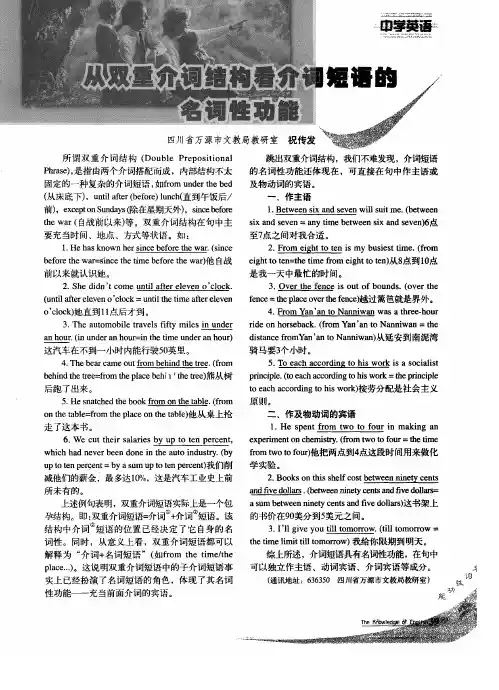
从双重介词结构看介词短语的名词性功能
e
h m
p o t o t
p 叮甲只
,
t =
by
u m s
1
叩
,
t o
t n e
p
r e c
n ) e t 我 们削
学实验
尽 旦
减他 们的薪 金 所未 有 的
。 。
最 多达
,
0 /
这是 汽车 工业史 上前
a su
Bo
k o
s
o n
.
t i h
s
sh e
lf
o c
e a n
s
t
b e tw
c
e e n
n i
n e
ty
e
n e
ts
旦 塑 』 些 些y 旦
m be twe
e n
仕
n
犯 tw
e
n n
in
t y
e n
v e
t s
n a o d
d i f
s
e v
do l
上述例 句表 明 双 重介词短 语实际上是一 个包 孕 结构 即 双重介 词短语 = 介词 ① + 介词 ② 短语 该
:
。
ln e y t
p
n n c e
ip l e
t (o
c
e
c h a a c
记
s
In w
g o t h i
s
w
o
k r
P r t i e h
n e
后 跑 了出来
5
o n
.
t o
c h a a c
。
r d o
in g o t h i
[全]中考初中英语考点详解:介词
中考初中英语考点详解:介词1.介词的分类及功能介词是一种用来表示词与词、词与句之间关系的词。
介词是虚词,一般不重读,不在句子中单独作成分,需要和它后面的词共同充当句子成分。
一介词的分类1根据介词的构成分类根据介词的构成形式,可将介词分为简单介词、合成介词、双重介词、短语介词四类。
(1)简单介词简单介词指的是由一个单词构成的介词。
Both my parents were born in 1970.我的父母都出生于1970年。
Whom are you taking the mobile phone to? 你要把这部手机带给谁?(2)合成介词合成介词指的是由两个词合在一起构成的介词。
He traveled throughout Europe in his twenties.在二十多岁时,他游历了整个欧洲。
I couldn’t see his face—he had his back towards me. (表示方向)我看不见他的脸——他背对着我。
(3)双重介词双重介词指的是由两个介词组成的介词。
I can take up to four people in my car.我的小汽车最多能坐4个人。
The moon finally appeared from behind the clouds.月亮终于从云后露了出来。
(4)短语介词短语介词由一个或几个简单介词和一个或几个其他词类组合构成,其作用只相当于一个介词。
Except for a broken bed,the room is empty.除了一张破旧的床,这个房间是空的。
Who are the boy and the girl in front of you?你前面的男孩和女孩是谁?提示短语介词是一个相当于简单介词的短语,不能单独使用,其后需加宾语。
而介词短语是由介词后加宾语构成,可以单独作句子成分。
2根据介词的意义分类根据介词的意义,可将介词分为表示时间的介词、表示空间(地点)的介词、表示原因(目的)的介词、表示让步的介词、表示方式(手段)的介词和其他介词。
初中英语语法:介词的用法归纳
初中英语语法:介词的用法归纳介词是一种用来表示词与词,句子与句子之间关系的词。
介词是一种虚词,不能独立使用。
介词之后一般有名词或代词(宾格)或相当于名词的其他词类、短语或从句作它的宾语,即构成介词短语。
有些介词是由两个以上的词构成的短语介词,如:out of(从…中出来),because of(因为),away from(距离…),on top of(在…顶上),ever since(自从…),next to(在…隔壁),according to(根据…),in front of(在…前方)等。
一、介词的分类1、按构成方式,可分为:①简单介词:即一个介词;②合成介词:由两个介词构成合成词;③短语介词:由短语构成;④双重介词:由两个介词搭配而成;⑤分词介词:由现在分词转化而来;⑥兼类介词:由形容词直接转化而来;2、按所表示的意义,可分如下几类:①地点(位置、范围)介词;②方向(目标趋向)介词;③时间介词;④方式介词;⑤涉及介词;⑥其它介词:目的介词,原因介词,比较介词,伴随/状态介词。
二、介词短语的句法作用介词与其宾语一起构成的短语叫做介词短语,可在句子中充当一定成分,通常用作状语、定语和表语和宾语补足语。
如:The man camedown the stairs。
(状)(那个人走下楼来)The womanwith a flower on her headisfrom the countryside.(定)(头上戴花的妇女来自乡下)The teacher is nowwith the pupils.(表)(老师现在和学生在一起)When she woke up,she found herselfin hospital.(宾补)当她醒来时,发现自己已经在医院里。
三、介词短语在句子中的位置介词短语做状语时,如果表示时间/地点,可以放在句首或句尾。
如果表示方向/方式/伴随/涉及/原因/目的/比较,一般放在句尾;介词短语作表语时放在连系动词之后;介词短语作定语时,只能放在被修饰的名词之后。
英语介词的分类
英语介词的分类一、根据结构分类根据介词的构成形式可将介词分为简单介词、合成介词、双重介词、短语介词和带-ing词尾的介词五类。
1、简单介词由一个词构成的介词称为简单介词。
At在……Please do it at your leisure.请你在空暇时间做一下。
About关于……There is no doubt whatever about it.关于这一点,没有任何疑问。
Above在……上In this matter we must place the common cause above all else.在这件事情上,我们必须把共同事业放在高于一切的位置上。
Between在...(和……、之间He fluctuated between hopes and fears.他在希望和恐惧中徘徊。
By在……附近I exist by what I think.我靠所思考的东西而生存。
down从……往下He would not knuckle down under their pressure.他不会在他们的压力下屈服的。
Except除……外Everyone came out well in the wedding photograph except the bridegroom.在结婚照片中除了新郎以外人人照得都不错。
For为了,对于I have ordered for you.我已为你点好菜了。
From从……We work from nine to five.我们从九点工作到五点。
Since自从I have not heard from him since writing last.自上次写信以后,我没有接到过他的信。
With和(用、……I have something to talk with you.我有点儿事要和你谈一谈。
2、合成介词由两个词合成在一起的介词称为合成介词。
Inside在……里面Don't keep the children inside all day.别把孩子们成天关在屋里。
高考英语 介词考点归纳及语法填空
介词考点归纳语法填空对介词的考查点是:1、常见介词的基本用法;2、与介词构成的一些习惯搭配。
例如:I didn’t want to be laughed at for talking to him but I didn’t like leaving him 23 his own either.(2011,广东)一、介词的分类1.按结构分类from behind until after since before2.按意义分类(1)表示地点、方位的介词: _____________________________________________________①We’ll meet each other _____ the bus stop.②Mr. White lived ______ Hong Kong for 20 years.Shandong Province lies _______ the east of China.③The book you want is _____ the shelf.Mongolia lies ______ the north of China.Wuhan is located ______ the Yangtze River.④Shandong Province lies ______ the southeast of Hebei Province.⑤There is a bridge ______ the river.She put her letter _______ the pillow.The plane is flying ________ our heads.(2)表示时间的介词: _______________________________________________________________①______ noon; _______ night; _______ midnight; ______ dawn; _______ daybreak; ______ dusk;_____ sunrise; _______ sunset; ______ 6:35②_____ the Qin Dynasty; _______ the 1980s; ______ October; _____ the eveningI’ll be back ______ an hour.My father will be back ________ 5 o’clock.My mother came back 3 days ______.③______ National Day; ______ a rainy day; ______ Monday morning; ______ Thursday; _____ December 23rd; _______ the afternoon of January 22nd; ______ the eve of victory④______ the time he was five, he had learned 500 Chinese characters.He had collected 3000 stamps ______ last month.⑤Mr. Brown has lived in the countryside ______ almost fifteen years after his retirement.⑥We have lessons _______ 6:30 to 22:30 every day.⑦Linda has been doing her homework ______ 7 o’clock.(3)表示方式的介词: __________________________________________________①She cut the apple into four equal parts ______ a knife.We see ______ our eyes, hear _______ our ears, and walk ______ our legs.②He made a living ______ fishing.③You must write your composition _____ black ink.They can communicate with each other ______ English.固定结构:“用……方法”:________ this/that/the same way________ means of________ this/that means________ this/that method(4)表示交通/旅行的方式: _______________________________________________①______ water; ______ land; _______ air; ______ rail; _______ sea; ______ taxi; ______ spaceship;_____ plane; _______ train; ______ ship; _______ boat; _____ bike; ______ bus②I came here ____ a taxi.They left ______ a early train.He usually goes to school ______ his own bike, but today he went to school ______ foot.(5)表示“在……之间”的介词This secret is only __________ you and me.What’s the difference __________ the two words?We visited a small village __________ mountains last month.He divided his money __________ John, Helen and his nephew.(注:当句中出现divide, share等词时,如果后面跟着几个单数名词,则用between;如果后面是复数名词,between和among都可以。