
高一英语_必修四_unit4_Using_language_Showing_our_feelings
Other expressions
agreement disagreement
uninterested or bored
interested
Page 8
Body language
Greetings
Cultural differences
Page 9
Skiming Divide the text into 3 parts and match the main idea with each part.
The body language. We can watch their eye contacts, facial expressions, body movements and gestures.
Page 12
2. Why should we be careful with our body languages?
All kinds of feelings, wishes and attitudes.
stop!
Hello/ Nice to meet U!
Page 4
Pray/ please!
The most universal facial expression smile
show happiness put people at ease
Page 13
Page 14
Page 15
Sample letter:
Dear in Pei,
friend's name
I noticed this morning that you seemed very upset. It looked as if you had been crying. When I asked you what was wrong, you put your head down. I'm sorry if I embarrassed you. I just want to help!
We should be careful of our own body language, as we must be sure not to be impolite in other cultures, and we need to communicate without being misunderstood.
angry
Page 3
curious
greedy
Body language What is body language?
A powerful means of communication Even more powerful than spoken language
What can body language show?
boredom 5. Universal body language to show respect
Page 11
Answer the following questions: 1. How can we know others' feelings, even if they do not speak to us?
Page 19
cheek 面颊 major 主要的 misunderstanding
误解;误会
Jordan 约旦 dash 猛冲;突进 adult 成人;成年人 spoken 口语的 unspoken 非口语的
Page 20
Spain 西班牙 Italy 意大利 likely 可能的 crossroads 十字路口 facial 面部的 function 作用;功能 ease 安逸;舒适 truly 真实地;真正的 false 错误的;假的 lose face 丢脸 anger 怒气;怒火
fist 拳头 yawn 打呵欠 subjective 主观的 hug 拥抱 rank 等级;军衔 defend against
保卫...以免受 in general 总的来说;通常 be likely to 很可能... at ease 舒适;自由自在 turn one's back to 背对
describe the body language that you noticed
Page 16
Is there anything wrong? I heard that your mum has been ill and that you are very tired from doing all the housework. Is that true?
Part 1
(Para 1)
Part 2 (Para 2-6)
examples of some body languages
There are differences in body language, and it's important for us to know them. Body language is sometimes more important than spoken language.
Page 5
The most universal facial expression
sometimes false
Hide anger fear worry
lose face
Page 6
Unhappy or anger
frowning turning one’s back
make a fist and shake
Part 3 (Para 7-8)
Page 10
The writing outline
Main idea: Points: 1.
Body language has many universal gestures. Showing happiness
2. Showing unhappiness or anger 3. Universal body language to show agreement or disagreement 4. Universal body language to show
Body language
Showing our feelings
How do we show our feelings usually? facial expessions gestures
Page 2
Look at these facial expressions
happy
sad
frightened
ask if something is wrong, perhaps make some guesses
Page 17
I really would like to help you if I can. Can I come and help you with your housewok or with your homework? Please let me help you. We are good friends.
offer to help; remind him/ her that you are a good friend Yours, closing Xiao your name Ling
Page 18
Summing up
Vocabularies and phrases
statement 陈述;说明 greet 迎接;问候 represent 代表;象征 association 社团;联系 dormitory 宿舍 flight 飞行;航班 curious 好奇的 Colombia 哥伦比亚 approach 接近;靠近
人教版英语必修四4Unit4(Showing Our Feelings)课程教学设计
Book4 Body LanguageShowing Our Feelings教学设计河北饶阳中学王晓莉一、教学内容(Teaching Content)人民教育出版社普通高中课程标准试验教科书英语必修四Body Language第三课时---Showing Our Feelings.二、教学设计(Teaching Plan)(1)教学思路本单元的中心话题是“身势语”,各项活动的设计都围绕着这个主题进行。
身势语是非语言交际手段中非常重要的一个方面,它通过无声的语言表达一个人的内心世界。
与有声语言一样,身势语也是文化的载体,在跨文化交际中起着举足轻重的作用。
了解身势语的不同文化涵义并正确地加以运用,会在交际场合中起到意想不到的好效果。
通过本堂课的学习,学生们能够了解世界各地的人们表达各种各样的情感、愿望和态度,“读懂”我们周围人的意思。
整个教学过程以“ 以学生为学习主体” 为设计理念,采用设置任务和小组讨论的形式组织教学,将学生的自主学习调动起来并把这样的活动作为课堂的主体,引导学生完成学习任务。
(2)课前准备要求学生预习课文Showing Our Feelings,并找出我们周围人们是怎样表达快乐、不高兴、愤怒、厌烦等情感的。
三、学生情况分析我们的学生绝大多数来自农村,学习英语的条件有限,大部分是上了初中才开始学习英语,所以英语意识淡薄,知识薄弱。
面对这样一群孩子,吸引他们对英语的兴趣是关键,因此我在这节课中使用了大量的图片,一方面吸引他们的注意力,引起兴趣,另一方面很大限度地帮助了学生们对这篇课文的理解。
四、三维目标(Teaching Aims)(1)知识目标(Knowledge Aims)让学生了解“身势语”的概念,掌握身势语的不同文化涵义并正确地加以运用。
通过阅读熟悉本课的相关单词、短语及重点句型,如spoken, unspoken, likely, be likely to, in general, at ease, etc.(2)能力目标(Ability Aims)提高学生的阅读能力,训练学生skimming和scanning的阅读技巧,提高学生归纳总结、善于提取有用信息的能力; 在教学总过程中锻炼学生听、说、读、写各方面的技能,培养学生独立思考和合作学习的能力; 快速获取信息和处理信息的能力。
英语必修四unit4usinglanguage
3.In most places around the world, frowning and turning one's back to someone shows anger. 背对 背弃
例句仿写:我永远都不会原谅他----在我失业的 时候,他背弃了我。
I'll neverf_o_r_g_i_v_e_him,he t_u_r_n__e_d_ h__is__b_a_c_k_ _t_o___
1. It is possible to “read〞 others around us,
even if they do not intend for us to catch their
unspoken communication.
read other’s mind
intend for sb to do:
2. Why should we be careful with our body language?
Because we should be sure not to be impolite in other cultures, and we need to communicate without being misunderstood.
14.尊重sb
14.be respectful to sb.
15.一般说来 15.in general
16.拥抱sb
16.give a hug to sb
17.更高级别的人 17. someone of a higher rank
18.以一定的距离 18.at a distance
19.愿意做sth 19.be willing to do sth
without looking
[人教必修四]Unit 4 Using Language
![[人教必修四]Unit 4 Using Language](https://360docs-1393072327.cos.ap-beijing.myqcloud.com/f9b4a016f5335a8103d2200e.webp)
Learning aims
1. To know more about body language. 2. To listen to the material about the detailed information about the story. 3. To describe each picture using spoken language and body language. 4. To learn how to write a passage.
Just then, the traffic light in front of him turns__re_d__. The car in front of him stops suddenly. Lin Pu quickly turns to the right to _a_v_o_id_ hitting the car in front of him. Crash! He hits a bicycle and _k_n_o_c_k_s over a basket full of apples. Then he sees a policeman walking towards him. Cyclist: Look what you did! All my apples are on the road! You must pay for them! Policeman: Driver, what were you thinking? You didn’t stay in your l_a_n_e_! You’ll have to pay a fine for this.
4. You should not greet your new boss by giving her or him a hug. 5. Body language is the same all over the world. Body language is sometimes the same, but it is sometimes quite different. 6. Most people can understand each other if they try.
using language 人教课标必修4 第四单元

lose face 丢脸;丢面子 ___________
1)There are unhappy smiles,such as when
someone “_____(lose) face” and smiles to hide it. loses
2)If Tom can not ____ _______,he’ll____ ___. keep ___ his promise lose face 如果汤姆不能信守诺言,他就会丢面子。
2.Which body language can show happiness
and put people at ease? A
A.Smiles.
C.Nodding.
B.Shaking hands.
D.Waving hands.
3.Frowning can show a person’s________. D A.Happiness B.satisfaction C.Excitement D.anger
4.If a person wants to threaten others,
he usually________. A A.makes a fist and shakes it B.frowns and turns his back to them C.shakes his head from side to side D.looks away from people or yawns
2)The sofa can also function ___a as bed.
ቤተ መጻሕፍቲ ባይዱ
(2) function n. 作用;功能;职能 In you new job, you will perform a variety of functions.
人教高中英语必修4Unit4Using language (共23张PPT)
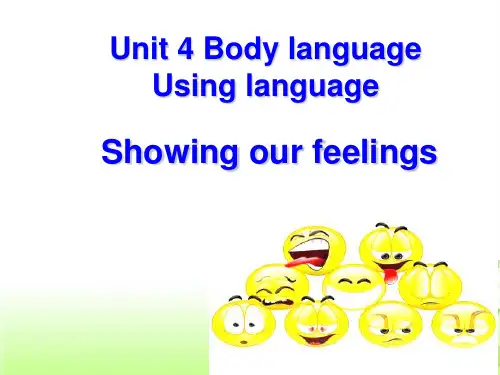
surprised
shy
Can you match the following facial expressions with the words.
surprise anger fear joy
sorrow
disgust contempt 厌恶 轻视
Open your books at Page30. Let’s go on enjoying body languages.
Unit 4 Body language Using language
Showing our feelings
Lead in
Let’s enjoy some pictures about facial expressions.
happy
fearful
sad
angry
angry
confused
• Some body language is different in different countries.
• We must use them correctly and properly.
Homework
• Read the passage fluently • Finish exercises in workbook
turn toward and look at
turn the head away
Listening
Pay attention to the pronunciation and intonation.
Reading loud
Read the whole text aloud one by
one.
Different body language??
2019外研版高中英语选择性必修四Unit4 Using language 课件
Grammar: Review—attributive clauses Look at the sentences from the reading passage and answer the questions. 1. What does “where” refer to in sentence (a)?
Grammar: Review—attributive clauses
分类 关系词 指代对象
定语
从句
中的
关系 代词
关系
词
who whom whose
that which
as
指人 指人 指人或物 指人或物 指物 指人或物
when
关系 副词
where
why
指时间 指地点 指原因
在从句中的作用 作主语、宾语、表语
该句中,when 引导时间状语从句,整个从句充当 时间状语。
Grammar: Review—attributive clauses 定语从句 I visited Mr and Mrs Smith in New York. It was when their first child was born. 我拜访了住在纽约的 Smith 夫妇。那年他们的第一个孩子出生了。
Grammar: Review—attributive clauses
Read the passage and rewrite the underlined sentences using attributive clauses.
Goodd DDeeaalliissaallooccaallmmoovveemmeennt tininsosmome ecocuonutnritersi.eIst(,) whorickhs twoohreklps tfoarhmeelrps faanrdmwerosrkaenrsdiwn olersksedrsevinelolepsesd adreevaeslorepceedivaeraeabsertteecrediveealafobrethterirdperaoldfuocre.thGeoirod Dpreoadl upcroed. ucts may be a little more expensive than regular products, but up to one-third of the sale price will be given back to the producers. This is more than they could get under the conventional trading system.
人教高中英语必修4 Unit4 Using languag(共22张PPT)
Listening
on P23
Predict:
1.What’s the relationship between Mary and John?
VS
2. What about the main idea about part1?
计划完成:56% 实际完成数目:820万 回款数:640万
Prove the prediction
“Well, it certainly will be late this morning” the man said, “because I happen to be flying it.”
1.Because I happen to be flying it.
The situation
What happened
1.What’s the relationship between Mary and John? They are husband and wife.
2. What about the main idea about part1?
The main idea:
Mary made some jam but left some on the kitchen table for a few days as she had to go to look after her sick mother. Some days later, John, knowing nothing about the jam, came home and throw it into the chicken yard.
Listen to Part 1 again and answer these questions.
Unit 4 Sharing Using language高中英语人教版(2019)选择性必修第四册
Listening material
Tony: Well, on Fridays, there are student volunteers who help serve food to homeless people. And on Saturday mornings, a group of students goes to a children’s hospital to cheer up all the little kids there.
Lead-in
If you have a chance to do volunteer work, what kind of work would you like to do?
Meet student volunteers
Activity 1
Have you or someone you know ever worked as a volunteer? Tell your partner about the experience.
volunteer _u_p_l_it_te_r____________________________________________________
project
spending time with _th_e__e_ld_e_r_ly_,_p_l_a_y_g_a_m__e_s,_s_i_n_g_o_r_c_h_a_t_____________
Wang Li: How about writing to some nursing homes to see if they need someone to spend time with the elderly people? We can play games, sing, or just chat!
人教版必修四unit4 Using Language
it is probably not a good idea to give a hug to a boss or teacher.
Para. 7 With so many cultural differences between people, it is great to have some similarities in body language.
Tip for Summary: the first or the last sentence of a paragraph in an informative or argumentative writing is often the topic sentence.
Using language
Showing our Feelings
1
2
3
4
5
6
7
8
9
10
11 12
13
14
15
16
17
18
19
20
21
22
Lead-in
When you are happy, what will you do to show your happiness?
What means of communication are used to show your happiness?
(closing), (your name)
Writing: Letter of concern
1. 开头常用语: (1) It broke my heart to notice that... (2) I just can’t tell you how sad I was when I notice that... (3) I’m writing to express my deep sympathy and care for you. 2. 结尾常用语: (1) If I can be of any help, please don’t hesitate to let me know. (2) I hope our caring will help to comfort you. (3) I hope that time will take away the sorrow of your recent loss. (4) Remember that my heart and my thoughts are always with you.
新人教版高中英语必修4Unit 4 Body Language Using language(含答案)
高一英语同步练习:必修4 Unit 4 Body Language第4课时Using language基础练习本单元重点知识归纳总结:一、重点词汇:(写出汉意及词性)1. represent______________2 .curious _______________3 .defend______________4 . approach ______________5. be likely to______________6 .in general______________7. at ease ______________8.lose face ______________9 .turn one’s back to______________二、重点句式:1. prohibition and warning(禁令和警告):Do not...; Stop! ;Keep away from...;Always stay...;Watch out! Look out! Go away. Don’t enter hereBe careful when..., Come here.You may not...You will be fined...,Don’t smoke here. Don’t slip;2.obligation(义务和责任)You must...,You should never...,You will be...,You will have to...,You will need to...,We ought to...,He’s supposed to...(书中supposed 第一个s是大写)三、课文重点句型:1 .Not all cultures greet each other the same way, nor arethey comfortable in the same way with touching or distance between people.1. 各种文化背景下的人互致问候的方式不尽相同,身体接触和相互间距的程度也不尽相同。