
高中英语-Unit-3---Life-In-the-Future教案
Unit 3 Life In the Future
教材分析
I.教学内容分析:
本单元的中心话题是“谈未来”,内容主要涉及人类对今后生活环境的想象、猜测和思
考。
语言技能和语言知识主要围绕“未来生活”这一中心话题进行设计的
Warming up 部分通过一个填表活动引导学生去回顾过去、认识现在和展望未来。
Pre-reading部分首先让学生列举一些当今世界存在的问题,接着要求学生考虑一下在未来社会里哪些问题会克服、哪些问题将恶化。
这样就为下面阅读做了铺垫。
Reading 部分以Li Qiang 发自宇宙空间站的电子邮件的形式向读者讲述了他是如何
安全到达“未来世界”以及在“未来世界”的第一印象。
教师引导学生把阅读的重点放在“未来世界”生活与现在生活的不同点上。
Comprehending 设计了五个教学活动来加深学生对“阅读”(Reading )的理解和复习。
活动一设计了5个问题,考查学生对文章主要信息的理解。
活动二要求学生通过阅读找到“未来世界”在以下几方面的变化:跨时空旅行、交通、
住房、城镇环境和空气质量。
接着学生应该在思考的基础上得出自己的结论,即哪些变化好,哪些变化不好,并说出理由。
活动三要求学生通过阅读来判断李强对未来的态度是乐观的还是悲观的。
学生应该在
文中找出支持自己观点的论据或例子,尽可能说服别人。
活动四让学生概括每一段的大意和具体信息,并复述课文,更深入地理解课文内容。
活动五让学生朗读课文最后一段,注意语音语调和节奏。
1。
高二英语必修五教案《Unit3Lifeinthefuture》

【导语】⾼⼆是承上启下的⼀年,是成绩分化的分⽔岭,成绩往往形成两极分化:⾏则扶摇直上,不⾏则每况愈下。
在这⼀年⾥学⽣必须完成学习⽅式的转变。
为了让你更好的学习⾼⼆频道为你整理了《⾼⼆英语必修五教案《Unit 3 Life in the future》》希望你喜欢! 教案【⼀】 本教学设计在新课程教学理念的指导下,⼒求在培养学⽣的语⾔知识、知识技能、情感态度、学习策略和⽂化意识等素养的基础上发展学⽣综合运⽤语⾔的能⼒,使学⽣通过观察、体验、探究等主动学习的⽅法优化英语学习⽅法,充分发挥⾃⼰的学习潜能,形成有效的学习策略。
1. 开展学⽣活动,发挥主体作⽤ 新课程强调要充分发挥学⽣在教学过程中的主体作⽤。
本课设计遵循以学⽣为主体,教师为主导这⼀教学原则,创设⾓⾊扮演情景、激烈讨论提出建议,让学⽣限度地参与教学过程,尊重学⽣的主体地位,充分发挥学⽣在学习过程中的主动性、积极性、创造性,使课堂充满活⼒。
2. 实施情景教学,统合三维⽬标 本课设计从教学需要出发,创设情景,进⾏情景设问、讨论,激起学⽣的情感体验,激活学⽣思维,帮助学⽣迅速、正确地理解和接受知识,并在学习过程中培养其积极进取的科学的⼈⽣观及价值观,较好地落实了三维⽬标。
⽽三维⽬标是相辅相成、相互渗透的,所以在情景教学的过程中,知识的落实、能⼒的培养、情感态度价值观的渗透交融在⼀起,实现了三维⽬标的和谐与统⼀。
3. 转变学习⽅式,增强教学效果 新课程要求提倡⾃主、合作、探究的学习⽅式,发挥学⽣的主体性、能动性和独⽴性,本课设计通过⾃学课本,⼩组讨论,综合分析,⾓⾊扮演等活动,为学⽣⾃主学习、合作学习、探究学习提供了空间,使学⽣体验了⾃主之乐,合作之趣,探究之悦,促进了学⽣知识的构建与运⽤,能⼒的培养和提⾼,情感体验和态度、价值观的形成,增强了教学效果。
4. 运⽤问题教学,启发学⽣思维 本课设计按照诱思探究理论要求,遵循学⽣的认知规律,引导学⽣去发现问题、分析问题和解决问题,从⽽掌握知识,形成能⼒,培养品质。
教案Unit3-life-in-the-future
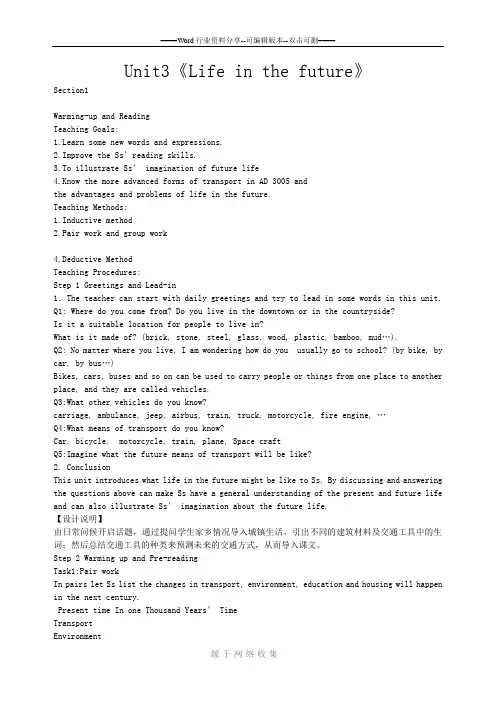
Unit3《Life in the future》Section1Warming-up and ReadingTeaching Goals:1.Learn some new words and expressions.2.Improve the Ss’reading skills.3.To illustrate Ss’ imagination of future life4.Know the more advanced forms of transport in AD 3005 andthe advantages and problems of life in the future.Teaching Methods:1.Inductive method2.Pair work and group work4.Deductive MethodTeaching Procedures:Step 1 Greetings and Lead-in1.The teacher can start with daily greetings and try to lead in some words in this unit. Q1: Where do you come from? Do you live in the downtown or in the countryside?Is it a suitable location for people to live in?What is it made of? (brick, stone, steel, glass, wood, plastic, bamboo, mud…).Q2: No matter where you live, I am wondering how do you usually go to school? (by bike, by car, by bus…)Bikes, cars, buses and so on can be used to carry people or things from one place to another place, and they are called vehicles.Q3:What other vehicles do you know?carriage, ambul ance, jeep, airbus, train, truck, motorcycle, fire engine, …Q4:What means of transport do you know?Car, bicycle, motorcycle, train, plane, Space craftQ5:Imagine what the future means of transport will be like?2. ConclusionThis unit introduces what life in the future might be like to Ss. By discussing and answering the questions above can make Ss have a general understanding of the present and future life and can also illustrate Ss’ imagination about the future life.【设计说明】由日常问候开启话题,通过提问学生家乡情况导入城镇生活,引出不同的建筑材料及交通工具中的生词;然后总结交通工具的种类来预测未来的交通方式,从而导入课文。
unit3-Life-in-the-future-说课稿
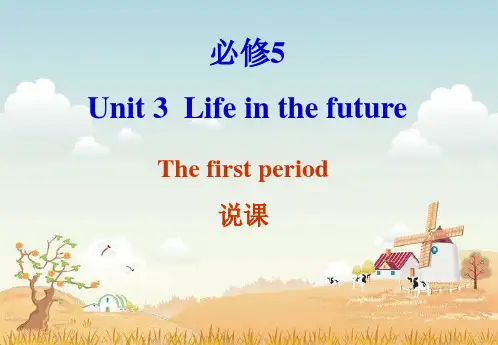
IV. Teaching Procedures
Step 1. Warming up and Lead-in Step 2. Pre-reading Step 3. While-reading
1.What is a “time lag”? 2.Who guides Li Qiang’s trip?
3.How did he feel when he was in the capsule ? How
to solve the problem?
green tablets
unbelievable, worried, unsettled,
2)Teaching aims: Ability aims
Develop students’ reading skills such as skimming and sanning and enable them to use different reading skills in different reading materials.
4) Teaching difficult points
How to help the students do the reading comprehension efficiently.
II. Analysis of the students
Students in Senior II are at the age of 17-18, who are curious about the world. Although they are at different levels of English fluency, they have a strong desire for knowledge. In addition, they already have enough vocabulary and the basis of reading .Therefore, they can communicate with each other and express themselves in plain English. During the teaching process, I will teach them the proper way to learn English and try my best to arouse their interest in English and their enthusiasm of the life.
高中英语-unit-3-Life-In-the-Future-全单元教案

⾼中英语-unit-3-Life-In-the-Future-全单元教案⾼⼆上学期第三次教案设计⼈:Unit 3 Life In the FuturePeriod 1 & 2 Warming Up & Pre-reading, ReadingTeaching Goals:1.To illustrate Ss’ imagination of future life.2.To arouse Ss to pay more attention to the problems that probably appeared in thefuture life.3.To make Ss know the difference of life between the past, present and future. Teaching Procedures:Step 1 Leading-inPurpose: To talk about past and future changes of life.1. Group workLet Ss discuss the questions in groups of four.(1)How do you usually get to school?(2)Where do you live, in a city or in the countryside?(3)Where would you like to live in the future?(4)Do you live in a flat or a house?(5)Do you have a room of you won? Can you describe the room in the picture?(6)What kind of housing would you like to have in the future?(7)What would you like to have in your room?(8)What can we use to build houses? (brick, stone , steel , glass, ice, wood , plasticbamboo, …)2. ConclusionThis unit introduces what life in the future might be like to Ss. By discussing and answering the questions above can make Ss have a general understanding of the present and future life and can also illustrate Ss’ imagination about the future life. Step 2. Warming Up1. Pair workIn pairs let Ss list the changes in housing, transport, jobs, families and education will happen in the next century.2. Individual workAccording to the result of the above Pair work, fill in the chart.Step 3. Pre-reading1. Pair workAsk Ss to discuss the following questions in pairs.(1)Make a list of the problems human beings are facing today.(2) What problems do you think people will have overcome in one thousand years? Which ones do you think will still exist inAD 3008?Suggested Answers:①The first problem I would like to point out is the decline of morality.(道德沦丧)②The second problem is the racial bias problem. (种族歧视)③The third problem , which is a most serious problem , is the rapid depletion of resources on the Earth. (资源匮乏)④Now I come to the fourth problem, the problem of the large gap between the poor and the rich . (贫富悬殊)⑤The fifth problem is the pollution problem.(环境恶化)⑥Now I would like to talk about the sixth problem, the expensive arms race problem. (军备竞争)。
人教版高中英语必修五unit3-Life-in-the-future-(1)
S: I think the problems of pollution and shortage of resources will still be there, and will even get worse.
S: I don’t think so. Now scientists all over the world are trying their best to develop new resources that human beings can make use of, such as solar energy. In my opinion, the problems can be solved one by one.
T: We all know that as our society develops, we have got much benefit. But at the same time, we have to face lots of problems. Can you find out what kind of problems human beings are facing
Give the Ss 1 or 2 minutes to think and they can discuss with their partners. Then check the answers.
After the Ss read the paragraphs, ask them the following questions.
高中英语必修四unit3教案
高中英语必修四unit3教案必修是新课程标准改革中的一个名词,是课程结构调整中的一种课程类型。
和必修相对的是选修。
按照规定必须学的,尤指取得学位或达到毕业要求必须学的必修课必修和选修,这是从课程计划中对课程实施的要求来区分的两种,下面是为大家整理的高中英语必修四unit3教案5篇,希望大家能有所收获!高中英语必修四unit3教案1教学准备教学目标1. Ss will be able to master the following useful new words and expressions.well,smelly,pond,burst,canal,steam,dirt,injure,brick,dam,useless,steel,sh ock,rescue,quake,electricity,army,shelter,fresh, organize, bury, at an end, dig out, coal mine, in ruins2. Ss will be able to know the basic knowledge about Earthquake教学重难点1. The usages of some words and expressions.2. How to train the students’ reading ability in learning the text.教学工具课件教学过程Step I lead-inLet students see a short video and answer the questions1.What happened in the video? Earthquakes2.How do you feel seeing the plots(情节)? Students’ discussion.Step II Fast reading1. What is the passage mainly about? In Tangshan ,earthquakes happened on July 28th 19762. Skim the text and answer the questionsThe type of writing (写作体裁)Narrative writingTopic sentence of Paragraph 1Sentence 1Topic sentence of Paragraph 2Sentence 2Topic sentence of Paragraph 3Sentence 1Topic sentence of Paragraph 4Sentence 1Step III Detailed readingAsk students to read the text carefully and answer the questions Task1: What were the nature signs of the coming earthquake?(选择)Para 11.Water in well( G )2. Well walls(D )3.Chickens pigs(F ) 4 .Mice (A)5.Fish(E )6. Bright lights( B)7. Water pipes(C )A. Ran out of fieldsB. in the skyC. Cracked and burstD. Deep cracksE. Jumped out of pondsF. Too nervous to eatG. Rose and fell, fell and roseTask 2 Fill in the blanksMain IdeaDetailsDamage caused byearthquakePara 2-3At _____ am, the __________ earthquake of the 20th century began . _______ burst from holes in the ground.Hard hills of the rock became rivers of ____.________ covered the ground like red autumn leaves.Two _______ and most of the bridges fell.The railway tracks were now _________pieces of _______.______ now filled the wells instead of water.Water,food,and ______________ were hard to get.The reconstruction(重建) after the earthquakePara 41. The army _____________2. Workers ____________for survivors.3._____________was taken to the city.Details:1. At 3:42 am, the greatest earthquake of the 20th century began.2. Steam burst from holes in the ground.3. Hard hills of the rock became rivers of dirt.4. Bricks covered the ground like red autumn leaves.5. Two dams and most of the bridges fell.6. The railway tracks were now useless pieces of steel.7. Sand now filled the wells instead of water.8. Water, food, and electricity were hard to get.Step IV consolidation (当堂巩固)Let students fill the blanks according to the passageStrange things were happening in the countryside of northeast Hebei. For three days the water in the village wells kept rising and 1_________(fall). Farmers noticed that the well walls had deep cracks 2___________ them. A smelly gas came out of the cracks. In 3_________farmyards, the chickens and even the pigs were too nervous 4__________(eat). 5_________(mouse) ran out of the fields looking for places 6________(hide). Fish jumped outOf their bowls and ponds. At about 3 am on July 28,1976, somepeople saw bright lights 7_________ the sky. The sound of planes could 8________(hear) outside the city of Tangshan even 9_________ no planes were in the sky.In the city, the water pipes in some buildings cracked and burst. But the one million people of the city, ________thought little of these events, were asleep as usual that night.1 falling2 in3 the4 to eat5 mice6 to hide 7in 8 be heard 9when 10 who这部分目的是让学生进一步巩固课文的内容。
步步高人教新课标高二英语必修 5 Unit 3 Life in the future导学案
重点单词1. 学习单词,注意重点单词的用法并灵活运用这些单词。
2. 牢记核心单词的介词搭配及其重要用法。
重点:lack, tolerate, instant, switch, require难点:lack作名词与动词的用法以及require后跟虚拟语气的用法。
【单词学习】1. lack vi.& vt.缺乏;没有n. 缺乏;短缺的东西lack+n.缺乏,缺少lack for+n.(多用于否定句中)(不)乏,(不)缺少for/through lack of +n. 因缺乏……a lack of +n. 缺乏……no lack of 不缺乏,不缺少Though lacking money, his parents managed to send him to a university.尽管缺钱,他的父母设法送他上大学。
The children lack for nothing although the parents are poorly dressed.虽然父母亲衣着朴素,但孩子们什么都不缺。
Living in the desert involves a lot of problems, of which the lack of water/lacking water is the worst.居住在沙漠里牵涉很多问题,其中缺水是最严重的问题。
lacking adj. 短缺的;缺乏的be lacking in…缺少She felt nervous, increasingly lacking in confidence about herself.她感到紧张,对自己越来越没有信心。
She’s not usually lacking in confidence.她平时并不缺乏自信心。
Health problems are closely connected with bad eating habits and a ________ of exercise.A. limitB. lackC. needD. demand答案:B思路分析:句意:健康问题与不良的饮食习惯和缺少锻炼密切相关。
高中英语必修五 Unit3 Life in the future教学案例分析
高中英语必修五 Unit3 Life in the future教学案例分析该课对课文内容进行创造性拓展与补充,改变传统教学过于注重传授知识的倾向,采用“任务型”教学模式,进行了一次实验和探究。
该课的中心话题是“谈未来”,内容主要涉及人类对未来生活的想象、猜测和思考。
该课旨在激发学生的想象力,探讨未来的世界,达到使学生学会用英语交流、培养实际运用英语的能力。
二、学情分析这个班虽然为农村普通平行班,英语基础较差,但是大部分学生的思维活动、学习热情、表现欲望和合作精神还是可以在平时的教学中不断提高和培养的。
根据这些特点,采用与新课标要求相一致的新的教学方式,即活动式的教学法,这样面向全体学生便于调动全班学生的积极性,在师生互动、生生互动中实现教学任务和目标。
三、学习目标1、展望未来,激发学生的想象力;2、学习使用有关预测和猜测和表达方式;3、培养学生用英语表达未来的生活状况,达到用英语交流、培养实际运用英语能力的目的;4、运用所学英语写出具有丰富想象力的短文。
四、设计理念“ Life in the future”一课倡导英语新课标理念下的合作学习。
根据英语《课程标准》的指导思想,英语课程改革的重点是要改变传统教学过分重视语法和词汇知识的讲解与传授、即忽视对学生实际语言运用能力的培养的倾向,强调课程从学生的学习兴趣和认知水平出发,倡导学生体验参与、合作与交流的学习方式和“任务型”的教学模式,由学生共同努力来实现教学目标。
教师要引导学生利用所学语言来完成任务,促进学生运用所学外语获取信息,处理信息,使用信息与人交流,让学生去发现问题、设计问题并解决问题,提高合作意识,培养合作精神,从而实现学生的主体地位,发展学生的综合语言运用能力。
五、教学媒体设计指导学生将信息技术与英语学习相结合。
学生学完“ life in the future”这一单元,教师鼓励学生利用网络资源及多媒体技术积极探索和运用知识。
让学生展开想象,搜集有关资料,制成课件。
Unit-3-Life-in-the-future市公开课一等奖课件名师大赛获奖课件
3. A. Knowledge is power. 4. B. It’s never too old to learn.
5. C. Where there is a will, there is a way.
6. D. No pains , no gains .
7. Para.5
What should we do to make sure we will have a bright future
advantages disadvantages
future transportation smart cards
onlinelean, fast, safe, without pollution
convenient, safe
convenient saving time
Interesting, convenient, saving time
high cost, expensive
no ensurance of quality
no face-to-face teachers
Making a dialogue:
You want your child to go to a real school , but your child prefers an e-school.
英语:必修5-Unit3-Life-in-the-future知识点剖析(人教新课标)
Unit 3 Life in the future (知识点剖析)(一)单词·巧记·典句·考点1. vehicle[v'i:ikl]n.交通工具;车辆【巧记提示】词根vect,“传送;运载”。
【经典例句】The street is dominated by car vehicles.街道上满是车辆。
【考点聚焦】1)vehicle 特指陆地上的交通工具。
2)vehicle还可以指“(思想、情报的)传达手段、媒介”,如:This radio station has become a vehicle for conservative opinion.这家电台已成为保守派意见的传播管道。
3)常见同义词有conveyance n.运输;财产让与;运输工具;carriage n.四轮马车;客车2. private[p'rivit] adj.私人的;私有的【巧记提示】priv(单独;个别;私下)+-ate(具有或显示某性质)。
【经典例句】This is private parking lot, you cannot park here.这是私人的停车点,你不能在这里停车。
【考点聚焦】1)固定搭配:in private 秘密的;不公开的;私下的反义词:in public 公开的;公众的2)同根词:privacy n.私生活;隐私如:Telling that on TV was invasion of her privacy.在电视上谈论那件事侵犯了她的隐私权。
']n.印象;感想;印记3. impression[im pre【巧记提示】im(置于某状态或条件中;向内)+press(给……以压力)+ion(表示行为;行为的状态或结果)【经典例句】His speech made quite an impression on the audience.他的演说给听众留下了相当好的印象。