
人教版七年级下英语Unit 12教案、导学案
七年级英语·下新目标【人】Unit 12 What did you do last weekend?话题Topic 周末活动(Weekend activities)功能Functions 能用所学语言谈论过去发生的事情(Talk about past events)I worked as a guide at the Natural History Museum.I stayed up late to watch the soccer game.A: What did you do last weekend? B: I played soccer.A: Where did he go last weekend? B: He went to the cinema.语法Grammar 1. 能正确运用一般过去时(Simple past tense)On Saturday morning, I cleaned my room.A: Did you do anything interesting last weekend?B: Not really.I just visited my sister.A: What did you do last weekend?B: I played badminton on Saturday morning.2.能正确使用一般过去时的特殊疑问句询问信息(Wh-questions) A: What did you do last weekend? B: I played soccer.A: Who went to the library? B: Sally did.A: Where did she go last weekend? B: She went to a farm.词汇和常用表达Words & expressions 1.能正确使用下列词汇(Curriculum words)(按词性排列)名词:lake, beach, sheep, visitor, mouse, baby, language, kite, India, moon, surprise, snake, forest, ear动词:camp, stay, shout, fly, move, start, jump, wake形容词:natural, tired, high其他:as, away, ago, into2.能正确使用下列常用表达(Useful expressions)stay up late, run away, shout at, fly a kite, put up, get a surprise, shoutto,up and down, wake… up, do homework, do some sports, study for a test, feed cows, go camping, go to the beach, fly a kite, have dinner with friends, swim in the river, put up a tent, make a fire, each other, last weekend 3.能认读下列词汇(Non-curriculum words)badminton, butterfly, woof, tent, scared学习策略Strategies 1.能根据标题和插图预测短文主要内容2.了解时间顺序是讲述故事的主线文化知识Culture1.了解国外学生的周末生活2.初步了解印度的蛇文化三维目标Three-dimensionaltarget 知识与技能1.能掌握以下单词:camp, lake, beach, sheep,as, natural, visitor, tired, stay,away, mouse, baby, shout, language, fly, kite, high, ago,India, moon, surprise, snake, move, start, jump, wake, into,forest, ear三维目标Three-dimensionaltarget 知识与技能2.熟练掌握本课短语: stay up late, run away, shout at, fly akite, put up, get a surprise, shout to, up and down, wake…up, do homework, do some sports, study for a test, feed cows,go camping, go to the beach, fly a kite, have dinner withfriends, swim in the river, put up a tent, make a fire, eachother, last weekend3.能掌握以下句型:What did you do last weekend?I did myhomework./We went boating.Who visited her grandma?Beckydid.Where did she go last weekend? She went to a farm.Who didshe go with?She went with her classmates.4.掌握以下语法:(1)能正确运用规则动词和不规则动词的一般过去时。
(2)能正确使用who, where, what等疑问词的一般过去时的特殊疑问句询问信息, 并能作出正确回答。
(3)能运用一般过去时谈论上周末的活动。
过程与方法1.通过师生对话、生生对话、小组讨论、游戏等活动培养和提高学生的口语交际能力,并使所学知识迁移到生活中。
2.通过图片提供语境,引出“谈论周末活动”的话题及所要用到的What did you do last weekend? I cleaned my room.这个重要句式,同时复习一些表示周末活动的动词短语,学习一些新短语;以任务促活动的方式展开教学,通过学生联系实际进行问答活动,学习、操练What did you do last weekend? I…引导学生在相应的语境中进行相对综合的语言输出;听力教学采用分层设计,降低听力难度的同时教授听力的答题技巧,使学生掌握一定的学习策略;语篇的学习主要采用读前预测、略读、详读等方法获取有关信息,理解文章大意,掌握相关短语句型;写作练习是在掌握本单元短语句型的基础上,先看图完成一篇半控制性的短文,梳理出写作的结构,然后创造性地写出自己的周末活动。
情感态度与价值观1.了解国外学生的周末生活。
2.初步了解印度的蛇文化。
Section A 概述本部分以周末活动为主线,功能是运用一般过去时谈论刚刚过去的一些常见周末活动。
1.1a—1c通过Lucy的周末活动和听力输入导入本单元的话题和本部分的关键句型。
1a活动引出“谈论周末活动”的话题及所要用到的What did you do last weekend?这个重要句式,同时复习一些表示周末活动的动词短语,学习一些新短语。
1b是一个听力输入活动,Lucy向Bob介绍自己上个周末是怎么度过的,让学生掌握1a谈到的句型和短语。
1c是基于听力内容的控制性口语操练活动。
2.2a-2c是基于1a-1c活动上的另一个听说任务链活动。
本部分在学习了1a-1c内容的基础上,给出了更为丰富的语言运用环境,即教师询问学生周末活动,以听力的形式对单元重点词汇进行了复习,拓展了单元重点句型,包括:Did you have a good weekend? Where did you go? Who did you visit? I visited my grandma.I studied for the math test.等。
同时呈现更多的动词过去式。
2a和2b是两个焦点不同的听力活动,2a的焦点是让学生捕捉“周末活动”这个行为,2b的焦点是让学生抓住“是谁做的那些事”这一信息。
2c训练学生问问题的能力,就听力内容进行Section A 概述问答。
2d对话活动集中呈现1a-2c部分所涵盖的主要内容,引导学生在相应的语境中进行相对综合的语言输出,对后面语法归纳和操练及Section B部分起着承上启下的作用。
对话里还出现了新的语言输入。
包括生词及短语natural,butterfly,visitor,tired,stay up late和评价周末生活的句子I had a nice weekend.。
3.Grammar Focus部分归纳了两项语法内容。
1) 学会使用规则和不规则动词的一般过去式。
2) 能用带有who,where,what等特殊疑问词的一般过去时句子询问信息并能做出正确回答。
4.3a-3c通过问答练习带领学生自主进行探究性的语法学习,发现并巩固本单元目标语言的主要语法知识。
3a是一个控制性较强的活动,让学生填合适的疑问词,训练学生根据上下文推断所缺信息的能力。
活动3b是一个小故事,学生根据丰富的语境用动词的适当形式填空,这个故事里面还包含着一个大道理:It’s important to learn a second language.活动3c是一个较为开放的猜测游戏,一名学生画能表现出周末活动的两个提示,其他学生根据画的提示猜其周末活动。
教学目标1.掌握表示周末活动的动词短语和不规则动词的过去式。
2.学会运用一般过去时的特殊疑问句。
3.能用带有who,where,what等特殊疑问词的一般过去时句子询问信息并能做出正确回答。
Section B 概述Section B部分是Section A的拓展,此部分更加强调语言的运用,要注意发展学生的语言流利性。
1.活动1a-1e是一个完整的听说任务链。
1a呈现更多关于周末活动的短语表达法和更多不规则动词的过去式。
1b是一个询问学生观点的开放活动,目的是巩固1a的语言。
1c是一个听力活动,两个学生Sally和Jim谈论自己的周末活动,信息量比较大,内容也较丰富。
1d是一个半控制性口语输出活动。
学生用1c的信息,谈论Sally和Jim的周末。
1e是一个开放性口语输出活动,学生两人一组谈论自己的周末。
2.2a-2c以阅读活动为主,通过阅读进一步巩固所学语言,并从读的输入过渡到写的输出。
2a 是读前活动,学生通过该活动复习学过的动物名称和描述动物的形容词,激活学生与文章有关的背景知识,为后面的阅读做好准备。
2b 活动让学生读后回答问题,检测学生对关键信息的理解。
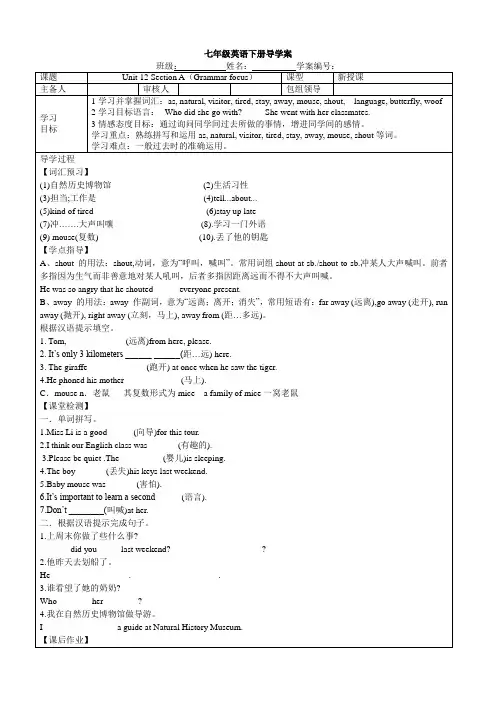
最新人教部编版七年级下册英语教案 Unit 12 Section A(Grammar focus)导学案
( ) 4. Do you have _______to say?
A.something important B. important something
C. important anything D. anything important
A.is, buy B.do,buy C.are,buying D.did,buy
( )11. -- Did you have a ___________ at school last week?
-- Yes, we did. I got an A.
A. test B. lookC. walk D.study
( ) 12. -- How long did Helen __________ in Changsha? -- For a week.
A. sit B. stay C. feel D.go
( ) 13. Lucy __________ go to the movies. She watched TV at home.
2学习目标语言:--Who did she go with? --She went with her classmates.
3情感态度目标:通过询问同学间过去所做的事情,增进同学间的感情。
学习重点:熟练拼写和运用as, natural, visitor, tired, stay, away, mouse, shout等词。
根据汉语提示填空。
1. Tom, ______ ______ (远离)from here, please.
2. It’s only 3 kilometers ______ ______(距…远) here.
人教版七年级下Unit12__Perioriod3导学案6121
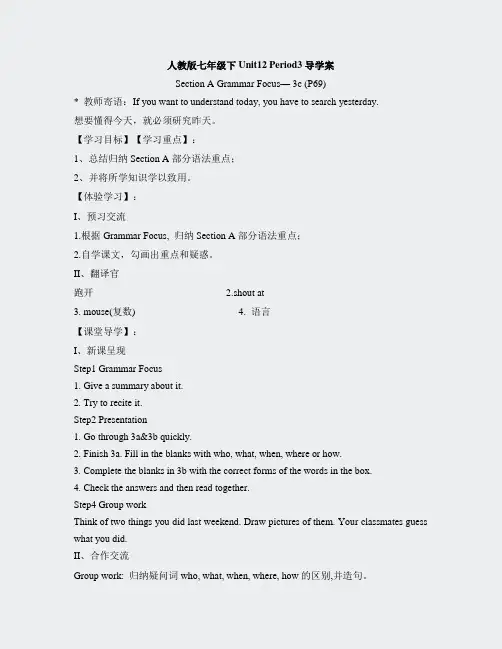
人教版七年级下Unit12 Period3导学案Section A Grammar Focus— 3c (P69)* 教师寄语:If you want to understand today, you have to search yesterday.想要懂得今天,就必须研究昨天。
【学习目标】【学习重点】:1、总结归纳Section A部分语法重点;2、并将所学知识学以致用。
【体验学习】:I、预习交流1.根据Grammar Focus, 归纳Section A部分语法重点;2.自学课文,勾画出重点和疑惑。
II、翻译官跑开______________________ 2.shout at_____________________3. mouse(复数)_________________4. 语言______________________【课堂导学】:I、新课呈现Step1 Grammar Focus1. Give a summary about it.2. Try to recite it.Step2 Presentation1. Go through 3a&3b quickly.2. Finish 3a. Fill in the blanks with who, what, when, where or how.3. Complete the blanks in 3b with the correct forms of the words in the box.4. Check the answers and then read together.Step4 Group workThink of two things you did last weekend. Draw pictures of them. Your classmates guess what you did.II、合作交流Group work: 归纳疑问词who, what, when, where, how的区别,并造句。
人教部编版七年级下册英语教案 Unit 12 Section A (2d-3c) 导学案
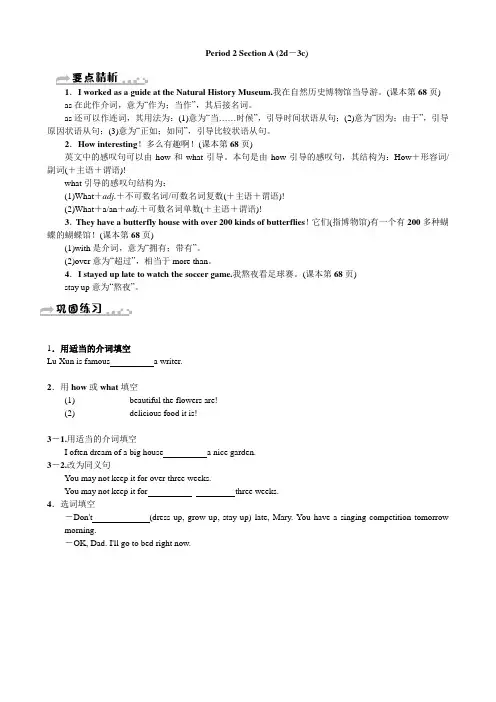
Period 2Section A (2d-3c)1.I worked as a guide at the Natural History Museum.我在自然历史博物馆当导游。
(课本第68页) as在此作介词,意为“作为;当作”,其后接名词。
as还可以作连词,其用法为:(1)意为“当……时候”,引导时间状语从句;(2)意为“因为;由于”,引导原因状语从句;(3)意为“正如;如同”,引导比较状语从句。
2.How interesting!多么有趣啊!(课本第68页)英文中的感叹句可以由how和what引导。
本句是由how引导的感叹句,其结构为:How+形容词/副词(+主语+谓语)!what引导的感叹句结构为:(1)What+adj.+不可数名词/可数名词复数(+主语+谓语)!(2)What+a/an+adj.+可数名词单数(+主语+谓语)!3.They have a butterfly house with over 200 kinds of butterflies!它们(指博物馆)有一个有200多种蝴蝶的蝴蝶馆!(课本第68页)(1)with是介词,意为“拥有;带有”。
(2)over意为“超过”,相当于more than。
4.I stayed up late to watch the soccer game.我熬夜看足球赛。
(课本第68页)stay up意为“熬夜”。
1.用适当的介词填空Lu Xun is famous a writer.2.用how或what填空(1)____________ beautiful the flowers are!(2)____________ delicious food it is!3-1.用适当的介词填空I often dream of a big house a nice garden.3-2.改为同义句You may not keep it for over three weeks.You may not keep it for three weeks.4.选词填空-Don't (dress up, grow up, stay up) late, Mary. You have a singing competition tomorrow morning.-OK, Dad. I'll go to bed right now.一、汉译英1.跑开____________2.当导游____________3.告诉某人有关某事____________4.自然历史博物馆____________5.生活习惯____________6.有一个愉快的周末____________7.有点儿累____________8.熬夜到很晚____________9.观看足球比赛____________10.一门外语____________11.冲着某人叫____________二、根据汉语提示完成句子1.Can you help me feed my cat when I'm ____________(离开)?2.Look! There are so many ____________(老鼠) in the old house.3.Please be quiet. The ____________(婴儿) is sleeping.4.Don't ____________(叫喊) at her.5.What ____________(语言) does Kelly speak?三、用所给单词的适当形式填空1.Last summer my family and I ____________(swim) in the sea.2.When it ____________(rain),I stayed at home and watched TV.3.They ____________(fly) a kite on the playground happily last weekend.4.Let the boy ____________(go) home, please.5.Yesterday they ____________(go) to the beach.6.Yesterday Ben __________ his homework. He often _________ his homework after school.(do)7.I ____________(hear) a boy ____________(sing) in the room when I went downstairs.8.Tom ____________(write) a new song the day before yesterday.9.I _____(stay) up late _______(do) my homework last night and ______(get) up late this morning.10.He ____________(lose) his key and he ____________(can not) get into his home yesterday.四、阅读理解Dave was ten years old and was a very lazy boy. He had to go to school every day. He didn't like school and didn't want to do much work. His parents are doctors. They hoped that their son would become a doctor when hegrew up. But one day Dave said to his mother,“When I finish school, I want to be a dustman(垃圾工人).”“A dustman?” his mother asked. She was very surprised(惊讶的). “That's not a pleasant job. Why do you want to be a dustman?”“Because I only have to work one day a week,” Dave answered.“One day a week?” his mother asked. “What do you mean?”“Well,” Dave answered, “I know that dustmen only come to our house and work on Wednesday, because I only see them on that day.”()1.Dave did not do much work at school because ________.A.he was lazy B.he didn't like the teacherC.he was good at his lessons D.his parents would help him()2.Dave knew that ________.A.his parents wanted him to be a doctorB.his father was one of the best doctorsC.his mother worked very hardD.his teachers were very good()3.Dave wanted to be a dustman because he thought ________.A.it was the easiest workB.it was the most interesting workC.it was much better than to be a doctorD.the dustmen didn't have to work every day()4.Dave's mother thought the dustman's job was ________.A.happy B.light C.not pleasant D.not busy()5.Which of the following is RIGHT?A.Dave was a student of a very big school.B.Dave's parents worked in the same hospital.C.Dave was the only son of the family.D.Dave didn't know how dustmen did their work.参考答案Period 2【巩固练习】1.As 2.(1)How (2)What3-1.with3-2.more than 4.stay up【课时训练】一、1.run away 2.work as a guide3.tell sb. about sth.4.Natural History Museum5.living habits6.have a good weekend7.a little tired 8.stay up late9.watch a soccer game10.a second language11.shout at sb.二、1.away 2.mice 3.baby 4.shout 5.language三、1.swam 2.rained 3.flew 4.go 5.went6.did, does7.heard, singing8.wrote 9.stayed, to do, got10.lost, couldn't四、1-5.AADCD。
Unit12导学案人教版七年级英语下册
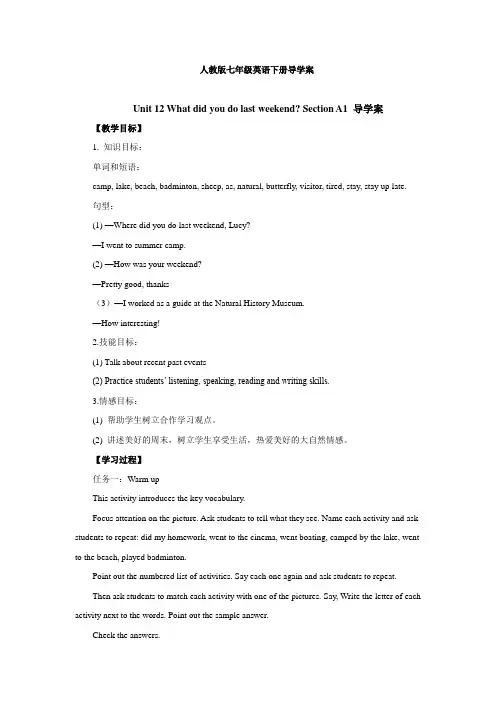
人教版七年级英语下册导学案Unit 12 What did you do last weekend? Section A1 导学案【教学目标】1. 知识目标:单词和短语:camp, lake, beach, badminton, sheep, as, natural, butterfly, visitor, tired, stay, stay up late.句型:(1) —Where did you do last weekend, Lucy?—I went to summer camp.(2) —How was your weekend?—Pretty good, thanks(3)—I worked as a guide at the Natural History Museum.—How interesting!2.技能目标:(1) Talk about recent past events(2) Practice students’ listening, speaking, reading and writing skills.3.情感目标:(1) 帮助学生树立合作学习观点。
(2) 讲述美好的周末,树立学生享受生活,热爱美好的大自然情感。
【学习过程】任务一:Warm upThis activity introduces the key vocabulary.Focus attention on the picture. Ask students to tell what they see. Name each activity and ask students to repeat: did my homework, went to the cinema, went boating, camped by the lake, went to the beach, played badminton.Point out the numbered list of activities. Say each one again and ask students to repeat.Then ask students to match each activity with one of the pictures. Say, Write the letter of each activity next to the words. Point out the sample answer.Check the answers.任务二:ListeningWork on 1bThis activity gives students practice in understanding the target language in spoken conversation.Point to the activities in the picture in activity la. Ask students to tell what the person did in each picture. For example, She played badminton, or Lucy went to the cinema. Play the recording the first time. Students only listen.Play the recording a second time. This time say. Listen to the recording and write the days and times Lucy did each thing under the pictures. Point out the sample answer under the picture of Lucy playing badminton; on Saturday morning.Correct the answers.任务三:Pair workWork on 1cThis activity provides guided oral practice using the target language.Point to the example conversation. Ask two students to read the dialogue to the class.Say, Now work with a partner. Student A, pretend to be Lucy. Student B, ask questions about what Lucy did on different days and times over the weekend. Talk about the activities in the picture.Students work in pairs. As they talk, move around the room monitoring their work. Offer language or pronunciation support as needed任务四:ListeningWork on 2a:This activity gives students practice in understanding the key vocabulary in spoken conversation.Point to the five sentences and ask a student to read these sentences to the class.You will hear recording of a conversation. The people will talk about some of the activities and people, but they will not talk about others. Please underline the words you hear on the recording.Play the recording the first time. Students only listen.Play the recording a second time. This time, ask students to underline each word that is saidon the tape. Point out the sample answer, grandmother.Correct the answers.1grandma 2 homework 3 English 4 farm 5 cows任务五:ListeningWork on 2b:This activity provides listening practice using the target language.Call attention to the pictures of Carol, Becky, and Jack and ask students to identify each person by name.Now I will play the recording again. Listen to the students talking about what they did over the weekend. Write C for Carol, B for B Becky or J for Jack next to each statement in activity 2a. The first one has been done for you.Play the recording the first time. Students only listen.Point out the sample answer, S, in statement 1. Say, Sonia visited her grandmother.Play the recording again. Ask students to write a letter in front of each statement to show what each person did.Check the answers. B B C J J任务六:Pair workAsk and answer in pairs.Point to the example conversation. Ask two students to read the dialogue to the class.Say, Now work with a partner. Student A, ask questions about what, who or where, Student B answers. Students work in pairs.任务七:Roleplay the conversation.1. Ask Ss to look at conversation in 2d. Then Ss read the dialogue by themselves and find the answer to these questions:(1) What did Lisa do on her weekend?(2) What did Paul do on his weekend?2. Ss work in pairs and roleplay the conversations.3. Have several pairs perform their conversations for the rest of the class.Unit 12 What did you do last weekend? Section A2 导学案【教学目标】1. 知识目标:单词和短语:away, mouse, baby, shout, woof, language,run away, shout at, last weekend, go boating, last weekend句型:(1)What did you do last weekend?(2)I did my homework.(3)Who visited her grandma?(4)Where did she go last weekend?(5)She went to a farm.(6)Who did she go with?(7)She went with her classmates.2.技能目标:(1)Talk about recent past events(2)Practice students’ listening, speaking, reading and writing skills.3.情感目标:(1)提高学生独立学习能力。
七年级下英语unit12Whatdidyoudolastweekend?导学案(人教版英语七年级)

七年级下英语unit12What did you do last weekend?导学案 (人教版英语七年级)Unit 12 What did you do last weekend? 课时1 (A1a-2d)班级:姓名:学号:【学习目标】一、Key words: camp lake beach sheep as natural visitor tired stay stay up late badminton butterfly二、Target language: –What did you/he/she/they do last weekend ?--I/We/He/She/They went boating-三、难点: 用过去时谈论过去发生的事。
【预习内容】一、词汇翻译。
(注意:用动词原形)1.做作业2.去电影院3.去划船4.去沙滩5.在湖边露营6.打羽毛球7.打排球 8.为考试而学习9.喂些羊 10.拜访奶奶二、根据汉语完成句子。
1.上周末你做了些什么事? did you ?2.他去划船了。
He 。
3.谁跟他一起去的?who she .?4.上周末他们去哪里了? they go ?三、通过预习你的疑问是【学习过程】1. 在书上完成P67的1a 1b 2a 2b部分。
2.合作学习(2c 2d),1)Pair work完成2c2)根据答句写出问句1. ?I did my homework2. ?They went to a farm3. ?She played badminton with her brother.test通常指小考,平时小测验等。
【课堂作业】一、根据句意和首字母提示完成单词。
1. Let’s go c____ __ in the mountains this Sunday,2. I s ___.for the math test last weekend .2.单项选择。
()1. ----______ did you go on vacation?----Beijing, the capital of China.A. HowB. WhenC. Where( ) 2.My elder sister likes to play ______ basketball but I like to play ______ violin.A. the theB.the \C. \ the( ) 3.I had a(n) in math yesterday.A. testB. examC. book3.句型转换:1)I went to the mountains( 改为一般疑问句)2)Tina visited grandma (对划线部分提问)3) Did you go to the beach? (肯定回答)4) Did they go to summer camp? (否定回答)Unit 12 What did you do last weekend? 课时2 (A2d-3c)班级:姓名:学号::【学习目标】一、Key words: away run away mouse mice baby shout shou at language二、Target language: -- What did you/he/she/they do last weekend ?--I/We/He/She/They went boatingWho visited her grandma ?Where did she go last weekend?Who did she go with?三、掌握和what / where /who/when引导的特殊疑问句。
Unit12SectionB(2a—2c)导学案人教版七年级英语下册(1)
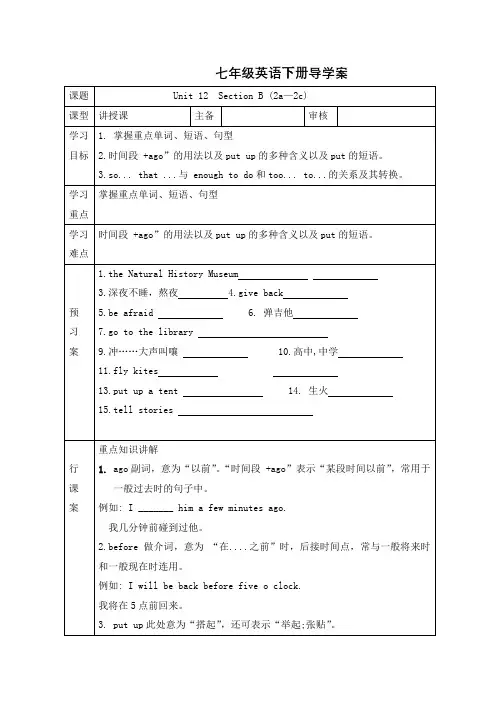
与put相关的其他短语动词
put off推迟put out熄灭
put away放好puton穿上
4.so... that... 意为“如此.....,以至.....”引导结果状语从句。其中,so是副词,常用来修饰形容词或副词。
例如:The boxis_____heavy that I can't move it away.
学习
重点
掌握重点单词、短语、句型
学习
难点
时间段 +ago”的用法以及put up的多种含义以及put的短语。
预
习
案
1.the Natural History Museum
3.深夜不睡,熬夜4.give back
5.be afraid6. 弹吉他
7.go to the library
9.冲……大声叫嚷10.高中,中学
( )11. She __________ a new bike last year.
A. buyB. buys C. boughtD. will buy
living活的; 活着的
强调说明“尚在人间”“健在”, 既可指人,又可指物;可用作定语或表语
alive活着的
其反义词为dead;既可指人,也可指物;可用作表语、后置定语或宾语补足语
(3)以-ly结尾的形容词还有
lovely(可爱的),lonely(孤独的),friendly(友好的),
likely(很可能的),daily(每日的),weekly(每星期的),yearly(每年的)等。
C. something importantD. important something
( )8. ______ did you go on vacation? I went to the Great Wall.
人教版七年级英语下册Unit12Whatdidyoudolastweekend教学设计
-教授动词过去式变化规则,并通过练习进行巩固。
2.教学目的:
-帮助学生掌握一般过去时态的语法结构,理解其用法。
-让学生学会动词过去式的变化规律,为实际运用打下基础。
(三)学生小组讨论
1.教学活动设计:
-教师将学生分成小组,每组选择一个周末活动的话题,如:go shopping,go to the movies,play soccer等。
四、教学内容与过程
(一)导入新课
1.教学活动设计:
-教师以提问方式引导学生回顾上一单元的主题,如:“Can you remember what we talked about last unit? What activities do you like to do in your free time?”
二、学情分析
针对人教版七年级英语下册Unit 12 "What did you do last weekend?",学生在之前的学习中已经掌握了基本的英语语法和词汇,能够运用一般现在时态描述日常生活。在此基础上,他们对于一般过去时态的掌握处于初步阶段,需要在本章节的学习中进行巩固和提高。
七年级的学生正处于青春期,好奇心强,喜欢分享自己的经历和见闻。因此,在本章节的教学中,教师应充分利用学生的这一特点,引导他们用英语表达过去发生的活动,激发学生的学习兴趣和表达欲望。
人教版七年级英语下册Unit12Whatdidyoudolastweekend教学设计
一、教学目标
(一)知识与技能
1.学生能够掌握并熟练运用一般过去时态描述过去发生的事情,如:“I went to the park last weekend.”。
人教版英语七年级下册Unit 12 Section A(2d-3c)导学案
Unit 12 Section A〔2d-3c〕导学案【课型】对话表演和语法课【学习目标】1. 通过2d的对话表演,领会一般过去时在具体语境中运用并熟练掌握目标语言:I worked as a guide at the Natural History Museum. I told the visitors about them and their living habits. I stayed up late to watch the soccer game.2. 通过语法表格,能更深入地理解一般过去时态的特殊疑问句的变化规律。
3. 3a(关注语言形式),3b〔关注语言意义〕和3c(关主口头交际)的逐级训练,能熟练地正确地运用过去时态的各种不同句式。
【自主学习】一、预习交流〔1〕根据Grammar Focus,归纳Section A局部语法重点。
〔2〕自学2d,勾画出重点和疑惑。
二、英汉互译(1)自然历史博物馆(2)生活习性(3)担当(4) tell about(5) kind of tired (6) stay up late【新课导入】Step l: Lead-in1. Greetings教师和学生互动交流周末怎么样,做了什么。
根据实际情况可用不同的活动短语,用得越多越好。
T: How was your weekend?S: It was great.T: What did you do?S: I fed some sheep....2. 两两对话。
Look at the pictures and talk about the weekendA: How was your weekend?B: It was great /OK /not bad/not very good...A: What did you do last weekend?B: ...【新知呈现】Step 2: Presentation1. 看图片,Lisa和Paul 正在谈论他们的周末活动。
【人教版】七下英语Unit12(Section A 1a-2d)导学案
樊城区第二代导学案模板课题:Unit12 What did you do last weekend?. Section A(1a-2d) 课型:听说课课时:1课时(具体课时任务: 导学、独学、互学、小展示)学习目标:1.能正确表达周末活动。
2..能用所学语言谈论过去发生的事情。
3.能正确使用一般过去时态的特殊疑问句询问信息。
重难点:1.能用所学语言谈论过去发生的事情。
2.能正确使用一般过去时态。
当堂测评分层达标基础落实★(一)用所给词的适当形式补充完整1.What's ____________ name?(you)2.Nice ____________ you.(meet)3.____________ name is Gina.(I)4.____________ this? It's a book.(what)(二)用am , is, are填空:1. -----Hi, I _______ Frank . What _______ your name? ----My name _______ Lisa.2. -----Hello! How ________ you? -----I ______ fine, thank you.3. -----What _______ this in English? ------ It _______a telephone.4. Her first name _____ Gina.5. ________ you Ben? No. I _______ Alan.(三)句型转换:1. My name is Amy.(就划线部分提问)______ ________ ________ name, please?2. Her name is Gina .(就划线部分提问)_______ ______ her name?3. He is Bob.(同义句转换)_______ ________ __________ ________4. I am fine .______ are you?6. That boy's name is Jeff . (对划线部分提问)_________ th at boy’s __________?(四)从B栏中找出A栏的答语。
人教版七年级下册英语Unit 12 教学设计
人教版七年级下册英语Unit 12 教学设计一. 教材分析人教版七年级下册英语Unit 12的主题是关于日常生活中的饮食和饮食相关的表达。
本单元通过学习食物名称、数量和口味等,让学生能够用英语进行简单的饮食交流。
教材包括词汇、对话、阅读理解和语法等部分,内容丰富,贴近生活,能够激发学生的学习兴趣。
二. 学情分析七年级的学生已经掌握了基本的英语语法和词汇,具备一定的听说读写能力。
他们对生活中的饮食有一定的了解,兴趣浓厚。
但部分学生在口语表达上还存在困难,需要教师的引导和鼓励。
三. 教学目标1.知识目标:学生能够掌握本单元的词汇、句型和语法,了解日常饮食的表达方式。
2.能力目标:学生能够用英语进行简单的饮食交流,提高口语表达能力。
3.情感目标:培养学生对饮食文化的兴趣,增进同学间的友谊。
四. 教学重难点1.重点:本单元的词汇、句型和语法。
2.难点:如何运用所学知识进行实际交流。
五. 教学方法1.任务型教学法:通过设定各种饮食相关的任务,让学生在完成任务的过程中学习和运用英语。
2.情境教学法:创设日常饮食的情境,让学生在真实的环境中进行语言实践。
3.小组合作学习:鼓励学生相互交流、合作,提高口语表达能力。
六. 教学准备1.准备食物图片、实物等教学资源。
2.设计各种饮食相关的任务和活动。
3.准备课堂录音、视频等教学材料。
七. 教学过程1.导入(5分钟)利用图片或实物展示各种食物,引导学生谈论他们喜欢吃的食物。
2.呈现(10分钟)介绍本课的主题,展示食物图片,引导学生用英语描述食物。
3.操练(15分钟)分组进行角色扮演,模拟餐厅点餐的场景,练习本课的句型和词汇。
4.巩固(10分钟)学生互相提问,用英语讨论喜欢的食物和口味。
教师给予指导和反馈。
5.拓展(10分钟)听录音或观看视频,了解不同地区的饮食习惯。
学生分享自己的饮食文化。
6.小结(5分钟)总结本节课所学内容,强调日常饮食的表达方式。
7.家庭作业(5分钟)布置作业:用英语写一篇关于自己喜欢的食物的短文。