
2020-2021学年北京市中考6月模拟(第二次模拟)英语试题含答案
门头沟区初三二模考试英语试卷听力理解(共30分)一、听对话,从下面各题所给的A、B、C三幅图片中选择与对话内容相符的图片。
每段对话你将听两遍。
(共5分,每小题1分)1.A B C2.A B C3.A B C4.A B C5.二、听对话或独白,根据对话或独白的内容,从下面各题所给的A、B、C三个选项中选择最佳选项。
每段对话或独白你将听两遍。
(共15分,每小题1.5分)请听一段对话,完成第6至7小题。
6. What will the weather be like in the afternoon?A. Windy.B. Cloudy.C. Rainy.7. What will the woman wear?A. The new coat.B. The new dress.C. The new trousers.请听一段对话,完成第8至9小题。
8. Which bus is the cheapest?A. No. 67 bus.B. No. 12 bus.C. No. 9 bus.9. Where is the bus stop?A. On the left of the fruit shop.B. On the right of the fruit shop.C. On the other side of the fruit shop.请听一段对话,完成第10至11小题。
10. Why did Peter call Linda?A. He wanted to invite her to the football game.B. He didn’t know how to get to the stadium.C. He wanted to know whether she could get a ticket for him.11. What advice did Linda give Peter?A. To set off early.B. To watch TV at home.C. To buy his tickets at once.请听一段对话,完成第12至13小题。
12. What is the boy’s suggestion for getting good results in exams?A. Talking with others.B. Often taking tests.C. Always working hard.13. What’s the possible relationship between the two speakers?【来源:21·世纪·教育·网】A. Classmates.B. A teacher and a student.C. A father and a daughter.请听一段独白,完成第14至15小题。
14. Who needs more personal space?A. People from China.B. People from Japan.C. People from America.15. How many ways are given to communicate with foreign students?2A. Three.B. Four.C. Five.三、听对话,记录关键信息,对话你将听两遍。
(共10分,每小题2分)Lily Brown’s 2017 Father’s Day GiftsWhom the gifts for 16 BrownWhat for him A cake Size: 17Some flowers Colour: 18How much the gifts are 19 dollarsWhat the address is No. 157 20 Road四、单项填空(共10分,每小题1分)从下面各题所给的A、B、C、D四个选项中,选择可以填入空白处的最佳选项。
21. The books are interesting and we like ________ very much.【A. usB. youC. theyD. them22. It’s five in the afternoon and my mother is ________ home.A. inB. onC. atD. of23. ________ of my parents like watching movies.A. AllB. BothC. EachD. None24. —Which book is ________, this one or that one?—I think this one.A. usefulB. more usefulC. the most usefulD. most useful25. —________ you swim?—Yes, and I can swim fast.A. CanB. NeedC. MustD. Should26. —________ do you go to the National Library?—Once a week.A. How muchB. How manyC. How longD. How often27. We ________ in Shanghai five years ago.A. liveB. livedC. is livingD. will live28. Li Linlin ________ a Mobike on the street when I saw her this morning.A. ridesB. rodeC. is ridingD. was riding29. Your homework ________ before five tomorrow.A. finishB. is finishedC. must be finishedD. was finished30. —Can you remember ________ our school?—Last month.A. when Mr. Smith visitsB. when does Mr. Smith visitC. when Mr. Smith visitedD. when did Mr. Smith visit五、完形填空(共15分,每小题1.5分)通读下面短文,掌握其大意, 然后从短文后各题所给的四个选项中,选择最佳选项。
Whenever my child caused me to change my schedule(计划), I thought to myself, “We don’t have 31 for this.”So, the two words I most commonly spoke to my child were: “Hurry up”. But my promise to slow down was made almost three years ago, and I began my journey to grasp (领会) what 32 in life.My younger daughter is my living reminder of why I must 33 trying to slow down.The two of us had taken a bike ride to the supermarket. After buying an ice cream for my daughter, she sat down at a table 193419 looking at the ice cream she held in her hand. Suddenly a look of worry came across her 35 . “Do I have to rush, Mama?”I could have cried. Perhaps the pains of a hurried life don’t ever completely disappear, I thought sadly. As my child looked up at me waiting to know if she could take her time, I 36I had a choice. I could sit there in sorrow (悲伤) thinking about the number of times when I rushed my child through life…or I could celebrate the fact that today I’m trying to do things differently. I chose to live in today.“You don’t have to rush,” I said gently. Her whole face immediately brightened and her shoulders relaxed. And so we sat side-by-side talking. There were even 37 when we sat in silence just smiling at each other.When she got to the 38 bite (一口), she held out a spoonful of ice crystals (冰晶) and sweet juice for me. “I 39 the last bite for you, Mama,” my daughter said proudly. I realized I just got the deal of a lifetime. I gave my child a little time… and in return, she gave me her last bite and reminded me that things taste sweeter and love comes 40 when you stop rushing through life.31. A. money B. place C. time D. room32. A. gives B. wins C. loses D. matters33. A. keep B. like C. hate D. forget34. A. sadly B. carelessly C. politely D. happily35. A. feet B. hand C. face D. head36. A. knew B. told C. described D. remembered37. A. weeks B. days C. hours D. moments38. A. first B. second C. third D. last39. A. ate B. had C. saved D. finished40. A. harder B. easier C. faster D. slower阅读理解(共50分)六、阅读下列短文,根据短文内容,从短文后各题所给的A、B、C、D四个选项中,选择最佳选项。
2023年北京市海淀区中考二模英语试题(含答案)
2023年北京市海淀区中考二模英语试题学校:___________姓名:___________班级:___________考号:___________一、单项选择1.This is Mary’s English book. ________ is at home.A.I B.My C.Me D.Mine2.Our school library opens ________ 8 a.m. on weekdays.A.at B.for C.in D.of3.—________ was your trip to Yunnan, Tom?—It was wonderful.A.How B.What C.When D.Where 4.—John, ________ you please take out the trash?—OK, Mum. I’ll do it right away.A.must B.should C.could D.need 5.Read these books, ________ you’ll get to know more about Chinese tea culture. A.though B.unless C.and D.but6.Linda is ________ in art than her sister Lily.A.creative B.more creative C.most creative D.the most creative 7.We ________ a survey about students’ reading habits last weekend.A.do B.did C.have done D.will do 8.Millions of tourists ________ the Great Wall every year.A.visit B.will visit C.visited D.have visited 9.I ________ a video call with Grandma when Dad arrived home.A.have B.will have C.am having D.was having 10.Time flies. Mr. Smith ________ English in our school for three years. We all enjoy his classes.A.teaches B.will teach C.has taught D.was teaching 11.The graduation party ________ in the school hall next month.A.was held B.will be held C.held D.will hold 12.—Jack, do you know ________?—Sure. Once a week would be OK.A.how long should I water the plantsB.how long I should water the plants C.how often should I water the plants D.how often I should water the plants二、完形填空三、阅读匹配A.Pet and Feed AnimalsB.Pick Your OwnC.Grow Vegetables D.Buy Fresh Products四、阅读单选It was a school trip. My friends and I were taking photos in the street of Vienna, trying to record the beauty of a foreign country. The change in climate had made my contacts (隐形眼镜) dry out quite often, so I was wearing my glasses.But I didn’t think the glasses looked good on me, so for any photo I was in, I would take them off. When I took them off in front of Vienna State Opera, I heard a tiny “ping!”—a screw (螺丝) fell off my glasses and they separated in half.Hurriedly, my friends and I began to search for the tiny screw. We looked everywhere, but it was nowhere to be found. I was close to tears. How could I enjoy the rest of my trip if I could see nothing clearly?!Just at that moment, my friend saw a store with a sign in German whose windows were full of various pairs of glasses. To try our luck, we raced into the store. Not speaking any German, we did our best to explain the situation. A friendly old man smiled gently and took my glasses into the back of the store.After a while, he came back into the room. Smiling softly, he handed me my glasses, fully fixed. I tried to ask the man how much it would cost. However, the man just smiled at me and said, “For you? I will do it for free.”That is the kindest thing a stranger has ever done for me. While I was in a foreign country and unable to even speak his language, this man, with a business to run, still gifted me that tiny, necessary screw—thus the ability to see for the rest of my trip and also a memory to be treasured.24.What happened in front of Vienna State Opera?A.The writer fell to the ground.B.The writer’s contacts dried out.C.The writer made new friends.D.The writer’s glasses broke apart. 25.How did the writer feel when she found the store?A.Regretful.B.Hopeful.C.Interested.D.Disappointed. 26.The writer will treasure the memory because ________.A.she was moved by a stranger B.she was gifted a set of screwsC.she liked the view in Vienna D.she picked up a new languageMost kids know it’s wrong to shout at or hit someone. But what if that someone is Alexa—an AI (Artificial Intelligence人工智能) speaker, or Roomba—a robot cleaner?A new study by Teresa Flanagan, a developmental psychologist from Duke University, found that kids aged four to eleven felt neither Roomba nor Alexa should be shouted at or attacked. However, that feeling weakened as kids grew into their teens.Flanagan was inspired to do the research after watching some movies about robots. “In those movies, we see adults interacting with robots in terrible ways,” said Flanagan. “But how would kids interact with them?”Flanagan invited 127 children aged four to eleven to take part in the study. The kids were asked to watch a video of the two devices (设备) and then answer a few questions, like whether it was wrong to attack AI devices and how smart and sensitive they thought Alexa was compared to Roomba. Flanagan studied the survey data and found something encouraging.Overall, kids decided that both Alexa and Roomba, unlike humans, probably weren’t ticklish (怕痒) and wouldn’t feel pain when they got hit. However, they gave Alexa, but not Roomba, high marks for mental and emotional abilities, such as being able to think or getting upset when someone was mean to it.“Young children think Alexa, even without a body, has emotions and a mind,” Flanagan said. “But they don’t think Roomba does—maybe that has something to do with Alexa’s ability to have verbal(语音的) communication.”Although they believed the two intelligent devices had different abilities, children acrossall ages agreed it was wrong to hit or shout at the machines. However, the older kids got, the more they reported it would be more acceptable to attack devices.The findings offer new ideas about the changing relationship between children and intelligent devices and raise important questions about how we are supposed to treat them in general and as parents. Should adults, for example, model good behavior for their kids by thanking AI devices for their help?For now, Flanagan is trying to understand why children think it is wrong to attack intelligent devices.27.Why does Flanagan mention some movies in Paragraph 3?A.To present how robots influence children.B.To stress the importance of AI technology.C.To explain where the research idea came from.D.To show the popularity of children’s TV shows.28.What can we learn from the passage?A.Adults set a good example on treating AI.B.Flanagan studied the data with the help of AI.C.Alexa has more physical feelings than Roomba.D.Younger kids hold a friendlier attitude to AI devices.29.What will Flanagan probably do next?A.Examine what good manners kids show toward AI.B.Test whether Alexa is much smarter than Roomba.C.Survey how adults interact with intelligent devices.D.Study why kids think AI is worthy of nice treatment.Awe is the feeling of amazement and respect mixed with surprise. Research shows that awe experiences decrease stress and anxiety and increase positive (积极的) emotions and overall satisfaction in life. It can also improve our relationships, making us more likely to help others and more supported.Most of us connect awe with something unusual and beautiful: nature, music or a spiritual experience. But ordinary people can bring about awe too. Research shows we can be awed by our nearest and dearest—the people sitting next to us, or talking on the other end of the phone. Psychologists call this interpersonal awe.B.try to get a full picture of other peopleC.watch carefully how others do their jobsD.learn from an expert in positive psychology32.The writer would probably agree that ________.A.awe often comes from senses of satisfactionB.awe moments are usually very difficult to createC.nature provides the most awe in our everyday lifeD.recalling awe experiences strengthens relationships33.Which of the following would be the best title for the passage?A.Respond to Awe in Everyday LifeB.Spread Awe to People AroundC.Express Thanks to Awesome PeopleD.Take down Awesome Moments五、阅读回答问题阅读短文,根据短文内容回答问题。
2020年北京市中考英语试题(含答案)

2020年北京市中考英语试题(含答案)四、单项填空(共13分,每小题1分)从下面各题所给的A、B、C、D四个选项中,选择可以填入空白处的最佳选项、22、I have a big brother、 __________name is Paul、A、 HisB、 HerC、 HeD、 Your23、I sometimes help my mom with herhousework____________ Saturdays、A、 atB、 inC、 onD、 to24、I’d like to go with you, _____________I’m too busy、A、 orB、 andC、 soD、 but25、Three、A、 How oftenB、 How longC、 How manyD、 How much26、Summer、A、 wellB、 betterC、 bestD、 the best27、No,you ________、A、can’tB、shouldn’tC、wouldn’tD、needn’t28、I often _________ my grandparents、A、 visitB、 visitedC、 have visitedD、 will visit29、My parents always tell me ______ more vegetables and fruit、A、 eatB、 eatingC、 eatsD、 to eat30、 I ______ the classroom、A、 was cleaningB、 have cleanedC、 will cleanD、 clean31、A、 new hospital _______ in my town next year、A、 buildsB、 builtC、 is builtD、 will be built32、He _____ in this factory for20 years already、A、 will workB、 worksC、 has workedD、 is working33、Look! The clock has stopped、Maybe there’s________ wrong with it、A、 everythingB、 somethingC、 anythingD、 nothing34、Tomorrow morning、A、 when they hadB、 when they are going to haveC、 when did they haveD、 when are they going to have五、完形填空(共12分,每小题3分)阅读下面的短文,掌握其大意,然后从短文后各题所给的A、B、C、D四个选项中,选择最佳选项Santa Can Come before ChristmasIt was last June、 I entered a supermarket to pick some vegetables,when a young man asked me,“Can you tell me where the35 counter(柜台)is? ”“Well,the milk is in the lower right corner,” I replied、Picking up my things,I finally came to the milk counter where I met the same man36 almost10 bottles of milk、Iasked,“Do you need a basket or a trolley?”“Sure,thank you、”he answered、I was37 he was still picking more bottles and after a few minutes his trolley had24 bottles of milk、I laug hed and asked, ”Why so many bottles?”He smiled and said, ”These are for my street dogs、 Today, I want to be a Santa38them、”I said,” Well ,it`s too39 for you to be a Santa,It is still June and Christmas comes in December、”He40 at me and walked a few steps,as if he wanted to say something but he left the counter without saying anything、41,we met again at the bread counter、“So these bread and cakes are alsofor the street dogs ,Mr 、Santa、”He smiled andsaid, ”Yes ,These are also for the dogs and I love to be Mr、 Santa in the month of June, Santa is a representation(象征)of surprises and42、 Santa comes in December as we43 him around Christmas、 But in real life there is a Santa in each one of us that shines through our personality at some point of time ,no matter which month it is、 Maybe when you offered help to me by getting me a trolley ,there was a44 Santa in you ,When we offer food to a poor man or a(n)45 to someone who is caught in the rain ,we are being Santa there, So when you offer help to others or get help from others, just think that Santa has come all the way for you、”He left and I was happy that I had met him、It was right to understand that Santa can come before Christmas, We just need to realize that he is around us by46 happiness and unconditional love、35、A、 vegetableB、 milkC、 breadD、 fish36、A 、puttingB、 choosingC、 holdingD、 bringing37、A、 sadB、 excitedC、 angryD、 surprised38、A、 forB、 onC、 ofD、by39、A、 easyB、 earlyC、 helpfulD、 important40、A 、pointedB、 laughedC、 shoutedD、 turned4 1、A、 LuckilyB、 SuddenlyC、 HopefullyD、 Naturally42、A、 loveB、 successC、 friendshipD、 honor43、A、 callB、 showC、 expectD、 invite44、A、 lostB、 frozenC、 forgottenD、 hidden45、A、 cameraB、 umbrellaC、 appleD、 box46、A、 storingB、 facingC、 spreadingD、 increasing六、阅读下列短文,根据短文内容,从短文后各题所给的ABCD四个选项中,选择最佳选项。
2021年北京市西城区中考二模英语试题(word版 含答案)
Some people still live in caves(洞穴)! Cave homes can be very comfortable today, and they usually have windows and electricity.
In Guadix, Spain, almost half of the people live underground in caves. Many of the homes have chimneys(烟囱), but these aren't to let smoke out—they are to let air in!
When he went home that night, he got out his bike. His parents had bought it for his birthday. When he’d first gotten it, he’d been excited and had tried to13. After a day or two and a scraped knee, he’d given up. His mother smiled now to see him trying again,but he just gave her an angry look. It was embarrassing not to be able to ride a bike!
7.We ________ several discussions since we started the project.
A.haveB.hadC.are havingD.have had
8.Jack is good at English. He ________ several prizes in the competition last year.
北京市西城区2024学年中考英语模试卷含答案
北京市西城区2024学年中考英语模试卷含答案注意事项:1.答卷前,考生务必将自己的姓名、准考证号、考场号和座位号填写在试题卷和答题卡上。
用2B铅笔将试卷类型(B)填涂在答题卡相应位置上。
将条形码粘贴在答题卡右上角"条形码粘贴处"。
2.作答选择题时,选出每小题答案后,用2B铅笔把答题卡上对应题目选项的答案信息点涂黑;如需改动,用橡皮擦干净后,再选涂其他答案。
答案不能答在试题卷上。
3.非选择题必须用黑色字迹的钢笔或签字笔作答,答案必须写在答题卡各题目指定区域内相应位置上;如需改动,先划掉原来的答案,然后再写上新答案;不准使用铅笔和涂改液。
不按以上要求作答无效。
4.考生必须保证答题卡的整洁。
考试结束后,请将本试卷和答题卡一并交回。
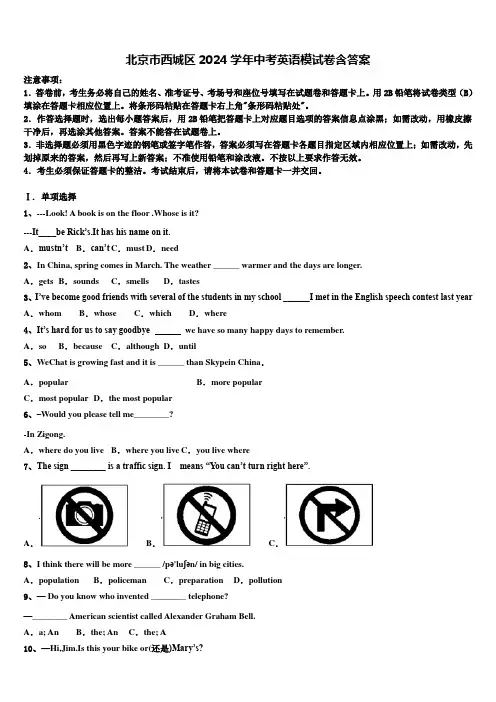
Ⅰ. 单项选择1、---Look! A book is on the floor .Whose is it?---It____be Rick’s.It has his name on it.A.mustn’t B.can’t C.must D.need2、In China, spring comes in March. The weather ______ warmer and the days are longer.A.gets B.sounds C.smells D.tastes3、I’ve become good friends with several of the students in my school ______I met in the English speech contest last year A.whom B.whose C.which D.where4、It’s hard for us to say goodbye we have so many happy days to remember.A.so B.because C.although D.until5、WeChat is growing fast and it is ______ than Skypein China.A.popular B.more popularC.most popular D.the most popular6、–Would you please tell me________?-In Zigong.A.where do you live B.where you live C.you live where7、The sign ________ is a traffic sign. I means “Y ou can’t turn right here”.A.B.C.8、I think there will be more ______ /pə'luʃən/ in big cities.A.population B.policeman C.preparation D.pollution9、— Do you know who invented ________ telephone?—________ American scientist called Alexander Graham Bell.A.a; An B.the; An C.the; A10、—Hi,Jim.Is this your bike or(还是)Mary’s?—It’s mine,not.A.her B.him C.his D.hersⅡ. 完形填空11、The child ren in Mrs. Taylor’s class had just sat down. Their teacher smiled and said, “This week we will paint a mural.”The children looked 1 each other. “What’s a mural?” Jason asked.“A mural is a big picture on a wall,” Mrs. Taylor said. “We will paint ou r mural outside. We will use the wall where everyone 2 .”“That’s a big wall!” cried Karen. “As big as a mountain!”“Yes,” said the teacher. “So, first we must plan 3 to paint on it.”“What about 4 a poem?” asked Jared. The children liked her idea.“I think we 5 paint pictures,” Carol said. The children liked Carol’s idea, too.“We can do 6 ,” Mrs. Taylor said. “Half the mural will be a poem. 7 half will be pictures. First let’s make up the poem.”The children 8 up and wrote a beautiful poem. 9 Mrs. Taylor led the children outside.They took paint and brushes with 10 . Some worked on the bottom half of the wall. Others worked on the top half. Soon the mural 11 .The next morning, a woman 12 was from a TV news show drove by the school. She saw the mural and liked it 13 . She spoke with Mrs. Taylor. “I’d like to do a news story about the mural,” she said.That afternoon, a news team came to the school. A man from 14 news team took pictures of the mural and the children.That night, all the children watched the news at home. They were very 15 to see their faces on TV. Karen said, “I was right! The whole city did see our mural! It’s as big as a mountain!”1.A.of B.at C.in D.for2.A.play B.played C.plays D.playing3.A.what B.where C.how D.when4.A.writes B.write C.to write D.writing5.A.should B.must C.need D.have to6.A.every B.both C.all D.each7.A.Other B.Another C.Others D.the other8.A.steppes B.will step C.was stepping D.stepped9.A.So B.Then C.But D.Or10.A.they B.theirs C.themselves D.them11.A.was done B.did C.was doing D.has done12.A.why B.who C.which D.where13.A.a little B.a few C.a lot D.a lot of14.A.a B.an C.the D./15.A.happy B.happily C.happier D.happiestⅢ. 语法填空12、短文填空Other fail little it surprised they possible back serve be call toThousands of people 1.attracted(吸引) to a 2-meter-wide lane in Tongcheng, Anhui province this spring festival. Although it was 2.to count the exact number, at3.5,000 people visited it each day.This narrow lane4.Liuchi Lane in Chinese, won greater popularity after the story behind it was broadcast(播放)on a CCTV show. At first glance it may seem unimportant, but to those who know5.history,Liuchi Lane means much more than its appearance. In the early Qing Dynasty, it 6.as the boundary(边界) between Zhang family and Wu family. They quarreled(争论)fiercely over which family had the right to build a wall on the dividing line. After 7.to make a compromise(妥协), the Zhangs turned to Zhang Ying, a family member of Zhangs and also a top official in the emperor’s court. To their8., Zhang Ying did not provide the support they needed. He called for his family to move back 1 meter from the boundary. Seeing that, the Wus agreed to move 9.another meter, thus Liuchi Lane was born.In reality, the story of Liuchi Lane is not only about how to get along with10., but also a guideline for all the officials in ChinaⅣ. 阅读理解A13、People are so busy these days that many people have no time to cook. This becomes a problem, because most families love home cooking! The food tastes good and warm, and a family meal brings everyone together. In some families, meals are often the only times everyone sees one another at the same time.Another reason people enjoy home cooking is that it is often a way of showing love. A parent who makes some cookies is not just satisfying (满足) a child’s sweet tooth. She or he is sending a message. The message says, “I care about you enough to spend an hour making cookies that you will eat up in 15 minutes if I let you.”There is also something about the smell of home cooking. The smell of home cooking pleases people of all ages. It makes most of us feel good and loved—even if we are the ones doing the cooking! Next time you smell a cake making, stop for a moment and pay attention to your mood (心情).1.Why do fewer people cook now?A.Many people are too busy. B.Because they are too tired to cook.C.Many people don’t like cooking. D.They don’t like family meals.2.The writer thinks a family meal .A.is a waste of time B.makes children happyC.is difficult for people to cook D.can bring family members together3.A parent spends an hour making cookies .A.only to send a message B.often to show her or his loveC.jus t to satisfy her or his child’s sweet tooth D.to let a child eat up in 15 minutes 4.Which of the following is NOT TRUE according to the passage?A.Many people have no time to cook these days.B.The smell of home cooking makes most of us feel good.C.It becomes a problem that most families love home cooking.D.There are quite a few reasons that people love home cooking.5.What’s the main idea of this passage?A.How to make cookies. B.Family meals are important.C.People are too busy to cook. D.Homemade cookies taste better.B14、B根据表格内容,从题中所给的A、B、C、D四个选项中,选择最佳答案。
北京市燕山区2021-2023年中考英语二模试题分类汇编:阅读理解(含答案)
北京市燕山区2021-2023年中考英语二模试题分类汇编阅读理解2023年北京市燕山区中考二模英语试题三、阅读下列短文,根据短文内容,从短文后各题所给的A、B、C、D 四个选项中,选择最佳选项。
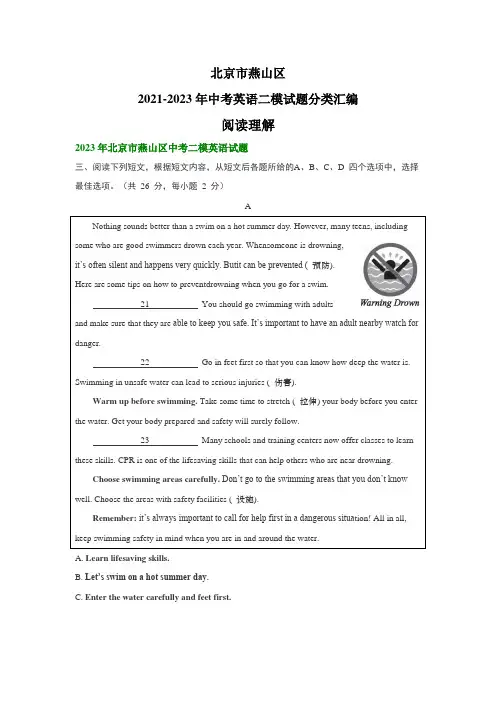
(共26 分,每小题2 分)ANothing sounds better than a swim on a hot summer day. However, many teens, including some who are good swimmers drown each year. Whensomeone is drowning,it’s often silent and happens very quickly. Butit can be prevented ( 预防).Here are some tips on how to preventdrowning when you go for a swim.21 You should go swimming with adultsand make sure that they are able to keep you safe. It’s important to have an adult nearby watch for danger.22 Go in feet first so that you can know how deep the water is. Swimming in unsafe water can lead to serious injuries ( 伤害).Warm up before swimming. Take some time to stretch ( 拉伸) your body before you enter the water. Get your body prepared and safety will surely follow.23 Many schools and training centers now offer classes to learn these skills. CPR is one of the lifesaving skills that can help others who are near drowning.Choose swimming areas carefully.Don’t go to the swimming areas that you don’t know well. Choose the areas with safety facilities ( 设施).Remember:it’s always important to call for help first in a dangerous situa tion! All in all, keep swimming safety in mind when you are in and around the water.A. Learn lifesaving skills.B. Let’s swim on a hot summer day.C. Enter the water carefully and feet first.D. Never swim alone — even for a moment.BThis was our last trip before high school. I had been looking forward to it for weeks. But at the roller coaster, my stomach felt too tight to say anything at all.The big girl beside us was Tasha, my best friend Dan’s sister.She was a singer. She was fantastic on the stage. Just the image ofher up there made me think she was so cool.Our roller coaster car pulled up, and my friends rushed forward, I felt my legs couldn’t move. All I could think about was the roller coaster might fly off into the sky.Without a word, I turned, ran out of the line. I knew what people were saying about me, but I didn’t care. I just kept moving past the crowd, found a bench ( 长椅) near the bathrooms to sit down and put my head in my hands.“Hey! Steve! Are you okay? ” I looked up. It was Tasha!“Oh, uh, yeah, I just started feeling, um, sick.” I responded.“You know, it’s okay if you were scared. Everyone gets scared.” She said.“You don’t.” I said in a low voice. “I’ve seen you on that stage. You were fearless.”“I’m glad it looks like I’m not scared!” Tasha smiled. “But that’s not true. I get really scaredand nervous before I perform.”Before I noticed she was on the bench by my side, her words moved on.“Hey, look, singing is important to me. And I want to share what I love wi th my people. So, even if I’m scared. I do it anyway. I push through the fear and just get up and do it. Is taking roller coaster important to you?”“Yeah, it is. And I want to be able to look back and remember having fun with my friends. I don’t want to remember running away and sitting alone by the bathrooms.”“Everyone gets scared, but brave people don’t let fear control them.” She looked into my eyes. Still being lost in what she said, I saw my friends coming towards me.I got up and went with them to the coaster.When we were leaving, Tasha took a photo of my big smile in front of the coaster. I put itonmy door. It stayed there through all four years of my high school, a reminder of what was more important to me than fear.24. What problem did Steve have on this trip?A. He was too tired to say anything.B. He was scared to sing on the stage.C. He broke his leg and couldn’t move.D. He was afraid to get on the roller coaster.25. With Tasha’s comfort, Steve decided to ______________.A. sit aloneB. join in the funC. run awayD. practice singing26. Why did Steve put the photo on his door?A. It was his only photo before high school.B. It encouraged him to be brave in the future.C. It showed his big smile in front of the coaster.D. It was a photo about the last trip before high school.CIt’s hard to say no to hamburgers, French fries and all of the otherjunk food. However, eating too much junk food can harm your body,especially if you’re between the agesof 10 and 19. “Junk food shapesteenage brains in ways that harm their abilityto think, learn and remember.It can also make it harder to control impulsive ( 冲动的) behaviors,” saidAmy Reichelt, at Western University, Canada. “It mayeven raise a teen’srisk of mental ( 精神上的) problems.”Reichelt and two other researchers reviewed more than 100 studies,about how poor food choices can affect teenage brains. They found teenagers are more sensitive ( 敏感的) than any other age group to foods with a lot of fat and sugar as their brains are not yet fully formed.Teenage brains are still developing the ability to notice risks and control actions. The prefrontal cortex ( 前额皮质) is the part of the brain that tells us we shouldn’t eat chips all the time and helps us contro l ourselves. However, this part doesn’t fully develop until we are in our early 20s.Meanwhile, teen brains get more excited from rewards ( 奖励). The parts of the brain thatmake us feel good when we do something enjoyable — like eating tasty foods — are fully developed by the teen years.In fact, these parts are even more sensitive when we are young. That’s because dopamine ( 多巴胺), a natural chemical that makes us feel happy when we experience something good, is especially active in teenage brains.Therefore, the teen brain has two attacks against it when it comes to saying no to junk food. “It has an increased drive for rewards and reduced self-control,” said Reichelt.Reichelt and her team did their own study using mice, whose brains develop much like our own. They discovered that “teenage” mice that had high-fat foods performed worse on memory tests than those eating normal foods. Researchers said the high-fat foods may make the mice’s prefrontal cortex work less effectively.S o, what’s the best way to say no to junk food? The answer is exercise. When we exercise, the brain becomes less sensitive to food, besides this, it also helps our brains grow and become better able to make wise decisions and control our behaviors.27. What does the first paragraph mainly talk about?A. What problems are caused by junk food.B. What junk food teenagers like most.C. How junk food harms teenage brains.D. How junk food shapes teenage brains.28. What can we learn from the studies mentioned in the passage?A. Teenagers are less sensitive than any other age group to junk food.B. Junk food may make people’s prefrontal cortex work less effectively.C. Dopamine helps our brains become better able to make wise decisions.D. The prefrontal cortex makes us happy when we do something enjoyable.29. Which of the following would be the best title for the passage?A. Teenage BrainsB. Healthy Food for TeenagersC. Food for ThoughtD. Exercise: the Best for BrainsDHumans are getting away from the nature gradually becauseof the developing technology. But now Digital ( 数字的) Technology is offering us an opportunity to listen tothe sounds in the nature in powerful ways, making us get closer to the worldsof animals and plants.All around the nature, there are sounds that we struggle to pick up andunderstand. Elephants, for example, communicate with each other using infrasound, a sound farbelow our human hearing range. Coral ( 珊瑚) in the ocean also communicates with each other through sound waves, with one purpose of attracting baby coral to areas where it can successfully grow. This is a shocking fact as coral doesn’t have any ears!To pick up sounds humans are normally unable to hear, scientists have placed listening devices ( 装置) in these environments. Researchers have attached ( 连接) tiny microphones to honeybees ( 蜜蜂) and turtles, and stuck listening posts that can receive different sound waves from coral reefs ( 礁) and trees. These devices are controlled by computers and networked with digital sensors and satellites. When interconnected, these digital devices work like a hearing aid ( 助听器): enabling humans to observe and record nature’s sounds beyond the limits of our own listening ability. After the sounds are recorded, AI is then able to determine their meanings.With this technology, humans can not only understand the animals, but also communicate back to them. For example, a team of researchers in Germany decoded the honeybees’ behavior with AI. Then they taught tiny robots how to do the honeybee dance. Using these dancing machines, the scientists were able to order the honeybees to stop moving, and to communicate where to fly to collect a specific nectar. In addition to the possibility of speaking with animals, the research could also be used to create a form of healing for animals and plants. That’s to say, in the near future, scientists might be able to get coral to grow in certain areas by playing “healthy reef” sounds, which could help some of the damage we have caused to become healthy again.Now, Digital Technology provides a new way for humans to listen to the lively sounds all around us. The dream of allowing humans to communicate with different animals and plants throughout the nature is being on its way.30. Which of the following is NOT true about listening devices?A. AI can help to explain the meanings of nature’s sounds.B. The hearing aid collects the sounds from the animals or plants.C. Scientists need to connect the devices with computers and networks.D. The devices can record nature’s sounds beyond people’s listening ability.31. The word “healing” in Paragraph 4 probably means “”.A. feedingB. killingC. repairingD. designing32. What can you infer from the last paragraph?A. Scientists are likely to discover a new way of recording.B. Humans will have better communication with the nature.C. It’s possible for people to dance with the honeybee together.D. Digital Technology can be used to communicate with anything.33. What is the writer’s main purpose in writing this passage?A. To discuss how to control listening devices.B. To compare different ways for communication.C. To introduce a technology to get closer to the nature.D. To suggest how to improve people’s listening ability.2022年北京市燕山区中考二模英语试题三、阅读单选Exercise responsibly During the pandemic (疫情), you’d better exercise at home. If you have to leave your home to walk, run, cycle, etc, be mindful of other people. The following rules will help keep you and others safe.Keep your distance (距离)●Exercise alone.●If you stop to catch your breath, do so away from the footpath.●Keep at least 2 meters of space when passing others.●Give way to walkers on narrow paths.Bring your towel and mask●Wipe your sweat (汗水) with a towel.●Avoid touching your face wit h your hands.●If you have to cough or sneeze, do it into your towel.●Wear your mask unless you are doing strenuous (剧烈的) exercise.●Put it on before and after your exercise.●Drink from your own water bottle and don’t share a bottle with others.●Av oid touching public objects with any part of your body.Keep safe●Avoid bumping into (撞上) other people. Slow down and check for blind spots (盲点).●Say “passing on your right/left” if necessary when going past others.21.During the pandemic, where is the best place to exercise?A.At home. B.In the park. C.At the gym. D.In the classroom. 22.What should you bring when you want to exercise outside?A.Water bottle and paper. B.Towel and mask.C.Gloves and sun glasses. D.Camera and smart phone.23.What can you do to keep safe when exercising outside?A.Exercise with your partner. B.Say “Thanks” when going past others.C.Slow down and check for blind spots. D.Keep at least 5 meters of space when passing others.Mrs. Thompson was a primary school teacher. As she stood in front of 5th grade class on the very first day of school, she told her students that she loved them all the same.But that was impossible because Teddy Stoddard sat in the front row. Mrs. Thompson saw the little b oy at school the year before. She noticed that he didn’t play well with other children. His clothes were always messy and he needed a bath. Teddy could be unpleasant.So, she was surprised when she read Teddy’s first grade teacher’s record, “Teddy is a br ight child with a cheerful laugh.” His second grade teacher wrote, “Teddy is an excellent student. He is troubled because his mother is sick. Life at home may be hard.” His third grade teacher wrote, “His mother’s death has been hard on him.” Teddy’s fourth grade teacher wrote, “Teddy is lonely and doesn’t show much interest in school.”By now, Mrs. Thompson saw the problem and felt bad for judging Teddy. That day, she didn’t teach reading, writing or math. Instead she started teaching her students how to be kind to each other.Over the school year, Mrs. Thompson paid lots of attention to Teddy. His mind seemed to come alive and his grades improved. By the end of the year, Teddy was doing better in school. He also had more friends than before.Years later, Teddy wrote to Mrs. Thompson. “Thank you for believing in me. Thank you for making me feel important and showing me that I could make a difference.”Mrs. Thompson, with tears in her eyes, replied, “Teddy, you have it all wrong. You were the one who taugh t me that I could make a difference. I didn’t know how to teach until I met you.”24.What surprised Mrs. Thompson when she read Teddy’s first record?A.Teddy grew up without parents. B.Teddy was slowly making progress. C.Teddy was once a bright and cheerful boy. D.Teddy had no friends when he was younger. 25.What was Teddy like at the end of 5th grade year?A.He was dirty and naughty. B.He was an improved student.C.He was lonely and unpleasant. D.He was the most popular student. 26.What happened to Mrs. Thompson after meeting Teddy?A.She didn’t like her job as a teacher.B.She became strict with her students. C.She worked harder than ever before. D.She learned how to be a better teacher.Every week, Liu Fang, a 38-year-old media worker in Beijing, goes to a store which sells near-expired (将要过期的) food in Sanlitun and returns with a bag of snacks or drinks.“The price tags on these goods have caught my eye. They are often sold at 10% to 30% of the market price,” Liu said. “More impor tantly, most of them are from big brands(品牌). Why wouldn’t I love them?”Liu is among the increasing number of Chinese people who enjoy buying near-expired food at much cheaper prices. According to the latest report by iiMedia Research, the near-expired food industry had a market size of over 30 billion yuan in 2020. 47.8% of the consumers (消费者) are aged between 26 and 35.Unlike the traditional thinking that buying such goods makes them feel shy, more and more young people consider it as a kind of sustainable consumption (可持续消费) that can help reduce food waste.“I don’t care much about the date as long as I can eat it before its expiry. It meets my needs while saving resources and protecting the environment, which is a good thing,” Wu Lin, a19-year-old college student and a fan of near-expired food, told Xinhua.Actually, food waste is a great challenge for China and other countries. According to a 2020 report from the National People’s Congress, about 18 billion kilograms of food is wasted every year in China’s urban catering industry (城镇餐饮业).“As more Chinese people choose to buy near-expired food, the food waste will be reduced,” said Liu.According to CGTN, China had the tradition of saving food leading to the 1990s.As people’s lives improved greatly, many began to make or order more food than could be consumed, CGTN reported. But the trend (趋势) of buying near-expired food may suggest that the Chinese virtue (美德) of frugality (节约) is coming back.“I’ve been very frugal all my life. Living through a serious famine (饥荒), I’m used to saving every grain and every penny,” a woman born in the 1950s, told CGTN. “I’m happy to see more young people joining our group.”27.Which of the following is TRUE according to the passage?A.Old consumers don’t like near-expired snacks or drinks.B.Most of food from big brands is at cheaper prices in Sanlitun.C.Liu Fang goes to Sanlitun to sell near-expired food every week.D.More Chinese people enjoy buying near-expired food at much cheaper prices now. 28.What is the influence of buying near-expired food in China according to CGTN? A.Young people won’t buy expensive things.B.People don’t like caring about the production date.C.More and more people won’t buy food at right prices.D.The Chinese virtue of frugality may return to our daily life.29.What does the passage mainly talk about?A.The Chinese traditional virtue of frugality.B.The success of the near-expired food business.C.A new shopping trend among young consumers.D.Different opinions about buying near-expired food.Visit a middle or large size of company these days, and you’re likely to find the staff (全体职工) members sharing a large, open space. Instead of having personal offices with doors and walls, most workers sit in cubicles that are half open. Whenever workers talk on the phone, other members of staff nearby can’t simply shut their doors. In fact, sometimes they can’t help but overhear everything that’s said. At times, the best way to focus in this ty pe of office is to reach for one’s headphones and listen to music.The open office idea is not new. It was created by a team of consultants (顾问) from Hamburg, Germany, in the 1950s. Called the office landscape (景观) plan, the idea was created to improve communication and the exchange of ideas. The design also encouraged managers and their teams to work near each other, making it easier for managers to guide projects. Now, the open office idea is often used as an excuse for companies to save money on building costs, paying no attention to the effect on working performance.Many start-ups have a great interest in the open office idea. Take Chartbeat for example, the company’s 50-plus staff members get to choose their desk and chair styles, and everyone shares an open space with the CEO sitting in the middle. The office space has both single workstations and informal meeting areas where workers can relax themselves on sofas. While this design may be perfect for workers in start-ups, it may not be convenient for workers who have a great need of personal space.In 2011 Matthew Davis, an organizational psychologist (心理学家), checked over a hundred studies about office environments. He found that, to staff in open offices, it was harder to stay focused and more likel y to get higher stress than those working in traditional offices. What’s worse, a study in Denmark found that workers in open offices took more sick days than those working in traditional offices.Even though open office plans present hidden problems on worker health and personal needs, businesses probably won’t return to traditional offices. Modern office workers tend (倾向) to need both time to focus and time to work together with others. So designing offices that account forboth needs may be the best way forward.30.What is mainly discussed about the open office in paragraph 1?A.The benefit. B.The problem. C.The history. D.The management. 31.What was the purpose of the office landscape plan at the beginning?A.To save space. B.To reduce cost.C.To improve working conditions. D.To encourage communication. 32.What does the underlined phrase “account for” in the last paragraph probably mean? A.Include. B.Record. C.Forget. D.Translate. 33.What can we learn from the passage?A.Working in open offices can reduce higher stress.B.The writer suggests working in traditional offices.C.Staff members like wearing headphones to listen to music in the open offices.D.The open offices are good for managers to guide projects and work with the staff.2021年北京市燕山区中考二模英语试题三、阅读单选Don’t you think robots are a part of your life? In factories, robots put together everything from toys to cars. Some homes have robots that sweep floors or mow the lawn (剪草坪). And more robots are soon to come.Like a Human Robots don’t expect any thanks for all the work theydo for us. After all, they don’t have feelings. But that may bechanging with Nexi, a robot created by scientists at theMassachusetts Institute of Technology. Nexi can move its face toshow anger, happiness or sadness. It can also raise its eyebrows ( 眉毛) to show surprise.Household Helpers How would you like a robot to help clean upyour toys, or one that plays hide-and-seek with you? Nao can beprogrammed to do both those activities, and more. A two-foot-tallrobot, Nao was designed by a company in France to be a helper andcompanion ( 伙伴). It can talk, walk and even remember faces,voices and places.Robots at Work Need a lift out of bed? RIBA, short for “Robot forInteractive Body Assistance”, will lend its helpful arms! Somepatients at hospitals and nursing homes have a hard time getting inand out of bed. RIBA can gently lift a patient out of bed and helphim or her into a wheelchair ( 轮椅).Water Bots Robots that work in water—and look like sea creatures( 生物)—are making news lately. One of them is a robotic fish.Researchers built the robotic fish to swim in water to find outpollution. There’s even a robotic penguin ( 企鹅) called the AP,which can move in water in all directions.21.By moving its ________, Nexi might show its anger, happiness or sadness.A.head B.face C.arm D.leg22.If a patient needs a lift out of bed, which may be a good helper?A.Nexi. B.Nao. C.RIBA.D.AP. 23.According to the passage, a robotic fish might be used for ________.A.discovering fish B.picking up rubbishC.studying sea creatures D.finding out pollution“It’s a waste of time,” I said when my mom told me to join Madcaps, a mothers and daughters club that helps charities ( 慈善). When she told me I had to volunteer at a homeless shelter ( 收容所), I thought that things could not get worse.We got there late and walked to the dirty homeless shelter, where we saw a lady yelling(叫喊) at the security guard. He dealt with her and then led us to the kitchen, where we ran into our five fellow Madcaps mothers and daughters.Then homeless people started to walk in and a little girl, around five years old, walked up and pointed to the food I was handing out. I handed her a cold sandwich and she nodded to say thanks. She then walked over to her parents, who were seated at a large table.As she walked away, I thought about how much I had. I go to one of the top schools in San Diego, I have a great house by the water, and I have a warm meal every night. Then I thought of how little she had. She probably didn’t go to school, and that is where she sleeps and eats every day. That little girl makes me realize just how lucky I am.After that moment, I had a change of heart. Now, I love Madcaps and don’t miss one meeting.I have little trouble socializing with others and now have many friends to play and chat with.I believe that if you have an open mind about things, you can learn a lot about yourself and the people in your community. You can make new friends and realize how lucky you are. I believe you can make a difference just by doing something that you don’t want to do.24.What did the writer see in the shelter when she arrived?A.The shelter was full of homeless kids.B.A lady was yelling at the security guard.C.A little girl was waiting for her sandwich.D.There were only mothers and daughters in the shelter.25.Comparing with the little girl, the writer realized that ________.A.she should study hardB.she was a lucky personC.she actually had a poor lifeD.she should take part in more school clubs26.What happened to the writer after her experience in Madcaps?A.She didn’t miss anybody from the club.B.She didn’t worry about her life anymore.C.She became more open-minded about life.D.She found it easy to communicate with homeless people.Chocolate-there’s nothing quite like it, is there? Chocolate is simply delicious. What is chocolate? Where does it come from?The history of chocolate goes back to the discovery of cacao beans. About 4,000 years ago, the Americans made cacao beans into a drink and they took it as a gift from nature.In 1519, the Spanish explorer Hernando Cortex visited Mexico in America. He saw people drink cacao mixed with spices (香料). Cortex took some cacao home as a gift to the Spanish King Charles. Since then, people in Spain began to drink cacao. However, the nature taste of cacao was too bitter for most people.To sweeten it, Spanish added sugar and honey to it. As a sweet drink, it became popular in Europe. By the 17th century, rich people in Europe began drinking cacao drink as a fashion.In 1828, a Dutch chemist, Conrad J. van Houten started using a new process to remove the fat from cacao beans. He made a machine that pressed the fat from the beans. The resulting powder ( 粉末) mixed better with water than cacao did. People called van Houten’s cacao powder “Dutch chocolate”-it is the beginning of modern chocolate.After that, chocolate makers started trying new recipes ( 配方) with Dutch chocolate. First it was mixed with sugar. Then butter was added to the sweetened chocolate to make chocolate bars. In 1849, an English chocolate maker successfully made the first chocolate bar. In the 19th century, the Swiss started making milk chocolate by mixing powdered milk. Milk chocolate has not changed much since this process was invented.Today the United States buys most of chocolate in the world, but the Swiss eat the most chocolate per person. The most chocolate eaten today is sweet milk chocolate, but people also eat white chocolate and dark chocolate. Chocolate has become a worldwide snack and also a popular holiday gift.27.What did the Americans think of cacao drink about 4,000 years ago?A.It was easy to make. B.It was too bitter to drink.C.It was a gift for the rich. D.It was treasure from nature.28.Who invented milk chocolate?A.The Swiss. B.Hernando Cortex.C.An English chocolate maker. D.Conrad J. van Houten.29.Which of the following is TRUE according to the passage?A.The United States buys and eats most of chocolate in the world.B.People called Conrad J. van Houten the father of “Dutch chocolate”.C.Chocolate became popular in Spain when Cortex took some cacao home.D.People like to eat sweet milk chocolate, white chocolate and dark chocolate today. 30.What does the passage mainly talk about?A.The tastes of chocolate. B.The history of chocolate.C.The makers of chocolate. D.The benefits of chocolate.As online learning becomes more common. Now more and more resources (资源) are convertedto digital (数码的) form. Some people have suggested that public libraries should be shut down and, in their place, everyone should be given an iPad with an e-reader subscription (订阅).Supporters of this idea state that it will save local cities and towns money because the operating costs of libraries are expensive. They also believe it will encourage more people to read because they won’t have to travel to a library to get a book. They can simply click on what they want to read and read it from wherever they are.However, it would be a serious mistake to replace libraries with tablets (平板电脑). First, digital books and resources are related to less learning and more problems than print resources. A study done on tablet vs book reading found people read 20-30% slower on tablets, keep 20% less information, and understand 10% less of what they read compared to people who read the same information in print.Second, it is not open-minded to state that the only service libraries offer is book lending. Libraries have lots of benefits, and many are only usable if the library has a physical location. Some of these benefits include acting as a quiet study space, giving people a way to commu nicate。
2024届北京市门头沟区中考英语质量检测试题(二模)含答案
2024届北京市门头沟区中考英语质量检测试题(二模)考生须知1.本试卷共10页,共两部分,共38题,满分60分,考试时间90分钟。
2.在试卷和草稿纸上准确填写姓名、准考证号、考场号和座位号。
3.试题答案一律填涂或书写在答题卡上,在试卷上作答无效。
4.在答题卡上,选择题用2B铅笔作答,其他试题用黑色字迹签字笔作答。
5.考试结束,请将本试卷、答题卡和草稿纸一并交回。
第一部分本部分共33题,共40分。
在每题列出的四个选项中,选出最符合题目要求的一项。
一、单项填空(每题0.5分,共6分)从下面各题所给的A、B、C、D四个选项中,选择可以填入空白处的最佳选项。
1.—David, is this your English book?—No, it isn’t. ______ is in my bag.A.Mine B.His C.Hers D.Yours 2.—Where shall we meet tomorrow, Linda?—Let’s meet ______ the school gate.A.in B.on C.at D.of 3.— ______ you sing Beijing Opera, Lingling?Yes, I can. I started learning it at the age of five.A.Can B.May C.Must D.Need 4.Tom was tired, ______ he decided to go home and have a rest.A.but B.so C.or D.for 5.— ______ books do you read every month?—Two.A.How many B.How much C.How often D.How long6.Tanzhe Temple(寺庙)is one of ______ tourist attractions in Mentougou.A.popular B.more popularC.most popular D.the most popular7.As soon as the weather clears up, we ______ out for a hike.A.go B.went C.will go D.have gone8.Last weekend, my parents and I ______ my grandparents with gardening.A.help B.helped C.are helping D.were helping9.Linda ______ her notes before doing homework every day.A.reviews B.was reviewing C.will review D.has reviewed10.—Amy, what are you doing?—I ______ my project on Chinese history.A.do B.am doing C.was doing D.has done11.The school hall ______ by the students of Class One yesterday.A.cleans B.will clean C.was cleaned D.will be cleaned12.—Do you remember ______?—On April 3rd last year.A.when we will visit the Science MuseumB.when will we visit the Science MuseumC.when we visited the Science MuseumD.when did we visit the Science Museum二、完形填空(每题1分,共8分)阅读下面的短文,掌握其大意,然后从短文后各题所给的A、B、C、D四个选项中,选择最佳选项。
2023年北京市平谷区中考二模英语试题(含答案)
2023年北京市平谷区中考二模英语试题学校:___________姓名:___________班级:___________考号:___________一、单项选择1.My sister and I like badminton. ________ often play it together at weekends.A.I B.We C.You D.They2.We planted some trees ________ the park last Sunday.A.on B.to C.in D.of3.—________ I finish the class project today?— No, you needn’t.A.Can B.Must C.Shall D.Could 4.After taking football classes for ten months, Tom is much ________ than before. A.strong B.stronger C.strongest D.the strongest 5.—________ do you usually go to school, Mike?—By bus.A.How B.When C.Where D.Why6.This coat is nice, ________ it doesn’t look good on me.A.so B.or C.but D.for7.Tom ________ a math problem with his friends after school yesterday.A.discussed B.will discuss C.is discussing D.has discussed 8.Mary often ________ her grandparents in the countryside at weekends.A.visits B.visited C.will visit D.has visited 9.—Peter, what were you doing at seven last night?—I ________ dinner for my parents.A.cooked B.will cook C.is cooking D.was cooking 10.Lily is my best friend. We ________ each other since she came to our class.A.know B.knew C.have known D.will know 11.More natural parks ________ in my hometown next year.A.build B.will build C.was built D.will be built 12.—Could you please tell me ________ last winter vacation?—Sure. I went to Harbin.A.where did you go B.where you went C.where will you go D.where you will go二、完形填空everything changed — for the better.13.A.alone B.ahead C.happily D.angrily 14.A.gift B.card C.smile D.kiss 15.A.knew B.learned C.talked D.heard 16.A.connecting B.competing C.discussing D.agreeing 17.A.eager B.lucky C.supposed D.expected 18.A.got B.moved C.grew D.spread 19.A.friendship B.appearance C.kindness D.confidence 20.A.coming B.handing C.pointing D.reachingstart a conversation. And before you begin, you should smile at her. Remember this: Don’t be shy. Just try.D.Do not worry. It is natural to forget new words! I suggest you write four or five words a day on pieces of paper and place them in your room. Read the words when you see them, and try to use them.四、阅读单选It was a beautiful day, and Lily was excited to go on a school field trip to the zoo. She had been looking forward to this day for weeks, and nothing could dampen her spirits (影响兴致). As she and her classmates walked through the zoo, they came across a group of monkeys.Lily was attracted by the monkeys and started taking pictures with her phone. As she was about to move on, she noticed one monkey that seemed different. It wasn’t moving around or playing with the others. Instead, it was sitting alone, looking sad and lonely.Lily couldn’t help but feel sorry for the monkey. She wondered why it was alone and why it seemed so sad. As she walked away, the image of the lonely monkey stayed with her, and she couldn’t shake off the feeling that something wasn’t right.The next day, Lily decided to do some research about monkeys and their behavior. She learned that monkeys are social animals and need to be with others of their kind to be happy and healthy. She also learned that many monkeys in captivity (圈养)suffer from loneliness and depression.Lily couldn’t stop thinking about the lonely monkey in the zoo. She knew she had to do something to help. She reached out to the zoo and asked if there was anything they could do for the monkey. The zookeeper explained that they were aware of the monkey’s situation and were working on finding it a monkey for company.Lily was less worried to hear that the zoo was taking actions, but she didn’t stop there. She started an event at her school to raise money for the zoo to build a monkey sanctuary (保护区). She talked to her classmates, teachers, and parents, and everyone was eager to help.Within a few weeks, Lily had raised enough money to build a monkey sanctuary at the zoo. The monkey from the zoo was moved to the sanctuary and was soon joined by othermonkeys, and they all seemed happy and satisfied.24.What drew Lily’s attention when she took pictures?A.Monkeys’ behavior.B.Her smart phone.C.A sad and lonely monkey.D.A group of monkeys.25.Why did she do some research about monkeys and their behavior?A.To know more about monkeys.B.To help the zookeeper.C.To start an event at her school.D.To raise money for the zoo. 26.From Lily’s experience, we learn that she ________.A.cares about animals B.hates field tripsC.loves money-raising D.likes to take photosStudents may feel a little bit nervous when they are faced with an exam. They may start to sweat and grow short of breath. They may even become so fearful that they can’t focus or think. This is known as test anxiety, which can stop students in their tracks.Stress causes different levels of anxiety. Good stress causes just enough worry to get someone to focus on a task and do it well. Bad stress, however, does just the opposite. Instead of helping someone to focus, bad stress may make a person not able to think or focus clearly. This stress response hurts more than it helps. So students should learn how to deal with anxiety and do well on exams in different ways.The first step involves keeping good stress from turning into bad stress. The best way to do this is to prepare the mind and the body. Instead of treating a test as a big challenge, you can use it as a motivator(动力)to learn. Prepare by making sure you understand what you will be tested on. This will help you do well.The next step is knowing about your body and recognizing the signs of anxiety before it happens. Metacognition can help you achieve this. Metacognition is self-awareness of what the mind and body are up to in the moment. One way to think of it is by placing yourself on a “mental balcony” and evaluating yourself as if observing from above. Recognizing your own stress signals can help you figure out how to keep from experiencing increased anxiety.Relaxation fights anxiety. If you find yourself really panicked (惊慌失措), take a moment to step back. Stop and close your eyes. Take deep breaths and think of a peaceful place to calm yourself down. As you relax, remind yourself that you have prepared and that all will be well.Remember, we all experience anxiety at times. Whether you’re taking a test, performing, or competing, you can apply anxiety—reducing strategies to keep cool. Using stress as a motivator instead of an obstacle can keep you from getting overly anxious. Coping with anxiety effectively will help you be your best for the test and for any other challenges you face.27.According to the passage, which of the following would reduce test anxiety? A.Keeping questions in mind.B.Placing yourself on a balcony. C.Allowing yourself to calm down.D.Focusing on your task all the time. 28.What can we learn from the passage?A.Stress signals can keep away test anxiety.B.Bad stress prevents a person from focusing or thinking.C.Using stress as an obstacle helps you do well in exams.D.Treating a test as a big challenge can reduce test anxiety.29.What is the passage mainly about?A.The ways to reduce test anxiety.B.The importance of having exams. C.The introduction of different kinds of stress.D.The reasons to turn bad stress into good stress.Teens with a greater sense of purpose may be happier and more satisfied with life than their peers who feel less purposeful.Studies have suggested that a sense of purpose in life is important for adults’ wellbeing and has many positive effects on their physical and mental health. However, less is known about its effects in teens who are struggling to develop their characters and plan for their future, according to the study led by educational psychology professor Kaylin Ratner.“Teens who scored high on purposefulness were more satisfied with their lives and experienced more positive emotions and fewer negative emotions, ” said Ratner. “When these teens felt more purposeful than usual, they also tended to experience greater wellbeing.”The project also examined some behavioral and cognitive (认知)patterns related to these teens’ sense of purpose in life and their overall happiness.Each day for 70 days, the participants—teens ages 14—19 in a 10-week Learning Challenge project of their choosing—were asked to rate how purposeful they felt, how satisfied they were with their lives and the levels of positive and negative emotions they were五、阅读回答问题阅读短文,根据短文内容回答问题。
2021届北京市高三上学期第二次普通高中学业水平合格性考试英语试题 Word版含答案
机密★本科目考试启用前2021届北京高三第二次普通高中学业水平合格性考试英语一、听力理解(共25小题;每小题1分,共25分)第一节(共20小题;每小题1分,共20分)听下面十段对话或独白,从每题所给的A、B、C三个选项中,选出最佳选项,并在答题卡上将该项涂黑。
每段对话或独白你将听两遍。
听第1段材料,回答第1题。
1. What does the man want?A. Coffee.B. Juice.C. Tea.听第2段材料,回答第2题。
2. Which one is the man’s new English teacher?听第3段材料,回答第3题。
3. What will the weather be like tomorrow?A. Cloudy.B. Rainy.C. Sunny.听第4段材料,回答第4题。
4. What are the speakers going to do at the weekend?A. Visit the Browns.B. Go to the sea.C. Have a picnic.听第5段材料,回答第5题至第6题。
5. How will the man get to school?A. By bus.B. On foot.C. By bike.6. What is the possible relationship between the two speakers?A. Mother and son.B. Doctor and patient.C. Teacher and student.听第6段材料,回答第7题至第8题。
7. Why do the speakers like the garden?A. It’s full of trees.B. It’s quiet and clean.C. It’s big and beautiful.8. What do the speakers think of their neighbors?A. Friendly.B. Noisy.C. Generous.听第7段材料,回答第9题至第11题。
2021年北京市东城区九年级二模英语试题(word版,含答案)
2021年北京市东城区九年级二模英语试题英语2021.6学校____________班级____________姓名____________教育ID号____________一、单项填空(共6分,每小题0.5分)从下面各题所给的A,B、C、D四个选项中,选择可以填入空白处的最佳选项。
1.——Is this book Betty's?——No, it's not . It's Ann's.A. mineB. hersC. yoursD. his2.——Happy birthday, Lily!I have got a present you.——Thank you so much.A. forB. ofC. toD. from3. We must work together as a team, we won't finish the task.A. andB. butC. orD.so4.—— do you play basketball with your friends?——Twice a week.A. How oftenB. How muchC. How soonD. How long5. Jason is good at running. He run 100 meters in 11 seconds.A. mustB. shouldC. needD. can6. Tom came to school than usual today.A. earlyB. earlierC. earliestD. the earliest7.——I a book report now. Can I talk to you later?——No problem.A. writeB. wroteC. am writingD. was writing8.——Shall we go to the museum tomorrow?——I'd love to, but I'm afraid I can't. I my grandparents.A. visitB. visitedC. have visitedD. will visit9. My friend David and I in touch since he moved to Shanghai.A. keepB. keptC. have keptD. will keep10.When I walked into the classroom yesterday, everyone .A. has studiedB. was studyingC. studiedD. studies11.——This car looks old.——Look at the sign. It says the car in 1975.A. makesB. madeC. is madeD. was made12.——Do you know ?——At 12:30 every weekday.A. when the school library opensB. when the school library openedC. when did the school library openD. when does the school library open二、完形填空(共8分,每小题1分)阅读下面的短文,掌握其大意,然后从短文后各题所给的A、B、C、D四个选项中,选择最佳选项。
2020-2021学年北京市中考第二次(6月)模拟英语试题含答案
顺义区九年级英语第二次模拟练习听力理解(共30分)一、听对话,从下面各题所给的A、B、C三幅图片中选择与对话内容相符的图片。
每段对话你将听两遍。
(共5分,每小题1分)1.A. B. C.2.A. B. C.3.A. B. C.4.A.B. C.5.A. B. C.二、听对话或独白,根据对话或独白的内容,从下面各题所给的A 、B 、C 三个选项中选择最佳选项。
每段对话或独白你将听两遍。
(共15分,每小题1.5分)请听一段对话,完成第6至第7小题。
6. Which museum did the boy visit yesterday?A. The Science Museum.B. The Art Museum.C. The History Museum.7. How did he go to the museum?A. By taxi.B. By bike.C. By bus.请听一段对话,完成第8至第9小题。
8. When did Anna ’s family move to the city?A. 3 weeks ago.B. 3 months ago.C. 3 days ago9. Who likes the city?A. The boy.B. The girl.C. Both of them.请听一段对话,完成第10至第11小题。
10. What are they talking about?A. A book.B. A teacher.C. A school.11. Why did the students like the class?A. Because the students felt free in the class.B. Because the class was interesting and helpful.C. Because the teacher was very strict with them.请听一段对话,完成第12至第13小题。