
最新人教版七年级英语下册教案 Unit 3 第3课时
Step 1完成教材1a—1b的任务
1.先让学生仔细看1a中的图片,并把他们与所给的词组匹配,并熟记这些词组。
2.分组练习。结合实际情况讨论上学的交通方式。
3.小结训练。(1)This bus stop (车站)is near the supermarket.
(2)The train station (车站)is next to the library.
nit 3 How do you get to school ?
Section B (1a~1e)
备课教师
使用教师
授课时间
课时
3
课题
Unit 3 How do you get to school ?Section B (1a~1e)
课型
新授课
教学目标
1.继续学习学生到校的方式。
2.学会做任务型阅读。
Do you ride or ride a bike?
He’s like a father to me.
Can their dream come true?
课后反思
B .what tiห้องสมุดไป่ตู้e he get to school
C .what time he gets to school
D.what he does like
小结
作业布置
1、熟记本课单词和句型。2、练习册相应练习做完。
板书设计
Unit 3 How do you get to school ?Section B (1a~1e)
Step 2完成教材1c—1e的任务
1.浏览1c中的五个句子,弄懂它们的意思,并注意特殊疑问句后面的语序,为听力做好准备。
2.认真听录音,找出Mary想知道的事情。
3.再听一遍录音,找出Bob去祖父母家所乘的交通工具。(2分钟)
4.听录音,并跟读,模仿语音语调。
5.让学生利用1d中的信息两人一组来讨论Bob是怎样到达祖父家的。
Step4问题探究
(1)— What do youAthe book?
— It’s very interesting,I like it.
A. think ofB.think up
C. think overD.think
(2)I want to knowC.
A. how does he get to school
B:It,s10 kilometers(10公里).
A:How long(多长时间)does it take you to get to your school?
B:Thirty minutes(三十分钟).
A:What do youthink of(认为)the trip?
B:It takes me too long to get to my school.
2.会做任务型阅读。
教学用具
录音机,多媒体
教学环节
说明
二次备课
复习
Review the key words and sentences.
新课导入
利用多媒体,展示公汽站,火车站,地铁站。(即bus stop/bus station, train/subway/station) Let the students guess the name of them,so that they can re¬member the words more easily.
6.小结训练。
A:I want to knowhowyou get to school.
B:First,Iwalk(走)to the bus stop,and Itake a bus(乘公汽)to the bank. Then I get to my schoolby boat(乘船).
A:How far(多远)is it?
重点
1.Do you walk or ride a bike?
2.There is a very big river between school and the village.
3.He is like a father to me.
4.Can their dream come true?
难点
1.本节课需要掌握的词汇和短语。
新人教版七年级下册英语 Unit 3 第3课时 教案(教学设计)
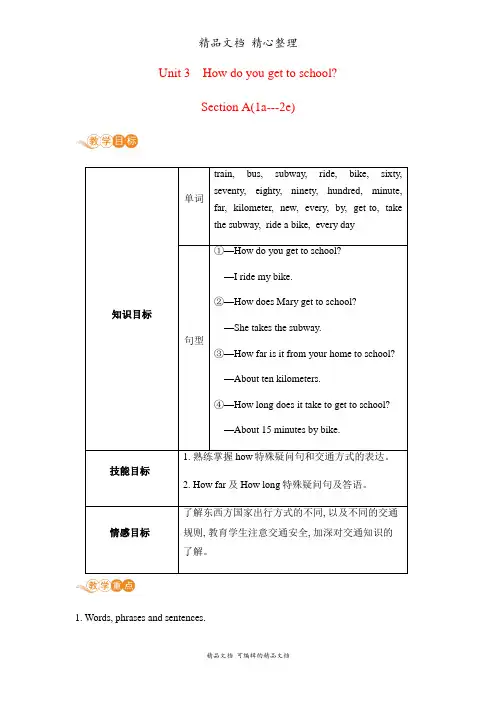
—About 15 minutes by bike.
技能目标
1.熟练掌握how特殊疑问句和交通方式的表达。
2. How far及How long特殊疑问句及答语。
情感目标
了解东西方国家出行方式的不同,以及不同的交通规则,教育学生注意交通安全,加深对交通知识的了解。
2. Play the tape of 2a.
3. Let Ss look at the chart of 2b carefully.
4. Play the tape of 2b.
1. Ss listen and repeat. Then write the correct numbers next to the word.
Unit 3How do you get to school?
Section A(1a---2e)
知识目标
单词
train, bus, subway, ride, bike, sixty, seventy, eighty, ninety, hundred, minute, far, kilometer, new, every, by, get to, take the subway, ride a bike, every day
About 15 minutes by bike.
2. Let Ss read theconversation together after the tape.
3. Explain the difficulties.
4. Let Ss read in pairs.
5. Let several pairs of students role-play the conversation in front of the class.
2019——2020学年人教版英语七年级下册Unit3教案

a.教师可以通过设置具体情境,帮助学生理解频率副词的层次,如通过图表展示不同活动发生的频率,让学生选择合适的副词进行描述。
b.在语法教学环节,教师应明确指出一般现在时态用于描述习惯性动作或普遍真理,并通过例句展示其用法,如:"He always eats breakfast at 7:00 a.m."
在反思今天的课堂时,我也意识到教学难点和重点的讲解需要更加具体和细致。尤其是对于一些理解上存在困难的学生,我需要设计更多的例句和练习,以确保他们能够彻底掌握这些语言点。
-句型:掌握"How often do you...?"句型的用法,并能用一般现在时态回答相关问题。
-语法:理解和运用一般现在时态描述日常习惯,特别是频率副词的使用规则。
举例:在课堂活动中,教师应重点强调如何将频率副词与动词结合起来,形成完整的句子,如:"I usually exercise every morning."
4.学习能力:通过小组合作、互动交流等形式,激发学生的学习兴趣,培养其自主学习、合作学习和探究学习的能力,为终身学习奠定基础。
三、教学难点与重点
1.教学重点
-词汇:本节课的核心词汇包括always, usually, often, sometimes, never等频率副词,以及与日常活动相关的动词(如:exercise, watch TV, play computer games等)。
2. Section B:通过对话和短文,运用目标词汇和句型谈论日常锻炼习惯。
3. Grammar Focus:学习一般现在时态的用法,特别是频率副词的使用。
4. Fun Time:创编小对话,让学生运用所学语言进行实际交流,巩固课堂所学。
初一七年级英语下册人教版Unit 3 How do you get to school? 单元教案、教学设计

Unit 3 How do you get to school?Learning Objectives一、Topics(话题):Transportation二、Functions (功能)Talk about how to get to places三、Structures (结构)1. How questions2. How long questions3. How far questions四、Target Language (目标语言)How do you get to school?I ride my bike.How long does it take to get to school?It takes about 20 minutes.How far is it from your home to school?It’s about two kilometers.五、V ocabulary (词汇)train, bus, subway, bike, car, boat, river, year, minute, kilometer, sixty, seventy, eighty, ninety, hundred, ride, drive, live, leave, cross take the train/bus, go by bike/subway, ride a bike, drive a car, think of, between … and …, leave home/school, come true六、Skills (技能)Listening for key informationScanning in reading七、Recycling (复习巩固)Numbers 1–30I usually …It is easy to …Thanks for …八、教材分析本单元以How do you get to school?为中心话题,主要运用How long/How far 询问“去某地的交通方式、时间、距离”,简单描述路线。
人教版七年级英语下册unit3教案

Unit 3 How do you get to school?Section A (1a-2d)一、教学目标:1. 语言知识目标:1) 能掌握以下单词:train, bus, subway, ride, bike, sixty, seventy, eighty, ninety, hundred, far, minute, kilometer, new, every, every day2) 能掌握以下句型:①—How do you get to school? —I ride my bike.②—How does Mary get to school? —She takes the subway.2. Talk about how to get to places (谈论出行方式)take the bus /subway /train /taxi , ride a bike /walk .3. how引导的特殊疑问句,表示乘坐何种交通工具的方式。
how far, how long 引导的特殊疑问句。
4. 复习基数词及时间的表示方法。
二、教学重难点1. 教学重点:1) how /how far /how long 引导的特殊疑问句.2) 乘坐交通工具的表示方法.3) It takes / sb some time to do sth .2. 教学难点:—How do you get to school? —I take the …/ride …/ walk…—How does Mary get to school? —She takes the subway.—How long does it take? —It takes forty minutes.—How far is it from… to…—It's… kilometers.三、教学过程Ⅰ. Warming-up and Lead in学生和老师进行简单的问候Ss : Good morning , teacher.T: Good morning , classT: Look at the picture. What can you see? Do you like your school? I usually get to school by bike, but sometimes on foot . How do you get to school?Ss 按实际情况作答S1: I ride my bike.S2: I go by bus.S3: ………T: Very good. You’re clever. Let’s learn Unit 4 Section A.之后板书:“Unit 4 How do you get to school?”Ⅱ. Presentation1. T: If you are here, but your school is in Shanghai. How do you get to school?Ss: I take the bus /plane/ boat / ship / car / taxiI ride a bike / motorbikeT: Do you know any other way?2. Teacher shows pictures on the big screen .归纳出行方式和常用短语.Ask some questions about how you get to…?(让学生积极主动的思考想象总结,多媒体增加趣味性,加强直观性,效果事半功倍)3. Show a picture about Part 1, on the screen.Point at girls or boys in the picture.Ask students to answer and write in the blanks.S1 : How does he / she go to school?S2 : He / She … …Ⅲ. 1aT: Look at the picture on your book. Match the words with the picture.(学生们完成1a的学习任务,然后校对答案)Ⅳ. Listening1. Make sure the Ss know what to do. Give them an example orally if possible.2. Read the names in the box.3. Play the tape and check the answers.Ⅴ. Pair workAsk two students to read the dialogue in the speech bubbles to the class. Then ask students to work in pairs. Ask and answer how students get to school in the picture.Finally ask some pairs of students to present their conversations to the class.Ⅵ. Listening1. Revise the numbers, first, zero~nine, next, ten~nineteen, then, twenty, thirty,forty…finally, twenty-one, twenty-two…Teach the new word "hundred".2. Play the tape for the students to finish 2a. Then play again and check the answers Ⅶ. PresentationShow a picture on the TV and explain these are your home and school.Teach: home----school How long 10 minutes How far two kilometersThen make up a dialogue to practice.A: How do you get to school?B: I usually take the bus.A: How far is it from your home to school?B: It's about two kilometers.A: How long does it take?B: It takes 30 minutes by busⅧ. Listening1. Tell Ss the following recording is about how Tom and Jane go to school.2. First, listen to the recording fill in the first column.3. Then, play the recording for the Ss again. Ss listen and complete the rest of thechart.4. Check the answers.Ⅸ. Role-play1. Read the dialogue and find the answer to these questions:①How does Jane get to school?②How far is it from home to school?③How long does it take to get to school from her home?2. Ss read the conversations and then find the answers to the questions.3. Check the answers with the class.4. Play the recording for the Ss to listen and repeat.5. Ss read the conversation then role-play the conversation.6. Let some pairs act out the conversation.HomeworkRole-play the conversation after class.教学反思:学生们初步掌握take 的用法但不熟练,需加强练习和记忆。
人教版七年级下册英语Unit3第三课时表格课时教学设计

1.教学活动:教师引导学生回顾本节课所学内容,总结一般现在时和频率副词的用法。
2.学生分享:学生分享自己在课堂上的收获和感悟,互相交流学习经验。
3.教学目的:通过总结归纳,帮助学生梳理所学知识,提高学习效果。
在整个教学内容与过程中,教师应以学生为中心,关注学生的个体差异,充分调动学生的积极性,激发他们的学习兴趣。同时,注重培养学生的合作精神、口语表达能力和阅读理解能力,为他们的英语学习奠定坚实基础。
人教版七年级下册英语Unit3第三课时表格课时教学设计
一、教学目标
(一)知识与技能
在本课时中,学生将通过学习人教版七年级下册英语Unit 3的第三课时,掌握以下知识与技能:
1.能够理解并运用表示日常活动的动词短语,如“go shopping”、“play soccer”、“watch TV”等。
2.能够运用一般现在时描述自己和他人的日常活动。
3.合作学习,提高口语表达能力:
采用小组合作的形式,进行角色扮演活动,让学生在实际情境中运用所学知识进行口语交流。通过互帮互助,提高学生的口语表达能力,培养团队精神。
4.阅读指导,提升阅读理解能力:
引导学生关注表格中的关键信息,通过阅读策略训练,提高他们获取、整理、运用信息的能力。针对不同难度的表格材料,设计相应的阅读任务,使学生在实践中提升阅读理解能力。
4.培养学生的团队精神和跨文化交际意识,为未来国际交流打下基础。
四、教学内容与过程
(一)导入新课
1.教学活动:教师播放一段关于日常活动的视频,引导学生关注视频中的人物正在做的事情,如“go shopping”、“play soccer”、“watch TV”等。
2.教师提问:What are they doing? How often do they do these activities?
新人教版七年级英语下册Unit3第三课时学案

Unit3第三课时1.课题概说:本节课我们主要学习阅读短文,从中找到有用的信息,学会正确地回答问题。
2.基础词汇:cross横过,越过river江,河between 介于...之间many许多village村庄bridge桥boat小船year 年,岁ropeway索道afraid害怕like像villager村民leave 离开dream梦想,做梦true真的3.必备词组:bus stop车站,bus station汽车站,trainstation火车站,subway station地铁站think of 认为between...and...在...与...之间come true 实现,in a village在一个村庄go on a ropeway 乘溜索11-year-old11岁的4.疑难句型解析:(1) Do you go by bus or by train?你乘公汽还是乘火车去上学?(2) For many students, it is easy to get to school. 对许多学生来说,上学很容易。
(3) There is a very big river between their school andthe village .在村与校间有条很大的河。
(4) There is no bridge and the river runs too quickly for boat.没有桥而且水流湍急,不能行船。
(5) It’s their dream to have a bridge .他们梦想能有座桥。
5.课文鸟瞰:阅读短文回答下列问题Crossing the River to SchoolHow do you get to school? Do you walk or ride a bike ? Do you go by bus or by train? For many students, it is easy to get to school .But for the students in one small village in China, it is difficult .There is a very big river between their school and the village .There is no bridge and the river runs too quickly for boats .So these students go on a ropeway to cross the river to school .One 11-year-old boy ,Liangliang, crosses the river every school day .But he is not afraid .“I love to play with my classmates .And I love my teacher .He’s like a father to me .”Many of the students and villagers never leavethe village .It’s their dream to have a bridge .Can their dream come true ?根据短文内容,回答下列问题:1.How do the students in the village go to school?2.Why do they go to like this ?3.Does the boy like his school ?4.What is the villagers ‘ dream? Do you think their dream can come true? How ?【巩固练习】再读一遍短文,用短文中的单词完成句子。
初中英语人教版七年级下册Unit 3教学设计
1)Purpose
Help the Ss learn and use the key words , key phrases and target languages well.
2)Activities:
1) Present the situations for the students .
5) Pair-work and group-work. Give them some minutes to practice the dialogue and make a report.
6)Check the pair-work and group-work.
Step 4 Summary
Sum up the key words ,phrases and sentences.
2..Make a survey about how the people around you get to places.
课
后
反
思
本节课我从生活实际出发导入新课,教学环节紧凑,内容层层递进,重点突出,练习到位。在讨论中体现了分层教学,激发了不同层次学生的积极性和主动性,给学生渗透了绿色出行的理念,达到了预期的教学目标。不足之处是应更宽地拓展学生的参与面,课堂气氛再活跃一些。
备课组长签字
教学
方法
municativeteaching method
2.Audio-visual teaching method
3.Task-based teaching method
学法
指导
(1). By listening
(2). By discussing
(3).By practicing
英语人教版七年级下册unit3教案
新人教版七年级英语下册第三单元教案Unit 3 How do you get to school?一、教学目标1.能谈论出行的方式A:Do Jane walk to school?B:No ,she doesn’t. She goes by bike .A:Do they take the bus to school ?B: No ,they don’t. They walk .2. 能熟练运用how, how long ,how far引导的特殊疑问句询问出行方式、所花费时间和两地之间的距离。
A:How do you get to school ?B:I ride my bike .A:How long does it take to get to school ?B:It takes about 15 minutes .A:How far is it from your home to school ?B:It’s only about two kilometers .二、重点词汇1. one hundred and five表示具体的“几百”时,用“基数词+hundred”表示,注意此时hundred 不能加s.hundreds of表示“数百;成百上千的”,这是hundred后面有s,而且hundreds后面要有介词of,并且不能与数词连用。
与hundred 用法类似的还有单词:thousand,million,billion.Our school is so famous that_____ people come and visit it every term.A. hundredB. hundredsC. hundred ofD. hundreds of2. I ride it to school every day.ride “骑”,后可接bike, horse, motorbike等。
新人教版七年级下册英语 Unit 3 第3课时 教学课件
1. b bus stop
2.
a train station
3. c bus station 4. d subway station
第五页,共十四页。
新课讲解
Guessing
How does he get to work?
First, he walks to the bus stop. Then, he takes a bus to work.
A: How do you get to school?
B: Well, first, I ride my bike to the subway station. Then I take the subway.
第九页,共十四页。
新课讲解
1c Listen and check(√ ) the things that Mary wants
to know.
Mary wants to know...
___ where Bob lives. _√__ how far he lives from his grandparents’ home. _√__ how he gets to his grandparents’ home. _√__ how long it takes to get to his grandparents’ home. ___ what he thinks of the trip
第十二页,共十四页。
当堂小练
根据汉语,完成句子
1.你怎样去上学?
_H__o_w_ do you __g_e_t_t_o_s_c_h_o_o_l?
2.你住的离学校有多远?
_______do you live __________?
人教版七年级英语下册Unit3教案
⼈教版七年级英语下册Unit3教案Unit 3 How do you get to school?单元教学⽬标⼀、Teaching Aims(教学⽬标)1.Knowledge Object and Ability(知识与技能)(1)掌握有关交通的词汇,如take the subway/train, ride the bicycle, by bus/boat, transportation, bus stop, trainstation,kilometer, mile, river以及其他⼀些词汇。
(2)掌握由how引导的特殊疑问句,表⽰乘坐何种交通⼯具的⽅式.how far,how long 引导的特殊疑问句及其答句:How do you get to school? I ride my bike.How long does it take?It takes about ...minutes.How far is it from your home to school? It’s /doc/93990d89f011f18583d049649b6648d7c1c7088f.html es...(3)复习基数词及时间的表达⽅法.(4)了解中外⽂化的差异.2.Process and teaching methods(过程与⽅法):(1)情景交际法:本单元话题源⾃⽣活,⽴⾜这⼀点,充分利⽤学⽣已有的知识和经验,创设⽣活化的真实情境,引导学⽣在运⽤中学习语⾔,然后在学习新的语⾔知识后创造性地运⽤语⾔(为⽤⽽学,在⽤中学,学了能⽤)。
(2)任务型语⾔教学法:设计多种任务活动,提供给学⽣合作交流的空间和时间,促使学⽣为完成任务和同学进⾏合作,为完成任务进⾏探究学习。
(3)开放性教学策略:教师要开放性地处理教材,结合教材插⼊学⽣感兴趣的图⽚、电影⽚段等,丰富学⽣知识,拓宽他们视野,实现知识的整合。
3.Moral Objects(情感态度与价值观):Through learning this unit , Ss can enable them to care for each other whenever crossing the roads and pay attention to the sign of traffic⼆、Teaching Key points(教学重点):掌握有关交通的词汇,如take the subway/train, ride the bicycle, by bus/boat, transportation, bus stop, train station,kilometer, mile, river以及其他⼀些词汇。