
高一人教版英语必修1课件 Unit 2 English around the world Using Language
Unit2
English around the world
第四课时
Using
Language
课前自主预习
课上重点讲解
课后强化作业
课前自主预习
Ⅰ.词汇过关 1.expression n. 词语;表示;表达→express vt. 表 示;表达 2.African adj. 非洲的;非洲人的→Africa n. 非洲 3.eastern adj. 东方的;东部的→southeastern adj. 东 南方的;来自东南的→northwestern adj. 西北方的;来自西 北的 4.recognize vt. 辨认出;承认;公认
课上重点讲解
1.Believe it or not, there is no such thing as standard English. 信不信由你,(世界上)没有什么标准英语。 [点津1] believe it or not 表示“信不信由你”;在句中作插入 语。 ①Believe it or not, he walked 12 miles to get help for you. 信不信由Байду номын сангаас,为你们求援,他步行了十二英里。
①Such a clever boy. 如此聪明的一个男孩。 ②Such an excellent student. 如此出色的一个学生。
[巩固训练] (1)(2010· 浙江-18)—According to my grandma, it is a good idea to eat chicken soup when you have a cold. —________, scientists agree with her. A.Sooner or later B.Once in a while C.To be exact D.Believe it or not
Ⅲ.经典句子 1.Believe_it_or_not,there standard English. 信不信由你,(世界上)没有什么标准英语。 2.So people from the mountains in the southeastern USA speak with almost the_same dialect as people in the northwestern USA. 因此,美国东南山区的人同美国西北部的人所说的方言 几乎相同。 is no_such thing as
②Believe it or not, we were left waiting in the rain for two hours. 信不信由你, 我们冒雨一直等了两个小时。 [点津2] no such... 没有这样/类的…… There is no such student in our class. 我们班上没有这样一个学生。
答案:(3)One such book (5)few such (4)many such books
2.When people use words and expressions different from the“standard language”, it is called a dialect. 当人们使用不同于“标准英语”的词语时,那就叫方 言。
5.accent n. 口音;腔调;重音 6.lightning n. 闪电 7.straight adv. 直接;挺直 adj. 直的;笔直的 8.block n. 街区;块;木块;石块
Ⅱ.短语自查 1.扮演一个角色;参与 play_a_part(in) 2.信不信由你 believe_it_or_not 3.建立;增进(健康) build_up 4.世界各地 all_over_the_world 5.从一个地方到另一个地方 from_one_place_to_another 6.转过拐角 go_around_the_corner 7.不断地/总是干某事 keep_doing_sth.
[点津] expression n. 词语;表示;表达;表情 ①Hearing her son was ill, the mother showed a worried expression on her face. 听说儿子病了,这位母亲脸上流露出焦急的表情。 ②The beauty of the Bird's Nest is beyond expression. 鸟巢的美无法形容。
答案:D 本题题意:“在我奶奶看来,在你感冒时喝 鸡汤是个好主意。”“信不信由你,科学家们与她的观点一 致”。A项“迟早”;B项“偶尔”;C项“确切地说”;D 项“信不信由你”。
(2)I'm amazed to hear from my school teacher again.________,it is ten years since we met last. A.In a word C.That's to say
[拓展] 当such与no/other/many/some/one等同时修饰名词时, 应该no/other/many/some/one在前,such在后。 One such collection of coins was found in America. 在美国发现了这样一堆硬币。 注意:当such与不定冠词a/an同时修饰某一可数名词单 数时,such应该在前,a/an在后。如:
答案:D
B.What's more D.Believe it or not
考查了状语的用法。本题题意:再次收到我
学校老师的来信我非常吃惊,信不信由你,自从上次见面以 来,现在已经10年了。believe it or not“信不信由你”;in a word“总之,一句话”;what's 是”;that's to say“也就是说”。 more“而且,更重要的
完成句子 (3)________________________is enough. 这样的书一本就够了。 (4)There are____________________in the library. 图书馆里有很多这样的书。 (5)There are________________stories in this book. 这本书里很少有这样的故事。
English around the world
第四课时
Using
Language
课前自主预习
课上重点讲解
课后强化作业
课前自主预习
Ⅰ.词汇过关 1.expression n. 词语;表示;表达→express vt. 表 示;表达 2.African adj. 非洲的;非洲人的→Africa n. 非洲 3.eastern adj. 东方的;东部的→southeastern adj. 东 南方的;来自东南的→northwestern adj. 西北方的;来自西 北的 4.recognize vt. 辨认出;承认;公认
课上重点讲解
1.Believe it or not, there is no such thing as standard English. 信不信由你,(世界上)没有什么标准英语。 [点津1] believe it or not 表示“信不信由你”;在句中作插入 语。 ①Believe it or not, he walked 12 miles to get help for you. 信不信由Байду номын сангаас,为你们求援,他步行了十二英里。
①Such a clever boy. 如此聪明的一个男孩。 ②Such an excellent student. 如此出色的一个学生。
[巩固训练] (1)(2010· 浙江-18)—According to my grandma, it is a good idea to eat chicken soup when you have a cold. —________, scientists agree with her. A.Sooner or later B.Once in a while C.To be exact D.Believe it or not
Ⅲ.经典句子 1.Believe_it_or_not,there standard English. 信不信由你,(世界上)没有什么标准英语。 2.So people from the mountains in the southeastern USA speak with almost the_same dialect as people in the northwestern USA. 因此,美国东南山区的人同美国西北部的人所说的方言 几乎相同。 is no_such thing as
②Believe it or not, we were left waiting in the rain for two hours. 信不信由你, 我们冒雨一直等了两个小时。 [点津2] no such... 没有这样/类的…… There is no such student in our class. 我们班上没有这样一个学生。
答案:(3)One such book (5)few such (4)many such books
2.When people use words and expressions different from the“standard language”, it is called a dialect. 当人们使用不同于“标准英语”的词语时,那就叫方 言。
5.accent n. 口音;腔调;重音 6.lightning n. 闪电 7.straight adv. 直接;挺直 adj. 直的;笔直的 8.block n. 街区;块;木块;石块
Ⅱ.短语自查 1.扮演一个角色;参与 play_a_part(in) 2.信不信由你 believe_it_or_not 3.建立;增进(健康) build_up 4.世界各地 all_over_the_world 5.从一个地方到另一个地方 from_one_place_to_another 6.转过拐角 go_around_the_corner 7.不断地/总是干某事 keep_doing_sth.
[点津] expression n. 词语;表示;表达;表情 ①Hearing her son was ill, the mother showed a worried expression on her face. 听说儿子病了,这位母亲脸上流露出焦急的表情。 ②The beauty of the Bird's Nest is beyond expression. 鸟巢的美无法形容。
答案:D 本题题意:“在我奶奶看来,在你感冒时喝 鸡汤是个好主意。”“信不信由你,科学家们与她的观点一 致”。A项“迟早”;B项“偶尔”;C项“确切地说”;D 项“信不信由你”。
(2)I'm amazed to hear from my school teacher again.________,it is ten years since we met last. A.In a word C.That's to say
[拓展] 当such与no/other/many/some/one等同时修饰名词时, 应该no/other/many/some/one在前,such在后。 One such collection of coins was found in America. 在美国发现了这样一堆硬币。 注意:当such与不定冠词a/an同时修饰某一可数名词单 数时,such应该在前,a/an在后。如:
答案:D
B.What's more D.Believe it or not
考查了状语的用法。本题题意:再次收到我
学校老师的来信我非常吃惊,信不信由你,自从上次见面以 来,现在已经10年了。believe it or not“信不信由你”;in a word“总之,一句话”;what's 是”;that's to say“也就是说”。 more“而且,更重要的
完成句子 (3)________________________is enough. 这样的书一本就够了。 (4)There are____________________in the library. 图书馆里有很多这样的书。 (5)There are________________stories in this book. 这本书里很少有这样的故事。
合集下载
人教版高中英语必修1 Unit 2《English around the_world》课本单词课件(共54张PPT)
⑶ He __________ the policeman and asked the wayc. ame up to
(4) This idea _c_a_m_e_u_p_ at the meeting yesterday.
2.because of 因为;由于(短语介词)
because 因为;由于(连词)
19.___s_p_e_l_li_n_g______ n. 拼写 20.____la_t_t_er________ adj. 较后的,后者的 21.____id_e_n_t_it_y______ n. 身份 22.____f_lu_e_n_t________ adj. 流利的 23. ___fl_u_e_n_t_ly________ adv. 流利地 24.____fr_e_q_u_e_n_t_______ adj. 频繁的, 25.___f_r_e_q_u_e_n_t_ly_______adv. 频繁地
同义:as a result of,due to,thanks to
because后加原因状语从句 because of 后加名词,动名词,代 词宾格以及what引导的宾语从句。
运用:用because 或because of填空。
⑴ He came late to school again _b_e_c_a_u_s_e he got up too late.
1. ____s_u_b_w__a_y______ n. 地铁 2._____el_e_v_a_t_o_r__ n.电梯 3. ____p__et_r_o_l_______ n. <英> 石油 4.______g_a_s_________ n. <美>汽油,煤气 5.______o_ff_i_c_ia_l______ adj. 官方的,正式的 6._____v_o_y_a_g_e_______ n. 航海,航行
(4) This idea _c_a_m_e_u_p_ at the meeting yesterday.
2.because of 因为;由于(短语介词)
because 因为;由于(连词)
19.___s_p_e_l_li_n_g______ n. 拼写 20.____la_t_t_er________ adj. 较后的,后者的 21.____id_e_n_t_it_y______ n. 身份 22.____f_lu_e_n_t________ adj. 流利的 23. ___fl_u_e_n_t_ly________ adv. 流利地 24.____fr_e_q_u_e_n_t_______ adj. 频繁的, 25.___f_r_e_q_u_e_n_t_ly_______adv. 频繁地
同义:as a result of,due to,thanks to
because后加原因状语从句 because of 后加名词,动名词,代 词宾格以及what引导的宾语从句。
运用:用because 或because of填空。
⑴ He came late to school again _b_e_c_a_u_s_e he got up too late.
1. ____s_u_b_w__a_y______ n. 地铁 2._____el_e_v_a_t_o_r__ n.电梯 3. ____p__et_r_o_l_______ n. <英> 石油 4.______g_a_s_________ n. <美>汽油,煤气 5.______o_ff_i_c_ia_l______ adj. 官方的,正式的 6._____v_o_y_a_g_e_______ n. 航海,航行
人教版高一英语必修1-Unit2-全套课件

二、请求的句型
1. would you please...?
could you please...? 你能…吗?/你可以…吗? 2. Would you mind +动名词: 如果不介意的话….. 3. How about +动名词+其他: …..怎么样可以么? 4. Please +动词原形:请…… 5. Would you like +动词原形:…..可以么?
The U.S.A.
Singapore
A: Do you like moving pictures?
B: Well. Yeah. Why not?
A: Ok, follow me .
笑
B: what?
话
A: Let’s go downstairs to move the pictures.
高考链接
1. Lizzie was __B__ to see her friend off at the airport. (2004,全国卷IV) A a little more than sad B more than a little sad C sad more than a little D a little more than sad 解析:more than a little + adj. 表“非常”的意思。
English Around the World
the United Kingdom
Ireland
India the USA
Canada
South Africa
Australia New Zealand
Australia
Canada
India
人教版高一英语必修一Unit_2_词汇教学 PPT课件 图文
•
present sb with sth 把某物送给某人
•
present sb to sb 把某人介绍给某人
• Eg: When Mr. Brown left the firm, the director
presented a gold watch to him.
• The mayor presented the winner with a silver cup.
handwriting.
• such as
• (1)例如……
• such as 和 for example/instance都可作“例如” 讲,但such as用来例举事物,放在被列举的
事物和前面的名词之间。其后直接跟名词,
没有逗号,一般不与and so on连用;for example/instance用来举例说明,可用作插入 语用在句子中,后面一般有逗号。
• 注意:
• come up作“被提出”“被谈到”讲时为不 及物动词,不用于被动语态,它用于下列 两种结构中:sb come up with sth 和 sth come up.
• base vt.或n. • (1)建于……之上,以……为根据 搭配:base…on/upon… 把……建立在……上
• Eg: You must make good use of any opportunity to practise English.
• 搭配: make good use of 好好利用
•
make full use of 充分利用
•
make better use of 更好地利用
•
make the best use of 最好地利用
• Eg: The Titanic sank on its maiden voyage.
英语:Unit2《English around the world》课件-reading(新人教版必修1)
Suggested answer:
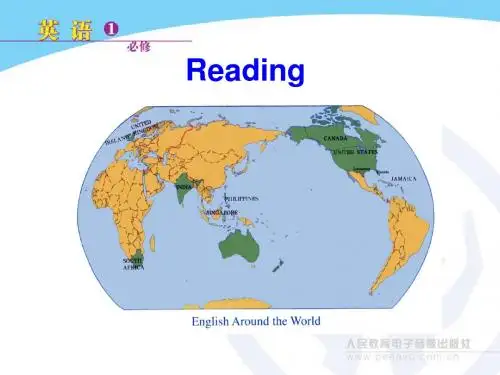
1. America, Britain, Canada, Australia, New Zealand, Singapore, Philippines, India 2. For those that speak English as their first language the USA or India must have the largest number of native speakers as they have the largest populations. For those who learn English as their first foreign language China must have the largest number as it has the largest population.
Homework
1. Reread the passage and list the reasons why English is spoken in many countries. 2. Review the words and expressions in the passage and try to use it in the sentences with context.
3. Guess according to the title.
The road to modern English
?
The road Modern English
the development of English language
What kind of English before Modern English?
1. English spoken in some other countries 2. changes of English 3. the change of English speakers 4. different kinds of Englishes
人教版高中英语 必修一 Unit2 《English around the world---Reading》 课件 (共27张ppt).ppt

Conclusion
Language can change with time.
Language can change
time
when cultures
communicate with
each other.
place
Some people say that Chinese is a much more elegant language, so it is more important for us to master it and it is not so necessary to master foreign language. Do you agree with this opinion and why?
Noah Webster Born: October 16, 1758 Died: May 28, 1843 When Noah was 43, he started writing the first American dictionary. He did this because Americans in different parts of the country spelled, pronounced and used words differently.
3 ____ will tell if Chinese English develop its own identity. A time B people
Thinking
Will Chinese English become one of the world Englishes?
“Only time will tell”.
Choose the main idea of the text.
人教版高中英语必修一Unit2Englisharoundtheworld整个单元课件

reignorsecondlanguageinmanycount ries.
15
Reading–III(5m)
Groupwork: Whatcanyoulearnfromthispassage? (discussingroupoffour,thenaskthestudentsto showtheirideas.)
2.Prepareforthenextclass. 3.FinishtheexercisesonWB.
19
20
Period3Learningaboutl anguage
Unit2Englisharoun dtheworld
21
Period3:幻灯片27-48页
Revision(3m)
Match:(Reivewthenewwords)
sIspoketothemjustnow? Helpthestudentsunderstandwhatisaco mmandorarequest.
27
Learningusefulstructure–II(2m)
Makeclearthedifferencebetweencommandsan drequestsandfinishthefollowingexercises:
apartment
autumn
fall
underground(地铁) subway university(大学) college
rubbish(垃圾) garbage
dustbin(垃圾箱) trashcan
holiday
vacation
fortnight(两星期)twoweeks
12
Reading–I(3m)
&
15
Reading–III(5m)
Groupwork: Whatcanyoulearnfromthispassage? (discussingroupoffour,thenaskthestudentsto showtheirideas.)
2.Prepareforthenextclass. 3.FinishtheexercisesonWB.
19
20
Period3Learningaboutl anguage
Unit2Englisharoun dtheworld
21
Period3:幻灯片27-48页
Revision(3m)
Match:(Reivewthenewwords)
sIspoketothemjustnow? Helpthestudentsunderstandwhatisaco mmandorarequest.
27
Learningusefulstructure–II(2m)
Makeclearthedifferencebetweencommandsan drequestsandfinishthefollowingexercises:
apartment
autumn
fall
underground(地铁) subway university(大学) college
rubbish(垃圾) garbage
dustbin(垃圾箱) trashcan
holiday
vacation
fortnight(两星期)twoweeks
12
Reading–I(3m)
&
Unit2《English Around the World》Reading课件(新人教版必修1)
Second reading
Make a timetable of the development of English. English was based more During the 5th century AD: on German Between about AD 800 and 1150: English was influenced by Danish and French invades. Shakespeare used a wider voacbulary By the 1600s: than ever before. British setters moved to America in the 1620: “Mayflower.” From the 18th century : British colonized Austrilia
7 native
8 come up 9 because of
19 identity
20 fluent 21 frequent
10 apartment
11 actually
22 usage
23 command
12 at present
24 request
25 dialect 26 expression 27 midwestern 28 African 29 Spanish 30 play a role (in) 31 recognize 32 accent 33 lightning 34 stright 35 block 36 cab
1765-1947 English spoken in India
By 19th century: Dictionaries standardized the spelling of English
英语:必修1 Unit2 English around the world--Listening课件(人教新课标)
Listening – II ( 10m )
Listening Task on Page 51. • 1. Ask the students to tell the names of the countries where English is spoken. • 2. Finish the listening task. • ( Students give their own answers after listening.)
Conclusion for listening skills (10m)
• After each step of listening, ask the students who did best to tell how he / she did it, other students can have a discussion or ask him / her some questions.Everyone should try his best to find a good way for himself to improve his listening ability.
Listening – I ( 13m )
Listening on Page 14. 1. Listen to the tape for the first time and try your best to get the main idea of what is talking. 2. Listen to the tape for the second time, pay attention to the exercise of page 14. Try your best to find out the answers to these questions.
人教版高一英语必修一课件:Unit2English around the word (共84张PPT)
警察要求目击者描述一下前一天所发生的事情。
• [联想发散] command后面跟从句时,从句谓语 用(should+)do/be done,以下动词具有相同的用 法: • 一坚持:insist; • 二命令:order,command; • 三建议:suggest,advise,recommend; • 四要求:demand,request,require,desire; • 再加一个敦促:urge。
我们的老师要求我们对考试做好充分的准备。 ② Don't respond to any e-mails r_e_q_u_e_s_t_in_g___(request)personal information , no matter
11.f_r_eq__u_e_n_t __ adj. 频繁的;
常见的 fr_e_q_u_e_n_t_ly___ adv. 常常;频繁地
12._la_t_t_e_r___ adj. 较后的;后半的;
(两者中)后者的 l_a_te_s_t___adj. 最新的;最近的 la_t_e_r___adv. 后来;adj.以后的 la_t_e_ly___ adv. 近来;最近
③The police commanded the witness to describe what had happened the day before.
→ The police commanded that the witness (s_h_o_u_l_d_)d__es_c_r_i_b_e__what had happened the day before.
3.The doctor said to me,“Come in.” →The doctort_o_ld____met_o_g_o___in.
• [联想发散] command后面跟从句时,从句谓语 用(should+)do/be done,以下动词具有相同的用 法: • 一坚持:insist; • 二命令:order,command; • 三建议:suggest,advise,recommend; • 四要求:demand,request,require,desire; • 再加一个敦促:urge。
我们的老师要求我们对考试做好充分的准备。 ② Don't respond to any e-mails r_e_q_u_e_s_t_in_g___(request)personal information , no matter
11.f_r_eq__u_e_n_t __ adj. 频繁的;
常见的 fr_e_q_u_e_n_t_ly___ adv. 常常;频繁地
12._la_t_t_e_r___ adj. 较后的;后半的;
(两者中)后者的 l_a_te_s_t___adj. 最新的;最近的 la_t_e_r___adv. 后来;adj.以后的 la_t_e_ly___ adv. 近来;最近
③The police commanded the witness to describe what had happened the day before.
→ The police commanded that the witness (s_h_o_u_l_d_)d__es_c_r_i_b_e__what had happened the day before.
3.The doctor said to me,“Come in.” →The doctort_o_ld____met_o_g_o___in.
Unit2 English around the world Period2 课件(新人教版必修1)
Why has English changed
over time?
Because of cultural communication.
Time
During the 5th century AD Between about AD 800 and 1150 By the 1600’s 1620
What happened
Task 3: Fill in the forms
Development of English
people
today the end of the 16th century the next century More people speak in more countries
England
Many other countries
The road to modern English
Task 1: skimming
Please match the main idea to each paragraph.
Para 1 Para 2 Para 3 Para 4 Para 5
Native speakers can understand each other even if they don’t speak the same kind of English. By the 19th century the language was settled finally. Why has English changed over time? English is spoken as a foreign language or second language in Africa and Asia. Many people all over the world speak English.