
仁爱版英语八年级上册Unit4 Topic3 SectionB教学设计
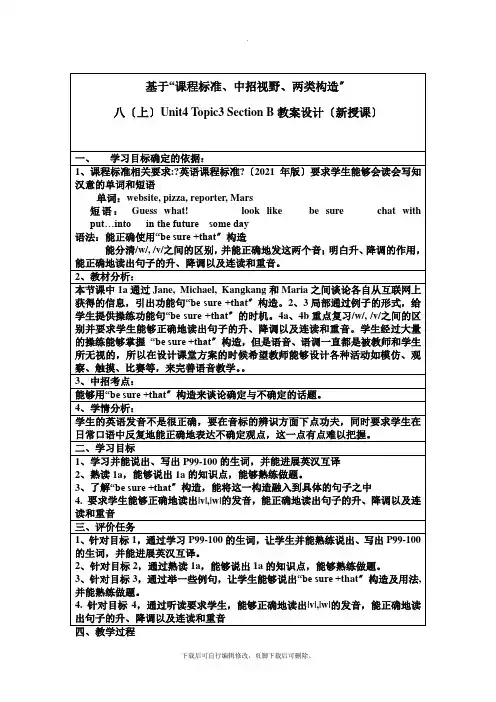
Unit4Our WorldTopic3The Internet makes the world smaller.(Section B)教学设计[Material analysis]本节课中1a通过Jane,Michael,Kangkang和Maria之间谈论各自从互联网上获得的信息,引出功能句“be sure+that”结构。
2、3部分通过例子的形式,给学生提供操练功能句“be sure+that”的机会。
4a、4b重点复习/w/,/v/之间的区别并要求学生能够正确地读出句子的升、降调以及连读和重音。
学生经过大量的操练能够掌握“be sure+that”结构,但是语音、语调一直都是被教师和学生所忽视的,所以在设计课堂方案的时候希望教师能够设计各种活动如模仿、观察、触摸、比赛等,来完善语音教学。
[Teaching aims]Knowledge aims:1.能根据音标正确朗读出下列单词:pizza,website,reporter。
2.能在老师的引导下分清/w/,/v/之间的区别,并能正确地发这两个音;明白升、降调的作用,能正确地读出句子的升、降调以及连读和重音。
3.能正确拼写并运用单词表中的单词,如:website,并能根据音标写出pizza,reporter等单词。
4.能正确使用“be sure+that”结构。
5.能够用“be sure+that”结构来谈论确定与不确定的话题。
Skill aims:1.能听懂谈论人们使用因特网获得信息的话题。
2.能正确地表达自己使用因特网所做的事情、并能够用“be sure+that”结构来谈论确定与不确定的话题。
3.能正确朗读课本的文本材料,能清楚模仿录音读含有/w/,/v/的单词,能根据谈话内容的需要读出句子的重音、语调等。
4.能用书面形式描述自己如何利用因特网购物、学习等,并能够用“be sure +that”结构写出句子来表达确定与不确定。
Emotional aims:能体会英语学习的乐趣,懂得在学习中遇到困难时可以通过网上查资料的形式自己解决问题。
[The key points and difficult points]Key points:1.学习“be sure+that”结构。
2.复习/w/,/v/的正确发音以及句子的升调、降调、连读和重音。
Difficult points:/w/,/v/的正确发音。
[Learning strategies]1.利用因特网在网上查找/w/,/v/之间的区别,可以帮助你在课堂上学习/w/,/v/的发音规则。
2.在课堂上多用“be sure+that”结构来谈论问题,这样你可以很快掌握这个结构。
[Teaching aids]Computer multimedia projector,mirrors,sketch map[Teaching procedures]Step InteractionpatternStudent activity Teacher activityIntroduction (5minutes)1.The wholeclass work2.The wholeclass workand individualwork3.The wholeclass work4.Pair work1.Focus students’attention onthe teacher.2.A student reads his/hercomposition like this:TheInternet helps us to findinformation of Englishlearning.And it makes theshopping cheaper.Otherstudents review thisstructure.3.Students listen to theteacher’s evaluation.Try tounderstand the meaning ofthe structure“be sure+that”.4.Students read their partner’scomposition and try toevaluate the composition withthe structure“be sure+that”.1.Get students ready for learning.2.Check students’homework aboutthe advantages of the Internet.Ask a student to read his/hercomposition in class.3.Teacher evaluates students’ideas ina low voice when students areshowing their ideas.Teacherevaluates students by saying:“Iam sure your idea is right./I amnot sure if that is a good idea”.4.Provide students with2minutesto read their partner’scomposition.And encourage themto evaluate the composition withthe structure“be sure+that”.Presentation (15minutes)1.The wholeclass work andgroup work2.The whole classwork and groupwork3.The wholeclass work4.The wholeclass work andindividual work5.The wholeclass work6.Group workand individualWork7.Group work8.Group work1.Students look at the picture,and they can get the answerquickly.Because there’s acomputer in the picture.2.Students listen to1acarefully and check theirpredictions.Study“Mars,pizza,website,reporter”ingroups.If they can’t workout the problem,they canask the teacher for help.3.Students read the new wordstogether and pay attention tothe pronunciation andintonation.4.Students listen to1a and fillin the blanks.5.Check the answers and readthe conversations sentence bysentence after the tape.6.Students finish1c and checkthe answers in groups.7.Students work in groups.Finish the passage quickly.8.Choose one student to readthe passage.Other groups tryto evaluate their passage1.Show the picture in1a to studentsand ask students to predict“Whatare they talking about?”2.Play1a and ask students to checktheir predictions.Teacher can tell thestudents like this:“I guess youranswers are all included in thecomputer.But I am not sure if youranswers are right.Let’s listen andcheck”.T eacher should use thestructure often in class.3.Teacher asks students to read thenew words together,and checktheir pronunciation.4.Finish1b.Show the table in1b tostudents,ask students to listen to1aagain carefully and fill in the table.5.Check the answers and play1asentence by sentence.6.Finish1c.Show1c to students.Ask students to rewrite theconversation in a passage based on1b.7.Finish1d.Ask students to write apassage from Jane’s point of view.8.Invite a group to share theirpassage.Other groups try toConsolidation (8minutes)1.The wholeclass work andgroup work2.Group work3.Individual work4.Group work5.Group work1.Students work in groups andanalyze the example.2.Students work in groups andanswer the four questions inthe box with the structure“be sure+that”.E.g.I am not sure ifeveryone in the world usesthe Internet in the future.3.Students give their answersand practice the structure.4.Students interview theirgroup members.A:What did yousee/hear on theInternet last night?B:I saw/I heard...C:I am not sure...Iwatched...D:I am sure...And I found...5.Students present theconversation on theplatform.Finish2.1.Show the example of2tostudents.Ask students to analyze thestructure in groups.2.Show the box in2to students.Ask students to makeconversations with the sentencesin the box.3.Invite students to share theiranswers.4.Finish3.Ask students to make asurvey in groups.Interview theirgroup members about what they sawor heard on the Internet.5.Invite two groups to present it tothe class.Give them smilingfaces.Practice (10minutes)1.The wholeclass work andindividualwork2.The wholeclass work3.The wholeclass work4.The wholeclass work5.Group workand individualwork6.The wholeclass work7.The wholeclass work1.Students look at the threegroups of words.Pronounceindividually.Then check eachother.Try to find the correctway to pronounce the twophonetic symbols.2.Students observe thedifferences between/w/and/v/,and imitate the sketchmap.3.The students look atthemselves from the mirrors,and imitate the sketch map orthe teacher.4.Students read after the tape.5.Students read in groups.Check each others’pronunciation.6.Students can find theanswer from these aspects:liaison,weak form,stress,and intonation.7.Students read4b after thetape.Pay attention to theliaison,weak form,stress andintonation.Finish4a,4b.1.Teacher says:“I am not sure if youcan pronounce/w/,/v/well.Look at4a and read in groups if you canpronounce the two phonetic symbolsthe same.I am sure you are wrong.”2.Show the sketch map.Askstudents to observe the sketchmap carefully and pay attention tothe mouth.3.Ask students to take out theirmirrors and compare themselveswith the sketch map or theteacher.4.Play the tape.Ask students tolisten and follow.5.Show4b to students and askstudents to read4b by themselves.Pay attention to/w/,/v/in thewords.6.Play4b.And ask students why therecording sounds better than themread.7.Play4b.Ask students to read afterthe tape and imitate.Production (7minutes)1.The wholeclass workand group work2.The wholeclass work3.Individualwork1.Volunteers read4b one byone.Pay more attention tothe liaison,weak form,stress and intonation.Thestudent who can read bestand get the most“A”is thewinner.And he/she is thestar of spoken English in thisweek.Other students try tochallenge him/her nextweek.2.Students read all the wordscorrectly,knowing theirmeanings.They have tomemorize their spelling aftere the structure“besure+that”often.3.Students read and record4bafter class,pay attention tothe pronunciation andintonation.Write a passageand preview Section C.1.Play a game.Find the mostbeautiful sound.Ask students toprepare four papers and write downA,B,C,D.Invite volunteers to read4b in class.Other students arecommentators.2.Teacher summarizes:(1)Write down the new words onthe blackboard:website,Mars,pizza,reporter(2)Write down the structure“besure+that”on the blackboard.I am sure that there are manyinteresting things to see on theInternet.I am not sure whetherit is good to shop online.3.Homework:(1)Read4b after class and recordit with your cell phone,andbring it to school next class.(2)Write a short passage aboutwhat you saw or heard on theInternet.And show your ideaswith the structure“be+surethat”.(3)Prepare for the learning ofSection C.[Blackboard design]Teaching ReflectionThis topic is related to students’life.Students can master the structure “be sure+that”well after practicing.But the pronunciation is still a problem.Most students can read the words well.But in a sentence,it is difficult for them to read the liaison,weak form,stress and intonation.。
Unit3 Topic3 sectionB 仁爱版八年级英语上册
八年级上册Unit 3 Topic 3 What were you doing at this time yesterday?Section B【教学构思】一、教材分析:本课属于课标话题人与自我——“个人兴趣(Personal interests)”中爱好(Hobbies)项目,主要谈论一部哈利波特电影的对话场景。
本课属于课标功能意念表“态度(Attitudes)”中同意和不同意(Agreement and disagreement)项目,主要学习同意与不同意、陈述个人观点等交际功能的基本表达法。
主要教学活动为1a和2a,2b。
本节课主要通过Jane和Michael之间的对话配合相应的图片,引出过去进行时和表达同意、不同意的句子。
谈论的内容从上个话题主要谈论过去某个时间在做什么,扩展到通过学生们熟悉的电影引出表示同意或者不同意的句子。
通过对话学习,引导学生用不同的方式表示同意或不同意。
二、设计说明:根据学情和本课的语法及话题,本节课的教学设计将听与说相结合,以1a为载体,聚焦语法,通过不同方式内化知识;在语言生成阶段,循序渐进,帮助学生运用所学。
本课在重、难点突破的方法上有所创新,教师通过设计pair work等,引导学生熟悉课文内容,接着通过仿编对话,培养学生语言运用能力。
【教学目标】1.能听懂就过去某个时段正在发生的事情的阐述以及他人对某个观点的态度,学会以“听”的方式理解语言意义;2.能积极主动地选择一些英文读物或者影视节目,养成从生活中学习英语的习惯,在分析、批判、评价等思维活动中,发展思维品质;3.能辨别音标/ l /,/ n /,/ /的区别,并模仿录音学习语音同化、重读、弱读及连读和不完全爆破,构建语言意识,提升“说”的语言能力;4.能仿编对话并用不同的方式表示同意或不同意来陈述自己的观点,发展学生多元学习策略,提高“说”的语言能力。
【教学重难点】Key points:1.继续学习sb. was / were + doing sth.的结构;2.能够用I agree with you. Just so-so.等表达自己的观点;3.复习/ l /,/ n / ,/ / 之间的发音区别。
仁爱版八年级英语上册Unit4Topic2SectionB优质教案
八年级上册教案设计Unit 4 Our WorldTopic 2 How can we protect ourselves from the earthquake?Section BⅠ. Material analysisSection B的主要教学活动为1a, 3a和3b。
本节课主要通过Miss Wang和班里的学生之间的谈话引出玉树地震的话题,在对话中了解玉树地震的信息。
简单讲述了如何在地震中逃生的问题以及复习双多音节形容词的比较级和最高级形式。
第二部分通过听力训练的方式要求学生学习表达关心的句子。
3a部分主要通过图片、音标的提示,展示了有关灾难的名词。
复习了/ð/ /θ/的不同发音以及升降调、连读和不完全爆破。
教师在讲解音标的时候可以借助多媒体或者图片,让学生直观地感受唇形、齿形和口型。
Ⅱ. Teaching aimsKnowledge aims:1. 能根据音标正确朗读出单词表中本课的单词:level, sad, calm, typhoon等。
2. 能在老师的引导下,读出句子的升降调、连读和不完全爆破,分清/ð/ /θ/之间的区别。
3. 能正确拼读并运用单词表中的黑体单词:level, sad等。
能根据音标正确地书写typhoon, flood 等。
4. 能掌握双多音节形容词的比较级和最高级的变化规则,能在具体句子中正确地应用。
5. 能正确运用本课所学知识谈论地震的话题,能够用所学知识向受灾的人们给予关爱。
Skill aims:1. 能听懂有关谈论地震的话题及用形容词比较级最高级谈论关于灾难的话题。
2. 能谈论灾难的情况,并能用所学知识表达自己的关怀。
3. 能正确朗读课本的文本材料及含有/ð/ /θ/的句子的正确发音。
4. 能用形容词的比较级和最高级写一篇有关灾难程度的文章。
Emotional aims:1. 通过本课学习,了解自然灾害带给人类的危害,学会沉着应对困难。
仁爱版八年级英语上Unit4Topic3SectionB优秀教学案例
在讲授新知环节,我首先向学生介绍一般现在时、一般过去时和一般将来时的基本结构和用法。通过举例和讲解,让学生理解和掌握这些时态的构成和表达方式。接着,我结合课本内容,向学生讲解如何用英语询问和表达现在、过去和将来的时间。例如,我通过展示一张日历,引导学生学习如何用英语表达每个月的时间,如“What time is it today?”“What time did you get up yesterday?”等。
(三)小组合作
我注重小组合作的学习方式,让学生在互动、合作中学习英语。我将学生分成不同的小组,让他们在小组内进行讨论、交流和合作,共同完成各种任务和活动。例如,我设计了一个小组讨论的活动,让学生就某一时间问题进行讨论,并给出自己的观点和理由。通过小组合作,学生能够提高团队合作能力和口语表达能力。
(四)反思与评价
在教学过程中,我以提高学生的英语口语表达能力和实际应用能力为目标,设计了丰富多样的教学活动。通过小组讨论、角色扮演、听力练习等形式,让学生在实际语境中感知、理解和运用所学知识。同时,我注重培养学生的自主学习能力,引导他们通过观察、思考、探究等方式,发现语言规律,提高学习效果。
在教学评价方面,我采用形成性评价和终结性评价相结合的方式,关注学生的学习过程和成果。通过课堂表现、小组合作、作业完成情况等多种评价手段,全面了解学生的学习状况,及时给予反馈和指导,确保教学目标的实现。
三、教学策略
(一)景创设
在教学过程中,我注重情景的创设,让学生在真实、生动的环境中学习英语。通过设计各种与时间相关的场景,如学校作息时间、家庭日常生活、约会等,让学生在实际语境中感知、理解和运用所学知识。例如,我设计了一个模拟电话交流的情景,让学生扮演不同角色,运用所学知识进行对话,从而提高他们的英语口语表达能力。
仁爱版英语八年级上册Unit1__Topic3__SectionB__精品教案

Unit1 Topic3 SectionB 精品教案Ⅰ. Material analysisSection A and Section B 的内容整合,用三个课时上完。
本节课为单元第二课和第三课时,用两课时上完。
主要活动为Section B 的1a 和3a, 3b。
通过Kangkang 和Michael相约去参加运动会,呈现了本课所要学的语法重点Future Tense with shall。
相约中,依次呈现了:What shall we take? When shall we meet? Where shall we meet? 等功能性语言。
对话中呈现了重点短语:take sth …, make it half past six等。
本对话呈现了孩子们亲密无间的友情,旨在让学生在学会课本语言知识的同时,向Kangkang 和Michael学习,善于表达自己的感情,在参加集体活动中提升同学间的友情。
语音学习要求学生掌握两个辅音字母在一起第一个辅音字母的轻读现象;学生能正确认识元音在句中的弱读现象,并能正确朗读。
Ⅱ. Teaching aimsKnowledge aims:1. 能正确认识两个辅音字母在一起第一个辅音字母的轻读现象;学生能正确认识朗读元音在句中的弱读现象,并能正确朗读发音。
2. 能听懂含有以下短语的英语对话或文章:take sth. for…, make it half past six, catch up with, neck and neck, run into等。
3. 能正确地理解下列句子和短语,并能加以运用:What shall me take?When shall we meet?take sth …, make it+时间、地点或价钱。
4. 学生能正确理解并运用shall将来时,能运用shall进行写作。
Skill aims:1. 能听懂相约见面的对话,能听懂对运动场景描述的文字材料。
仁爱初中英语八年级上册精品教案设计 Unit 2 Topic 3Section B
八年级上册教案设计Unit 2 Keeping HealthyTopic 3 Must we exercise to prevent the flu?Section BⅠ. Material analysis本课时的主要活动为1a, 3a和3b。
本课1a通过Kangkang给他的爸爸电话留言这件事,体现了医生的忙碌和重要性。
3a的语音学习,让学生体会一些辅音字母组合的发音规则。
3b的学习继续巩固学生对清辅音的不完全爆破的掌握,同时要求学生能掌握句子内部的连读现象。
Ⅱ. Teaching aimsKnowledge aims:1. 能根据读音写出规则的辅音字母组合;学生要模仿并掌握句子中的不完全爆破和连读现象。
2. 能正确运用反身代词进行听、说、读、写的学习活动。
3. 能正确写出电话留言。
Skill aims:1. 能准确朗读语言材料里的单词和句子。
2. 能听懂有关电话留言的对话或文章。
3. 能正确地运用情态动词must, mustn’t和反身代词themselves, myself, yourself, himself。
4. 能读懂有关流感等日常小病以及含有医生建议的文章。
5. 能运用情态动词、反身代词结合本课动词短语,将对话和电话留言自如地转换。
Emotional aims:通过对话学习,了解医生的忙碌,要学会理解医生。
提醒自己要保持健康。
Ⅲ. The key points and difficult pointsKey points:反身代词的运用:themselves, myself, yourself, himself, give him the message myself, finishit by myself, they have problems themselves。
Difficult points:1. tell sb. (not) to do 短语的正确使用。
2.语音中的连读和爆破的准确把握。
仁爱版英语八年级上册Unit 4 Topic 3 Section B 教案
( ) 5 Don’t let him ______. I want him ______ here for one more night.
A. leaves; stays B. leave; stay C. to leave; to stay D. leave; to stay
3、中招考点:
能够用“be sure +that〞构造来谈论确定与不确定的话题。
4、学情分析:
学生的英语发音不是很正确,要在音标的辨识方面下点功夫,同时要求学生在日常口语中反复地能正确地表达不确定观点,这一点有点难以把握。
二、学习目标
1、学习并能说出、写出P99-100的生词,并能进展英汉互译
2、熟读1a,能够说出1a的知识点,能够熟练做题。
I visited the website and a reporter said...
I’m not sure if/whether...
自学指导5
自学内容:课本100页4a-4b
自学方法读出|v|,|w|的发音,能够正确地读出句子的升、降调以及连读和重音。
自学指导4
自学内容:预习课本“be sure +that〞构造构造及用法。
自学方法:通过例子总结用法
自学时间:5分钟
自学要求:通过预习能够自己总结“be sure +that〞〞构造及用法
自学检测4
完成课本Part 3局部
E.g: I saw /looked at/watched...
I’m sure ...
学习目标
教学活动
评价要点
要点归纳
目标2、熟读1a,能够说出1a的知识点,能够熟练做题。
仁爱版八年级英语上册-Unit-4-Topic-3-Section-D-课件(共23张PPT)
The Internet is not perfect. • __u_s_e_t_h_e_I_n_t_e_r_n_e_t_t_o_h_u_r_t_o_t_h_e_r_s________ Disadvantage • __s_a_y_fa_l_se_t_h_in_g_s_a_n_d_g_e_t_m_o_n_e_y_b_y_c_h_e_at_in_g_____ • __s_p_e_n_d__to_o__m__u_c_h_t_im__e_p_l_a_y_i_n_g_g_a_m__e_s____ •__m__a_k_e_u_s__h_a_v_e_s_o_r_e_e_y_e_s_______________ • ...
(Beginning-body- end)
写作三步曲
Three steps : (Beginning-body- end)
I. Present your opinion: (呈现你的观点) The Internet is changing the world.
II. Write down the key points:(写出主要观点)
名词
make/headmaster
Mother doesn’t let the boy
(to) watch TV.
not let/watch TV
let sb. (to) do sth: 让某人 做某事
She keeps the room clean.
形容词
keep/clean
The man saw the boy playing
互联网改变了世界也改变了我们的生活, 在给我们带来了便利的同时,也产生了一 些弊端。请结合课文以及自己的思考,以 《The Advanage and Disadvantage of the Internet》为题,写一篇短文谈谈互联网的 优缺点,以及我们应该怎样正确对待它。 字数要求不少于80个。
仁爱版英语八年级上册 Unit4 Topic3 SectionA 教学设计
Unit4 Topic3 SectionA 教学设计Ⅰ. Material analysisSection A的主要教学活动为1a和2。
本节课主要是通过Maria和Kangkang的对话,来谈论因特网带给人们的便利,并简单地介绍了因特网的知识,通过对话引出了本节课的语法重点“Subject+Vt.+Object+Object complement”结构,这也是本话题的重点。
本课2部分提供了大量的图片、短语等操练该语法结构。
语法练习比较枯燥,老师可以通过设计对话练习、抢答、竞赛等方式,吸引学生的注意力。
学生通过模仿、操练逐步达到应用的水平。
Ⅱ. Teaching aimsKnowledge aims:1. 能够根据音标正确拼读cheap, online, information, headmaster等。
2. 能正确地拼写本课生词,明白形容词、名词、动词不定式等可以用作宾语补足语。
3. 了解“主语+及物动词+宾语+宾语补足语”的结构,能将这一结构融入到具体的句子之中。
4. 能运用本课所学语言知识,谈论因特网带给我们的便利。
Skill aims:1. 能听懂有关谈论因特网的作用及简单的背景知识的对话。
2. 能运用本课所学知识正确地谈论因特网带给我们的便利。
3. 能正确朗读课本的文本材料,读懂介绍人们在生活中如何利用因特网带给自己便利的文章。
4. 能用书面形式介绍自己及他人如何利用因特网带给生活便利的文章。
Emotional aims:培养学生通过各种不同的方式学习英语,正确地使用因特网。
Ⅲ. The key points and difficult pointsKey points:1. 学习“Subject+Vt.+Object+Object complement”结构在句子当中的使用。
2. 了解有关因特网带给人们便捷的知识。
3. 复习形容词的比较级和最高级。
Difficult points:学习“主语+及物动词+宾语+宾语补足语”的结构在句子当中的使用。
仁爱版八年级英语上Unit4Topic3SectionB教学设计
(二)讲授新知
1.教师呈现本课词汇,如pollute, environment, protect, recycle等,通过图片、例句等方式帮助学生理解和记忆。
2.学生结合课文内容和自己的生活经验,讨论以下问题:
a. What causes this environmental problem?
b. How does this problem affect our lives?
c. What can we do to solve this problem?
1.词汇巩固:学生需注意词汇的拼写、词义和用法,通过编写对话或短文,提高词汇运用能力。
2.语法练习:学生要关注语法规则的正确运用,通过练习题检验自己对语法知识的掌握程度。
3.阅读拓展:选择一篇适合自己水平的英文文章,通过分析文章,提高阅读理解能力,并撰写阅读心得,分享自己的感悟。
4.口语实践:鼓励学生大胆开口说英语,与家人或朋友分享环保知识,提高口语表达能力。
2.语法练习:完成一般现在时和一般将来时的语法练习题,强化语法知识在实际语境中的运用。
3.阅读拓展:阅读一篇关于环保的英文文章,分析文章中的观点和论述,并撰写一篇阅读心得。
4.口语实践:与家人或朋友进行英语对话,讨论身边的环境问题,并提出至少三个解决建议。
5.环保行动:结合所学知识,开展一次环保实践活动,如垃圾分类、节约用水用电等,并记录下实践过程和感受。
2.能够熟练运用一般现在时和一般将来时描述环境问题和解决方案。
3.能够通过阅读文章,理解作者的观点和论述,提高阅读理解能力。
仁爱版八年级英语上册Unit4Topic3SectionB优质教案
八年级上册教案设计Unit4OurWorldTopic3TheInternetmakestheworldsmaller.SectionBⅠ.MaterialanalysisSectionB的主要教学活动为1a、2、4a和4b。
本节课中1a通过Jane,Michael,Kangkang和Maria之间谈论各自从互联网上获得的信息,引出功能句“besure+that”结构。
2、3部分通过例子的形式,给学生提供操练功能句“besure+that”的机会。
4a、4b重点复习/w/,/v/之间的区别并要求学生能够正确地读出句子的升、降调以及连读和重音。
学生经过大量的操练能够掌握“besure+that”结构,但是语音、语调一直都是被教师和学生所忽视的,所以在设计课堂方案的时候希望教师能够设计各种活动如模仿、观察、触摸、比赛等,来完善语音教学。
Ⅱ.TeachingaimsKnowledgeaims:1.能根据音标正确朗读出下列单词:pizza,website,reporter。
2.能在老师的引导下分清/w/,/v/之间的区别,并能正确地发这两个音;明白升、降调的作用,能正确地读出句子的升、降调以及连读和重音。
3.能正确拼写并运用单词表中的单词,如:website,并能根据音标写出pizza,reporter等单词。
4.能正确使用“besure+that”结构。
5.能够用“besure+that”结构来谈论确定与不确定的话题。
Skillaims:1.能听懂谈论人们使用因特网获得信息的话题。
2.能正确地表达自己使用因特网所做的事情、并能够用“besure+that”结构来谈论确定与不确定的话题。
3.能正确朗读课本的文本材料,能清楚模仿录音读含有/w/,/v/的单词,能根据谈话内容的需要读出句子的重音、语调等。
4.能用书面形式描述自己如何利用因特网购物、学习等,并能够用“besure+that”结构写出句子来表达确定与不确定。