
牛津译林七年级下册 Unit 8 知识点总结
江苏专版译林七下U8知识点总结1.Bring me something to eat.给我拿些吃的东西来。
解析:something to eat意为“吃的东西”,something 为不定代词,to eat为动词不定式,修饰something。
如:➢ Can I have something to eat, please?请问我能要些吃的东西吗?拓展:英语中动词不定式作定语放在被修饰词之后。
如:➢ I have something to tell you.我有些事要告诉你。
2.How rude you are! 你太粗鲁了!解析:rude,形容词,意为“粗鲁的,不礼貌的”,作定语或表语。
反义词为polite(有礼貌的)。
如:➢ He is a rude man and we don't like him.他是一个粗鲁的人,我们不喜欢他。
拓展:rudeness,名词,意为“粗鲁,无礼”。
3.goldfish 金鱼解析:goldfish,名词,意为“金鱼”,复数为goldfish,但表示各种各样的金鱼时,要用goldfishes.如:➢ There are many goldfish in the pool.水池里有许多金鱼。
拓展:类似goldfish单复数相同的可数名词:fish → fish鱼sheep → sheep绵羊deer → deer鹿Chinese → Chinese中国人Japanese → Japanese日本人4....I like watching them swim around.....我喜欢看着它们游来游去。
(1)解析:watch sh. do sth. 为动词短语,意为“观看某人做某事”,表示所做的事情已经完成或经常发生(强调经常性)。
如:➢ I don't like watching her dance.我不喜欢看她跳舞。
辨析:watch sb. do sth. 与watch sb. doing sth.如:➢ I watched him enter that shop.我看见他进了那家商店。
➢ The PE teacher is watching the students running.体育老师正在看着学生们跑步。
提醒:英语中类似的结构有: heat/see/find sb. do sth. 听见/看见/发现某人做某事(已做/常做); hear/see/find sb. doing sth. 听见/看见/发现某人正在做某事。
(2)解析:swim around意为“游来游去”,相当于swim here and there.如:➢ The fish swim around in the lake.= The fish swim here and there in the lake.这些鱼在湖里游来游去。
联想:常用短语:look around环顾四周;walk around四处走动;look around for四处寻找。
5....it's very small and soft and I can hold it in my hand....它非常小且柔软,我可以把它握在手里。
解析:hold,动词,意为“握住,拿”,过去式为held,后面直接跟宾语。
如:➢She is holding a torch in her hand. 她手里握着一个火炬。
6....I can feed her carrots and I like her long ears.....我可以喂她胡萝卜,而且我喜欢她的长耳朵。
解析:feed,动词,意为“喂,喂养”,过去式为fed.拓展:如:➢Could you please feed my cat for me?请你帮我喂猫好吗?➢Horses feed on grass.马以草为食。
➢The child is old enough to feed himself.这个孩子足够大了,能自己吃饭了。
➢We feed wheat to the cattle.= We feed the cattle wheat.我们用小麦喂牛。
7....he can sing, and 1 want to teach him to speak....他会唱歌,而且我想教他说话.解析:teach,动词,意为“教”,后面直接跟宾语,名词形式为teacher(老师)。
如:➢ ---Who teaches you Maths? 谁教你们数学?--- Mr Green. 格林老师。
拓展:如:➢Miss Chen teaches me Chinese.陈老师教我语文。
➢Can you teach me to dance?你能教我跳舞吗?➢He taught himself how to use this camera.他自学了怎样使用这台照相机。
提醒:teach后接双宾语时,指人的是间接宾语,指物的是直接宾语,所以sb.若是代词,要用人称代词的宾格。
8.My dog is the cleverest animal of all.我的狗是最聪明的动物,解析:of all意为“在所有当中”,最高级的范围由of,in,among等构成的介词短语引出。
形容词最高级是用于三者或三者以上的人或物之间的比较,其句型结构为“主语+谓语+ the +形容词的最高级+范围(三者或三者以上)”,形容词最高级前必须加定冠词the。
如:➢ This building is the newest of the five.这幢楼是五幢楼中最新的。
9.With eyes open wide, he hunts when I hide.当我躲起来,他就把眼睛睁得大大的,到处找我。
(1)解析:hunt (for)意为“寻找”,相当于look for。
但hunt (for)含“竭力寻找”的意思,其对象为某个迫切需要的事物;而look for 强调寻找的过程。
如:➢ They hunted everywhere for the missing watch.他们到处寻找那块丢失的手表。
➢ What are you hunting for?你在寻找什么呢?拓展:hunt还可作名词,意为“打猎”。
如:➢ I took part in the hunt.我参加了打猎。
(2)解析:hide,动词,意为“藏,隐藏”。
如:➢ There was nowhere to hide. 无处可藏。
10.Builds me camps out of sticks.用树枝为我搭建营地。
解析:build,动词,意为“建造,建筑",其过去式为built,后面直接跟宾语或双宾语。
拓展:如:➢ He built a school for the blind.他创办了一所盲人学校。
➢ He built me a model ship out of wood.他用木料为我做了一个轮船模型。
11.He'd never bark or bite, and he doesn't like to fight.他从不乱叫,也不咬人,而且不喜欢争斗。
解析:fight,动词,意为“打仗(架)”,常与介词with,against,for等连用,其过去式是fought.如:➢ Stop fighting, boys!别打了,小伙子们!➢ He always fights with his neighbours about the noise.他总是为了噪音的事和邻居们打架。
拓展:① fight 用作及物动词,意为“与....打仗(架)”。
如:➢ Tom fought the tall boy just now.刚才汤姆和那个高个子男孩打架了。
② fight用作名词,意为“战斗;打架”。
如:➢ The police stopped the fight outside the school.警察阻止了校外的斗殴事件。
12.My dog is my best friend, and I'll look after him till the end.我的狗是我最好的朋友,我会照顾他一直到最后。
(1)解析:till,介词,意为“到....时,直到....为止”如:➢ We'll stay here till/ until next month.我们要在这儿”直逗留到下个月。
注意:① till作介词时,其后接名词(短语);作连词时,其后接句子。
如:➢ I waited t ill ten o’clock yesterday.昨天我一直等到10点。
➢ I'll wait here till you come back.我将在这里等,直到你回来。
② till和until都可作介词和连词,都有“直到...为止”的含义,用法基本相同。
但位于句首时只能用until.(2) 解析:end,名词,意为“末尾,终点”。
如:➢ The story has a happy end.这个故事有一个开心的结局。
拓展:如:➢ He will come back the end of the month.他将在月底回来。
➢ He became a manager in the end.最终,他当上了经理。
注意:end作动词,意为“终止,结束”。
如:➢ When the meeting ended, 1 began to chat with others.会议结束时,我开始和其他人聊了起来。
13.She isn't any trouble.她一点也不麻烦。
解析:trouble,名词,意为“麻烦”,为不可数名词。
如:➢ The little boy caused a lot of trouble to his parents.这个小男孩给他的父母惹了很多麻烦。
拓展:trouble还可作动词,意为“使烦恼”。
如:➢ I'm sorry to trouble you. 对不起,打扰你了。
14.She doesn't need a gentle touch.她也不需要温柔的抚摸。
(1)解析:gentle,形容词,意为“温柔的”,指性情温和的,近义词为soft/quiet。
副词形式为gently(轻轻地;温柔地)。
如:➢ My son is a quiet and gentle boy.我儿子是个安静且温和的男孩。
拓展:(2)解析:touch,名词,意为“触摸,碰”。
如:➢ The blind have a keen sense of touch.盲人有敏锐的触觉。
牛津译林版七年级英语下册Unit8重点知识点归纳
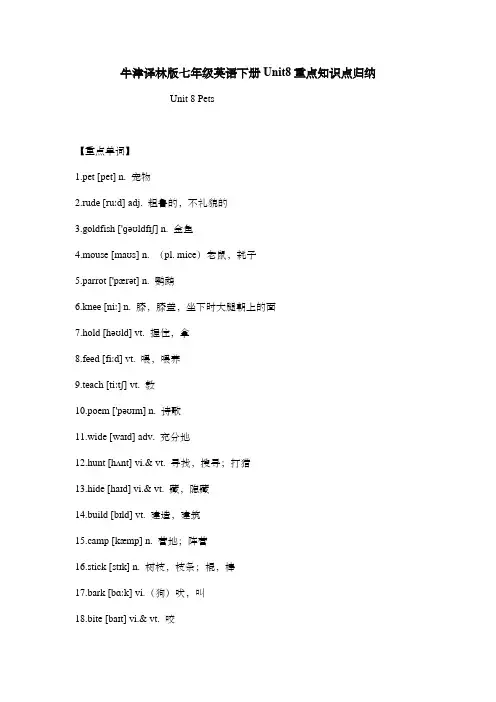
牛津译林版七年级英语下册Unit8重点知识点归纳Unit 8 Pets【重点单词】1.pet [pet] n. 宠物2.rude [ruːd] adj. 粗鲁的,不礼貌的3.goldfish ['ɡəʊldfɪʃ] n. 金鱼4.mouse [maʊs] n. (pl. mice)老鼠,耗子5.parrot ['pærət] n. 鹦鹉6.knee [niː] n. 膝,膝盖,坐下时大腿朝上的面7.hold [həʊld] vt. 握住,拿8.feed [fiːd] vt. 喂,喂养9.teach [tiːtʃ] vt. 教10.poem ['pəʊɪm] n. 诗歌11.wide [waɪd] adv. 充分地12.hunt [hʌnt] vi.& vt. 寻找,搜寻;打猎13.hide [haɪd] vi.& vt. 藏,隐藏14.build [bɪld] vt. 建造,建筑15.camp [kæmp] n. 营地;阵营16.stick [stɪk] n. 树枝,枝条;棍,棒17.bark [bɑːk] vi.(狗)吠,叫18.bite [baɪt] vi.& vt. 咬19.fight [faɪt] vi.& vt. 打仗(架);与……打仗(架)20.till [tɪl] prep. 到……时,直到……为止21.end [end] n. 终止;末尾,终点22.trouble ['trʌbl] n. 麻烦23.bubble ['bʌbl] vi. 吐泡泡24.gentle ['dʒent(ə)l] adj. 温柔的25.touch [tʌtʃ] n. 触摸,碰26.rhyme [raɪm] vi. 押韵27.care [keə] n. 照料,照顾28.anywhere ['enɪweə] adv. 任何地方29.repeat [rɪ'piːt] vi.& vt. 重复30.agree [ə'griː] vi.& vt. 同意;应允31.keep [kiːp] vt. 养,饲养32.weigh [weɪ] linking v. 重;有……重33.gram [ɡræm] n. 克34.talk [tɔːk] n. 讲座;演讲35.noise [nɔɪz] n. 声音,响声;噪音36.brush [brʌʃ] vt. 刷;擦37.fur [fɜː] n.(动物的)软毛,毛皮38.paw [pɔː] n.(动物的)爪39.basket ['bɑːskɪt] n. 篮子40.noisy ['nɔɪzi] adj. 吵闹的,嘈杂的【重点短语】1.something to eat 一些吃的东西2.sleep on my knees 睡在我的膝盖上3.hold sth in one’s hand 某人手里握着某物4.teach sb to do sth 教某人做某事5.with eyes open wide 睁大眼睛6.build me camps out of sticks 用树枝为我搭建营地7.look after 照顾8.look around for me 四处找我9.take care of 照顾10.repeat my words 重复我的话11.all the time 一直,总是12.in the sun 在阳光下13.weigh about 40 grams 重约40克14.grow up 成长;长大成人15.make any noise 发出任何噪音16.brush her fur 给她刷毛17.sleep in a basket 睡在篮子里【重点句型】1.Bring me my lunch.把午餐给我带来。
[全]译林版七年级英语下册Unit8重点知识与语法总结
![[全]译林版七年级英语下册Unit8重点知识与语法总结](https://360docs-1393072327.cos.ap-beijing.myqcloud.com/27d550fae2bd960591c67715.webp)
译林版七年级英语下册Unit8重点知识与语法总结七年级英语下册Unit 8 Pets一、重点词组二、重要句型1、Bring me my lunch. 把午餐给我带来。
(过去式brought)句中的bring的意思是“带来,拿来”。
Bring常后接双宾语,即“bring somebody something”或“bring something to somebody”。
2、I can feed her carrots. 我能喂胡萝卜给她吃. (过去式fed)句中feed的意思是“喂养,给予食物”。
常见的短语有feed something to . . . (把……喂给……),feed on . . .(以……为食)eg. Cats feed on fish. 猫以鱼为食。
3、With eyes open wide, he hunts when I hide. 当我躲起来的时候,他睁大眼睛来找我。
句中的介词短语with eyes open wide表示伴随情况,在句中作状语。
它的结构是with + 名词或代词(宾格)+分词/形容词/副词/介词短语/不定式。
如:The teacher came in with a book in his hand. 老师手里拿着一本书进来了。
4、He’d never bark or bite, and he doesn’t like to fight. 它从不叫,也不咬人,也不喜欢打斗。
fight(fought) with sb. 和某人打架have a fight with sb.5、I will look after him until the end. 我将照顾他一直到最后。
look after ……well=take good care of……照顾好……句中until的意思是“直到……时候”,相当于till,但until比till更加正式,until多用于句首。
译林版本牛津英语初中七年级的下册的全册Unites8单元总结复习学习知识点及语法归纳
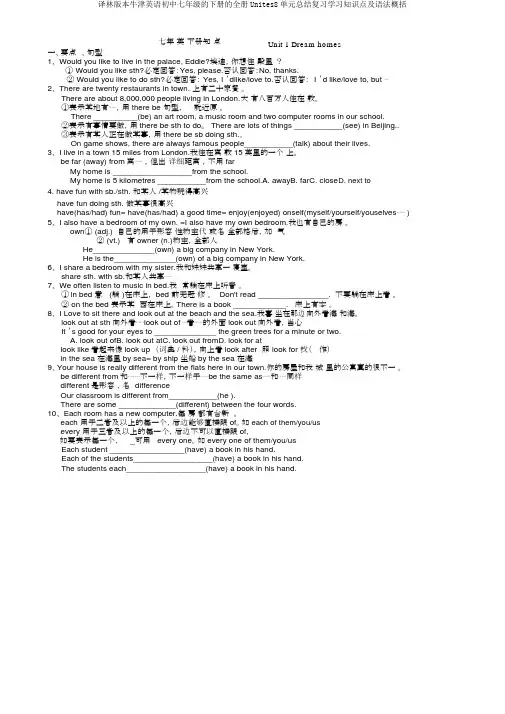
七年英下册知点Unit 1 Dream homes一、要点、句型1、 Would you like to live in the palace, Eddie?埃迪,你想住殿里?① Would you like sth?必定回答:Yes, please.否认回答:No, thanks.② Would you like to do sth?必定回答:Yes, I’dlike/love to.否认回答:I’d like/love to, but⋯2、 There are twenty restaurants in town.上有二十家餐。
There are about 8,000,000 people living in London.大有八百万人住在敦。
①表示某地有⋯⋯,用there be 句型,就近原。
There __________(be) an art room, a music room and two computer rooms in our school.②表示有事情要做,用there be sth to do。
There are lots of things ___________(see) in Beijing..③表示有某人正在做某事,用there be sb doing sth.。
On game shows, there are always famous people___________(talk) about their lives.3、 I live in a town 15 miles from London.我住在离敦15 英里的一个上。
be far (away) from离⋯⋯,但出详细距离,不用farMy home is __________________from the school.My home is 5 kilometres ___________from the school.A. awayB. farC. close D. next to4.have fun with sb./sth. 和某人 /某物玩得高兴have fun doing sth. 做某事很高兴have(has/had) fun= have(has/had) a good time= enjoy(enjoyed) onself(myself/yourself/youselves⋯⋯) 5、 I also have a bedroom of my own. =I also have my own bedroom.我也有自己的房。
新牛津译林版七年级英语下册Unit8 知识点复习

Unit 8 Pets知识点复习一、知识点详解1.bring me something to eat =bring something to eat to me给我一些吃的(bring sb sth=bring sth to sb) to 侧重朝着,向着,对着某人;(get sb sth=get sth for sb ) for 侧重强调动作的受益者,为了某人,替某人。
常见此类双宾语动词:①可转换成to 的动词:take / send / lend / give / pass / hand / show / tell / w ish / write / teach feed②可转换成for的动词:buy / get / make / cook / build / draw / choose / prepare / spare / sing / save / order / find2. say “ please” / “ hello ”/ “sorry”(to sb) 对某人说“请”-----①say 说,强调说话内容,及物动词带宾语或句子。
也可作不及物动词,。
Eg.It’s hard to say. say to sb (oneself) 自言自语②speak强调单方的“说”或“讲”,一般用作不及物动词,要表示“对某人说(某事)”,可用speak to [with] sb (about sth)。
可接语言的名词,eg: speak English③tell tell 表示“告诉”,可接双宾语,双宾语易位时用介词to 引出间接宾语。
④talk talk 强调双方“交谈”,一般用作不及物动词,表示“同某人谈论(某事)”,可用talk to [with] sb (about sth)。
如:3.watch them swim around看他们游来游去hear birds singwatch / see / hear / listen to / notice sb do sth” 是指看见某人做过某事”是看着事情的发生全过程,hear someone calling / shouting for helpwatch / see / hear / listen to / notice sb doing doing sth是指”看见某人正在做某事”,表正在进行4. teach parrots to speak 教鹦鹉说话teach sb to do sth 教某人做某事teach sb sth =teach sth to sb 教某人--teach sb how to do sth教某人如何做某事5.the cleverest animal of all 最聪明的动物the biggest restraunt in Tifth Street五大街上最大的餐馆6.wonder n. 奇迹v.想知道wonderful adj 精彩的wonderfully adv 精彩地7.build me camps out of sticks 用树枝造……①常见短语:build ----out of 用---建造---make a bird out of wood make ---out of 用---制作---take a watch out of its pocket take …out of 从-----中取出----helpMrs Sun out (of the fire ) help…out of 帮----从中逃离get …out of②build sb sth = build sth for sb 替某人建造----※※unt with eyes open wide 睁大眼睛寻找do sth with eyes open wide睁大眼睛做某事with复合结构表动作的伴随,通常为:①with +n+adj sleep with eyes closed / open ;②with +n+prep come in with a big smile on one’s facego to school with a big bag on one’s backleave the office with lights on / off8.till the end直到最后eg look after him till the endnot ------till 直到----才eg. do / does / did / will not do homework till 9.pm don’t have to do = don’t need to do 不必做某事9. look around环顾四周常见与look搭配的短语look up/down 朝上/ 下看look after照顾look for寻找look out当心/ 朝外看look out of sth朝------外看look out at sth眺望---look at朝------看look adj 看上去/ 看起来-----look like sth看上去/ 看起来像-----10.be afraid of 害怕be afraid to do害怕做某事be afraid that 恐怕,担心---[来源:学&科&网11.There’s nothing wrong with keeping a snake if you like.如果你喜欢,养蛇并没有错。
牛津译林版英语初中七年级的下册的Unit8学习知识点精讲下
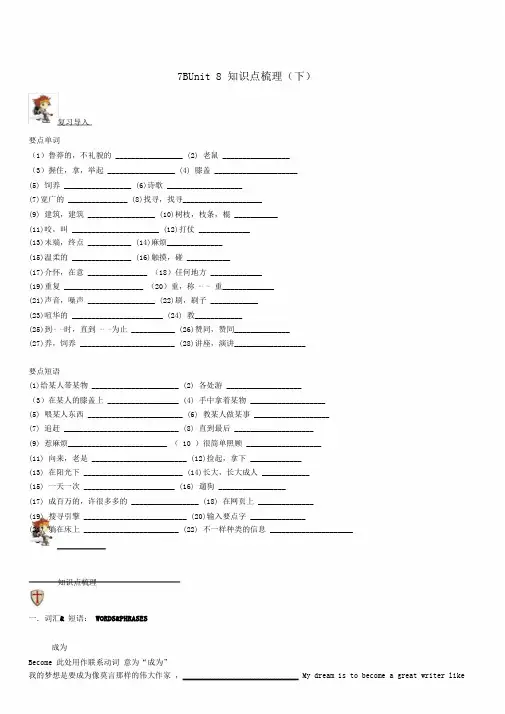
7BUnit 8 知识点梳理(下)复习导入要点单词(1)鲁莽的,不礼貌的 _________________ (2) 老鼠 _________________(3)握住,拿,举起 _________________ (4) 膝盖 _____________________(5) 饲养 _________________ (6)诗歌 ___________________(7)宽广的 _______________ (8)找寻,找寻____________________(9) 建筑,建筑 _________________ (10)树枝,枝条,棍 ___________(11)咬,叫 ______________________ (12)打仗 _____________(13)末端,终点 ___________ (14)麻烦______________(15)温柔的 _______________ (16)触摸,碰 ___________(17)介怀,在意 _______________ (18)任何地方 _____________(19)重复 ____________________ (20)重,称⋯⋯重_____________(21)声音,噪声 _________________ (22)刷,刷子 ____________(23)喧华的 _______________________ (24) 教____________(25)到⋯⋯时,直到⋯⋯为止 ___________ (26)赞同,赞同______________(27)养,饲养 ________________________ (28)讲座,演讲__________________要点短语(1)给某人带某物 ______________________ (2) 各处游 ___________________(3)在某人的膝盖上 __________________ (4) 手中拿着某物 ___________________(5) 喂某人东西 ________________________ (6) 教某人做某事 ___________________(7) 追赶 _____________________________ (8) 直到最后 ____________________(9) 惹麻烦_________________________ ( 10 )很简单照顾 ___________________(11) 向来,老是 ________________________ (12)捡起,拿下 _____________(13) 在阳光下 _________________________ (14)长大,长大成人 ____________(15) 一天一次 _______________________ (16) 遛狗 _________________(17) 成百万的,许很多多的 _________________ (18) 在网页上 ______________(19) 搜寻引擎 __________________________ (20)输入要点字 ______________(21) 躺在床上 ________________________ (22) 不一样种类的信息 _____________________知识点梳理一.词汇& 短语:WORDS&PHRASES成为Become 此处用作联系动词意为“成为”我的梦想是要成为像莫言那样的伟大作家,_____________________________ My dream is to become a great writer likeMo Yan.第 1 页辨析: become ,get turnbecome ,get turn 用作连系动词,意为“成为”(1) become 常用来表示身份、职位的变化。
牛津译林版英语七年级下册 Unit 8 Pets 单元知识点总结

Unit 8 Pets单元知识点总结◆bring sb sth=bring sth to sb 把某物带给某人bring me my lunch=bring my lunch to me 把我的午饭拿来◆something to eat 吃的东西◆something to drink 喝的东西◆watch sb do sth观看某人做了某事或经常做某事watch them swim around看它们游来游去hold it in my hand 把它拿在我的手里◆feed sb sth=feed sth to sb 拿某物喂某人feed her carrots=feed carrots to her喂她吃胡萝卜◆teach sb to do sth教某人做某事teach the parrot to speak教鹦鹉说话His father is teaching him to make a kite. 他的爸爸正在教他做风筝。
◆teach sb sth 教某人某物Mr Zhang will teach us English next term.下学期张老师将会教我们英语。
◆the cleverest animal of all所有动物中最聪明的→of all所有的当中,是最高级的标志。
run after a ball 追一只球do wonderful tricks玩精彩的把戏play tricks on sb=play a trick on sb拿某人开玩笑,捉弄某人He likes playing tricks on his friends on April Fool’s Day.他喜欢在愚人节捉弄他的朋友。
◆build A out of B 用B搭建A◆build sb A out of B 用B为某人搭建Abuild me camps out of sticks用树枝给我搭帐篷build sb sth=build sth for sb 为某人建造某物◆look around for me 到处找我◆look after….. =take care of….. 照顾◆look after…..well =take good care of….. 好好的照顾◆need意思是需要,作为情态动词的时候,后面加动词原形◆need do sth需要做某事例:(1)肯定句He need have a rest. 他需要休息一下。
七年级下英语Unit8知识点(译林版)
七下英语Unit8知识点(译林版)【单词】1.pet宠物2.mouse老鼠(复数mice)3.knee膝盖4.feed喂养(过去式fed)5.teach教(过去式taught)6.hold拿,握住(过去式held)7.poem诗歌8.enough充分地9.find寻找,搜寻(过去式found)10.hide隐藏,躲藏(过去式hid)11.build建造(过去式built)12.camp营地,阵营13.stick树枝,枝条14.bite咬(过去式bit)15.fight打架(过去式fought)16.take care of=look after照顾17.till直到…为止18.end终止,末尾19.gentle温柔的20.touch触摸(过去式touched)21.care关心,照料22.everywhere任何地方23.repeat重复24.agree同意(过去式agreed)25.keep饲养(过去式kept)26.weigh重,有……重(过去式weighed)27.talk讲座,演讲28.noise噪音noisy嘈杂的noisily嘈杂地29.brush刷(三单式brushes)30.basket篮子【语法】1.bring me something to eat=bring something to eat to me给我一些吃的(bring sb sth=bring sth to sb)to侧重朝着,向着,对着某人(get sb sth=get sth for sb)for侧重强调动作的受益者,为了某人,替某人。
常见此类双宾语动词:①可转换成to的动词:take/send/lend/give/pass/hand/show/tell/wish/write/teach/feed②可转换成for的动词:buy/get/make/cook/build/draw/choose/prepare/spare/sing/save/order/ find2.say“please”/“hello”/“sorry”(to sb)对某人说“请”.......①say说,强调说话内容,及物动词带宾语或句子。
牛津译林版七年级英语下册Unit8语法知识点讲解 形容词及不定代词用法
牛津译林版七年级英语下册Unit8语法知识点讲解形容词形容词是英语中重要的词类之一,主要用来描述人或事物的性质、特征、状态或属性,在句中可以作表语、定语等。
形容词一般有以下用法:【注意】(1)形容词在修饰something, anything, nothing等不定代词时,习惯上放在这些不定代词之后。
(F) Is there new anything in today’s newspaper?(T)Is there anything new in today’s newspaper? 今天的报纸上有什么新的东西吗?(2)形容词作表语时,句中be(am,is,are)在汉语中虽没有翻译出来,但千万不能漏掉。
(F)The bag too heavy.(T)The bag is too heavy.这个书包太重了。
(3)为了帮助我们更好地掌握形容词的用法,现提供口诀一则,供参考:形容词,用法多,作定作表都许可;作定位于名词前,作表放在系之后;如有不定代词现,定在它的后面见;副词是我的好朋友,它在前来我在后。
形容词及副词专题训练1.Lizzie was ________to see her friend off at the airport.A.a little more than sad B.more than a little sadC.sad more than a little D.a little more sad than2.If you can’t come tomorrow,we’ll ______have to hold the meeting next week.A.yet B.even C.rather D.just3.The husband gave his wife ________every month in order to please her.A.all half his income B.his half all incomeC.half his all income D.all his half income4.The great success of this programme has been ________due to the support given by the local businessmen.A.rather B.very C.quickly D.1argely5.The number of people present at the concert was ________than expected.There were many tickets left.A.much smaller B.much more C.much larger D.many more6.John Smith,a successful businessman,has a _________car.A.1arge German white B.1arge white GermanC.white large German D.German large white7.________students are required to take part in the boat race.A.Ten strong young Chinese B.Ten Chinese strong youngC.Chinese ten young strong D.Young strong ten Chinese8.The ________ house smells as if it hasn’t been lived in for years.A.1ittle white wooden B.1ittle wooden whiteC.white wooden little D.wooden white little9.When we plan our vacation,mother often offers ________suggestions.A.careful B.practical C.effective D.acceptable10.Mary kept weighing herself to see how much ________she was getting.A.heavier B.heavy C.the heavier D.the heaviest11.He speaks English well indeed,but of course not ________a native speaker.A.as fluent as B.more fluent thanC.so fluently as D.much fluently than12.In _________Chinese culture,marriage decisions were often made by parents for their children.A.traditional B.historic C.remote D.initial13.Most people on this island are recreational fishers,and________,fishing formsan actual part of their leisure time.A.accidentally B.purposefully C.obviously D.formally 14.I must be getting fat--I can ________dress my trousers up.A.fairly B.hardly C.nearly D.seldom15.Mr. Smith used to smoke ________but he has given it up.A.seriously B.heavily C.badly D.hardly【答案及解析】1.【答案】B从比较级的结构上,可看出选项C、D错误,应予以排除;根据句子的意义,选项A(与其悲伤,倒不如有一点)意思不完整;因此答案选B,more表示程度。
Unit8知识点梳理英语牛津译林版七年级下册
7B Unit 8 知识点梳理1. bring vt.带来(后通常跟双宾语)常用搭配: bring sb. sth. = bring sth to sb 给某人拿来某物bring sth with sb 某人随身携带某物2. teach sb sth. = teach sth to sb 教某人某事teach sb to do sth. 教某人做某事teach oneself=learn by oneself 自学3. watch sb.do sth. “看见某人做某事”,强调看到动作的全过程或经常看见。
watch sb.doing sth. “看见某人正在做某事”,强调看到的动作正在进行。
e.g. I like watching them swim around. 我喜欢看着他们游来游去。
4. hold vt.①握住,拿,抱住②举行③容纳vi. 不挂断 e.g. Hold on , please. 请别挂断。
5. feed sheep grass 给羊喂草feed sheep on/with grass6. My dog is the cleverest animal of all.(adj.最高级前加定冠词the,用于三者及以上之间的比较)7.run after… 追赶……8.With eyes open wide, he hunts when I hide. (with介词短语作状语表伴随的状态)当我躲起来,他就把眼睛睁得大大的,到处找我。
【拓展】wide adj.宽阔的;…宽的e.g. The river is 100 metres wide.这条河一百米宽。
adv.充分地,完全的9.hunt v. ① 捕猎,猎杀② 搜寻,追捕hunt for… 寻找;搜寻hunter n.猎人10.trick n.把戏,戏法; 玩笑,恶作剧常用搭配:play a trick on sb. / play tricks on sb. 捉弄某人【辨析】treat v.对待;招待n.招待11.build sb sth = build sth for sb. 为某人建造...12.fight for…为...而战斗(打架)& fight with… 和...打架13.till=until 介词直到……为止not …until… 直到……才……e.g. He didn’t e until ten o’clock.他直到十点钟才来。
牛津译林版七年级英语下册Unit 8重点短语、句型 、语法 、单元作文汇总
2. You shouldn't fight with your little sister. 你不应该和你的小妹妹打架。
3. People often have to fight for their freedom. 人们常常不得不为他们的自由而斗争。
The cake tastes good. (置于感官系动词之后) 蛋糕尝起来不错。
◆ 个别形容词还可单独成句。
【例句】 — How are you today? 你今天好吗? — Fine. Thank you. 很好。谢谢你
不定代词的用法
不 定 代 词 有 四 种 , 由 some-, any-, no-, every-与 -thing, -one, -body 等构成。
★teach
teach 为 动 词 , 意 为 “教 ”。 其 后 可 接 双 宾 语 , 常 见 搭 配 为 teach sb sth 意 为 “教 某 人 某 事 ”, 如 例 句 1; teach oneself 意 为 “自 学 ”, 如 例 句 2; teach sb to do sth 意 为 “教 某 人 做 某 事 ”, 如 例 句 3。
【例句】 1. Hold your sister's hand while you cross the street. 当你过马路时,你要抓住你妹妹的手。
2. They will hold the meeting next Monday. 他们将会在下周一举行会议。
3. My box is too small to hold all these things. 我的箱子太小,装不了这么多东西。