
人教版八年级英语下册Unit3学案(教师版)
Unit 3学生通过本讲学习,能够掌握本单元的重点词汇句型,并在综合能力上有一定的拓展。
1.all the time: 一直2.neitherneither:表示两者都不,谓语动词经常用单数;neither。
nor的谓语选择需遵从就近原则。
表示一个事情不怎么样,另一个事情也是同样如此的句型:He doesn’t like dancing, neither/nor do IHe can’t swim, neither/nor do IHe isn’t good at English, neither/nor do I对此一个事情怎么样,另一个事情也是同样如此的句型:He likes dancing, so do IHe can swim, so do IHe is good at English, so do I3.as soon as引导时间状语从句,遵循主将从现的原则4.borrow/lendborrow 对主语来说表示借进,固定搭配为borrow…fromlend相对主语来说表示借出,固定搭配为lend…to5.in order t o do用于目的状语从句,表示为了…, 否定形式为in order not to do6.depend on: 取决于,依靠7.take care of=look after 照看,照顾8.provide sb with sth /provide sth for sb: 为某人提供某物1. I'm not sure whether I can hold a party in the open air, because it the weather.A. stands forB. depends onC. lives onD. agrees with解析:本句题意为能否在户外举行舞会取决于天气,去选B2. The charity provides homeless people food and clothes.A. withB. forC. as解析:本题题意为提供无家可归的人食物和衣服,固定搭配为Provide sb with sth,故选A。
3. --- May I borrow these two books, plea se?--- Yes, you can them for two weeks.A. borrowB. lendC. buyD. keep解析:本题题意为你可以借这两本书两礼拜,因为borrow为点动词,需要延续性动词,故选D。
4. of us wants to go to the park today, because we have to finish so much homework.A. EitherB. BothC. Neither解析:本题题意为我们两人都不想去公园,因为我们必须完成作业,故选C。
5. — Tom doesn't know how to draw a comic row of pictures.— .A. So do IB. So am IC. Neither do ID. Neither am I解析:本题题意为Tom不知道怎么画图,我也不知道,因为谓语doesn't know可知我也不的表达应为Neither do I,故选C.基础演练1. --- Unluckily, Jim didn't pass the English test.--- .A. So did KateB. Neither did KateC. So Kate didD. Neither Kate did2. --- Could I some money? I want to buy some food.--- Certainly! Here you are.A. borrowB. lendC. keepD. buy3. --- Can I this book?--- Yes, but you mustn't it to others.A. lend; borrowB. borrow; keepC. borrow; lendD. lend; keep4. — Tom doesn't know how to draw a comic row of pictures.— .A. So do IB. So am IC. Neither do ID. Neither am I5. I will go to bed I finish my homework.A. whileB. even ifC. untilD. as soon as6. She has lived in the city she was seven years old.A. sinceB. ifC. untilD. that7. you have so much free time, why don't you help me a little?A. ThoughB. ForC. SinceD. So8. This company will young people with good jobs.A. fillB. connectC. compareD. provide9. --- Does Peter still feel lonely in the new school?--- Not any more. He has a friendship with all his classmates.A. madeB. becomeC. developedD. taken10. --- Jack, you don't need these things at all, so don't your money on them.--- Sor ry, Mum, I won't.A. useB. costC. payD. wasteBACCD ACDCD巩固提高1. 他和他的父母一直住在天津。
He lives in Tianjin with his parents .2. 假期一开始,我们一家人总是尽快去某个有趣的地方。
My family always go somewhere interestingthe holiday begins.3. 请把这些面包递给你的弟弟。
Please the bread your brother.4.她不做任何家务,我也不做。
She did n ot do any housework and .5. 你能把垃圾倒了吗?Could you please the rubbish?6. 为了英语考试及格,你应该努力学习。
fail in the English exam, you should work hard.7. 每个人都应该依靠自己去创造未来。
We should to create the future.8. 我们经常为山区的孩子提供学习用品。
We often children in village many school things.9. 她是一个新妈妈, 她不知道怎样照顾孩子。
She is a new mother. She doesn'tknow of the baby.10. 汤姆,不要玩游戏了。
那简直是浪费时间。
Don't play games, Tom. It's time.1. all the time2. as soon as3. pass, to4. neither did I5. take out6. In order not to7. depend on ourselves8. provide; with9. how to take care10. a waste of一、单项选择1. You buy this kind of MP3. It sells .A. should; goodB. could; goodC. must; wellD. could; well2. --- Could I call you by your first name?--- Yes, you .A. willB. couldC. mayD. might3. --- Could I invite my friends to my birthday party?--- Sorry, you .A. canB. can'tC. couldD. couldn't4. Could you me a ruler? Mine is broken.A. lendB. lend toC. borrowD. borrow from5. I'll be upset someone talks to me I'm reading.A. when; whileB. while; whenC. when; whenD. while; while6. The teacher came into the classroom we were writing.A. asB. afterC. beforeD. while7. --- When I was young, I liked playing with toy animals.--- .A. So I wasB. So was IC. So did ID. So I did8. --- Kate didn't leave for Shanghai yesterday evening.--- .A. Mary didn't neitherB. Neither Mary didC. Mary did eitherD. Neither did Mary9. Thanks for your invitation, but I'm so sorry I can't go. I need to my sister at home.A. take awayB. take offC. take care ofD. take out of10. --- Could you come, please? I want some help.--- .A. Sure. I'm coming nowB. You're welcomeC. Yes, I couldD. That's right二、完形填空Nowadays more and more Chinese teenagers find life more difficult without their parents. They don't know how to do 11 . Because their parents do almost everything for them at home. This is a big problem.Joy is 14 years old. One day her parents went away 12 busin ess, so she had to stay at home alone. At first she thought she would be happy 13 her parents were not in. She could do everything 14 she liked. But it wa s six o'clock in the afternoon, she felt 15 . “Oh, it's time to have supper. Where can I get my food?” she said to herself. Later she found some food in the fridge, but she 16 know how t o cook. At that moment, she missed her 17 very much. At last she could only go to the supermarket and 18 some food to eat.Many of teenagers are 19 as Joy. So I think they should learn some basic life skills, like cooking, tidying up their rooms or dressing themselves 20 . They shouldn't depend too much on their parents.11. A. their homework B. some shoppingC. businessD. housework12. A. in B. at C. on D. with13. A. so B. because C. but D. until14. A. that B. who C. where D. when15. A. hungry B. full C. excited D. bored16. A. couldn't B. didn't C. might not D. wouldn't17. A. cousin B. aunt C. brother D. parents18. A. made B. bought C. gave D. saw19. A. the same B. difficult C. different D. warm-hearted20. A. actually B. c arelessly C. properly D. slowly一、单项选择DCBAA DCDCA二、完形填空DCBAA BDBAC_________________________________________________________________________________ _________________________________________________________________________________一、单项选择1. you wait a few more minutes? It'll be your turn soon.A. MustB. ShouldC. MightD. Could2. I need bananas to make fruit salad. Could you please buy some?A. fewB. a fewC. littleD. a little3. --- Do you know the way to the post office?--- Yes. Follow me and I'll you.A. callB. pickC. showD. invite4. You may easily lose your way in Shanghai you don't have a map or a guide.A. untilB. unlessC. thoughD. if5. Some Chinese singers sing English songs just as as native speakers do.A. goodB. wellC. betterD. worse6. --- Are your father and mother teachers?--- No, . My father is a doctor and my mother is an office worker.A. bothB. eitherC. neitherD. none7. --- Could you please help me choose an MP4 player online?--- . My computer doesn't work.A. I think soB. I hope soC. I'm afraid I can'tD. I don't agree8. --- Can I help you, boy?--- Yes. There is wrong with my bike.A. somethingB. anythingC. everythingD. nothing9. --- How long may I your bike?--- For a week. But you mustn't it to others.A. borrow; lendB. keep; lendC. lend; borrowD. keep; borrow10. Tom rushed into the house his mother was cooking.A. asB. beforeC. whileD. afterDBCDB CCABC二、阅读理解AShould we teenagers help our parents do chores? Is it important for us to learn how to do chores? I think so. Most of the teenagers like us students are the only children in each family. So our parents love us very much. They do everything for us and don't want us to do any housework. I think it's bad for us. The following is a real story.I have a classmate named Li Ting. She is the only child in her family. Her parents love her so much that they don't let her do any chores. Every day she only gets up, has meals, goes to school, comes home, does homework and goes to bed. So she doesn't know how to do chores. One day, her father was badly ill and had an operation in a hospital. Her mother had to take care of her father in the hospital and couldn't cook the dishes for her. Li Ting didn't know how to cook the meals. She often felt hungry. Later she even ate instant noodles only for her meals. From the story we know it's important for us to learn to do chores and other skills from now on.1. Teenagers are the children who are .A. young boysB. young girlsC. middle school studentsD. primary school students2. The writer thinks it's necessary for the teenagers to .A. learn to do choresB. do the dishesC. make the bedsD. fold the clothes3. What does "instant noodles" mean in Chinese?A. 烩面B. 方便面C. 拉面D. 米饭4. Now most of the teenagers .A. like making meals.B. can make noodles for themselves and the familyC. are the only children in each familyD. do most of the chores in the family5. Which of the following is true?A. Li Ting's father was ill in hospital.B. One day Li Ting was ill and needed an operation.C. Li Ting often does housework at home.D. Li Ting's teacher wrote this article.BMicrosoft founder Bill Gates says that 13 is a right age for a child's first cell phone. He said that he didn't allow his children Jennifer and Rory to have phones until their thirteenth birthday and his youngest daughter Phoebe was still waiting for one."In our family, it's 13 where you get a phone, " Mr. Gates said. "Because of the rule, my children often complained from school. They thought all the other kids had cell phones except them. "Though Bill Gates is very rich, he said he wanted their children to be as common as other kids. It was reported that their children had to do chores and had a little pocket money. And in 2010 Mr. Gates said that he planned to give most of his $61 billion fortune(财富) away rather than hand it down. "That wouldn't be good either for my kids or society, " he said.Since he stepped down from Microsoft in 2008, he has concentrated(专注) on charity. He said that helping others gave him the same energy as creating software. Mr. Gates was once the richest man in the world, but he became the second in 2010 after he decided to give away $28 billion to charity.6. According to the passage, Mr. Gates has children.A. tworB. threeC. fourD. five7. From the passage we know that Phoebe .A. is less than 13 years oldB. is more than 13 years oldC. usually gets much pocket moneyD. has got a cell phone8. The underlined word "that" here means .A. having a cell phoneB. getting pocket moneyC. giving away the moneyD. handing down the money9. What did Mr. Gates do after he left Microsoft?A. He sold cell phones.B. He stayed at home and did nothing.C. He opened another software company.D. He put his heart into charity and helped others.10. What can we know from the passage?A. Gates doesn't let his children own phones.B. Gates doesn't love his children at all.C. Gates is strict with all his children in life.D. Gates' children will inherit(继承) much money.CAn old man lived with his little grandson. Every day the old man got up early to read books.One day the grandson asked, "Grandpa, I want to read books as you. But I always forget what I read. What are the advantages of reading?"The grandfather didn't answer him, but he said to the boy, "Take this little basket to the river and bring back a basket of water for me." The boy went to the river to fill the basket with water, but all the water leaked out before he got back home. The boy was sad, but his grandfather laughed and said, "You'll have to walk faster next time."The next time the boy ran faster, but the basket was still empty before he returned home. The boy said, "See, grandpa, it's no use!""Is it useless?" the old man said, "Look at the basket."The boy looked at the basket and found that the basket was different. It was much cleaner."That's what happens when you read books. Maybe you can't understand or remember everything. Something will change in your mind after you read. Just like the basket."11. The old man every day.A. carried waterB. read booksC. wrote booksD. told his grandson some stories12. Aft er the grandson read books, he .A. threw the booksB. got up lateC. always forgot what he readD. couldn't s leep as well as usual13. The grandson used to get some water from a river.A. a basketB. a bowlC. a glassD. a bottle14. The underlined "leaked out" may mean in the passage.A. 装满B. 漏完C. 沸腾D. 灌溉15. We will after we read books.A. not have any changesB. understand everythingC. change something in our mindD. never forget what we read CABCA BADDC BCABC课程顾问签字: 教学主管签字:。
八年级英语下册(人教版).docUnit3第二课时教学设计
4.学生将结合课本和实际生活,设计人预算,实践理财概念,将语言学习与生活实际相结合。
(三)情感态度与价值观
1.学生在学习中培养正确的消费观念,认识到合理管理和使用金钱的重要性。
2.通过讨论个人经济活动,学生能够体会到节约与合理消费的价值,树立健康、环保的消费意识。
3.学生在学习过程中,增强团队协作意识,学会尊重他人意见,培养积极向上的合作态度。
4.学生通过对金钱话题的探讨,认识到努力工作、诚信待人的重要性,培养良好的道德品质。
在教学设计中,将结合人教版八年级英语下册Unit3的话题,围绕“金钱管理”这一核心,开展有针对性的教学活动。通过听力、口语、阅读和写作等多种形式,帮助学生将英语学习与实际生活相结合,提高他们的语言运用能力,同时培养正确的价值观和消费意识。
2.口语作业:
学生以小组为单位,录制一段关于金钱管理的对话,话题可以包括购物、旅游、预算制定等。要求对话中包含本节课的重点词汇和时态,每个小组成员都要有发言。此作业旨在提高学生的口语表达能力,同时加强团队合作。
3.听力作业:
学生需要在家中观看一段与金钱管理相关的英语视频或听力材料,并完成相应的听力练习。这些练习旨在帮助学生提高听力理解能力,特别是在捕捉关键信息和处理复杂句子结构方面。
二、学情分析
八年级学生已具备一定的英语基础,他们对日常生活中的经济活动有自己的理解和认识,对于金钱管理和消费决策的话题感到好奇且有一定的实践经验。然而,学生在运用英语准确表达经济活动时,可能会遇到时态选择、词汇运用等方面的困难。此外,他们在团队合作中,虽然表现出一定的沟通能力,但仍有待提高表达清晰度和逻辑性。因此,本节课将从学生的实际水平和兴趣出发,结合课本内容,设计不同难度的教学活动,帮助学生巩固语言知识,提升语言运用能力。同时,注重培养学生的团队协作意识和解决问题的能力,使他们在探讨金钱话题的过程中,形成正确的消费观念和价值观。
人教版八年级英语下册Unit3单元教学设计
1.通过情景教学法,创设真实语境,让学生在实际语境中学习并运用一般过去时;
2.运用任务型教学法,设计各种听说读写活动,提高学生的语言综合运用能力;
3.采用小组合作学习,鼓励学生互相交流,分享自己的经历,培养合作精神;
4.利用多媒体教学资源,如图片、视频等,丰富课堂教学内容,提高学生的学习兴趣;
d.课后布置相关作业,让学生运用所学知识进行写作,提高语言运用能力。
2.针对教学难点,采取以下措施:
a.提供典型例句,分析一般过去时的句子结构,帮助学生掌握语法规则;
b.创设丰富的语境,让学生在情境中进行角色扮演,提高口语表达能力;
c.设计分层教学,针对不同水平的学生提供不同难度的练习,使每个学生都能在原有基础上得到提高;
5.通过学习英语,拓宽视野,增强对世界的认知,树立正确的人生观和价值观。
二、学情分析
八年级下册的学生已经具备了一定的英语基础,对一般现在时和一般将来时有了较好的掌握。在此基础上,本单元的一般过去时对于学生来说是一个新的挑战。学生在学习过程中可能存在以下情况:
1.对一般过去时的理解和运用尚不熟练,需要通过具体实例和反复练习来巩固;
2.学会使用一般过去时描述过去发生的事情,如:I visited my grandparents last week;
3.能够听懂并参与课堂讨论,分享自己的过去经历;
4.提高阅读理解能力,理解并掌握课文中的重点句型和语法结构;
5.提高写作能力,能够运用一般过去时写作文,描述过去发生的事情。
(二)过程与方法
4.教师带领学生进行句型替换练习,巩固一般过去时的用法。
(三)学生小组讨论
1.教师将学生分成小组,要求他们用一般过去时描述过去发生的事情,如:“What did you do last weekend?”
八年级英语人教版下册Unit3_Period3参考学案
年级:八年级学科:英语主备人:审核人:执教人:班级:
课题
Unit 3 SectionB(1a-1e, Self Check)
课型
新授课
学习目标
1.进一步掌握谈论家务劳动的动词短语和句型。
2.听力训练,能听懂所说的为party的准备的事情。
学习重点
掌握表示家务活动的动词短语。
打扫房间______________________
倒垃圾______________________
整理床铺_______________________
洗碗________________________
看电视_________________________
和朋友闲逛__________________
参加聚会_______________________
我不赞同__________________
4).小组合作完成1a,并核对答案.
2.通过预习你还有什么不懂的地方吗?
【2】借助媒介正音操练
1.完成1a.呈现本节课目标语言
What do teenagers ask your parents’ permission for?
3.go tothe store______________4.用你的CD播放机_______________
5.buy some drinks and snacks____________________________
二、选择填空。
( )1.Could I______some money______you.
掌握礼貌的请求和许可的句型。
学习难点
听力训练,能听懂所说为party的准备的事情。
人教版八年级英语下册Unit3优秀教学案例
2.问题导向的教学策略:本节课通过设计具有启发性和思考性的问题,如"你能想到哪些交通方式?"和"当你不知道怎么去一个地方时,你会怎么办?",引导学生主动探究和发现知识。这种问题导向的教学策略不仅培养了学生的思维能力,还提高了他们的学习积极性。
4.教师在小组合作过程中进行巡视指导,关注学生的学习进度和需求,及时给予帮助和反馈。
(四)反思与评价
1.学生对自己在课堂上的表现进行反思,如对所学知识的理解和运用情况进行评估。
2.学生之间进行相互评价,发现他人的优点和不足,进行总结和借鉴。
3.教师对学生的学习情况进行评价,关注学生的进步和问题,为下一步教学提供参考。
4.教育学生遵守交通规则,注意交通安全,培养良好的交通意识。
三、教学策略
(一)情景创设
1.结合实际生活场景,设计学生熟悉的交通方式、路线和方向的情境,如上学、购物、旅游等。
2.使用图片、地图、道具等辅助材料,营造真实、生动的学习氛围。
3.角色扮演法,让学生扮演不同角色,如问路者、指路者等,进行实际交流互动。
为了营造一个轻松愉快的学习氛围,我在课堂上注重与学生的情感交流,关心他们的学习进度,及时给予鼓励和表扬。在教学过程中,我始终以学生为中心,关注他们的需求,努力让每一个学生在课堂上都能感受到成功的喜悦。
二、教学目标
(一)知识与技能
1.学生能够掌握与交通方式、路线和方向相关的词汇,如bus, train, plane, street, turn, left, right等。
人教版八年级英语下册unit3教学设计
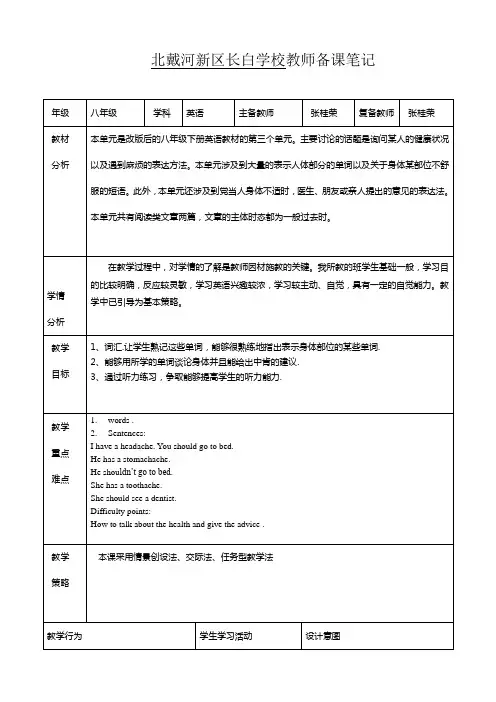
北戴河新区长白学校教师备课笔记
(一)创设情境,激趣导入
教师问:
1.Do you often help your parents at
home ?
2.What do you usually do to help
your parents ? …(指名回答)Today we are going to learn to do chores .(板书do chores 并解释)I
hope you can learn it carefully and help your parents at home,Ok? 学生回答老师问题通过师生之间的自由对话导入新课同
时引导学生要热爱父母,帮父母做家
务活。
(二)出示学习目标
多媒体出示学习目标学生认真阅读学习目标让学生明确本节课的学习任务,以做
到有的放矢地学习
(三)自主学习
从课本1a-1c中找出下列短语。
(多媒体图片加以辅助同时呈现一些学生以前学过的有关家务短语)
1、洗盘子____
2、扔垃圾____
3、叠衣服____
4、扫地____
5、整理床____ 1.学生看课本同时借助
老师出示的多媒体图
片填写短语,并识记
这些短语同时复习以
前学过的有关家务短
语。
调动学生自主学习话题词汇,为下一
环节操练目标语言做好准备
a dirty room
Chores
A:B,could you please …?
B: Yes, sure./ Of course/
Certainly. /All right./ I can
Sorry, I can’t. I have to。
人教新目标八年级英语下册第3单元教学设计(教案)

-引导学生通过预测、提问、总结等策略,提高阅读理解的深度和广度。
(二)教学设想
1.情境教学法:将学生带入真实的语言环境,让他们在情境中感知、体验和运用语言。
-设想实践:利用多媒体资源,如视频、音频,创建生动的情境,让学生在情境中学习。
2.互动式教学:鼓励学生参与课堂讨论,促进学生之间的互动,提高课堂活跃度。
人教新目标八年级英语下册第3单元教)知识与技能
本章节的教学目标是让学生在人教新目标八年级英语下册第3单元的学习中,掌握以下知识与技能:
1.词汇:学习并掌握与日常生活、学校生活相关的词汇,如permission, apologize, impressive, confident等,以及短语如"make decisions", "give permission", "lose confidence"等。
2.听说能力:提高学生的听说能力,尤其是日常交流中的礼貌用语和表达请求、允许的能力,是本章节的另一个重点和难点。
-教学设想:利用角色扮演、小组讨论等形式,模拟真实场景,让学生在互动中练习听说技巧。
-定期举办英语角活动,鼓励学生大胆开口,提高口语表达能力。
3.阅读理解:培养学生快速捕捉文章主旨和细节信息的能力,是阅读教学的重点。
在本环节中,教师将通过以下步骤引导学生进入新课的学习:
1.利用多媒体展示与新课主题相关的图片或视频,激发学生的兴趣和好奇心。
-例如,展示一些学生在学校参加活动的照片,引导学生关注学校生活中的规则和礼貌。
2.提出问题,引导学生思考与新课内容相关的话题。
-如:“Can you tell me what you need to do before you take part in a school activity?”
2020-2021学年人教版英语八年级下册Unit3SectionA(6课时)教案
-举例:组织口语交流和写作活动,如编写旅行日记或小组讨论旅行经历,强调时态的正确运用。
四、教学流程
(一)导入新课(用时5分钟)
同学们,今天我们将要学习的是Unit 3 Section A的旅行主题。在开始之前,我想先问大家一个问题:“你们在旅行中有没有遇到过特别难忘的经历?”这个问题与我们将要学习的内容密切相关。通过这个问题,我希望能够引起大家的兴趣和好奇心,让我们一同探索旅行中的精彩故事。
在教学过程中,我注意到学生对一般过去时态的掌握程度不尽相同。一些学生在运用不规则动词的过去式时感到困难,而另一些学生则在构建疑问句时遇到了挑战。为了帮助学生克服这些难点,我采用了不同的教学策略,如记忆口诀、对比练习和角色扮演活动。这些方法似乎对学生有所帮助,但我认为在未来的教学中,我还需要寻找更多创新和有趣的方式来加强学生对这些难点的理解和记忆。
3.重点难点解析:在讲授过程中,我会特别强调一般过去时态的动词形式和疑问句结构这两个重点。对于不规则动词过去式和时态区分这些难点,我会通过举例和对比来帮助大家理解。
(三)实践活动(用时10分钟)
1.分组讨论:学生们将分成若干小组,每组讨论一个与旅行相关的实际问题,如如何用一般过去时态描述旅行中的活动。
2020-2021学年人教版英语八年级下册Unit 3 Section A(6课时)教案
一、教学内容
2020-2021学年人教版英语八年级下册Unit 3 Section A围绕“旅游”主题展开,本教案涵盖6课时。教学内容如下:
1.第一课时:Section A 1a-1c,学习描述旅行经历的一般过去时态,掌握重点词汇如attraction, exciting, ancient等,并学会运用Where did you go? How did you go there? What did you do there?等进行交流。
及分析人教版英语八年级下册Unit3大单元教学设计
-定期组织展示活动,让学生在实践中展示自己的学习成果,增强自信心。
4.教学延伸:
-鼓励学生参与学校或社区的实际志愿者活动,将所学知识运用到实践中。
-建立学习小组,利用课后时间进行英语角活动,提高学生的语言实际运用能力。
-结合单元主题,开展跨学科活动,如社会调查、研究报告等,拓宽学生的学习视野。
4.口语作业:与家人或朋友进行一次关于志愿者工作的英语对话,尝试使用本节课学到的词汇和时态,记录下对话内容。
5.研究任务:选择一个感兴趣的志愿者组织或活动,通过网络或图书馆资源,了解该组织或活动的基本信息、活动宗旨和参与方式,下节课向同学分享。
作业布置注意事项:
-确保作业难度适中,既能巩固课堂所学,又不会给学生造成过重的负担。
四、教学内容与过程
(一)导入新课
在这一阶段,教师将运用多媒体资源,以生动有趣的方式导入新课。首先,在大屏幕上展示一组志愿者活动的图片,如环保清洁、帮助老人过马路等,让学生们观察并思考这些图片中的共同点。随后,提出问题:“What are they doing? Why do they do these things?”引导学生展开思考。
(二)过程与方法
在本章节的教学过程中,教师将采用以下方法帮助学生达成学习目标:
1.采用任务型教学法,引导学生通过完成具体的任务,如小组讨论、角色扮演等,提高英语实际运用能力。
2.利用多媒体教学资源,如图片、视频等,激发学生的学习兴趣,增强课堂的趣味性。
3.通过小组合作学习,培养学生的团队协作能力和沟通能力。
-通过真实语境的创设,让学生在实践中感受时态的用法,提高口语表达能力。
-引导学生通过预读、细读和总结等步骤,提高阅读理解能力。
八年级英语下册《Unit3》教学设计 人教新目标版
山东省邹平县实验中学八年级英语下册《Unit3》教学设计人教新目标版本学期第课时本单元第课时上课日期:________主备人:复备人:___________ 审核人:____________学习目标:1 掌握本单元中的词汇和短语;2. 背诵短文3a和Grammar的重点短语和句子3.掌握过去进行时态。
教学过程一、先复习单词和短语(8分钟)然后听写下列单词和短语:单词:1. 浴室2. 厨房 3. 经历4. 想象5. 奇怪的6. 令人吃惊的7. 攀登8. 事故9. 现代化的10. 寂静写出下列单词的过去式及过去分词1. buy2. get3. ride4. run5. meet6. hear7. ring 8. become 9. fly 10. tell短语:1. 理发店2. 起飞3. 逃跑 4. 听说 5. 发生6. 像…一样…7.从浴室出来8. 进来9. 理发10. 跟随某人做某事11. 默默地二、复习Unit 3课本内容,(15分钟)重点背诵下列重点句子:1. 当不明飞行物到达时,我正在通电话。
2. 当它到达时,他正在睡懒觉。
3. 当一个不明飞行物着陆时,这个男孩正沿着街道走着。
4. 当这个外星人正在买纪念品时,这个女孩给警察打了电话。
5. 你在开玩笑。
6. 甚至是这个日期-2001年9月11日,对绝大多数美国人来说都有着非同寻常的意义。
7. 并不是历史上所有的事件都像这个一样可怕。
三、教师抽查,同学互查,对出现的问题加以讲解。
四、教师点拨:过去进行时标志词:when, while, at that time, at eight last night, from 8:00 to 9:00 last night结构:was/were + Ving比较:The boy was walking down the street when the UFO landed.While the boy was walking down the street, the UFO landed.The girl was shopping when the alien got out.While the girl was shopping, the alien got out.五、达标测试1. While we __________ (wait) for the bus, a girl __________ (run) up to us.2. I __________ (telephone) a friend when Bob __________ (come) in.3. Jim __________ (jump) on the bus as it __________ (move) away.4. We _______ (test) the new machine when the electricity ______ (go) off.5. She __________ (not want) to stay in bed while the others _____________ (all, work) in the fields.6. While mother _______ (put) Cathy to bed, the door bell ________ (ring).7. As I __________ (walk) in the park, it __________ (begin) to rain.8. Even when she ___________ (be) a child she ________________ (already, think) ofbecoming a ballerina (芭蕾舞演员).9. It was quite late at night. George __________ (read) and Amy __________ (ply) her needle when they __________ (hear) a knock at the door.10. There __________ (be) a group round the fire when they ________ (reach) it. An old woman __________ (sit) on the ground near the kettle; two small children __________ (lie) near her; a donkey __________ (bend) his head over a tall girl.11. I _____ (have) my breakfast at half past six yesterday morning.12. Mary ____ (go) over her lessons from six to seven last night. John and peter ____(do) the same thing.13. What _____ you ___ (do) at that time? We _____ (watch) TV.14. Was your father at home yesterday evening? Yes ,he was. He____ (listen) to the radio.15. They _____(not make) a model ship when I saw him.16. _____ they ____ (have) a meeting at 4 yesterday afternoon?No, they _____. They _____ (clean) the classroom.17. ____ it _____(rain) when you left school? Yes, it ____. (No, it ____)18. What _____ your father _____ (do) when he was your age?19. One day, Edison _____ (wait) for a train to arrive, and suddenly a little boy ran to the track(轨道) to play.20. He asked me if I ______ (go) fishing that afternoon.21. The three of them were in a hurry because their plane _____ (leave) in five minutes.22. In a letter, john told us that he _____ (come) to china next month.23. When the bell rang, jenny _____ (wait) in her seat.24. She _____ (make) her dress the whole afternoon.25. While my father ___ (look) through the evening paper, he suddenly ____ a cry.26. When I ____ (come) in the room, he ____ (see) me, for he ____ (read) something27. When we _____ (arrive) at the village, it _____ (get) dark and it ____(rain) hard.28. I _____ (know) you ____(wait) for me here.29. One day a little monkey ____(play) in a tall tree. A mother crocodile(鳄鱼) ____ (look) for food near the bank.30. What ____ your father ____ (do) yesterday evening? He ____ (study) at the evening school.31. Later his parents found that he _____ (sit) on some eggs.32. When he knocked at the door, my aunt ____ (cook)33. The students ______ (sing) and ____ (dance) happily on the playground at that time.34. I ____ (write) a letter when the door bell rang.35. We had no classed at that time. We ____ (plant) trees.教学反思:。
人教版初中八年级英语下册第三单元Unit 3 教案含教学反思
Section A 单词rubbish n.垃圾;废弃物fold v.折叠;对折sweep v.(swept)扫;打扫floor n.地板mess n.杂乱;不整洁throw v.(threw)扔;掷neither adv.也不; pron.两者都不shirt n.衬衫pass v.给;递;走过;通过borrow v.借;借用lend v.(lent)借给;借出finger n.手指hate v.厌恶;讨厌while conj.与……同时;当……的时候;而;然而chore n.杂务;乏味无聊的工作snack n.点心;小吃;快餐短语take out the rubbish 倒垃圾all the time频繁;反复as soon as 一……就……句型1.Peter,could you please take out the rubbish? 彼得,你能把垃圾倒了吗?2.And she won’t be happy if she sees this mess.而且如果她看到这么乱,她会不高兴的。
3.Could I at least finish watching this show?至少等我看完这个节目可以吗?4.For one week, she did not do any housework and neither did I.在—周时间里,她没有做任何家务,我也没有做。
that everyone should do their part in keeping it clean and tidy.既然他们和父母生活在同一所房子里,他们就应该知道每个人都应该为保持房屋的干净和整洁尽一份力。
5.The earlier kids learn to be independent,the better it is for theirfuture.孩子们越早学会独立,对他们的未来就越好。
语法情态动词could的用法掌握本单元中的重点词汇及相关短语,并灵活运用。