
Target2011年最新验厂文件清单
Records of color vision testing for all lab personnel responsible for color evaluation 实验室所有负责颜色评估人员的色觉测试记录
Testing results of all Third Party Lab / Internal testing results 第三方实验室或工厂内部的测试结果
Documented training program for QC Inspectors on QC Processes QC 验货流程的培训计划 Documented training program for Maintenance Workers 维修工人的培训计划
Documented training program for Production Workers 生产工人的培训计划
1 of 4
Factory Documentation Preparation Resource – SL, SH, HG
Quality Control Meeting schedule 质量控制会议安排
Quality Control Meeting results 质量控制会议记录
Maintenance Workers personnel files 维修工人个人档案
Documented process for proper packaging/handling of product going to a Subcontractor 外加工产品的正确包装、处理流程
xx x xx x xx x xx x xx x
xx x
xx x
xx x xx x xx x xx x xx x xx xx xx xx x xx x xx x
Documented pre-production meeting procecords 产前会议记录
Documented Pilot/Test Run process 试产流程
Documented Pilot/Test Run results 试产结果
Documented process for inventorying, reconciling and inspecting product received from sub-contractor 外加工产品回厂的库存、核对及检验流程
Inventory and Inspection records of product received from sub-contractor. 外加工产品回厂的库存及检验记录
Factory Documentation Preparation Resource – SL, SH, HG
Purpose: The purpose of the Factory Documentation Preparation Resource is to identify and provide a comprehensive list of documentation that factories should pull together before a scheduled TCPS Factory Evaluation.
Laboratory 实验室
Lightbox maintenance, calibration inspection results 灯箱的维护、校验记录
Documentation / Certification of training for Lab Technicians 实验室技术员的培训文件或证书
QC Inspectors personnel files QC 员个人档案 Production workers personnel files 生产工人个人档案
Material/Supplier Management 材料与供应商管理
Documented inventory process for monitoring/documenting incoming/outgoing material 监控或记录进出材料的库存清单
Sewing / Production Floor 车缝/生产车间 Documented process for reconciling second quality product 次品的核对流程
Documented Production procedures/instructions for all processes 各步骤的生产流程及操作指南
Documented Inspection procedures/instructions for all stages of production 各生产步骤的检验流程及操作指南
Documented process for reviewing all incoming raw material, components, subassemblies conform to Specifications, Quality Standards and US safety requirements 检查所有进厂原材料、零部件及半成品是否符合说明书、质量标准及美国的安全要求 的程序
Factory Organizational Chart 工厂组织架构图
Factory QC Shift schedule 工厂 QC 员轮班表 Daily/Weekly quality goals and results 每日或每周的质量目标及结果
Factory Defect Classification List 产品瑕疵分类清单
Documented process for proper storage and handling of hazardous chemicals 有害化学品的正确储存及使用流程
Documented process for proper storage and handling of dyes/inks 染料或油墨的正确储存及使用流程
Documented process for fabric inspection 面料的检验流程
Incoming fabric inspection results 进厂面料的检验结果
Incoming fabric count, construction, weight records 进厂面料的经纬密度、结构、及重量的记录
not be reproduced, disseminated, or disclosed in any form to any party whatsoever without the express written consent of Target. 2 of 4
Factory Documentation Preparation Resource – SL, SH, HG
Copyright 2007 Target Corporation. This document and the contents within are the property of Target Corporation and its subsidiaries (collectively “Target”). They are for the sole use of designated employees of Target as well as certain authorized business partners and shall
Documented process for reviewing all incoming packaging material under lightbox (UL3000 lightsource) 在灯箱下(UL3500 光源)对所有进厂包装材料的检查程序 Records of non-conforming packaging status and disposition 不合格包装的状态及处理记录
Supplier performance and reliability documentation 供应商绩效和可靠性记录
Non-conforming/rejected raw material, in process product, finished product disposition records 不合格或拒绝的原材料、半成品及成品的处理记录
H SL SH G xx x
xx x xx x xx x xx x xx x xx x xx x xx x xx x xx x
xx x xx x xx x xx x xx x xx x xx x
Copyright 2007 Target Corporation. This document and the contents within are the property of Target Corporation and its subsidiaries (collectively “Target”). They are for the sole use of designated employees of Target as well as certain authorized business partners and shall not be reproduced, disseminated, or disclosed in any form to any party whatsoever without the express written consent of Target.
TARGET质量验厂最新的要求及详细解释
5020
供货商管理
工厂是否有一个程序文件规定在检验产品颜色和零售包装颜色时,必须在装配了
Target规定的光源的灯箱中进行,以确保颜色的一致性?
核对工厂的相关颜色检查程序。
程序文件必须解释了如何评估颜色,检查的数量和怎样使用灯箱等等。如果工厂不生产最终成品,不需要这个程序。
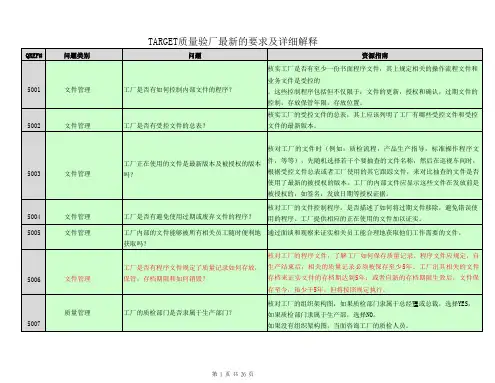
TARGET质量验厂最新的要求及详细解释
QREF#
问题类别
问题
资源指南
5001
文件管理
工厂是否有如何控制内部文件的程序?
核实工厂是否有至少一份书面程序文件,其上规定相关的操作流程文件和业务文件是受控的
。这些控制程序包括但不仅限于:文件的更新,授权和确认,过期文件的控制,存放保管年限,存放位置。
5002
5009
质量管理
工厂是否有可衡量的质量目标并收集实际的执行结果?
随机核对工厂的质量目标及执行结果。文件、记录必须包括每种产品的质量目标和通过率。记录完整的文件应可以随时提供以便于查阅。
5010
质量管理
工厂是否举行持续的、生产部门一同参加的质量控制会议,是否有会议记录?
核实工厂是否至少每周举行一次质量会议,以便讨论生产中的问题,,产品疵点等。会议记录必须包括生产中遇到的问题和整改措施。生产经理或生产主管应该出席质量会议。在质量会议记录中必须显示上述内容及出席人员名单。
5016
供货商管理
工厂是否保存供应商审核记录?
核对供应商审核记录是否在生产结束后,至少保存了5年。如果工厂不生产最终成品,不需要这个程序。
5017
供货商管理
工厂是否根据确定的评审条件及绩效标准来评判供应商?
核对工厂的供货商审核记录,证实工厂是否按照既定的评审条件及绩效标准来评估供应商。如果工厂不生产最终成品,不需要这个程序。
Target质量体系验厂清单中英文
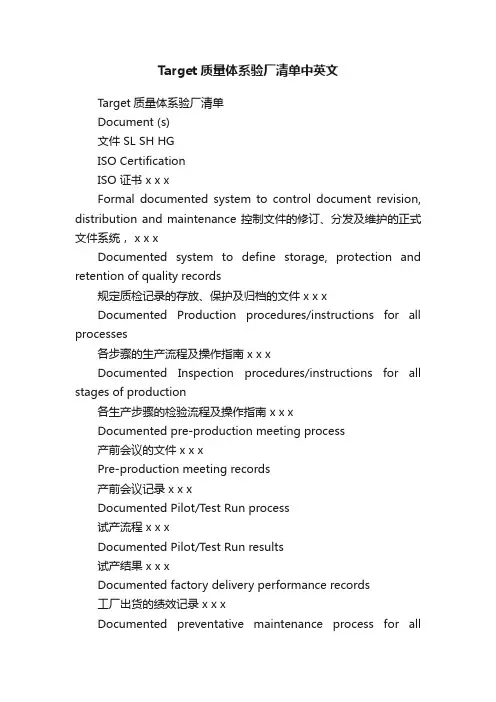
Target质量体系验厂清单中英文Target质量体系验厂清单Document (s)文件 SL SH HGISO CertificationISO 证书 x x xFormal documented system to control document revision, distribution and maintenance 控制文件的修订、分发及维护的正式文件系统, x x xDocumented system to define storage, protection and retention of quality records规定质检记录的存放、保护及归档的文件 x x xDocumented Production procedures/instructions for all processes各步骤的生产流程及操作指南 x x xDocumented Inspection procedures/instructions for all stages of production各生产步骤的检验流程及操作指南 x x xDocumented pre-production meeting process产前会议的文件 x x xPre-production meeting records产前会议记录 x x xDocumented Pilot/Test Run process试产流程 x x xDocumented Pilot/Test Run results试产结果 x x xDocumented factory delivery performance records工厂出货的绩效记录 x x xDocumented preventative maintenance process for allfactory equipment工厂所有设备的预防维护流程 x x xTraining培训Documented training program for QC Inspectors on QC ProcessesQC验货流程的培训计划 x x xDocumented training program for Maintenance Workers维修工人的培训计划 x x xDocumented training program for Production Workers生产工人的培训计划 x x xFactory Organizational Chart工厂组织架构图 x x xFactory QC Shift schedule工厂QC员轮班表 x x xDaily/Weekly quality goals and results每日或每周的质量目标及结果 x x xFactory Defect Classification List产品瑕疵分类清单 x x xQuality Control Meeting schedule质量控制会议安排 x x xQuality Control Meeting results质量控制会议记录 x x xMaintenance Workers personnel files维修工人个人档案 x x xQC Inspectors personnel filesQC员个人档案 x x xProduction workers personnel files生产工人个人档案 x x xMaterial/Supplier Management材料与供应商管理Documented inventory process for monitoring/documenting incoming/outgoing material 监控或记录进出材料的库存清单 x x xDocumented process for reviewing all incoming raw material, components, sub-assemblies conform to Specifications, Quality Standards and US safety requirements检查所有进厂原材料、零部件及半成品是否符合说明书、质量标准及美国的安全要求的程序 x x xDocumented process for reviewing all incoming raw material, components, sub-assemblies conform to Specifications, Quality Standards and US regulatory requirements检查所有进厂原材料、零部件及半成品是否符合说明书、质量标准及美国的法规要求的程序 x x xDocumented process for reviewing all incoming packaging material under lightbox (UL3500 lightsource)在灯箱下(UL3500 光源)对所有进厂包装材料的检查程序 x x x Records of non-conforming packaging status and disposition不合格包装的状态及处理记录 x x xSupplier performance and reliability documentation供应商绩效和可靠性记录 x x xNon-conforming/rejected raw material, in process product, finished product disposition records不合格或拒绝的原材料、半成品及成品的处理记录 x x xDocumented process for fabric inspection面料的检验流程 x xIncoming fabric inspection results进厂面料的检验结果 x xIncoming fabric count, construction, weight records进厂面料的经纬密度、结构、及重量的记录 x xDocumented process for proper storage and handling of hazardous chemicals有害化学品的正确储存及使用流程 x x xDocumented process for proper storage and handling of dyes/inks染料或油墨的正确储存及使用流程 x x xDocumented process for proper packaging/handling of product going to a Sub-contractor 外加工产品的正确包装、处理流程 x x xDocumented process for inventorying, reconciling and inspecting product received from sub-contractor外加工产品回厂的库存、核对及检验流程 x x x。
TARGET验厂文件清单
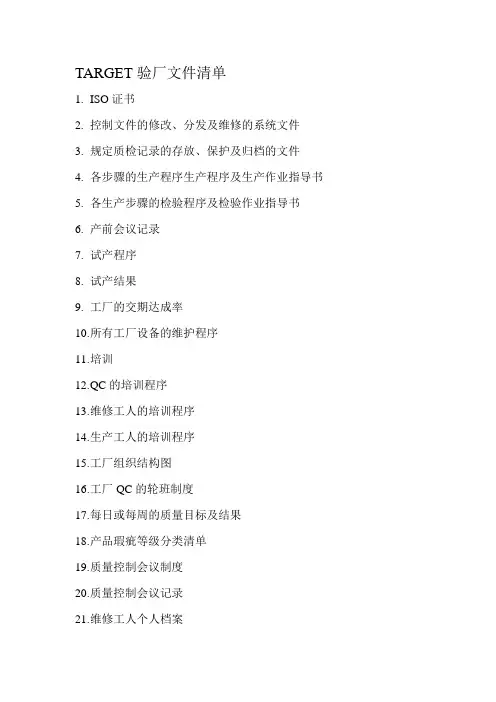
TARGET验厂文件清单1.ISO证书2.控制文件的修改、分发及维修的系统文件3.规定质检记录的存放、保护及归档的文件4.各步骤的生产程序生产程序及生产作业指导书5.各生产步骤的检验程序及检验作业指导书6.产前会议记录7.试产程序8.试产结果9.工厂的交期达成率10.所有工厂设备的维护程序11.培训12.Q C的培训程序13.维修工人的培训程序14.生产工人的培训程序15.工厂组织结构图16.工厂QC的轮班制度17.每日或每周的质量目标及结果18.产品瑕疵等级分类清单19.质量控制会议制度20.质量控制会议记录21.维修工人个人档案22.Q C个人档案23.生产工人个人档案24.物料与供应商管理25.监控或记录进出物料的库存程序26.原材料、零部件及配件的规格、质量标准及美国法规安全要求的检查程序27.在灯箱下(UL3000光源)对所有进厂包装物料的对色检查程序28.不合格包装的处理结果29.供应商交货合格率和可靠率记录30.不合格或拒收的原材料、半成品及成品的处理记录31.面料的检验程序32.面料的检验结果33.面料的经纬度、结构、及克重的记录34.有害化学品的正确储存及使用程序35.外加工产品的正确包装、处理程序36.外加工产品回厂的核数、检验、及入库程序37.外加工产品回厂的库存及品检记录38.外加工产品的品质控制及考核记录,等等39.辅料、吊牌、配件的检验记录40.辅料、配件、吊牌的检验记录41.辅料、配件、吊牌的发料记录42.实验室43.对色灯箱的维护、校验记录44.实验室技术员的培训文件或证书45.实验室所有负责颜色评估人员的色觉能力测试记录46.第三方实验室或工厂内部的测试结果47.车缝/生产车间48.次品的核对程序49.现场线检结果50.成品生产中的检验程序51.成品生产中的检验结果52.成品包括包装和纸箱的抽检结果53.断针控制程序54.断针控制每月记录55.过针测试56.对适用产品的过针测试程序57.所有需要过针测试产品的过针测试记录58.过针测试器的校验记录59.验布/裁剪60.用料记录61.丝印/绣花62.丝印材料的库存和发放记录63.丝印网版的清洁程序64.水洗65.测量适当水洗记录的程序66.污水处理文件。
Target 验厂自检表格(FE Form With Chinese 2009 5 14)
2.Training and Quality Systems 培训和品质系统
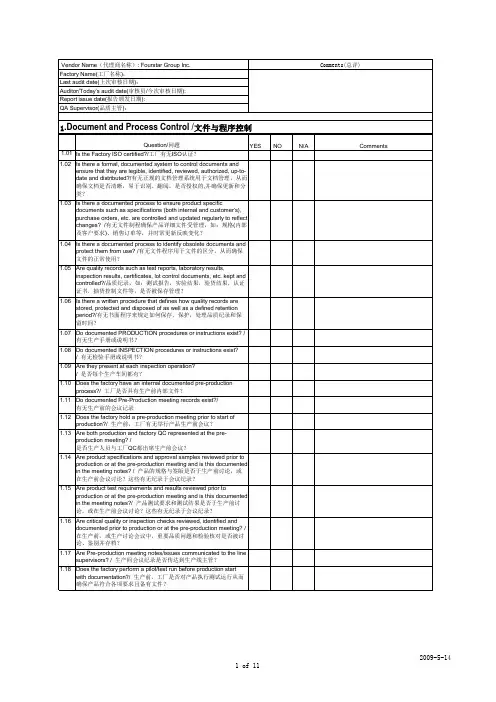
Question/问题 Training /培训 培训 2.01 Is there a formal, documented training or certification program for QC INSPECTORS on QC processes?/ 是否有给在产线、工作岗位、机械上工作的工人提供一个正规、书 面的培训/交叉培训或证明程序? 2.02 Are defect samples used during training to indicate what they should be looking for?/ 在培训中是否用到暇疵品来指出他们应该找什么的问题? 2.03 If hiring maintenance workers without a formal technical education, is there a formal, documented training or certification program for MAINTENANCE OR EQUIPMENT TECHNICIANS?/ 假如雇佣没有受过正规维修教育的工人,是否有提供一个正规的、 书面的维修机器工人培训或证明程序? 2.04 Are training requirements AND records maintained?/ 培训的要求和记录是否有保留? 2.05 Is training performed off of the production line?/ 是否有进行现场培训? 2.06 Is there a formal, documented training/cross-training or certification program for PRODUCTION WORKERS on process, work station, equipment that they perform/use?/是否有给在产线、工作岗位、机 械上工作的工人提供一个正规、书面的培训/交叉培训或证明程序? Quality Systems/品质系统 品质系统 2.07 Does the QA (Quality Assurance) or QC (Quality Control) department operate separately from the Production department?/QA(品质保证)或QC(品质控制)部门与生产部门 是否是独立操作的? 2.08 Does the quality department have adequate coverage during all shifts? /品质部是每一班次是否有足够人手? 2.09 Are daily or weekly quality goals developed and actual performance results collected?/品质目标与实际执行结果是否被保 存? 2.10 Are DCL's (Defect Classification List) or similar being used?/有无 DCL(缺陷分类目录)或其他类似的? 2.11 Are defects identified and recorded by operation, operator and machine?/操作人员,管理者以及机器是否有标记以及记录产品缺 陷? 2.12 Are weekly documented, ongoing Quality Control (QC) meetings held at the factory during production?/生产过程中,工厂有无召开 每周有纪录的,生产中品质管理会议? 2.13 Are quality records reviewed at the weekly QC meetings? /品质纪 录是否在QC每周例会上评论? 2.14 Are corrective action plans developed and documented based on the results of the weekly QC meetings?/有无根据每周QC例会的结 果来制定改善计划并存档? YES NO N/A Comments
最新验厂资料汇总(完整版)
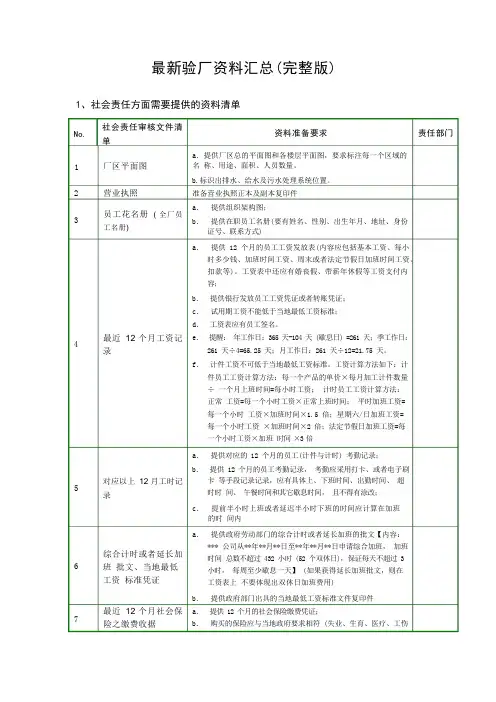
最新验厂资料汇总(完整版) 1、社会责任方面需要提供的资料清单No. 1 234567 社会责任审核文件清单厂区平面图营业执照员工花名册( 全厂员工名册)最近12 个月工资记录对应以上12 月工时记录综合计时或者延长加班批文、当地最低工资标准凭证最近12 个月社会保险之缴费收据资料准备要求a.提供厂区总的平面图和各楼层平面图,要求标注每一个区域的名称、用途、面积、人员数量。
b.标识出排水、给水及污水处理系统位置。
准备营业执照正本及副本复印件a.提供组织架构图;b.提供在职员工名册(要有姓名、性别、出生年月、地址、身份证号、联系方式)a.提供 12 个月的员工工资发放表(内容应包括基本工资、每小时多少钱、加班时间工资、周末或者法定节假日加班时间工资、扣款等)。
工资表中还应有婚丧假、带薪年休假等工资支付内容;b.提供银行发放员工工资凭证或者转账凭证;c.试用期工资不能低于当地最低工资标准;d.工资表应有员工签名。
e.提醒:年工作日:365 天-104 天 (歇息日) =261 天;季工作日:261 天÷4=65.25 天;月工作日:261 天÷12=21.75 天。
f.计件工资不可低于当地最低工资标准。
工资计算方法如下:计件员工工资计算方法:每一个产品的单价×每月加工计件数量÷一个月上班时间=每小时工资;计时员工工资计算方法:正常工资=每一个小时工资×正常上班时间;平时加班工资=每一个小时工资×加班时间×1.5 倍;星期六/日加班工资=每一个小时工资×加班时间×2 倍;法定节假日加班工资=每一个小时工资×加班时间×3 倍a.提供对应的 12 个月的员工(计件与计时) 考勤记录;b.提供 12 个月的员工考勤记录,考勤应采用打卡、或者电子刷卡等手段记录记录,应有具体上、下班时间、出勤时间、超时时间、午餐时间和其它歇息时间,且不得有涂改;c.提前半小时上班或者延迟半小时下班的时间应计算在加班的时间内a.提供政府劳动部门的综合计时或者延长加班的批文【内容:*** 公司从**年**月**日至**年**月**日申请综合加班,加班时间总数不超过 432 小时 (52 个双休日),保证每天不超过 3小时,每周至少歇息一天】 (如果获得延长加班批文,则在工资表上不要体现出双休日加班费用)b.提供政府部门出具的当地最低工资标准文件复印件a.提供 12 个月的社会保险缴费凭证;b.购买的保险应与当地政府要求相符 (失业、生育、医疗、工伤责任部门891011 11.111.211.311.41213 有薪年假记录厂规或者员工手册(招聘,奖惩,考评,工资,工时,福利制度)员工入职登记表(附身份证复印件)劳动合同合同期限合同试用期 (合同期小于3 个月的试用期不可超过15 天,合同期限大于3个月小于一年的,试用期不可超过1 个月,如合同期大于1 年小于3 年的,试用期不超过60 天,合同期大于 3 年或者无固定期限的,试用期不可超过6 个月)工资发放日,单月工资不超过30 天发放工作内容及劳动报酬、基本工资、福利待遇等员工请假、病假、休假、离职记录表(最近12 个月)未成年工体检证明/劳动部门登记表险等)a.带薪年休假条款应在员工合同或者管理制度中体现;b.提供员工带薪年休假记录;c.提供休假员工休假时间对应的考勤记录。
验厂所需文件清单
验厂所需文件清单
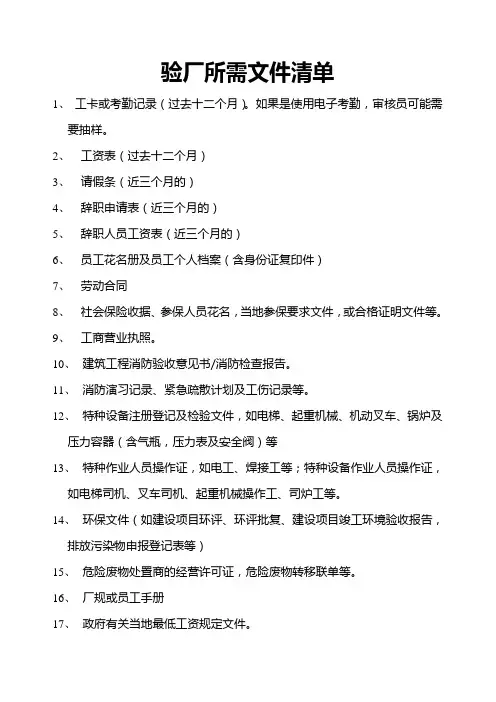
1、工卡或考勤记录(过去十二个月)。
如果是使用电子考勤,审核员可能需
要抽样。
2、工资表(过去十二个月)
3、请假条(近三个月的)
4、辞职申请表(近三个月的)
5、辞职人员工资表(近三个月的)
6、员工花名册及员工个人档案(含身份证复印件)
7、劳动合同
8、社会保险收据、参保人员花名,当地参保要求文件,或合格证明文件等。
9、工商营业执照。
10、建筑工程消防验收意见书/消防检查报告。
11、消防演习记录、紧急疏散计划及工伤记录等。
12、特种设备注册登记及检验文件,如电梯、起重机械、机动叉车、锅炉及
压力容器(含气瓶,压力表及安全阀)等
13、特种作业人员操作证,如电工、焊接工等;特种设备作业人员操作证,
如电梯司机、叉车司机、起重机械操作工、司炉工等。
14、环保文件(如建设项目环评、环评批复、建设项目竣工环境验收报告,
排放污染物申报登记表等)
15、危险废物处置商的经营许可证,危险废物转移联单等。
16、厂规或员工手册
17、政府有关当地最低工资规定文件。
18、当地劳动局关于综合计算工时工作制批文或延长加班批文。
19、未成年工体检及劳动局登记记录。
20、厂房平面图。
21、化学品清单。
22、机械设备维修计划。
Target质量体系验厂清单
Target质量体系验厂清单文件SL SH HG ISO 证书x x x控制文件的修订、分发及维护的正式文件系统,x x x规定质检记录的存放、保护及归档的文件x x x各步骤的生产流程及操作指南x x x各生产步骤的检验流程及操作指南x x x产前会议的文件x x x产前会议记录x x x试产流程x x x试产结果x x x工厂出货的绩效记录x x x工厂所有设备的预防维护流程x x x培训QC验货流程的培训计划x x x 维修工人的培训计划x x x生产工人的培训计划x x x工厂组织架构图x x x工厂QC员轮班表x x x 每日或每周的质量目标及结果x x x产品瑕疵分类清单x x x质量控制会议安排x x x质量控制会议记录x x x维修工人个人档案x x x QC员个人档案x x x 生产工人个人档案x x x材料与供应商管理监控或记录进出材料的库存清单x x x检查所有进厂原材料、零部件及半成品是否符合说明书、质量标准及美国的安全要求的程序x x x检查所有进厂原材料、零部件及半成品是否符合说明书、质量标准及美国的法规要求的程序x x x在灯箱下(UL3500 光源)对所有进厂包装材料的检查程序x x x 不合格包装的状态及处理记录x x x 供应商绩效和可靠性记录x x x 不合格或拒绝的原材料、半成品及成品的处理记录x x x 面料的检验流程x x进厂面料的检验结果x x进厂面料的经纬密度、结构、及重量的记录x x有害化学品的正确储存及使用流程x x x 染料或油墨的正确储存及使用流程x x x外加工产品的正确包装、处理流程x x x 外加工产品回厂的库存、核对及检验流程x x x 外加工产品回厂的库存及检验记录x x x 外加工厂的质量控制及绩效结果,等等x x x 辅料、配件、吊牌的检验流程,等等x x x 辅料、配件、吊牌的检验结果x x x 辅料、配件、吊牌的库房出库记录x x x实验室灯箱的维护、校验记录x x x 实验室技术员的培训文件或证书x x x 实验室所有负责颜色评估人员的色觉测试记录x x x 第三方实验室或工厂内部的测试结果x x x车缝/生产车间次品的核对流程x x x 现场线检流程x x x 现场线检结果x x x 成品生产中的检验流程x x x 成品生产中的检验结果x x x 成品包括包装和纸箱的抽检流程x x x 成品的终期抽检结果x x x 断针控制流程x x x 断针控制每日记录x x x金属探测器对适用产品的过针测试流程x x x 所有需要过针测试产品的过针测试记录x x x 金属探测器的校验结果x x x验布/裁剪用料记录x x x 丝印/绣花丝印材料的库存和发放记录x x x 丝印网版的清洁流程x x x水洗测量适当水洗量的记录x x x 污水处理文件x x x九段人权验厂系统是一套完整的验厂管理工具,包括人事、考勤、工资等的管理,已有数千家企业成功通过验厂,包括玩具、服装、家具、礼品、印刷、家居、五金等行业,也是众多顾问咨询公司的推荐产品。
史上最详细的Target验厂清单
史上最详细的Target验厂清单???Target验厂清单序号清单列表1.健康与安全1.01灭火器和消防栓,数量要和工厂的规模符合。
1.02工厂需要安装紧急照明系统。
1.02足够数量的安全出口,安全出口在任何时间段必须要保持通畅。
1.03员工必须接受消防演习的培训。
1.04对员工身体有伤害的工作环境必须佩带防护设备(如眼罩,耳塞)。
1.05工厂的宿舍必须符合消防安全,房间的面积和每个房间的员工数量必须合理。
1.06 机器设备是否有适当的安全装置?1.07 工厂是否避免工人不必要地暴露在有害有工作环境下? 1.08 工厂是否有“三合一”或'二合一’厂房?1.09 工厂的消防应急灯和灭火器数量是否足够,灭火器是否可以正常使用?1.10 厂房结构是否安全并妥善保养?1.11 厂房及宿舍的安全出口数量是否足够?1.12 工厂是否保存工伤事故记录?1.13 人事部是否有队新入职员工进行岗前安全培训?1.14 工厂是否有任命专人负责工厂安全健康工作的落实?1.15 工厂是否建立事故调查、报告和处理程序?1.16 是否建立一个安全卫生体系来检测、预防和应对安全卫生方面的潜在威胁?1.17 工厂是否为员工免费提供劳保用品?1.18 公司贴有紧急事故联系电话吗?1.19 是否建立应急反应方案?是否定期演习和测试?1.20 是否有足够受过训练的急救员?必要时能否得到紧急医疗救护?车间是否有足够的急救箱?1.21 工厂是否采取切实可行的措施控制职业危害?1.22 工厂是否为了工人提供干净并且数量足够的厕所1.23 工厂是否为了工人提供水质合格的饮用水? 1.24 工人使用厕所和饮水是否受到限制?1.25 公司是否提供足够的文件,记录和相关证据?1.26 公司管理层是了解并尊重法律法规要求?1.27 如果提供宿舍,宿舍是否干净、安全和卫生? 1.28 宿舍面积是否符合当的法规的规定,并满足基本的需要?1.29 男女宿舍是否分开,有效保护工人隐私?1.30 工厂是否提供洗衣、晾衣设备?1.31 工厂是否提供足够的澡堂或沐浴设备?1.32 若有必要,是否提供卫生的食物存放设施?1.33 饭堂设备及食物是否卫生、干净?2.童工/未成年工管理2.01 工厂是否有直接或间接地雇佣儿童(年龄小于16周岁或者某些国家规定的最低工作年龄)? 2.02 工厂规定的最低招工年龄是多少岁?2.03 工人的年龄证明资料(身份证件/出生证明/其他资料)是否过期?2.04 工厂在招聘过程中是否有核实员工的真实年龄?2.05 工厂是否制定拯救童工及保护未成年工的程序,并且有效的向员工及未成年员工宣传教育?2.06 工厂是否向童工提供足够的支持,以便他们接受学校教育直到超过16周岁? 2.07 工厂是否向学龄儿童提供教育支持? 2.08 工厂所雇佣的员工是否都超过了法律规定的最低工龄?2.09 工厂雇佣有多少名未成年工人?公司是否将未成年工安排在一些危险岗位或安排未成年上夜班?2.10 生产单位是否有办理未成年工登记手续,是否免费为未成年工提供入职前的体检以及入职后的定期体检?2.11 未成年工每天上班时间是否超过10小时?2.12 工厂是否存有所有在职员工的个人信息档案,附有相片及身份证复印件?3.禁止强迫和强制性劳动3.01 审核中是否发现工厂有直接或间接使用强迫性劳工的证据?3.02 是否所有工人都自愿受雇佣工作?3.03 工厂是否有与工人签定雇佣劳动合同?工人是否有一份合同副本?3.04 有否在工厂内发现如遭贩卖或受欺骗的无人身自由的工人?3.05 工厂是否有借款或垫款给工人?3.06 是否有証据显示,工人是受到非法惩罚或其它非法处分的威胁下工作呢? 3.07 是否使用监狱劳工或士兵?3.08 下班后,工人是否可以自由离开工厂?是否要求交纳押金或扣押工人身份文件?3.09 工人是否可以根据法规规定自由辞工?3.10 是否采用工作时间锁住工厂,或者休息时间锁住宿舍的方法来防止工人逃跑?3.11 通过检查保安合约、访问保安员,确认保安员是否只用作保护财产和人员安全等的保安目的? 4.工资报酬4.01 公司支付的工资是否达到当地最低工资标准?4.02 员工薪资如何计算?工资表上是否分计时、计件与月薪?4.03 工厂是否有对员工采取罚款的处罚?4.04 工人工资是否满足员工的基本需要,并能提供一些可以随意支配的收入?4.05 工资和福利的组成是否清楚列明?包括基本工资、工作时间、奖金、扣减额、福利部分、津贴。
欧美客户质量验厂必备程序文件汇编
欧美客户质量验厂必备程序文件汇编适用于:各欧美客户的质量验厂,如SQP,COSTCO质量标准,WALMART 的FCCA,TARGET质量标准,KMART的质量标准,家乐福的质量标准,JCS的质量标准等。
虫害控制程序利器管理控制程序(重点)玻璃管理控制程序客户抱怨处理控制程序(重点)试产控制程序(重点)产品变更控制程序样品管理控制程序装配快速转线控制程序防静电控制程序测量系统分析控制程序首件确认控制程序产品风险评估控制程序(重点)产品召回控制程序(重点)SPC程序成本控制程序(重点)来料检验控制程序(重点)过程检验控制程序(重点)成品检验控制程序(重点)客户验货控制程序模具管理控制程序工装管理控制程序相关重要记录其他现场相关要求虫害控制程序利器管理控制程序玻璃控制程序客户抱怨处理控制程序试产控制程序产品变更控制程序1、目的为了保证公司对申请认证的产品,在生产中按认证的要求一致性生产,特制定本办法。
2、范围适用于本公司通过认证的所有认证产品的变更。
3、职责各部门(包括客户):提出对产品某些特性、结构或外观等更改。
研发中心:对更改做出变更评估。
品保部:对变更进行监督。
《文件控制程序》《质量记录控制程序》样品管理控制程序防静电控制程序测量系统分析控制程序首件确认控制程序产品风险风评控制程序产品召回控制程序SPC控制程序能力较高或顾客有较高(或较低)的过程能力或性能要求时,由技术部对其相应的控制计划进行修订并将其在控制计划中予以明确注明。
125.12当过程能力(Ppk、Cpk)分析结果长期显示稳定时,由研发中心按《持续改进管理程序》的规定对其进行过程能力(Ppk、Cpk)的持续改进。
135.13公司必须按PPAP中的规定维持顾客零件批准过程要求所规定的过程能力或绩效,并对过程变更生效日期的记录。
145.14如顾客要求时,相关数据的收集由研发中心、品保部、生产部使用顾客要求的表格进行数据收集过程能力改进过程变更记录6.相关文件《统计过程控制参考手册》7.相关记录7.1 Xbar-R 图/ P 图成本控制程序来料检验控制程序过程检验控制程序。
Guidebook to Target ESC_ENG V1
GUIDEBOOK TOTARGETETHICAL SOURCING CODEFOR MERCHANDISE VENDORS & FACTORIESDecember 2011Table of ContentsIntroduction (3)Target Ethical Sourcing Code and Supplemental Standards1. Labour (4)1.1 Child labour (4)1.2 Wages, Benefits, Working Hours and Transparent Record Keeping (5)1.3 Forced/Bonded Labour (7)1.4 Discrimination (8)1.5 Harassment and Abuse (9)1.6 Freedom of Association (9)1.7 Health and Safety (10)2. Environment (12)3. Business Integrity (13)4. Compliance with the Law (13)5. Management Systems (14)6. Compliance with our Ethical Sourcing Code (14)AppendixA. Definitions (15)B. Target Contacts (18)IntroductionTarget is committed to conducting its business in accordance with a high standard of business ethics, a regard for human rights, and in compliance with all applicable laws governing issues such as child labour, wages, benefits, working hours, harassment and health and safety. We expect our vendors to share our high standards of conduct, as outlined in Target Ethical Sourcing Code (“ESC”).Our ESC includes minimum requirements and expectations that all vendors and factories must comply with as a condition of doing business with Target. The purpose of the Guidebook is to provide additional guidance and clarification to vendors and factories on Target’s ESC standards. We expect vendors and factories to use it as a reference tool to help identify what workplace practices and working conditions are acceptable when doing business with our company. Please note that it does not replace the local laws of each country where vendors and factories operate. At a minimum, vendors and factories should always be familiar with and comply with all relevant laws and regulations. Target standards should be followed where there is no law or where our standard is stricter.Target is committed to working with vendors and factories by providing continuous education and support. It is our expectation that vendors and factories are honest and transparent in their dealings with us and committed to making continuous improvements.If you have any questions that cannot be answered by reviewing the Guidebook and referring to local laws, please contact your designated Target ESC associates (Appendix B).Target Ethical Sourcing Code and Supplemental Standards1. Labour1.1 Child LabourVendor will comply with the minimum employment age limit defined by national law or by International Labor Organization (ILO) Convention 138, whichever is higher. The ILO Convention 138 minimum employment age is the local mandatory schooling age, but not less than 15 years of age, subject to exceptions allowed by the ILO and national law.- Target Ethical Sourcing CodeSupplemental Standards:• Factories must comply with all applicable laws governing minimum working age. If set below 15, then no one under the age of 15 is permitted to work (subject to exceptions allowed by the ILO and ational law). If set at 15, then no one under 15 is permitted to work. If set above 15, then no one under the age established by law may work in the factory.• Factory has implemented a written policy specifying the youngest age for workers hired in the factory to ensure compliance with the child labour provision in the ESC. Policy is effectively communicated to all workers.• Factory must comply with all legal restrictions placed on young/juvenile workers. This includes the number of overtime hours, hazardous and/or night work, annual medical checkups, and taking all necessary precautions to ensure juvenile workers are protected from working conditions likely to endanger their health, safety or welfare.• Required documentation is maintained for juvenile workers, as required by law, including registration, school completion certificates, doctor certificates, and permission from parents.• Factory has hiring procedures in place to verify age documentation.• To verify age and thereby compliance with legal age limitations, proof of age documentation must be maintained in personnel files for all workers in the form of birth certificates, government identification cards, or other official documents.• No children are allowed in the factory, even if they are not working.1.2 Wages, Benefits, Working Hours and Transparent Record KeepingVendors must comply with all laws regulating local wages, overtime compensation, and legally mandated benefits. Wage and benefit policies must satisfy all applicable laws and regulations. Under ordinary business circumstances, employees must not be required to work excessive working hours per week, including overtime, and have the option of at least one day off in seven. We expect that all record keeping will be accurate and transparent at all times.- Target Ethical Sourcing CodeSupplemental Standards: Wages and benefits• Legal minimum wage is guaranteed to all workers. If a worker is paid by piece instead of hour, the worker must receive a wage equal to or above minimum wage.• In addition to wages for the standard workweek, all workers must be compensated for overtime hours at the legally or contracted mandated premium rates.• Workers must be paid on time, in accordance with the law, and in the form of the local currency. • Factory has a written policy on wage and compensation awards, based on legal requirements.• Legal and company minimum wage rates are posted or available to workers.• Worker is notified of wages, withholdings and other legal deductions prior to commencement of employment via a labour contract (if required by law) or other means (e.g., a written summary or a company handbook of key terms and conditions of employment).• Factory is prohibited from the use of fines/deductions not permitted by law, e.g., disciplinary fines. • Legal deductions for food and housing and other factory provided items should be reasonable, as defined by applicable laws and regulations or, in the absence of the law, industry best practice.• The factory must pay and/or provide all legally required benefits, including vacation, social insurance, etc.• Pay slips provided and include workers’ personal information (name, address, etc.) and a detailed explanation of payment, including days worked, wage or piece rate earned per day, hours of overtime, bonuses, allowances and a description of any and all deductions. This same information should be available for subcontractors who work on-site.• Legally required withholdings are withheld correctly and paid to the proper agency(ies).Supplemental Standards: Working hours• Factory has a written policy for working hours and overtime in accordance with the legal requirements.• Factory complies with the legal requirements and limitations on regular and overtime.• Where the law permits working hours beyond 60 in a week, Target requests that factories work no more than 60 hours per week on a regularly-scheduled basis and are provided with at least one day off in seven.• All hours are tracked and time cards accurately reflect the real working hour situation in the factory.Absence of an adequate system of tracking hours worked means that correct pay for hours worked cannot be verified.• Workers punch in and out for themselves and have access to their own attendance records upon request.• All overtime is voluntary. Workers are educated on the standard workweek and the factory seeks their willingness to work overtime hours. For workers not interested in working overtime, the factory is supportive of their decision and does not, in any way, force or coerce them to work overtime hours. • Legal working hours and factory working hours are made available to all workers.• Workers are given the legally required rest or break time during working hours.Supplemental Standards: Transparent record keeping• Regardless if announced or unannounced, factories must be cooperative and transparent during an ESC audit and provide full access to workers, records and factory work areas as well as dormitories. • Worker interviews are allowed in a private setting and workers are not coached.• Factories must maintain only one set of complete and accurate working-hour and payroll documents and records on site that represent true work conditions.1.3 Forced/Bonded LabourFactories shall not use any type of forced labour, which means any work or service performed involuntarily under threat of physical or other penalty, such as prison, indentured or bonded labour. Further, they shall respect the freedom of movement of its workers and not restrict their movement by controlling identity papers, holding money deposits, or taking any other action to prevent workers from terminating their employment.- Target Ethical Sourcing CodeSupplemental Standards:• Indentured, bonded and prison labour are strictly prohibited in a factory producing merchandise for Target.• Workers are not forced to work against their will, ability, or in a manner outside the provisions of the labour contract, where applicable.• Workers must be allowed to freely move within the factory to use the toilets, take designated breaks, etc., and leave the factory at the end of their shift or after giving their employer reasonable notice. • Workers are not coerced by factory personnel, including supervisors, security personnel, etc.• Factory/Agency does not restrict the movement of its workers by controlling identity papers or withholding money deposits, requiring excessive fees, etc.• Factories shall only retain a worker’s government issued identification, passport, work permit or other personal identification with the worker’s written permission, and shall return such materials to the worker at the worker’s request.• Factory has a written policy concerning forced labour which meets the requirements of the Target ESC. Policy is effectively communicated to all workers.• Workers must be able to end their employment, as outlined in legally compliant contracts. Factories shall pay all wages fully and promptly and not employ other tactics to prevent workers from leaving at will, such as withholding salary as a “year-end bonus” or charging a penalty when workers terminate their contract.• Workers must be able to refuse to perform certain tasks that the worker believes to be hazardous without penalty of termination.1.4 DiscriminationAll conditions of employment must be based on an individual’s ability to do the job, not on the basis of personal characteristics, such as gender, ethnic origin, religion, or personal beliefs. Factories must ensure that they provide an environment where their employees can work without distress or interference caused by harassment, discrimination or any other inappropriate workplace behaviour.- Target Ethical Sourcing CodeSupplemental Standards:• Different treatment is not given to workers based on personal characteristics or beliefs, such as age, race, color, nationality, gender, religion, marital status, sexual preference, maternity status, disability or political beliefs. This includes denial of work and promotions, and differing pay rates, benefits and disciplinary practices.• Discrimination based on workers’ associations is prohibited. This includes refusing to hire workers because of their associations, as well as threatening, disciplining, punishing or firing workers because they exercise this right.• Factories have a written policy against discrimination in the workplace based on gender, ethnic origin, religion, and/or personal beliefs, etc. Policy is effectively communicated to all workers.• Factory does not question prospective workers about their pregnancy status, and pregnancy tests are not conducted before hiring or as a pre-condition to employment.• The use of medical examinations, to prevent a worker from being hired or firing a worker who becomes ill or injured, is not allowed.• Religious observance, prayer breaks and religious holidays should not be prohibited.• Factory policies do not favor one group of workers over another.• Hiring notices do not specify discriminatory factors, such as gender or race.• Contracted agencies are reviewed to ensure they do not have discriminatory practices.1.5 Harassment and AbuseWorkers shall be treated with dignity and respect. In particular, factories will provide a workplace free from harassment, which can take many forms, including physical, sexual, verbal or visual behavior that creates an offensive, hostile, or intimidating environment.- Target Ethical Sourcing CodeSupplemental Standards:• Factory has a written policy prohibiting acts of harassment or abuse in connection with workers’ employment. Policy is effectively communicated to all workers.• Management must not tolerate any type of harassment or abuse. This includes, but is not limited to: Physical contact intended to hurt or harm a worker;Requiring any form of sexual favor in exchange for beneficial treatment in employment, or asa condition of maintaining employment;Touching workers in any way that could be considered to have sexual implications;Making inappropriate sexual comments to workers;Threats of behaviour to harm a worker physically or psychologically;Comments or behaviour which is reasonably understood by the worker to be threatening, demeaning or coercive;• Illegal methods of discipline, as well as the withdrawal of basic physical comforts provided to other workers, are prohibited.1.6 Freedom of AssociationVendors should respect the rights of employees to lawfully associate or not to associate with groups of their choosing, as long as such groups are legal in the country where the merchandise is manufactured. Vendors should not interfere with, obstruct or prevent legitimate related activities.- Target Ethical Sourcing CodeSupplemental Standards:• Factory has a policy and procedures on freedom of association and educates their workers and supervisors to ensure they understand their rights.• Factories do not interfere with workers’ ability to exercise their right to associate or join legal organizations of their choosing.• Workers have the ability to approach management on issues of concern, on their own or through a worker representative.1.7 Health and SafetyConditions in all production and residential facilities must be safe, clean and consistent with all applicable laws and regulations or industry best practices, whichever is higher in order to avoid preventable work related accidents and injuries.- Target Ethical Sourcing CodeSupplemental Standards: General Environmental Health and Safety (EHS)• Factory has knowledge of and complies with all local legal regulations on health and safety. Factory is aware of industry best practices and has a Policy and plan to achieve the higher standards on a continuous improvement basis. Policy is effectively communicated to all workers.• Factory has appointed a senior management representative to govern health and safety in the workplace. Regular monitoring is conducted to check that health and safety procedures are being followed.• Workers are appropriately supervised and trained to perform their jobs safely and receive formal training on safety procedures in general.• Factory is generally kept clean and hygienic in accordance with the law. This includes regular and systematic refuse collection.• Periodic testing is conducted on all drinking water to ensure it is safe.• There are a reasonable number of operating toilets that are clean, offer privacy (i.e., ability to lock doors) and a good ventilation system to provide good circulation of air to reduce odors.• Identify risk areas, such as toxic substances and dangerous machinery, and effectively manage by providing the applicable training and ensuring chemicals are properly stored and labeled with Material Safety Data Sheets (MSDS) and available to workers in the local language.• Chemicals are stored in a separate area which is equipped with the appropriate fire extinguishers, safety signs, ventilation, and instructions on handling and disposal and personal protective equipment for workers.• Emergency eyewash stations and/or showers are provided where corrosive chemicals or high volumes of solvents are handled and used.• Adequate ventilation is provided where paints, chemicals, sprays (solvents, solder, dust) are used to prevent accumulation of flammable vapors.• Factory provides the appropriate personal protective equipment (PPE)/clothing for workers and machines, and ensures workers are trained on how to use the PPE and why it is important and the use of it is required.• Injury records are properly maintained and all significant accidents and near misses are investigated, reported and corrective action is performed to minimise any re-occurrence.• Machinery, equipment and fixtures are checked regularly to ensure they are in safe working condition. Documentation is maintained to demonstrate compliance.• Railings guard all stairs, platforms, and elevated floors.• Confined spaces are secured and identified with the proper signage (e.g., "no smoking").Supplemental Standards: Emergency/Fire Preparedness• Factory communicates fire and emergency evacuation plans and posts the diagrams in the local language in various locations around the factory. The plan illustrates critical information such as emergency evacuation routes, “you are here” mark, correct layout direction, location of fire extinguishers and hydrants, and instructions in the local language of what to do in the event of an evacuation.• Evacuation drills are conducted regularly, at least annually or more often where required by law. • Exit routes are not obstructed by equipment, materials, production, etc. (internally and externally) and are regularly checked.• The number of emergency exits is in accordance with the local law and exits are unlocked, clearly marked, and lead to the outside. Doors that are not exits are labeled as such, i.e., “NOT AN EXIT”. • Fire alarm system is audible throughout the entire factory. The system is inspected regularly and tested in coordination with fire drills.• Fire equipment, including fire extinguishers, are easily accessible, clearly marked, and routinely inspected to ensure they remain operational.• Factory has emergency lighting for all stairways and where needed on exit routes. The lighting is inspected periodically.• Designated factory personnel (workers and supervisors) are trained at regular intervals in fire safety, the use of fire extinguishers, and how to administer the fire prevention procedures and emergency evacuation plan.• Sufficient first-aid supplies are maintained on work floors with adequate personnel trained in First Aid to assist in an emergency.• Floors are kept clean from hazardous spills and materials.• Emergency and other hazardous signage is adequate.• Electrical equipment and wiring is properly maintained, covered/insulated to prevent exposure of wires.• Gas cylinders are properly marked, used, inspected, stored and secured.Supplemental Standards: Accommodations• In addition to the following, all health and safety guidelines listed above are implemented in factory sponsored dormitory buildings.• Accommodations and food service area are generally kept clean, provide a safe, hygienic living environment for workers, and comply with all legal regulations regarding residential facilities, where provided.• Dormitories are not attached to any production or warehouse building.• Separate accommodations exist for males and females.• In workers’ sleeping rooms, the ILO recommends the floor area not be less than 7.5 square metres in rooms accommodating two persons; 11.5 square metres in rooms accommodating three persons;or 14.5 square metres in rooms accommodating four persons. If a room accommodates more than four persons, the floor area should be at least 3.6 square metres per person.• Residents should have their own bed, an area for personal items and the ability to secure belongings.• There are a reasonable number of operating toilets and showers that are clean and separated by gender. The ILO recommends a minimum of one toilet, one wash basin and one bathtub or shower for every six persons. Toilets offer privacy (i.e., ability to lock doors) and a good ventilation system to provide good circulation of air to reduce odors.2. EnvironmentFactories, as a minimum, will meet all relevant local and national environmental protection laws, and will strive to comply with international environment protection standards.- Target Ethical Sourcing CodeSupplemental Standards:• Factory has a written policy and procedures on environmental protection, based on the national environmental protection laws.• Where required by law, factory maintains environmental records and certificates and disposes of hazardous materials and chemicals according to the law so that these materials are not discharged and do not pollute the environment.• Factories should be aware of international environment protection standards and have a plan to achieve these standards on a continuous improvement basis.3. Business IntegrityVendors must demonstrate a high degree of professionalism and have a close affinity with our business ethics. In particular, honesty, fair dealing and the proper treatment of workers are required at all times.Bribes, favours, benefits or other similar unlawful or improper payments, in cash or kind, are strictly prohibited, whether given to obtain business or otherwise.- Target Ethical Sourcing CodeSupplemental Standards:• Business is carried out with a high degree of ethics, honesty and fair dealings.• Factory has a written policy on ethical standards/business integrity that does not permit bribes, special favors, benefits or other similar unlawful behaviour.• Offering compensation of any value (gifts, discounts, services, loans, payments) to any Target or affiliate worker, service provider or government/political official to influence any act or decision to secure a business advantage is strictly prohibited.4. Compliance with the LawTarget requires all vendors and factories to comply fully with the legal requirements of the countries in which they operate. All requirements in this Code are in addition to compliance with applicable local laws.-Target Ethical Sourcing CodeSupplemental Standards:• At a minimum, factories must comply with local laws and regulations of the country of manufacture.• Business licenses and other documents are in order and up-to-date.• Factory has written procedures in place, with a designated responsible management representative, to ensure they are aware of and understand changes that are made to the local labour law (e.g., local minimum wage).• The designated responsible management representative communicates these changes and implications to all workers and works with the factory staff to ensure the necessary changes are made in a timely manner to ensure compliance with the law.• Factory provides a labour contract to each worker which stipulates the wage and compensation awards legislated in the country.• Labour contracts, where applicable, are written in compliance with the law and signed by workers.Workers receive a copy in their native language.5. Management SystemsWith a scope related to the content of this Code, vendors shall adopt or establish a management system for all its factories and vendors providing materials or labour in the manufacture of goods ordered by Target. The management system shall be designed to ensure (a) compliance with applicable laws and regulations; (b) conformance with this Code; and (c) identification and mitigation of operational risks related to this Code. It should also facilitate continual improvement.- Target Ethical Sourcing CodeSupplemental Standards (factory management system components):• Policies and procedures are in place to ensure the factory and their subcontractors are aware of and comply with applicable laws, regulations and, where stricter, Target ESC.• A management representative is appointed to implement the factory’s policies, procedures and improvement objectives.• Factory has a working communication/grievance system, and workers are aware and educated on how to use the system. Issues are reviewed regularly, responded to with a sense of urgency, and properly filed to demonstrate compliance.• Factory conducts internal audits on a regular basis to ensure conformity to legal and regulatory requirements and the content of the ESC.• Managers, staff, supervisors and workers are trained on the factory’s Code of Conduct and/or Target ESC. This training is embedded in the orientation process.6. Compliance with our Ethical Sourcing CodeTarget will monitor compliance with this Code, and we, or our representatives, may visit factories to ensure compliance with this policy. Any violations of our Code will be reported to the vendor for follow up and corrective action. Vendors are required to cooperate with the entire process. Where there are egregious violations and/or the vendor/factory does not demonstrate a willingness to comply, Target reserves the right to discontinue business with the vendor/factory.- Target Ethical Sourcing CodeSupplemental Standards:• Factory has reviewed Target ESC and support documents and understands the company’s expectations and the associated procedures if selected for an audit.• Factory is available, transparent and cooperative with Target representatives during an audit.• Factory has a corrective action process for timely correction of deficiencies identified by internal or external assessments, inspections, investigations and reviews.APPENDIX A: DefinitionsBonded labourWork for an employer not for compensation received by the worker, but to pay off a debt, which is often incurred by another worker offering the worker’s labour in exchange.Corrective actionA corrective action is a change implemented to address a weakness or non-complianceidentified in an audit. It is the action taken to correct any non-compliance which has been found in an assessment to an agreed standard.Corrective action plan (CAP)The document completed after the audit which confirms the findings and any agreed necessary corrective actions that must be improved to meet our compliance standards.Excessive feesFees charged to a worker that is in excess of the amount legally permitted by any applicable law of the host or home country. Or, in the absence of such law, fees substantially above the prevailing market rate.Freedom of associationThe right of all workers to join or form a trade union of their own choosing, which is legal in the country in which merchandise is manufactured, and carry out trade union activities without interference from their employer or from public authorities.Forced labourAll work or service that is extracted from any person under the menace of any penalty for which the said person has not offered him/herself voluntarily or for which such work or service is demanded as a means of repayment of debt.Grievance procedureA process or procedure for workers who may feel that they have been treated unfairly to voicetheir concerns without fear of repercussion.HarassmentAny physical, verbal, sexual, or psychological nature, offensive conduct that threatens human dignity and worker morale.Hazardous jobsHazardous jobs include working with dangerous machinery/ equipment (e.g. knives, saws);chemicals or hazardous substances; noisy environments; lifting heavy things; extreme cold or hot conditions.Human rightsA set of principles defined in the Universal Declaration of Human Rights (1948), based on therecognition of the inherent dignity and the equal and inalienable rights of all members of the human family as the foundation of freedom, justice and peace in the world.Indentured labourWork performed on behalf of an employer who forbids workers from leaving employment at the worker’s discretion.International Labour Organization (ILO)The ILO is the international organisation responsible for drawing up and overseeing international labour standards. It is the only 'tripartite' United Nations agency that brings together representatives of governments, employers and workers to jointly shape policies and programmes promoting Decent Work for all.ILO Convention 138This Convention, concerning Minimum Age for Admission to Employment, was adopted in 1973 by the International Labour Organization. It requires ratifying states to pursue a national policy designed to ensure the effective abolition of child labour and to raise progressively the minimum age for admission to employment or work. For details on ILO Convention 138, see /ilolex/english/convdisp1.htm.。