
2014年普通高等学校招生全国统一考试(天津卷)
绝密★启用前2014 年普通高等学校招生全国统一考试(天津卷)英语本试卷分第I卷(选择题)和第II卷(非选择题)两部分。
考试结束后,将本试卷和答案卡一并交回。
第I卷注意事项:1.答第I卷前考生务必将自己的姓名、准考证号填写在答题卡上。
2.选出每小题答案前,用2B铅笔把答题卡上对应题目的答案标号涂黑。
如需改动,用橡皮擦干净后,再选涂其他答案标号框,不能答在本试卷上,否则无效。
第一部分英语知识运用(共两节,满分45分)第一节单项填空(共15小题;每小题1分,满分15分)从A、B、C、D四个选项中,选出可以填入空白处的最佳选项,并在答题卡上将该项涂黑。
1.Give me a chance, ________ I’ll give you a wonderful surprise.A.ifB. orC. andD. while2.---Ok, I’ll fix your computer right now. ---Oh, take your time. __________.A.I can’t stand itB. I’m in no hurryC. That’s a great ideaD. It’s not my cup of tea3.Wind is now the world’s fastest growing ________ of power.A.sourceB. senseC. resultD. root4._______ you start eating in a healthier way, weight control will become much easier.A. unlessB. AlthoughC. BeforeD. Once5. Anxiously, she took the dress out of the package and tried it on, only _________ id didn’t fitA. to findB. foundC. findingD. having found6. _______ the school, the village has a clinic, which was also built with government support.A. In reply toB. In addition toC. In charge ofD. In place of7. Clearly and thoughtfully________, the book inspires confidence in students who wish to seek their own answers.A. writingB. to writeC. writtenD. being written8. Life the like ________ ocean; Only ________strong-willed can reach the other shore.A. an; theB. the; aC. the ;/D. / ; a9. My parents always _______ great importance to my getting a good education.A. haveB. attachC. acceptD. pay10. ---How long have you been learning English? ----_________! Your English is so good.A. You can’t be seriousB. You got itC. I couldn’t agree moreD. I’m stuck11. We won’t start the work until all the preparations __________.A. are being madeB. will be madeC. have been madeD. had been made12. English is a language shared by several diverse cultures, _________ uses it differently.A. all of whichB. each of whichC. all of themD. each of them13. The two countries are going to meet to _______ some barriers to trade between them.A. make upB. use upC. turn downD. break down14. I think _______ impresses me about his painting is the colours he uses.A. whatB. thatC. whichD. who15. ________ the morning train, he would not have been late for the meeting.A. Did he catchB. should be catchC. has he caughtD. Had he caught第二节完形填空(共20小题,每小题1.5分,满分30分)阅读下面短文,掌握其大意,然后从16-35各题所给A,B,C,D的四个选项中,选出最佳选项。
One night, when I was eight , my mother gently asked me a question I would never forget. “Sweetie, my company wants to 16 me but needs me to work in Brazil. This is like yourteacher telling that you’ve done 17 and allowing you to skip a grade(跳级), but you’ll have to 18 your friends. Would you say yes to your teacher?” She gave me a hug and asked me to think about it. I was puzzled. The question kept me 19 for the rest of the night I had said “yes”but for the first time, I realized the 20 decisions adults had to make.For almost four years, my mother would call us from Brazil every day. Every evening I’d 21 wait for the phone to ring and then tell her every detail of my day. A phone call, however, could never replace her 22 and it was difficult not to feel lonely at times.During my fourth-grade Christmas break, we flew to Rio to visit her. Looking at her large 23 apartment, I became 24 how lonely my mother must have been in Brazil herself. It was then 25 I started to appreciate the tough choices she had to make on 26 family and work. 27 difficult decisions, she used to tell me, you wouldn’t know whether you make the right choice, but you could always make the best out of the situation, with passion and a 28 attitude.Back home , I 29 myself that what my mother could do, I could, too. If she 30 to live in Rio all by herself, I, too, could learn to be 31 . I learn how to take care of myself and set high but achievable 32 .My mother is now back with us. But I will never forget what the 33 has really taught me. Sacrifices 34 in the end. The separation between us has proved to be 35 for me.16. A. attract B. promote C. surprise D. praise17. A. little B. much C. well D. wrong18. A. leave B. refuse C. contact D. forgive19. A. explaining B. sleeping C. wondering D. regretting20. A. poor B. timely C. final D. tough21. A. eagerly B. politely C. nervously D. curiously22. A. patience B. presence C. intelligence D. Influence23. A. Comfortable B. Expensive C. Empty D. Modern24. A. Interested in B. aware of C. doubtful D. satisfied with25. A. when B. where C. which D. that26. A. abandoning B. balancing C. comparing D. mixing27. A. Depending on B. supplied withC. Faced withD. Insisting on28. A. different B. friendly C. positive D. general29. A. criticized B. informed C. warned D. reminded30. A. managed B. offered C. attempted D. expected31. A. grateful B. energetic C. independent D. practical32. A. examples B. limits C. rules D. goals33. A. question B. experience C. history D. occasion34. A. pay off B. come back C. run out D. turn up35. A. blessing B. gathering C. failure D. pleasure第二部分:阅读理解(共20小题,每小题2.5分,满分50分)阅读下列短文,从每题所给的四个选项(A、B、C和D)中,选出最佳选项,并在答题卡上将该项涂黑。
2014年普通高等学校招生全国统一考试天津卷-物理试题解析

2.如图所示,电路中R1、R2均为可变电阻,电源内阻不能忽略,平行板电容器C的极板水平放置。闭合电键S,电路达到稳定时,带电油滴悬浮在两板之间静止不动,如果仅改变下列某一个条件,油滴仍能静止不动的是
A.增大R1的阻值B.增大R2的阻值
C.增大两板间的距离D.断开电键S
【考点】本题考查闭合电路欧姆定律及平行板电容器的基础知识,属于简单题。
祝各位考生考试顺利!
第Ⅰ卷
注意事项:
1.每题选出答案后,用铅笔将答题卡上对应题目的答案标号涂黑。如需改动,用橡皮擦干净后,再选涂其它答案标号。
2.本卷共8题,每题6分,共48分。
一、单项选择题(每小题6分,共30分。每小题给出的四个选项中,只有一个选项是正确的。)
1.质点做直线运动的速度-时间图像如图所示,该质点
【解析】电容器C中的带电油滴能悬浮在两板间可知粒子带负电且有,按照题目要求,仅改变四个选项中的一个条件,若只增大R1阻值,由闭合电路欧姆定律可知,干路的总电流减小,内电压下降,路端电压增大,故电容器C的极板电压会增大,场强增大,导致液滴受到的电场力大于重力从而向上运动,故A选项错误;若增大R2阻值,由于电容器在电路中起到“通交流,阻直流”的作用,因此不会对本电路产生影响,B选项正确;若增大两板间距离,由于电容器C仍与R1并联,极板电压不变,故根据可知场强E减小,故而液滴会向下运动,C选项错误。若断开电键S,则电容器会对外放电,导致两板电荷量减小,而电容器C的电容不变,由可知U减小,场强E减小,液滴向下运动,故D选项错误。综上,B选项正确。
D.观察者与波源互相远离时接收到波的频率与波源频率不同
【考点】本题考查原子结构、原子核、电磁波谱,天然放射现象及其射线,多普勒效应等知识,属于简单题。
2014年高考真题——理综物理(天津卷)解析版.pdf
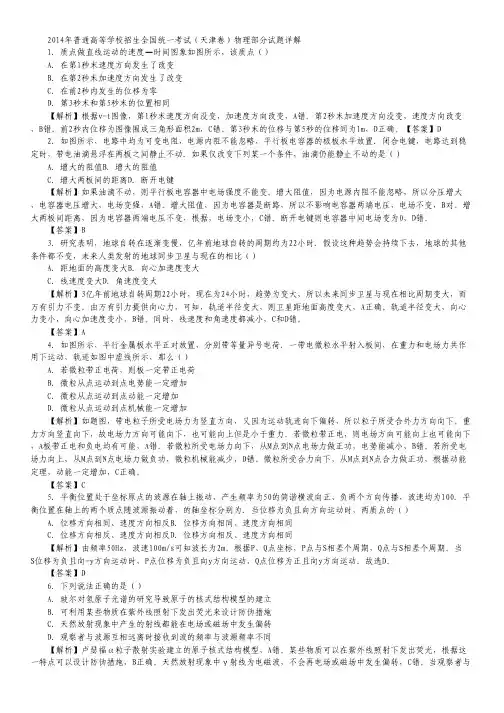
2014年普通高等学校招生全国统一考试(天津卷)物理部分试题详解 1.质点做直线运动的速度—时间图象如图所示,该质点() A.在第1秒末速度方向发生了改变 B.在第2秒末加速度方向发生了改变 C.在前2秒内发生的位移为零 D.第3秒末和第5秒末的位置相同 【解析】根据v-t图像,第1秒末速度方向没变,加速度方向改变,A错。
第2秒末加速度方向没变,速度方向改变,B错。
前2秒内位移为图像围成三角形面积2m,C错。
第3秒末的位移与第5秒的位移同为1m,D正确。
【答案】D 2.如图所示,电路中均为可变电阻,电源内阻不能忽略,平行板电容器的极板水平放置.闭合电键,电路达到稳定时,带电油滴悬浮在两板之间静止不动.如果仅改变下列某一个条件,油滴仍能静止不动的是() A.增大的阻值B.增大的阻值 C.增大两板间的距离D.断开电键 【解析】如果油滴不动,则平行板电容器中电场强度不能变。
增大阻值,因为电源内阻不能忽略,所以分压增大,电容器电压增大,电场变强,A错。
增大阻值,因为电容器是断路,所以不影响电容器两端电压,电场不变,B对。
增大两板间距离,因为电容器两端电压不变,根据,电场变小,C错。
断开电键则电容器中间电场变为0,D错。
【答案】B 3.研究表明,地球自转在逐渐变慢,亿年前地球自转的周期约为22小时.假设这种趋势会持续下去,地球的其他条件都不变,未来人类发射的地球同步卫星与现在的相比() A.距地面的高度变大B.向心加速度变大 C.线速度变大D.角速度变大 【解析】3亿年前地球自转周期22小时,现在为24小时,趋势为变大,所以未来同步卫星与现在相比周期变大,而万有引力不变。
由万有引力提供向心力,可知,轨道半径变大,则卫星距地面高度变大,A正确。
轨道半径变大,向心力变小,向心加速度变小,B错。
同时,线速度和角速度都减小,C和D错。
【答案】A 4.如图所示,平行金属板水平正对放置,分别带等量异号电荷.一带电微粒水平射入板间,在重力和电场力共作用下运动,轨迹如图中虚线所示,那么() A.若微粒带正电荷,则板一定带正电荷 B.微粒从点运动到点电势能一定增加 C.微粒从点运动到点动能一定增加 D.微粒从点运动到点机械能一定增加 【解析】如题图,带电粒子所受电场力为竖直方向,又因为运动轨迹向下偏转,所以粒子所受合外力方向向下。
2014年普通高等学校招生全国统一考试分类汇编2—常用逻辑用语(文科)
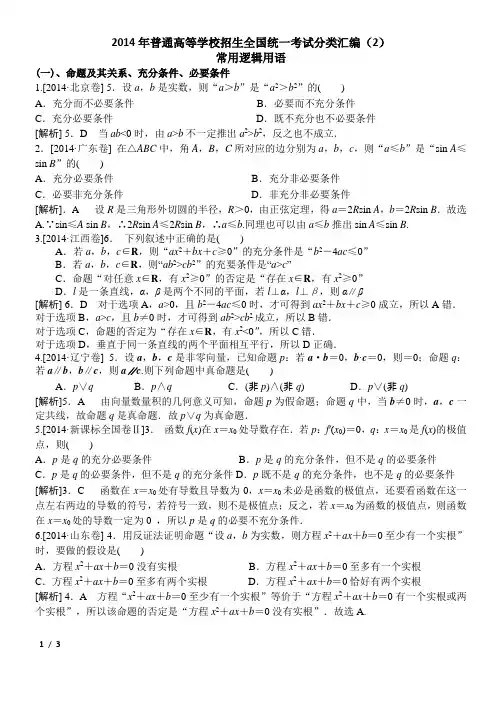
2014年普通高等学校招生全国统一考试分类汇编(2)常用逻辑用语(一)、命题及其关系、充分条件、必要条件1.[2014·北京卷] 5.设a,b是实数,则“a>b”是“a2>b2”的()A.充分而不必要条件B.必要而不充分条件C.充分必要条件D.既不充分也不必要条件[解析] 5.D当ab<0时,由a>b不一定推出a2>b2,反之也不成立.2.[2014·广东卷] 在△ABC中,角A,B,C所对应的边分别为a,b,c,则“a≤b”是“sin A≤sin B”的()A.充分必要条件B.充分非必要条件C.必要非充分条件D.非充分非必要条件[解析].A设R是三角形外切圆的半径,R>0,由正弦定理,得a=2R sin A,b=2R sin B.故选A.∵sin≤A sin B,∴2R sin A≤2R sin B,∴a≤b.同理也可以由a≤b推出sin A≤sinB.3.[2014·江西卷]6.下列叙述中正确的是()A.若a,b,c∈R,则“ax2+bx+c≥0”的充分条件是“b2-4ac≤0”B.若a,b,c∈R,则“ab2>cb2”的充要条件是“a>c”C.命题“对任意x∈R,有x2≥0”的否定是“存在x∈R,有x2≥0”D.l是一条直线,α,β是两个不同的平面,若l⊥α,l⊥β,则α∥β[解析] 6.D对于选项A,a>0,且b2-4ac≤0时,才可得到ax2+bx+c≥0成立,所以A错.对于选项B,a>c,且b≠0时,才可得到ab2>cb2成立,所以B错.对于选项C,命题的否定为“存在x∈R,有x2<0”,所以C错.对于选项D,垂直于同一条直线的两个平面相互平行,所以D正确.4.[2014·辽宁卷] 5.设a,b,c是非零向量,已知命题p:若a·b=0,b·c=0,则=0;命题q:若a∥b,b∥c,则a∥c.则下列命题中真命题是()A.p∨q B.p∧q C.(非p)∧(非q) D.p∨(非q)[解析]5.A由向量数量积的几何意义可知,命题p为假命题;命题q中,当b≠0时,a,c一定共线,故命题q是真命题.故p∨q为真命题.5.[2014·新课标全国卷Ⅱ]3.函数f(x)在x=x0处导数存在.若p:f′(x0)=0,q:x=x0是f(x)的极值点,则()A.p是q的充分必要条件B.p是q的充分条件,但不是q的必要条件C.p是q的必要条件,但不是q的充分条件D.p既不是q的充分条件,也不是q的必要条件[解析]3.C函数在x=x0处有导数且导数为0,x=x0未必是函数的极值点,还要看函数在这一点左右两边的导数的符号,若符号一致,则不是极值点;反之,若x=x0为函数的极值点,则函数在x=x0处的导数一定为0 ,所以p是q的必要不充分条件.6.[2014·山东卷] 4.用反证法证明命题“设a,b为实数,则方程x2+ax+b=0至少有一个实根”时,要做的假设是()A.方程x2+ax+b=0没有实根B.方程x2+ax+b=0至多有一个实根C.方程x2+ax+b=0至多有两个实根D.方程x2+ax+b=0恰好有两个实根[解析] 4.A方程“x2+ax+b=0至少有一个实根”等价于“方程x2+ax+b=0有一个实根或两个实根”,所以该命题的否定是“方程x2+ax+b=0没有实根”.故选A.7.[2014·陕西卷] 8.原命题为“若a n +a n +12<a n ,n ∈N +,则{a n }为递减数列”,关于其逆命题,否命题,逆否命题真假性的判断依次如下,正确的是( )A .真,真,真B .假,假,真C .真,真,假D .假,假,假[解析] 8.A 由a n +a n +12<a n ,得a n +1<a n ,所以数列{a n }为递减数列,故原命题是真命题,其逆否命题为真命题.易知原命题的逆命题为真命题,所以其否命题也为真命题.8.[2014·四川卷]. 以A 表示值域为R 的函数组成的集合,B 表示具有如下性质的函数φ(x )组成的集合:对于函数φ(x ),存在一个正数M ,使得函数φ(x )的值域包含于区间[-M ,M ].例如,当φ1(x )=x 3,φ2(x )=sin x 时,φ1(x )∈A ,φ2(x )∈B .现有如下命题:①设函数f (x )的定义域为D ,则“f (x )∈A ”的充要条件是“∀b ∈R ,∃a ∈D ,f (a )=b ”; ②若函数f (x )∈B ,则f (x )有最大值和最小值;③若函数f (x ),g (x )的定义域相同,且f (x )∈A ,g (x )∈B ,则f (x )+g (x )∈/B ;④若函数f (x )=a ln(x +2)+x x 2+1(x >-2,a ∈R )有最大值,则f (x )∈B . 其中的真命题有________.(写出所有真命题的序号)[解析] 15.①③④ 若f (x )∈A ,则函数f (x )的值域为R ,于是,对任意的b ∈R ,一定存在a ∈D ,使得f (a )=b ,故①正确.取函数f (x )=x (-1<x <1),其值域为(-1,1),于是,存在M =1,使得函数f (x )的值域包含于[-M ,M ]=[-1,1],但此时函数f (x )没有最大值和最小值,故②错误.当f (x )∈A 时,由①可知,对任意的b ∈R ,存在a ∈D ,使得f (a )=b ,所以,当g (x )∈B 时,对于函数f (x )+g (x ),如果存在一个正数M ,使得f (x )+g (x )的值域包含于[-M ,M ],那么对于该区间外的某一个b 0∈R ,一定存在一个a 0∈D ,使得f (x )+f (a 0)=b 0-g (a 0),即f (a 0)+g (a 0)=b 0∉[-M ,M ],故③正确.对于f (x )=a ln(x +2)+x x 2+1(x >-2),当a >0或a <0时,函数f (x )都没有最大值.要使得函数f (x )有最大值,只有a =0,此时f (x )=x x 2+1(x >-2).易知f (x )∈⎣⎡⎦⎤-12,12,所以存在正数M =12,使得f (x )∈[-M ,M ],故④正确9.[2014·浙江卷] 设四边形ABCD 的两条对角线为AC ,BD ,则“四边形ABCD 为菱形”是“AC ⊥BD ”的( )A .充分不必要条件B .必要不充分条件C .充分必要条件D .既不充分也不必要条件[解析] 2.A 若四边形ABCD 为菱形,则AC ⊥BD ;反之,若AC ⊥BD ,则四边形ABCD 不一定为平行四边形.故“四边形ABCD 为菱形”是“AC ⊥BD ”的充分不必要条件.故选A.10.[2014·重庆卷] 已知命题p :对任意x ∈R ,总有|x |≥0,q :x =1是方程x +2=0的根.则下列命题为真命题的是( )A .p ∧非qB .非p ∧qC .非p ∧非 qD .p ∧q[解析]6.A 由题意知 p 为真命题,q 为假命题,则綈q 为真命题,所以p ∧綈q 为真命题.(二) 基本逻辑联结词及量词11.[2014·安徽卷] 2.命题“∀x ∈R ,|x |+x 2≥0”的否.定是( ) A .∀x ∈R ,|x |+x 2<0 B .∀x ∈R ,|x |+x 2≤0C.∃x0∈R,|x0|+x20<0 D.∃x0∈R,|x0|+x20≥0[解析] .C易知该命题的否定为“∃x0∈R,|x0|+x20<0”.12.[2014·福建卷]5.命题“∀x∈[0,+∞),x3+x≥0”的否定是()A.∀x∈(-∞,0),x3+x<0 B.∀x∈(-∞,0),x3+x≥0C.∃x0∈[0,+∞),x30+x0<0 D.∃x0∈[0,+∞),x30+x0≥0[解析] 5.C “∀x∈[0,+∞),x3+x≥0”是含有全称量词的命题,其否定是“∃x0∈[0,+∞),x30+x0<0”,故选C.13.[2014·湖北卷] 命题“∀x∈R,x2≠x”的否定是()A.∀x∈/R,x2≠x B.∀x∈R,x2=x C.∃x0∈/R,x20≠x0D.∃x0∈R,x20=x0[解析]3.D特称命题的否定方法是先改变量词,然后否定结论,故命题“∀x∈R,x2≠x”的否定是“∃x0∈R,x20=x0”. 故选D.14.[2014·湖南卷] 设命题p:∀x∈R,x2+1>0,则非p为()A.∃x0∈R,x20+1>0 B.∃x0∈R,x20+1≤0C.∃x0∈R,x20+1<0 D.∀x∈R,x2+1≤01.B[解析] 由全称命题的否定形式可得綈p:∃x0∈R,x20+1≤0.15.[2014·天津卷] 已知命题p:∀x>0,总有(x+1)e x>1,则綈p为()A.∃x0≤0,使得(x0+1)e x0≤1 B. ∃x0>0,使得(x0+1)e x0≤1C. ∀x>0,总有(x+1)e x≤1D. ∀x≤0,总有(x+1)e x≤1[解析] 3B.含量词的命题的否定,先改变量词的形式,再对命题的结论进行。
2014高考天津卷英语试题及答案
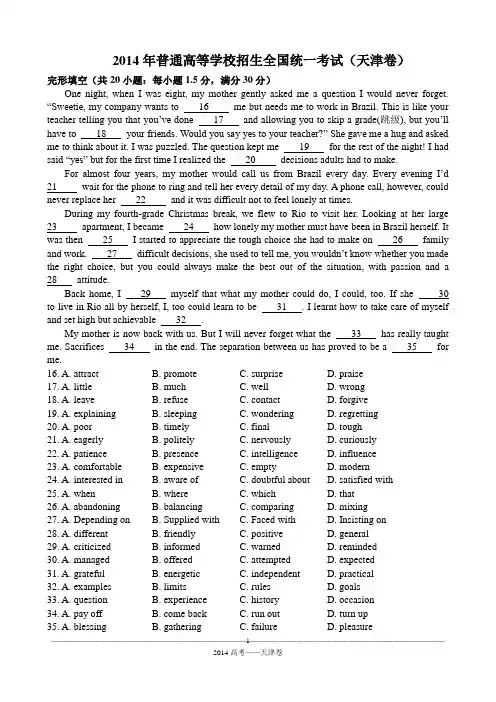
2014年普通高等学校招生全国统一考试(天津卷)完形填空(共20小题:每小题1.5分,满分30分)One night, when I was eight, my mother gently asked me a question I would never forget. “Sweetie, my company want s to 16 me but needs me to work in Brazil. This is like your teacher telling you tha t you’ve done 17 and allowing you to skip a grade(跳级), but you’ll have to 18 your friends. Would you say yes to your teacher?” She gave me a hug and asked me to think about it. I was puzzled. The question kept me 19 for the rest of the night! I had sa id “yes” but for the first time I realized the 20 decisions adults had to make.For almost four years, my mother would call us from Brazil every day. Every evening I’d 21 wait for the phone to ring and tell her every detail of my day. A phone call, however, could never replace her 22 and it was difficult not to feel lonely at times.During my fourth-grade Christmas break, we flew to Rio to visit her. Looking at her large 23 apartment, I became 24 how lonely my mother must have been in Brazil herself. It was then 25 I started to appreciate the tough choice she had to make on 26 family and work. 27 difficult decisions, she used to tell me, you wouldn’t know whether you made the right choice, but you could always make the best out of the situation, with passion and a 28 attitude.Back home, I 29 myself that what my mother could do, I could, too. If she 30 to live in Rio all by herself, I, too could learn to be 31 . I learnt how to take care of myself and set high but achievable 32 .My mother is now back with us. But I will never forget what the 33 has really taught me. Sacrifices 34 in the end. The separation between us has proved to be a 35 for me.16. A. attract B. promote C. surprise D. praise17. A. little B. much C. well D. wrong18. A. leave B. refuse C. contact D. forgive19. A. explaining B. sleeping C. wondering D. regretting20. A. poor B. timely C. final D. tough21. A. eagerly B. politely C. nervously D. curiously22. A. patience B. presence C. intelligence D. influence23. A. comfortable B. expensive C. empty D. modern24. A. interested in B. aware of C. doubtful about D. satisfied with25. A. when B. where C. which D. that26. A. abandoning B. balancing C. comparing D. mixing27. A. Depending on B. Supplied with C. Faced with D. Insisting on28. A. different B. friendly C. positive D. general29. A. criticized B. informed C. warned D. reminded30. A. managed B. offered C. attempted D. expected31. A. grateful B. energetic C. independent D. practical32. A. examples B. limits C. rules D. goals33. A. question B. experience C. history D. occasion34. A. pay off B. come back C. run out D. turn up35. A. blessing B. gathering C. failure D. pleasure阅读理解(共20小题;每小题2.5分,满分50分)AFoodThe TWU Cafeteria is open 7 am to 8 am. It serves snacks(小吃), drinks, ice cream bars and meals. You can pay with cash or your ID cards. You can add meal money to your ID cards at the Front Desk. Even if you do not buy your food in the cafeteria, you can use the tables to eat your lunch, to have meetings and to study.If you are on campus in the evening or late at night, you can buy snacks, fast food, and drinks in the Lower Cafélocated in the bottom level of the Douglas Centre. This area is often used for entertainment such as concerts, games or TV watching.RelaxationThe Globe, located in the bottom level of McMillan Hall, is available for relaxing, studying, cooking, and eating. Monthly activities are held here for all international students. Hours are 10 am to 10 pm, closed on Sundays.HealthLocated on the top floor of Douglas Hall, the Wellness Centre is committed to physical, emotional and social health. A doctor and nurse is available if you have health questions or need immediate medical help or personal advice. The cost of this is included in your medical insurance. Hours are Monday to Friday, 9 am to noon and 1:00 to 4:30 pm.Academic SupportAll students have access to the Writing Centre on the upper floor of Douglas Hall. Here, qualified volunteers will work with you on written work, grammar, vocabulary, and other academic skills. You can sign up for an appointment on the sing-up sheet outside the door; two 30-minute appointments per week maximum. This service is free.TransportationThe TWU Express is shuttle(班车) service. The shuttle transports students between campus and the shopping centre, leaving from the Mattson Centre. Operation hours are between 9 am and 3 pm, Saturdays only. Round trip fare is $ 1.36. What can you do in the TWU Cafeteria?A. Do homework and watch TV.B. Buy drinks and enjoy concerts.C. Have meals and meet with friends.D. Add money to your ID and play chess.37. Where and when can you cook your own food?A. The Globe, Friday.B. The Lower Café, Sunday.C. The TWU Cafeteria, Friday.D. The McMillan Hall, Sunday.38. The Guide tell us that the Wellness Centre__________.A. is open six days a weekB. offers services free of chargeC. trains students in medical careD. give advice on mental health39. How can you seek help from the Writing Centre?A. By applying online.B. By calling the centre.C. By filling in a sign-up form.D. By going to the centre directly.40. What is the function of TWU Express?A. To carry students to the lecture halls.B. To provide students with campus tours.C. To take students to the Mattson Centre.D. To transport students to and from the stores.A world-famous Canadian author, Margaret Atwood, has created the world’s first long-distance signing device(装置), the LongPen.After many tiring book-signing tours from city to city, Atwood thought there must be a better way to do them. She hired some technical experts and started her own company in 2004. Together they designed the LongPen. Here’s how it works: The author writes a personal message and signature on a computer tablet(手写板) using a special pen. On the receiving end, in another city, a robotic arm fitted with a regular pen signs the book. The author and fan can talk with each other via webcams(网络摄像机) and computer screens.Work on the LongPen began in Atwood’s basement(地下室). At first, they had no idea it would be as hard as it turned out to be. The device went through several versions, including one that actually had smoke coming out of it. The inventing finally completed, test runs were made in Ottawa, and the LongPen was officially launched at the 2006 London Book Fair. From here, Atwood conducted two transatlantic book signings of her latest book for fans in Toronto and New York City.The LongPen produces a unique signature each time because it copies the movement of the author in real time. It has several other potential applications. It could increase credit card security and allow people to sign contracts from another province. The video exchange between signer and receiver can be recorded on DVD for proof when legal documents are used.“It’s really fun,” said the owner of a bookstore, who was present for one of the test runs. “Obviously you can’t shake hands with the author, but there are chances for a connection that you don’t get from a regular book signing.”The response to the invention hasn’t been all favorable. Atwood has received criticism from authors who think she’s trying to end book tours. But she said, “It will be possible to go to pl aces that you never got sent to before because the publishers couldn’t afford it.”41. Why did Atwood decide to invent the LongPen?A. To set up her own company.B. To win herself greater popularity.C. To write her books in a new way.D. To make books signings less tiring.42. How does the LongPen work?A. It copies the author’s signature and prints it on a book.B. It signs a book while receiving the author’s signature.C. The webcam sends the author’s signature to another city.D. The fan uses it to copy the author’s signature himself.43. What do we know about the invention of the LongPen?A. It has been completed but not put into use.B. The basement caught fire by accident.C. Some versions failed before its test run.D. The designers were well- prepared for the difficulty.44. How could the LongPen be used in the future?A. To draft legal documents.B. To improve credit card security.C. To keep a record of the author’s ideas.D. To allow author and fan to exchange videos.45. What could be inferred from Paragraphs 5 and 6?A. Atwood doesn’t mean to end book tours.B. Critics think the LongPen is of little use.C. Bookstore owners don’t support the LongPen.D. Publishers dislike the LongPen for its high cost.“Dad,” I say one day, “Let’s take a trip. Why don’t you fly out and meet me?”My father had just retired after 27 years as manager for IBM. His job filled his day, his thoughts, his life. While he woke up and took a warm shower, I screamed under a freezing waterfall in Peru. While he tied a tie and put on the same Swiss watch, I rowed a boat across Lake of the Ozarks.My father sees me drifting aimlessly nothing to show for my 33 years but a passport full of funny stamps. He wants me to settle down. But now I want him to find an adventure.He agrees to travel with me through the national parks. We meet four weeks later in Rapid City.“What’s our first stop?” asks my father.“What time is it?”“Still don’t have a watch?”Less than an hour away is Mount Rushmore. As he stares up at the four Presidents carved in granite(花岗岩), his mouth and eyes open slowly, like those of a little boy.“Unbelievable,”he says, “How was this done?”A film in the information center show sculptor Gutzon Borglum devoted 14 years to the sculpture and the left the final touches to his son.We stare up and I ask myself. Would I ever devote my life to anything?No directions, no goals. I always used to hear those words in my father’s voice. Now I hear them in my own.The next day we’re at Yellowston e National Park, where we have a picnic.“Did you ever travel with your dad?” I ask.“Only once,” he says. “I never spoke much with my father. We loved each other—but never said it. Whatever he could give me, he gave.”The last sentence---it’s probably the same thing I’d say about my father. And what I’d want my child to say about me.In Glacier National Park, my father says, “I’ve never seen water so blue.” I have, in several places of the world. I can keep traveling. I realize---and maybe a regular j ob won’t be as dull as I feared.Weeks after our trip, I call my father.“The photos from the trip are wonderful,”he says. “We’ve got to take another trip like that sometime.”I tell him I’ve decided to settle down, and I’m wearing a watch.46. We can learn from Paragraphs 2 and 3 that the father _____________.A. followed the fashionB. got bored with his jobC. was unhappy with the author’s lifestyleD. liked the author’s collection of stamps47. What does the author realize at Mount Rushmore?A. His father is interested in sculpture.B. His father is as innocent as a little boy.C. He should learn sculpture in the future.D. He should pursue a specific aim in life.48. From the underlined paragraph, we can see that the author ___________.A. wants his children to learn from their grandfatherB. comes to understand what parental love meansC. learns how to communicate with his fatherD. hopes to give whatever he can to his father49. What could be inferred about the author and his father from the end of the story?A. The call solves their disagreements.B. The Swiss watch has drawn them closer.C. They decide to learn photography together.D. They began to change their attitudes to life50. What could be the best title for the passage?A. Love Nature, Love LifeB. A Son Lost in AdventureC. A Journey with DadD. The Art of TravelPeople aren’t walking any more—if they can figure out a way to avoid it.I felt superior about this matter until the other day I took my car to mail a small parcel. The journey is a matter of 281 steps. But I used the car. And I wasn’t in any hurry, either. I had merely become one more victim of a national sickness: motorosis.It is an illness to which I had thought myself immune(免疫的), for I was bred in the tradition of going to places on my own two legs. At that time, we regarded 25 miles as a good day’s walk and the ability to cover such a distance in ten hours as a sign of strength and skill. It did not occur to us that walking was a hardship. And the effect was lasting. When I was 45 years old I raced—and beat —a teenage football player the 168 steps up the Statue of Liberty.Such enterprises today are regarded by many middle-aged persons as bad for the heart. But a well-known British physician, Sir Adophe Abrahams, pointed out recently that hearts and bodies need proper exercise. A person who avoids exercise is more likely to have illness than one who exercises regularly. And walking is an ideal form of exercise—the most familiar and natural of all.It was Henry Thoreau who showed mankind the richness of going on foot. The man walking can learn the tree, flowers, insects, birds and animals, the significance of seasons, the very feel of himself as a living creature in a living world. He cannot learn in car.The car is a convenient means of transport, but we have made it our way of life. Many people don’t dare to approach Nature anymore; to them the world they were born to enjoy is all threat. To them security is a steel river thundering on a concrete road. And much of their thing takes place while waiting for the traffic light to turn green.I say that the green of forests is the mind’s best light. And none but the man on foot can evaluate what is basic and everlasting.51. What is the national sickness?A. Walking too much.B. Traveling too much.C. Driving cars too muchD. Climbing stairs too much.52. What was life like when the author was young?A. People usually went around on foot.B. People often walked 25 miles a day.C. People used to climb the Statue of Liberty.D. People considered a ten-hour walk as a hardship.53. The author mentions Henry Thoreau to prove that________________.A. middle-aged people like getting back to nature.B. walking in nature helps e nrich one’s mindC. People need regular exercise to keep fitD. going on foot prevents heart disease54. What is compared to “a steel river” in Paragraph 6?A. A queue of cars.B. A ray of traffic light.C. A flash of lightning.D. A stream of people.55. What is the author’s intention of writing this passage?A. To tell people to reflect more on life.B. To recommend people to give up driving.C. To advise people to do outdoor activities.D. To encourage people to return to walking.Travel LightGetting away for a short time always seems like a great idea—until you have to pack. ____1_____ The rule is: pack light. Here are some tips to help you pack.1.Make a list. Think of what you need from your head to your toes. _____2_____ When you've done this once, it'll be easier next time.2.Consider buying small-size samples of shampoo, toothpaste, and other items at your local drugstore. You can reuse the plastic containers next time you go away too.3.Choosing which clothes to bring is probably the hardest packing decision to make. Think once again from head to toe—hat, shirts, jeans, sneakers, etc. Once you've picked out what you want to bring, think carefully. Do you really need that extra pair of jeans? If so, fine. _____3_____ Don't try to fool yourself. You are the one who will be left holding the bag.4.Weather is an important factor in your packing. If it's cold, you could wear a jacket, a sweater, a regular shirt, and a T-shirt. Putting them on will keep you warm. _____4_____ Remember how much easier it will be to carry your bag! As for shoes, you may want to call ahead to see if dress shoes are necessary. If so, one pair will be enough, along with one pair of comfortable shoes.Remember that it is you who have been invited somewhere, not your things. _____5_____ So, do it right—pack light.A.Mixing and matching is a smart and easy way to lighten your load.B.But packing won't be a problem if you remember one simple rule.C.You will have an easier time if you're weighed down.D.But make sure they're really worth the extra weight.E.It's best to bring these things with you.F.And it'll leave more room in your bag.G.Keep the list for future reference.I asked my uncle, who plays 1 piano well, 2 he would assess (评定) the tone of a second hand piano I was hoping to buy. We arrived 3 the house and Uncle Frank looked the piano over, then 4 (sit) down and played a mixture of honky-tonk numbers and classical pieces. When he finished, we told the family that we would call 5 in 15 minutes.Outside, Uncle Frank said that 6 the wood was battered (坏掉的),the sound was good and we should buy it.When I phoned the woman back, she sounded as if she was crying. 7 (concern), I asked, “What’s the matter?”“We didn’t know the piano 8 play like that,” she replied. The piano wasn’t 9 sale, and her daughter had to resume(重新开始) taking piano 10 .短文改错:Can money buy happiness? Different people have different opinion. With money one can buy that he wants and live a happy life. It’s a common view which money is the root of all evil. The pursuit of money dri ve many people to cheat and steal. In some places there is nothing cann’t be bought by money, resulting in societies where everybody is miserable. So money doesn’t necessary mean happiness. It all depends on what it is used. If we make proper use of money, it can be a bright path into happiness. Money can’t buy happiness, but it can make happiness be possible if it is employed sensibly.书面表达(满分25分)假如你是晨光中学高二(1)班的班长李津,得知美国学生Chris作为交换生,下学期将到你班学习。
天津2010—2015年高考听力试题及原文
2010—2015年普通高等学校招生全国统一考试(天津卷)英语听力目录➢2010年普通高等学校招生全国统一考试(天津卷)英语听力➢2011年普通高等学校招生全国统一考试(天津卷)英语听力➢2012年普通高等学校招生全国统一考试(天津卷)英语听力➢2013年普通高等学校招生全国统一考试(天津卷)英语听力➢2014年普通高等学校招生全国统一考试(天津卷)英语听力➢2015年普通高等学校招生全国统一考试(天津卷)英语听力❖2010年普通高等学校招生全国统一考试(天津卷)英语听力录音文字材料❖2011年普通高等学校招生全国统一考试(天津卷)英语听力录音文字材料❖2012年普通高等学校招生全国统一考试(天津卷)英语听力录音文字材料❖2013年普通高等学校招生全国统一考试(天津卷)英语听力录音文字材料❖2014年普通高等学校招生全国统一考试(天津卷)英语听力录音文字材料❖2015年普通高等学校招生全国统一考试(天津卷)英语听力录音文字材料注:需要听力录音的可以邮箱联系作者,听力录音格式均为mp3邮箱:*****************由于编辑时间紧急,难免会有些错误,欢迎指正,使之更加完善。
最后祝大家在2016年天津市高考中取得优异成绩。
绝密★启用前2010年普通高等学校招生全国统一考试(天津卷)英语听力注意事项:1.英语听力测试由试卷A和试卷B两套试卷组成。
每套试卷各15小题,满分各为20分。
考生可依次作答两套试卷,也可选择其中一套试卷作答。
试卷A第1至第3页,试卷B第4至第6页。
2.作答前,考生务必将自己的姓名、准考号填写在答题卡上,并在规定位置粘贴考试用条形码。
3.作答过程中,可先将答案标在试卷上。
每套试卷试题录音播放结束后,考生均有两分钟的时间将试卷上的答案转涂到答题卡上。
4.转涂答案时,请用铅笔把答题卡上对应题目的答案标号涂黑。
如需改动,用橡皮擦干净后,再选涂其他答案标号。
5.考生务必将答案涂写在答题卡的对应位置上,答在试卷上的无效。
(天津卷)2014年普通高等学校招生全国统一考试(天津卷)语文试题

(天津卷)2014年普通高等学校招生全国统一考试(天津卷)语文试题新高考新题目2014-06-08 20515cc149a20102ebzs2014年普通高等学校招生全国统一考试(天津卷)语文试题1.本试卷分第I卷(阅读题)和第II卷(表达题)两部分。
答卷前,考生务必将自己的姓名、准考证号填写在答题卡上.2.作答时,将答案写在答题卡上。
写在本试卷上无效。
3.考试结束后,将本试卷和答题卡一并交回.第I卷阅读题甲必考题一、现代文阅读(9分,每小题3分)阅读下面的文字,完成1~3题.周代,尽管关于食品安全事件的记载不多,但我们还是看到,由于食品安全关系重大,统治者对此非常重视并作出了特别规定.周代的食品交易是以直接收获采摘的初级农产品为主,所以对农产品的成熟度十分关注.据《礼记》记栽,用代对食品交易的规定有“五谷不时,果实未熟,不鬻于市.”这是我国历史上最早的关于食品安全管理的记录.汉唐时期,食品交易活动非常频繁,交易品种十分丰富.为杜绝有毒有害食品流入市场,国家在法律上作出了相应的规定.汉朝《二年律令》规定“诸食脯肉,脯肉毒杀、伤、病人者,亟尽孰燔其余•……当燔弗燔,及吏主者,皆坐脯肉赃,与盗同法.即肉类因腐坏等因素可能导致中毒者,应尽快焚毁,否则将处罚当事人及相关官员.唐朝《唐律》规定“脯肉有毒,曾经病人,有余者速焚之,违者杖九十.若故与人食并出卖,令人病者,徒一年;以故致死者,绞.即人自食致死者,从过失杀人法。
”从《唐律》中可以看到,在唐代,知脯肉有毒不速焚而构成的刑事犯罪分为两种情况,处罚各不相同一是得知脯肉有毒时,食品的所有者应当立刻焚毁所剩有毒食品,以绝后患,否则杖九十;二是明知脯肉有毒而不立刻焚毁,致人中毒,则视情节及后果以科罚。
宋代,饮食市场空前繁荣。
孟元老在《东京梦华录》中,追述了北宋都城开封府的城市风貌,并且以大量笔墨写到饮食业的昌盛,书中共提到一百多家店镝以及相关行会. 商品市场的繁荣,不可避免地带来一些问题,一些商贩“以物市于人,敝恶之场,饰为新奇;假伪之物,饰为真实.如绢帛之用胶糊,米麦之增温润,肉食之灌以水,药材之易以他物(《袁氏世范》)有的不法分子甚至采用鸡塞沙,鹅羊吹气、卖盐杂以灰之类伎俩谋取利润,为了加强对食品掺假,以次充好现象的监督和管理,宋代规定从业者必须加入行会,而行会必须对商品质量负责,市肆谓之行者,因官府料索而得此名,不以其物小大,但合充用者,皆置为行,虽医卜亦有职.”(《都城纪胜》商人们依经营类型组成行会,商铺,手工业和其他服务性行业的相关人员必领加入行会组织,并按行业登记在籍,否则就不能从业经营.各个行会对生产经营的商品质量进行把关,行会的首领作为拉保人,负责评定物价和监察不法行为.除了由行会把关外,宋代法律也继承了《唐律》的规定,对有毒有害食品的销售者予以严惩上述朝代对食品流通的安全管理及有关法律举措,可以给我们很多启示•也可以为现今我国食品质量和安全监管模式的合理构建提供新的思路和路径选择.(摘编自张炸达《古代食品安全监管述略》)1.下列关于原文第一、二两段内容的表述,不正确的一项是A周代统治者严禁未成熟的果实和谷物进入流通市场,以防止此类初级农产品引起食品安全方面的问题。
2014年普通高等学校招生全国统一考试理综试题(天津卷,答案不全)
2014年普通高等学校招生全国统一考试(天津卷)理科综合生物部分word精校高清重绘版试题1.二倍体生物细胞正在进行着丝点分裂时,下列有关叙述正确的是A.细胞中一定不存在同源染色体B.着丝点分裂一定导致DNA数目加倍C.染色体DNA一定由母链和子链组成D.细胞中染色体数目一定是其体细胞的2倍【答案】C2.下图是细胞中糖类合成与分解过程示意图。
下列叙述正确的是A.过程①只在线粒体中进行,过程②只在叶绿体中进行B.过程①产生的能量全部储存在ATP中C.过程②产生的(CH2O)中的氧全部来自H2OD.过程①和②中均能产生[H],二者还原的物质不同【答案】D3.图a、b分别为农村和城市生态系统的生物量(生命物质总量)金字塔示意图。
下列叙述正确的是A.两个生态系统均可通过信息传递调节种间关系B.两个生态系统的营养结构均由3个营养级组成C.城市生态系统不具有自我调节能力,抵抗力稳定性低D.流经两个生态系统的总能量均是其植物所固定的太阳能【答案】A4.为达到相应目的,必须通过分子检测的是A.携带链霉素抗性基因受体菌的筛选B.产生抗人白细胞介素-8抗体的杂交瘤细胞的筛选C.转基因抗虫棉植株抗虫效果的鉴定D.21三体综合征的诊断【答案】B5.MRSA菌是一种引起皮肤感染的“超级细菌”,对青霉素等多种抗生素有抗性。
为研究人母乳中新发现的蛋白质H与青霉素组合使用对MRSA菌生长的影响,某兴趣小组的实验设计及结果如下表。
下列说法正确的是A.细菌死亡与否是通过光学显微镜观察其细胞核的有无来确定B.第2组和第3组对比表明,使用低浓度的青霉素即可杀死MRSA菌C.实验还需设计有2μg/mL青霉素做处理的对照组D.蛋白质H有很强的杀菌作用,是一种新型抗生素【答案】C6.神经递质乙酰胆碱与突触后膜的乙酰胆碱受体(AChR)结合,突触后膜兴奋,引起肌肉收缩。
重症肌无力患者体内该过程出现异常,其发病机理示意图如下。
下列叙述错误的是A.物质a作为抗原能激活B细胞增殖分化为浆细胞B.抗a抗体与物质a的结合物不能被吞噬细胞清除C.物质a引发的上述免疫过程属于体液免疫D.患者体内乙酰胆碱与突触后膜的AChR特异性结合减少【答案】B7.(16分)Kisspeptin,简称Kp,是Kp神经元产生的一类多肽类激素,它通过调节生物体内雌激素含量来调控生殖活动。
2014年高考生物试卷及答案解析汇总(全国15套)
2014高考生物试题汇编(含解析)目录1、全国大纲卷(考试地区:广西)2---72、新课标全国卷(I)(河南、河北、山西、陕西、湖北、江西、湖南)7--133、新课标全国卷(II)(青海、西藏、甘肃、贵州、吉林、宁夏、内蒙古、黑龙江、新疆、云南、辽宁)14--204、北京市21--275、浙江省27--326、四川省33--407、天津市40--478、福建省47--549、重庆市55--6010、安徽省61--6711、上海市(生命科学)67--8712、广东省87--9613、山东省96--10614、江苏省(生物)106--12315、海南(生物)123--1352014年普通高等学校招生全国统一考试(大纲卷)理科综合生物部分(大纲卷)1.下列有关细胞核的叙述,错误..的是A.蛋白质是细胞核中染色质的组成成分B.细胞核中可进行遗传物质的复制和转录C.小分子物质可以通过核孔,大分子物质不能D.有丝分裂过程中存在核膜消失和重新形成的现象【答案】C【解析】细胞核中染色质是由DNA和组蛋白构成,A正确;细胞核是遗传物质复制和转录的主要场所,B正确;原则上分子直径较小的物质可通过核孔,大分子物质如酶或mRNA 也能通过核孔,故C项错误;有丝分裂过程中核膜的消失和重建分别在前期和末期,D项正确。
(大纲卷)2.A TP是细胞中重要的高能磷酸化合物。
下列有关ATP的叙述,错误..的是A.线粒体合成的ATP可在细胞核中发挥作用B.机体在运动时消耗ATP,睡眠时则不消耗A TPC.在有氧与缺氧的条件下细胞质基质中都能形成A TPD.植物根细胞吸收矿质元素离子所需的A TP来源于呼吸作用【答案】B【解析】细胞核无法进行细胞呼吸,细胞核需要的ATP主要由线粒体提供,A项正确;ATP是生命活动直接的能源物质,机体无时无刻不在消耗ATP,睡眠时生命活动并没停止,也需要消耗能量,故B项错误;有氧呼吸和无氧呼吸第一阶段都在细胞质基质中有ATP形成,C项正确;根细胞吸收矿质元素离子主要通过主动运输的形式,其消耗的能量主要是由细胞呼吸所提供的ATP,故D项正确。
2014年高考英语天津卷(含详细答案)
英语试卷 第1页(共32页)英语试卷 第2页(共32页)绝密★启用前2014年普通高等学校招生全国统一考试(天津卷)英语本试卷分为第I 卷(选择题)和第II 卷(非选择题)两部分。
共130分,考试用时100分钟。
第I 卷1至10页,第II 卷11至12页。
答卷前,考生务必将自己的姓名、准考号填写在答题卡上,并在规定位置粘贴考试用条形码。
答卷时,考生务必将答案涂写在答题卡上,答在试卷上的无效。
考试结束后,将本试卷和答题卡一并交回。
祝各位考生考试顺利!第Ⅰ卷注意事项:1. 每小题选出答案后,用铅笔将答题卡上对应题目的答案标号涂黑,如需改动,用橡皮擦干净后,再选涂其他答案标号。
2. 本卷共55小题,共95分。
第一部分 英语知识运用(共两节,满分45分)第一节 单项填空(共15小题,每小题1分,满分15分)从A 、B 、C 、D 四个选项中,选出可以填入空白处的最佳选项。
例: We feel _____ our duty to make our country a better place. A. it B. thisC. thatD. one答案是B 。
1. Give me a chance, _____ I ’11 give you a wonderful surprise. A. ifB. orC. andD. while2. —OK, I ’ll fix your computer right now. —Oh, take your time. _____. A. I can ’t stand itB. I ’m in no hurryC. That ’s a great ideaD. It ’s not my cup of tea 3. Wind is now the world ’s fastest growing _____ of power. A. sourceB. senseC. resultD. root4. _____ you start eating in a healthier way, weight control will become much easier. A. UnlessB. AlthoughC. BeforeD. Once5. Anxiously, she took the dress out of the package and tried it on, only _____ it didn ’t fit. A. to findB. foundC. findingD. having found6. _____ the school, the village has a clinic, which was also built with government support. A. In reply toB. In addition toC. In charge ofD. In place of7. Clearly and thoughtfully _____, the book inspires confidence in students who wish to seek their own answers. A. writingB. to writeC. writtenD. being written8. Life is like ____ ocean: Only ____ strong-willed can reach the other shore. A. an; theB. the; aC. the; /D. /; a9. My parents always _____ great importance to my getting a good education. A. haveB. attachC. acceptD. pay10. —How long have you been learning English? —About four months.—_____! Your English is so good. A. You can ’t be serious B. You got itC. I couldn ’t agree moreD. I ’m stuck11. We won ’t start the work until all the preparations _____. A. are being made B. will be made C. have been madeD. had been made12. English is a language shared by several diverse cultures, _____ uses it differently. A. all of which B. each of whichC. all of themD. each of them13. The two countries are going to meet to _____ some barriers to trade between them. A. make upB. use upC. turn downD. break down14. I think _____ impresses me about his painting is the colours he uses. A. whatB. thatC. whichD. who15. _____ the morning train, he would not have been late for the meeting. A. Did he catch B. Should he catchC. Has he caughtD. Had he caught-------------在--------------------此--------------------卷--------------------上--------------------答--------------------题--------------------无--------------------效姓名________________ 准考证号_____________第二节完形填空(共20小题:每小题1.5分,满分30分)阅读下面短文,掌握其大意,然后从16~35各题所给出的A、B、C、D四个选项中选出最佳选项。
2014天津高考真题及答案汇总
2014天津高考真题及答案汇总
高考不但需要深厚的知识储备,也还需要冷静沉着的临场发挥。考生和家长们都希望能够取得一个满意的成绩。高考频道也在紧密的关注高考动向,会在最快时间内发布天津2014年高考真题以及解析。希望广大考生和家长们能够持续关注本站。小编在此也祝愿考生朋友们能够细致作答,考出优异的成绩。
下载
--高考频道
2014年天津高考分数线查询
一本
二本
三本
专科
艺术
美术
体育
2014年天津高考成绩查询信息
成绩查询时间
成绩查询系统
2014年天津高考志愿填报信息
志愿填报时间
志愿填报系统
志愿填报指南
2014年天津高考录取查询信息
录取查询时间
录取查询系统
年天津高考文字版
答案
下载
2014天津高考数学(文)试题
图片版
文字版
答案
下载
2014天津高考数学(理)试题
图片版
文字版
答案
下载
2014天津高考文综试题
图片版
文字版
答案
下载
2014天津高考理综试题
图片版
文字版
答案
下载
2014天津高考英语试题
图片版
文字版
答案