
2019秋外研版八年级英语上册教案:Module 3 Unit 3 Language in use
Unit 3 Language in use
语法链接
1. 形容词和副词的比较级(二)
(1)多音节形容词、副词的比较级
1)概念:有三个或三个以上音节的词称为多音节词,如:wonderful, dangerous, difficult等。
2)多音节形容词、副词比较级的构成:在多音节形容词、副词原级前加more,如:popular →more popular, relaxing→more relaxing, carefully→more carefully等。
(2)副词比较级的规则变化
大多数副词有比较级,其规则变化形式和形容词大致相同。
如:
Lily does her homework more carefully than Mary does.
莉莉做作业比玛丽认真。
2. 副词
(1)副词的种类及作用
英语中的副词一般分为时间、地点、方式、程度等几类,在句子中主要用来修饰动词、形容词和副词。
修饰动词时,副词一般放在动词之后。
如:
He is reading English loudly.
他正在大声地读英语。
(2)副词的构成
英语中的副词多数是由形容词加后缀转化而来的。
1)直接在形容词后加-ly。
如:slow→slowly careful→carefully
2)以“辅音字母+y”结尾的形容词,把y变为i,再加-ly。
如:happy→happily noisy→noisily easy→easily
3)一些副词和形容词同形,可以加-ly构成别的词。
如:hard(努力地)→hardly(几乎不)late(迟地)→lately(近来)
写作解码
【话题呈现】
本模块以“学生熟悉和喜爱的体育运动”为话题,结合学校体育活动和奥运会的相关内容
展开教学,激发学生的学习兴趣,培养学生对体育活动的热爱,并学会对某一体育活动进行描述。
具体到书面表达中,要求我们会写有关对比的短文。
写此类文章时,应注意以下几点:首先仔细审题,明确写作内容;然后紧紧围绕文中给出的提示,理清思路,调整语言,借助本模块所学的相关知识和各种句型结构,展开对比。
【佳句荟萃】
①My favourite sport is...
我最喜爱的运动是……
②Of all the sports, I like...best.
所有的体育运动中,我最喜欢……
③Nothing is more enjoyable than playing tennis.
比起打网球,没有什么是更令人喜爱的。
④It’s safer than playing tennis.
比起打网球,它更安全。
⑤Staying at home is easier than going to the stadium.
待在家里比去体育馆更容易。
⑥We all arrive as early as we can so that we have time to warm up.
我们都尽可能早地到达,以便我们有时间热身。
⑦Staying fit is important, so choose a sport that you like.
保持健康是重要的,所以选一项你喜欢的运动。
⑧I’m in our school team and we’re playing against another school next week.
我是校队成员,我们(队)下周将要和另一个学校比赛。
⑨That means we have a better chance of winning.
那就意味着我们获胜的机会更大。
⑩It’s good to have our fans around because they cheer us on loudly.
有我们的球迷在周围真好,因为他们为我们大声欢呼加油。
⑪It’s more difficult to practise in winter because the days are shorter.
在冬季训练更困难,因为白天时间更短了。
⑫The more you go jogging, the healthier you will feel.
你慢跑越多,你就会觉得越健康。
【写作任务】
请根据下表提示,以“My Favourite Sport”为题写一篇60词左右的短文。
My Favourite Sport
Table tennis is my favourite sport. It is very popular in China. To be healthy, many people play table tennis in their free time.
Table tennis is a kind of relaxing sport. It is very easy to learn and it is safer than other sports. I am good at playing table tennis. I often play table tennis with my friends in the school stadium at weekends or on holidays.
Playing table tennis makes me strong, healthy and bright. I want to play table tennis at the Olympic Games one day.
【升格点拨】
1. 开篇点题。
用“...is my favourite sport”简单介绍自己喜爱的运动。
2. 中间具体描述某项运动,陈述喜爱的原因,并作适当的扩展。
(relaxing sport, easy to learn, safer than, play with friends)
3. 结尾评价该运动,谈论该运动的益处。
(make me strong, healthy and bright)
4. 建议再用一两个比较级的句型。
Module3Unit3教案英语八年级上册
Unit 3Language in useⅠ.Teaching modelRevision and applicationⅡ.Teaching aims1.To summarize and consolidate the use of paratives.2.To practice using adverbs after verbs and distinguishing adverbs from adjectives. 3.Learn different sports and hobbies,cultivate interest in sports.Ⅲ.Teaching aidsTape recorder,OHP,videoⅣ.Teaching steps第一课时(Activity 1-Activity 4)Step 1:Warming upAsk and answer the questions about the photos in Activity 1:1.Do you like sports?2.Do you have any sports that you like best?What is it?Step 2:Language practice1.Read the sentences and fill in the blanks with proper words.(1)This week's match is already________ ________.(2)It is________ ________ to practise in winter.(3)We are training________ than usual.(4)This year we want to do________.2.Check the answers.3.Read the sentences aloud,then pay attention to the attributive clause.Step 3:Review1.Review the rules to make paratives.Elicit which words take “-er”and which words need “more” to make a parativ e.2.Work in pairs.Look at the pictures and talk about the sports in Activity 1.For example:—What's your favourite sport?—My favourite sport is swimming.It's exciting.3.Then pare the sports.For example:(1)Table tennis is more exciting than tennis.(2)Tennis is…(3)Basketball is…(4)Football is…(5)Swimming is…(6)Baseball is…4.Let students write sentences as many as possible.Step 4:Practice1.Ask students to plete the sentences with the correct form of the words in brackets, and check the answers,finishing Activity 2.2.Read through the sentences,plete the sentences individually and then check the answers in pairs,finishing Activity 3.3.Talk about the missing words in each,plete the passage and then check answers in pairs,finishing Activity 4.Then the teacher explains some grammar points for the students and ask them to read the passage aloud.Step 5:Homework1.Finish the workbook in this unit.2.Revise all the key points.Blackboard DesignUnit 3Language in usemore excitingmore difficultharderbetter—What's your favourite sport?—My favourite sport is swimming.It's exciting.第二课时(Activity 5-Activity 9)Step 1:Pre-listening1.Ask the students to read the questions and predict what the recording is about.2.Explain the key words in the questions.3.Ask the students to predict the answers.Step 2:Listening1.Play the recording.Ask the students to check whether their predictions are correct.2.Play the recording again for the students to answer the questions.3.Ask and answer in pairs to check the answers.Step 3:Reading1.Read the passage first by themselves.2.Ask what the passage is about and if the sport in the passage is popular.Tell the students to read to find the answers.3.Read the sentences first.Then read the passage again and underline the keyinformation to plete the sentences.Then check answers in pairs.4.The teacher explains some useful points in the passage and summarizes it.5.Ask students to read the sentences aloud.Step 4:Around the worldThe marathon race1.Get the students to read this passage.Before reading,teach the key words and phrases.2.Then ask a few students to read it,and translate it into Chinese at last.3.Solve the problems which the students meet in reading.Step 5:WritingMaking a sports poster.1.Work in groups.Talk about their favourite Olympic sports and choose one for the poster.2.Put the students into groups.3.Write down their answers to the questions in Activity 7 and sort out the information they want to include in their posters.4.Find a photo for their favorite Olympic sport and include it in the poster.5.Show their posters to the class.Step 6:Homework1.Finish the workbook.2.Revise all the check points.Blackboard DesignUnit 3Language in usetake part inat firstWhat happened to…?later onsee sb.doing sth. running shoesgo joggingat weekendsin the fresh airget one's name from all over the word。
新外研版八年级上册英语 Module 3 Unit3 教案(教学设计)
Module 3 Sports Unit 3Language in use知识目标单词boring,exciting,relaxing,enjoyable,careless词组better, pleased, pass, pity, chance, loudly句型Table tennis is more exciting than tennis.2) Tennis is…3) Basketball is …4) Football is …5) Swimming is…6) Baseball is…技能目标能区别并能正确使用形容词和副词及其比较级。
能根据本模块所学的知识,介绍自己喜爱的体育项目,并制作海报陈述喜爱的理由及该项目特点。
能够用形容词及其比较级描述运动并制作明信片。
能够运用形容词的比较级形式作出合适的比较。
Step 1 Lead-in1.Show students a short video about different kinds of ball games.2.Have a free talk with students.What’s your favourite sport?Step 2 Work in pairs.1. Ask the students to use the words in the box in Activity 1.boring cheap difficult easy exciting expensive popular relaxing2. Ask the students to look at the pictures in Activity 1 carefully.3. Talk about the sports.4. Read through the example with the class.Step 3 Language practice1. Read through the example sentences in the box with the whole class.2. Ask the students to repeat the sentences in the box.Step 4 GrammarStep 5 Exercises一、写出下列形容词的副词。
2019年外研版八年级上册英语教案:M10Unit3Languageinuse
2.思维品质:培养学生运用英语进行逻辑思维和批判性思维,学会分析、比较和总结过去事件。
3.文化意识:通过学习本单元内容,增强学生对中外文化差异的认识,培养跨文化交际意识。
4.学习能力:激发学生的自主学习兴趣,培养合作学习、探究学习的能力,提高学生的英语学习策略。
3.成果分享:每个小组将选择一名代表来分享他们的讨论成果。
(五)总结回顾(用时5分钟)
今天的学习,我们了解了过去进行时和一般过去时的基本概念、重要性和应用。同时,我们也通过实践活动和小组讨论加深了对这两个时态的理解。我希望大家能够掌握这些知识点,并在日常生活中灵活运用。最后,如果有任何疑问或不明白的地方,请随时向我提问。
3.重点难点解析:在讲授过程中,我会特别强调过去进行时和一般过去时的区别和用法这两个重点。对于难点部分,我会通过举例和比较来帮助大家理解。
(三)实践活动(用时10分钟)
1.分组讨论:学生们将分成若干小组,每组讨论一个与过去进行时和一般过去时相关的实际问题。
2.实验操作:为了加深理解,我们将进行一个简单的角色扮演活动。这个活动将演示如何在实际场景中运用这两个时态。
四、教学流程
(一)导入新课(用时5分钟)
同学们,今天我们将要学习的是M10 Unit 3 Language in use这一章节。在开始之前,我想先问大家一个问题:“你们在日常生活中是否遇到过需要描述过去正在进行的动作或事件的情况?”(如:昨天你在做作业时,妈妈在做饭。)这个问题与我们将要学习的内容密切相关。通过这个问题,我希望能够引起大家的兴趣和好奇心,让我们一同探索过去进行时和一般过去时的奥秘。
4.教学过程中,我注意到部分学生在记忆不规则动词过去式时感到困难。为了帮助学生更好地掌握这部分内容,我计划在下一节课中增加一些有趣的记忆方法,如编写顺口溜、进行联想记忆等。
外研版初中英语八年级上册Unit 3 教案
Unit 3 Language in useⅠTeaching modelRevision and applicationⅡTeaching methodFormal and interactive practiceⅢTeaching aims1. Function: Describing and comparing modes of transportation.2. Structure: Superlative adjectives and adverbs (-est, most); irregular superlatives.3. Around the world: The longest railway4. Task: Making a holiday plan for a family trip to a city in China.ⅣTeaching aidsTape recorder, OHP, handoutsⅤTeaching StepsStep 1 RevisionHow do you often travel?Step 2 Language practice1. Read through the example sentences in the box with the whole class.1) It’s the most comfortable way, but it’s the most expensive.2) He lives farthest from school.3) It is the fastest and the second cheapest.4) The more information, the better.2. Ask the students to repeat the sentences in the box.Step 3 Complete the sentences.1. Ask the students to read through the sentences in Activity 1.1) This bus takes the _________ (long) and goes the _________ (slow).2) The new train travels _________ (fast) of all the trains in the world.3) The _________ (cheap) way to get there is by coach.4) I am in a hurry. What’s the _________ (fast) way?5) The fastest way to travel is by plane, but it is also the _________ (expensive).2. Complete the sentence with the correct form of the words in brackets.3. Check the answers.Keys: 1. longest slowest 2. fastest 3. cheapest 4. fastest 5. most expensiveStep 4 Complete the conversation.1. Ask the students to read through the sentences in Activity2.a) By plane, but you have to go to the airport by taxi and that takes time too.b) The cheapest way is going by train,c) The most comfortable way is going by train, but it takes more time, thangoing by plane.d) There are three ways: by plane, by train and by coach.2. Complete the conversation with the sentences in the box.3. Check the answers.Keys: 1. d 2. a 3. b 4. c5. Read the conversation together.Step 5 Complete the conversation.1. Ask the students to read through the words in the box in Activity 3.2. Read through the conversation in Activity3.A: What’s the (1) __________ way to go to Qingdao?B: We can take a plane but that’s (2) __________. We can also take the train.It’s (3) __________,but it’s not so expensive.B: The coach is the (4) __________ way to go and it takes (5) __________ time.A: So how should we go?B: I think the best way is by train because the train station is the (6) __________ to our home.3. Complete the conversation with the correct form of the words in the box.4. Check the answers.Keys: 1. best 2. the most expensive 3. the slowest 4. cheapest5. the most6. the closest6. Read the conversation together.Step 6 Complete the word map.1. Learning to learnRemember that putting words in groups (for example, bus, train, plane, taxi) makes them easier to learn. Make sure you give your groups a title (for example, Ways of travelling). Remember also that it’s useful to learn expressions as well as the words (for example, take a bus / plane / taxi, bus stop / train station).2. Complete the word map in Activity 4.Step 7 Work in pairs.Choose a place you would like to visit. Ask and answer the questions about the ways by which you can get there.1. What’s the cheapest way to get there?2. What’s the most expensive way to get there?3. What’s the fastest way to get there?4. What’s the most comfortable way to get there?5. What’s the safest way to get there?Step 8 Complete the email.1. Ask the students to read through the words in the box in Activity 6.2. Read through the email in Activity 6.FROM: SallyTO: TonySUBJECT: Journey to ChinaHi Tony,My family is planning a journey to China in the summer. We want to visit Beijing first. Do you think we should (1) _________ the plane tickets early? After Beijing we want to visit Xi’an and Hangzhou, and maybe somewhere else. How can we (2) _________ from Beijing to Xi’an, by train or by plane? The (3) _________ is not so important, but the time is.After Xi’an, we want to go to Hangzhou. Is it better to go to Shanghai first, or can we go from Xi’an to Hangzhou directly?And after Hangzhou what’s the best (4) __________? Can we make a short (5) __________ to Suzhou? What do you think?Thanks for your help.Sally3. Complete the email with the words in the box.4. Check the answers.Keys: 1.book 2. travel 3. cost 4. choice 5. trip5. Read together.Step 9 Listening practice.1. Ask the students to read through the information in Activity 7 individually.2. Play the tape.3. Listen and match the cities with the information.4. Ask the students to check with a partner.5. Check the answers.Step 10 Listening practice.1. Ask the students to read through the questions in Activity 8 individually.1) Which city has the largest population?2) Which cities have the oldest universities in the world?3) Which city is the nearest to London?4) What are the popular places for sightseeing in London?2. Play the tape.3. Listen again and answer the questions.4. Check the answers.Step 11 Around the world: The longest railway1. Ask the students to look at the picture and discuss what they can see.2. Read through the information with the whole class.The Trans-Siberian Railway is the longest railway in the world. You can go from Moscow, the capital of Russia, to Vladivostok on the east coast. It is not the fastest way to travel from Moscow to Vladivostok, but it is the most interesting and also the most comfortable way.3. Talk something about “The longest railway”.Step 12 Module task: Make a holiday plan for a family trip to a city in China. 1. Work in groups. Make a holiday plan for a family trip to a city in China.• Find a map of China. Choose a city to visit and decide on the best way to get there.• Make a list of things to do there.•Present your plan to the class and make notes about other groups’ plans.2. Work in groups. Choose the best plan.• Use your notes to compare the different plans and decide which one is best.I think the trip to Shanghai by train is better because the journey is shorter and there are a lot of interesting places to visit in Shanghai.Step 13 Homework1. Write a holiday plan for a family trip.2. Master the new words and useful expression in Module 4.。
外研版-英语-八上-八上Module3 3单元 同步教案
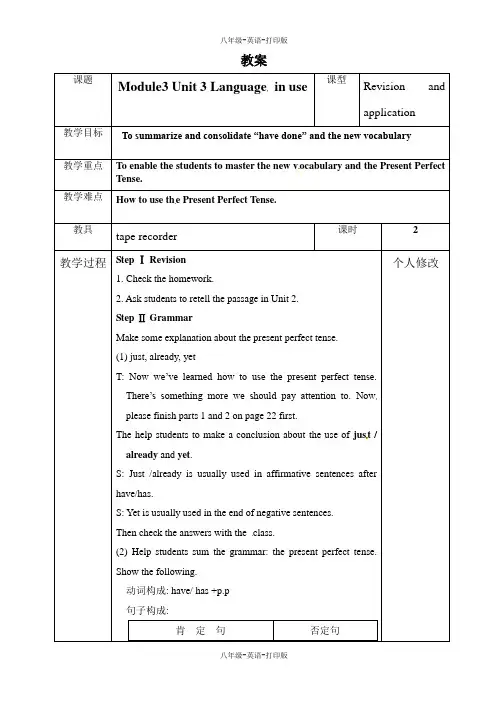
教案课题Module3 Unit 3 Language in use 课型Revision andapplication教学目标To summarize and consolidate “have done” and the new vocabulary教学重点To enable the students to master the new v ocabulary and the Present Perfect Tense.教学难点How to use the Present Perfect Tense.教具tape recorder 课时 2教学过程Step Ⅰ Revision个人修改1. Check the homework.2. Ask students to retell the passage in Unit 2.Step Ⅱ GrammarMake some explanation about the present perfect tense.(1) just, already, yetT: Now we’ve learned how to use the present perfect tense.There’s something more we should pay attention to. Nowplease finish parts 1 and 2 on page 22 first.The help students to make a conclusion about the use of jus t /already and yet.S: Just /already is usually used in affirmative sentences afterhave/has.S: Yet is usually used in the end of negative sentences.Then check the answers with the class.(2) Help students sum the grammar: the present perfect tense.Show the following.动词构成: have/ has +p.p句子构成:肯定句否定句S +have/has +p.p S +have/has+not +p.p特殊疑问句回答WhatWhoWhen h ave/has +p.p?S +have/has+p.p WhereWhyHow一般疑问句回答Have/Has+ S+p.p? Yes, S+ have/has.No, S +haven't/hasn't..(3) have/has been, have/has goneCreate a situation as follows to help students make clear about the different usage of have/has b een, have/has gone.T: Liu Mei, will you please go to the office to bring my book here? (Liu Mei goes to the office.) Class, where is Liu Mei? S: She has gone to the office.(After a while Liu Mei comes back with a book.)T: Thank you, Liu Mei. OK. Has Liu Mei been to the office? S: Yes, she has.T: Now, do you know the differences between h ave/has gone and have/has been?S: Yes. have/has gone: 去了某地,还没回来。
外研版八年级上册m3u3教案
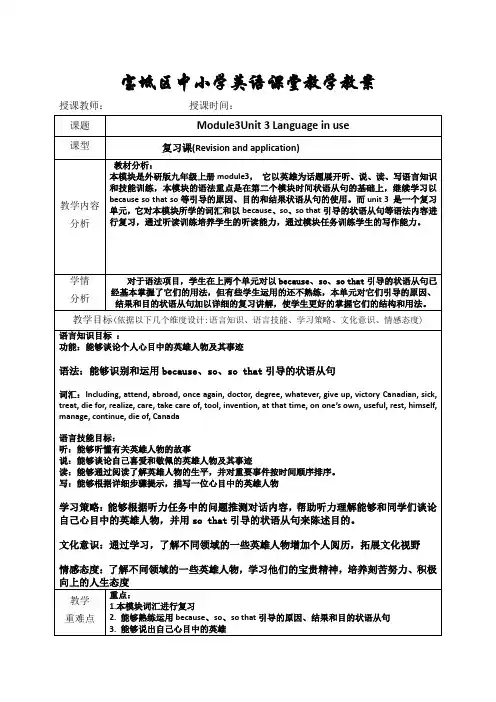
要求用because、so、so that来填空,完成练习。
Step 3呈现
1、对以because、so、so that引导的状语从句加以详细的复习和讲解。
1、根据刚刚的复习内容完成课本练习1、2、3。联系一这一环节主要考查学生在语境中综合运用because、so、so that引导的状语从句的能力,并让学生了解加加林生平故事;练习二让学生进一步感知这三个连词引导状语从句的不同;练习三让学生通过回答由why引导的问句,继续练习使用状语从句。
语言知识目标:
功能:能够谈论个人心目中的英雄人物及其事迹
语法:能够识别和运用because、so、so that引导的状语从句
词汇:Including, attend, abroad, once again, doctor, degree, whatever, give up, victoryCanadian, sick, treat, die for,realize, care, take care of, tool, invention, at that time, on one’s own, useful, rest, himself, manage, continue, die of, Canada
3.. Search for some information abouthome alone rules.
板书设计
Module 3
Unit3 Language in use
教学反思
Most of students have already finished the tasks .
词汇和短语复习
听力和阅读能力的培养
知识拓展
巩固语法知识
写作训练
Module+3+Unit+3 外研版八年级英语上册
预习检测
3.Study hard! C you study,
results you’ll get.
A.Harder; better
B.The harder; betterC.The harder;
the better Let’s stop
D.Harder; the better4.James, I’m too tired.
a rest. A.havingD
B.have
C.to having
D.to have5B.Mr Wang does what he can
us improve our English. A.hel.helped
知识梳理
1 Work in pairs. Look at the pictures and talk about the sports. Use the words in the box to help you.
D.interesting somewhere2.I have
to tell you. Maybe
you will be D
in it. A.interesting something;
interestedB.interested something; interestingC.something
interesting; interestingD.something interesting; interested
Now compare the sports. 1 Table tennis is more exciting than tennis. 2 Tennis is… 3 Basketball is … 4 Football is … 5 Swimming is … 6 Baseball is…
外研版英语八年级上册Module3 Unit3 精品教案 (2)
Unit3 精品教案Teaching modelRevision and applicationTeaching aims:1.掌握副词的根本用法以及副词比拟级的用法。
2.掌握并熟练运用多音节形容词及局部双音节形容词的比拟级的用法。
3.掌握比拟级特殊用法:the +比拟级,the +比拟级Teaching key points:语法:掌握副词的根本用法以及副词比拟级的用法。
比拟级特殊用法:the +比拟级,the +比拟级句型:1. My favorite sport is...我最喜欢的体育工程是......2. In the mornings and evenings you can see people jogging in parks or along city streets.3. The more you go jogging, the longer you will run and you the healthier you will feel.Teaching difficulties:形容词和副词的比拟级构成以及用法Teaching aidsTape recorder, OHPTeaching StepsStep 1 RevisionShow some pictures to review the text of Unit 1 and Unit 2Step 2 Language practice1. Read through the example sentences in the box with the whole class.2. Ask the students to repeat the sentences in the box.Step 3 Work in pairs and talk about sports1. Look at the pictures in activity 1.2. Let Ss talk about sports and ask some of them to make a dialogue.Step 4 Do activity21. Ask the students to read the sentences carefully.2. Let Ss finish them.3. Check the answers:4. Let the Ss read the sentences by themselves.Step 5 Do activity31. Ask the students to read the sentences carefully and finish them.2. Ask the students to check with a partner.3. Check the answers:4. Read the sentences together.Step 6 Complete the passage1. Ask the students to read through the conversation.2. Complete the conversation with the correct form of the words.3. Ask the students to check with a partner.4. Check the answers5. Ask some students to read the passage.Step 7 Listening1. Listen and choose the correct answer.2. Check the answers.3. Listen and complete the sentences.4. Check the answers.Step 8 Around the world1. Ask the students to look at the picture and discuss what they can see.2. Read through the information with the whole class.3. Talk something about “The marathon race〞.Step 9 Module task1. Let Ss talk about their favourite sports.2. Choose one sport for their poster.3. Work in pairs and make a poster.Step 10 Homework。
2019年外研版初中英语八年级上册Module 3 Unit 3 Language in use优质课教案(3)
1. short 2. hot 3. busy 4. early 5. good
6. large 7. badly 8. relaxing 9. difficult
10. well 11. quickly 12. enjoyable
自我小结1):形容词、副词比较级变化规则:
1.单音节和少数双音节形容词直接在词尾+________。
对于不规则变化的单词当做新单词记忆。
C.选择
1) Football is _____________ than baseball in most countries.
在很多国家,足球比棒球更流行。
2) Nothing is ______________ than playing tennis.
没有什么比打网球更令人愉快的了。
3) It’s ______________ to practise in winter (than in summer).
冬季训练(要比夏季训练)难度更大。
4)I can carry as ______ ________as you can.(一样多的纸)
5)Tony is _________ _____ ______ _______Daming.(不如大明高)
要求:1.交换课本,先根据PPT核对答案,安静独立完成。
2.组长组织释义,小组解答不了的用红笔圈出,再由书记员将此题目简写于小黑板。
知者加速:任务完成坐下,可以帮助临近小组。
六、中考链接
选择题
1. — Sorry, I can’t follow you. Would you
please speak ______?
1.许多时间2.看起来疲惫3.热身
外研版八年级英语上册教案(三)
学习动词不定式作宾语及宾语补助语的用法。
学习能带双宾语的动词。
【学法指导】本课为复习课,所以必须在对UIU2已经掌握很好的基础上再完成U3的学习,先复习检测,并通过U3的作业得到检测反馈
导 学 过 程
方法导引
【复习巩固】
检测U1U2重点单词重点短语的掌握情况
【自主学习,基础过关】
完成U3中的activity1、2、3、4、8,找出并翻译下列短语并大声朗读:
Lucy gave Daming an apple .
Lucy gave an apple ____________________ .
Mr. Wang taught the English Chinese in London .
Mr. Wang taught Chinese ______________________________ in London .
课后反思:
先自主拼读单词,再跟点读笔读,纠正发音,熟读后完成自主检测一题。
熟读Activity3总结出短语以及重点句子,完成activity4提出疑惑。
合作探究,需要小组成员配合完成,等级不等成员之间要互相帮助,对完成的探究案,每个成员都要知道答案是怎样得来的。
在自主预习与师的引导与补充后,完成当堂检测,
3.Many wild animals don’t have a safe placetolive .
4.Also , often there isn’t enough cleanwater, because we’ve made it dirty .
2.难点:动词不定式作宾语补足语和作状语的用法。
单项选择:
( ) 1 . The boy is __________ to look after himself .