
(完整版)北师大版小学英语六年级知识点总结.doc
北 大版小学英 六年 知 点 Grade Six
Unit 1 Structures:
What's your favorite subject? Geography. It's the most exciting subject.
tall taller
the tallest
boring
more boring
the most boring
funny funnier the funniest
will go / will swim
Words: art English history
science music math P.E.
interesting difficult
easy boring
法知 :复 去 (yesterday, last week ⋯)将来 (tomorrow, next week) 、形容 的比
的构成及用法
(比 +than ; the+最高 )
Unit 2 Structures: I have to water the plants.
have to/has to+ 原形
He doesn't have to wash the dog.
What chores do you have to do?
I have to ....
Words: make my bed walk the dog take out the trash polish my shoes wash the dishes clean my room feed the fish water the flowers cut the grass dust the furniture wash the clothes every day every week once a week twice a week hardly ever always often usually sometimes never
法知 : 度副 的基本用法
Unit 3 Words:
karate Structures: What are you doing tomorrow?
I am playing tennis tomorrow. How often do you play tennis?
I play tennis three times a week.
skiing swimming
ice-skating
bowling
going shopping playing football doing
working out at the gym on Sunday next week every day once a week sometimes 法知 :能 理解并初步运用“
be ( am/is/are )+ doing + 将来 状 ”表示将来的用法
.
Unit 4 Structures: We hate/ like/ prefer to shop.
How much does this T-shirt cost? How much do these gloves cost?
Which sunglasses do you prefer?
He hates/ likes/ prefers these belts.
It costs ...
They cost ⋯.
I prefer these.
Words:
belt sunglasses gloves sweatpants 法知 :在具体 境中理解并会使用表示 近、 复数的代 。
近指: this ( 个 ) this hat
these ( 些) these shoes
指: that (那个)
those (那些)
that shirt
those gloves
Unit 5 Structures: What should I/ he/ they do?
Should/shouldn ’t+ 原形
I/ He/ They should work hard. Sb. shouldn't eat fast food.
Words: feel cold —wear a sweater
have a headache — go to bed early
have a problem — ask the teacher have a toothache — take some medicine feel scared — take deep breaths
feel dizzy — sit down
法知 :
1. 用 should 表达建 的基本 构和用法。
2.掌握不定冠
umbrella octopus a, an 的用法
( apple
English old )
orange
egg
eraser
ant
elephant
ice-cream。
(完整word版)北京版六年级英语上册重点总结
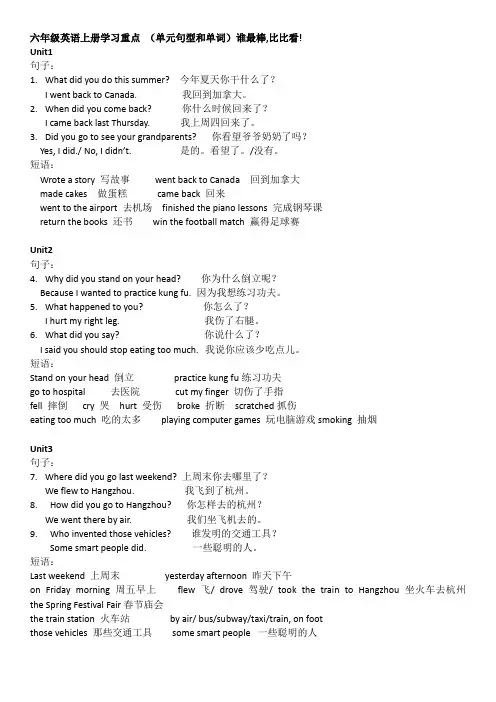
六年级英语上册学习重点(单元句型和单词)谁最棒,比比看!Unit1句子:1.What did you do this summer? 今年夏天你干什么了?I went back to Canada. 我回到加拿大。
2.When did you come back? 你什么时候回来了?I came back last Thursday. 我上周四回来了。
3.Did you go to see your grandparents? 你看望爷爷奶奶了吗?Yes, I did./ No, I didn’t.是的。
看望了。
/没有。
短语:Wrote a story 写故事went back to Canada 回到加拿大made cakes 做蛋糕came back 回来went to the airport 去机场finished the piano lessons 完成钢琴课return the books 还书win the football match 赢得足球赛Unit2句子:4.Why did you stand on your head? 你为什么倒立呢?Because I wanted to practice kung fu. 因为我想练习功夫。
5.What happened to you? 你怎么了?I hurt my right leg. 我伤了右腿。
6.What did you say? 你说什么了?I said you should stop eating too much. 我说你应该少吃点儿。
短语:Stand on your head 倒立practice kung fu练习功夫go to hospital 去医院cut my finger 切伤了手指fell 摔倒cry 哭hurt 受伤broke 折断scratched抓伤eating too much 吃的太多playing computer games 玩电脑游戏smoking 抽烟Unit3句子:7.Where did you go last weekend? 上周末你去哪里了?We flew to Hangzhou. 我飞到了杭州。
北师大版六年级英语上册基础知识梳理(20201226114506)
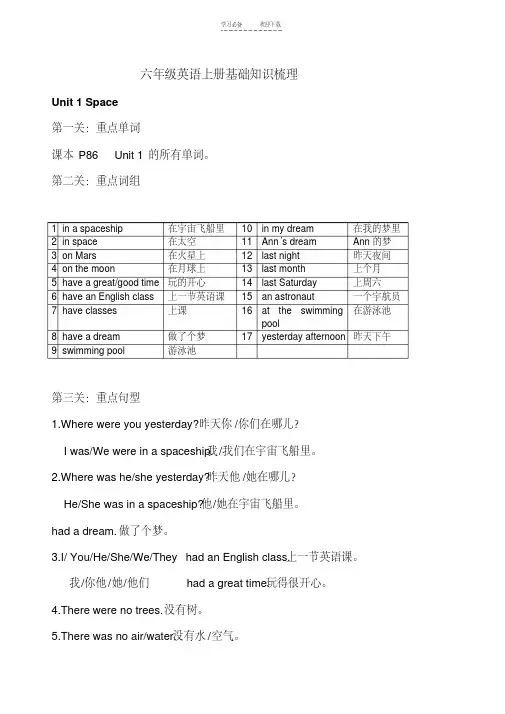
六年级英语上册基础知识梳理Unit 1 Space第一关:重点单词课本P86 Unit 1的所有单词。
第二关:重点词组1 in a spaceship 在宇宙飞船里10 in my dream 在我的梦里2 in space 在太空11 Ann’s dream Ann的梦3 on Mars 在火星上12 last night 昨天夜间4 on the moon 在月球上13 last month 上个月5 have a great/good time 玩的开心14 last Saturday 上周六6 have an English class 上一节英语课15 an astronaut 一个宇航员在游泳池7 have classes 上课16 at the swimmingpool8 have a dream 做了个梦17 yesterday afternoon 昨天下午9 swimming pool 游泳池第三关:重点句型1.Where were you yesterday? 昨天你/你们在哪儿?I was/We were in a spaceship.我/我们在宇宙飞船里。
2.Where was he/she yesterday? 昨天他/她在哪儿?He/She was in a spaceship? 他/她在宇宙飞船里。
had a dream. 做了个梦。
3.I/ You/He/She/We/They had an English class.上一节英语课。
我/你他/她/他们had a great time.玩得很开心。
4.There were no trees. 没有树。
5.There was no air/water.没有水/空气。
6.I had a dream last night.昨晚我做了个梦。
7.Ken was in my dream. Ken在我的梦里。
8.It was cold on Mars. 火星上很冷。
北师大版英语六年级上册
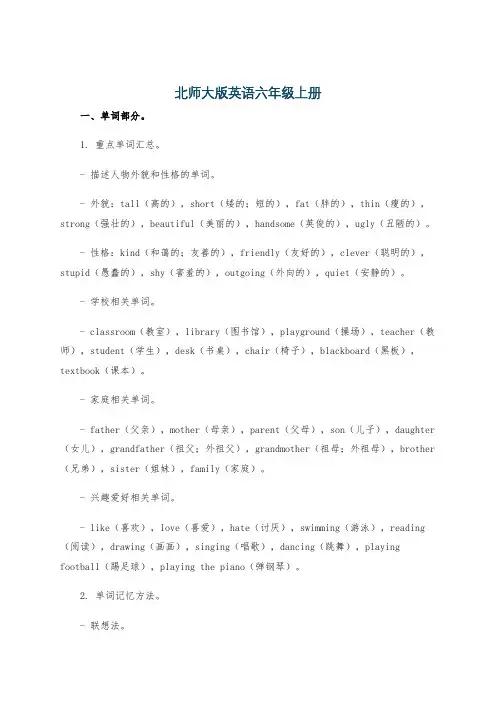
北师大版英语六年级上册一、单词部分。
1. 重点单词汇总。
- 描述人物外貌和性格的单词。
- 外貌:tall(高的),short(矮的;短的),fat(胖的),thin(瘦的),strong(强壮的),beautiful(美丽的),handsome(英俊的),ugly(丑陋的)。
- 性格:kind(和蔼的;友善的),friendly(友好的),clever(聪明的),stupid(愚蠢的),shy(害羞的),outgoing(外向的),quiet(安静的)。
- 学校相关单词。
- classroom(教室),library(图书馆),playground(操场),teacher(教师),student(学生),desk(书桌),chair(椅子),blackboard(黑板),textbook(课本)。
- 家庭相关单词。
- father(父亲),mother(母亲),parent(父母),son(儿子),daughter (女儿),grandfather(祖父;外祖父),grandmother(祖母;外祖母),brother (兄弟),sister(姐妹),family(家庭)。
- 兴趣爱好相关单词。
- like(喜欢),love(喜爱),hate(讨厌),swimming(游泳),reading (阅读),drawing(画画),singing(唱歌),dancing(跳舞),playing football(踢足球),playing the piano(弹钢琴)。
2. 单词记忆方法。
- 联想法。
- 例如记忆“piano”这个单词,可以联想为“pi(屁)+ an(一个)+ o(鸡蛋)”,想象在钢琴上有一个鸡蛋,然后放了个屁,虽然这个联想很滑稽,但可以帮助记忆。
- 词根词缀法(适用于部分有词根词缀的单词)- 像“un - ”这个前缀表示否定,“happy”(高兴的)加上“un - ”变成“unhappy”(不高兴的)。
归纳北师大三起版小六英语毕业考试知识点

归纳北师大三起版小六英语毕业考试知识点Unit 1 How can I get there ?一、主要单词:museum博物馆bookstore书店cinema电影院turn 转弯hospital医院left向左post office 邮局science科学right向右straight笔直地crossing十字路口二、习惯语搭配:post office邮局science museum科学博物馆pet hospital宠物医院Italian restaurant意大利餐馆Beihai Park北海公园Palace Museum故宫博物院go straight直走turn right/left右/左转next to挨着in front of...在...前面near the park在公园附近on Dong fangStreet在东方大街上三、惯用表达式:Excuse me 打扰一下Follow me, please!请跟着我!四、公式化句型:1、问路的句型及其答语:问句:Where is the + 地点?……在哪儿?答语:It’s + 表示地点的词语。
它……。
next to the bookstore, near the hospital/post office, over there,on Dongfang Street, in front of the school...2、询问怎么到某地的句型及其答语:问句:How can +主语+ get (to)+地点?……怎么到……?同义句型:Can you tell me the way to +地点?Whereis + 地点?Which is the way to +地点?答语:Turn +方向+表示地点的介词短语。
……转。
at the cinema at thecorner near the post office...五、例句:Where is the cinema, please? 请问电影院在哪里?It’s next to the hospital. 它与医院相邻。
北师大版六年级英语上册高级知识梳理
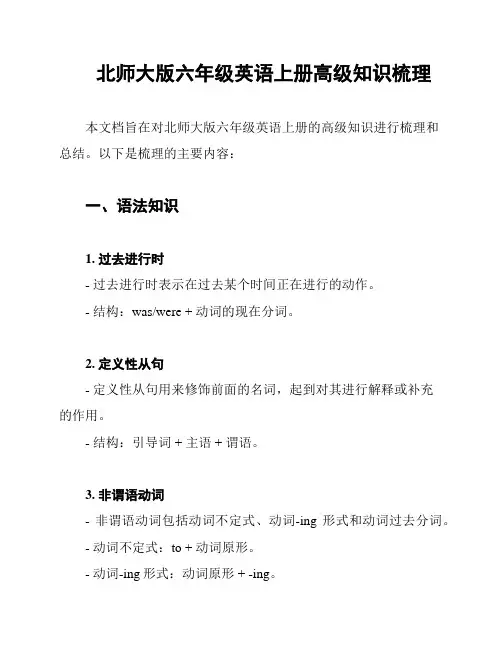
北师大版六年级英语上册高级知识梳理本文档旨在对北师大版六年级英语上册的高级知识进行梳理和总结。
以下是梳理的主要内容:一、语法知识1. 过去进行时- 过去进行时表示在过去某个时间正在进行的动作。
- 结构:was/were + 动词的现在分词。
2. 定义性从句- 定义性从句用来修饰前面的名词,起到对其进行解释或补充的作用。
- 结构:引导词 + 主语 + 谓语。
3. 非谓语动词- 非谓语动词包括动词不定式、动词-ing形式和动词过去分词。
- 动词不定式:to + 动词原形。
- 动词-ing形式:动词原形 + -ing。
- 动词过去分词:动词的过去分词形式。
二、词汇知识1. 名词复数- 名词复数表示一个以上的人或事物。
- 规则变化:大部分名词在词尾加-s。
- 不规则变化:如man变成men,child变成children等。
2. 动词变化- 动词的不同形式表示不同的时间和人称。
- 基本形式:动词原形。
- 第三人称单数:动词加-s。
- 过去式:动词过去式形式。
- 过去分词:动词的过去分词形式。
三、听力技巧1. 预测答案- 预测答案可以根据对话或问题的内容来推断可能的答案。
- 借助关键词和上下文来帮助预测答案。
2. 注意关键词- 在听力中,要注意关键词的出现,这些关键词通常会给出重要信息。
- 抓住关键词可以帮助理解整个对话或问题的意思。
以上是对北师大版六年级英语上册高级知识的梳理和总结。
希望本文档对您的研究有所帮助。
北师大版六年级英语上册复习总结.doc
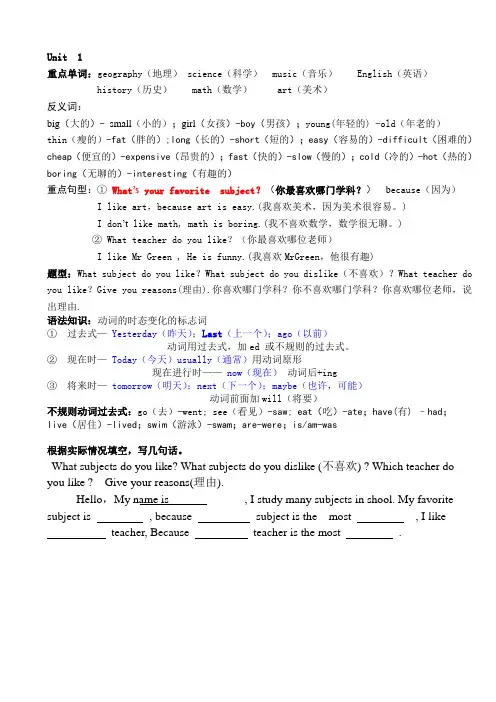
Unit 1重点单词:geography(地理) science(科学) music(音乐) English(英语)history(历史) math(数学) art(美术)反义词:big(大的)- small(小的);girl(女孩)-boy(男孩);young(年轻的) -old(年老的)thin(瘦的)-fat(胖的);long(长的)-short(短的);easy(容易的)-difficult(困难的)cheap(便宜的)-expensive(昂贵的);fast(快的)-slow(慢的);cold(冷的)-hot(热的)boring(无聊的)-interesting(有趣的)重点句型:①What’s your favorite subject?(你最喜欢哪门学科?)b ecause(因为)I like art,because art is easy.(我喜欢美术,因为美术很容易。
)I don’t like math, math is boring.(我不喜欢数学,数学很无聊。
)② What teacher do you like?(你最喜欢哪位老师)I like Mr Green , He is funny.(我喜欢MrGreen,他很有趣)题型:What subject do you like?What subject do you dislike(不喜欢)?What teacher do you like?Give you reasons(理由).你喜欢哪门学科?你不喜欢哪门学科?你喜欢哪位老师,说出理由.语法知识:动词的时态变化的标志词①过去式— Yesterday(昨天);Last(上一个);ago(以前)动词用过去式,加ed 或不规则的过去式。
②现在时— Today(今天)usually(通常)用动词原形现在进行时—— now(现在)动词后+ing③将来时— tomorrow(明天);next(下一个);maybe(也许,可能)动词前面加will(将要)不规则动词过去式:go(去)-went; see(看见)-saw; eat(吃)-ate;have(有) –had;live(居住)-lived;swim(游泳)-swam;are-were;is/am-was根据实际情况填空,写几句话。
六年级英语上册知识点北京版完美版
They held them in1896 inAthens.
How many medals did the Chinese athletes win?
They won 51 gold medals, 21 silver medals, and 28 bronzemedals.
Z, zebra, zip, zipper
词汇:交通工具词汇;动词过去式(规则和不规则变化)
句型:
G5U2
What did you do yesterday?
I watched TV.
G4U10
How do you go to school?
I go by bus.
词汇:miss(错过),flight, passport,hotel, fantastic, silk, subway,bridge,sound,special,the Spring Festival Fair,invent,vehicles,smart,invention
Y, year, yellow baby, lucky stay, play by, fly, sky
词汇:身体部位词汇;动词过去式(规则和不规则变化)
句型:
G3U11
How are you today?
What’s the matter?
My head/leg/mouth hurts.
词汇:stand on your head,ache, terribly,kung fu,a blood test,scratch, upset, pill, stop doing
Unit 6
北师大版六年级英语下册知识点总汇
北师大版六年级英语下册知识点总汇本文档为北师大版六年级英语下册知识点的总结和概述。
1. 所学课文知识点:
- 课文内容:文中的主要人物、事件和情节。
- 预导引:研究课文前的提示和问题。
- 语法与词组:课文中涉及的语法知识和常用词组。
2. 语法知识点:
- 时态:一般现在时、一般过去时、一般将来时等。
- 句型:陈述句、特殊疑问句、一般疑问句等。
- 名词:可数名词和不可数名词的用法。
- 形容词和副词:形容词和副词的比较级和最高级等。
3. 词汇知识点:
- 名词:常见名词的读音和用法。
- 动词:常见动词的过去式和现在分词形式。
- 形容词和副词:常见形容词和副词的用法和变化形式。
- 介词:常用介词的用法和搭配。
4. 阅读理解:
- 阅读技巧:识别关键词、推断意义和理解上下文等。
- 阅读理解题型:选择题、填空题和解答题等。
5. 写作:
- 口头表达:描述人物、事物和事件等。
- 书面表达:写信、日记等常见写作形式。
以上是北师大版六年级英语下册知识点的总汇。
通过对这些知识点的梳理和研究,同学们可以更好地掌握相关的英语知识,提升自己的英语水平。
注:本文摘要自北师大版六年级英语下册教材,具体内容请以教材为准。
六年级下册英语素材-期末复习重点内容归纳 北师大版
北师大版本小学英语六年级下册Unit 7crash 碰,碰撞elbow 肘fill out 填写flat 瘪的,平的helmet 安全帽,头盔invite 邀请mail 邮寄number 第……号pad 垫子rider 自行车手sign 标志tire 轮胎,车胎track 赛道warning 警告,提示brakes 刹车pedal 踏板pump 打气handlebars 车把competitor 比赛选手cycling shoes 自行车专用鞋official 工作人员puddle 水洼,积水skid 打滑,滑溜slippery 滑的二、短语fill out填写entry form报表at first 首先decide to do sth决定做某事Be careful=Look out!=Watch out!小心/注意On time准时,in time及时三、重点句、语法You must wear a helmet.你必须带上头盔。
We must not be late.我们不能迟到。
She has to fill in the form.她必须填表。
He mustn’t play with fire.他不能玩火。
I have to read the rules.我必须读规则。
No talking. 不要说话。
Don’t touch.禁止触摸。
(三)副词(形容词变副词的规则变化和不规则变化)quick-quickly slow-slowly bad-badly good-wellhard-hard fast-fast四语音了解祈使句中的重音在开头。
Put on your coat. It’s cold. Don’t lose your purse.You need it.Wash your hands. They are dirty. Don’t touch the glass. It’s broken. Unit 8一、四会单词(19 个)1. bone 骨头,骨骼2. chin 下巴3. crutch 拐杖4. relax 放松5. wrist 手腕6. elbow 胳膊肘7. ankle 脚踝8. hand 手9. ear 耳朵10. knee 膝盖11. foot 脚12. nose 鼻子13. eye 眼睛14. smell 闻15. taste 品尝16. look 看上去17. sound 听上去18. feel 感觉19. hear 听见,听到其余均为三会单词。
六年级英语上册知识点归纳北师大版
六年级英语上册知识点归纳北师大版一、单词1. 动词•be(是)•have(有)•do(做)•go(去)•see(看到)•play(玩)•like(喜欢)•want(想要)•eat(吃)•drink(喝)•sleep(睡觉)•read(读)•write(写)•listen(听)•speak(说)2. 名词•book(书)•pencil(铅笔)•ruler(尺子)•eraser(橡皮)•bag(书包)•desk(桌子)•chair(椅子)•school(学校)•friend(朋友)•teacher(老师)•student(学生)•parent(家长)•brother(兄弟)•sister(姐妹)•cat(猫)•dog(狗)•bird(鸟)•apple(苹果)•banana(香蕉)•orange(橙子)3. 形容词•big(大)•small(小)•short(矮)•long(长)•short(短)•happy(快乐)•sad(伤心)•funny(有趣的)•boring(无聊的)•difficult(困难的)•easy(容易的)•beautiful(美丽的)•ugly(丑陋的)•old(老的)•young(年轻的)二、句型1. be动词句型•I am a student.(我是一个学生。
)•He is my brother.(他是我的兄弟。
)•She is a teacher.(她是一名教师。
)•They are my friends.(他们是我的朋友。
)2. have句型•We have a bag.(我们有一个书包。
)•She has a book.(她有一本书。
)•He has two pencils.(他有两支铅笔。
)•They have a pet.(他们有一只宠物。
)3. 动词原形句型•I like to play basketball.(我喜欢打篮球。
)•She wants to eat an apple.(她想吃一个苹果。