
2019年教师资格考试英语学科知识与教学能力模拟试题
2019年11月教师资格考试英语学科知识与教学能力模拟3. The girls are afraid that being friendly to strangers could be misinterpreted by their__neighbours.A. ever-presentB. ever-presentedC. ever-presentingD. ever-presently4. His presentation will show you ____ can be used in other contexts.A. that you have observedB. that how you have observedC. how that you have observedD. how what you have observed5. Many students start each term with an award check, but by the time books are bought, food is paid for, and a bit of social life __, it looks rather emaciated.A. livesB. livedC. was livedD. has lived6. Which of the following is correct in its use of punctuation?A. The teacher asked, “Who said, ‘Give me liberty or give me death’?”B. The teacher asked, “Who said, ‘Give me liberty or give me death?’”C. The teacher asked, “Who said ‘Give me liberty or give me death’”?D. The teacher asked, “Who said ‘Give me liberty or give me death’?”7. The pair of English phonemes _ differ in the place of articulation.A. /ʃ/ and /ʒ/B. /θ/ and /ð/C. /d/ and /z/D. /m/ and /n/8. There are _consonant clusters in the sentence “Brian, I appreciate beautiful scarf you brought me.”A. twoB. threeC. fourD. five9. When saying “It’s noisy outside” to get someone to close the window, the s peaker intends to perform a(n) _.A. direct speech actB. locutionary actC. indirect speech actD. perlocutionary act10. That a Japanese child adopted at birth by an American couple will grow up speaking English indicates _of human language.A. dualityB. cultural transmissionC. arbitrarinessD. cognitive creativity11. Fluent and appropriate language use requires knowledge of _and this suggeststhat we should teach lexical chunks rather than single words.A. denotationB. connotationC. morphologyD. collocation12. “Underlining all the past form verbs in the dialogue” is a typical exercise focusing on _.A. useB.formC. meaningD. function13. Which of the following activities may be more appropriate to help students practice a new structure immediately after presentation in class?A. Role play.B. Group discussion.C. Pattern drill.D. Written homework.14. When teaching students how to give appropriate responses to a congratulation or an apology, the teacher is probably teaching at _.A. lexical levelB. sentence levelC. grammatical levelD. discourse level15. Which of the following activities can help develop the skill of listening for gist?A. Listen and find out where Jim lives.B. Listen and decide on the best title for the passage.C. Listen and underline the words the speaker stresses.D. Listen to pairs of words and tell if they are the same.16. When an EFL teacher asks his student “How do you know that the author liked the place since he did not tell us explicitly?”, he/she is helping stud ents to reach _comprehension.A. literalB. appreciativeC. inferentialD. evaluative17. Which of the following types of questions are mostly used for checking literal comprehension of the text?A. Display questions.B. Rhetorical questions.C. Evaluation questions.D. Referential questions.18. Which of the following is a typical feature of informal writing?A. A well-organized structure is preferred.B. Short and incomplete sentences are common.C. Technical terms and definitions are required.D. A wide range of vocabulary and structural patterns are used.19. Peer-editing during class is an important step of the _approach to teaching writing.A. genre-basedB. content-basedC. process-orientedD. product-oriented20. Portfolios, daily reports and speech delivering are typical means of _.A. norm-referenced testB. criterion-referenced testC. summative assessmentD. formative assessment请阅读Passage l,完成第21~25小题。
Passage l.When the Viaduct de Millau opened in the south of France in 2004, this tallest bridge in the world won worldwide accolades. German newspapers described how it “floated above the clouds” with “elegance and lightness” and “breathtaking” beauty. In France, papers praised the “immense” “concrete giant.” Was it mere coincidence that the Germans saw beauty where the French saw heft and power? Lera Borodisky thinks not.In a series of clever experiments guided by pointed questions, Boroditsky is amassing evidence that, yes, language shapes thought. The effect is powerful enough, sh e says, that “the private mental lives of speakers of different languages may differ dramatically,” not only when they are thinking in order to speak, “but in all manner of cognitive tasks,” including basic sensory perception. “Even a small fluke of gramma r”—the gender of nouns—“can have an effect on how people think about things in the world,” she says.As in that bridge, in German, the noun for bridge, Brucke, is feminine. In French, pont is masculine. German speakers saw prototypically female features; French speakers, masculine ones. Similarly, Germans describe keys (Schlussel) with words such as hard, heavy, jagged, and metal,while to Spaniards keys (llaves) are golden, intricate, little, and lovely. Guess which language construes key as masculine and which as feminine? Grammatical gender also shapes how we construe abstractions. In 85 percent of artistic depictions of death and victory, for instance, the idea is represented by a man if the noun is masculine and a woman if it is feminine, says Boroditsky. Germans tend to paint death as male, and Russians tend to paint it as female.Language even shapes what we see. People have a better memory for colors if different shades have distinct names—not English’s light blue and dark blue, for instance, but Russian’s goluboy and sinly. Skeptics of the language-shapes-thought claim have argued that that’s a trivial finding, showing only that people remember what they saw in both a visual form and a verbal one, but not proving that they actually see the hues differently. In an ingenious experiment, however, Boroditsky and colleagues showed volunteers three color swatches and asked them which of the bottom two was the same as the top one. Native Russian speakers were faster than English speakers when the colors had distinct names, suggesting that having a name for something allows you to perceive it more sharply. Similarly, Korean uses one word for “in” when one object is in another snugly, and a different one when an object is in something loosely. Sure enough, Koreanadults are better than English speakers at distinguishing tight fit from loose fit.Science has only scratched the surface of how language affects thought. In Russian, verb forms indicate whether the action was completed or not—as in “she ate[and finished] the pizza.” In Turkish, verbs indicate whether the action was observed or merely rumored. Boroditsky would love to run an experiment testing whether native Russian speakers are better than others at noticing if an action is completed, and if Turks have a heightened sensitivity to fact versus hearsay. Similarly, while English says “she broke the bowl” even if it smashed accidentally, Spanish and Japanese describe the same event more like “the bowl broke itself.” “When we show people video of the same event,” says Boroditsky, “English speakers remember who was to blame even in an accident, but Spanish and Japanese speakers remember it less well than they do intentional actions. It raises questions about whether language affects even something as basic as how we construct our ideas of causality.”21. Which of the following is closest in meaning to the underlined word “accolades” in PARAGRAPH ONE?A. Praises.B. Awards.C. Support.D. Gratitude.22. What can be inferred from PARAGRAPH TWO?A. Language does not shape thoughts in any significant way.B. The relationship between language and thought is an age-old issue.C. The language we speak determines how we think and see the world.D. Whether language shapes thought needs to be empirically supported.23. What is the role of the underlined part “As in that bridge” in PARAGRAPH THREE?A. Reflecting on topics that appeal to the author and readers.B. Introducing new evidence to what has been confirmed before.C. Identifying the kinds of questions supported by the experiments.D. Claiming that speakers of different languages differ dramatically.24. Which of the following has nothing to do with the relationship between language and thought?A. People remember what they saw both visually and verbally.B. Language helps to shape what and how we perceive the world.C. Grammar has an effect on how people think about things around us.D. Science has only scratched the surface of how language affects thought.25. Which of the following best represents the au thor’s argument in the passage?A. The gender of nouns affects how people think about things in the world. .B. Germans and Frenchmen think differently about the Viaduct de Millau.C. Language shapes our thoughts and affects our perception of the world.D. There are different means of proving how language shapes our thoughts.请阅读Passage 2.完成第26~30小题。
2019上半年《英语学科知识与教学能力(初中》教师资格试题及答案
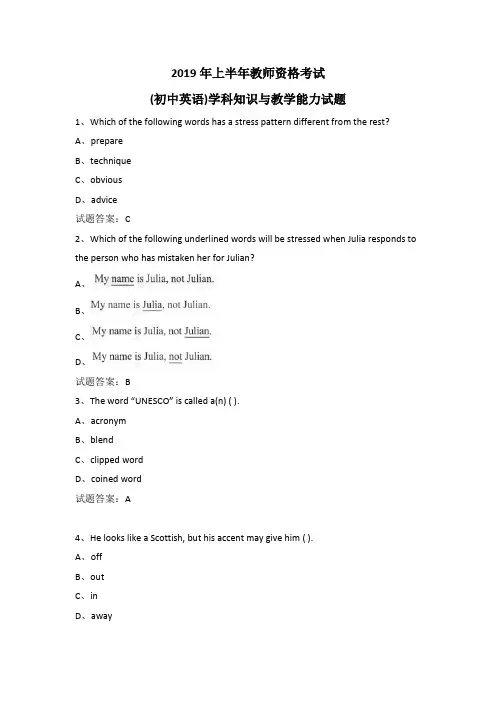
2019年上半年教师资格考试(初中英语)学科知识与教学能力试题1、Which of the following words has a stress pattern different from the rest?A、prepareB、techniqueC、obviousD、advice试题答案:C2、Which of the following underlined words will be stressed when Julia responds to the person who has mistaken her for Julian?A、B、C、D、试题答案:B3、The word “UNESCO” is called a(n) ( ).A、acronymB、blendC、clipped wordD、coined word试题答案:A4、He looks like a Scottish, but his accent may give him ( ).A、offB、outC、inD、away试题答案:'D5、The book is so well received that it sells ( )the million.A、atB、inC、byD、to试题答案:c6、( )we are successful, we can be sure that we did our best.A、Provided thatB、If onlyC、If or notD、Whether or not试题答案:d7、—Will you be able to go swimming with us?— ( ).A、I’m afraid notB、I’m afraidC、I’m not afraidD、I’m not afraid so试题答案:a8、( ) is the custom,the investigators carried out a painstaking search of the debris after the air crash.A、WhatB、AsC、WhichD、That试题答案:b9、There are different words for paternal grandmother (nainai) and maternal grandmother(waipo) in Chinese, but in English the word “grandmother” is generally used in both cases, which suggests that ( ).A、equal importance is given to maternal and paternal grandparents in ChinaB、equal importance is given to maternal and paternal grandparents in BritainC、language may influence people’s ways of thinking to a large extentD、people of different languages categorize things in different ways试题答案:d10、Which of the following is employed by a speaker who addresses senior people as “the elderly” rather than “the old”?A、Social dialect.B、Taboo.C、Lingua franca.D、Euphemism.试题答案:d11、By asking the question, “Can you list your favorite food in English?” , the teacher is using the technique of ( ).A、elicitationB、monitoringC、promptingD、recasting试题答案:a12、If a teacher wants to check how much students have learned at the end of a term, he/she would give them a(n) ( ).A、diagnostic testB、placement testC、proficiency testD、achievement test试题答案:d13、What learning style does Xiao Li exhibit if she tries to understand every single word when listening to a passage?A、Field-dependence.B、Intolerance of Ambiguity.C、Risk-taking.D、Field-independence.试题答案:b14、If a teacher asks students to put jumbled sentences in order in a reading class, he/she intends to develop their ability of ( ).A、word-guessing through contextB、summarizing the main ideaC、understanding textual coherenceD、scanning for detailed information试题答案:c15、When a teacher says “What do you mean by that?”,he/she is asking the student for ( ).A、repetitionB、suggestionC、introductionD、clarification试题答案:d16、When a teacher says “You’d better talk in a more polite way when speaking to the elderly.”,he/she is drawing the students’ attenti on to the of language use( ).A、fluencyB、complexityC、accuracyD、appropriacy试题答案:d17、Which of the following is a display question?A、What part of speech is “immense”?B、How would you comment on this report?C、Why do you think Hemingway is a good writer?D、What do you think of the characters in this novel?试题答案:a18、Which of the following represents a contextualized way of practising “How often ...” ?A、Make some sentences with “how often” .B、Use “how often" and the words given to make a sentence.C、I go shopping twice a week. How often do you go shopping?D、Please change the statement into a question with “how often” .试题答案:c19、Which of the following are controlled activities in an English class?A、Reporting, role-play and games.B、Reading aloud, dictation and translation.C、Role-play, problem solving and discussion.D、Information exchange, narration and interview.试题答案:b20、The ( )is designed according to the morphological and syntactic aspects of a language.A、structural syllabusB、situational syllabusC、skill-based syllabusD、content-based syllabus试题答案:a阅读理解The brain is truly a marvel. A seemingly endless library, whose shelves house our most precious memories as well as our lifetime’s knowledge. But is there a point where it reaches capacity? In other words, can the brain be “full”?The answer is a resounding no, because, well, brains are more sophisticated than that. A study published in Nature Neuroscience earlier this year shows that instead of just crowding in, old information is sometimes pushed out of the brain for new memories to form.Previous behavioral studies have shown that learning new information can lead to forgetting. But in this study, researchers used new neuroimaging techniques to demonstrate for the first time how this effect occurs in the brain.The paper’s authors set out to investigate what happens in the brain when we try to remember information that’s very similar to what we already know. This is important because similar information is more likely to interfere with existing knowledge, and it’s the stuff that crowds without being useful.To do this, they examined how brain activity changes when we try to remember a “target” memory, that is, when we try to recall something very specific, at the same time as trying to remember something similar (a “competing” memory). Participants were taught to associate a single word (say, the word sand) with two different images—such as one of Marilyn Monroe and the other of a hat.They found that as the target memory was recalled more often, brain activity for it increased. Meanwhile, brain activity for the competing memory simultaneouslyweakened. This change was most prominent in regions near the front of the brain, such as the prefrontal cortex, rather than key memory structures in the middle of the brain, such as the hippocampus, which is traditionally associated with memory loss.The prefrontal cortex is involved in a range of complex cognitive processes, such as planning, decision making, and selective retrieval of memory. Extensive research shows this part of the brain works in combination with the hippocampus to retrieve specific memories.If the hippocampus is the search engine, the prefrontal cortex is the filter determining which memory is the most relevant. This suggests that storing information alone is not enough for a good memory. The brain also needs to be able to access the relevant information without being distracted by similar competing pieces of information.In daily life, forgetting actually has clear advantages. Imagine, for instance, that you lost your bank card. The new card you receive will come with a new personal identification number (PIN). Research in this field suggests that each time you remember the new PIN, you gradually forget the old one. This process improves access to relevant information, without old memories interfering.When we acquire new information, the brain automatically tries to incorporate it within existing information by forming associations. And when we retrieve information, both the desired and associated but irrelevant information is recalled.The majority of previous research has focused on how we learn and remember new information. But current studies are beginning to place greater emphasis on the conditions under which we forget, as its importance begins to be more appreciated.21、Which of the following is closest in meaning to the underlined word“resounding” in Paragraph 2?A、Definite.B、Repetitive.C、Echoing.D、Impressive.22、According to the passage, why can’t our brain be “full”?A、It can forget what we want to remember.B、It can memorize what we want to remember.C、It can store limitless information like a library.D、It forgets the old information while absorbing the new.23、According to the passage, which part of our brain is traditionally considered to be fundamental to the formation of new memories?A、The frontal cortex.B、The middle of the brain.C、The prefrontal cortex.D、The back part of the brain.24、What is the main purpose of writing this article?A、To interpret why our memory loss occurs.B、To elaborate how we retrieve specific memories.C、To explain why our memory capacity seems to be limitless.D、To present the balance between remembering and forgetting.25、Which of the following is likely to be discussed in the subsequent study?A、The influence of memory.B、The conditions related to forgetting.C、The ways used to prevent forgetting.D、The factors involved in memory formation.试题答案:[['A'],['D'],['B'],['C'],['B']]For most American kids, it wouldn’t be Halloween w ithout trick-or-treating for candy; however, that wasn’t always the case. When the custom of trick-or-treating started in the 1930s and early 1940s, children were given everything fromhomemade cookies and pieces of cake to fruit, nuts, coins and toys. In the 1950s, candy manufacturers began to get in on the act and promote their products for Halloween, and as trick-or-treating became more popular, candy was increasingly regarded as an affordable, convenient offering. It wasn’t until the 1970s, though, that wrapped, factory-made candy was viewed as the only acceptable thing to hand out to all the little ghosts and goblins that showed up on people’s doorsteps. A key reason for this was safety, as parents feared that real-life boogeymen might tamper with goodi es that weren’t store-bought and sealed.Today, when it comes to Halloween candy, a number of the most popular brands are enduring classics. For example, the first Hershey’s Milk Chocolate bar was produced in 1900 and Hershey’s Kisses made their debut in 1907. Company founder Milton Hershey was a pioneer in the mass- production of milk chocolate and turned what previously had been a luxury item for the well-to- do into something affordable for average Americans. In the early 1900s, he also built an entire town, Hershey, Pennsylvania, around his chocolate factory. In 1917, Harry Burnett Reese moved to Hershey, where he was a dairyman for the chocolate company and later worked at its factory. Inspired by Milton Hershey’s success, Reese, who eventually had 16 children, began making candies in his basement. In the mid-1920s, he built a factory of his own and produced an assortment of candies, including peanut butter cups, which he invented in 1928 and made with Hershey’s chocolate. During World War II, a shortage of ingredients led Reese to pull the plug on his other candies and focus on his most popular product, peanut butt cups. In 1963, Hershey acquired the H.B Reese Candy Company.In 1923, a struggling, Minnesota-born candy maker, Frank Mars, launched the Milky Way bar, which became a best-seller. In 1930, he introduced the Snickers bar, reportedly named for his favorite horse, followed in 1932 by the 3 Musketeers bar. Frank’s son Forrest eventually joined the company, only to leave after a falling out with his father. Forrest Mars relocated to England, where he created the Mars bar in the early 1930s. In 1941, he launched M&Ms. Mars anticipated that World War II would produce a cocoa shortage, so he partnered with Bruce Murrie, son of aHershey executive, in order to have access to a sufficient supply of ingredients; the candy’s name stands for Mars and Murrie.Another crowd-pleasing Halloween candy, the Kit Kat bar, was first sold in England in 1935 as a Rowntree’s Chocolate Crisp and in 1937 was rechristened the Kit Kat Chocolate Crisp. The name is said to be derived from a London literary and political group, the Kit-Cat (or Kit Kat) club, established in the late 17th century. The group’s moniker is thought to be an abbreviation of the name of the man who owned the shop where the group originally gathered. Since 1988, the brand has been owned by Nestle, maker of another perennial trick-or-treat favorite, the Nestle Crunch bar, which debuted in the late 1930s.What are the main features of Halloween candy in the 1970s?A、Safe, wrapped and factory-made.B、Original, homemade and expensive.C、Delicious, manufactured and expensive.D、Convenient, homemade and inexpensive.Who does the underlined word “boogeymen” in Paragraph 1 refer to?A、Evil spirits haunting kids.B、People with evil intentions.C、Kids in Halloween costumes.D、Candy makers and store keepers.Which of the following correctly describes Milton Hershey?A、He mass-produced milk chocolate bars for the wealthy.B、He duplicated the brand of Hershey’s Kisses in 1907 for Halloween.C、He employed Harry Burnett Reese who later founded his own company.D、He encouraged Forrest Mars and Bruce Murrie to jointly produce M&Ms.How was the name “Kit Kat Chocolate Crisp” derived?A、It was renamed by Nestle, another maker of the Halloween candies.B、It was borrowed from the name of Rowntree’s Chocolate Crisp.C、It was named after a London literary and political group.D、It was abbreviated from the name of a shop owner.What is the passage mainly about?A、The names and brands of Halloween candies.B、The origin and history of Halloween candies.C、The popularity and fame of Halloween candies.D、The consumers and manufacturers of Halloween candies.试题答案:[['A'],['B'],['C'],['C'],['B']]23、根据题目要求完成下列任务,用中文作答。
(完整word版)2019上半年《英语学科知识与教学能力(高中》教师资格试题及答案,推荐文档

2019年上半年教师资格考试(高中英语)学科知识与教学能力试题1、The main difference between /f/ and /v/ lies in ( ).A、the manner of articulationB、the place of articulationC、voicingD、sound duration试题答案:c2、Which of the following involves a sound deletion?A、Bean.B、Design.C、Sport.D、Big.试题答案:b3、In the economic ( )established recently, more progress has been made by the European countries in harmonizing their countries.A、regulationB、climateC、circumstanceD、requirement4、Smoking heavily at home will expose children to ( )their health.A、multipleB、surplusC、durableD、excessive试题答案:d5、Which of the following pairs of words are gradable antonyms?A、Buy and sell.B、Big and small.C、Male and female.D、Red and green.试题答案:b6、Naturally, she ( )that once there was a new film everybody would be eager to go and see it.A、had assumedB、assumedC、has assumedD、was assuming7、If he had fought in the First World War, he might have returned ( ).A、a different manB、with a different manC、as a different manD、to be a different man试题答案:c8、In fact, they would rather have left for London ( )in Birmingham.A、to stayB、in order to stayC、than have stayedD、instead of having stayed试题答案:c9、What kind of speech act is performed in utterance “Come round on Saturday”when it is said as an invitation rather than a demand?A、Direct speech act.B、Locutionary act.C、Indirect speech act.D、Perlocutionary act.试题答案:c10、By asking the question,“Can you list your favorite food in English?”, the teacher is using the technique of ( ).A、elicitationB、monitoringC、promptingD、recasting试题答案:a11、If a teacher wants to check how much students have learned at the end of a term, he/she would give them a(n) ( ).A、diagnostic testB、placement testC、proficiency testD、achievement test试题答案:d12、What learning style does Xiao Li exhibit if she tries to understand every single word when listening to a passage?A、Field-dependence.B、Intolerance of Ambiguity.C、Risk-taking.D、Field-independence.试题答案:b13、If a teacher asks students to put jumbled sentences in order in a reading class, he/she intends to develop their ability of ( ).A、word-guessing through contextB、summarizing the main ideaC、understanding textual coherenceD、scanning for detailed information试题答案:c14、When a teacher says “What do you mean by that?”,he/she is asking the student for ( ).A、repetitionB、suggestionC、introductionD、clarification试题答案:d15、When a teacher says u “You 'd better talk in a more polite way when speaking to the elderly.”,he/she is drawing the students’attention to the ( )of language use.A、fluencyB、complexityC、accuracyD、appropriacy试题答案:d16、Which of the following is a display question?A、What part of speech is “immense”?B、How would you comment on this report?C、Why do you think Hemingway is a good writer?D、What do you think of the characters in this novel?试题答案:a17、Which of the following represents a contextualized way of practising “How often ...”?A、Make some sentences with“how often”.B、Use“how often”and the words given to make a sentence.C、I go shopping twice a week. How often do you go shopping?D、Please change the statement into a question with “how often”.试题答案:c18、Which of the following are controlled activities in an English class?A、Reporting, role-play and games.B、Reading aloud, dictation and translation.C、Role-play, problem solving and discussion.D、Information exchange, narration and interview.试题答案:b19、The ( )is designed according to the morphological and syntactic aspects of a language.A、structural syllabusB、situational syllabusC、skill-based syllabusD、content-based syllabus试题答案:a阅读The number of Americans who read books has been declining for thirty years, and those who do read have become proud of, even a bit over-identified with, the enterprise. Alongside the tote bags you can find T-shirts, magnets, and buttons printed or sewn with covers of classic novels; the Web site Etsy sells tights printed with poems by Emily Dickinson. A spread in The Paris Review featured literature-inspired paint-chip colors. The merchandising of reading has a curiously undifferentiated flavor, as if what you read mattered less than that you read. In this climate of embattled bibliophilia, a new subgenre of books about books has emerged, a mix of literary criticism, autobiography, self-help, and immersion journalism: authors undertake reading stunts to prove that reading—anything—still matters.“I thought of my adventure as Off-Road or Extreme Reading,”Phyllis Rose writes in “The Shelf: From LEQ to LES,”the latest stunt book, in which she reads through a more or less random shelf of library books. She compares her voyage, to Ernest Shackleton’s explorations in the Antarctic. “However, I like to sleep under a quilt with my head on a goose down pillow,”she writes. “So I would read my way into the unknown一into the pathless wastes, into thin air, with noreviews, no best-seller lists, no college curricula, no National Book Awards or Pulitzer Prizes, no ads, no publicity, not even word of mouth to guide me.”She is not the first writer to set off on armchair expedition. A. J. Jacobs, a self-described “human guinea pig,”spent a year reading the encyclopedia for “The Know-It-All: One Man’s Humble Quest to Become the Smartest Person in the World”(2004). Ammon Shea read all of the Oxford English Dictionary for his book “Reading the OED: One Man, One Year, 21, 730 Pages”(2008). In “The Whole Five Feet”(2010), Christopher Beha made his way through the Harvard Classics during a year in which he suffered serious illness and had a death in the family. In “Howard’s End Is on the Landing”(2010), Susan Hill limited herself to reading only the books that she already owned. Such “extreme reading”requires special personal traits: perseverance, stamina, a craving for self- improvement, and obstinacy.Rose fits the bill. A retired English professor, she is the author of popular biographies of Virginia Woolf and Josephine Baker, as well as “The Year of Reading Proust”(1997), a memoir of her family life and the manners and mores of the Key West literary scene. Her best book is “Parallel Lives”(1983), a group biography of five Victorian marriages. (It is filled with marvellous details and set pieces, like the one in which John Ruskin, reared on hairless sculptures of female nudes, defers consummating his marriage to Effie Gray for so long that she sues for divorce.) Rose is consistently generous, knowledgeable, and chatty, with a knock for connecting specific incidents to large social trends. Unlike manybiblio-memoirists, she loves network television and is un-nostalgic about print; in “The Shelf’she says that she prefers her e-reader to certain moldy paperbacks.The way most of us choose our reading today is simple. Someone posts a link, and we click on it. We set out to buy one book, and Amazon suggests that we might like another. Friends and retailers know our preferences, and urge recommendations on us. The bookstore and the library could assist you, too—the people who work there may even know you and track your habits—but they are organized in an impersonal way. Shelves and open stacks offer not only immediate access to books but strange juxtapositions. Arbitrary classification breeds surprises—Nikolai Gogol next to William Golding, Clarice Lispector next to Penelope Lively. The alphabet has no rationale, agenda, or preference.20、What can be inferred from Paragraph 1 about the author’s opinion on reading?A、What really matters is the fact that you read.B、An emphasis should be placed on what you read.C、The merchandising of reading can boost book sales.D、Reading as a serious undertaking should not be merchandised.21、Why does Phyllis Rose compare her reading to Ernest Shackleton’s explorations in the Antarctic?A、To emphasize the adventurous and stirring experience of reading.B、To emphasize the role of reading in broadening people’s horizon.C、To emphasize the amusement in reading without specific guidance.D、To emphasize the challenges in reading books of varying categories.22、Which of the following is closest in meaning to underlined phrase “human guinea pig”in Paragraph 3?A、A person used in experiments.B、An uneducated person.C、A lazy person.D、A vulnerable person.23、Why is Rose considered a good instance to manifest “extreme reading”?A、People’s interest in reading needs to be inspired.B、Most people do not know what they should read.C、She knows how to relieve her mental suffering via reading.D、She has special personal traits needed for “extreme reading”.24、In what sense is the arbitrary classification of books considered to be impersonal?A、It brings about surprises.B、It fails to track readers’habits.C、It ignores the content of books.D、It fails to consider reader’s preferences.试题答案:[['D'],['C'],['A'],['D'],['A']]21、If you have got kids, here is a nasty truth: they are probably not very special, that is, they are average, ordinary, and unremarkable. Consider the numbers of those applications your daughter is sending to Ivy League schools, for instance. There are more than a quarter of a million other kids aiming for the same eight colleges at the same time, and less than 9% of them will make the cut. And those hours you spend coaching Little League because you just know your son’s sweet swing will take him to the professionals. There are 2.4 million other Little Leaguers out there, and there are exactly 750 openings for major league ballplayers at the beginning of each season. That gives him a 0.0313% chance of reaching the big clubs. The odds are just as long for the other dreams you’ve had for your kids: your child the billionaire, the Broadway star, the Rhodes scholar. Most of those things are never going to happen.The kids are paying the price for parents’delusions. In public schools, some students are bringing home 17.5 hours of homework per week or 3.5 per school night and it’s hard to see how they have time to do it. From 2004 to 2014, the number of children participating in up to three hours of after-school activities on any given day rose from 6.5 million to 10.2 million. And all the while, the kids arebeing fed a promise—that they can be tutored and coached, pushed and tested, hot- housed and advance placed until success is assured.At last, a growing chorus of educators and psychologists is saying, “Enough!”Somewhere between the self-esteem building of going for the gold and the self esteem crushing of the Ivy-or-die ethos there has to be a place where kids can breathe, where they can have the freedom to do what they love and where parents accustomed to pushing their children to excel can shake off the newly defined shame of having raised an ordinary child.If the system is going to be fixed, it has to start, no surprise, with the parents. For them, the problem isn’t merely the expense of the tutors, the chore of the homework checking and the constant search for just the right summer program. It’s also the sweat equity that comes from agonizing over every exam, grieving over every disappointing grade—becoming less a guide in a child’s academic career than an intimate fellow traveler.The first step for parents is accepting that they have less control over their children’s education than they think they do—a reality that can be both sobering and liberating. You can sign your kids up for ballet camp or violin immersion all you want, but if they’re simply doing what they’re told instead of doing what they love, they’ll take it only so far.Ultimately, there’s a much larger national conversation that needs to be had about just what higher education means and when it’s needed at all. Four yearsof college has been sold as being a golden ticket in the American economy, and to an extent that’s true.But pushing all kids down the bachelor’s path ensures not only that some of them will lose their way but also that critical jobs that require a two-year or less —skilled trades, some kinds of nursing, computer technology, airline mechanics and more—will go unfilled.There will never be a case to be made for a culture of academic complacency or the demolition of the meritocracy. It can be fulfilling for kids to chase a ribbon, as long as it’s a ribbon the child really wants. And the very act of making that effort can bring out the best in anyone’s work.But we cheat ourselves, and worse, we cheat our kids, if we view life as a single straight-line race in which one one-hundredth of the competitors finish in the money and everyone else loses. We will all be better off if we recognize that there are a great many races of varying lengths and outcomes. The challenge for parents is to help their children find the one that’s right for them.Which of the following factors deprives the kids of freedom to do what they love?A、3.5 hours of school assignments set by their teachers every day.B、The educational reforms made by the public schools they attend.C、The growing number of peers taking part in off-campus activities.D、Their parents’unrealistic wish for them to have a promising future.What are parents supposed to do to alter the current educational system?A、To pay for their kids’education.B、To take up all the household chores.C、To provide guidance to their children.D、To push their children to excel at exams.According to the author, which of the following perceptions should parents adopt concerning their kids’education?A、They should be their kids’companions on their journey to academic excellence.B、They should realize the fact that most children would remain mediocre despite their wills.C、They should feel relieved if they don’t have to pay for their kid’s off-school art lessons.D、They should be their kids’career director rather than help them find a right path to walk on.What does the underlined word “one”in the last paragraph refer to?A、Race.B、Length.C、Challenge.D、Outcome.试题答案:[['D'],['C'],['B'],['A']]22、根据题目要求完成下列任务,用中文作答。
中学教师资格认定考试初级英语学科知识与教学能力模拟题2019年(8)_真题-无答案
中学教师资格认定考试(初级英语学科知识与教学能力)模拟题2019年(8)(总分150,考试时间120分钟)选择题1. How many liaisons of sound are there in the sentence "Tell us all about it" ?A. One.B. Two.C. Three.D. Four.2. Which of the following shows the proper pronunciation of the word "should" in the sentence " What should we do" ?A. [∫u:d]B. [∫ud]C. [∫d]D. [∫Id]3. Since his works earned him quite a reputation in Liverpool, he has stayed there most of his life,______the visit to his hometown by chance.A. apart fromB. instead ofC. thanks toD. as for4. If the earth suddenly______spinning, people would all fly off it.A. had stoppedB. stoppedC. has stoppedD. would stop5. There are some health problems that, when______in time, can become bigger ones later on.A. not treatedB. not being treatedC. not to be treatedD. not have been treated6. Clever girls need never work very hard,______?A. needn't theyB. need theyC. don't they7. If you are curious about the history of our school or concerned about the future, you ______miss the excellent opportunity.A. mayB. needn'tC. couldD. mustn't8. If you swim in a river or lake, be sure to investigate______is below the water surface.Often there are rocks or branches hidden in the water.A. whatB. whoC. thatD. whoever9. From the perspective of traditional approach of syntax, noun has the categories of number, gender and______.A. aspectB. caseC. tenseD. voice10. Generally speaking, the syntactic relations include three basic types. Which of the following is NOT a type of syntactic relations?A. Positional relations.B. Relations of substitutability.C. Relations of co-occurrence.D. Syntagmatic relation.11. Which of the following is NOT a suitable pre-task activity?A. Introducing the topic.B. Dividing students into several groups and assigning task to them.C. Working in groups to recite the text.D. Offering important words and phrases related to the topic.12. ______are often used in pronunciation practice because they are fun and motivating.Also the relaxing atmosphere helps students **e inhibition. Students should be given time to practice on their own for a few minutes before they are asked to perform in front of the whole class.A. Tongue twistersB. Meaningful contextsC. Filling in the blanksD. Listening and repeating13. A teacher lists twenty "simple present tense" sentences and asks students to discuss and find out the grammatical structures. What's the teacher's grammar teaching method?A. Induction.B. Conduction.C. Construction.D. Deduction.14. Which of the following practices aims at skill training and pronunciation knowledge?A. Odd one out.B. Tongue twister.C. Context practice.15. In a pre-listening activity, students need to learn to cope with some ambiguity in listening and realize that they can still learn even when they do not understand every single word. The aim of this activity is to develop the skill of______.A. listening for specific informationB. listening for gistC. listening for structureD. listening for vocabulary16. Which of the following statements is NOT a way of consolidating vocabulary?A. Defining.B. Matching.C. Gap-filling.D. Labeling.17. What is the teacher doing in terms of error correction?T: Make a sentence with "have "!S: He have a car.T: He HA VE a car?S: He HAS a car.T: Very good. He HAS a car.A. Direct correction.B. Indirect correction.C. Self-correction.D. Peer correction.18. ______assessment is based on a fixed standard that is usually the ultimate goal which the students are expected to achieve at the end of the course.A. Criterion-referencedB. Norm-referencedC. SummativeD. Diagnostic19. When the teacher asks questions, which should be excepted?A. Questions that require students to compare, evaluate, or infer should be encouraged.B. Questions should be balanced among different types.C. Questions should be focused on those who can answer them.D. Questions should be closely related to the suggested class lesson plan.20. Which of the following does not make a good English teacher?A. Following strictly the lesson plan.B. Considering students' needs and levels.C. Using very simple and clear instructions.D. Keeping on teaching reflection.简答题21. 请谈谈在写作教学的PWP模式中,写前环节要考虑哪三个要素(10分),并列举三种写作教学活动中的写作练习类型(10分)。
中学教师资格认定考试初级英语学科知识与教学能力模拟题2019年(25)_真题-无答案
中学教师资格认定考试(初级英语学科知识与教学能力)模拟题2019年(25)(总分150,考试时间120分钟)选择题1. The following phrases exemplify the lose of plosion at the junction of words EXCEPT______.A. keep goingB. that carC. delicious appleD. a thousand pardons2. Which of the following doesn't contain liaison?A. What would you do?B. It's an old book.C. Here is a letter for you.D. Did he get there?3. With lots of wounded people, the quake-stricken area is______for medical assistance now.A. crazyB. oppositeC. desperateD. reluctant4. We take our skin for granted until it is burned______repair.A. beyondB. forC. withoutD. under5. There______ice on the road, I told the driver to slow down.A. wasB. wereC. beD. being6. I can't thank you______much for your kindness because without your help I ______have won the first prize in the speech contest.A. too; wouldn'tB. very; shouldn'tC. that; might notD. so; couldn't7. A number of trees have been planted______there was nothing a year ago but ruins.A. whereB. whenC. beforeD. until8. —Would you mind answering some questions on education? —______A. Yes, it's worth the time.B. Yes, with great pleasure.C. No, as long as it doesn't take long.D. No, I'm afraid I can't make it.9. According to Krashen,______refers to the gradual and subconscious development of ability in the first language by using it naturally in **municative situations.A. learningB. competenceC. performanceD. acquisition10. When the word "law" means "the whole system of rules that everyone in a country or society must obey", it's______meaning.A. connotativeB. conceptualC. associativeD. complementary11. Which teaching **bines form-focused teaching **munication-focused teaching?A. PPP.B. TBLT.C. CLT.D. TPR.12. Which of the following cannot be used as a way to show the stress pattern of words, phrases, and sentences?A. Facial expressions.B. Gestures.C. V oices.D. The blackboard.13. If a teacher attempts to implement the bottom-up model to teach listening, he/she is likely to present______.A. new words after playing the tapeB. new words before playing the tapeC. background information after playing the tapeD. background information before playing the tape14. A student has something in his mind and he should ignore the irrelevant parts and read to locate specific information when reading. Which of the following strategies can be used?A. Skimming.B. Detailed reading.C. Scanning.D. Predicting.15. In speaking activities, a speaker often tries to avoid using a difficult word or structure and chooses to use a simpler one. What learning strategy does the speaker use?A. Simplification.B. Generalization.C. Paraphrase.D. Avoidance.16. How should the teacher deal with students' writing errors?A. Teachers should limit students to taking risks to use new vocabulary and structures.B. Teachers should often show negative attitude towards students' writing errors.C. Teachers should make corrections of all the writing errors for students.D. Teachers should underline the errors and leave them for students to correct themselves.17. When a teacher helps students deal with the information gap of real discourse, he/she probably aims at developing students'______.A. **petenceB. **petenceC. **petenceD. fluency18. During class, the teacher draws a flow chart on the blackboard to show the structure and its inner connection of a passage. What class do you think is it most possible be?A. Word class.B. Reading and speaking class.C. Grammar class.D. Phonetics class.19. After teaching sounds, a teacher makes a test that aims to find out which sounds students are not able to pronounce. This test belongs to______.A. aptitude testB. proficiency testC. achievement testD. diagnostic test20. Before doing a writing task, the teacher elicits students' ideas by asking them to list as many words or phrases **e into their mind about the topic as possible. Here the teacher is playing the role of a(n)______.A. controllerB. participantC. organizerD. prompter简答题21. 课堂提问有哪些功能(10分)?简述展示性问题和参考性问题的内涵,并各写出一个英语例子加以说明(10分)。
2019 上半年教师资格证考试《英语学科知识与教学能力》(初级中学
2019上半年教师资格证考试《英语学科知识与教学能力》(初级中学)真题及答案下列每小题的四个选项中,只有一项是最符合题意的正确答案,多选、错选或不选均不得分。
1.【单项选择题】在每小题列出的四个备选项中选择一个最佳答案,请用28铅笔把答题卡上对应题目的答案字母按要求涂黑。
错选、多选或未选均无分。
Whichof the following words has a stress pattern different from the rest?A.prepareB.techniqueC.obviousD.advice答案:C参考解析:本题考查单词的重音位置。
题干:下面哪个单词的重音模式与其他单词不同?A、B、D 三项的重音位置均在第二个音节上,只有C项的重音在第一个音节上。
故本题选C。
做题笔记(1)2.【单项选择题】Which of the following underlined words will be stressed when Julia responds to the person who has mistaken her for Julian?A.My name is Julia,not Julian.B.My name is Julia,not Julian.C.My name is Julia,not Julian.D.My name is Julia,not Julian.答案:B参考解析:因为Julia想纠正跟她对话的那个人对她名字的误读,名字是“Julia”而不是“Julian”,所以此处应该把正确的名字“Julia”重读。
故本题选B。
3.【单项选择题】Theword“UNESCO”is called a(n)_______.A.acronymB.blendC.clipped wordD.coined word答案:A参考解析:本题考查构词法。
A项“首字母缩略词”指由几个单词的首字母派生出来的新词;B 项意为“混成词”;C项意为“截断词”;D项意为“新创词”。
2019年初中英语教师资格考试学科知识与教学能力样题
2019年教师资格考试英语学科知识与教学能力样卷四、题型示例I.语言知识与能力1.单项选择题(语言知识)(1)It was very ________ of him to wait for us.A.considerable B.considering C.considerate D.considered答案:C(2)________ from the top of the hill, the town looks beautiful.A.Seeing B.Having seen C.Seen D.To see答案:C2.单项选择题(阅读理解)Every year hundreds of thousands of visitors to New York City go to see the United Nations Headquarters in midtown Manhattan. The 18-acre site includes four buildings –the Secretariat, the General Assembly, the Conference building, and the Dag Hammarskjold Library. The United Nations (UN) currently has 192 members, and the flags of those nations line the plaza in front of the General Assembly Hall and Secretariat. The row of flags, displayed in English alphabetical order, from Afghanistan to Zimbabwe, stretches from 48th Street to 42nd Street.The decision to locate United Nations Headquarters in the United States was made in 1946 by the UN General Assembly, then meeting in London. Several U.S. locations were considered, but a donation of 8.5 million dollars from philanthropist John D. Rockefeller, Jr. secured the purchase of land at the present site. And the City of New York provided a gift of additional land. The UN complex was designed by an international team of prominent architects. American Wallace K. Harrison was named chief architect, and ten other countries each nominated an architect to the Board of Design Consultants. The 11 architects began the project in early 1947. The U.S. government provided an interest-free loan to the United Nations for the cost of construction, which began in 1949.The Secretariat Building, which houses the UN administrative offices, was completed in 1950, and United Nations Headquarters officially opened in 1951. The Library was dedicated in 1961. Over the years, changes have been made inside the buildings to accommodate the expanded membership of the United Nations. Today the General Assembly Hall, the largest conferenceroom, seats more than 1,800 people.The UN Headquarters site is international territory owned by the member nations. It has its own security force, fire department, and postal service. The postal service issues stamps that can only be mailed from the Headquarters; tourists often mail postcards bearing these stamps.Taking a guided tour is the only way for visitors to see the inside of the UN Headquarters. Tours are led by professional guides representing all the member nations and are conducted in many different languages. Visitors taking a tour see exhibits, various council chambers, and the General Assembly Hall. If their timing is good, they might even see a council meeting in session.The United Nations Headquarters displays many beautiful and meaningful works of art created specially for its halls and chambers. Sculptures and statues donated by member nations adorn the grounds of the complex. One sculpture, the Japanese Peace Bell, was made from the metal of coins collected from 60 different countries. Japan presented the bell to the United Nations in 1954, and it is rung every year on September 21, the International Day of Peace.The Peace Bell and other sculptures, as well as paintings and murals inside the buildings, create an impression of grandeur and dignity, reflecting the importance of the work being done at the United Nations.(1)If you want to see the flag of the People’s Republic of China in front of the UN headquarters, you would most probably find it ________.A.near the 48th streetB.near the 42nd streetC.in the middle between 48th and 42nd streetsD.in the third position from the flag of Afghanistan答案:C(2)The UN was most likely formed ________.A.before 1946 B.after 1946 C.in 1950 D.in 1947答案:A(3)As a response to the increase in the UN membership, ________ to meet the needs over the years.A.more buildings have been built B.internal changes have been madeC.old buildings have been enlarged D.more new land has been purchased答案:B(4)Which of the following statements about the tour guide is true?A.A tour guide may show his pride of his home country before visitors.B.Each member country sends its tour guide to work in the UN Headquarters.C.Each tour guide must be able to speak the languages of the member countries.D.A tour guide should not just feel proud of his own home country before visitors.答案:C(5)This article is most likely written for ________.A.general newspapers B.magazines on architectural artC.books on the international affairs D.encyclopedic information brochure for students答案:DII.语言教学知识与能力1.单项选择题Which of the following activities does not belong to mechanical practice?A.Transformation. B.Sentence making. C.Substitution. D.Making up a story.答案:D2.简答题(中文作答)(1)blackboard这个词由哪两个部分组成?该词的重音位置在哪里?请描述相关的语音规律。
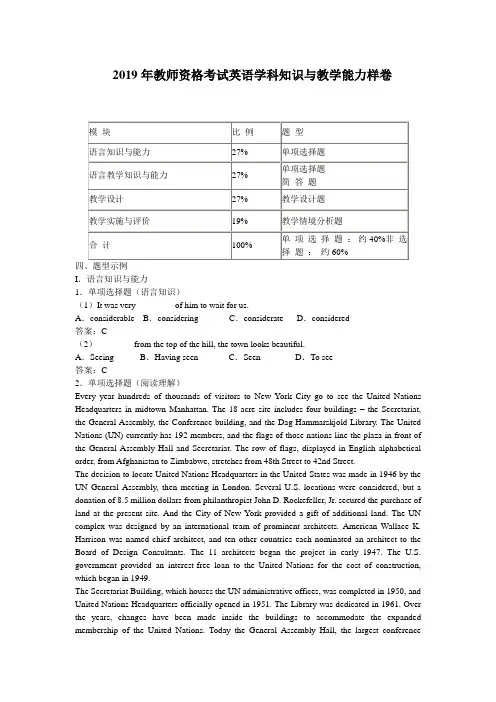
2019下半年年英语教师资格证学科知识与能力模拟试题
2019年英语教师资格证学科知识与能力模拟题4. Being__________ of money, she managed to save enough for a holiday.A. economicB. economicalC. economicsD. economies4.【答案】B。
解析:考查形近词辨析。
economics意为“经济学”,economies意为“经济”,economic意为“经济上的”,economical意为“节俭的,合算的.经济的”。
根据句意“由于节俭,她设法存够了度假的钱”可知选B。
5. Farmers are allowed to grow small gardens of their own and they sell their vegetables__________ the black market.A. onB. atC. inD. for5.【答案】A。
解析:考查介词搭配。
on the market意为“上市,出售中”,句意为“农夫们被允许在自己的菜园耕种.并将蔬菜拿到黑市上去卖”。
6. --I'll be away on a business trip. Would you mind looking after my cat?--Not at all.__________.A. I've no timeB. I'd like itC. I'd rather notD. I'd be happy to6.【答案】D。
解析:考查交际用语。
根据句意,可将此对话翻译为“——我将要出差了,你介意帮我照顾我的猫吗?——一点也不介意,我很乐意”。
故选D。
7. Can you imagine the difficulty I had __________ language obstacles I first studied abroad?A. to overcomeB. overcomingC. overcomeD. overcame7.【答案】B。
中学教师资格认定考试高级英语学科知识与教学能力模拟题2019年(11)_真题(含答案与解析)-交互
中学教师资格认定考试(高级英语学科知识与教学能力)模拟题2019年(11) (总分150, 做题时间120分钟)选择题1.Which of the following do not belong to the same type according to the manner or place of articulation?SSS_SINGLE_SELA/p//b//m/B/θ//3//h/C/g//h//k/D/g////w/该问题分值: 2.4答案:C考查辅音分类。
A项中的3个音都属于双唇音;B项中的3个均为擦音;C项中的/g/与/k/均为爆破音和软腭音,/h/按发音部位分的话,为声门音,按发音方式分的话,为擦音;D项中的3个均为软腭音。
故选C。
2.The pronunciation of the English word "selected" is______.SSS_SINGLE_SELA[sI'lectId]B[sI'lektId]C['sIlektId]D[sI'lekt]该问题分值: 2.4答案:B考查单词select及其过去式的读音。
select的读音为[sI'lekt],变为过去式后读音为[sI'lektId]。
故选B。
3.George took______ of the fine weather to do a day' s work in his garden.SSS_SINGLE_SELAadvantageBprofitCpossessionDcharge该问题分值: 2.4答案:A考查动词短语辨析。
句意为“乔治利用好天气在花园里干了一天的活”。
take advantage of“利用”,take profit“获利”,take possession of“占领,夺取”,take charge of“负责;担任”。
中学教师资格认定考试初级英语学科知识与教学能力模拟题2019年(17)_真题-无答案
中学教师资格认定考试(初级英语学科知识与教学能力)模拟题2019年(17)(总分150,考试时间120分钟)选择题1. Which one below has the proper word stress?A. systeMaticB. SystematicC. systematicD. systemaTic2. Which of the following is the proper pronunciation of "meet you" as a result of assimilation?A. [ma:tju:]B. [mi:tju]C. [mi:tju:]D. [mi:t∫u:]3. —Hi, this way, please. —Ok. I sometimes have no sense of______when I arrive at the crossroad.A. directionB. positionC. situationD. condition4. His experience abroad provides a wider______on the problem.A. privilegeB. perspectiveC. participationD. priority5. A great number of national parks have been set up to______endangered species from extinction.A. conserveB. preserveC. reserveD. observe6. The old man entered the hall,______in hand.A. bookB. a bookC. the bookD. the books7. Only after talking to two students______that having strong motivation is one of the biggest factors in reaching goals.A. I did discoverB. did I discoverC. I discoveredD. discovered I8. Taipei is a city of many faces,______you can experience a typical urban lifestyle and understand the traditional spirit of Chinese culture.A. howB. whenC. whereD. why9. According to Britain linguist F. Palmer, there are no real synonyms. Though "daddy" and "father" are considered synonyms, they are different in______.A. styleB. collocationC. emotive meaningD. regions where they are used10. X: He likes dogs. Y: He likes animals. The relationship of X and Y is that "______".A. X is synonymous with YB. X is inconsistent with YC. X entails YD. X presupposes Y11. Which of the following statements about task-based language teaching is NOT true?A. Students should be given tasks to perform or problems to solve in the classroom.B. Students are task-driven.C. Task-based language teaching is student-centered.D. Task-based language teaching follows the PPP model.12. Which of the following can be adopted as a post-reading activity?A. Guessing word meaning from context.B. Concluding the main idea.C. Clearing up linguistic and cultural barriers.D. Rehearse the reading material.13. A student finds it difficult to learn the English sounds [θ] and . If you are the teacher, which of the following strategies can be used?A. Explaining how to make the sounds.B. Using tongue twisters.C. Writing them on the blackboard.D. Making up sentences.14. In writing, which activity is used to get students to exchange their papers and correct in terms of spelling, grammar point?A. Editing.B. Brainstorming.C. Mapping.D. Drafting.15. Which of the following grammar activities is **municative?A. Asking the students to read and correct the mistakes in the sentences.B. Asking the students to tell the differences between two pictures in groups.C. Asking the students to make sentences with the given words.D. Asking the students to complete the translation exercises.16. When a student said in class, "I come home at 6 o'clock yesterday", the teacher said "Came **e". Which rule of effective feedback does the teacher NOT obey?A. Relevance.B. Accuracy.C. Guidance.D. Timeliness.17. ______is the constant aim of teachers and the uppermost way to improve the quality of teaching in subjects.A. To pursue the maximum of the classroom teachingB. Profound teaching experiencesC. The unique teaching personalityD. Precise classroom teaching evaluation18. When the teacher says " Who wants to have a try?", he/she wants to______.A. control disciplineB. prompt class activityC. evaluate students' workD. draw students' attention to the lesson19. Which of the following types of questions can least elicit students' ideas?A. Display questions.B. Divergent questions.C. Open questions.D. Evaluation questions.20. What is the teacher doing by saying this in terms of instruction? "Now, did the questions help you understand the text better?"A. Observing the activity.B. Evaluating the activity.C. Monitoring the activity.D. Controlling the activity.简答题21. 在口语教学中,教师应如何平衡准确性与流利性(10分)?列举二者常见的活动方式(至少两种),并各举一例进行说明(10分)。
2019下半年全国教师资格统考模拟卷:初中《英语学科知识与教学能力》卷一含答案解析
2019下半年全国教师资格统考模拟卷:初中《英语学科知识与教学能力》卷一一、单项选择题(本大题共30小题,每小题2分,共60分)在每小题列出的四个备选项中选择一个最佳答案,错选、多选或未选均无分。
1.We’ve had a good start,but next,more work needs_____to achieve the final success.A.being doneB.doC.to be doneD.to do2.Don’t worry.The hard work that you do now_____later in life.A.will be repaidB.was being repaidC.has been repaidD.was repaid3.Time,_____correctly,is money in the bank.A.to useedinge4.Bicycling is good exercise;_____,it does not pollute the air.A.neverthelessB.besidesC.otherwiseD.therefore5.Close the door of fear behind you,and you_____the door of faith open before you.A.sawB.have seenC.will seeD.are seeing6.The place we live in is called house in English but房子in Chinese.This shows the______of language.A.arbitrarinessB.dualityC.creativityD.displacement7.In Chinese if someone breaks a bowl or a plate the host or the people present are likely to say sui sui ping an.This language phenomenon reflects the______of language.A.Performative FunctionB.Emotive FunctionC.Phatic FunctionD.Recreational Function8.Both syntax and semantics are the branches of linguistics,the former studies the rules governing the combination of words into sentences,the latter studies_____.A.the form of wordsB.the meaning of languageC.the sound patterns of languageD.the change of language9.A syllable is a part of a word which contains a_____and is pronounced as a unit.A.consonantB.vowelC.phonemeD.pitch10.The most distinguishable linguistic feature of a regional dialect is its_____.A.accente of wordsC.morphemese of structures11.In meaningful practice the focus is on the production,comprehension or exchange of___.A.structuresB.sentencesC.formD.meaning12.PPP and TBL are two approaches to language teaching.PPP stands for presentation,practice and production,and TBL stands for_____.A.Task Book Language standsB.Text Book LearningC.Teacher-Based LearningD.Task-Based Learning13.Hedge discusses five main components of communicative competence.These components include linguistic competence,pragmatic competence,discourse competence,strategic competence,and_____.A.accuracyB.fluencyC.correctnessD.grammaticality14._____does not belong to formative assessment.A.Learner portfolioB.Test resultsC.Classroom observationD.Student diaries15.What is the teacher doing in terms of error correction?“S:I go to the theatre last night.”T:You GO to the theatre last night?A.Correcting the student’s mistake.B.Hinting that there is a mistake.C.Encouraging peer correction.D.Asking the student whether he really went to the theatre.16.When learners come across new words,they are required to focus on_____.A.spellingB.semantic featuresC.form,meaning and useD.word formation17.Which of the following features is not exhibited by the deductive method?A.It saves time.B.It pays more attention to form.C.It teaches grammar in a decontextualized.D.It encourages students to work out the grammatical way rules.18._____may be defined as any kind of engaging with the language on the part of the learners,usually under the teacher supervision,whose primary objective is to consolidate learning.A.PresentationB.PracticeC.ProductionD.Preparation19.The activity of_____may maximize the possibility of eliciting ideas,words or concepts from students when it is focused on a given topic.A.retellingB.assessing outputC.brainstormingprehension20.Which of the following nominating patterns can a teacher adopt to ensure that all students are activity involved in classroom activities?A.Nominating those who are good at English.B.Asking questions in a predicable sequence.C.Nominating students after the question is given.D.Nominating students before giving the question.请阅读Passage1,完成21~25小题。