
《英语语言学》答案完整版(可打印修改)
12. Morpheme 词素 It is a minimal unit of meaning or grammatical function. For example, the word tourists contains three morphemes tour, -ist, and -s. 13. Immediate Constituent 直接成份 It is an approach to describe the regular structures of the language. It is designed to show constituents immediately, directly, below the level of a construction. 14. Syntax 句法;语法 The study of structure and ordering of components within a sentence. 15.semantics 语义学 The study of the meaning of linguistic units, words and sentence in particular. 16. Hyponymy 下义关系,上下位关系 When the meaning of one form is included in the meaning of another, the relationship is described as hyponymy. 17. Homonymy 同音异义 It is used when one word is written and spoken are the same while possessing different meanings. For example, the bank can be referred to a river and financial institution as well. 18.synonymy 同义 It refers to the case that two or more forms have very closely related meanings, which are often, but not always, intersubstitutable in sentence,such as broad and wide. 19. Pragmatics 语用学 The study of what the writer or speaker of those words intended to convey. 20. Synchronic 共时性,历时性 It is the case that we concentrate on variation in language in terms of differences within one language in different places and among different groups at the same time. 第一章 语言的起源 概念辨析 The “bow-wow” theory The “yo-heave-ho” theory 思考 “bow-wow”理论和“哟哦呵”理论的差异何在? The former theory means that primitive words could have been imitations of the natural sounds which early men and women heard around them while‘yo-he-ho’ theory means a set of grunts, groans and curses involved in physical effort 自然声音模仿假说有什么不足之处?
2
Duality 应用
能够根据所观察到的语言现象来解释语言的定义性特征。 能够根据语言的定义性特征来区别人类语言和动物交流系统 思考 人类语言有哪些功能? First, it has the function of cultural transmission. People pass knowledge, skills from one generation to the next only through oral language especially in the old days, Second, it has the function of communication. Human use their language to communicate with each other, socially or emotionally, to indicate their friendliness, cooperation or annoyance and pleasure. Third, it plays an important role in thinking. Language is the instrument of thought and people often feel it necessary to speak their thoughts aloud. 动物交流系统里存在“说谎”吗? It absolutely exists in animal communication system. For example, some animals will pretend to die to avoid being eaten. Therefore,it is common phenomenon in animal for survive or foods. 第五章 语音学 概念辨析 Articulatory/acoustic/auditory phonetics manners of articulation vs. places of articulation Consonants vs. Vowels Whether they are produced with obstruction of the air stream in the mouth. phonetics vs. Phonology Production and characteristics of speech sound vs. How speech sound forms and abstract or mental aspect of it. broad transcription vs. narrow transcription Whether they have allophones 理解 Speech organs The classification and description of consonants The classification and description of vowels 应用 能够识别发声器官图中的发声器官名称 Vocal cords 声带 alveolar 齿龈 palate 上颚 velum 软腭 能够根据发音部位/方式英语辅音进行分类和描述。
On the other hand, soundless and abstract things have not been explained since a language cannot be only a set of words used as‘names’ for entities. 第 3 章 语言的属性 概念辨析 language Design features of language Displacement Arbitrariness
On the one hand, it does not answer our question regarding the origins of the sounds produced because primates have grunts and social calls, but they do not have developed the capacity for speech.
《英语语言学概论》答案完整版
考核方法:闭卷 考试 时间:100 分钟 题型: I. 单项选择(15×1’=15’) II.判断 (15×1’=15’) III.填空(10×1’=10’) IV.术语解释(5×2’ =10’) V.简答题 (4×5’ =20’) VI. 分析题 (30’)
重点掌握的术语: 1. Linguistics 语言学 The study of the nature, structure, and variation of language, including phonetics, phonology, morphology, syntax, semantics and pragmatics. 2. design features 设计特点 They are a series of features which are uniquely a part of human language and unlikely to be found in the communication system of other creatures. They are displacement, productivity, cultural transmission, arbitrariness, discreteness and duality. 3. Displacement 移位 Language can be used to refer to things which are in the past, present or future, real or imagined,or in far-away places. 4. Duality 二元性 It is generally the case that language is organized at two levels or layers which is known as the physical level and meaningful level simultaneously. 5. Arbitrariness 任意性 It is generally the case that there is no ‘natural’ connection between a linguistic form and its meaning. 6ቤተ መጻሕፍቲ ባይዱ Manner of articulation 发音方法 It is the case that we describe the consonant sounds in terms of how they are articulated. 7. Place of articulation 发音部位 It focuses on describing consonant sounds in terms of where they are articulated. 8. articulatory phonetics 发音语言学 The general study of the characteristics of speech sounds is called phonetics. And the study of how speech sounds are made, or ‘articulated’ is articulatory phonetics. 9. Phonology 音系学 The description of the systems and patterns of the speech sounds in a language. 10. Assimilation 同化 It is the process when two phonemes occur in sequence and some aspect of one phoneme is taken or ‘copied’ by the other. For example, the word ‘can’ in the sentence ‘I can go.’may pronounce as [kæŋ] instead of [kæn] because of the influence of the following sound [g]. 11. Back-formation 逆构法,逆序构词 A word of one type is reduced to form another word of different type. For example, the word ‘donation’ first came into use and then the verb ‘donate’ was created from it.
194《英语语言学》答案
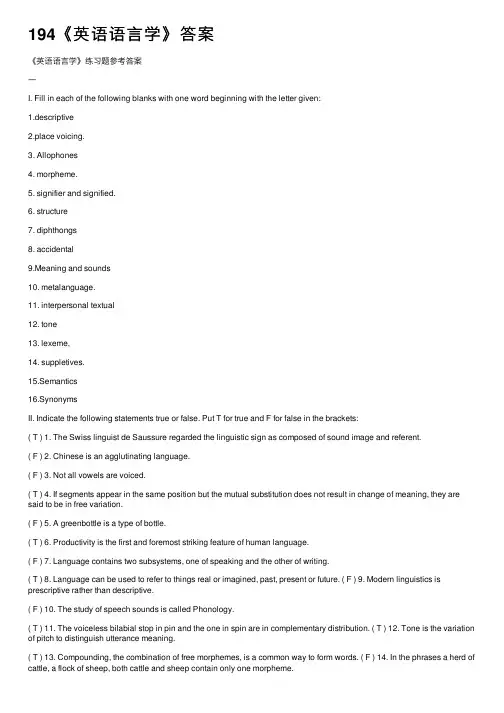
194《英语语⾔学》答案《英语语⾔学》练习题参考答案⼀I. Fill in each of the following blanks with one word beginning with the letter given:1.descriptive2.place voicing.3. Allophones4. morpheme.5. signifier and signified.6. structure7. diphthongs8. accidental9.Meaning and sounds10. metalanguage.11. interpersonal textual12. tone13. lexeme,14. suppletives.15.Semantics16.SynonymsII. Indicate the following statements true or false. Put T for true and F for false in the brackets:( T ) 1. The Swiss linguist de Saussure regarded the linguistic sign as composed of sound image and referent.( F ) 2. Chinese is an agglutinating language.( F ) 3. Not all vowels are voiced.( T ) 4. If segments appear in the same position but the mutual substitution does not result in change of meaning, they are said to be in free variation.( F ) 5. A greenbottle is a type of bottle.( T ) 6. Productivity is the first and foremost striking feature of human language.( F ) 7. Language contains two subsystems, one of speaking and the other of writing.( T ) 8. Language can be used to refer to things real or imagined, past, present or future. ( F ) 9. Modern linguistics is prescriptive rather than descriptive.( F ) 10. The study of speech sounds is called Phonology.( T ) 11. The voiceless bilabial stop in pin and the one in spin are in complementary distribution. ( T ) 12. Tone is the variation of pitch to distinguish utterance meaning.( T ) 13. Compounding, the combination of free morphemes, is a common way to form words. ( F ) 14. In the phrases a herd of cattle, a flock of sheep, both cattle and sheep contain only one morpheme.( F ) 15. The meaning of compounds is always the sum of meaning of the compounds.III. Multiple Choice1.C2.D3.A4.B5.D6.A7.D8.B9.AIV. For each group of sounds listed below, state the phonetic feature(s) then share: Example: [s] [f] [p] [h] voiceless1)[g] [z] [d]2)[v] [h] [s]3)[m] [p] [b] [f] [v]4)[t] [d] [n] [l] [s] [z]5)[i:] [i] [u] [u:]1.voiced2. fricative3. labial4. alveolar5. high, vowelV. Transcribe the sound represented by the underlined letter(s) in the words and then describe it.Example: heat [i:] vowel front higha)photob)writec)card)actore)cityf)cityg)worryh)yesa)[f] voiceless labiodental fricativeb)[r] alveolar retroflex liquidc)[a:] low back voweld) [k] voiceless velar stope)[i] lax high front vowelf)[s] voiceless alveolar fricativeg)[w] labiovelar glideh) [j] palatal glideVI. Write the phonetic symbol that corresponds to the articulatory description.Example: vowel front high [i:]1bilabial nasal [m]2voiced labiovelar glide [w]3literal liquid [l]4voiced bilabial stop [b]5front high lax [i]VII. Pronounce the words key and core, ski and score, paying attention to the phoneme /k/. What difference do you notice between the first pair and the second pair in terms of the phonetic features of the voiceless velar stop?In pronouncing key, the voiceless velar stop is palatalized. In key and core, the stop is aspirated. In ski, the stop is also palatalized. In ski and score, the stop is unspirated. VIII. Consider the following words and answer the questions below:a)fingerb)disgracefulc)stepsisterd)psycholinguisticse)antidisestablishmentarianismi.Tell the number of morphemes in each word.ii.Underline the free morphemes in each word where possible to do so.i) a) one b) three c) two d) four e) sevenii)f)g)disgracefulh)stepsisteri)j)antidisestablishmentarianisIX. Identify the difference between a greenhouse and a green house, and the difference betweena sleeping car and a sleeping baby.1) a greenhouse, the stress is on green; a green house, the stress is on house.Greenhouse is a compound word; green house is a noun phrase.A greenhouse refers to a building with sides and roof of glass, used for growing plantsthat need protection from the weather, while a green house refers to a house whose color is green.2) a sleeping car, the stress is on sleeping; a sleeping boy, the stress is on boy.A sleeping car means a car in which one can sleep. A sleeping boy means a boy who is sleeping. X. Define the following term, giving examples for illustration:AllophoneAllophones are actual realizations of a phoneme in different phonetic contexts. For example, the [l], the dark [] in deal, and the voiceless [] in slight are the realizations of the phoneme /l/. [] appears after vowels, [] after voiceless consonants, and [l] elsewhere. The relation between the phoneme and its allophones can be shown in the following figure:XI. Draw tree diagrams for the following two sentences:1. A clever magician fooled the audience.2.The tower on the hill collapsed in the wind.3.They can fish.4.Pat found a book on Wall Street.5.I saw the man with a telescope.XII. Explain the ambiguity of the following sentences.a.This is a beautiful girl’s dress.b.Those who went there quickly made a fortune.c. A woman murderera. This is a dress for beautiful girls.This is a beautiful dress for girls.b. Those who quickly went there made a fortune.Those who went there made a fortune quickly.c. A female murderer A murderer who has murdered a womanXIII. Tell the process of word formation illustrated by the example and find as many words as you can that are formed in the same way.(1)flu(2)OPEC(3)Nobel(4)televise(5)better (v.)1. clipping2. acronyming3. eponyming4. back formation5. conversionXIV. How would you read the phrases in the two columns? What does each of them mean?Column I Column IIa. The White House a white houseb. a redcoat a red coatc. a bluebird a blue birdd. a lighthouse keeper a light housekeepera) The Whit House is a proper noun, which is the estate of the American government. Awhite house refers to a house which is painted white.b) A redcoat refers to a British soldier who is in red coat. A red coat means a coat whosecolor is red.c. A bluebird refers to a kind of bird. A blue bird means a bird whose feathers areblue.d. A lighthouse keeper refers a keeper who keeps lighthouse. A light housekeeper meansa housekeeper who is light.XV. Explain the relation between bank1(the side of a river) and bank2(the financial institute). The relation between bank1 and bank2 is homonymy. They are two words which have the same sound and spelling but different meanings.XVI. Identify the type of transitivity process in each of the following sentences.(1)John washed the car.(2)John likes the car.1. material2. mentalXVII.(答案略)⼆I.Indicate the following statements true or false. Put T for true and F for false in the brackets:( T ) 1. Pragmatics is concerned with speaker meaning.( F ) 2. The reference of a deixis to a preceding expression is technically termed cataphoric reference.II. Multiple Choice1.___ A _____ .2.___ B ___ .3. ___ C ___ .4. ___ B ___ .5. __ C ___ .6.___ A ___ .III. Tell the semantic relation within the given sentence and that between the two sentences.a)My uncle is male.b)The spinster is married.c)Jim is an orphan. Jim lives with his parents.d)Sam is the husband of Sally. Sally is the wife of Sam.e)He has gone to London. He has gone to England.a. tautologyb. contradictionc. inconsistencyd. entailmente. presupposition IV. Data Analysis:1.What is the illocution of A’s utterance in the following brief encounter?A: You are in a non-smoking zone, sir.B: Thanks (extinguishing the cigarette).2.What kind of pre-sequence is A’s first utterance? (Hint: A and B are two secretaries workingin the same office.)A: Are you going to be here long?B: You can go if you like.A: I’ll just be outside. Call me if you need me.B: OK.1. A wants to stop B from smoking there.2. Pre-requestV. Try to think of contexts in which the following sentences can be used for other purposes than just stating facts: 1. The room is messy.2. It would be good if she had a green skirt on1. A mild criticism of someone who should have cleaned the room.2. A request to someone to tidy up the circumstances.VI. Define the following term, giving examples for illustration:VarietyThe term variety is the label given to the form of a language used by any group of speakers or used in a particular field. A variety is characterized by the basic lexicon, phonology, syntax shared by members of the group. Varieties of a language are of four types: the standard variety, regional (geographical) dialects, sociolects (social dialects) and registers (functional varieties).VII. Give examples to illustrate gradable antonyms, complementary antonyms, and reversalantonyms.Gradable antonyms are pairs of words opposite to each other, but the positive of one word does not necessarily imply the negative of the other, or vice versa. A person who is not rich is not necessarily poor. Complementary antonyms are words opposite to each other and the positive of one implies the negative of the other. Dead/alive, male/female, pass/fail, etc. are complementary antonyms. Reversal antonyms are words that denote the same relation or process from one or the other direction. Push/pull, come/go, ascend/descend, buy/sell, up/down in/out, employer/employee, husband/wife, are all reversal antonyms.VIII. Answer the following questions(答案略)。
(完整word版)英语语言学试题(1)及答案

英语语言学试题(1)I. Directions: Read each of the following statements carefully. Decide which one of the four choices best completes the statement and put the letter A, B, C or D in the brackets. (2%×10=20%)1、As modern linguistics aims to describe and analyze the language people actually use, and not to lay down rules for "correct" linguistic behavior, it is said to be ___.A、prescriptiveB、sociolinguisticC、descriptiveD、psycholinguistic2、Of all the speech organs, the ___ is/are the most flexible.A、mouthB、lipsC、tongueD、vocal cords3、The morpheme "vision" in the common word "television" is a(n) ___.A、bound morphemeB、bound formC、inflectional morphemeD、free morpheme4、A ___ in the embedded clause refers to the introductory word that introduces the embedded clause.A、coordinatorB、particleC、prepositionD、subordinator5、"Can I borrow your bike?" _____ "You have a bike."A、is synonymous withB、is inconsistent withC、entailsD、presupposes6、The branch of linguistics that studies how context influences the way speakers interpret sentences is called ___.A、semanticsB、pragmaticsC、sociolinguisticsD、psycholinguistics7、Grammatical changes may be explained, in part, as analogic changes, which are ___ or generalization.A、elaborationB、simplificationC、external borrowingD、internal borrowing8、___ refers to a marginal language of few lexical items and straightforward grammatical rules, used as a medium of communication.A、Lingua francaB、CreoleC、PidginD、Standard language9、Psychologists, neurologists and linguists have concluded that, in addition to the motor area which is responsible for physical articulation of utterances, three areas of the left brain are vital to language, namely, ___ .A、Broca's area, Wernicke's area and the angular gyrusB、Broca's area, Wernicke's area and cerebral cortexC、Broca's area, Wernicke's area and neuronsD、Broca's area, Wernicke's area and Exner's area10、According to Krashen, ___ refers to the gradual and subconscious development of ability in the first language by using it naturally in daily communicative situations.A、learningB、competenceC、performanceD、acquisitionII. Directions: Fill in the blank in each of the following statements with one word, the first letter of which is already given as a clue. Note that you are to fill in One word only, and you are not allowed to change the letter given. (1%×10=10%)11、Chomsky defines "competence" as the ideal user's k_______ of the rules of his language.12、The four sounds /p/,/b/,/m/ and /w/have one feature in common, i.e, they are all b______ .13、M_______ is a branch of grammar which studies the internal structure of words and the rules by which words are formed.14、A s______ is a structurally independent unit that usually comprises a number of words to form a complete statement, question or command.15、Synonyms that are mutually substitutable under all circumstances are called c______ synonyms.16、The illocutionary point of r_____ is to commit the speaker to something's being the case, to the truth of what has been said.17、Words are created outright to fit some purpose. Such a method of enlarging the vocabulary is known as word c______.18、Wherever the standard language can use a contraction (he+is→he's), Black English can d___ the form of "be".19、The basic essentials of the first language are acquired in the short period from about age two to puberty, which is called the c______period for first language acquisition.20、As a type of linguistic system in 12 learning, I ______is a product of L2 training, mother tongue intereference, overgeneralization of the target language rules, and learning and communicative strategies of the learner.III. Directions: Judge whether each of the following statements is true or false. Put a T for true or F for false in the brackets in front of each statement. If you think a statement is false, you must explain why you thin k so and give the correct version. (2%×10=20%)( )21、In modern linguistic studies, the written form of language is given more emphasis than the spoken form for a number of reasons.( )22、Voicing is a phonological feature that distinguishes meaning in both Chinese and English. ( )23、The compound word "bookstore" is the place where books are sold. This indicates that the meaning of a compound is the sum total of the meanings of its components.( )24、Syntactic categories refer to sentences (S) and clauses (C) only.( )25、Dialectal synonyms can often be found in different regional dialects such as British English and American English but cannot be found within the variety itself, for example, within British English or American English.( )26、Only when a maxim under Cooperative Principle is blatantly violated and the hearer knows that it is being violated do conversational implicatures arise.( )27、The territory in which the Indo-European languages are mainly spoken today also includes languages that are not Indo-European.( )28、In most bilingual communities, two languages have the same in speech situations known as domains.( )29、According to the strong version of the Sapir-Whorf hypothesis, speakers' perceptions determine language and pattern their way of life.( )30、All normal children have equal ability to acquire their first language.IV. Directions: Explain the following terms, using one or two examples for illustration. (3%×10=30%)31、duality32、diachronic linguistics33、broad transcription34、morphological rules35、phrase structure rule36、relational opposites37、componential analysis38、context39、euphemism40、brain lateralizationV. Answer the following questions. (10%×2=20%)41、Explain how the inventory of sounds can change, giving some examples in English for illustration.42、Briefly discuss the individual factors which affect the acquisition of a second language.语言学试题(1)参考答案一、单项选择题(本大题共10小题,每小题2分,共20分)1、C2、C3、D4、D5、D6、B7、B8、C9、A 10、D二、填空题(本大题共10小题,每小题1分,共10分)11、knowledge12、bilabial13、morphology14、sentence15、complete16、representatives17、coinage18、delete19、critical20、interlanguage三、判断改错题(本大题共10小题,每小题2分,共20分)21、FActually modern linguistics lays more emphasis on the spoken form of language than the written form for a number of reasons.22、FVoicing distinguishes meaning in English but not in Chinese.23、FThe meaning of some compound words has nothing to do with the sum total of the meanings of their components, such as the compound "redcoat".24、FApart from S and C, they also refer to a word, or a phrase that performs a particular grammatical function.25、FDialectal synonyms can often be found not only in different regional dialects such as British English and American English but also within the variety itself. For example, within British English, "girl" is called "lassie" in Scottish dialect, and "liquor" is called "whishey" in Irish dialect.26、T27、T28、FThey have a fairly clear fairly clear functional differentiation, i.e. one language may be used in some domains, other language in other domains.29、FThe true statement is "According to the strong version of the Sapir-Whorf hypothesis, language determines speakers' perceptions and patterns their way of life"30、T四、名词解释题(本大题共10小题,每小题3分,共30分)31、One of the major defining features of human language. Human language consists of two levels. At the lower level, there are a limited number of sounds which are meaningless while at the higher level there are an unlimited number of combinations of these sounds. It is also known as double articulation.32、Linguistics that studies language over a period of time, also known as historical linguistics,e.g.the study of the Chinese language since the end of the Qing dynasty up to the present.33、A way to transcribe speech sounds. The basic principle is to use one letter to indicate one sound. It is generally used in dictionaries and language teaching textbooks.34、The rules that govern which affix can be added to what type of stem to form a new word, e.g.-ly can be added to a noun to form an adjective.35、a rewrite rule that allows for the possible combinations of words to form phrases and sentences36、Relational opposites, a kind of antonyms, refer to pairs of words that exhibit the reversal of a relationship between the two items. For example, "husband" and "wife", "father" and "son" etc. 37、Componential analysis is a way proposed by the structural semanticists to analyze word meaning. The approach is based upon the belief that the meaning of a word can be dissected into meaning components, called semantic features. For example, the word "man" is analyzed as comprising of +HUMAN,+ADULT,+ANIMATE,+MALE.38、Context is regarded as constituted by all kinds of knowledge assumed to be shared by the speaker and the hearer, For example, the knowledge of the language used and the knowledge of the world, including the general knowledge about the world and the specific knowledge about the situation in which linguistic communication is taking place.39、A euphemism is a mild, indirect or less offensive word or expression that replaces a taboo word or serves to avoid more direct wording that might be harsh, unpleasantly direct, or offensive, e.g. "pass away" for "die".40、Brain lateralization refers to the localization of cognitive and perceptual functions in a particular hemisphere of the brain. For example, the right hemisphere processes stimuli more holistically and the left hemisphere more analytically. In most people, the left hemisphere has primary responsibility for language, while the right hemisphere controls visual and spatial skills.五、论述题(本大题共2小题,每小题10分,共20分)41、The inventory of sounds can change, and sound changes include changes in vowel sounds, sound loss, sound addition, and sound movement.1) Vowel sound change: English has undergone the systematic and regular change in the vowel sounds, known as the Great Vowel shift which occurred at the end of the Middle English period and which involved seven long, or tense vowels. These changes led to one of the major discrepancies between the phonemic representations of words and morphemes, i.e. between pronunciation and the spelling system of Modern English, e.g.five→/fi:v/(Middle English)→/faiv/(Modern English) 2) Sound loss: Sounds can change by the loss of phonemes. In the history of English the velar fricative /x/ was lost. This sound existed in Old English, so "night" was pronounced as /nixt/, but in Modern English, its pronunciation is /nait/.3) Sound addition: Sound addition includes the gain or insertion of a sound. For example, the word leisure was borrowed from French, so the phoneme /3/ was added to the inventory of English sounds. A change that involves the insertion of a consonant or vowel sound to the middle of a word is known as epenthesis, e.g.spinle--spindle.4) Sound movement: Sound change as a result of sound movement known as metathesis involves a reversal in position of two adjoining sound segments. Metathesis is less common, but it does exist. In some dialects of English, for example, the word ask is pronounced /? ks/. Also, bridd ("bird") is an Old English word. When metathesis occurred to this word, the movement of /r/ sound to the right of the vowel sound resulted in its Modern English counterpart "bird".评分标准:满分为10分,总论及四小点各占2分。
英语语言学课后答案
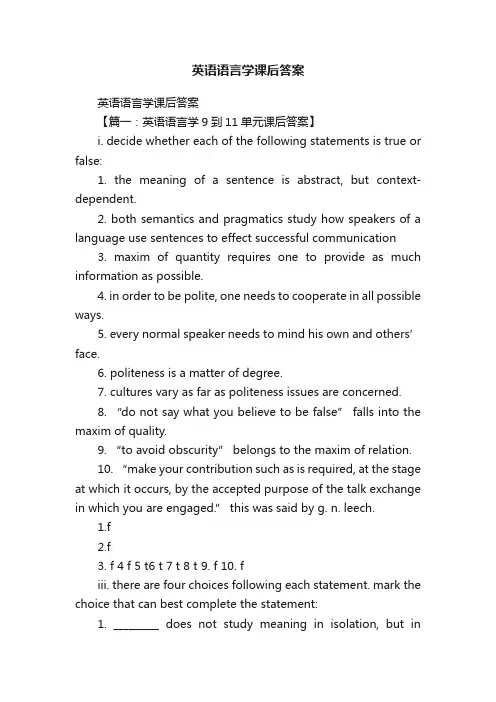
英语语言学课后答案英语语言学课后答案【篇一:英语语言学9到11单元课后答案】i. decide whether each of the following statements is true or false:1. the meaning of a sentence is abstract, but context-dependent.2. both semantics and pragmatics study how speakers of a language use sentences to effect successful communication3. maxim of quantity requires one to provide as much information as possible.4. in order to be polite, one needs to cooperate in all possible ways.5. every normal speaker needs to mind his own and others’ face.6. politeness is a matter of degree.7. cultures vary as far as politeness issues are concerned.8. “do not say what you believe to be false” falls into the maxim of quality.9. “to avoid obscurity” belongs to the maxim of relation.10. “make your contribution such as is required, at the stage at which it occurs, by the accepted purpose of the talk exchange in which you are engaged.” this was said by g. n. leech.1.f2.f3. f 4 f 5 t6 t 7 t 8 t 9. f 10. fiii. there are four choices following each statement. mark the choice that can best complete the statement:1. _________ does not study meaning in isolation, but incontext. a. pragmaticsb. semantics c. sense relationd. concept2. which of the following is true?a. utterances usually do not take the form of sentences.b. some utterances cannot be restored to complete sentences.c. no utterances can take the form of sentences.d. all utterances can be restored to complete sentences.3. __________ is advanced by paul grice a. cooperative principle b. politeness principlec. the general principle of universal grammard. adjacency principle4. when any of the maxims under the cooperative principle is flouted, _______ might arise.a. impolitenessb. contradictionsc. mutual understandingd. conversational implicatures5. which of the following utterances below is performative?a. i command you to put out that cigarette.b. i warned you not to go.c. put your toys awayd. i envy you1. a2. b3. a4. d5. aunit 10 the varieties of english (i)i. decide whether each of the following statements is true or false:1. language as a means of social communication is a homogeneous system with a homogeneous group of speakers.2. the kind of name or term speakers use to call or refer to someone may indicate something of their social relationship to or personal feelings about that individual.3. language use varies from one speech community to another, from one regional group to another, from one social group toanother, and even from one individual to another.4. the goal of sociolinguistics is to explore the nature of language variation and language use among a variety of speech communities and in different social situations.5. the linguistic markers that characterize individual social groups may serve as social markers of group membership.6. the use of euphemisms has the effect of removing derogatory overtones and the disassociative effect as such is usuallylong-lasting.7. sociolinguistics is the sub-discipline of linguistics that studies social contexts.8. two speakers of the same language or dialect use their language or dialect in the same way.9. geographical barriers are the only source of regional variation of language.10. a person’s social back grounds do not exert a shaping influence on his choice of linguistic features1. f2.t3.t4.t5. f6.f7.f8.f9.f10. fiii. there are four given choices for each statement below. mark the choice that can best complete the statement:1. the meaning of language was considered as something_______ in traditional semantics.a. contextualb. behaviouristicc. intrinsicd. logical2. _______ are language varieties appropriate for use in particular speech situation.a. slangb. address termsc. registersd. education varieties3. ________ is speech variation according to the particular area where a speaker comes from.a. regional variationb. language variationc. social variationd. register variationbackgrounds.a. lingua francab. registerc. creoled. national language5. although _______ are simplified languages with reduced grammatical features, they are rule-governed, like any human language.a. vernacular languagesb. creolesc. pidginsd. sociolects6. probably the most widespread and familiar ethnic variety of the english language is _______.a. british englishb. american englishc. black englishd. australian english7. in normal situations, ____ speakers tend to use more prestigious forms than their ____ counterparts with the same socialbackground.a. female; maleb. male; femalec. old; youngd. young; old8. _______ is concerned with the social significance of language variation and language use in different speech communities.a. psycholinguisticsb. sociolinguisticsc. historical linguisticsd.general linguistics9. _______ in a person’s speech, or writing, usually ranges ona continuum from casual to formal according to the typeof communicative context.a. regional variationb. social variationc. stylistic variationd. idiolectal variation10. _________ means that certain authorities, such as the government, choose a particular speech variety, standardize it and spread the use of it across regional boundaries.a. language interferenceb. language changesc. language planningd. language transfer1. c2. c3.a4.a5. c6.c7.a8.b 9d10.cunit 11 the varieties of english (ii)i. decide whether each of the following statements is true or false:1. in the most bilingual communities, two languages have the same in speech situations known as domains.2. a regional variety of a language is intrinsically inferior to the standard variety of that language.3. the standardization of a particular dialect in relation to one or more vernaculars is the result of a deliberate government policy.4. a pidgin is not a native language of a particular region.5. when a bilingual speaker switches between the two languages concerned, he is converting one mode of thinking into the other.6. the most distinguishable linguistic feature of a regional dialect is its grammar and uses of vocabulary7. the standard language is a better language than nonstandard languages.8. a lingua franca can only be used within a particular country for communication among groups of people with different linguistic backgrounds.9. a pidgin usually reflects the influence of the higher, or dominant, language in its lexicon and that of the lower language in their phonology and occasionally syntax.10. african-american vernacular english is an inferior dialect of english.11. pidgin english no longer exists today.12. some people speak a creole as their mother tongue.13. british english and american english are identical in grammar but different in vocabulary.l.f 2.f3.f4.t5.f6.f7.f8.f9.t 10.f 11. f 12. t. 13. fiii. there are four choices following each statement. mark the choice that can best complete the statement:1. _______ are the major source of regional variation of language.a. geographical barriersb. loyalty to and confidence in one’s native speechc. physical discomfort and psychological resistance to changed. social barriers2. a linguistic ____ refers to a word or expression that is prohibited by the polite society from general use. a. slangb. euphemismc. jargond. taboo3. _______ is not a typical example of official bilingualism.a. canadab. finlandc. belgiumd. germany4. in a speech community people have something in common _______ --a language or a particular variety of language and rules for using it.a. sociallyb. linguisticallyc. culturally d. pragmatically5. _______ is defined as any regionally or socially definable human group identified by shared linguistic system.a. a speech community b. a race c. a society d.a country6. the most recognizable differences between american english and british english are in _______ and vocabulary.a. diglossiab. bilingualismc. pidginizationd. blending7. _______ is a causal use of language that consists of expressive but nonstandard vocabulary, typically of arbitrary, flashy and often ephemeral coinages and figures of speech.a. language taboo b. slangc. address terms d. register variety iii. there are four choices following each statement. mark the choice that can best complete the statement:1. _______ are the major source of regional variation oflanguage.a. geographical barriersb. loyalty to and confidence in one’s native speechc. physical discomfort and psychological resistance to changed. social barriers2. a linguistic ____ refers to a word or expression that is prohibited by the polite society from general use. a. slangb. euphemismc. jargond. taboo3. _______ is not a typical example of official bilingualism.a. canada b. finland c. belgium d. germany4. in a speech community people have something in common _______ --a language or a particular variety of language and rules for using it.a. sociallyb. linguisticallyc. culturally d. pragmatically5. _______ is defined as any regionally or socially definable human group identified by shared linguistic system.a. a speech community b. a race c. a society d.a country6. the most recognizable differences between american english and british english are in _______ and vocabulary.a. diglossiab. bilingualismc. pidginizationd. blending7. _______ is a causal use of language that consists of expressive but nonstandard vocabulary, typically of arbitrary, flashy and often ephemeral coinages and figures of speech.a. language taboo b. slangc. address terms d. register variety 【篇二:《新编简明英语语言学教程》第二版课后习题答案 chapter 8】ty1. how is language related to society?答:there are many indications of the inter-relationship between language and society. one of them is that while language is principally used to communicate meaning, it is also used to establish and maintain social relationships. this social function of language is embodied in the use of such utterances as “good morning!”, “hi!”, “hows your family?”, “nice day today, isnt it?”. another indication is that use rs of the same language in a sense all speak differently. the kind of language each of them chooses to use is in part determined by his social background. and language, in its turn, reveals information about its speaker. when we speak, we cannot avoid giving clues to our listeners about ourselves.then to some extent, language, especially the structure of its lexicon, reflects both the physical and the social environments of a society. for example while there is only one word in english for “snow”, there a re several in eskimo. this is a reflection of the need for the eskimos to make distinctions between various kinds of snow in their snowy living environment.as a social phenomenon language is closely related to the structure of the society in which it is used, and the evaluation of a linguistic form is entirely social. to a linguist, all language forms and accents are equally good as far as they can fulfill the communicative functions they are expected to fulfill. therefore, judgments concerning the correctness and purity of linguistic varieties are social rather than linguistic. a case in point is the use of the postvocalic [r]. while in english accents withoutpostvocalic [r] are considered to be more correct than accents with it, in new york city, accents with postvocalic [r] enjoys more prestige and are considered more correct than without it.2. explain with an example that the evaluation of language is social rather than linguistic.答:the evaluation of language is social rather than linguistic. this is because every language or language variety can express all ideas that its native speakers want to express. that is to say, language and language variety are equal in expressing meaning. for example, the much-prejudiced black english can be used by the black people to communicate with each other without feeling any hindrance. but many other people think black english is not pure english because it does not conform to their grammar and not adopted by educated people. as a result, many people feel shameful to use black english. from this example we can know that the evaluation of language is social, not linguistic.3. what are the main social dialects discussed in this chapter? how do they jointly determine idiolect?答:the main social dialects discussed in this chapter are regional dialect, sociolect, gender and age. idiolect is a personal dialect, of an individual speaker that combines elements regarding regional, social, gender, and age variations. these factors jointly determine the way he/she talks. while the language system provides all its users with the same set of potentials, the realization of these potentials is individualizedby a number of social factors, resulting in idiolects.4. in what sense is the standard dialect a special variety of language?答: first of all, the standard dialect is based on a selectedvariety of the language, usually it is the local speech of an area which is considered the nations political and commercial center. forexample, standard english developed out of the englishdialects used in and around london as they were modified overthe centuries by speakers in the court, by scholars from universities and writers. gradually the english used by the upper classes in the capital city diverged markedly from the english used by other social groups and came to be regarded as the model for all those who wished to speak and write well. second, the standard dialect is not dialect a child acquires naturally like his regional dialect. it is a superimposed variety; it is a variety imposed from above over the range of regional dialects. some government agency writes grammar books and dictionaries to ?fix? this variety and everyone agrees on what is correct usage of the language. so it has a widely accepted codified grammar and vocabulary. once codification takes place, it is necessary for an ambitious citizen to learn to use the correct language and to avoid ?incorrect? language. therefore, the standard dialect is the variety which is taught and learnt in schools.then the standard dialect has some special functions. also designated as the official or national language of a country, the standard dialect is used for such official purposes as government documents, education, news reporting; it is the language used on any formal occasions.5. what is register as used by halliday? illustrate it with an example of your own.答:according to halliday, “language varies as its function varies; it differs in different situations.” the type of languagewhich is selected as appropriate to the type of situation is a register. halliday further distinguishes three social variables that determine the register: field of discourse, tenor of discourse, and mode of discourse.for example, a lecture on linguistics could be identified asfield: scientific (linguistic)tenor: teacher — students (formal, polite)mode: oral (academic lecturing)6. what linguistic features of black english do you know? do you think black english is an illogical and inferior variety of english? why (not)?答: (1) a prominent phonological feature of black english is the simplification of consonant clusters at the end of a word. according to this consonant deletion rule, the final-position consonants are often deleted; thus “passed” is pronounced [pa:s], mend [men], desk [des], and told[t??l].a syntactic feature of black english that has often been cited to show its illogicality is the deletion of the link verb “be”. in black english we frequently come across sentences without the copula verb: “they mine”,“you crazy”, “her hands cold”, and “that house big”. in fact, copula verb deletion is not a unique feature of black english; it is also found in some other dialects of english and in languages like russian and chinese. another syntactic feature of black english that has been the target of attack is the use of double negation constructions,e.g.(8 — 2) he dont know nothing. (he doesnt know anything.)(8 — 3) i aint afraid of no ghosts. (im not afraid of ghosts.)some people consider these sentences illogical because they claim that two negatives make a positive. but in fact such double negative constructions were found in all dialects of english of the earlier periods.(2) (略)7. what peculiar features docs pidgin have?答: pidgins arose from a blending of several languages such as chinese dialects and english, african dialects and french, african dialects and portuguese. usually a european language serves as the basis of the pidgin in the sense that some of its grammar and vocabulary is derived from the european language used by traders and missionaries in order to communicate with peoples whose languages they did not know.pidgins typically have a limited vocabulary and a very reduced grammatical structure characterized by the loss of inflections, ge nder end case, the “simplified” variety performs its functions as trading and employment.8. how do bilingualism and diglossia differ, and what do they have in common?答: bilingualism refers to the situation that in some speech communities, two languages are used side by side with each having a different role to play; and language switching occurs when the situation changes. but instead of two different languages, in a diglossic situation two varieties of a language exist side by side throughout the community, with each having a definite role to play.the two languages of bilingualism and the two varieties of diglossia each has different role to play as situation changes.【篇三:《新编简明英语语言学教程》第二版课后习题答案 chapter 7】> 1. the vocabulary of english consists of native and also thousands of borrowed words. look up the following words in a dictionary which provides the etymologies (history) of words. in each case speculate as to how the particular word came to be borrowed from a particular language.a. size b. skillc. royald. ranche. robotf. potatog. astronauth. emeraldi. pagodaj. khakik. bulldoze1. hoodlum答:a. size ( old french)b. skill ( old norse)c. royal ( old french latin)d. ranch ( spanish french)e. robot ( czech old church slavonic)f. potato ( spanish taino)g. astronaut ( french)h. emerald ( middle english old french)i. pagoda ( persian sanskrit)j. khaki ( hindi persian)k. bulldoze ( bull(botany bay slang) old english)l. hoodlum ( german)2. the encyclopedia britannica yearbook has usually published a new word list, which is, in the britannica’s editors view, a list of those words that had entered the language during the year. would you expect a yearbook to publish a “lost-word list” reco rding the words dropped from the language during the year? defend your answer.答:(略)3. below is a passage from shakespeares hamlet,king: where is pelonius?hamlet: in heaven, send thither to see.if your messenger find him not there, seek him i theother place yourself. but indeed, if you find him notwithin this month, you shall nose him as you go up thestairs into the lobby.act iv, scene iiistudy these lines and identify every difference in expression between elizabethan and modern english that is evident.答:in modern english, these lines are more likely written as: king: where is pelonius?hamlet: in heaven, send to see there. if your messengercannot find him there, yourself seek him at the other place. but indeed, if you cannot find him within this month, you shall notice him as you go up the stairs into the lobby.4. comment with examples on the following statement “words and expressions will be forced intouse in spite of a ll the exertions of all the writers in the world.”答: the statement means that when necessary, people will make use of available uses even if there is no writers efforts.for example, there are more and more new words and expressions which are introduced into language not by writers, e.g., email, hacker, ibm (international big mouth, means a person who acts like a gossip.)5. suppose you are outside a government office where doors still bear the notice, “this door must not be left in an open position.” now t ry to explain the notice in simple and plain english. 答:“keep the door dote. ” or “the door must be kept close.”6. give at least two examples showing the influence ofamerican english on british english. 答:(略)7. find in any books, newspapers, or journals newly coined words in association with social and political needs, internet or computer language.答:for example: sars, golden week, euro, e-mail, bi-media(双媒体的), cybernaut计算机(网络)漫游者, dvd, eyephone(视像耳机), etc.8. with examples, give some plausible explanations for linguistic change.答:(略)。
(完整版)英语语言学习题与答案

Chapter 1 Introductions to LinguisticsI. Choose the best answer. (20%)1. Language is a system of arbitrary vocal symbols used for human__________A. contactB. communicationC. relationD. community2. Which of the following words is entirely arbitrary?A. treeB. typewriterC. crashD. bang3. The function of the sentence “Water boils at 100 degrees Centigrade.”is__________.A. interrogativeB. directiveC. informativeD. performative4. In Chinese when someone breaks a bowl or a plate the host or the people present are likely to say“碎碎(岁岁)平安”as a means of controlling the forces which they believes feel might affect their lives. Which functions does it perform?A. InterpersonalB. EmotiveC. PerformativeD. Recreational5. Which of the following property of language enables language users to overcome the barriers caused by time and place, due to this feature of language, speakers of a language are free to talk about anything in any situation?A. TransferabilityB. DualityC. DisplacementD. Arbitrariness6. Study the following dialogue. What function does it play according to the functions of language?—A nice day, isn't it?—Right! I really enjoy the sunlight.A. EmotiveB. PhaticC. PerformativeD. Interpersonal7. __________ refers to the actual realization of the ideal language user's knowledge of the rulesof his language in utterances.A. PerformanceB. CompetenceC. LangueD. Parole8. When a dog is barking, you assume it is barking for something or at someone that exists hear and now. It couldn't be sorrowful for some lost love or lost bone. This indicates the designfeature of __________.A. cultural transmissionB. productivityC. displacementD. duality9. __________ answers such questions as how we as infants acquire our first language.A. PsycholinguisticsB.Anthropological linguisticsC. SociolinguisticsD. Applied linguistics10. __________ deals with language application to other fields, particularly education.A. Linguistic theoryB. Practical linguisticsC. Applied linguisticsD. Comparative linguisticsII. Decide whether the following statements are true or false. (10%)11. Language is a means of verbal communication. Therefore, the communication way usedby the deaf-mute is not language.12. Language change is universal, ongoing and arbitrary.13. Speaking is the quickest and most efficient way of the human communication systems.14. Language is written because writing is the primary medium for all languages.anyof details the means which language, acquire to ability the with born all were We 15.language system can be genetically transmitted.16. Only human beings are able to communicate.17. F. de Saussure, who made the distinction between langue and parole in the early 20th century, was a French linguist.18. A study of the features of the English used in Shakespeare's time is an example of the diachronic study of language.19. Speech and writing came into being at much the same time in human history.20. All the languages in the world today have both spoken and written forms.III. Fill in the blanks. (10%)21. Language, broadly speaking, is a means of __________ communication.22. In any language words can be used in new ways to mean new things and can be combined into innumerable sentences based on limited rules. This feature is usually termed__________.23. Language has many functions. We can use language to talk about itself. This function is __________.24. Theory that primitive man made involuntary vocal noises while performing heavy work has been called the __________ theory.25. Linguistics is the __________ study of language.26. Modern linguistics is __________ in the sense that the linguist tries to discover what language is rather than lay down some rules for people to observe.27. One general principle of linguistic analysis is the primacy of __________ over writing.28. The description of a language as it changes through time is a __________ study.29. Saussure put forward two important concepts. __________ refers to the abstract linguistic system shared by all members of a speech community.30. Linguistic potential is similar to Saussure's langue and Chomsky's __________.IV. Explain the following terms, using examples. (20%)31. Design feature32. Displacement33. Competence34. Synchronic linguisticsV. Answer the following questions. (20%)35. Why do people take duality as one of the important design features of human language? Can you tell us what language will be if it has no such design feature? (南开大学,2004)36. Why is it difficult to define language? (北京第二外国语大学,2004)VI. Analyze the following situation. (20%))1999(青岛海洋大学,How can a linguist make his analysis scientific? 37.Key:[In the reference keys, I won't give examples or further analysis. That seems too much work for me. Therefore, this key is only for reference. In order to answer this kind of question, you need more examples. So you should read the textbook carefully. –icywarmtea]I.1~5 BACCC 6~10 BACACII.11~15 FFTFF 16~20 FFFFFIII.21. verbal 22. productivity / creativity23. metalingual function 24. yo-he-ho25. scientific 26. descriptive27. speech 28. diachronic linguistic29. langue 30. competenceIV.31. Design feature: It refers to the defining properties of human language that tell the difference between human language and any system of animal communication.32. Displacement: It means that human languages enable their users to symbolize objects, events and concepts, which are not present (in time and space) at the moment of communication. 33. Competence: It is an essential part of performance. It is the speaker's knowledge of his or her language; that is, of its sound structure, its words, and its grammatical rules. Competence is, ina way, an encyclopedia of language. Moreover, the knowledge involved in competence is generally unconscious. A transformational-generative grammar is a model of competence.34. Synchronic linguistics: It refers to the study of a language at a given point in time. The time studied may be either the present or a particular point in the past; synchronic analyses can also be made of dead languages, such as Latin. Synchronic linguistics is contrasted with diachronic linguistics, the study of a language over a period of time.V.35.Duality makes our language productive. A large number of different units can be formed out of asmall number of elements –for instance, tens of thousands of words out of a small set of sounds, around 48 in the case of the English language. And out of the huge number of words, there can be astronomical number of possible sentences and phrases, which in turn can combine to formunlimited number of texts. Most animal communication systems do not have this design feature of human language.If language has no such design feature, then it will be like animal communicational system whichwill be highly limited. It cannot produce a very large number of sound combinations, e.g. words,which are distinct in meaning.36.It is difficult to define language, as it is such a general term that covers too many things. Thus, definitions for it all have their own special emphasis, and are not totally free from limitations.VI.37.It should be guided by the four principles of science: exhaustiveness, consistency, economy and objectivity and follow the scientific procedure: form hypothesis –collect data –checkagainst the observable facts –come to a conclusion.Chapter 2 Speech SoundsI. Choose the best answer. (20%)1. Pitch variation is known as __________ when its patterns are imposed on sentences.A. intonationB. toneC. pronunciationD. voice2. Conventionally a __________ is put in slashes (/ /).A. allophoneB. phoneC. phonemeD. morpheme3. An aspirated p, an unaspirated p and an unreleased p are __________ of the p phoneme.A. analoguesB. tagmemesC. morphemesD. allophones4. The opening between the vocal cords is sometimes referred to as__________.A. glottisB. vocal cavityC. pharynxD. uvula5. The diphthongs that are made with a movement of the tongue towards the center are known as __________ diphthongs.A. wideB. closingC. narrowD. centering6. A phoneme is a group of similar sounds called __________.A. minimal pairsB. allomorphsC. phonesD. allophones7. Which branch of phonetics concerns the production of speech sounds?A. Acoustic phoneticsB. Articulatory phoneticsC. Auditory phoneticsD. None of the above8. Which one is different from the others according to places of articulation?A. [n]B. [m]C. [ b ]D. [p]9. Which vowel is different from the others according to the characteristics of vowels?A. [i:]B. [ u ]C. [e]D. [ i ]10. What kind of sounds can we make when the vocal cords are vibrating?A. VoicelessB. VoicedC. Glottal stopD. ConsonantII. Decide whether the following statements are true or false. (10%)11. Suprasegmental phonology refers to the study of phonological properties of units larger than the segment-phoneme, such as syllable, word and sentence.12. The air stream provided by the lungs has to undergo a number of modification to acquirethe quality of a speech sound.13. Two sounds are in free variation when they occur in the same environment and do not contrast, namely, the substitution of one for the other does not produce a different word, but merelya different pronunciation.14. [p] is a voiced bilabial stop.Acoustic phonetics is concerned with the perception of speech sounds.15.16. All syllables must have a nucleus but not all syllables contain an onset and a coda.17. When pure vowels or monophthongs are pronounced, no vowel glides take place.18. According to the length or tenseness of the pronunciation, vowels can be divided into tense vs. lax or long vs. short.19. Received Pronunciation is the pronunciation accepted by most people.20. The maximal onset principle states that when there is a choice as to where to place a consonant, it is put into the coda rather than the onset.III. Fill in the blanks. (20%)21. Consonant sounds can be either __________ or __________, while all vowel sounds are __________.22. Consonant sounds can also be made when two organs of speech in the mouth are brought close together so that the air is pushed out between them, causing __________.23. The qualities of vowels depend upon the position of the __________ and the lips.24. One element in the description of vowels is the part of the tongue which is at the highest point in the mouth. A second element is the __________ to which that part of the tongue is raised.25. Consonants differ from vowels in that the latter are produced without __________.26. In phonological analysis the words fail / veil are distinguishable simply because of the two phonemes /f/ - /v/. This is an example for illustrating __________.27. In English there are a number of __________, which are produced by moving from one vowel position to another through intervening positions.28. __________ refers to the phenomenon of sounds continually show the influence of their neighbors.29. __________ is the smallest linguistic unit.30. Speech takes place when the organs of speech move to produce patterns of sound. These movements have an effect on the __________ coming from the lungs.IV. Explain the following terms, using examples. (20%)31. Sound assimilation32. Suprasegmental feature33. Complementary distribution34. Distinctive featuresV. Answer the following questions. (20%)35. What is acoustic phonetics?(中国人民大学,2003)36. What are the differences between voiced sounds and voiceless sounds in terms of articulation?(南开大学,2004)VI. Analyze the following situation. (20%)Write the symbol that corresponds to each of the following phonetic descriptions; then give37.an English word that contains this sound. Example: voiced alveolar stop [d] dog. (青岛海洋大学,1999)(1) voiceless bilabial unaspirated stop(2) low front vowel(3) lateral liquid(4) velar nasal(5) voiced interdental fricative答案I.1~5 ACDAA 6~10 DBABBII.11~15 TTTFF 16~20 TTTFFIII.21. voiced, voiceless, voiced 22. friction23. tongue 24. height25. obstruction 26. minimal pairs27. diphthongs 28. Co-articulation29. Phonemes 30. air streamIV.31. Sound assimilation: Speech sounds seldom occur in isolation. In connected speech, under the influence of their neighbors, are replaced by other sounds. Sometimes two neighboring sounds influence each other and are replaced by a third sound which is different from both original sounds. This process is called sound assimilation.32. Suprasegmental feature: The phonetic features that occur above the level of the segments are called suprasegmental features; these are the phonological properties of such units as the syllable, the word, and the sentence. The main suprasegmental ones includes stress, intonation,and tone.33. Complementary distribution: The different allophones of the same phoneme never occur in the same phonetic context. When two or more allophones of one phoneme never occur in the same linguistic environment they are said to be in complementary distribution.34. Distinctive features: It refers to the features that can distinguish one phoneme from another. If we can group the phonemes into two categories: one with this feature and the other without, this feature is called a distinctive feature.V.35.Acoustic phonetics deals with the transmission of speech sounds through the air. When a speech sound is produced it causes minor air disturbances (sound waves). Various instruments are used to measure the characteristics of these sound waves.36.When the vocal cords are spread apart, the air from the lungs passes between them unimpeded. Sounds produced in this way are described as voiceless; consonants [p, s, t] are produced in this way. But when the vocal cords are drawn together, the air from the lungs repeatedly pushes them apart as it passes through, creating a vibration effect. Sounds produced in this way are described as voiced. [b, z, d] are voiced consonants.VI.37.Omit.Chapter 3 LexiconI. Choose the best answer. (20%)1. Nouns, verbs and adjectives can be classified as __________.A. lexical wordsB. grammatical wordsC. function wordsD. form words2. Morphemes that represent tense, number, gender and case are called __________ morpheme.A. inflectionalB. freeC. boundD. derivational3. There are __________ morphemes in the word denationalization.A. threeB. fourC. fiveD. six4. In English –ise and –tion are called __________.A. prefixesB. suffixesC. infixesD. stems5. The three subtypes of affixes are: prefix, suffix and __________.A. derivational affixB. inflectional affixC. infixD. back-formation6. __________ is a way in which new words may be formed from already existing words by subtracting an affix which is thought to be part of the old word.A. affixationB. back-formationC. insertionD. addition7. The word TB is formed in the way of __________.A. acronymyB. clippingC. initialismD. blending8. The words like comsat and sitcom are formed by __________.A. blendingB. clippingC. back-formationD. acronymy9. The stem of disagreements is __________.A. agreementB. agreeC. disagreeD. disagreement10. All of them are meaningful except for __________.A. lexemeB. phonemeC. morphemeD. allomorphII. Decide whether the following statements are true or false. (10%)11. Phonetically, the stress of a compound always falls on the first element, while the secondelement receives secondary stress.12. Fore as in foretell is both a prefix and a bound morpheme.13. Base refers to the part of the word that remains when all inflectional affixes are removed.14. In most cases, prefixes change the meaning of the base whereas suffixes change theword-class of the base.15. Conversion from noun to verb is the most productive process of a word.16. Reduplicative compound is formed by repeating the same morpheme of a word.17. The words whimper, whisper and whistle are formed in the way of onomatopoeia.18. In most cases, the number of syllables of a word corresponds to the number of morphemes.19. Back-formation is a productive way of word-formations.20. Inflection is a particular way of word-formations.III. Fill in the blanks. (20%)21. An __________ is pronounced letter by letter, while an __________ is pronounced as a word.22. Lexicon, in most cases, is synonymous with __________.23. Orthographically, compounds are written in three ways: __________, __________ and__________.24. All words may be said to contain a root __________.25. A small set of conjunctions, prepositions and pronouns belong to __________ class, while the largest part of nouns, verbs, adjectives and adverbs belongs to __________ class.26. __________ is a reverse process of derivation, and therefore is a process of shortening.27. __________ is extremely productive, because English had lost most of its inflectional endings by the end of Middle English period, which facilitated the use of words interchangeably as verbs or nouns, verbs or adjectives, and vice versa.28. Words are divided into simple, compound and derived words on the __________ level.29. A word formed by derivation is called a __________, and a word formed by compounding is called a __________.30. Bound morphemes are classified into two types: __________ and __________.IV. Explain the following terms, using examples. (20%)31. Blending32. Allomorph33. Closed-class word34. Morphological ruleV. Answer the following questions. (20%)35. How many types of morphemes are there in the English language? What are they? (厦门大学,2003)36. What are the main features of the English compounds?VI. Analyze the following situation. (20%)37. Match the terms under COLUMN I with the underlined forms from COLUMN II (武汉大学,2004)I II(1) acronym a. foe(2) free morpheme b. subconscious(3) derivational morpheme c. UNESCOoverwhelmedd. inflectional morpheme (4)(5) prefix e. calculationKey:I.1~5 AACBB 6~10 BCADBII.11~15 FTFTT 16~20 FTFFFIII.21. initialism, acronym 22. vocabulary23. solid, hyphenated, open 24. morpheme25. close, open 26. back-formation27. conversion 28. morpheme29. derivative, compound 30. affix, bound rootIV.31. Blending: It is a process of word-formation in which a new word is formed by combiningthe meanings and sounds of two words, one of which is not in its full form or both of which are not in their full forms, like newscast (news + broadcast), brunch (breakfast + lunch)32. Allomorph: It is any of the variant forms of a morpheme as conditioned by position or adjoining sounds.33. Close-class word: It is a word whose membership is fixed or limited. Pronouns, prepositions, conjunctions, articles, etc. are all closed-class words.34. Morphological rule: It is the rule that governs which affix can be added to what type ofbase to form a new word, e.g. –ly can be added to a noun to form an adjective.V.Omit.VI.37.(1) c (2) a (3) e (4) d (5) bChapter 4 SyntaxI. Choose the best answer. (20%)1. The sentence structure is ________.A. only linearB. only hierarchicalC. complexD. both linear and hierarchical2. The syntactic rules of any language are ____ in number.A. largeB. smallC. finiteD. infinite3. The ________ rules are the rules that group words and phrases to form grammatical sentences.A. lexicalB. morphologicalC. linguisticD. combinational4. A sentence is considered ____ when it does not conform to the grammati?cal knowledge in the mind of native speakers.A. rightB. wrongC. grammaticalD. ungrammatical5. A __________ in the embedded clause refers to the introductory word that introduces the embedded clause.D. subordinatorC. preposition B. particle A. coordinator6. Phrase structure rules have ____ properties.A. recursiveB. grammaticalC. socialD. functional7. Phrase structure rules allow us to better understand _____________.A. how words and phrases form sentences.B. what constitutes the grammaticality of strings of wordsC. how people produce and recognize possible sentencesD. all of the above.8. The head of the phrase “the city Rome”is __________.A. the cityB. RomeC. cityD. the city Rome9. The phrase “on the shelf”belongs to __________ construction.A. endocentricB. exocentricC. subordinateD. coordinate10. The sentence “They were wanted to remain quiet and not to expose themselves.”is a__________ sentence.A. simpleB. coordinateC. compoundD. complexII. Decide whether the following statements are true or false. (10%)11. Universally found in the grammars of all human languages, syntactic rules that comprise the system of internalized linguistic knowledge of a language speaker are known as linguistic competence.12. The syntactic rules of any language are finite in number, but there is no limit to the number of sentences native speakers of that language are able to produce and comprehend.13. In a complex sentence, the two clauses hold unequal status, one subordinating the other.14. Constituents that can be substituted for one another without loss of grammaticality belong to the same syntactic category.15. Minor lexical categories are open because these categories are not fixed and new members are allowed for.16. In English syntactic analysis, four phrasal categories are commonly recognized and discussed, namely, noun phrase, verb phrase, infinitive phrase, and auxiliary phrase.17. In English the subject usually precedes the verb and the direct object usually follows the verb.18. What is actually internalized in the mind of a native speaker is a complete list of words and phrases rather than grammatical knowledge.19. A noun phrase must contain a noun, but other elements are optional.20. It is believed that phrase structure rules, with the insertion of the lexicon, generate sentences at the level of D-structure.III. Fill in the blanks. (20%)21. A __________ sentence consists of a single clause which contains a subject and a predicate and stands alone as its own sentence.22. A __________ is a structurally independent unit that usually comprises a number of words to form a complete statement, question or command.23. A __________ may be a noun or a noun phrase in a sentence that usually precedes the predicate.24. The part of a sentence which comprises a finite verb or a verb phrase and which says something about the subject is grammatically called __________.25. A __________ sentence contains two, or more, clauses, one of which is incorporated into the other.26. In the complex sentence, the incorporated or subordinate clause is normally called an__________ clause.27. Major lexical categories are __________ categories in the sense that new words are constantly added.28. __________ condition on case assignment states that a case assignor and a case recipient should stay adjacent to each other.29. __________ are syntactic options of UG that allow general principles to operate in oneway or another and contribute to significant linguistic variations between and amongnatural languages.30. The theory of __________ condition explains the fact that noun phrases appear only in subject and object positions.IV. Explain the following terms, using examples. (20%)31. Syntax32. IC analysis33. Hierarchical structure34. Trace theoryV. Answer the following questions. (20%)35. What are endocentric construction and exocentric construction? (武汉大学,2004)36. Distinguish the two possible meanings of “more beautiful flowers”by means of IC analysis. (北京第二外国语大学,2004)VI. Analyze the following situation. (20%)37. Draw a tree diagram according to the PS rules to show the deep structure of the sentence:The student wrote a letter yesterday.Key:I.1~5 DCDDD 6~10 ADDBAII.11~15 TTTTF 16~20 FTFTTIII.21. simple 22. sentence23. subject 24. predicate25. complex 26. embedded28. Adjacency27. open29. Parameters 30. CaseIV.31. Syntax: Syntax refers to the rules governing the way words are combined to form sentences ina language, or simply, the study of the formation of sentences.32. IC analysis: Immediate constituent analysis, IC analysis for short, refers to the analysis of a sentence in terms of its immediate constituents –word groups (phrases), which are in turn analyzed into the immediate constituents of their own, and the process goes on until the ultimate sake of convenience.33. Hierarchical structure: It is the sentence structure that groups words into structural constituents and shows the syntactic category of each structural constituent, such as NP, VP and PP.34. Trace theory: After the movement of an element in a sentence there will be a trace left in the original position. This is the notion trace in T-G grammar. It's suggested that if we have the notion trace, all the necessary information for semantic interpretation may come from the surface structure.E.g. The passive Dams are built by beavers. differs from the active Beavers built dams. in implying that all dams are built by beavers. If we add a trace element represented by the letter t after built in the passive as Dams are built t by beavers, then the deep structure information that the word dams was originally the object of built is also captured by the surface structure. Trace theory proves to be not only theoretically significant but also empirically valid.V.35.An endocentric construction is one whose distribution is functionally equivalent, or approaching equivalence, to one of its constituents, which serves as the center, or head, of the whole. A typical example is the three small children with children as its head. The exocentric construction, oppositeto the first type, is defined negatively as a construction whose distribution is not functionally equivalent to any of its constituents. Prepositional phrasal like on the shelf are typical examples ofthis type.36.(1) more | beautiful flowers(2) more beautiful | flowersChapter 5 Meaning[Mainly taken from lxm1000w's exercises. –icywarmtea]I. Choose the best answer. (20%)1. The naming theory is advanced by ________.A. PlatoB. BloomfieldC. Geoffrey LeechD. Firth2. “We shall know a word by the company it keeps.”This statement represents _______.A. the conceptualist viewB. contexutalismC. the naming theoryD. behaviorism3. Which of the following is NOT true?A. Sense is concerned with the inherent meaning of the linguistic form.B. Sense is the collection of all the features of the linguistic form.C. Sense is abstract and decontextualized.D. Sense is the aspect of meaning dictionary compilers are not interested in.4. “Can I borrow your bike?”_______ “You have a bike.”A. is synonymous withB. is inconsistent withC. entailsD. presupposes5. ___________ is a way in which the meaning of a word can be dissected into meaning components, called semantic features.A. Predication analysisB. Componential analysisC. Phonemic analysisD. Grammatical analysis6. “Alive”and “dead”are ______________.A. gradable antonymsB. relational antonymsC. complementary antonymsD. None of the above7. _________ deals with the relationship between the linguistic element and the non-linguistic world of experience.A. ReferenceB. ConceptC. SemanticsD. Sense8. ___________ refers to the phenomenon that words having different meanings have the same form.A. PolysemyB. SynonymyC. HomonymyD. Hyponymy9. Words that are close in meaning are called ______________.A. homonymsB. polysemiesC. hyponymsD. synonyms10. The grammaticality of a sentence is governed by _______.A. grammatical rulesB. selectional restrictionsC. semantic rulesD. semantic features。
奥鹏东师 《英语语言学》练习题参考答案.doc
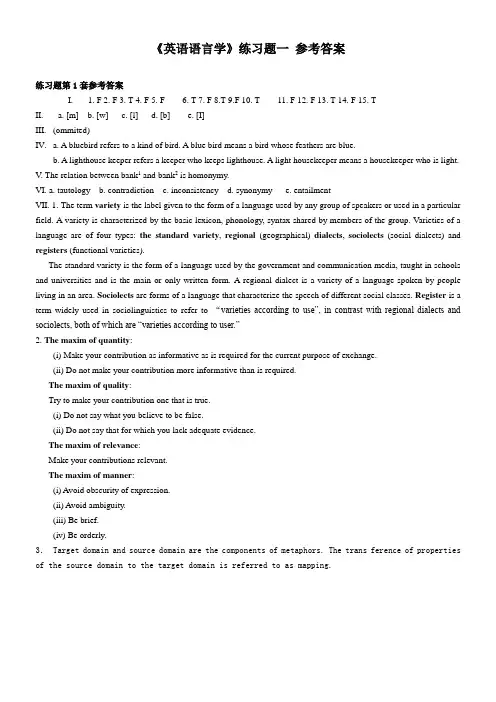
练习题第1套参考答案I. 1. F 2. F 3. T 4. F 5. F 6. T 7. F 8.T 9.F 10. T 11. F 12. F 13. T 14. F 15. TII. a. [m] b. [w] c. [l] d. [b] e. [I]III.(ommited)IV. a. A bluebird refers to a kind of bird. A blue bird means a bird whose feathers are blue.b. A lighthouse keeper refers a keeper who keeps lighthouse. A light housekeeper means a housekeeper who is light. V. The relation between bank1 and bank2 is homonymy.VI. a. tautology b. contradiction c. inconsistency d. synonymy e. entailmentVII. 1. The term variety is the label given to the form of a language used by any group of speakers or used in a particular field. A variety is characterized by the basic lexicon, phonology, syntax shared by members of the group. Varieties of a language are of four types: the standard variety, regional(geographical) dialects, sociolects(social dialects) and registers (functional varieties).The standard variety is the form of a language used by the government and communication media, taught in schools and universities and is the main or only written form. A regional dialect is a variety of a language spoken by people living in an area. Sociolects are forms of a language that characterize the speech of different social classes. Register is a term widely used in sociolinguistics to refer to “varieties according to use”, in contrast with regional dialects and sociolects, both of which are “varieties according to user.”2. The maxim of quantity:(i) Make your contribution as informative as is required for the current purpose of exchange.(ii) Do not make your contribution more informative than is required.The maxim of quality:Try to make your contribution one that is true.(i) Do not say what you believe to be false.(ii) Do not say that for which you lack adequate evidence.The maxim of relevance:Make your contributions relevant.The maxim of manner:(i) Avoid obscurity of expression.(ii) Avoid ambiguity.(iii) Be brief.(iv) Be orderly.3. Target domain and source domain are the components of metaphors. The trans ference of properties of the source domain to the target domain is referred to as mapping.I. 1. descriptive 2. places, voicing 3. Allophones 4.morpheme 5. signifier, signified 6. structure 7. diphthongs 8. accidental 9. Meaning, sounds 10. metalanguage 11. interpersonal, textualI.voiced 2. fricative 3. labial 4. alveolar 5. high, vowelII.1.This is a dress for beautiful girls.This is a beautiful dress for girls.2.Tom hates his boss and I hate his boss too.Tom hates his boss and I hate my boss too.III.a) The Whit House is a proper noun, which is the estate of the American government. A white house refers to a house which is painted white.b) A redcoat refers to a British soldier who is in red coat. A red coat means a coat whose color is red.IV.(ommited)V.1. Ideational function --- we use language to talk about our experience of the world, including our inner world, to describe events, states and the entities involved (language serves as a cording system which deals with the relation between man and nature);·Interpersonal function --- we use language to interact with others, to establish and maintain relations with them, to please them, to anger them, and influence their behavior, to get their help or sympathy (language servers as a medium between individuals);·Textual function --- language as a system organizes messages in a unified manner so that chunks of messages fit logically with others around them and with the wider context in which the talking or writing takes place (when language is in use, playing the above two functions, it naturally forms a text).2. Metaphors have three main features: systematicity, creation of similarities, and imaginative rationality. Metaphors are systematic precisely because they are conceptual in nature. Metaphor can create similarities between the two domains involved. This runs counter to the traditional view which holds that similarities are inherent in the entities themselves. But cognitive linguists hold that the similarities relevant to metaphors are experiential rather than objective. Metaphors are characterized by imaginative rationality. They unite reasoning and imagination. Metaphors as a form of reasoning by analogy involve categorization, entailment and inference. By metaphors we understand one kind of thing in terms of another kind of thing.1.Homonymy Homonyms are words which have the same form, but different meanings. Words which have the samespelling but different meanings are called homographs, such as bow (v.) and bow (n., a weapon). Words which have the same pronunciation but different meanings are called homophones. Flour/flower, pale/pail, whole/hole are all homophones. Words which have the same spelling and pronunciation but different meanings are full homonyms, as exemplified by bear (v.)/bear (an animal), ground (n.)/ground(v.).Polysemy Homonyms are listed as separate entries in a dictionary, because lexicographers see them as unrelated in sense. A polyseme is a word which has several related senses. In many dictionaries you can find bank1 and bank2 as separate entries. The relation between the two is homonymy. Both of them are polysemes, because each of them has several definitions. Lexicographers make the distinction between homonyms and polysemes based on the intuition of native speakers as well as the etymology or history of words.练习题第3套参考答案I.1—5 T F F T F 6—10 TF T F F 11—15 T F T T FII.I.[f] voiceless labiodental fricativeII.[r] alveolar retroflex liquidIII.[a:] low back vowelIV.[k] voiceless velar stopV.[i] lax high front vowelIII.i) a) one b) three c) two d) four e) sevenii)b)c)disgracefuld)stepsistere)f)antidisestablishmentarianismII.(参见课件或教材)III.1. A wants to stop B from smoking there.2. Pre-requestVI. 1. Metaphor is the mapping from the source domain to the target domain. The domain to be conceptualized is called target domain, while the conceptualizing domain is termed the source domain. The transference of properties of the source domain to the target domain is referred to by some cognitive linguists as mapping. For example, neck is a part of human body, while the neck in the compound bottleneck is metaphorically used. The properties of human neck (source domain) have been transferred to the neck of the bottle (target domain).2. linguistic competence accounts for a speaker's knowledge of his language. accounts for both the tacit knowledge of language and the ability to use it. According to Hymes (1972), there are four parameters that underlie a speaker's communicative competence, namely the ability to judge:1. Whether (and to what degree) something is formally possible;2. Whether (and to what degree) something is feasible;3. Whether (and to what degree) something is appropriate;4. Whether (and to what degree) something is in fact done.3. Referential meaning (sometimes called denotative meaning) is widely believed to be the central meaning of words. It is comparatively more stable and universal. The word woman refers to female human adult. This kind of meaning of the word has not changed and will not change. Associative meanings are meanings that hinge on referential meaning. In contrast to referential meaning, they are less stable and more culture-specific. For example, although the referential meaning of the word king has not changed in English, English people today have different conceptions of the king than before. The English word pig may have the same referent as its equivalent in a language of Islamic culture. Yet, the associative meanings are totally different.I. 1. tone 2. lexicon 3. suppletives 4. Semantics 5. Synomyms 6. Meaning, sounds7. metalanguage 8. interpersonal, textual 9. descriptive 10. places, voicing 11. Allophones 12.morphemeII. a). voiced b). fricative c). bilabial d). velar e). high; vowelIII. 1) a greenhouse, the stress is on green; a green house, the stress is on house.Greenhouse is a compound word; green house is a noun phrase.A greenhouse refers to a building with sides and roof of glass, used for growing plants that needprotection from the weather, while a green house refers to a house whose color is green.2) a sleeping car, the stress is on sleeping; a sleeping boy, the stress is on boy.A sleeping car means a car in which one can sleep. A sleeping boy means a boy who is sleeping.IV. a. Allophones are actual realizations of a phoneme in different phonetic contexts. For example, the [l], the dark [] in deal, and the voiceless [] in slight are the realizations of the phoneme /l/. [] appears after vowels, [] after voiceless consonants, and [l] elsewhere. The relation between the phoneme and its allophones can be shown in the following figure:b. The term variety is the label given to the form of a language used by any group of speakers or used in a particular field. A variety is characterized by the basic lexicon, phonology, syntax shared by members of the group. Varieties of a language are of four types: the standard variety, regional (geographical) dialects, sociolects (social dialects) and registers (functional varieties).V (ommited)VI 1. A mild criticism of someone who should have cleaned the room.2. A request to someone to tidy up the circumstances.VII. 1. 1. Reference is the relation by which a word picks out or identifies an entity in the world. London refers to or denotes the capital of Great Britain. The word dog denotes a kind of domestic animal. The referential theory, the simplest theory of meaning, claims that meaning is reference. Words stand not only in relation to the world but also to human mind. So in addition to reference, there is another dimension of word meaning called sense. For example, when you hear the expression dog, you will naturally reflect on its features in addition to the kind of animal as the referent of the expression. Sense is mental representation, the association with something in the speaker/hearer's mind. Words like dragon, but, of and phrases like a round triangle have sense, but no referent. Words like dog, horse, car and gun have both referent and sense.2. ·Ideational function --- we use language to talk about our experience of the world, including our inner world, to describe events, states and the entities involved (language serves as a cording system which deals with the relation between man and nature);·Interpersonal function --- we use language to interact with others, to establish and maintain relations with them, to please them, to anger them, and influence their behavior, to get their help or sympathy (language servers as a medium between individuals);·Textual function --- language as a system organizes messages in a unified manner so that chunks of messages fit logically with others around them and with the wider context in which the talking or writing takes place (when language is in use, playing the above two functions, it naturally forms a text).。
新编简明英语语言学教程第二版课后参考答案

新编简明英语语言学教程第二版课后参考答案 Last updated on the afternoon of January 3, 2021《新编简明英语语言学教程》第二版练习题参考答案Chapter 1 Introduction1. How do you interpret the following definition of linguistics: Linguistics is the scientific study of language.答: Linguistics is based on the systematic investigation of linguistic data, conducted with reference to some general theory of language structure. In order to discover the nature and rules of the underlying language system, the linguists has to collect and observe language facts first, which are found to display some similarities, and generalizations are made about them; then he formulates some hypotheses about the language structure. The hypotheses thus formed have to be checked repeatedly against the observed facts to fully prove their validity. In linguistics, as in any other discipline, data and theory stand in a dialectical complementation, that is, a theory without the support of data can hardly claim validity, and data without being explained by some theory remain a muddled mass of things.2. What are the major branches of linguistics What does each of them study答: The major branches of linguistics are:(1) phonetics: it studies the sounds used in linguistic communication;(2) phonology: it studies how sounds are put together and used to convey meaning in communication;(3) morphology: it studies the way in which linguistic symbols representing sounds are arranged and combined to form words;(4) syntax: it studies the rules which govern how words are combined to form grammatically permissible sentences in languages;(5) semantics: it studies meaning conveyed by language;(6) pragmatics: it studies the meaning in the context of language use.3. In what basic ways does modern linguistics differ from traditional grammar?答: The general approach thus traditionally formed to the study of language over the years is roughly referred to as “traditional grammar.” Modern linguistics differs from traditional grammar in several basic ways.Firstly, linguistics is descriptive while traditional grammar is prescriptive.Second, modem linguistics regards the spoken language as primary, not the written. Traditional grammarians, on the other hand, tended to emphasize, maybe over-emphasize, the importance of the written word, partly because of its permanence.Then, modem linguistics differs from traditional grammar also in that it does not force languages into a Latin-based framework.4. Is modern linguistics mainly synchronic or diachronic Why答: In modem linguistics, a synchronic approach seems to enjoy priority over a diachronic one. Because people believed that unless the various states of a language in different historical periods are successfully studied, it would be difficult to describe the changes that have taken place in its historical development.5. For what reasons does modern linguistics give priority to speech rather than to writing? 答: Speech and writing are the two major media of linguistic communication. Modem linguistics regards the spoken language as the natural or the primary medium of human language for some obvious reasons. From the point of view of linguistic evolution, speech is prior to writing. The writing system of any language is always “invented” by its users to record speech when the need arises. Even in today's world there are still many languages that can only be spoken but not written. Then in everyday communication, speech plays a greater role than writing in terms of the amount of information conveyed. And also, speech is always the way in which every native speaker acquires his mother tongue, and writing is learned and taught later when he goes to school. For modern linguists, spoken language reveals many true features of human speech while written language is o nly the “revised” record of speech. Thus their data for investigation and analysis are mostly drawn from everyday speech, which they regard as authentic.6. How is Saussure's distinction between langue and parole similar to Chomsky's distinction between competence and performance?答: Saussure's distinction and Chomsky's are very similar, they differ at least in that Saussure took a sociological view of language and his notion of langue is a matter of social conventions, and Chomsky looks at language from a psychological point of view and to him competence is a property of the mind of each individual.7. What characteristics of language do you think should be included in a good, comprehensive definition of language?答: First of all, language is a system, ., elements of language are combined according to rules.Second, language is arbitrary in the sense that there is no intrinsic connection between a linguistic symbol and what the symbol stands for.Third, language is vocal because the primary medium for all languages is sound. Fourth, language is human-specific, i. e., it is very different from the communication systems other forms of life possess.8. What are the main features of human language that have been specified by C. Hockett to show that it is essentially different from animal communication system?答:The main features of human language are termed design features. They include:1) ArbitrarinessLanguage is arbitrary. This means that there is no logical connection between meanings and sounds. A good example is the fact that different sounds are used to refer to the same object in different languages.2) ProductivityLanguage is productive or creative in that it makes possible the construction and interpretation of new signals by its users. This is why they can produce and understand an infinitely large number of sentences, including sentences they have never heard before.3) DualityLanguage consists of two sets of structures, or two levels. At the lower or the basic level there is a structure of sounds, which are meaningless by themselves. But the sounds of language can be grouped and regrouped into a large number of units of meaning, which are found at the higher level of the system.4) DisplacementLanguage can be used to refer to things which are present or not present, real or imagined matters in the past, present, or future, or in far-away places. In other words, language can be used to refer to contexts removed from the immediate situations of the speaker. This is what “displacement” means.5) Cultural transmissionWhile human capacity for language has a genetic basis, ., we were all born with the ability to acquire language, the details of any language system are not genetically transmitted, but instead have to be taught and learned.9. What are the major functions of language Think of your own examples for illustration. 答: Three main functions are often recognized of language: the descriptive function, the expressive function, and the social function.The descriptive function is the function to convey factual information, which can be asserted or denied, and in some cases even verified. For examp le: “China is a large country with a long history.”The expressive function supplies information about the user’s feelings, preferences, prejudices, and values. For example: “I will never go window-shopping with her.”The social function serves to establish and maintain social relations between people. . For example: “We are your firm supporters.”Chapter 2 Speech Sounds1. What are the two major media of linguistic communication Of the two, which one is primary and why答: Speech and writing are the two major media of linguistic communication.Of the two media of language, speech is more primary than writing, for reasons, please refer to the answer to the fifth problem in the last chapter.2. What is voicing and how is it caused?答: Voicing is a quality of speech sounds and a feature of all vowels and some consonants in English. It is caused by the vibration of the vocal cords.3. Explain with examples how broad transcription and narrow transcription differ?答: The transcription with letter-symbols only is called broad transcription. This is the transcription normally used in dictionaries and teaching textbooks for general purposes. The latter, . the transcription with letter-symbols together with the diacritics is called narrow transcription. This is the transcription needed and used by the phoneticians in their study of speech sounds. With the help of the diacritics they can faithfully represent as much of the fine details as it is necessary for their purpose.In broad transcription, the symbol [l] is used for the sounds [l] in the four words leaf [li:f], feel [fi:l], build [bild], and health [helθ]. As a matter of fact, the sound [l] in all these four sound combinations differs slightly. The [l] in [li:f], occurring before a vowel, is called a dear [l], and no diacritic is needed to indicate it; the [1] in [fi:l] and [bild], occurring at the end of a word or before another consonant, is pronounced differently from the clear [1] as in “leaf”. It is called dark [] and in narrow transcription the d iacritic [] is used to indicate it. Then in the sound combination [helθ], the sound [l] is followed by the English dental sound [θ], its pronunciation is somewhat affected by the dental sound that follows it. It is thus called a dental [l], and in narrow transcription the diacritic [、] is used to indicate it. It istranscribed as [helθ].Another example is the consonant [p]. We all know that [p] is pronounced differently in the two words pit and spit. In the word pit, the sound [p] is pronounced with a strong puff of air, but in spit the puff of air is withheld to some extent. In the case of pit, the [p] sound is said to be aspirated and in the case of spit, the [p] sound is unaspirated. This difference is not shown in broad transcription, but in narrow transcription, a small raised “h” is used to show aspiration, thus pit is transcribed as [pht] and spit is transcribed as [spt].4. How are the English consonants classified答: English consonants can be classified in two ways: one is in terms of manner of articulation and the other is in terms of place of articulation. In terms of manner of articulation the English consonants can be classified into the following types: stops, fricatives, affricates, liquids, nasals and glides. In terms of place of articulation, it can be classified into following types: bilabial, labiodental, dental, alveolar, palatal, velar and glottal.5. What criteria are used to classify the English vowels?答: Vowels may be distinguished as front, central, and back according to which part of the tongue is held highest. To further distinguish members of each group, we need to apply another criterion, . the openness of the mouth. Accordingly, we classify the vowels into fourgroups: close vowels, semi-close vowels, semi-open vowels, and open vowels. A third criterion that is often used in the classification of vowels is the shape of the lips. In English, all the front vowels and the central vowels are unfounded vowels, i. e., without rounding the lips, and all the back vowels, with the exception of [a:], are rounded. It should be noted that some front vowels can be pronounced with rounded lips.6. A. Give the phonetic symbol for each of the following sound descriptions:1) voiced palatal affricate2) voiceless labiodental fricative3) voiced alveolar stop4) front, close, short5) back, semi-open, long6) voiceless bilabial stopB. Give the phonetic features of each of the following sounds:1) [ t ] 2) [ l ] 3) [] 4) [w] 5) [] 6) []答:A. (1) [] (2) [ f ] (3) [d ] (4) [ ] (5) [ :] (6) [p]B. (1) voiceless alveolar stop (2) voiced alveolar liquid(3) voiceless palatal affricate (4) voiced bilabial glide(5) back, close, short (6) front, open7. How do phonetics and phonology differ in their focus of study Who do you think will be more interested in the difference between, say, [l] and [], [ph] and [p], a phonetician or a phonologist Why答: (1) Both phonology and phonetics are concerned with the same aspect of language ––the speech sounds. But while both are related to the study of sounds,, they differ in their approach and focus. Phonetics is of a general nature; it is interested in all the speech sounds used in all human languages: how they are produced, how they differ from each other, what phonetic features they possess, how they can be classified, etc. Phonology, on the other hand, aims to discover how speech sounds in a language form patterns and how these sounds are used to convey meaning in linguistic communication.(2) A phonologist will be more interested in it. Because one of the tasks of the phonologists is to find out rule that governs the distribution of [l] and [], [ph] and [p].8. What is a phone How is it different from a phoneme How are allophones related to a phoneme答: A phone is a phonetic unit or segment. The speech sounds we hear and produce during linguistic communication are all phones. A phoneme is not any particular sound, but rather it is represented or realized by a certain phone in a certain phonetic context. The different phones which can represent a phoneme in different phonetic environments are called the allophones of that phoneme. For example, the phoneme /l/ in English can be realized as dark [], clear [l], etc. which are allophones of the phoneme /l/.9. Explain with examples the sequential rule, the assimilation rule, and the deletion rule. 答: Rules that govern the combination of sounds in a particular language are called sequential rules.There are many such sequential rules in English. For example, if a word begins with a [l] or a [r], then the next sound must be a vowel. That is why [lbik] [lkbi] are impossible combinations in English. They have violated the restrictions on the sequencing of phonemes. The assimilation rule assimilates one sound to another by “copying” a feature of a sequential phoneme, thus making the two phones similar. Assimilation of neighbouring sounds is, for the most part, caused by articulatory or physiological processes. When we speak, we tend to increase the ease of articulation. This “sloppy” tendency may become regularized as rules of language.We all know that nasalization is not a phonological feature in English, ., it does not distinguish meaning. But this does not mean that vowels in English are never nasalized in actual pronunciation; in fact they are nasalized in certain phonetic contexts. For example, the [i:] sound is nasalized in words like bean, green, team, and scream. This is because in all these sound combinations the [i:] sound is followed by a nasal [n] or [m].The assimilation rule also accounts for the varying pronunciation of the alveolar nasal [n] in some sound combinations. The rule is that within a word, the nasal [n] assumes the same place of articulation as the consonant that follows it. We know that in English the prefix in- can be added to ma adjective to make the meaning of the word negative, . discreet –indiscreet, correct – incorrect. But the [n] sound in the prefix in- is not always pronounced as an alveolar nasal. It is so in the word indiscreet because the consonant that follows it, . [d], is an alveolar stop, but the [n] sound in the word incorrect is actually pronounced as a velar nasal, . []; this is because the consonant that follows it is [k], which is a velar stop. So we can see that while pronouncing the sound [n], we are “copying” a feature of the consonant that follows it. Deletion rule tells us when a sound is to be deleted although it is orthographically represented. We have noticed that in the pronunciation of such words as sign, design, and paradigm, there is no [g] sound although it is represented in spelling by the letter g. But in their corresponding forms signature, designation, and paradigmatic, the [g] represented by the letter g is pronounced. The rule can be stated as: Delete a [g] when it occurs before a final nasal consonant. Given the rule, the phonemic representation of the stems in sign –signature, resign – resignation, phlegm – phlegmatic, paradigm – paradigmatic will include the phoneme /g/, which will be deleted according to the regular rule if no suffix is added. 10. What are suprasegmental features How do the major suprasegmental features of English function in conveying meaning答: The phonemic features that occur above the level of the segments are called suprasegmental features. The main suprasegmental features include stress, intonation, and tone. The location of stress in English distinguishes meaning. There are two kinds of stress:word stress and sentence stress. For example, a shift of stress may change the part of speechof a word from a noun, to a verb although its spelling remains unchanged. Tones are pitchvariations which can distinguish meaning just like phonemes.Intonation plays an important role in the conveyance of meaning in almost everylanguage, especially in a language like English. When spoken in different tones, the samesequence of words may have different meanings.Chapter 3 Morphology1. Divide the following words into th eir separate morphemes by placing a “+” between eachmorpheme and the next:a. microfile e. telecommunicationb. bedraggled f. forefatherc. announcement g. psychophysicsd. predigestion h. mechanist答:a. micro + file b. be + draggle + edc. announce + mentd. pre + digest + ione. tele + communicate + ionf. fore + fatherg. psycho + physics h. mechan + ist2. Think of three morpheme suffixes, give their meaning, and specify the types of stem theymay be suffixed to. Give at least two examples of each.Model: -orsuffix: -ormeaning: the person or thing performing the actionstem type: added to verbsexamples: actor, “one who acts in stage plays, motion pictures, etc.” translator, “onewho translates”答:(1) suffix: -ablemeaning: something can be done or is possiblestem type: added to verbsexamples: acceptable, “can be accepted”respectable, “can be respected”(2) suffix: -lymeaning: functionalstem type: added to adjectivesexamples: freely. “adverbial form of ‘free’ ”quickly, “adverbial form of 'quick' ”.(3) suffix: -eemeaning: the person receiving the actionstem type: added to verbsexamples: employee, “one who works in a company”interviewee, “one who is interviewed”3. Think of three morpheme prefixes, give their meaning, and specify the types of stem they may be prefixed to. Give at least two examples of each.Model: a-prefix: a-meaning: “without; not”stem type: added to adjectivesexamples: asymmetr ic, “lacking symmetry” asexual, “without sex or sex organs”答:(1) prefix: dis-meaning: showing an oppositestem type: added to verbs or nounsexamples : disapprove, “do not approve”dishonesty, “lack of honesty”.(2) prefix: anti-meaning: against, opposed tostem type: added to nouns or adjectivesexamples : antinuclear, “opposing the use of atomic weapons and power”antisocial, “opposed or harmful to the laws and customs of an organized community. ”(3) prefix: counter-meaning: the opposite ofstem type: added to nouns or adjectives.examples: counterproductive, “producing results opposite to those intended”counteract, “act against and reduce the force or effect of (sth.) ”4. The italicized part in each of the following sentences is an inflectional morpheme. Study each inflectional morpheme carefully and point out its grammatical meaning.Sue moves in high-society circles in London.A traffic warden asked John to move his car.The club has moved to Friday, February 22nd.The branches of the trees are moving back and forth.答:(1) the third person singular(2) the past tense(3) the present perfect(4) the present progressive5. Determine whether the words in each of the following groups are related to one another by processes of inflection or derivation.a) go, goes, going, goneb) discover, discovery, discoverer, discoverable, discoverabilityc) inventor, inventor’s, inventors, inventors’d) democracy, democrat, democratic, democratize答:(略)6. The following sentences contain both derivational and inflectional affixes. Underline all of the derivational affixes and circle the inflectional affixes.a) The farmer’s cows escaped.b) It was raining.c) Those socks are inexpensive.d) Jim needs the newer copy.e) The strongest rower continued.f) She quickly closed the book.g) The alphabetization went well.答:(略)Chapter 4 Syntax1. What is syntax?Syntax is a branch of linguistics that studies how words are combined to form sentences and the rules that govern the formation of sentences.2. What is phrase structure rule?The grammatical mechanism that regulates the arrangement of elements . specifiers, heads, and complements) that make up a phrase is called a phrase structure rule.The phrase structural rule for NP, VP, AP, and PP can be written as follows:NP →(Det) N (PP) ...VP →(Qual) V (NP) ...AP → (Deg) A (PP) ...PP → (Deg) P (NP) ...We can formulate a single general phrasal structural rule in which X stands for the3. What is category How to determine a word's category?Category refers to a group of linguistic items which fulfill the same or similar functions in a particular language such as a sentence, a noun phrase or a verb.To determine a word's category, three criteria are usually employed, namely meaning, inflection and distribution.若详细回答,则要加上:Word categories often bear some relationship with its meaning. The meanings associated with nouns and verbs can be elaborated in various ways. The property or attribute of the entities denoted by nouns can be elaborated by adjectives. For example, when we say that pretty lady, we are attributing the property ‘pretty’ to the lady designated by the noun.Similarly, the properties and attributes of the actions, sensations and states designated by verbs can typically be denoted by adverbs. For example, in Jenny left quietly the adverb quietly indicates the manner of Jenny's leaving.The second criterion to determine a word's category is inflection. Words of different categories take different inflections. Such nouns as boy and desk take the plural affix -s. Verbs such as work and help take past tense affix -ed and progressive affix -ing. And adjectives like quiet and clever take comparative affix -er and superlative affix -est. Although inflection is very helpful in determining a word's category, it does not always suffice. Some words do not take inflections. For example, nouns like moisture, fog, do not usually take plural suffix -s and adjectives like frequent, intelligent do not take comparative and superlative affixes -er and -est.The last and more reliable criterion of determining a word's category is its distribution. That is what type of elements can co-occur with a certain word. For example, nouns can typically appear with a determiner like the girl and a card, verbs with an auxiliary such as should stay and will go, and adjectives with a degree word such as very cool and too bright.A word's distributional facts together with information about its meaning and inflectional capabilities help identify its syntactic category.4. What is coordinate structure and what properties does it have?The structure formed by joining two or more elements of the same type with the help of a conjunction is called coordinate structures.It has (或写Conjunction exhibits) four important properties:1) There is no limit on the number of coordinated categories that can appear prior to theconjunction.2) A category at any level (a head or an entire XP) can be coordinated.3) Coordinated categories must be of the same type.4) The category type of the coordinate phrase is identical to the category type of theelements being conjoined.5. What elements does a phrase contain and what role does each element play?A phrase usually contains the following elements: head, specifier and complement. Sometimes it also contains another kind of element termed modifier.The role each element can play:Head:Head is the word around which a phrase is formed.Specifier:Specifier has both special semantic and syntactic roles. Semantically, it helps tomake more precise the meaning of the head. Syntactically, it typically marks a phrase boundary.Complement:Complements are themselves phrases and provide information about entities andlocations whose existence is implied by the meaning of the head.Modifier:Modifiers specify optionally expressible properties of the heads.6. What is deep structure and what is surface structure?There are two levels of syntactic structure. The first, formed by the XP rule in accordance with the head's subcategorization properties, is called deep structure (or D-structure). The second, corresponding to the final syntactic form of the sentence which results from appropriate transformations, is called surface structure (or S-structure).(以下几题只作初步的的成分划分,未画树形图, 仅供参考)7. Indicate the category of each word in the following sentences.a) The old lady got off the bus carefully.Det A N V P Det N Advb) The car suddenly crashed onto the river bank.Det N Adv V P Det Nc) The blinding snowstorm might delay the opening of the schools.Det A N Aux V Det N P Det Nd) This cloth feels quite soft.Det N V Deg A8. The following phrases include a head, a complement, and a specifier. Draw the appropriate tree structure for each.a) rich in mineralsXP(AP) → head (rich) A + complement (in minerals) PPb) often read detective storiesXP(VP) →specifier (often) Qual +head (read) V +complement (detective stories) NP c) the argument against the proposalsXP(NP) →specifier (the) Det +head (argument) N +complement (against theproposals) PPd) already above the windowXP(VP) →specifier (already) Deg +head (above) P +complement (the window) NP d) The apple might hit the man.S →NP (The apple) + Infl (might) +VP (hit the man)e) He often reads detective stories.S →NP (He) +VP (often reads detective stories)9. The following sentences contain modifiers of various types. For each sentence, first identify the modifier(s), then draw the tree structures.(斜体的为名词的修饰语,划底线的为动词的修饰语)a) A crippled passenger landed the airplane with extreme caution.b) A huge moon hung in the black sky.c) The man examined his car carefully yesterday.d) A wooden hut near the lake collapsed in the storm.10. The following sentences all contain conjoined categories. Draw a tree structure for each of the sentences.(划底线的为并列的范畴)a) Jim has washed the dirty shirts and pants.b) Helen put on her clothes and went out.c) Mary is fond of literature but tired of statistics.11. The following sentences all contain embedded clauses that function as complements of a verb, an adjective, a preposition or a noun. Draw a tree structure for each sentence.a) You know that I hate war.b) Gerry believes the fact that Anna flunked the English exam.c) Chris was happy that his father bought him a Rolls-Royce.d) The children argued over whether bats had wings.12. Each of the following sentences contains a relative clause. Draw the deep structure and the surface structure trees for each of these sentences.a) The essay that he wrote was excellent.b) Herbert bought a house that she lovedc) The girl whom he adores majors in linguistics.13. The derivations of the following sentences involve the inversion transformation. Give the deep structure and the surface structure of each of these sentences. (斜体的为深层结构,普通字体的为表层结构)a) Would you come tomorrow?you would come tomorrowb) What did Helen bring to the party?Helen brought what to the partyc) Who broke the window?who broke the windowChapter 5 Semantics。
194《英语语言学》答案
《英语语言学》练习题参考答案一I. Fill in each of the following blanks with one word beginning with the letter given:1.descriptive2.place voicing.3. Allophones4. morpheme.5. signifier and signified.6. structure7. diphthongs8. accidental9.Meaning and sounds10. metalanguage.11. interpersonal textual12. tone13. lexeme,14. suppletives.15.Semantics16.SynonymsII. Indicate the following statements true or false. Put T for true and F for false in the brackets:( T ) 1. The Swiss linguist de Saussure regarded the linguistic sign as composed of sound image and referent.( F ) 2. Chinese is an agglutinating language.( F ) 3. Not all vowels are voiced.( T ) 4. If segments appear in the same position but the mutual substitution does not result in change of meaning, they are said to be in free variation.( F ) 5. A greenbottle is a type of bottle.( T ) 6. Productivity is the first and foremost striking feature of human language.( F ) 7. Language contains two subsystems, one of speaking and the other of writing.( T ) 8. Language can be used to refer to things real or imagined, past, present or future. ( F ) 9. Modern linguistics is prescriptive rather than descriptive.( F ) 10. The study of speech sounds is called Phonology.( T ) 11. The voiceless bilabial stop in pin and the one in spin are in complementary distribution. ( T ) 12. Tone is the variation of pitch to distinguish utterance meaning.( T ) 13. Compounding, the combination of free morphemes, is a common way to form words. ( F ) 14. In the phrases a herd of cattle, a flock of sheep, both cattle and sheep contain only one morpheme.( F ) 15. The meaning of compounds is always the sum of meaning of the compounds.III. Multiple Choice1.C2.D3.A4.B5.D6.A7.D8.B9.AIV. For each group of sounds listed below, state the phonetic feature(s) then share: Example: [s] [f] [p] [h] voiceless1)[g] [z] [d]2)[v] [h] [s]3)[m] [p] [b] [f] [v]4)[t] [d] [n] [l] [s] [z]5)[i:] [i] [u] [u:]1.voiced2. fricative3. labial4. alveolar5. high, vowelV. Transcribe the sound represented by the underlined letter(s) in the words and then describe it.Example: heat [i:] vowel front higha)photob)writec)card)actore)cityf)cityg)worryh)yesa)[f] voiceless labiodental fricativeb)[r] alveolar retroflex liquidc)[a:] low back voweld) [k] voiceless velar stope)[i] lax high front vowelf)[s] voiceless alveolar fricativeg)[w] labiovelar glideh) [j] palatal glideVI. Write the phonetic symbol that corresponds to the articulatory description.Example: vowel front high [i:]1bilabial nasal [m]2voiced labiovelar glide [w]3literal liquid [l]4voiced bilabial stop [b]5front high lax [i]VII. Pronounce the words key and core, ski and score, paying attention to the phoneme /k/. What difference do you notice between the first pair and the second pair in terms of the phonetic features of the voiceless velar stop?In pronouncing key, the voiceless velar stop is palatalized. In key and core, the stop is aspirated. In ski, the stop is also palatalized. In ski and score, the stop is unspirated. VIII. Consider the following words and answer the questions below:a)fingerb)disgracefulc)stepsisterd)psycholinguisticse)antidisestablishmentarianismi.Tell the number of morphemes in each word.ii.Underline the free morphemes in each word where possible to do so.i) a) one b) three c) two d) four e) sevenii)f)g)disgracefulh)stepsisteri)j)antidisestablishmentarianisIX. Identify the difference between a greenhouse and a green house, and the difference betweena sleeping car and a sleeping baby.1) a greenhouse, the stress is on green; a green house, the stress is on house.Greenhouse is a compound word; green house is a noun phrase.A greenhouse refers to a building with sides and roof of glass, used for growing plantsthat need protection from the weather, while a green house refers to a house whose color is green.2) a sleeping car, the stress is on sleeping; a sleeping boy, the stress is on boy.A sleeping car means a car in which one can sleep. A sleeping boy means a boy who is sleeping. X. Define the following term, giving examples for illustration:AllophoneAllophones are actual realizations of a phoneme in different phonetic contexts. For example, the [l], the dark [] in deal, and the voiceless [] in slight are the realizations of the phoneme /l/. [] appears after vowels, [] after voiceless consonants, and [l] elsewhere. The relation between the phoneme and its allophones can be shown in the following figure:XI. Draw tree diagrams for the following two sentences:1. A clever magician fooled the audience.2.The tower on the hill collapsed in the wind.3.They can fish.4.Pat found a book on Wall Street.5.I saw the man with a telescope.XII. Explain the ambiguity of the following sentences.a.This is a beautiful girl’s dress.b.Those who went there quickly made a fortune.c. A woman murderera. This is a dress for beautiful girls.This is a beautiful dress for girls.b. Those who quickly went there made a fortune.Those who went there made a fortune quickly.c. A female murderer A murderer who has murdered a womanXIII. Tell the process of word formation illustrated by the example and find as many words as you can that are formed in the same way.(1)flu(2)OPEC(3)Nobel(4)televise(5)better (v.)1. clipping2. acronyming3. eponyming4. back formation5. conversionXIV. How would you read the phrases in the two columns? What does each of them mean?Column I Column IIa. The White House a white houseb. a redcoat a red coatc. a bluebird a blue birdd. a lighthouse keeper a light housekeepera) The Whit House is a proper noun, which is the estate of the American government. Awhite house refers to a house which is painted white.b) A redcoat refers to a British soldier who is in red coat. A red coat means a coat whosecolor is red.c. A bluebird refers to a kind of bird. A blue bird means a bird whose feathers areblue.d. A lighthouse keeper refers a keeper who keeps lighthouse. A light housekeeper meansa housekeeper who is light.XV. Explain the relation between bank1(the side of a river) and bank2(the financial institute). The relation between bank1 and bank2 is homonymy. They are two words which have the same sound and spelling but different meanings.XVI. Identify the type of transitivity process in each of the following sentences.(1)John washed the car.(2)John likes the car.1. material2. mentalXVII.(答案略)二I.Indicate the following statements true or false. Put T for true and F for false in the brackets:( T ) 1. Pragmatics is concerned with speaker meaning.( F ) 2. The reference of a deixis to a preceding expression is technically termed cataphoric reference.II. Multiple Choice1.___ A _____ .2.___ B ___ .3. ___ C ___ .4. ___ B ___ .5. __ C ___ .6.___ A ___ .III. Tell the semantic relation within the given sentence and that between the two sentences.a)My uncle is male.b)The spinster is married.c)Jim is an orphan. Jim lives with his parents.d)Sam is the husband of Sally. Sally is the wife of Sam.e)He has gone to London. He has gone to England.a. tautologyb. contradictionc. inconsistencyd. entailmente. presupposition IV. Data Analysis:1.What is the illocution of A’s utterance in the following brief encounter?A: You are in a non-smoking zone, sir.B: Thanks (extinguishing the cigarette).2.What kind of pre-sequence is A’s first utterance? (Hint: A and B are two secretaries workingin the same office.)A: Are you going to be here long?B: You can go if you like.A: I’ll just be outside. Call me if you need me.B: OK.1. A wants to stop B from smoking there.2. Pre-requestV. Try to think of contexts in which the following sentences can be used for other purposes than just stating facts: 1. The room is messy.2. It would be good if she had a green skirt on1. A mild criticism of someone who should have cleaned the room.2. A request to someone to tidy up the circumstances.VI. Define the following term, giving examples for illustration:VarietyThe term variety is the label given to the form of a language used by any group of speakers or used in a particular field. A variety is characterized by the basic lexicon, phonology, syntax shared by members of the group. Varieties of a language are of four types: the standard variety, regional (geographical) dialects, sociolects (social dialects) and registers (functional varieties).VII. Give examples to illustrate gradable antonyms, complementary antonyms, and reversal antonyms.Gradable antonyms are pairs of words opposite to each other, but the positive of one word does not necessarily imply the negative of the other, or vice versa. A person who is not rich is not necessarily poor. Complementary antonyms are words opposite to each other and the positive ofone implies the negative of the other. Dead/alive, male/female, pass/fail, etc. are complementary antonyms. Reversal antonyms are words that denote the same relation or process from one or the other direction. Push/pull, come/go, ascend/descend, buy/sell, up/down in/out, employer/employee, husband/wife, are all reversal antonyms.VIII. Answer the following questions(答案略)。
英语语言学linian试题及答案
英语语言学linian试题及答案英语语言学试题及答案1. 语言学的主要分支有哪些?答案:语言学的主要分支包括语音学、音系学、形态学、句法学、语义学、语用学、社会语言学、心理语言学、神经语言学、计算语言学等。
2. 请解释“语言习得”和“语言学习”的区别。
答案:语言习得是指儿童在成长过程中自然掌握母语的能力,而语言学习则是指在学校或其他正式环境中有意识地学习第二语言或外语。
3. 什么是语言的“深层结构”和“表层结构”?答案:深层结构是指句子的内在意义和逻辑关系,而表层结构则是指句子的外在形式,即我们实际听到或说出的句子。
4. 请列举至少三种不同的语言变异现象。
答案:语言变异现象包括地域变异(方言)、社会变异(社会方言)、时间变异(历史方言)等。
5. 什么是转换生成语法?答案:转换生成语法是由诺姆·乔姆斯基提出的语言学理论,它认为所有人类语言都遵循一套普遍的语法规则,而这些规则可以通过转换规则从深层结构转换到表层结构。
6. 请解释“语码转换”和“语码混合”的概念。
答案:语码转换是指在不同语言或方言之间切换使用,而语码混合则是指在同一句话中混合使用两种或两种以上的语言或方言。
7. 语言学中“语料库”的作用是什么?答案:语料库是语言学研究中用来收集和分析自然语言数据的大型数据库,它可以帮助研究者进行语言模式、语言变化和语言使用等方面的研究。
8. 请简述“语言相对性假设”。
答案:语言相对性假设,也称为萨丕尔-沃尔夫假设,认为一个人的思维方式受到其母语的影响,即语言的结构决定了思维的结构。
9. 什么是“语言的普遍语法”?答案:语言的普遍语法是指所有人类语言共有的一套基本语法规则,这些规则是语言能力的基础,由诺姆·乔姆斯基提出。
10. 请解释“语境”在语言交际中的作用。
答案:语境是指语言交际发生的环境,包括物理环境、社会环境和心理环境等。
语境对语言的理解和使用有重要影响,它可以帮助解释语言的模糊性,提供语言交流的背景信息。
英语语言学(高起本).pdf
单选题1.The term______is used for less drastic difference restricted to variation in pronunciation.A.sociolectB.dialectC.geographical dialectD.accent答案:D2.______is a term widely used to refer to varieties according to use in sociolinguistics.A.RegisterB.DialectC.TenorD.Variety答案:A3.The followings are all features of language except__________.A.dualityB.productivityC.changeabilityD.displacement答案:C4.____is the first and foremost striking feature of human language.A.creativityB.arbitrarinessC.displacementD.interchangeability答案:A5._________are a fundamental unit of conversational structure.A.back-channel signalsB.adjacency pairsC.pre-sequencesD.insertion sequences答案:B6.It is the____function of language,in a sense,that brings the world into our mind.A.IdeationalB.InterpersonalC.LogicalD.Textual答案:A7.The idea that the learners have a sense of achievement as long as they learn if of vital importance.This kind of motivation may be termed____motivation.A.instrumentalB.integrativeC.cognitiveD.none of them答案:C8.(EEC)is an important organization in the world.(为括号部分的单词选择相对应的构词法)A.DerivationB.BlendingC.BackformationD.Acronym答案:D9.______is the label given to the form of a language used by any group of speakers or used in a particular field.A.varietyB.registerC.dialectD.Creole答案:A10.______,created by linguists in their analysis of the sound system,the lexicogrammar and the meaning of a language,makes it possible to talk about what to teach.A.Pedagogic grammarsB.DictionariesC.LinguisticsD.The metalanguage答案:D11.Every syllable has a(n)____,which is usually a vowel.A.nucleusB.onsetC.codeD.rhyme答案:A12.British English and American English are______varieties of the English language.A.functionalB.socialC.regionalD.standard答案:C13.Minimal pairs can be exemplified by____________.A.moon/noonB.foot/foodC.she/sheetD.sea/sea答案:A14.______is a process that puts an existing word of one class into another class.A.ConversionB.AbbreviationC.EponymsD.Blending答案:A15.goody-goody(为下列单词选择相对应的构词法)A.Sound ReduplicationB.CoinageC.EponymD.Clipping答案:A16.Both pretty and handsome mean good-looking but they differ in ________meaning.A.collocativeB.socialC.affectiveD.reflected答案:A17.This(classroom)is large.(为括号部分的单词选择相对应的构词法)A.ConversionB.BackformationC.Blendingpounding答案:D18.(Tick-tuck)is the sound produced by a clock.(为括号部分的单词选择相对应的构词法)poundingB.CoinageC.Sound ReduplicationD.Clipping答案:C19.1.The term______is the label given to the form ofa language used by any group of speakers or used in a particular field.A.varietyB.registerC.dialectD.Creole答案:A20._________theories are those that attempt to explain acquisition on the basis of assuming an innate biological endowment that makes learning possible.A.EnvironmentalistB.functionalistC.nativistD.both a and b答案:C21.______refers to the fact that a speaker changes from one language to the other in different situations or when talking about different topics.A.BilingualismB.Code-mixingC.Code-switchingD.Pidgin答案:C22.may be defined as the scientific study of language.A.MorphologyB.LinguisticsC.PhonologyD.Phonetics答案:B23.is defined as the scientific study of language.A.MorphologyB.LinguisticsC.PhonologyD.Phonetics答案:B24.______is used between very family members and close friends.A.The consultative styleB.The casual styleC.The intimate styleD.The formal style答案:C25.A(n)________is the minimal or the smallest distinctive linguistic unit in a language.A.phonetic symbolB.alphabetC.phonemeD.allophone答案:C26.What maxis of the cooperative principle does the following dialogue flout?A:How do you like the film?B:Well,the music is very nice.A.QualityB.QuantityC.RelationD.Manner答案:C27.blackboard(为下列单词选择相对应的构词法)A.ConversionB.BackformationC.Blendingpounding答案:D28.peddle(为下列单词选择相对应的构词法)A.ConversionB.BackformationC.Blendingpounding答案:B29.When the tongue touches the alveolar ridge,the sound produced is described as__________.A.alveolarB.palatalC.velarD.interdental答案:D30.If segments appear in the same position but the mutual substitution does not change the meaning,they are said to be in ____.A.contrastive distributionB.free variationplementary distributionD.distinctive features答案:C31.(EEC)is an organization in the world.(为括号部分的单词选择相对应的构词法)A.AcronymB.Sound ReduplicationC.CoinageD.Eponym答案:A32.Analysis of______necessarily involves the interpretation of what people do through language in a particular context.A.intentional meaningB.conventional meaningC.syntactic meaningD.semantic meaning答案:A33.enlarged(为下列单词选择相对应的构词法)B.ConversionC.BackformationD.Blending答案:A34.__________specifies the feature of[+continuant].A.all the fricativesB.all the fricatives and glidesC.all the fricatives and liquidsD.all the fricatives,liquids and glides答案:D35.impossible(为下列单词选择相对应的构词法)A.DerivationB.ConversionC.BackformationD.Blending答案:Anguage has the following features except______.A.dualityB.productivityC.changeabilityD.displacement答案:C37.In compounds,the____morpheme determines the part of speech of the word.A.leftmostB.rightmostC.centralD.initial答案:Ctech(为下列单词选择相对应的构词法)B.BackformationC.Blendingpounding答案:C39.are words that originate from proper names of individuals or places.Sandwich is a common noun originating from the fourth Earl of Sandwich,who put his food between two slices of bread so that he could eat while gambling.A.OriginatorsB.EponymsC.Abbreviationspoundings答案:B40.This(vet)is famous in the town.(为括号部分的单词选择相对应的构词法)A.Sound ReduplicationB.CoinageC.EponymD.Clipping答案:D41.The longest____in English may contain four consonants,as shown by prompts.A.wordB.onsetC.nucleusD.coda答案:D42.__________is the variation of pitch to distinguish utterance meaning.A.StressB.PitchC.ToneD.Intonation答案:C43.______is the basic teaching unit in the structural syllabus.A.the wordB.the discourseC.the sentenceD.the text答案:C44.The vibrating of the vocal cords when sounds produced is regarded as__________.A.VoicingB.voicedC.nasalizationD.aspiration答案:A45.edits(为下列单词选择相对应的构词法)A.ConversionB.BackformationC.Blendingpounding答案:B46.___________are minimal pairs.A.moon/noonB.foot/foodC.she/sheetD.sea/sea答案:A47.____________is a process that creates new words by droppinga real or supposed suffix.Edit was originally backformed from editor,and peddle from peddler.rmationB.backformulaC.backformationD.backformative答案:C48.The process that puts an existing word of one class into another class is______.A.ConversionB.AbbreviationC.EponymsD.Blending答案:A49.vet(为下列单词选择相对应的构词法)A.Sound ReduplicationB.CoinageC.EponymD.Clipping答案:D判断题1.Blending is a process that creates new words by putting together non-morphemic parts of existing words.A well-known example is smog(smoke and fog).A.错误B.正确答案:B2.Coinage is a process of inventing words not based on existing morphemes.A.错误B.正确答案:B3.Hyponymy is a relation of inclusion.Tiger,lion and dog are hyponyms of the word animal.A.错误B.正确答案:B4.The syllabic unit made up by the onset and nucleus is calleda rhyme.A.错误B.正确答案:A5.Acoustic phonetics focuses on the production of sounds from a physiological perspective.A.错误B.正确6.Tenor depends on the relations between the participants.A.错误B.正确答案:B7.Implicature is an expression that substitutes one which may be seen as offensive or disturbing to the addressee.A.错误B.正确答案:A8.Interpersonal function does not belong to the language metafunctions illustrated by M.A.K.Halliday.A.错误B.正确答案:A9.A syllable is not always composed of onset,nucleus and coda.A.错误B.正确答案:B10.Turn-talking refers to having the right to speak by turns.A.错误B.正确答案:A11.Syntactically,Japanese is an isolating language.B.正确答案:A12.Pidgin refers to the fact that a speaker changes from one language to the other in different situations or when talking about different topics.A.错误B.正确答案:A13.English is an example of SVO languages.A.错误B.正确答案:B14.Mood is a syntactic constituent made up of the Subject and the Predicate.A.错误B.正确答案:A15.Phonology and phonetics are both concerned with the study of speech sounds,but the two differ in perspectives.A.错误B.正确答案:B16.The word“went”contains two morphemes.A.错误B.正确17.Logical function does not belong to the language metafunctions illustrated by M.A.K.Halliday.A.错误B.正确答案:B18.The sentence The woman can’t bear children is structurally ambiguous.A.错误B.正确答案:A19.A test is an official document that authoritatively determines the content and principles of teaching and learning.A.错误B.正确答案:A20.Relevance is a relative notion.It is determined by two factors: contextual effect and processing effort.A.错误B.正确答案:B21.The Swiss linguist de Saussure regarded the linguistic sign as composed of sound image and referent.A.错误B.正确22.Learning strategy is an important factor in second language.A.错误B.正确答案:B23.Back-channel signals are a fundamental unit of conversational structure.A.错误B.正确答案:A24.The conceptualizing domain in metaphor is termed the source domain.A.错误B.正确答案:B25.In second language acquisition,age is an important factor.A.错误B.正确答案:B26.All vowels are voiced.A.错误B.正确答案:B27.According to referential content,deixis can be put into person deixis,place deixis,time deixis and discourse deixis.B.正确答案:B28.Adjacency pairs are a fundamental unit of conversational structure.A.错误B.正确答案:B29.In holophrastic stage,children use single words to represent various meanings.A.错误B.正确答案:B30.A creole is a mixed language which has become the mother tongue of a speech community.A.错误B.正确答案:B31.The domain to be conceptualized in metaphor is called target domain.A.错误B.正确答案:B32.Morphology is defined as the study of the internal structure and the formation of words.B.正确答案:B33.Traditional grammar was initially based on European languages, particularly on Latin and Greek.A.错误B.正确答案:B34.Tone is the variation of pitch to distinguish utterance meaning.A.错误B.正确答案:B35.Pragmatics is the analysis of meaning in context.A.错误B.正确答案:B。
英语语言学练习(含答案)
Chapter 11.Linguistics is generally defined as the scientific study of language .(√)2.What first drew the attention of the linguistics were the rules used in language .(×)[What first drew the attention of the linguistics were the sounds used in language .]3The major branches of linguistics are phonetics ,phonedogy ,psycholinguistics ,morphology ,syntax ,semantics ,pragmat ic ,sociolinguistics ,and applied linguistics .(√)4.As linguist became interest in how sounds are put together and used to convey meaning in communication ,they developed another branches of study related to sounds called phonetics .(×)[As linguist became interest in how sounds are put together and used to convey meaning in communication ,they developed another branches of study related to sounds called phonology .]5.Linguistic study aims to describe and analyze the language people actually use ,it is said to be descriptive and modern linguistics is mostly descriptive .(√)6.The description of a language at some point of time in history is a diachronic study ,but the description of language as it changes changes though time is a synchronic .(×)[The description of a language at some point of time in history is a synchronic study ,but the description of language as it changes changes though time is a diachronic .]ngue and parole are relatively stable ,it does not change frequently .(×) [Langue and parole varies from person to person ,from situation to situation .]8.Chomsky define competence as the ideal user's knowledge of the rules of his language ,and performance the actual realization of this language in linguistic communication .(√)9.Modern linguistics regards the written as primary .(×)[Modern linguistics regards the spoken language as primary .]nguage is a s ystem of arbitrary vocal symbols used for human communication .(√)nguage is arbitrary ,this means that there is logical connection between meanings and sounds .(×)[Language is arbitrary ,this means that there is not logical connection between meanings and sounds .]nguage feature are arbitrariness ,productivity ,duality ,displacement ,cultural transmission .(√) nguage is arbitrary by nature ,and it is entirely arbitrary .(×) [Language is arbitrary by nature ,and it is not entirely arbitrary .]14.Productivity is unique to human language .(√)nguage is a system ,which consists of three sets of structures ,or three levels .(×)[Language is a system ,which consists of two sets of structures ,or three levels .]16.Three main functions of language are :the descriptive function ,the expressive,and the social function.(√)nguage cannot beautiful used to refer to contexts removed from the immediate situation of the speaker .(×)[Language can beautiful used to refer to contexts removed from the immediate situation of the speaker .]18."what cannot I do for you ,girl ?" This sentence illustrates the expressive function of language .(×)["what cannot I do for you ,girl ?" This sentence illustrates the social function of language .]19.An English speaker and a Chinese speaker are both able to use a language ,but are not mutually intelligible . This indicates cultural transmission feature of language .(√)20The ideational function is indicate ,establish ,or maintain social relationships be tween people .(×)[The interpersonal function is indicate ,establish ,or maintain social relationships between people .]Chapter 21.Speech and writing are the two media order substances used by natural language as vehicle for communication .(√)2.Phonetics is defined as the study of the phonic medium of language ;it is concerned with a part of the sounds that occur in the world's language .(×)[Phonetics is defined as the study of the phonic medium of language ;it is concerned with all the sounds that occur in the world's language .]3.The branches of phonetics are articulatory phonetics ,auditory phonetics ,and acoustics phonetics .(√)4.Phonetic similarly ,phonetic identity is the criterion with which were operatein the phonolgical analysis of langua ge .(×)[Phonetic similarly ,not phonetic identity is the criterion with which were operate in the phonolgical analysis of language .]5.When the vocal cords are drawn wide apart,letting air go through without causing vibration, the sounds produced in suc h a condition are voiceless. (√)6.The speech organ located in this cavity are the tongue, the uvula,the soft palate (the velum), the hard palate,the teeth ridge(the alveolus),the teeth and the lips.(√)7.Two ways to transcribe speech sounds are broad transcription and narrow transcription. Narrow transcription is the transcription with letter-symbols only,broad transcription is the transcription with letter-symbols together with the diacritics.(×)[Two ways to transcribe speech sounds are broad transcription and narrow transcription. broad transcription is the transcription with letter-symbols only,Narrow transcription is the transcription with letter-symbols together with the diacritics.]8.In the case of sport,the [p] sound is said to be unaspirated,and in the case of speed,the [p] sound is said to be aspirated.(×)[In the case of sport,the [p] sound is said to be aspirated,and in the case of speed,the [p] sound is said to be unaspirated.]9.English consonants can be classified in two ways:one is in terms of manner of articulation and the other is in terms of place of articulation.(√)10.In terms of manner of articulation the English consonants can be classified into six types:stops、fricatives、affricates、liquids、nasals、and bilabial. (×)[In terms of manner of articulation the English consonants can be classified into six types:stops、fricatives、affricates、liquids、nasals、and glides . ]11.In terms of place of articulation,the English consonants can be classified into seven types:bilabial、labiodental、dental、alveolar、palatal、velar、and glottal. (√)12.Vowels may be distinguished as front,central,and back according to which part of the tongue is held lowest.(×)[Vowels may be distinguished as front,central,and back according to which part of the tongue is held highest .]13、We classify the vowels into four groups:close vowels,semi-close vowels,semi-open vowels, and open vowels. (√)14、In English,all the front vowels and the central vowels are unrounded vowels,without rounding the lips,and all the back vowels are rounded.(×)[In English,all the front vowels and the central vowels are unrounded vowels without the [a:],without rounding the lips,and all the back vowels are rounded.]15.The main supranational features include stress ,intonation ,and tone .Stressc ontains word stress and sentence stress.(√)16.There are four tones .The first tone is level ,the second rise ,the third fall -rise ,and the fourth fall .(√)17."He is driving my car ",the words that are normally unstressed .i.e.is ,car ,can all bear the stress to express what the speaker intends to mean.(×)["He is driving my car ",the words that are normally unstressed .i.e.is ,my ,can all bear the stress to express what the speaker intends to mean.]18.The location of stress in English distinguishes me aning .(√)19When spoken in different intonation ,the same sequence of word may have different meanings.(×)[When spoken in different tones ,the same sequence of word may have different meanings.]20.A phoneme is a phonological unit ,it is an concrete unit . (×)[A phoneme is a phonological unit ,it is an abstract unit .]Chapter 31. Conjunctions,prepositions,articles and pronouns consist of the "grammatical" and "functional" words. (√)2. Linguisis use the term morphlolgy to refer to the part of the grammar that is concerned with word and word structure.(√)3.Linguisis define the word as the smallest free form found in language. (√)4. The plural marking -s is a free form. (×) [The plural marking -s is not a free form]5. Morpheme is the smallest unit of language that carries information about meaning or function. (√)6. The word READER consists of two morphemes:read and -er. (√)7. The English plural and possessive morphems may be said to share a single morph,the suffix /-s/. (√)8. A morpheme which can be a word by itself is called a bound morpheme,whereas a morpheme that must be attached to another one is a free morpheme. (×)[A morpheme which can be a word by itself is called a free morpheme,whereas a morpheme that must be attached to another one is a bound morpheme.]9. STEM is any morpheme or combination of morphemes to which an inflectional affix can be added. (√)10. AFFIX is a collective term for the type of morpheme that can be used only when added to another morpheme (the root or stem). (√)11. The root constitutes the core of the word and carries the major component of its meaning. (√)12. Unlike roots,affixes do not belong to a lexical category and are always free morphemes. (×)[Unlike roots,affixes do not belong to a lexical category and are always bound morphemes.]13. A morpheme can be defined as a minimal unit of meaning. (√)14. -en,-ate,and -ic are thus called derivational morphemes. (√)15.The morpheme BOY is free morpheme since it can be used as a word on its own;the plural -s ,on the other hand,is bound. (√)16. It is not always possible to assign a lexical meaning to some of the morphemes. (√)17. Compounding is a very common and frequently process for enlarging the vocabulary of the English language. (√)18. Morphemes m ay have different forms. (√)19. The plural marking -s is not a free form since it never occurs in isolation and cannot be separated from the noun to which it belongs. (√)20.It is important to note that a morpheme is neither a meaning nor a stretch of s ound joined together. (√)Chapter 41.Category refers to a group of linguistic items which fullfill the different functiongs in a particular language such as a sentence ,a noun phrase order averb .(×)[Category refers to a group of linguistic items which f ullfill the same or similar functiongs in a particular language such as a sentence ,a noun phrase order a verb .]2.Syntax is a branch of linguistics that studies the rules that govern the formation of sentences .(√)3.Phrases that are formed of more than one word usually contain the following elements :head and specifier .(×)[Phrases that are formed of more than one word usually contain the following elements :head,specifier and complement .]4.Such special type of grammatical mechanism that regulates the arrangement of elements that make up a phrase is called a phrase structure rule .(√)5.Syntactic units that are built around a certain word category are called sentences .(×)[Syntactic units that are built around a certain word category are called phrases .]6.Such special type of grammatical mechanism that regulates the arrangement of elements that make up a phrase structure rule .(√)7.The words on the right side of the heads are said to function as specifiers . (×) [The words on the right side of the heads are said to function as specifiers . ]8.Major lexical categories are Non ,verb ,Adjevtive and Preposition .(√)9.The XP rules =(specifier )×(complement).(√)10.Major lexical categories play a very important role in sentence . (×) [Major lexical categories play a very important role in sentence formation .]11.The most central categories to the synthetic study are the word-level categories .(√)12.According to the XP rules ,the auxiliary is the tail of a sentence which takesa vp category as its complement on the right and an vp ,the subject ,as its specifier on the left .(×)[According to the XP rules ,the auxiliary is the head of a sentence which takes a vp category as its complement on the right and an vp ,the subject ,as its specifier on the right .]13.The words around which a phrase is formed is termed head .(√)14.Words which include the sentence complement are termed complementizers . (√)15.The construction in which the phrase is embedded a complement is called matrix clause .(×)[T he construction in which the complement phrase is embedded a complement is called matrix clause .]16.This classification reflects a variety of factors ,including the type of meaning that words express ,the type of affixes that they take ,and the type of structures in which they can occur .(√)Chapter 51.In semantic triangle, the relation between a word and a thing it refers to is not direct,and it is mediated by concept. (√)2.The relationship of “flower”,“violet”,“rose” and “tulip” is hyponymy. (√)3. A referring expression can be used to refer to nonexistent things. (√)4.Pragmatics studies the aspect of meaning that is not accounted for by semantics.(√)5.In terms of truth condition, if X is true, Y is false, and if X is false, Y is true. The relationship6. “I bought some roses” entails “I bought some flowers”. (√)7. The naming theory was proposed by the Greek scholar Plato. (√)8.According to Behaviorist learning theory, children are believed to gradually assume correct forms of the languag e of their community when their “bad” speech gets corrected and when their good speech gets positively reinforced. (√)9.The contextualist view of meaning is based on the presumption that one can derive meaning from or reduce meaning to observable context.(√)10.The term antonymy is used for oppositeness of meaning;words that are opposite in meaning are antonymy. (√)11.Semantics can be defined as the study of naming.(×)[Semantics can be defined as the study of meaning.]12.Once the notion of meaning was taken into consideration, semantics spilled into pragmatics.(×)[Once the notion of context was taken into consideration,semantics spilled into pragmatics.]13.According to semantic triangle, there is a direct link between a symbol and referent, i.e. between a word and a thing it refers to.(×)[According to semantic triangle, there is no direct link between a symbol and referent, i.e. between a word and a thing it refers to.]14.Antonyms are divided into three kinds:gragable,relational,superordinate.(×) [Antonyms are divided into three kinds:gragable,relational,complementary.]16.The meaning of the word black consists in the two collocational of black hair and black coffee. (×)17.Words are identical in sound and spelling but nearly alike or exacyly the same in meaning.(×)[Words are different in sound and spelling but nearly alike or exacyly the same in meaning.]18.Hyponyms is helpless in both receptive and productive processing of language.(×) [Hyponyms is helpful in both receptive and productive processing of language.]19.”Can I borrow your bike?"is synonymous with "You have a bike."(×)[”Can I borrow your bike?" presupposes "You have a bike."]ponential analysis can help explain the sense relations of words.(×) [Componential analysis cannot help explain the sense relations of words.](注:可编辑下载,若有不当之处,请指正,谢谢!)。