
八年级下册重点语法和短语
八年级下册重点语法和短语Unit 1 Will people have robots?重点语法:一般将来时态的应用do/does 的一般将来时态形式:(shall/will) dodo/does 的一般将来时态的被动语态:(shall/will) be done一般将来时态的肯定句、否定句、疑问句形式:肯定句例句:People will have robots in a few years.否定句例句:People (will not/won't) have robots in a few years.一般疑问句例句:Will people have robots in a few years?特殊疑问句例句:What will people have in a few years?重点短语:won't = will notthey'll = they willshe'll = she willhe'll = he willI'll = I willfall in love with(sb./sth.) 爱上(某人/某物)be able to do sth. 能够做某事come true 实现in the future 未来hundreds of 数以百计的thousands of 数以千计的look for(sb./sth.) 寻找(某人/某物)will → would 情态动词will 的原形和过去式may → might 情态动词may 的原形和过去式Reading Strategy(阅读方法)Look at the title and picture, and predict what you will read about. (看着标题和图片,预知你要阅读那些方面的内容。
)This helps you get ready to acquire new information. (这样可以帮助你获得一些新的信息。
)Unit 2 What should I do?重点语法:过去将来时态(将来时态的委婉说法)do/does 的过去将来时态形式:(should/would) dodo/does 的过去将来时态的被动语态:(should/would) be done过去将来时态的肯定句、否定句、疑问句形式:肯定句例句:You should write a letter to him.否定句例句:You shouldn't write a letter to him.一般疑问句例句:Should I write a letter to him?特殊疑问句例句:What should I do?重点短语:keep sb. out 不让某人进入What's wrong? = What's the matter? = What's the problem? 怎么了?out of style 不时髦的;过时的call sb. up 给某人打电话pay for sth. 为某事付款part-time job 兼职工作the same as = be same (to/with) 与……同样in style 时髦的;流行的get on [well] with sb. = get along [well] with sb. 与某人相处(好)didn't = did notcouldn't = could notas ... as possible 尽可能……(eg/ as soon as possible 尽快)all kinds of 各种;许多on the one hand 一方面on the other hand 另一方面ask sb. for sth. = ask sb. to do sth. 请求某人做某事ask sb. not to do sth. 请求某人不要做某事spend (money) on sth. = spend (money) [in] doing sth. 花钱做某事sth. cost sb. (money) 某人花钱为了某事take sb. sometime to do sth. 花某人时间做某事find out 查明find sb. doing sth. 发现某人做某事be angry with sb. 生某人的气be angry at sth. 生某事的气the same age as = as old as 与某人年龄一样have fight with sb. 与某人打架learn to do sth. 学会做某事not ... until ... 直到……才……compare sth.(A) with sth.(B) 把某事(A)与某事(B)作比较it's time for sth. = it's time to do sth. 到该做某事的时间了maybe adv. 或许may be (情态动词+ 动词原形)可能是shall → should 情态动词shall 的原形和过去式pay → paid → paid 动词pay 的原形、过去式和过去分词Reading Strategy(阅读方法)You will learn to use new words better if you use a learner's dictionary. (时刻学着应用新单词来学习比时刻使用字典这种途径方法更好。
)A bilingual dictionary sometimes gives the wrong meaning for the situation you want. (在某些你需要的场合下,一本双语字典有时会给你错误的解释。
)Unit 3 What were you doing when the UFO arrived?重点语法:过去进行时态do/does 的过去进行时态形式:(was/were) doingdo/does 的过去进行时态的被动语态:(was/were) being done过去将来时态的肯定句、否定句和疑问句形式:肯定句例句:I was walking down the street when a UFO landed.否定句例句:I wasn't walking down the street when a UFO landed.一般疑问句例句:Were you walking down the street when a UFO landed?特殊疑问句例句:What were you doing when a UFO landed?动词when 和while 的选择:when 后加瞬间动词,while 后加延续性动词。
例句:The boy was walking down the street when the UFO landed.=While the boy was walking down the street, the UFO landed.感叹句结构:(1) How + adj. + the + 主语+ 谓语动词=(2) What + (a/an) + [adj.] + n. + 主语+ 谓语动词例句:What a beautiful flower [it is]!=How beautiful the flower is!What beautiful flowers [they are]!=How beautiful the flowers are!重点短语:get out 出去;离开take off 起飞run away 逃跑;跑掉come in 进来hear about = hear of 听说take place 发生as ... as 像……一样(eg/ as old as him 像他一样老)anywhere = everywhere = here and there 任何地方think about 考虑think of 认为get up = get out of the bed 起床at the doctor's 在诊所every day 每一天everyday adj. 日常的most adj. 大部分the most 最多的in space 在太空中national hero 民族英雄all over the world = in the world 全世界Reading Strategy(阅读方法)The title can be helpful for you to understand a text. (一篇文章的标题可以帮助你理解整篇文章。
)It's also a good idea to read the first sentence of each paragraph before you read. (在阅读整篇文章之前,阅读每段的第一句话也是一个很有效的方法。
)Unit 4 He said I was hard-working.重点语法:宾语从句结构:主语+ 谓语动词+ 宾语从句(主语+ 谓语动词+ 宾语/表语)例句:----I'm good at English. He says. (改为加宾语从句的复合句)----He says I'm good at English.注意:①主句是一般现在时态,宾语从句的时态不受其影响。
例句:He says I'm good at English now.He says I was good at mathematics when I was young.②主句是过去时态,宾语从句也要用过去时态。
例句:He said I was good at mathematics when I was young yesterday.He said I was good at English now yesterday.③宾语从句是客观真理时永远用一般现在时态。
例句:Our teacher says 24 hours make a day.Our teacher said the sun gives us so many energy yesterday.④动词原形不能作主语,必须用其-ing 形式。
例句:She said helping others changed her life.重点短语:direct speech 直接引语reported speech = indirect speech 间接引语first of all = at first 首先pass on 传递be supposed to do sth. 应该做某事be good at = do well in 在某方面做得好in good health 身体健康get over 克服open up 打开care for = take care of = look after 照料;照顾not any more = not any longer = no longer 不再have a cold 感冒end-of-year exam 年终考试get nervous 变得紧张forget to do sth. 忘记做某事(该事未做)forget doing sth. 忘记做某事(该事已做)it's + adj. + [for sb.] + to do sth. 做某事[对某人来说]……(加形容词)context 上下文Reading Strategy(阅读方法)First read for meaning, not for detail. (首先理解文段的大致意思,不在于文段的细节部分。
八级英语下册重点语法和短语

八年级下册重点语法和短语Unit 1 Will people have robots?重点语法:一般将来时态的应用do/does 的一般将来时态形式:(shall/will) dodo/does 的一般将来时态的被动语态:(shall/will) be done 一般将来时态的肯定句、否定句、疑问句形式:肯定句例句:People will have robots in a few years. 否定句例句:People (will not/won't) have robots in a few years. 一般疑问句例句:Will people have robots in a few years? 特殊疑问句例句:What will people have in a few years? 重点短语:won't = will nothe'll = he will they'll = they will she'll = she willI'll = I will fall in love with(sb./sth.) 爱上(某人/某物)be able to do sth. 能够做某事come true 实现in the future 未来hundreds of 数以百计的thousands of 数以千计的look for(sb./sth.) 寻找(某人/某物)will → would 情态动词will 的原形和过去式may → might 情态动词may 的原形和过去式Unit 2 What should I do?重点语法:过去将来时态(将来时态的委婉说法)do/does 的过去将来时态形式:(should/would) dodo/does 的过去将来时态的被动语态:(should/would) be done 过去将来时态的肯定句、否定句、疑问句形式:肯定句例句:You should write a letter to him. 否定句例句:You shouldn't write a letter to him. 一般疑问句例句:Should I write a letter to him? 特殊疑问句例句:What should I do? 重点短语:keep sb. out 不让某人进入out of style 不时髦的;过时的call sb. up 给某人打电话pay for sth. 为某事付款part-time job 兼职工作the same as = be same (to/with) 与……同样in style 时髦的;流行的all kinds of 各种;许多get on [well] with sb. = get along [well] with sb. 与某人相处(好)didn't = did notcouldn't = could not as ... as possible 尽可能……(eg/ as soon as possible 尽快) What's wrong? = What's the matter? = What's the problem? 怎么了?on the one hand 一方面on the other hand 另一方面ask sb. for sth. = ask sb. to do sth. 请求某人做某事ask sb. not to do sth. 请求某人不要做某事spend (money) on sth. = spend (money) [in] doing sth. 花钱做某事sth. cost sb. (money) 某人花钱为了某事take sb. sometime to do sth. 花某人时间做某事find out 查明find sb. doing sth. 发现某人做某事be angry with sb. 生某人的气be angry at sth. 生某事的气the same age as = as old as 与某人年龄一样have fight with sb. 与某人打架learn to do sth. 学会做某事not ... until ... 直到……才……maybe adv. 或许compare sth.(A) with sth.(B) 把某事(A)与某事(B)作比较it's time for sth. = it's time to do sth. 到该做某事的时间了may be (情态动词+ 动词原形)可能是shall → should 情态动词shall 的原形和过去式pay → paid → paid 动词pay 的原形、过去式和过去分词Unit 3 What were you doing when the UFO arrived?重点语法:过去进行时态do/does 的过去进行时态形式:(was/were) doingdo/does 的过去进行时态的被动语态:(was/were) being done 过去将来时态的肯定句、否定句和疑问句形式:肯定句例句:I was walking down the street when a UFO landed. 否定句例句:I wasn't walking down the street when a UFO landed. 一般疑问句例句:Were you walking down the street when a UFO landed? 特殊疑问句例句:What were you doing when a UFO landed?二、动词 when 和 while 的选择:when 后加瞬间动词,while 后加延续性动词。
(完整版)人教版英语八年级下册重点词组、句型及语法点汇总,推荐文档

13.be back 回来14.be angry with sb 生某人的气15.throw down 扔下16.the minute=as soon as 一…就…e over 过来18.sit down 坐下19.take sb. for a walk 带某人去散步20.all the time 频繁;反复21.all day / evening 整日/夜22.shout back 大声回应23.walk away 走开24.in surprise 惊讶地25.share the housework 分担家务26.hang out 闲逛27.do chores 做杂务28.go to the store 去商店29.buy drinks and snacks 买饮料和点心30.make sb. do sth. 使某人做某事31.have enough stress from 有来自…足够的压力32.a waste of time 浪费时间33.in order to 为了34.get good grades 取得好成绩35.depend on 依赖;依靠36.have no idea 不知道37.develop children’s independence 发展孩子独立性38.look after=take care of 照顾;照看39.as a result 结果40.agree with sb 同意某人的观点/意见disagree with sb 不同意某人的观点/意见二、常见搭配1.finish doing sth. 完成做某事2.a few “几个”,后接可数名词复数few “很少,几乎没有”,后接可数名词复数a little “一点儿”,后接不可数名词little “很少,几乎没有”,后接不可数名词3.1> question “问题”,需要回答的问题,与ask或answer 搭配2> problem “问题”,需要解决的问题,与solve 搭配in the front of “在…前面”,在所说范围之内5.as…as… “与…一样…”,中间加形容词或副词原级,。
新教材八年级下册英语1-10单元短语语法
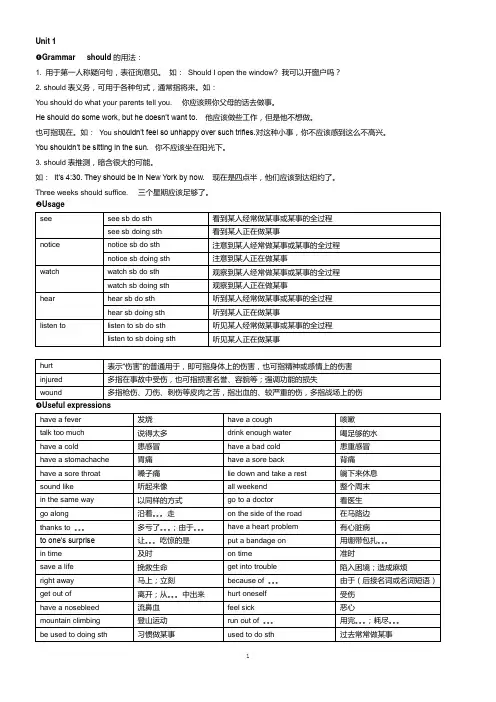
Unit 1❶Grammar should的用法:1. 用于第一人称疑问句,表征询意见。
如:Should I open the window? 我可以开窗户吗?2. should表义务,可用于各种句式,通常指将来。
如:You should do what your parents tell you. 你应该照你父母的话去做事。
He should do some work, but he doesn’t want to. 他应该做些工作,但是他不想做。
也可指现在。
如:You sh ouldn’t feel so unhappy over such trifles.对这种小事,你不应该感到这么不高兴。
You shouldn’t be sitting in the sun.你不应该坐在阳光下。
3. should表推测,暗含很大的可能。
如:It’s 4:30. They should be in New York by now. 现在是四点半,他们应该到达纽约了。
Three weeks should suffice. 三个星期应该足够了。
❷UsageUnit 2❶Gramma r 动词短语由动词加介词构成,相当于一个及物动词,后面要跟宾语❷Usagesuch和so的区别alone lonelyopen,close,turn on,turn off的区别Useful expressionsUnit 3❶Grammar Would/ Could you please…?表示提出请求或许可时;would/ could 并非是动词过去式。
而是表示说话者语气较为委婉。
例:uld you please tell me how to get the post office? 请你告诉我怎么才能到邮局,好吗?❷Usage❸ExpressionsUnit 4Gramma r时间状语从句(1)时间状语从句常用when, as, while, before, after, since, till, until, as soon as等连词来引导。
人教版初二英语下册语法

⼀.重点短语归纳1. foot---feet 脚 tooth---teeth ⽛齿2. have a cold 感冒3. have a stomachache 胃疼4. have a sore back背疼5. have a sore throat喉咙疼6. have a fever发烧7. lie down and (have a)rest 躺下休息 have a rest 休息8. hot tea with honey 加蜜的热茶9. see a dentist 看⽛医 see a doctor 看医⽣10.drink lots of water多喝⽔11.lots of ,a lot of, a lota lot of=lots of,可以修饰可数名词复数和不可数名词,⼀般⽤在肯定句中。
:There are lots of ( a lot of) books in our library.There is a lot of water on the grounda lot,是⼀个副词词组,跟动词连⽤;表⽰⼗分,很等意思; Thanks a lot.12. have a toothache⽛疼13. That’s a good idea好主意14. go to bed 去睡觉 go to bed early 早上床睡觉15. feel well感到好 feel ill 感到不舒服I don’t feel well= I’m not feeling well我感觉不舒服.16. start doing/ to do sth开始做某事TO DO 是⼀件事情完成了,开始做另外⼀件事情DOING是原来的那件事情做到⼀半,现在⼜开始做了,是同⼀件事情。
17. two days ago两天前18. get some rest 多休息, 休息⼀会⼉19. I think so我认为是这样20. be thirsty⼝渴21. be hungry 饥饿22. be stressed out紧张23. listen to music听⾳乐24. healthy lifestyle健康的⽣活⽅式25. traditional Chinese doctors传统中医26. need to do sth 需要做某事I have a toothache. I need to see a dentist. 我⽛痛, 我需要去看⽛医.We need to keep our classroom clean. 我们需要保持教室的⼲净.27. a balance of yin and yang阴阳平衡28. for example例如29. too much yin太多的阴, 阴⽓太盛too much + 不可数名词太多的…much too +形/副实在太… 极其,⾮常too many + 可数名词复数太多的…30.be good for sth./ doing sth. 对什么有益,对什么有好处be bad for sth./ doing sth. 对什么有害be good to 对…好be good at =do well in 在……⽅⾯好,擅长be good(bad) for、be good at的相关⽤法 1.be good for 对......有益 Doing morning exercises is good for your health. 做早操对你们的建康有益。
人教版英语八年级下册知识点

Unit 1 What’s the matter?一、重点短语1. have a fever 发烧2. have a cough 咳嗽3. have a toothache 牙疼4. have a sore back 背疼5. have a sore throat 喉咙痛6.have a cold 受凉;感冒7. have a nosebleed 流鼻血8.have a heart problem 有心脏病9.have a stomachache 胃疼10.have problems breathing 呼吸困难11. talk too much 说得太多12. drink enough water 喝足够的水13. lie down and rest 躺下来休息14. hot tea with honey 加蜂蜜的热茶15. see a dentist 看牙医16. get an X-ray 拍X 光片17. take one’s temperature 量体温18. feel very hot 感到很热19. go along 沿着……走20. go to a doctor 看医生21. get off/on 下车/上车22. get into trouble 造成麻烦23. get into/out of 进入/从……出来24. be in control (of) 掌管;管理25.be out of control(of)失控26. thanks to 多亏了27. on the side of the road 在马路边28. shout for help 大声呼救29. put some medicine on sth. 在…上面敷药30. all weekend 整个周末31.put a bandage on sth. 用绷带包扎32. hurt oneself 受伤33. to one’s surprise 使....... 惊讶的34.fall down 摔倒35. without thinking twice 没有多想36. save a life 挽救生命37. put her head back 把她的头向后仰38. cut his knee 割伤他的膝盖39. be used to doing sth. 习惯做某事40. used to do过去常常41. in the same way 以同样的方式42. sound like 听起来像43. make a decision 做出决定44. because of 由于45. mountain climbing 登山运动46. feel sick 感到恶心47. in a difficult situation 在困境中48. take risks 冒险49. keep on doing sth. 继续做某事50. give up (doing) sth. 放弃51. run out (of) 用完;用尽52. in time 及时on time准时53. right away/at once 立刻54. so that 以便二、重点语法1.What’s th e matter(with sb)?怎么了?询问麻烦事或身体状况=What’s the trouble (with sb)?=What’s the problem (with sb)?=What’s up?=What’s your trouble/problem?2.1.) have a+名词,表示某种病have a cough咳嗽2.)sore也可表疾病have a sore back/throat背疼/喉咙痛3. need有两种词性,实义动词和情态动词实义动词:1. need sth 2. need (sb) to do 3. don’t need.....情态动词:1. need+原型2. Need I ....? 肯Yes,you must. 否No, you needn’t.4.see sb do sth看见某人做某事(强调全过程)see sb doing sth看见某人正在做某事(强调正在发生)5.expect sth期待某物agree with sb同意某人expect(sb) to do 期待做某事agree to do同意做某事expect+that从句期待agree+that从句6.have trouble/problems in doing sth 做某事有困难7.trouble用法:1).be in trouble处于困境2).get(sb) into trouble(使某人)陷入困境8.词组辨析:used to do过去常常be used to doing习惯于做9.so...that+从句如此...以至于so that为了,目的是引导目的状语从句(当主句主语与从句主语一致时可用in order to)Eg: He works hard so that he can succeed=He works hard in order to succeed.10.What’s the meaning of...?=What does...mean?....的意思是什么?11.反身代词:myself, yourself, himself, herself, itself, ourselves, yourselves, themselvesteach oneself,enjoy oneself,dress oneself,introduce oneself,help oneself12.躺:lie-lay-lain-lying 说谎:lie-lied-lied-lying下蛋:lay-laid-laid-laying(规则的撒谎,不规则的躺,躺过就下蛋)Unit 2 I ’ll help to clean up the city parks.一、重点短语1. Clean-Up Day 清洁日2. an old people’s home 养老院3. help out with sth. 帮助解决困难4. used to do sth.过去常常做某事5. care for 关心;照顾6. the look of joy 快乐的表情7. at the age of 在......岁时8. clean up 打扫(或清除)干净9. cheer up (使)变得更高兴;振奋10. give out 分发;散发11. come up with 想出;提出12. make a plan 制订计划13. make some notices 做些公告牌14. try out 试用;试行15. work for 为…工作;为…. 效力16. put up 建造;举起;张贴17. hand out 分发;散发;发给18. call up 打电话;召集19. put off 推迟;延迟20. for example 比如;例如21. raise money 筹钱;募捐22. take after 与......相像;像23. give away 赠送;捐赠24. fix up 修理;修补;解决25. be similar to 与……相似26. set up 建立;设立27. disabled people 残疾人28. make a difference 影响;有作用29. be able to 能够30. after-school reading program课外阅读项目31.a feeling of satisfaction满足感32.several hours若干小时33.volunteer to do自愿做34.sick kids生病的孩子35.homeless people无家可归的人36.be busy with sth忙于37.disabled people残疾人38.a trained dog一只受过训的狗39.book lover爱书者40.think up想出二、重点语法1. notice sb do sth注意到某人做过某事,notice sb doing sth注意到某人正在做某事3.satisfaction用法:1.)satisfy v. satisfy sb 使某人满意2.)satisfied/satisfying adj. be satisfied with对...满意3.)satisfaction n. to one’s satisfaction令某人满意4.owner用法:1.)the owner of...的主人the owner of the shop 2.)one’s own+名词my own shop5. sick adj. 定语,表语sickness n.ill adj. 表语illness n. He is ill.=He is sick. Here is a sick dog.5.raise 及物动词rise 不及物动词The sun rises. Raise your hands.6.take after像(品质,外貌)look like像(外貌)7.imagine+动名词/名词/代词imagine sb doing8.have trouble/problems/difficulty in doing做某事有困难He has trouble in learning English.9.形容词+ness变名词:kind-kindness,ill-illness,sick- sickness, sad-sadness,happy-happiness,busy-business,fair-fairness10.句型辨析:It is clever/smart/kind/nice/friendly of sb to 某人做某事是...的It is +adj+for sb to do 做某事对某人来说是...的11.change one’s mind改变主意change green into yellow由绿变黄12.be interested in=have an interest in 对...感兴趣Unit 3 Could you please clean your room?一、重点短语1.go out for dinner 出去吃饭2. stay out late 在外面待到很晚3. go to the movies 看电影4. take sb. for a walk 带某人去散步5.all day/evening 整曰/夜6.do housework 做家务7. get a ride 搭车8. work on 从事9. finish doing sth. 完成做某事10. clean and tidy 干净整洁11. do the dishes 洗餐具12. take out the rubbish 倒垃圾13. fold the clothes 叠衣服14. sweep the floor 扫地15. make the bed 整理床铺16. as a result结果17. help out 帮忙18. get good grades取得好成绩19. throw down 扔下20.as soon as=the minute 一...就...21. come over 过来22.shout back 大声回应23.walk away 走开24.all the time 一直;总是25.share the housework 分担家务26. a comfortable home 一个舒适的家27.in surprise 惊讶地28. get something to drink 拿点喝的东西29.hang out 闲逛30. watch one show 观看一个节目31. pass sb. sth. 把某物传给某人32. lend sb. sth. 把某物借给某人33. get sth. wet 使某物弄湿34. hate to do sth. 讨厌做某事35. do chores 做杂务36. help sb. (to ) do /with sth 帮助某人干某事37.bring a tent带顶帐篷来38. buy some snacks买些小吃39. go to the store去商店40. invite sb. to a party邀请某人参加聚会41. make sb. do sth. 使某人做某事42. enough stress足够的压力43.a waste of time浪费时间44. in order to为了45. provide sb with sth=provide sth for sb46. mind doing sth. 介意做某事47. depend on依赖;依靠48. look after/take care of 照顾;照看49. develop children’s independence发展孩子的独立性50. do one’s part in (doing ) sth.做某人分内的事51. come home from school/ work放学/下班回家二、重点语法1.Could you please(not) do sth ?用于提出请求,希望得到对方肯定回答,语气较委婉。
八年级英语下册知识点归纳总结
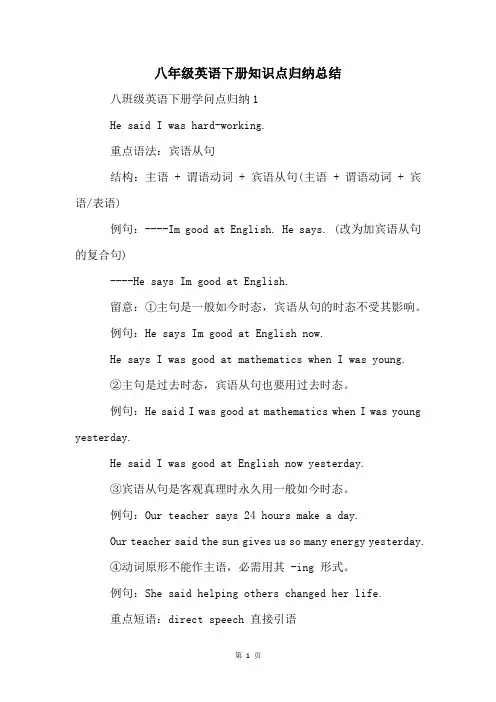
八年级英语下册知识点归纳总结八班级英语下册学问点归纳1He said I was hard-working.重点语法:宾语从句结构:主语 + 谓语动词 + 宾语从句(主语 + 谓语动词 + 宾语/表语)例句:----Im good at English. He says. (改为加宾语从句的复合句)----He says Im good at English.留意:①主句是一般如今时态,宾语从句的时态不受其影响。
例句:He says Im good at English now.He says I was good at mathematics when I was young.②主句是过去时态,宾语从句也要用过去时态。
例句:He said I was good at mathematics when I was young yesterday.He said I was good at English now yesterday.③宾语从句是客观真理时永久用一般如今时态。
例句:Our teacher says 24 hours make a day.Our teacher said the sun gives us so many energy yesterday.④动词原形不能作主语,必需用其 -ing 形式。
例句:She said helping others changed her life.重点短语:direct speech 直接引语reported speech = indirect speech 间接引语first of all = at first 首先pass on 传递be supposed to do sth. 应当做某事be good at = do well in 在某方面做得好in good health 身体健康get over 克服open up 打开care for = take care of = look after 照料;照看not any more = not any longer = no longer 不再have a cold 感冒end-of-year exam 年终考试get nervous 变得紧急forget to do sth. 遗忘做某事(该事未做)forget doing sth. 遗忘做某事(该事已做)its + adj. + [for sb.] + to do sth. 做某事[对某人来说](加形容词)context 上下文Reading Strategy(阅读方法)First read for meaning, not for detail. (首先理解文段的大致意思,不在于文段的详情部分。
牛津译林版八年级英语下册单元重点词组,句型、语法汇总
牛津译林版八年级英语下册单元重点词组,句型、语法汇总
- 第一单元:
- 重点词组:
- I've just eaten it. 我刚刚把它吃了。
- 重点句型:
- used to do sth. 意为“过去常常做某事/以前经常做某事/曾经做某事”,表示过去的习惯。
- 第二单元:
- 重点词组:
- over the years 多年来
- 重点句型:
- It is/has been+时间段+since+一般过去时。
- 第三单元:
- 重点词组:
- married/divorced/single 已婚的/离婚的/单身的
- 重点句型:
- 疑问词+动词不定式
- 第四单元:
- 重点词组:
- be full of 充满
- 重点句型:
- so that 以便,为了
- 第五单元:
- 重点词组:
- as a result 结果
- 重点句型:
- 现在完成时
- 第六单元:
- 重点词组:
- interview sb. about sth. 就某事采访某人- 重点句型:
- It is+形容词+to do sth.
- 第七单元:
- 重点词组:
- return to sp. 回到某地
- 重点句型:
- 现在完成时
- 第八单元:
- 重点词组:
- primary school 小学
- 重点句型:
- 祈使句。
人教版八年级下册英语——知识点语法归纳总结
人教版八年级下册英语——知识点语法归纳总结Unit 1 What’s the matter?1. 短语归纳①have a cold/ fever/ stomachache…感冒、发烧、胃疼……②lie down 躺下③too much 太多④get an X-ray 拍片⑤take one’s temperature量体温⑥sound like 听起来像……⑦take breaks (take a break) 休息⑧go to a doctor 看医生⑨get off 下车⑩on the side of…在……边上have a heart problem 患心脏病wait for 等待to one’s surprise 使……惊讶的;出乎意料? thanks to 多亏;由于in time 及时think about 考虑,认为right away 立刻,马上get into trouble 陷入麻烦fall down 摔倒a few 几个,一些21 have problems breathing 呼吸困难22 get sunburned 晒伤23 look up 查阅24 be interested in…对……感兴趣25 be used to doing…习惯于做某事26 take risks (take a risk) 冒险27 lose one’s life 丧生28 became of 因为29 run out (of) 用尽,耗尽30 be ready to do sth. 准备做某事31 cut off 切除32 climb down 爬下33 get out of 离开;从……出来34 tell of 讲述35 the importance of (doing sth.) (做某事的)重要性36 be in control of 掌管,管理37 make a decision 做决定38 keep on doing sth. 坚持做某事39 give up 放弃40 cut/ hurt oneself 使自己受伤2. 典句必背①What’s the matter?②I have a stomachache.③What should I do?④Should I take my temperature?⑤I think you should lie down and rest.⑥If your head and neck still hurt tomorrow, then go to a doctor.⑦His love for mountain climbing is so great that he kept on climbing mountains even after this experience.3. 用法集萃(1) 当别人心情不好,身体不适或遇到麻烦时,我们可以用如下表达表示关心:What’s the matter?What’s the matter with you?What’s wrong with …?What’s the trouble\problem with …?(2) 英语中常用have描述身体的不适,此时have意为“患有”,常用结构:①have a + 疾病例:have a cold 感冒;have a fever 发烧;have a cough 咳嗽②have a + 身体部位-ache例:have a headache 头痛;have a toothache 牙痛③have a sore + 身体部位例:have a sore throat 咽喉痛;have a sore back 背痛(3) lie down躺下;tell lies/a lie 说谎含义过去式过去分词躺;平躺lay lain位于撒谎;说谎lied lied(4) maybe & may be①maybe,“或许”,常用于句首,表示可能性,后加句子。
八年级下册英语知识点Unit1 to Unit5 单词短语语法
Unit 1 What’s the matter?一、识记单词matter n.问题,事情sore adj.疼痛的,酸痛的stomachache n.胃痛,腹痛foot n.足,脚neck n.颈,脖子stomach n.胃,腹部throat n.咽喉,喉咙fever n.发烧lie v.躺,平躺rest v&n.放松,休息cough v.咳嗽toothache n.牙痛headache n.头痛break n.间歇;休息hurt v.(使)疼痛,受伤passenger n.乘客,旅客trouble n. 问题,苦恼hit v.(用手或器具)击,打sick adj.生病的;有病毒knee n.膝盖,膝accident n.(交通)事故;意外遭遇situation n.情况,状况knife n.(knives) 刀blood n.血mean v.意思是,打算,意欲importance n.重要性,重要decision n.决定,抉择control n.﹠v.限制,约束,管理spirit n.勇气,意志death n.死,死亡nurse n.护士breathe n.呼吸sunburned adj.晒伤的ourselves pron.(we的反身代词)我们自己,自己climber n.登山者;攀登者risk n &v.危险,风险herself pron.(she的反身代词)她自己bandage n.绷带v.用绷带包扎一、背诵短语have a fever/ cough / toothache/ stomachache 发烧/咳嗽/牙疼/胃疼have a cold 受凉;感冒lie down and rest 躺下来休息hot tea with honey 加蜂蜜的热茶see a dentist 看牙医take one’ s temperature 量体温put some medicine on sth. 在……上面敷药sound like 听起来像in the same way 以同样的方式go to a doctor 看医生go along 沿着……走on the side of the road 在马路边shout for help 大声呼救without thinking twice 没有多想get off 下车in time 及时thanks to 多亏了;由于to one’ s surprise 使....... 惊讶的save a life 挽救生命get into trouble 造成麻烦right away 立刻;马上because of 由于get out of 离开hurt oneself 受伤put a bandage on sth. 用绷带包扎fall down 摔倒feel sick 感到恶心have problems breathing 呼吸困难mountain climbing 登山运动be used to doing sth. 习惯做某事run out (of) 用完;用尽be in control of 掌管;管理in a difficult situation 在闲境屮keep on doing sth. 继续或坚持做某事make a decision 做出决定take risks 冒险give up 放弃二、重点句型1.What’ s the matter?=What’ s the matter wit h you?= What’s the trouble with you?= What’ s wrong with you?你怎么了?2. What should she do? 她该怎么办呢?Should I take my temperature? 我应该量一下体温吗?主语+ should/shouldn’t + 动词原形. ..①You should lie down and rest. 你应该躺下休息一会儿。
人教版丨八年级英语下册9~10单元重点短语与重点语法详解
人教版I八年级英语下册9~10单元重点短语与重点语法详解Unit9Have you ever been to a museum._、重点短语a couple of —对..tea art茶艺tea set茶具thousands of数以千计on the one hand,.....on the other hand—方面,另一方面all year round全年space museum太空博物馆history museum历史博物馆art museum艺术博物馆water park水上公园amusement park游乐园science/nature museum科学博物馆,自然博物馆somewhere different不一样的地方take the subway乘地铁by bike骑自行车have a great time玩的愉快film museum电景?博物馆learn about学习关于...put up搭建better than比..好encourage sb.to do sth鼓劫某人去做某事right now立刻,马上walk around the park在公园里走take a ride兜风the Great Wall长城the Palace Museum故宫take a holiday度假English-speaking country说英语的国家at night在夜晚during the daytime在白天be asleep睡着nature environment自然环境be close to挨着of course当然二、重点句型:1.-Have you ever been to a science museum?--Yes,I have.一一你曾经去过科学博物馆吗?--是的,去过。
2,—F ve been to the art museum many times.我去过艺术博物馆许多次。