
Unit6_Do_you_like_bananas第一课时
人教版七年级上Unit6_Do_you_like_bananas)课件
1. Write down the conversation(2c) between your and your partner.
2. Write a report according to the survey.
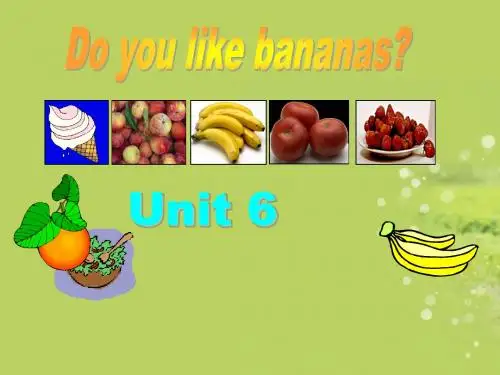
Unit 6 Do you like bananas
Aims and Language points:
2. -Let’s think about the food.
-Sure.
-让我们想想(吃什么)食物吧。 -当然。/没问题
think about “对…有(某种观点); 回想起;考虑”
Eg. You can think about it. 你可以把这事考虑一下。
Sure.
What do you think about him? 你觉得他这人怎么样?
中用助动词does。 疑问句和否定句中用到does后,谓语动词用原形(like).
Let’s chant
Join us, join us. Let’s have a party. Do you like salad ? Yes, I do. Do you like bread ? No, I don’t. Does he like apples ? Yes, he does. Does she like pears? No, she doesn’t. Do they like hamburgers? Yes, they do. I see. I see. Let’s have a party.
Do you like …?
Names
tomatoes
ice-cream
hamburger s
2a.Listen and circle the food. (Students’ Book Page 32)
七年级英语上册-Unit6-Do-you-like-bananas课件-人教新目标版
a banana s
a hamburger s
a tomatoes
broccoli
French fries
an orange s
ice cream
a strawberry ies
a pears
salad
Let’s have a big meal.(让我们大吃一顿.)
Explanation
1. Running star Sandra Clark eats lots of healthy food. some , many , lots of , a lot of 的区别 (1) some 意思是 “一些”, 可以修饰 可 数名词,也可以修饰不可数名词。 如:some friends 一些朋友 some water 一些水
Sandra: No, I don’t like vegetables.
Well, only salad. I like
salad. But I like fruit. I like
bananas, oranges…
Tom: How about apples? I don’t like apples!
hamburgers
French fries
ice cream
tomatoes
broccoli
strawberry strawberries salad
/e/ e
pears
bananas
oranges
/ e/
1a Match the words
1. hamburgers 2. tomatoes 3. broccoli 4. French fries 5. orange 6. ice cream 7. salad 8. bananas 9. strawberries 10.pears d g a h e f c b i j
《Unit 6 Do you like banana?》说课稿
《Unit 6 Do you like banana? 》说课稿Section A 1 (1a-2d)一、教学目标:1. 语言知识目标:1) 能掌握下列词汇:banana, hamburger, tomato, ice-cream, salad, strawberry, pear, milk, bread, birthday, dinner, food, week, sure, How about …?, burger, vegetable, fruit, right, then2) 能掌握以下句型:①—Do you like salad? —Yes, I do. / No, I don’t.②—Does she/he like …? —Yes, she/he does./ No, she/he doesn’t.③—I like … /I don’t like …④—He/Sh e likes … / He/She doesn’t like …3) 能通过介绍食物学会询问对方喜欢与不喜欢的食物。
2. 情感态度价值观目标:该部分学习内容贴近学生的生活,谈论的主题涉及学生的饮食习惯和偏爱,对学生养成健康的饮食习惯很有帮助,能引起学生的特别关注,极易于激发学生学习英语的欲望和兴趣,使他们乐于参与各种英语实践活动。
通过学习西方食品文化,促使学生了解西方生活方式与文化,培养跨文化交际的意识。
二、教学重难点1. 教学重点:1) 学习并积累一些食物的词汇。
2) 名词复数的使用。
3)动词like一般现在时的各种句式及一般疑问句的肯定、否定回答;2. 教学难点:1) 行为动词like的一般现在时的用法;2) 使用do和does引导的一般疑问句的构成和使用。
三、教学过程I. New wordsAccording the pictures, learn the new words.II. Warming-upAsk some Ss questions:T: What’s that?S1: It’s _______.T: What are those?S1: They are _______.III. Presentation1. Show some pictures of food on the screen and learn the new words.(banana, hamburger, tomato, ice-cream, salad, strawberry, pear, milk, bread, birthday, food, burger, vegetable, fruit)2. Let Ss read and try to remember the new words.3. T: Let’s look at the picture in 1a. Match the words with the things in the picture. Thencheck the answers.IV. ListeningT: Let’s work on 1b. Listen and number the conversations [1-3].Ss listen to the tape and number the conversations.V. Pa ir work1. Read the conversations in 1b. Have Ss read after the teacher.2. Now let’s act out the conversations 1-3.(Ss work with their partner and act out the conversation 1-3.)3. Look at the picture and make more conversations using the words in 1a.4. Let some pairs act out their conversations.VI. Listening1. Point to and read each word aloud, Ss only listen. Then let some Ss read the words bythemselves. Check that Ss understand the meaning of the ea ch word.2. Play the recording for the first time, Ss only listen.3. The n play the recording again Ss circle the words they hear. Play the recording again.Check the answers.4. A girl and a boy want to have something in the restaurant. Do they like hamburgers? Doesthe boy like milk? Does the boy like ice-cream? Now let’s listen to the recording.For the first time, Ss only listen.For the second time, Ss listen and fill in the blanks.Play the recording for the third time, Check the answers.VII. Pair work1. Read the conversation in speech bubbles in 2b. Ask Ss to read after the teacher.2. Ss practice the conversations in pairs.3. Let some pairs act out the conversations.4. Ss give answers that are true for them. Then practice their conversations.5. Ask some pairs act out their conversations.VIII. Reading1.According the pictures, learn the new words.2.Read the dialogue in 2d. Then answer the questions.Does John like hamburgers?What does Jack don’t like?What fruit does John like?3. Read the dialogue with your partner. Then role play the conversation.4. Practice the conversation with your partner.5. 评价:(让学生们对自己的表现及语言表达能力进行自我评价,在小组内评价,然后进行评出最优秀的小组。
初一年级-英语6单元11
初⼀年级-英语6单元11Unit 6 Do you like bananas?第⼀课时Section A 1a-1c导学案tomato, ice-cream ,salad, strawberry, pear, milk, bread,banana; 复习orange, like, and2. 句型 -Do you like bananas? -Yes, I do.\No, I don’t.- Do Tom and Bob like salad? - Yes, they do.\ No, they don’t.- Does she like milk? - Yes, she does.\No, she doesn’t.- Does Tom like tomatoes? - Yes, he does.\ No, he doesn’t.重点:1、可数名词的复数变化规则和不可数名词。
2、含有like的⼀般疑问句的问答⽅式。
难点: 1.‘like’后名词的形式。
2. 对既可数⼜不可数单词的认知。
使⽤说明及学法指导1 .课前预习单词完成预习⾃测2.⼩组合作探究,学⽣掌握⾷物类词语3 师⽣合作探究可数名词和不可数名词4 在掌握可数和不可数名词的基础上,学⽣进⼀步练习like相关句型5.完成本课的“练⼀练”部分,个⼈总结反思本课所学内容知识链接⼀.我⾃学我成功汉堡包_______⾹蕉______西红柿______梨_____草莓______苹果冰激凌________沙拉______⾯包______⽜奶___ _桔⼦我思考,我问疑:合作学习1,单词朗读2.师⽣单词句型学习3.师⽣,⽣⽣对话练习4.听⼒练习,答案核对5.导学案练习题探究学习探究点⼀:可数与不可数;单数与复数。
翻译并观察:some milk______some water______some bread______ a hamburger________an orange_______two pears_______3 photos______4 radios______ 4tomatoes_______8 dictionaries_______ 9 families_________ 2 keys______3 boys_____9 boxes______5watches_________ 2 pencil boxes________总结:可数名词变化规则:1.可数名词的复数⼀般加_____2.以____字母+y结尾的,变y为i加_____3.tamato 复数加_____不能计算数量的名词叫____________ 不可数名词____⽤a,an,one修饰。
Unit 6 第1课时 Section A(1a-2d)(精品课件)-【大单元教学】七年级英语上册
pears
strawberries
apples
tomatoes
hamburgers
oranges
vegetables
不可数名词:
bread
milk
既是可数名词也是不可数名词: salad
ice-cream
Play a game Quick eyes
—What are these? —They’re... Do you like…?
3 A: Do you like oranges? B: Yes, I do.
—Do you like…? —Yes, I do./No, I don’t.
5 Post-listening
1c Practice the conversations with your partner. Then make your own conversations.
hamburgers pears
tomatoes strawberries
oranges
ice-cream salad
bananas
2b Listen again. Fill in the blanks.
I like hamburgers. Do you like _h_a_m_b_u_r_g_e_rs_?
2. Girl: Do you like tomatoes? Boy: No, I don't like tomatoes.
3. Girl: Let's have ice-cream. Boy: Oh, no. Girl: No? Boy: I don't like ice-cream.
2c Practice the conversations in 2b. Give answers that are true for you. Do a survey in groups of four and give a report.
795.初中英语七年级上册-Unit 6 Do you like bananas?(第 1、2课时)教案 (新版)人教新目标版.doc

Unit 6 Do you like bananas?I.Teaching objectives单元教学目标Skill Focus 听Listen for different foodsListen for likes and dislikes说Learn to recognize names for various foodsLearn to tell fruits from vegetablesLearn to talk about one’s likes and dislikes读Read about names of different foodsRead about one’s likes and dislikes写Write about one’s likes and dislikes for three meals功能句式Talk about one’s likes and dislikesDo you like…?Yes, I do. / No, I don’t.Does he like…?Yes, he does. / No, he doesn’t.She likes….She doesn’t like…词汇food, hamburger, tomato, ice-cream, salad, banana, strawberry, pear, milk, bread, chicken, vegetable, fruit, apple, rice, egg, carrot, breakfast, lunch, dinner, think about语法Present tense to likeYes/No questions and short answersAffirmative and negative statementsNoun: countable noun and uncountable noun话题FoodII. Teaching materials analyzing and rearranging 教材分析与重组1.教材分析本单元以food 为话题,设计了三个部分的内容。
人教版七年级上册英语第六单元第一课时教案设计
Unit6 Do you like bananas?SectionA period oneTeaching aims:1.knowledge objects(1)Function:Let the Ss know how to talk about their likes and dislikes. Learn somenew words ab o ut food。
(2)Keyvocabulary:hamburgers,tomatoes,oranges,ice-cream,salad,bananas strawberries,pears,milk,bread(3)Target language:①-I like bananas。
Do you like bananas?—Yes,I do./No,I don’t。
②-I don’t like salad。
Do you like salad?—Yes,I do./No,I don’t.③—Does he/she like hamburgers?—Yes,he/she does.He/She likes…No,he/she doesn’t。
He/She doesn’t like(4)Structure:The countable nouns and uncountable nouns.2。
Ability objects:To learn to talk about likes and dislikes.3.Moral objects:Learn to care about others。
Teaching key points:new words;sentence patternsTeaching difficult points:To talk about the countable nouns and uncountable nouns. Teachingmethods:Pairwork;Groupwork;Free talk;Listening Teaching aids:ppt; some real objectsTeaching procedures:Step1:Lead in(1)Show a ping—pong ball。
人教版七年级英语上册教案(RJ) Unit 6 Do you like bananas
Unit 6Do you like bananas?第一课时Section A(1a-1c)1.重点单词:banana,hamburger,tomato,icecream,salad,strawberry,pear,milk,bread2.重点句式:—Do you like bananas?—Yes,I do.—Do you like salad?—No,I don't.1.用like来谈论喜好2.可数名词的单复数1.用like来谈论喜好2.可数名词的单复数一、预习课本P31新单词并背诵,完成下面的汉译英。
1.香蕉____________ 2.汉堡____________3.西红柿____________ 4.冰激凌__________5.沙拉____________ 6.草莓____________7.梨____________ 8.牛奶____________9.面包____________二、认真预习1a,1b,1c,找出下列句型。
1.—你喜欢香蕉吗?—是的,我喜欢。
________________________________________________________________________ 2.—你喜欢沙拉吗?—不,我不喜欢。
________________________________________________________________________Step 1情景导入Teacher:There are many different kinds of fruits and vegetables in the world,and different people like different food.Everyone has its own taste.What kind of food do you like?What kind of food do you dislike?Today let's talk about the food we like and we dislike in Unit 6.环节说明:由学生感兴趣的话题导入新课,简洁明了,激起学生的学习兴趣。
内蒙古百灵庙第二中学:Unit 6 Do you like bananas(第1课时)学案(人教新目标七年级下册)
【学习目标】:1,掌握重点单词的用法2,掌握重点句型:--Do you/they like salad? Yes, I/they do./ No, I/they don’t.---Does she like tomatoes? Yes, she does./ No, she doesn’t.----I like oranges. I don’t like bananas.----We like rice. We don’t like hamburgers.----He likes ice-cream. He doesn’t like vegetables.【学习重点】:1.掌握动词like在一般现在时的用法;肯定句和否定句;一般疑问句及其回答。
2.能够正确使用可数名词和不可数名词(milk,bread,rice)以及既可用作可数,又可用作不可数的名词(food,fruit,ice-cream,salad,chicken)。
【课前预习】:A)看单词表,读会所有单词,尽量背写出下列单词(周报):(每个两遍)1.食物2. 水果3. 蔬菜4.香蕉5.西红柿6. 草莓7.梨8.苹果9.胡萝卜10. 汉堡包11冰激凌12.沙拉13.牛奶14.面包15. 鸡蛋16. 大米17. 鸡肉______________________短语18.思考,思索_____________________ 19.(提出建议)----怎么样?_____________________【知识点探究】)有,拥有;单三是has,强调所属关系My father has many new books.I have a new computer.b)“have+ 表示一日三餐的名词”表示“用餐”这里一般不用eat.have注意:在英语中一日三餐breakfast/lunch/dinner的名词前面一般不加冠词,(dinner “正餐,主餐,可以是午餐也可是晚餐;supper仅指晚餐,通常指非正式场合的晚餐)。
Unit 6 第1课时 (Section A 1a-2d) 教学课件-七年级英语上册(人教新目标)
like后接可数名词, 常使用复数形式; 接不可数名词,用 原形。
Let’s talk Ask your partner about his/her eating habits.
Do you like ...?
Yes, I do. I like ...
/peə(r)/
/peə(r)z/
➢ pear -a pear -two pears
➢ orange -an orange -two oranges
/bəˈnɑːnə/
➢ banana -a banana -three bananas /bəˈnɑːnəz/
Let’s learn Let’s learn and talk.
They are/It is … (healthy/
sweet/ juicy/... )
No, I don’t.
I don’t like ... They are/It
is … (unhealthy/...)
开始
Let’s predict Liu Li and John meet their friends in the dining hall.
/ˈsæləd/
➢ salad -a salad-two salads /ˈsælədz/
Let’s learn Let’s learn and talk.
/ˈtʃɪkɪn/
➢ chicken-a chicken-chickens/ˈtʃɪkɪnz/
/mɪlk/
➢ milk -milk -milk
Jack: Hey, John’s birthday dinner is next week. 下周。 该短语前不加介词。