
约翰.赫尔,期权期货和其他衍生品(third edition)习题答案
CH 77.1 一位投资者购买了一个执行价格为X 的看涨期权并出售了一个相同执行价格的看跌期权。
请描述他的头寸情况。
解:投资者头寸状况为: max (S T - X,0)- max (X - S T ,0)此头寸相当于执行价格为X 的远期合约。
当X 与远期合约价格相同时,合约价值为0,此时看涨期权与看跌期权价值相等。
7.2 请说明为什么欧式期权总是不如有相同标的物、相同执行价格、相同到期 日的美式期权值钱。
解:美式期权持有者除具有欧式期权持有者所拥有的所有权利外,还有提早执行权。
因此,美式期权至少应与相应的欧式期权有相同的价值。
7.3 请解释为什么美式期权的价值总是大于等于它的内在价值。
解:美式期权的持有者有立即执行期权,实现期权内在价值的权利,因此,美式期权的价值至少应等于其内在价值。
7.4 列举影响期权价格的6个因素。
解:影响期权价格的6个因素有:标的资产价格、期权的执行价格、无风险利率、资产价格的波动率、期限以及持有期间收益。
7.5 基于无红利支付股票的看涨期权,期限为4个月,执行价格为$25,股票价格为$28,无风险利率为8%。
该看涨期权价格下限为多少?解:该看涨期权的价格下限为:28-25×=$3.660.08*0.3333e −7.6基于无红利支付股票的欧式看跌期权,期限为1个月,股票价格为$12,执行价格为$15,无风险年利率6%,该期权的价格下限为多少?解:该看跌期权价格下限为:15×-12=$2.930.06*0.083333e −7.7请给出两个原因说明为什么早执行无红利支付股票的美式看涨期权不是最好的。
第一条原因应包括货币时间价值。
第二条原因在利率为零时也成立。
解:1)推迟执行可推迟支付期权的执行价格,期权持有者可赚取执行价格更长时间的时间价值;2)推迟执行可提供保值价值,避免执行日时股价低于执行价格。
假设期权购买者有现金X ,且利率为0。
提早执行会使期权购买者头寸在到期日为, 而推迟执行买方头寸在到期日则为max (X,)T S T S7.8 “提前执行美式看跌期权是在货币的时间价值与看跌期权的保险价值之间的权衡。
” 请解释这句话。
解: 美式期权能为其标的股票提供保险,它可使股票以执行价格X 出售。
如果期权提早执行,则保险消失,但期权多头立即获得股票价格,并可获得提早执行日至到期日间资金X 的时间价值。
7.9 执行价格为$20,3个月后到期的欧式看涨期权和欧式看跌期权,售价都为$3。
无风险年利率为10%,股票现价为$19,预计1个月后发红利$1。
请说明对投资者而言,存在什么样的套利机会。
解:因为 ,031922P S +=+=而 23.500.10*0.250.10*0.0833320*1*rt C Xe D e e −−−++=++=所以,。
因而存在套利机会,可通过买看跌期权,卖空股票及看涨期权来进行套利。
0rt P S C Xe D −+<++7.10 请解释为什么对欧式看涨期权平价关系的讨论用于美式期权不可能得出同样的结论。
解:当不可提前执行时,我们可认为若两资产价值在T 期相同,则在前几期也应相同。
当可提前执行,以上论述则不成立。
假设:,这并不存在套利机会。
因为如果我们买看涨期权,卖空看跌期权并卖空股票,我们并不能确定其结果,因为我们并不确定看跌期权是否会被执行。
0rt P S C Xe −+>+7.11一个无红利支付股票的看涨期权,期限为6个月,执行价格为$75,股票价格为$80,无风险年利率为10%。
它的价格下限为多少?解:看涨期权价格下限为:0.10*0.500$8.66S E e −−=7.12一个无红利支付股票的欧式看跌期权,期限为2个月,股票价格为$58,执行价格为$65,无风险年利率为5%,它的价格下限为多少?解:该看跌期权的价格下限为: 0.1667*0.056558$6.46e−−=7.13一个期限为4个月的无红利支付股票的欧式看涨期权现价为$5,股票价格为$64,执行价格为$60,1个月后发红利$0.08。
对所有期限的无风险年利率为12%。
对套利者而言存在什么样的机会。
解:执行价格现值为,红利现值为。
因为,50.3333*0.1260$57.65e −=0.08333*0.120.8$0.79e −=6457.650.79<−−,所以,应买看涨期权的同时卖空股票,则无论如何,均将获利。
1)如果股价降到低于$60,套利者将在期权损失$5,但从空头股票上至少可获得64(现值)利润。
57.650.79$5.56−−=2)如果到期日股价高于$60,套利者可获5.56-5.00=$0.56(现值)利润。
7.14一个期限为1个月的无红利支付股票的欧式看跌期权现价为$2.5。
股票价格为$47,执行价格为$50,风险年利率为6%。
对套利者而言存在什么样的机会?解:执行价格的现值为 ,因为2.5<49.75-47.00,套利者可通过买看跌期权、卖空股票,将利润锁定在至少$0.25。
0.06*0.0833350$49.75e −=7.15请直观地解释为什么当无风险利率上升且波动率减少时提前执行美式看跌期权变得很有吸引力。
解:当执行价格的利息(时间价值)大于保险价值损失时,提前执行美式看跌期权更具吸引力。
1)当利率上升,执行价格的利息(时间价值)增加,这会使提前执行更具吸引力。
2)当波动率减少,保险价值下降,也使提前执行更具吸引力。
7.16执行价格为$30,6个月后到期的欧式看涨期权的价格为$2。
标的股票的价格为$29,2个月后和5个月后分红利$0.50。
期限结构为水平,无风险利率为10%。
执行价格为$30,6个月后到期的欧式看跌期权的价格为多少? 解:由看涨-看跌期权平价公式:0rt C Xe D P S −++=+,则有:0r t P C X e D S −=++− =0.5*0.100.1667*0.10.4167*0.12300.50.529 2.51e e e −−−+++−= 所以6个月后到期的欧式看跌期权价格为$2.517.17在习题7.16中,如果欧式看跌期权的价格为$4,请说明存在什么样的套利机会。
解:若上题中,欧式看跌期权为$3,套利者可买入看涨期权、卖空看跌期权、卖空股票进行套利。
无论在何种情形中,均可将利润锁定在3.00-2.51=$0.49的现值水平。
7.18一个无红利支付股票的美式看涨期权的价格为$4。
股票价格为$31,执行价格为$30,3个月后到期。
无风险利率为8%。
请推出相同股票、相同执行价格、相同到期日的美式看跌期权的价格上下限。
解:由公式00rt S X S Xe −−<−,可得:31-30<4-P<31-30 0.25*0.08e − 即 1.00<4.00-P<1.59该美式看跌期权的价格上下限为:2.41<P<3.007.19在习题7.18中,如果美式看跌期权的价格高于所计算的上限值,请说明存在什么样的套利机会。
解:如果美式看跌期权价格高于$3.00,则套利者可通过卖空看跌期权、买进看涨期权、并卖空股票的操作进行套利,并至少可获得3+31-4=$30的资金进行无风险利率投资机会。
7.20假设分别是执行价格为的欧式看涨期权的价格。
且,。
所有的期权有相同的到期日。
证明: 12c c c 、、33113c 12X 、、X X 32X X >>X 322X X X −=−X210.5()c c ≤+解:构造一投资组合:买进一份执行价格为1X 的期权及一份执行价格为的期权为、卖空2份执行价格为1c 3X 3c 2X 的期权,到期日股票价格为,则组合价值为:2c T S max (,0)+max (1T S X −3T S X −,0)-2max (2T S X −,0)的数值 组合价值T S 01T S X ≤ 1T X S X <≤21T S X −2T X S X <<3212T X X S −−3T X S ≤212X X X 3−−由此可知,无论的数值如何,该组合的价值均大于等于零。
根据无套利定价理论,在期初,组合价值也应大于等于0,即T S 132c c c 2+−应大于等于0。
所以,成立。
210.5()c c ≤+3c7.21如果习题7.20中期权为美式看跌期权,会有何结果?解:同样构造一投资组合:买进一份执行价格为1X 的看跌期权1p ,一份执行价格为的看跌期权3X 3p 同时卖空2份执行价格为2X 的看跌期权2p ,到期日股票价格为,则组合价值为:max (T S 1T X S −,0)+max(3T X S −,0)-2max(,0) 2T X S − 的数值 组合价值T S 1T S X ≤132X X X 2−+1T X S X <≤2232T S X X +−2T X S X <<33T X S −3T X S ≤因此,在期初该组合价值132p p p 2+−应大于等于0,即210.5()p p 3p ≤+成立。
7.22假设你是一家杠杆比例很高的公司的经理及唯一所有者。
所有的债务在1年后到期。
如果那时公司的价值高于债务的面值,你就可以偿还债务。
如果公司的价值小于债务的面值,你就必须宣布破产,让债务人拥有公司。
a) 将公司的价值作为期权的标的物,描述你的头寸状况。
b)按照以公司价值为标的物的期权的形式,描述债务人的头寸状况。
c)你应当如何做来提高你头寸的价值?解:a) 拥有一份看涨期权多头,头寸为max (T V D −,0)其中,为公司价值,为债务面值;T V D b)拥有一份看跌期权空头及债券多头,其头寸价值为 -max (D T D V −,0) c)应通过努力经营公司,使公司价值提高。
7.23经理股票期权是公司向它的经理们发行的看涨期权。
通常期权执行价格接近于期权发行时的股票市场价格。
如果期权被执行,公司发行新的库存股票。
经理人员通常不能将经理股票期权出售给其他人,有时在经理人员离开公司后将被取消。
他们通常为期10年。
在刚好到期前被执行。
请讨论一位经理为什么会提前执行期权。
解:当经理需要现金,或他对公司未来前景不确定时,他会选择提前执行期权。
一般的看涨期权在这两种情形下都会被执行,但经理执行期权不同。
理论上,经理可卖空公司股票作为一种替代选择,但实际中这行为并不鼓励,甚至是违法的。
因而只有提前执行期权。
约翰.赫尔,期权期货和其他衍生品(third edition)习题答案
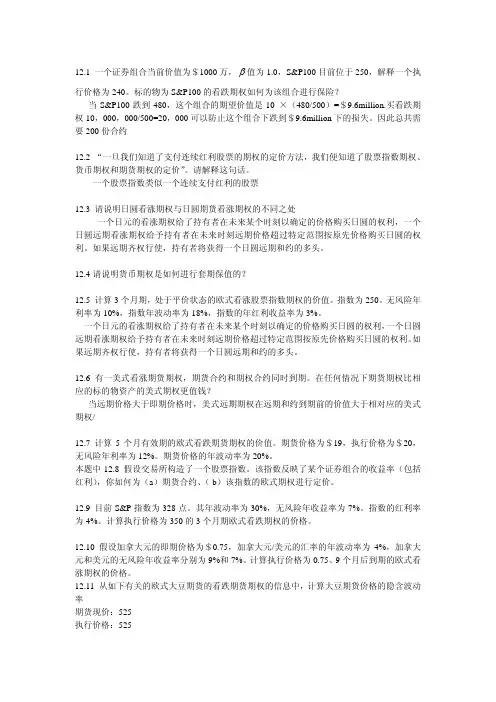
12.1 一个证券组合当前价值为$1000万,β值为1.0,S&P100目前位于250,解释一个执行价格为240。
标的物为S&P100的看跌期权如何为该组合进行保险?当S&P100跌到480,这个组合的期望价值是10 ×(480/500)=$9.6million.买看跌期权10,000,000/500=20,000可以防止这个组合下跌到$9.6million下的损失。
因此总共需要200份合约12.2 “一旦我们知道了支付连续红利股票的期权的定价方法,我们便知道了股票指数期权、货币期权和期货期权的定价”。
请解释这句话。
一个股票指数类似一个连续支付红利的股票12.3 请说明日圆看涨期权与日圆期货看涨期权的不同之处一个日元的看涨期权给了持有者在未来某个时刻以确定的价格购买日圆的权利,一个日圆远期看涨期权给予持有者在未来时刻远期价格超过特定范围按原先价格购买日圆的权利。
如果远期齐权行使,持有者将获得一个日圆远期和约的多头。
12.4请说明货币期权是如何进行套期保值的?12.5 计算3个月期,处于平价状态的欧式看涨股票指数期权的价值。
指数为250。
无风险年利率为10%,指数年波动率为18%,指数的年红利收益率为3%。
一个日元的看涨期权给了持有者在未来某个时刻以确定的价格购买日圆的权利,一个日圆远期看涨期权给予持有者在未来时刻远期价格超过特定范围按原先价格购买日圆的权利。
如果远期齐权行使,持有者将获得一个日圆远期和约的多头。
12.6 有一美式看涨期货期权,期货合约和期权合约同时到期。
在任何情况下期货期权比相应的标的物资产的美式期权更值钱?当远期价格大于即期价格时,美式远期期权在远期和约到期前的价值大于相对应的美式期权/12.7 计算5个月有效期的欧式看跌期货期权的价值。
期货价格为$19,执行价格为$20,无风险年利率为12%。
期货价格的年波动率为20%。
本题中12.8 假设交易所构造了一个股票指数。
期权 期货及其他衍生品 第 版 课后作业题解答 章
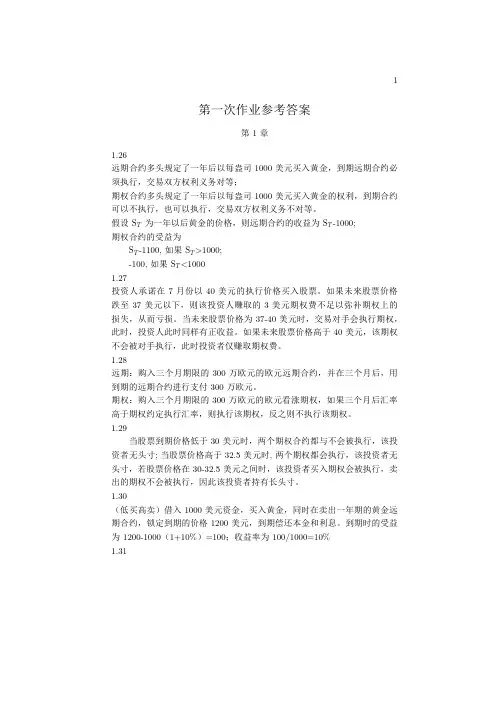
1第一次作业参考答案第1章1.26远期合约多头规定了一年后以每盎司1000美元买入黄金,到期远期合约必须执行,交易双方权利义务对等;期权合约多头规定了一年后以每盎司1000美元买入黄金的权利,到期合约可以不执行,也可以执行,交易双方权利义务不对等。
假设S T为一年以后黄金的价格,则远期合约的收益为S T-1000;期权合约的受益为S T-1100,如果S T>1000;-100,如果S T<10001.27投资人承诺在7月份以40美元的执行价格买入股票。
如果未来股票价格跌至37美元以下,则该投资人赚取的3美元期权费不足以弥补期权上的损失,从而亏损。
当未来股票价格为37-40美元时,交易对手会执行期权,此时,投资人此时同样有正收益。
如果未来股票价格高于40美元,该期权不会被对手执行,此时投资者仅赚取期权费。
1.28远期:购入三个月期限的300万欧元的欧元远期合约,并在三个月后,用到期的远期合约进行支付300万欧元。
期权:购入三个月期限的300万欧元的欧元看涨期权,如果三个月后汇率高于期权约定执行汇率,则执行该期权,反之则不执行该期权。
1.29当股票到期价格低于30美元时,两个期权合约都与不会被执行,该投资者无头寸;当股票价格高于32.5美元时,两个期权都会执行,该投资者无头寸,若股票价格在30-32.5美元之间时,该投资者买入期权会被执行,卖出的期权不会被执行,因此该投资者持有长头寸。
1.30(低买高卖)借入1000美元资金,买入黄金,同时在卖出一年期的黄金远期合约,锁定到期的价格1200美元,到期偿还本金和利息。
到期时的受益为1200-1000(1+10%)=100;收益率为100/1000=10%1.312由于期权存在杠杆效应,看张期权的风险更大,同时收益率也更高。
假设股票在S时,购入看涨期权和购入股票无差异,则100*(S-94)=2000(S-95)-9400即S=100。
如果未来股票价格高于100美元,则购入看涨期权合约则盈利更高,反之,如果未来股票价格低于100美元,则购入股票比购入期权合约盈利更多。
JohnHull《期货期权和衍生证券》章习题解答
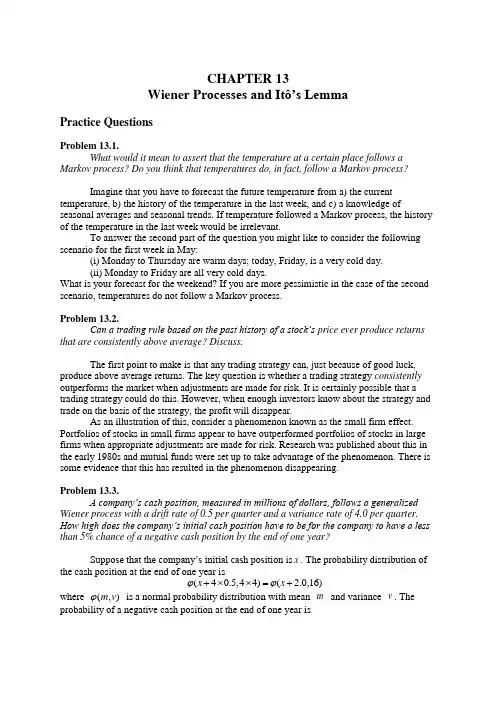
CHAPTER 13Wiener P rocesses and Itô’s LemmaPractice QuestionsProblem 13.1.What would it mean to assert that the temperature at a certain place follows a Markov process? Do you think that temperatures do, in fact, follow a Markov process?Imagine that you have to forecast the future temperature from a) the current temperature, b) the history of the temperature in the last week, and c) a knowledge ofseasonal averages and seasonal trends. If temperature followed a Markov process, the history of the temperature in the last week would be irrelevant.To answer the second part of the question you might like to consider the following scenario for the first week in May:(i) Monday to Thursday are warm days; today, Friday, is a very cold day. (ii) Monday to Friday are all very cold days.What is your forecast for the weekend? If you are more pessimistic in the case of the second scenario, temperatures do not follow a Markov process.Problem 13.2.Can a trading rule based on the past history of a stock’s price ever produce returns that are consistently above average? Discuss.The first point to make is that any trading strategy can, just because of good luck, produce above average returns. The key question is whether a trading strategy consistently outperforms the market when adjustments are made for risk. It is certainly possible that a trading strategy could do this. However, when enough investors know about the strategy and trade on the basis of the strategy, the profit will disappear.As an illustration of this, consider a phenomenon known as the small firm effect. Portfolios of stocks in small firms appear to have outperformed portfolios of stocks in large firms when appropriate adjustments are made for risk. Research was published about this in the early 1980s and mutual funds were set up to take advantage of the phenomenon. There is some evidence that this has resulted in the phenomenon disappearing.Problem 13.3.A company’s cash position, measured in millions of dollars, follows a generalized Wiener process with a drift rate of 0.5 per quarter and a variance rate of 4.0 per quarter. How high does the company’s initial cash position have to be for the company to have a less than 5% chance of a negative cash position by the end of one year?Supp ose that the company’s initial cash position is x . The probability distribution of the cash position at the end of one year is (40544)(2016)x x ϕϕ+⨯.,⨯=+.,where ()m v ϕ, is a normal probability distribution with mean m and variance v . The probability of a negative cash position at the end of one year is204x N +.⎛⎫- ⎪⎝⎭where ()N x is the cumulative probability that a standardized normal variable (with mean zero and standard deviation 1.0) is less than x . From normal distribution tables200054x N +.⎛⎫-=. ⎪⎝⎭when:20164494x +.-=-.i.e., when 45796x =.. The initial cash position must therefore be $4.58 million.Problem 13.4.Variables 1X and 2X follow generalized Wiener processes with drift rates 1μ and2μ and variances 21σ and 22σ. What process does 12X X + follow if:(a) The changes in 1X and 2X in any short interval of time are uncorrelated?(b) There is a correlation ρ between the changes in 1X and 2X in any short interval of time?(a) Suppose that X 1 and X 2 equal a 1 and a 2 initially. After a time period of length T , X 1 has the probability distribution2111()a T T ϕμσ+,and 2X has a probability distribution2222()a T T ϕμσ+,From the property of sums of independent normally distributed variables, 12X X + has the probability distribution()22112212a T a T T T ϕμμσσ+++,+i.e.,22121212()()a a T T ϕμμσσ⎡⎤+++,+⎣⎦This shows that 12X X + follows a generalized Wiener process with drift rate 12μμ+and variance rate 2212σσ+.(b) In this case the change in the value of 12X X + in a short interval of time t ∆ has the probability distribution:22121212()(2)t t ϕμμσσρσσ⎡⎤+∆,++∆⎣⎦If 1μ, 2μ, 1σ, 2σ and ρ are all constant, arguments similar to those in Section 13.2 show that the change in a longer period of time T is22121212()(2)T T ϕμμσσρσσ⎡⎤+,++⎣⎦The variable,12X X +, therefore follows a generalized Wiener process with drift rate12μμ+ and variance rate 2212122σσρσσ++.Problem 13.5.Consider a variable,S , that follows the process dS dt dz μσ=+For the first three years, 2μ= and 3σ=; for the next three years, 3μ= and 4σ=. If the initial value of the variable is 5, what is the probability distribution of the value of the variable at the end of year six?The change in S during the first three years has the probability distribution (2393)(627)ϕϕ⨯,⨯=,The change during the next three years has the probability distribution (33163)(948)ϕϕ⨯,⨯=,The change during the six years is the sum of a variable with probability distribution(627)ϕ, and a variable with probability distribution (948)ϕ,. The probability distribution of the change is therefore (692748)ϕ+,+ (1575)ϕ=,Since the initial value of the variable is 5, the probability distribution of the value of the variable at the end of year six is (2075)ϕ,Problem 13.6.Suppose that G is a function of a stock price, S and time. Suppose that S σ and G σ are the volatilities of S and G . Show that when the expected return of S increases by S λσ, the growth rate of G increases by G λσ, where λ is a constant.From Itô’s lemmaG S GG S Sσσ∂=∂Also the drift of G is222212G G G S S S t S μσ∂∂∂++∂∂∂where μ is the expected return on the stock. When μ increases by S λσ, the drift of Gincreases byS GS Sλσ∂∂ orG G λσThe growth rate of G , therefore, increases by G λσ.Problem 13.7.Stock A and stock B both follow geometric Brownian motion. Changes in any short interval of time are uncorrelated with each other. Does the value of a portfolio consisting of one of stock A and one of stock B follow geometric Brownian motion? Explain your answer.Define A S , A μ and A σ as the stock price, expected return and volatility for stock A. Define B S , B μ and B σ as the stock price, expected return and volatility for stock B. Define A S ∆ and B S ∆ as the change in A S and B S in time t ∆. Since each of the two stocks follows geometric Brownian motion,A A A A A S S t S μσε∆=∆+B B B B B S S t S μσε∆=∆+where A ε and B ε are independent random samples from a normal distribution.()(A B A A B B A A A B B B S S S S t S S μμσεσε∆+∆=+∆++This cannot be written as()()A B A B A B S S S S t S S μσ∆+∆=+∆++for any constants μ and σ. (Neither the drift term nor the stochastic term correspond.) Hence the value of the portfolio does not follow geometric Brownian motion.Problem 13.8.S S t S μσε∆=∆+ where μ and σ are constant. Explain carefully the difference between this model andeach of the following:S t S S t S t S μσεμσεμσε∆=∆+∆=∆+∆=∆+Why is the model in equation (13.8) a more appropriate model of stock price behavior than any of these three alternatives?In:S S t S μσε∆=∆+ the expected increase in the stock price and the variability of the stock price are constant when both are expressed as a proportion (or as a percentage) of the stock price In:S t μ∆=∆+the expected increase in the stock price and the variability of the stock price are constant in absolute terms. For example, if the expected growth rate is $5 per annum when the stockprice is $25, it is also $5 per annum when it is $100. If the standard deviation of weekly stock price movements is $1 when the price is $25, it is also $1 when the price is $100. In:S S t μ∆=∆+the expected increase in the stock price is a constant proportion of the stock price while the variability is constant in absolute terms. In:S t S μσ∆=∆+the expected increase in the stock price is constant in absolute terms while the variability of the proportional stock price change is constant. The model:S S t S μσ∆=∆+ is the most appropriate one since it is most realistic to assume that the expected percentage return and the variability of the percentage return in a short interval are constant.Problem 13.9.It has been suggested that the short-term interest rate,r , follows the stochastic process()dr a b r dt rc dz =-+where a , b , and c are positive constants and dz is a Wiener process. Describe the nature of this process.The drift rate is ()a b r -. Thus, when the interest rate is above b the drift rate is negative and, when the interest rate is below b , the drift rate is positive. The interest rate is therefore continually pulled towards the level b . The rate at which it is pulled toward this level is a . A volatility equal to c is superimposed upon the “pull” or the drift.Suppose 04a =., 01b =. and 015c =. and the current interest rate is 20% per annum. The interest rate is pulled towards the level of 10% per annum. This can be regarded as a long run average. The current drift is 4-% per annum so that the expected rate at the end of one year is about 16% per annum. (In fact it is slightly greater than this, because as the interest rate decreases, the “pull” decreases.) Superimposed upon the drift is a volatility of 15% per annum.Problem 13.10.Suppose that a stock price, S , follows geometric Brownian motion with expected return μ and volatility σ: dS S dt S dz μσ=+What is the process followed by the variable n S ? Show that n S also follows geometric Brownian motion.If ()n G S t S ,= then 0G t ∂/∂=, 1n G S nS -∂/∂=, and 222(1)n G S n n S -∂/∂=-. Using Itô’s lemma:21[(1)]2dG nG n n G dt nG dz μσσ=+-+This shows that n G S = follows geometric Brownian motion where the expected return is21(1)2n n n μσ+-and the volatility is n σ. The stock price S has an expected return of μ and the expected value of T S is 0T S e μ. The expected value of n T S is212[(1)]0n n n T n S eμσ+-Problem 13.11.Suppose that x is the yield to maturity with continuous compounding on a zero-coupon bond that pays off $1 at time T . Assume that x follows the process0()dx a x x dt sx dz =-+where a , 0x , and s are positive constants and dz is a Wiener process. What is the process followed by the bond price?The process followed by B , the bond price, is from Itô’s lemma:222021()2B B B B dB a x x s x dt sxdz x t x x ⎡⎤⎢⎥⎢⎥⎢⎥⎣⎦∂∂∂∂=-+++∂∂∂∂Since: ()x T t B e --=the required partial derivatives are()()22()22()()()()x T t x T t x T t Bxe xB t BT t e T t B x B T t e T t B x------∂==∂∂=--=--∂∂=-=-∂ Hence:22201()()()()2dB a x x T t x s x T t Bdt sx T t Bdz⎡⎤⎢⎥⎢⎥⎢⎥⎣⎦=---++---Problem 13.12 (Excel Spreadsheet)A stock whose price is $30 has an expected return of 9% and a volatility of 20%. In Excel simulate the stock price path over 5 years using monthly time steps and random samples from a normal distribution. Chart the simulated stock price path. By hitting F9 observe how the path changes as the random sample change.The process ist S t S S ∆⨯ε⨯⨯+∆⨯⨯=∆20.009.0Where ∆t is the length of the time step (=1/12) and ε is a random sample from a standard normal distribution.Further QuestionsProblem 13.13.Suppose that a stock price has an expected return of 16% per annum and a volatility of 30% per annum. When the stock price at the end of a certain day is $50, calculate the following:(a) The expected stock price at the end of the next day.(b) The standard deviation of the stock price at the end of the next day. (c) The 95% confidence limits for the stock price at the end of the next day.With the notation in the text2()St t S ϕμσ∆∆,∆In this case 50S =, 016μ=., 030σ=. and 1365000274t ∆=/=.. Hence(016000274009000274)50(0000440000247)Sϕϕ∆.⨯.,.⨯.=.,.and2(50000044500000247)S ϕ∆⨯.,⨯.that is, (002206164)S ϕ∆.,.(a)(b) The standard deviation of the stock price at the end of the next day is 0785=. (c) 95% confidence limits for the stock price at the end of the next day are 500221960785and 500221960785.-.⨯..+.⨯. i.e.,4848and 5156..Note that some students may consider one trading day rather than one calendar day. Then 1252000397t ∆=/=.. The answer to (a) is then 50.032. The answer to (b) is 0.945. The answers to part (c) are 48.18 and 51.88.Problem 13.14.A company’s cash position, measured in millions of dollars, follows a generalized Wiener process with a drift rate of 0.1 per month and a variance rate of 0.16 per month. The initial cash position is 2.0.(a) What are the probability distributions of the cash position after one month, six months, and one year?(b) What are the probabilities of a negative cash position at the end of six months and one year?(c) At what time in the future is the probability of a negative cash position greatest?(a) The probability distributions are:(2001016)(21016)ϕϕ.+.,.=.,.(20060166)(26096)ϕϕ.+.,.⨯=.,.(201201612)(32196)ϕϕ.+.,.⨯=.,.(b) The chance of a random sample from (26096)ϕ.,. being negative is(265)N N ⎛=-. ⎝where ()N x is the cumulative probability that a standardized normal variable [i.e., avariable with probability distribution (01)ϕ,] is less than x . From normaldistribution tables (265)00040N -.=.. Hence the probability of a negative cash position at the end of six months is 0.40%.Similarly the probability of a negative cash position at the end of one year is(230)00107N N ⎛=-.=. ⎝or 1.07%.(c) In general the probability distribution of the cash position at the end of x months is(2001016)x x ϕ.+.,.The probability of the cash position being negative is maximized when:is minimized. Define11223122325025250125(250125)y x xdy x xdxx x----==+.=-.+.=-.+.This is zero when 20x=and it is easy to verify that 220d y dx/>for this value of x. It therefore gives a minimum value for y. Hence the probability of a negative cash position is greatest after 20 months.Problem 13.15.Suppose that x is the yield on a perpetual government bond that pays interest at the rate of $1 per annum. Assume that x is expressed with continuous compounding, that interest is paid continuously on the bond, and that x follows the process()dx a x x dt sx dz=-+where a,x, and s are positive constants and dz is a Wiener process. What is the process followed by the bond price? What is the expected instantaneous return (including interest and capital gains) to the holder of the bond?The process followed by B, the bond price, is from Itô’s lemma:222021()2B B B BdB a x x s x dt sxdzx t x x⎡⎤⎢⎥⎢⎥⎢⎥⎣⎦∂∂∂∂=-+++∂∂∂∂In this case1Bx=so that:222312B B Bt x x x x∂∂∂=;=-;=∂∂∂Hence2202322021121()21()dB a x x s x dt sxdzx x xs sa x x dt dzx x x⎡⎤=--+-⎢⎥⎣⎦⎡⎤=--+-⎢⎥⎣⎦The expected instantaneous rate at which capital gains are earned from the bond is therefore:2021()sa x xx x--+The expected interest per unit time is 1. The total expected instantaneous return is therefore:20211()sa x xx x--+When expressed as a proportion of the bond price this is:202111()sa x xx x x⎛⎫⎛⎫--+ ⎪⎪⎝⎭⎝⎭20()ax x x s x=--+Problem 13.16.If S follows the geometric Brownian motion process in equation (13.6), what is the process followed by (a) y = 2S, (b) y=S 2 , (c) y=e S , and (d) y=e r(T-t)/S. In each case express the coefficients of dt and dz in terms of y rather than S.(a) In this case 2y S ∂/∂=, 220y S ∂/∂=, and 0y t ∂/∂= so that Itô’s lemma gives 22dy S dt S dz μσ=+or dy y dt y dz μσ=+(b) In this case 2y S S ∂/∂=, 222y S ∂/∂=, and 0y t ∂/∂= so that Itô’s lemma gives2222(2)2dy S S dt S dz μσσ=++ or2(2)2dy y dt y dz μσσ=++ (c) In this case S y S e ∂/∂=, 22S y S e ∂/∂=, and 0y t ∂/∂= so that Itô’s lemma gives22(2)S S S dy Se S e dt Se dz μσσ=+/+ or22[ln (ln )2]ln dy y y y y dt y y dz μσσ=+/+(d) In this case ()2r T t y S e S y S -∂/∂=-/=-/, 22()3222r T t y S e S y S -∂/∂=/=/, and()r T t y t re S ry -∂/∂=-/=- so that Itô’s lemma gives2()dy ry y y dt y dz μσσ=--+- or2()dy r y dt y dz μσσ=-+--Problem 13.17.A stock price is currently 50. Its expected return and volatility are 12% and 30%,respectively. What is the probability that the stock price will be greater than 80 in two years? (Hint 80T S > when ln ln 80T S >.)The variable ln T S is normally distributed with mean 20ln (2)S T μσ+-/ and standarddeviation σ050S =, 012μ=., 2T =, and 030σ=. so that the meanand standard deviation of ln T S are 2ln 50(012032)24062+.-./=. and 00424.=., respectively. Also, ln804382=.. The probability that 80T S > is the same as the probability that ln 4382T S >.. This is4382406211(0754)0424N N .-.⎛⎫-=-. ⎪.⎝⎭where ()N x is the probability that a normally distributed variable with mean zero and standard deviation 1 is less than x . From the tables at the back of the book (0754)0775N .=. so that the required probability is 0.225.Problem 13.18 (See Excel Worksheet)Stock A, whose price is $30, has an expected return of 11% and a volatility of 25%. Stock B, whose price is $40, has an expected return of 15% and a volatility of 30%. The processes driving the returns are correlated with correlation parameter ρ. In Excel, simulate the two stock price paths over three months using daily time steps and random samples from normal distributions. Chart the results and by hitting F9 observe how the paths change as the random samples change. Consider values of ρ equal to 0.50, 0.75, and 0.95.The processes aret S t S S A A A A ∆⨯ε⨯⨯+∆⨯⨯=∆25.011.0t S t S S B B B B ∆⨯ε⨯⨯+∆⨯⨯=∆30.015.0Where ∆t is the length of the time step (=1/252) and the ε’s are correlated samples from standard normal distributions.。
约翰.赫尔,期权期货和其他衍生品(third edition)习题答案
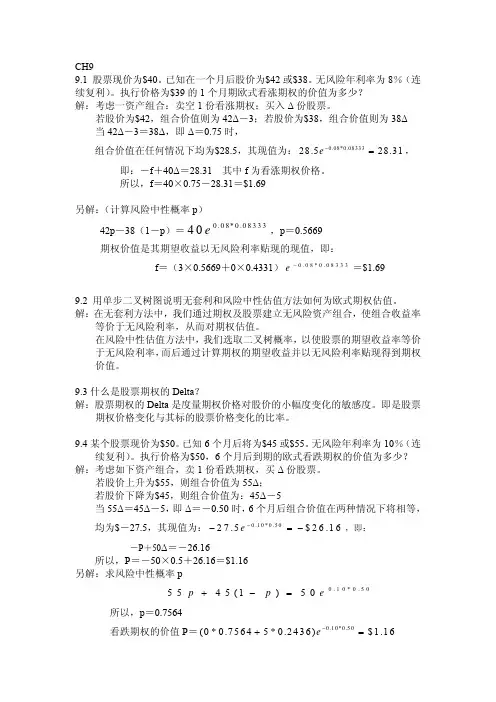
CH99.1 股票现价为$40。
已知在一个月后股价为$42或$38。
无风险年利率为8%(连续复利)。
执行价格为$39的1个月期欧式看涨期权的价值为多少? 解:考虑一资产组合:卖空1份看涨期权;买入Δ份股票。
若股价为$42,组合价值则为42Δ-3;若股价为$38,组合价值则为38Δ 当42Δ-3=38Δ,即Δ=0.75时,组合价值在任何情况下均为$28.5,其现值为:,0.08*0.0833328.528.31e −=即:-f +40Δ=28.31 其中f 为看涨期权价格。
所以,f =40×0.75-28.31=$1.69另解:(计算风险中性概率p ) 42p -38(1-p )=,p =0.56690.08*0.0833340e期权价值是其期望收益以无风险利率贴现的现值,即: f =(3×0.5669+0×0.4331)=$1.690.08*0.08333e−9.2 用单步二叉树图说明无套利和风险中性估值方法如何为欧式期权估值。
解:在无套利方法中,我们通过期权及股票建立无风险资产组合,使组合收益率等价于无风险利率,从而对期权估值。
在风险中性估值方法中,我们选取二叉树概率,以使股票的期望收益率等价于无风险利率,而后通过计算期权的期望收益并以无风险利率贴现得到期权价值。
9.3什么是股票期权的Delta ?解:股票期权的Delta 是度量期权价格对股价的小幅度变化的敏感度。
即是股票期权价格变化与其标的股票价格变化的比率。
9.4某个股票现价为$50。
已知6个月后将为$45或$55。
无风险年利率为10%(连续复利)。
执行价格为$50,6个月后到期的欧式看跌期权的价值为多少? 解:考虑如下资产组合,卖1份看跌期权,买Δ份股票。
若股价上升为$55,则组合价值为55Δ;若股价下降为$45,则组合价值为:45Δ-5 当55Δ=45Δ-5,即Δ=-0.50时,6个月后组合价值在两种情况下将相等,均为$-27.5,其现值为:,即:0.10*0.5027.5$26.16e −−=− -P +50Δ=-26.16所以,P =-50×0.5+26.16=$1.16 另解:求风险中性概率p0.10*0.505545(1)50p p e+−= 所以,p =0.7564看跌期权的价值P =0.10*0.50(0*0.75645*0.2436)$1.16e −+=9.5 某个股票现价为$100。
HullOFOD9eSolutionsCh03第九版期权期货及其他衍生品课后答案
CHAPTER 3Hedging Strategies Using FuturesPractice QuestionsProblem 3.1.Under what circumstances are (a) a short hedge and (b) a long hedge appropriate?A short hedge is appropriate when a company owns an asset and expects to sell that asset in the future. It can also be used when the company does not currently own the asset but expects to do so at some time in the future. A long hedge is appropriate when a company knows it will have to purchase an asset in the future. It can also be used to offset the risk from an existing short position.Problem 3.2.Explain what is meant by basis risk when futures contracts are used for hedging.Basis risk arises from the hedger’s uncertainty as to the difference between the spot price and futures price at the expiration of the hedge.Problem 3.3.Explain what is meant by a perfect hedge. Does a perfect hedge always lead to a better outcome than an imperfect hedge? Explain your answer.A perfect hedge is one that completely eliminates the hedger’s risk. A p erfect hedge does not always lead to a better outcome than an imperfect hedge. It just leads to a more certain outcome. Consider a company that hedges its exposure to the price of an asset. Suppose the asset’s price movements prove to be favorable to the company. A perfect hedge totally neutralizes the company’s gain from these favorable price movements. An imperfect hedge, which only partially neutralizes the gains, might well give a better outcome.Problem 3.4.Under what circumstances does a minimum-variance hedge portfolio lead to no hedging at all?A minimum variance hedge leads to no hedging when the coefficient of correlation between the futures price changes and changes in the price of the asset being hedged is zero.Problem 3.5.Give three reasons why the treasurer of a company might not hedge the company’s exposure to a particular risk.(a) If the company’s competitors are not hedging, the treasurer might feel that the company will experience less risk if it does not hedge. (See Table 3.1.) (b) The shareholders might not want the company to hedge because the risks are hedged within their portfolios. (c) If there is a loss on the hedge and a gain from the company’s exposure to the underlying asset, the treasurer might feel that he or she will have difficulty justifying the hedging to other executives within the organization.Problem 3.6.Suppose that the standard deviation of quarterly changes in the prices of a commodity is $0.65, the standard deviation of quarterly changes in a futures price on the commodity is $0.81, and the coefficient of correlation between the two changes is 0.8. What is the optimal hedge ratio for a three-month contract? What does it mean?The optimal hedge ratio is 065080642081..⨯=.. This means that the s ize of the futures position should be 64.2% of the size of the company’s exposure in a three-month hedge.Problem 3.7.A company has a $20 million portfolio with a beta of 1.2. It would like to use futures contracts on a stock index to hedge its risk. The index futures is currently standing at 1080, and each contract is for delivery of $250 times the index. What is the hedge that minimizes risk? What should the company do if it wants to reduce the beta of the portfolio to 0.6?The formula for the number of contracts that should be shorted gives 20000000128891080250,,.⨯=.⨯ Rounding to the nearest whole number, 89 contracts should be shorted. To reduce the beta to 0.6, half of this position, or a short position in 44 contracts, is required.Problem 3.8.In the corn futures contract, the following delivery months are available: March, May, July, September, and December. State the contract that should be used for hedging when the expiration of the hedge is in a) June, b) July, and c) JanuaryA good rule of thumb is to choose a futures contract that has a delivery month as close aspossible to, but later than, the month containing the expiration of the hedge. The contracts that should be used are therefore(a) July(b)September(c)MarchProblem 3.9.Does a perfect hedge always succeed in locking in the current spot price of an asset for a future transaction? Explain your answer.No. Consider, for example, the use of a forward contract to hedge a known cash inflow in a foreign currency. The forward contract locks in the forward exchange rate — which is in general different from the spot exchange rate.Problem 3.10.Explain why a short hedger’s position improves when the basis strengthens unexpectedly and worsens when the basis weakens unexpectedly.The basis is the amount by which the spot price exceeds the futures price. A short hedger is long the asset and short futures contracts. The value of his or her position therefore improves as the basis increases. Similarly, it worsens as the basis decreases.Problem 3.11.Imagine you are the treasurer of a Japanese company exporting electronic equipment to the United States. Discuss how you would design a foreign exchange hedging strategy and the arguments you would use to sell the strategy to your fellow executives.The simple answer to this question is that the treasurer should1.Estimate the company’s future cash flows in Japanese yen and U.S. dollars2.Enter into forward and futures contracts to lock in the exchange rate for the U.S. dollarcash flows.However, this is not the whole story. As the gold jewelry example in Table 3.1 shows, the company should examine whether the magnitudes of the foreign cash flows depend on the exchange rate. For example, will the company be able to raise the price of its product in U.S. dollars if the yen appreciates? If the company can do so, its foreign exchange exposure may be quite low. The key estimates required are those showing the overall effect on the company’s profitability of changes in the exchange rate at various times in the future. Once these estimates have been produced the company can choose between using futures and options to hedge its risk. The results of the analysis should be presented carefully to other executives. It should be explained that a hedge does not ensure that profits will be higher. It means that profit will be more certain. When futures/forwards are used both the downside and upside are eliminated. With options a premium is paid to eliminate only the downside.Problem 3.12.Suppose that in Example 3.2 of Section 3.3 the company decides to use a hedge ratio of 0.8. How does the decision affect the way in which the hedge is implemented and the result?If the hedge ratio is 0.8, the company takes a long position in 16 December oil futures contracts on June 8 when the futures price is $88.00. It closes out its position on November 10. The spot price and futures price at this time are $90.00 and $89.10. The gain on the futures position is(89.10 − 88.00) × 16,000 = 17,600The effective cost of the oil is therefore20,000 × 90 – 17,600 = 1,782, 400or $89.12 per barrel. (This compares with $88.90 per barrel when the company is fully hedged.)Problem 3.13.“If the minimum -variance hedge ratio is calculated as 1.0, the hedge must be perfect." Is this statement true? Explain your answer.The statement is not true. The minimum variance hedge ratio is S Fσρσ It is 1.0 when 05=.ρ and 2S F =σσ. Since 10<.ρ the hedge is clearly not perfect.Problem 3.14.“If there is no basis risk, the minimum variance hedge ratio is always 1.0." Is this statement true? Explain your answer.The statement is true. Using the notation in the text, if the hedge ratio is 1.0, the hedger locks in a price of 12F b +. Since both 1F and 2b are known this has a variance of zero and must be the best hedge.Problem 3.15“For an asset where futures prices for contracts on the asset are usually less than spot prices, long hedges are likely to be particularly attractive." Explain this statement.A company that knows it will purchase a commodity in the future is able to lock in a price close to the futures price. This is likely to be particularly attractive when the futures price is less than the spot price.Problem 3.16.The standard deviation of monthly changes in the spot price of live cattle is (in cents per pound)1.2. The standard deviation of monthly changes in the futures price of live cattle for the closestcontract is 1.4. The correlation between the futures price changes and the spot price changes is 0.7. It is now October 15. A beef producer is committed to purchasing 200,000 pounds of live cattle on November 15. The producer wants to use the December live-cattle futures contracts to hedge its risk. Each contract is for the delivery of 40,000 pounds of cattle. What strategy should the beef producer follow?The optimal hedge ratio is 12070614..⨯=.. The beef producer requires a long position in 20000006120000⨯.=, lbs of cattle. The beef producer should therefore take a long position in 3 December contracts closing out the position on November 15.Problem 3.17.A corn farmer argues “I do not use futures co ntracts for hedging. My real risk is not the price of corn. It is that my whole crop gets wiped out by the weather.”Discuss this viewpoint. Should the farmer estimate his or her expected production of corn and hedge to try to lock in a price for expected production?If weather creates a significant uncertainty about the volume of corn that will be harvested, the farmer should not enter into short forward contracts to hedge the price risk on his or her expected production. The reason is as follows. Suppose that the weather is bad and the farmer’sproduction is lower than expected. Other farmers are likely to have been affected similarly. Corn production overall will be low and as a consequence the price of corn will be relatively high. The farmer’s problems arising from the bad harvest will be made worse by losses on the short futures position. This problem emphasizes the importance of looking at the big picture when hedging. The farmer is correct to question whether hedging price risk while ignoring other risks is a good strategy.Problem 3.18.On July 1, an investor holds 50,000 shares of a certain stock. The market price is $30 per share. The investor is interested in hedging against movements in the market over the next month and decides to use the September Mini S&P 500 futures contract. The index is currently 1,500 and one contract is for delivery of $50 times the index. The beta of the stock is 1.3. What strategy should the investor follow? Under what circumstances will it be profitable?A short position in 50000301326501500,⨯.⨯=⨯,。
赫尔《期权、期货及其他衍生产品》复习笔记及课后习题详解(利率期货)【圣才出品】
赫尔《期权、期货及其他衍⽣产品》复习笔记及课后习题详解(利率期货)【圣才出品】第6章利率期货6.1 复习笔记1.天数计算和报价惯例天数计算常表⽰为X/Y,计算两个⽇期间获得的利息时,X定义了两个⽇期间天数计算的⽅式,Y定义了参照期内总天数计算的⽅式。
两个⽇期间获得的利息为:(两个⽇期之间的天数/参考期限的总天数)×参考期限内所得利息在美国常⽤的三种天数计算惯例为:①实际天数/实际天数;②30/360;③实际天数/360。
(1)美国短期债券的报价货币市场的产品报价采⽤贴现率⽅式,该贴现率对应于所得利息作为最终⾯值的百分⽐⽽不是最初所付出价格的百分⽐。
⼀般来讲,美国短期国债的现⾦价格与报价的关系式为:P=360(100-Y)/n其中,P为报价,Y为现⾦价格,n为短期债券期限内以⽇历天数所计算的剩余天数。
(2)美国长期国债美国长期国债是以美元和美元的1/32为单位报出的。
所报价格是相对于⾯值100美元的债券。
报价被交易员称为纯净价,它与现⾦价有所不同,交易员将现⾦价称为带息价格。
⼀般来讲,有以下关系式:现⾦价格=报价(即纯净价)+从上⼀个付息⽇以来的累计利息2.美国国债期货(1)报价超级国债和超级国债期货合约的报价与长期国债本⾝在即期市场的报价⽅式相同。
(2)转换因⼦当交割某⼀特定债券时,⼀个名为转换因⼦的参数定义了空头⽅的债券交割价格。
债券的报价等于转换因⼦与最新成交期货价格的乘积。
将累计利息考虑在内,对应于交割100美元⾯值的债券收⼊的现⾦价格为:最新的期货成交价格×转换因⼦+累计利息(3)最便宜可交割债券在交割⽉份的任意时刻,许多债券可以⽤于长期国债期货合约的交割,这些可交割债券有各式各样的券息率及期限。
空头⽅可以从这些债券中选出最便宜的可交割债券⽤于交割。
因为空头⽅收到的现⾦量为:最新成交价格×转换因⼦+累计利息买⼊债券费⽤为:债券报价+累计利息因此最便宜交割债券是使得:债券报价-期货的最新报价×转换因⼦达到最⼩的债券。
约翰.赫尔,期权期货和其他衍生品(third edition)习题答案
8.14 执行价格为$60 的看涨期权成本为$6,相同执行价格和到期日的看跌期权成
本为$4,制表说明跨式期权损益状况。请问:股票价格在什么范围内时,
跨式期权将导致损失呢?
解:可通过同时购买看涨看跌期权构造跨式期权:max( ST -60,0)+max(60
- ST )-(6+4),其损益状况为:
股价 ST
解:(a)该组合等价于一份固定收益债券多头,其损益V = C ,不随股票价格变化。 (V 为组合损益,C 为期权费,下同)如图 8.2: (b)该组合等价于一份股票多头与一份固定收益债券多头,其损益V = ST + C , 与股价同向同幅度变动。( ST 为最终股票价格,下同)如图 8.3 (c)该组合等价于一份固定收益债券多头与一份看涨期权空头,其损益为
8.18 盒式价差期权是执行价格为 X 1 和 X 2 的牛市价差期权和相同执行价格的熊 市看跌价差期权的组合。所有期权的到期日相同。盒式价差期权有什么样的 特征?
解:牛市价差期权由 1 份执行价格为 X 1 欧式看涨期权多头与 1 份执行价格为 X 2 的欧式看涨期权空头构成( X 1 < X 2 ),熊市价差期权由 1 份执行价格为 X 2 的 欧式看跌期权多头与 1 份执行价格为 X 1 的看跌期权空头构成,则盒式价差
8.17 运用期权如何构造出具有确定交割价格和交割日期的股票远期合约? 解:假定交割价格为 K,交割日期为 T。远期合约可由买入 1 份欧式看涨期权,
同时卖空 1 份欧式看跌期权,要求两份期权有相同执行价格 K 及到期日 T。 可见,该组合的损益为 ST -K,在任何情形下,其中 ST 为 T 时股票价格。 假定 F 为远期合约价格,若 K=F,则远期合约价值为 0。这表明,当执行价 格为 K 时,看涨期权与看跌期权价格相等。
赫尔《期权期货及其他衍生产品》第1章(第八版)讲述
期权、期货及其他衍生产品(第八版) Copyright © John C. Hull 2012
32
对冲基金( 见业界事例1-2,p8)
• 对冲基金受到的约束与共同基金不同,一般不对外公 布持有的证券组合。
• 共同基金必须
– 披露投资策略 – 在任意时刻允许份额赎回 – 杠杆率受到限制 – 不能持有空头头寸
20
2. 石油:另外一种套利机会?
假定:
- 石油的即期价格为95美元 - 1年期原油期货的标价为80美元 - 1年期的美元利率为 5% - 原油的储存成本为每年2%
是否存在套利机会?
期权、期货及其他衍生产品(第八版) Copyright © John C. Hull 2012
21
期权
• 看涨期权:其持有者有权在将来某一特定时间 以某一确定价格( 执行价格)买入某种资产。
卖出价 1.4411 1.4413 1.4415 1.4422
期权、期货及其他衍生产品(第八版) Copyright © John C. Hull 2012
8
远期价格
• 合约的远期价格是今天约定的合约支付价 格(使合约价值为零的支付价格);
• 对不同期限的远期合约而言,远期价格也 不同(如表1-1所示) 。
期权、期货及其他衍生产品(第八版) Copyright © John C. Hull 2012
34
期权、期货及其他衍生产品(第八版) Copyright © John C. Hull 2012
23
表1-2 谷歌股票看涨期权在2010年6月15日的价格
(P6)
执行 2010年7月
价格
买入价
2010年7月 卖出价
2010年9月 买入价
HullOFOD9eSolutionsCh13第九版期权、期货及其他衍生品课后答案
HullOFOD9eSolutionsCh13第九版期权、期货及其他衍生品课后答案CHAPTER 13 Binomial TreesPractice QuestionsProblem 13.1.A stock price is currently $40. It is known that at the end of one month it will be either $42 or $38. The risk-free interest rate is 8% per annum with continuous compounding. What is the value of a one-month European call option with a strike price of $39?Consider a portfolio consisting of 1-: Call option +?: Shares If the stock price rises to $42, the portfolio is worth 423?-. If the stock price falls to $38, it is worth 38?. These are the same when42338?-=? or 075?=.. The value of the portfolio in one month is 28.5 for both stock prices. Its value today must be the present value of 28.5, or 0080083332852831e -.?..=.. This means that 402831f -+?=.where f is the call price. Because 075?=., the call price is 400752831$169?.-.=.. As an alternative approach, we can calculate the probability, p , of an up movement in a risk-neutral world. This must satisfy: 0080083334238(1)40p p e .?.+-= so that 00800833344038p e .?.=-or 05669p =.. The value of the option is then its expected payoff discounted at the risk-free rate: 008008333[305669004331]169e -.?.?.+?.=. or $1.69. This agrees with the previous calculation.Problem 13.2.Explain the no-arbitrage and risk-neutral valuationapproaches to valuing a European option using a one-step binomial tree.In the no-arbitrage approach, we set up a riskless portfolio consisting of a position in the option and a position in the stock. By setting the return on the portfolio equal to the risk-free interest rate, we are able to value the option. When we use risk-neutral valuation, we first choose probabilities for the branches of the tree so that the expected return on the stock equals the risk-free interest rate. We then value the option by calculating its expected payoff and discounting this expected payoff at the risk-free interest rate.Problem 13.3.What is meant by the delta of a stock option?The delta of a stock option measures the sensitivity of the option price to the price of the stock when small changes are considered. Specifically, it is the ratio of the change in the price of the stock option to the change in the price of the underlying stock.Problem 13.4.A stock price is currently $50. It is known that at the end of six months it will be either $45 or $55. The risk-free interest rate is 10% per annum with continuous compounding. What is the value of a six-month European put option with a strike price of $50?Consider a portfolio consisting of 1-: Put option +?: Shares If the stock price rises to $55, this is worth 55?. If the stock price falls to $45, the portfolio is worth 455?-. These are the same when 45555?-=?or 050?=-.. The value of the portfolio in six months is 275-. for both stock prices. Its value today must be the present valueof 275-., or 010********e -.?.-.=-.. This means that 502616f -+?=-.where f is the put price. Because 050?=-., the put price is $1.16. As an alternative approach we can calculate the probability, p , of an up movement in a risk-neutral world. This must satisfy: 01055545(1)50p p e .?.+-= so that 010*******p e .?.=- or 07564p =.. The value of the option is then its expected payoff discounted at the risk-free rate: 0105[007564502436]116e -.?.?.+?.=. or $1.16. This agrees with the previous calculation.Problem 13.5.A stock price is currently $100. Over each of the next two six-month periods it is expected to go up by 10% or down by 10%. The risk-free interest rate is 8% per annum with continuous compounding. What is the value of a one-year European call option with a strike price of $100?In this case 110u =., 090d =., 05t ?=., and 008r =., so that00805090***********e p .?.-.==..-.The tree for stock price movements is shown in Figure S13.1. We can work back from the end of the tree to the beginning, as indicated in the diagram, to give the value of the option as $9.61. The option value can also be calculated directly from equation (13.10): 22200805[0704121207041029590029590]961e -?.?..?+?.?.?+.?=. or $9.61.Figure S13.1: Tree for Problem 13.5Problem 13.6.For the situation considered in Problem 13.5, what is the value of a one-year European put option with a strike price of $100? Verify that the European call and European put prices satisfy put –call parity.Figure S13.2 shows how we can value the put option using the same tree as in Problem 13.5. The value of the option is $1.92. The option value can also be calculated directly from equation (13.10): 20080522[0704102070410295910295919]192e -?.?..?+?.?.?+.?=.or $1.92. The stock price plus the put price is 10019210192$+.=.. The present value of the strike price plus the call price is 008110096110192e $-.?+.=.. These are the same, verifyingthat put –call parity holds.Figure S13.2: Tree for Problem 13.6Problem 13.7.What are the formulas for u and d in terms of volatility?u e =and d e -=Problem 13.8.Consider the situation in which stock price movements during the life of a European option are governed by a two-step binomial tree. Explain why it is not possible to set up a position in the stock and the option that remains riskless for the whole of the life of the option.The riskless portfolio consists of a short position in the option and a long position in ? shares. Because ? changes during the life of the option, this riskless portfolio must also change.Problem 13.9.A stock price is currently $50. It is known that at the end of two months it will be either $53 or $48. The risk-free interest rate is 10% per annum with continuous compounding. What is thevalue of a two-month European call option with a strikeprice of $49? Use no-arbitrage arguments.At the end of two months the value of the option will be either $4 (if the stock price is $53) or $0 (if the stock price is $48). Consider a portfolio consisting of:shares1option+?:-:The value of the portfolio is either 48? or 534?- in two months. If48534?=?- i.e.,08?=. the value of the portfolio is certain to be 38.4. For this value of ? the portfolio is therefore riskless. The current value of the portfolio is: 0850f .?-where f is the value of the option. Since the portfolio must earn the risk-free rate of interest010212(0850)384f e .?/.?-=.i.e.,223f =.The value of the option is therefore $2.23.This can also be calculated directly from equations (13.2) and (13.3). 106u =., 096d =. so that01021209605681106096e p .?/-.==..-. and010212056814223f e -.?/=?.?=.Problem 13.10.A stock price is currently $80. It is known that at the end of four months it will be either $75or $85. The risk-free interest rate is 5% per annum with continuous compounding. What is the value of a four-monthEuropean put option with a strike price of $80? Use no-arbitrage arguments.At the end of four months the value of the option will be either $5 (if the stock price is $75) or $0 (if the stock price is $85). Consider a portfolio consisting of:shares1option-?:+:(Note: The delta, ? of a put option is negative. We have constructed the portfolio so that it is +1 option and -? shares rather than 1- option and +? shares so that the initial investment is positive.)The value of the portfolio is either 85-? or 755-?+ in four months. If 85755-?=-?+ i.e.,05?=-. the value of the portfolio is certain to be 42.5. For this value of ? the portfolio is therefore riskless. The current value of the portfolio is: 0580f .?+where f is the value of the option. Since the portfolio is riskless005412(0580)425f e .?/.?+=.i.e.,180f =.The value of the option is therefore $1.80.This can also be calculated directly from equations (13.2) and (13.3). 10625u =., 09375d =. so that00541209375063451062509375e p .?/-.==..-. 103655p -=. and005412036555180f e -.?/=?.?=.Problem 13.11.A stock price is currently $40. It is known that at the end ofthree months it will be either $45 or $35. The risk-free rate of interest with quarterly compounding is 8% per annum. Calculate the value of a three-month European put option on the stock with an exercise price of $40. Verify that no-arbitrage arguments and risk-neutral valuation arguments give the same answers.At the end of three months the value of the option is either $5 (if the stock price is $35) or $0 (if the stock price is $45).Consider a portfolio consisting of:shares1option-?:+:(Note: The delta, ?, of a put option is negative. We have constructed the portfolio so that it is +1 option and -? shares rather than 1- option and +? shares so that the initial investment is positive.)The value of the portfolio is either 355-?+ or 45-?. If:35545-?+=-?i.e.,05?=-.the value of the portfolio is certain to be 22.5. For this value of ? the portfolio is therefore riskless. The current value of the portfolio is 40f -?+where f is the value of the option. Since the portfolio must earn the risk-free rate of interest (4005)102225f ?.+?.=. Hence 206f =. i.e., the value of the option is $2.06.This can also be calculated using risk-neutral valuation. Suppose that p is the probability of an upward stock price movement in a risk-neutral world. We must have 4535(1)40102p p +-=?. i.e., 1058p =. or: 058p =.The expected value of the option in a risk-neutral world is:00585042210?.+?.=. This has a present value of210206102.=..This is consistent with the no-arbitrage answer.Problem 13.12.A stock price is currently $50. Over each of the next two three-month periods it is expected to go up by 6% or down by 5%. The risk-free interest rate is 5% per annum with continuous compounding. What is the value of a six-month European call option with a strike price of $51?A tree describing the behavior of the stock price is shown in Figure S13.3. The risk-neutral probability of an up move, p , is given by00531209505689106095e p .?/-.==..-. There is a payoff from the option of 561851518.-=. for the highest final node (which corresponds to two up moves) zero in all other cases. The value of the option is therefore 2005612518056891635e -.?/.?.?=.This can also be calculated by working back through the tree as indicated in Figure S13.3. The value of the call option is the lower number at each node in the figure.Figure S13.3:Tree for Problem 13.12Problem 13.13.For the situation considered in Problem 13.12, what is the value of a six-month European put option with a strike price of $51? Verify that the European call and European put prices satisfy put–call parity. If the put option were American, would it ever be optimal to exercise it early at any of the nodes on the tree?The tree for valuing the put option is shown in Figure S13.4. We get a payoff of-.=.if -.=.if the middle final node is reached and a payoff of 51451255875 515035065the lowest final node is reached. The value of the option is therefore2005612.??.?.+.?.=.(06520568904311587504311)1376e-.?/This can also be calculated by working back through the tree as indicated in Figure S13.4. The value of the put plus the stock price is.+=.137********The value of the call plus the present value of the strike price is005612e-.?/.+=.16355151376This verifies that put–call parity holdsTo test whether it worth exercising the option early wecompare the value calculated for the option at each node with the payoff from immediate exercise. At node C the payoff from -.=.. Because this is greater than 2.8664, the option should immediate exercise is 5147535be exercised at this node. The option should not be exercised at either node A or node B.Figure S13.4:Tree for Problem 13.13Problem 13.14.A stock price is currently $25. It is known that at the end of two months it will be either $23 or $27. The risk-free interest rate is 10% per annum with continuous compounding. Suppose T S is the stock price at the end of two months. What is the value of a derivative that pays off2T S at this time?At the end of two months the value of the derivative will be either 529 (if the stock price is 23) or 729 (if the stock price is 27). Consider a portfolio consisting of:shares1derivative+?:-:The value of the portfolio is either 27729?- or 23529?- in twomonths. If2772923529?-=?- i.e.,50?= the value of the portfolio is certain to be 621. For this value of ? the portfolio is therefore riskless. The current value of the portfolio is: 5025f ?-where f is the value of the derivative. Since the portfolio must earn the risk-free rate of interest 010212(5025)621f e .?/?-= i.e., 6393f =. The value of the option is therefore $639.3.This can also be calculated directly from equations (13.2) and (13.3). 108u =., 092d =. so that01021209206050108092e p .?/-.==..-. and 010212(0605072903950529)6393f e -.?/=.?+.?=.Problem 13.15.Calculate u , d , and p when a binomial tree is constructed to value an option on a foreign currency. The tree step size is one month, the domestic interest rate is 5% per annum, the foreign interest rate is 8% per annum, and the volatility is 12% per annum.In this case (005008)11209975a e .-.?/==.010352u e .==.109660d u =/=.0997509660045531035209660p .-.==..-.Problem 13.16.The volatility of a non-dividend-paying stock whose price is $78, is 30%. The risk-free rate is 3% per annum (continuously compounded) for all maturities. Calculate values for u, d, and pwhen a two-month time step is used. What is the value of a four-month European call option with a strike price of $80 given by a two-step binomial tree. Suppose a trader sells 1,000 options (10 contracts). What position in the stock is necessary to hedge the trader’s position at the time of the trade?4898.08847.01303.18847.08847.0/11303.112/230.01667.030.0=--=====??e p u d e uThe tree is given in Figure S13.5. The value of the option is $4.67. The initial delta is 9.58/(88.16 –69.01) which is almost exactly 0.5 so that 500 shares should be purchased.Figure S13.5: Tree for Problem 13.16Problem 13.17.A stock index is currently 1,500. Its volatility is 18%. The risk-free rate is 4% per annum (continuously compounded) for all maturities and the dividend yield on the index is 2.5%. Calculate values for u, d, and p when a six-month time step is used. What is the value a 12-month American put option with a strike price of 1,480 given by a two-step binomial tree.4977.08805.01357.18805.08805.0/11357.15.0)025.004.0(5.018.0=--=====?-?e p u d e uThe tree is shown in Figure S13.6. The option is exercised at the lower node at the six-month point. It is worth 78.41.Figure S13.6: Tree for Problem 13.17Problem 13.18.The futures price of a commodity is $90. Use a three-step tree to value (a) a nine-month American call option with strike price $93 and (b) a nine-month American put option with strike price $93. The volatility is 28% and the risk-free rate (all maturities) is 3% with continuous compounding.4651.08694.01503.18694.018694.0/11503.125.028.0=--=====?u u d e u The tree for valuing the call is in Figure S13.7a and that for valuing the put is in Figure S13.7b. The values are 7.94 and 10.88, respectively.824637Figure S13.7a : CallFigure S13.7b : PutFurther QuestionsProblem 13.19.The current price of a non-dividend-paying biotech stock is $140 with a volatility of 25%. The risk-free rate is 4%. For a three-month time step: (a) What is the percentage up movement? (b) What is the percentage down movement?(c) What is the probability of an up movement in a risk-neutral world? (d) What is the probability of a down movementin a risk-neutral world?Use a two-step tree to value a six-month European call option and a six-month European put option. In both cases the strike price is $150.(a) 25.025.0?=e u = 1.1331. The percentage up movement is13.31% (b) d = 1/u = 0.8825. The percentage down movement is11.75%(c) The probability of an up movement is 5089.0)8825.1331.1/()8825.()25.004.0=--?e (d) The probability of a down movement is0.4911.The tree for valuing the call is in Figure S13.8a and that for valuing the put is in Figure S13.8b. The values are 7.56 and 14.58, respectively.Figure S13.8a : CallFigure S13.8b : PutProblem 13.20.In Problem 13.19, suppose that a trader sells 10,000 European call options. How many shares of the stock are needed to hedge the position for the first and second three-month period? For the second time period, consider both the case where the stock price moves up during the first period and the case where it moves down during the first period.The delta for the first period is 15/(158.64 – 123.55) = 0.4273. The trader should take a long position in 4,273 shares. If there is an up movement the delta for the second period is 29.76/(179.76 – 140) = 0.7485. The trader should increase the holding to 7,485 shares. If there is a down movement the trader should decrease the holding to zero.Problem 13.21.A stock price is currently $50. It is known that at the end of six months it will be either $60 or $42. The risk-free rate of interest with continuous compounding is 12% per annum. Calculate the value of a six-month European call option on the stock with an exercise price of $48. Verify that no-arbitrage arguments and risk-neutral valuation arguments give the same answers.At the end of six months the value of the option will be either $12 (if the stock price is $60) or $0 (if the stock price is $42). Consider a portfolio consisting of:shares1option+?:-:The value of the portfolio is either 42? or 6012?- in sixmonths. If426012?=?- i.e.,06667?=. the value of the portfolio is certain to be 28. For this value of ? the portfolio is therefore riskless. The current value of the portfolio is: 0666750f .?-where f is the value of the option. Since the portfolio must earn the risk-free rate of interest01205(0666750)28f e .?..?-=i.e.,696f =.The value of the option is therefore $6.96.This can also be calculated using risk-neutral valuation. Suppose that p is the probability of an upward stock price movement in a risk-neutral world. We must have 0066042(1)50p p e .+-=? i.e., 181109p =. or: 06161p =.The expected value of the option in a risk-neutral world is: 120616100383973932?.+?.=. This has a present value of 00673932696e -..=.Hence the above answer is consistent with risk-neutral valuation.Problem 13.22.A stock price is currently $40. Over each of the next two three-month periods it is expected to go up by 10% or down by 10%. The risk-free interest rate is 12% per annum with continuous compounding.a. What is the value of a six-month European put option witha strike price of $42?b. What is the value of a six-month American put option with a strike price of $42?a. A tree describing the behavior of the stock price is shownin Figure S13.9. The risk-neutral probability of an up move, p , is given by012312090065231109e p .?/-.==..-.Calculating the expected payoff and discounting, we obtain the value of the option as 2012612[24206523034779603477]2118e -.?/.??.?.+.?.=.The value of the European option is 2.118. This can also be calculated by working back through the tree as shown in Figure S13.9. The second number at each node is the value of the European option.b. The value of the American option is shown as the third number at each node on the tree. It is 2.537. This is greater than the value of the European option because it is optimal to exercise early at node C.40.0002.1182.53744.000 0.8100.81036.0004.7596.00048.4000.0000.00039.6002.4002.40032.4009.6009.600ABCFigure S13.9: Tree to evaluate European and American put options in Problem 13.22. At each node, upper number is the stock price, the next number is the European put price, and the final number is the American put priceProblem 13.23.Using a “trial -and-error” approach, estimate how high the strike price has to be in Problem 13.17 for it to be optimal toexercise the option immediately.Trial and error shows that immediate early exercise is optimal when the strike price is above 43.2. This can be also shown to be true algebraically. Suppose the strike price increases by a relatively small amount q . This increases the value of being at node C by q and the value of being at node B by 0030347703374e q q -..=.. It therefore increases the value of being at node A by 003(065230337403477)0551q q e q -..?.+.=.For early exercise at node A we require 253705512q q .+.<+ or 1196q >.. This corresponds to the strike price being greater than 43.196.Problem 13.24.A stock price is currently $30. During each two-month period for the next four months it is expected to increase by 8% or reduce by 10%. The risk-free interest rate is 5%. Use a two-step tree to calculate the value of a derivative that pays off 2[max(300)]T S -, whereT S is the stock price in four months? If the derivative is American-style, should it be exercised early?This type of option is known as a power option. A tree describing the behavior of the stock price is shown in Figure S13.10. The risk-neutral probability of an up move, p , is given by 005212090602010809e p .?/-.==..-. Calculating the expected payoff and discounting, we obtain the value of the option as393.5]3980.049.323980.06020.027056.0[12/405.02=?+-eThe value of the European option is 5.393. This can also be calculated by working back through the tree as shown in Figure S13.10. The second number at each node is the value of theEuropean option. Early exercise at node C would give 9.0 which is less than 13.2435. The option should therefore not be exercised early if it is American.Figure S13.10: Tree to evaluate European power option in Problem 13.24. At each node, upper number is the stock price and the next number is the option priceProblem 13.25.Consider a European call option on a non-dividend-paying stock where the stock price is $40, the strike price is $40, the risk-free rate is 4% per annum, the volatility is 30% per annum, and the time to maturity is six months.a. Calculate u , d , and p for a two step treeb. Value the option using a two step tree.c. Verify that DerivaGem gives the same answerd. Use DerivaGem to value the option with 5, 50, 100, and 500 time steps.0.0000 29.1600 0.705624.3000 32.4900 F(a) This problem is based on the material in Section 13.8. In this case 025t ?=.so that03011618u e .==., 108607d u =/=., and00402508607049591161808607e p .?.-.==..-.(b) and (c) The value of the option using a two-step tree as given by DerivaGem is shown in Figure S13.11 to be 3.3739. To use DerivaGem choose the first worksheet, select Equity as the underlying type, and select Binomial European as the Option Type. After carrying out the calculations select Display Tree.(d) With 5, 50, 100, and 500 time steps the value of the option is 3.9229, 3.7394, 3.7478, and 3.7545, respectively.Figure S13.11: Tree produced by DerivaGem to evaluate European option in Problem 13.25Problem 13.26.Repeat Problem 13.25 for an American put option on a futures contract. The strike price and the futures price are $50, the risk-free rate is 10%, the time to maturity is six months, and the volatility is 40% per annum.(a) In this case 025t ?=.and 04012214u e .==., 108187d u =/=., and0102508187045021221408187e p .?.-.==..-.(b) and (c) The value of the option using a two-step tree is4.8604.(d) With 5, 50, 100, and 500 time steps the value of the option is 5.6858, 5.3869, 5.3981, and 5.4072, respectively.Problem 13.27.Footnote 1 shows that the correct discount rate to use for the real world expected payoff inAt each node:Upper v alue = Underlying Asset PriceLower v alue = Option Price Values in red are a result of early exercise.Strike price = 40Discount factor per step = 0.9900Time step, dt = 0.2500 years, 91.25 daysGrowth factor per step, a = 1.0101Probability of up mov e, p = 0.4959Up step size, u = 1.16180.00000.25000.5000the case of the call option considered in Figure 13.1 is 42.6%. Show that if the option is a put rather than a call the discount rate is –52.5%. Explain why the two real-world discount rates are so different.The value of the put option is012312.?+.?=.*************)10123e-.?/The expected payoff in the real world is.?+.?=.*************)08877The discount rate R that should be used in the real world is therefore given by solving025.=.1012308877Re-.-.or 52.5%.The solution to this is 0525The underlying stock has positive systematic risk because it expected return is higher than the risk free rate. This means that the stock will tend to do well when the market does well. The call option has a high positive systematic risk because it tends to do very well when the market does well. As a result a high discount rate is appropriate for its expected payoff. The put option is in the opposite position. It tends to provide a high return when the market does badly. As a result it is appropriate to use a highly negative discount rate for its expected payoff.Problem 13.28.A stock index is currently 990, the risk-free rate is 5%, and the dividend yield on theindex is 2%. Use a three-step tree to value an 18-month American put option with astrike price of 1,000 when the volatility is 20% per annum. How much does the option holder gain by being able to exercise early? When is the gain made?The tree is shown in Figure S13.12. The value of the option is 87.51. It is optimal to exercise at the lowest node at time one year. If early exercise were not possible the value at this node would be 236.63. The gain made at the one year point is therefore 253.90 – 236.63= 17.27.Figure 13.12: Tree for Problem 13.28Problem 13.29.Calculate the value of nine-month American call option on a foreign currency using athree-step binomial tree. The current exchange rate is 0.79 and the strike price is 0.80 (both expressed as dollars per unit of the foreign currency). The volatility of the exchange rate is 12% per annum. The domestic and foreign risk-free rates are 2% and 5%, respectively. Suppose a company has bought options on 1 million units of the foreign currency. What position in the foreign currency is initially necessary to hedge its risk?The tree is shown in Figure S13.13. The cost of an American option to buy one million units of the foreign currency is $18,100. The delta initially is (0.0346 ?0.0051)/(0.8261 – 0.7554) = 0.4176. The company should sell 417,600 units of the foreign currencyFigure S13.13: Tree for Problem 13.29。
赫尔《期权、期货及其他衍生产品》复习笔记及课后习题详解(凸性、时间与Quanto调整)【圣才出品】
赫尔《期权、期货及其他衍生产品》复习笔记及课后习题详解(凸性、时间与Quanto调整)【圣才出品】第30章凸性、时间与Quanto调整30.1 复习笔记1.凸性调整考虑对这样一种产品定价,其收益依赖于在收益发生时间点所观察到的债券收益率。
通常一个变量的远期值是通过一个在时间T收益为S T-K的远期合约来计算的,它是对应于使合约价值为0的价格K。
一般来讲,远期债券收益率是远期债券价格所隐含的利率。
假定B T是在时间T的一个债券价格,y T为其收益率。
B T与y T之间(债券定价)的关系式为:B T=G(y T)定义B F为时间T到期的合约在时间0的远期债券价格,y F为时间0的远期债券收益率。
由定义得出:B F=G(y F)函数G为非线性函数。
这意味着,当将来债券价格的期望值等于远期债券价格时(于是我们在一个对于时间T到期的零息债券为风险中性世界里),将来的债券期望收益率并不等于远期债券收益率。
这一点可通过图30-1来说明。
假定只有三种可能的债券价格B1、B2和B3,假如债券价格的间隔是相同的,即B2-B1=B3-B2。
债券的远期价格是债券的期望值B2。
由债券价格,可以计算出三个具有相同可能性的收益率:y1、y2和y3。
这些收益率之间的间隔并不相同。
变量y2为远期债券的收益率,这是因为它对应于远期债券价格。
债券收益率的期望值为y1、y2和y3的平均值,显然该平均值大于y2。
图30-1 在时间T 时债券价格与债券收益率的关系对于一个收益依赖于时间T 的债券收益率的衍生产品,可以通过以下过程来定价:(a )在对于时间T 到期的零息债券为远期风险中性的世界里计算收益的期望值;(b )以当前期限为T 的无风险利率进行贴现。
在所考虑的世界里,债券价格期望值等于远期价格。
因此,需要计算当债券价格期望值等于远期价格时债券收益率的期望值。
债券收益率的期望值可以由以下近似式表示()()()2212F T T F F y F G y E y y y T G y ''=-'σ (30-1)式中G ′和G ″表示函数G 的一阶和二阶偏导数,E T 表示在一个对于计价单位P (t ,T )为远期风险中性世界里的期望值,σy 为远期收益率的波动率。