
初中英语的八种时态
Ⅰ. 初中英语八种时态归纳复习
时态是英语学习中一个至关重要的内容,广大初中学生在实际运用时,往往对时态总是倍感棘手,下面我们就归纳复习一下這几种时态。
一、一般现在时:
概念:经常、反复发生的动作或行为及现在的某种状况。
时间状语:
always, usually, often, sometimes, every week (day, year, month…), once a week, on Sundays, etc.基本结构:①be动词;②行为动词
否定形式:①am/is/are+not;②此时态的谓语动词若为行为动词,则在其前加don't,如主语为第三人称单数,则用doesn't,同时还原行为动词。
一般疑问句:①把be动词放于句首;②用助动词do提问,如主语为第三人称单数,则用does,同时,还原行为动词。
二、一般过去时:
概念:过去某个时间里发生的动作或状态;过去习惯性、经常性的动作、行为。
时间状语:ago, yesterday, the day before yesterday, last week(year, night, month…), in 1989, just now, at the age of 5, one day, long long ago, once upon a time, etc.
基本结构:①be动词;②行为动词
否定形式:①was/were+not;②在行为动词前加didn't,同时还原行为动词。
一般疑问句:①was或were放于句首;②用助动词do的过去式did 提问,同时还原行为动词。
三、现在进行时:
概念:表示现阶段或说话时正在进行的动作及行为。
时间状语:now, at this time, these days, etc.
基本结构:am/is/are+doing
否定形式:am/is/are+not+doing.
一般疑问句:把be动词放于句首。
四、过去进行时:
概念:表示过去某段时间或某一时刻正在发生或进行的行为或动作。
时间状语:at this time yesterday, at that time或以when引导的谓语动词是一般过去时的时间状语等。
基本结构:was/were+doing
否定形式:was/were + not + doing.
一般疑问句:把was或were放于句首。
五、现在完成时:
概念:过去发生或已经完成的动作对现在造成的影响或结果,或从过去已经开始,持续到现在的动作或状态。
时间状语:recently, lately, since…for…,in the past few years, etc.
基本结构:have/has + done
否定形式:have/has + not +d one.
一般疑问句:have或has。
六、过去完成时:
概念:以过去某个时间为标准,在此以前发生的动作或行为,或在过去某动作之前完成的行为,即“过去的过去”。
时间状语:before, by the end of last year(term, month…),etc.
基本结构:had + done.
否定形式:had + not + done.
一般疑问句:had放于句首。
七、一般将来时:
概念:表示将要发生的动作或存在的状态及打算、计划或准备做某事。
时间状语:tomorrow, next day(week, month, year…),soon, in a few minutes, by…,the day after tomorrow, etc.
基本结构:①am/is/are/going to + do;②will/shall + do.
否定形式:①was/were + not; ②在行为动词前加didn't,同时还原行为动词。
一般疑问句:①be放于句首;②will/shall提到句首。
八、过去将来时:
概念:立足于过去某一时刻,从过去看将来,常用于宾语从句中。
时间状语:the next day(morning, year…),the following month(week…),etc.
基本结构:①was/were/going to + do;②would/should + do.
否定形式:①was/were/not + going to + do;②would/should + not + do.
一般疑问句:①was或were放于句首;②would/should 提到句首。
Ⅱ. 几种常見时态的相互轉换
英语中的几种时态在一定情况下可以互相轉换,以下是几种常見的轉换形式:
一、一般过去时与现在完成时的轉换
在现在完成时中,延续性动词能与表示一段时间的状语連用,瞬间动词却不能。
但是,可用別的表达方式:①瞬间动词用于“一段时间+ ago”的一般过去时的句型中;②瞬间动词可改成与之相对應的延续性动词及短语,与一段时间連用;③瞬间动词用于“It is + 一段时间 + since + 一般过去时”的句型中,表示“自从……以来有……时间”的意思,主句一般用it is来代替It has been;④瞬间动词用于“Some time has passed since + 一般过去时”的句型中。
请看:
A. He joined the League two years ago.
B. He has been in the League for two years.
C. It is two years since he joined the League.
D. Two years has passed since he joined the League.
二、一般现在时与现在进行时的轉换
在一般现在时中,at加上名词表示“处于某种状态”,如at work(在工作), at school(上学、上课)等。
此短语可与进行时态轉换。
请看:
Peter is at work, but Mike is at play.
Peter is working, but Mike is playing.
三、现在进行时与一般将来时的轉换
在现在进行时态中go, come, leave, start, arrive等动词常与表示将来的时间状语連用表示将要发生的动作。
如:I am coming, Mum! 意为“我就来,妈妈!”请看:
The train is leaving soon.
The train will leave soon.
四、“be going to+动词原形”与“will(shall)+动词原形”结构的轉换
“be going to+动词原形”、表示打算、计划要做的事;将来时“will(shall)+动词原形”结构在书面语中,当主语为第一人称时,常用助动词shall。
在口语中,所有人称都可以用will。
请看:
We are going to visit the Great Wall next Sunday.
We shall visit the Great Wall next Sunday。
【初中】英语八大时态详细汇总
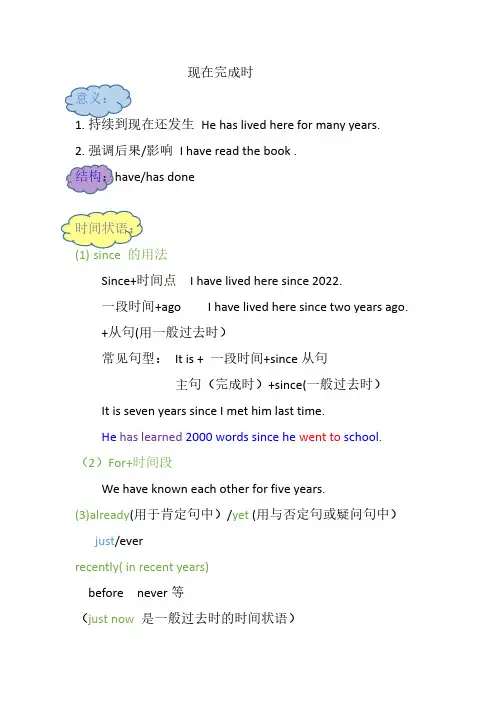
现在完成时意义:He has lived here for many years.2.强调后果/影响I have read the book .结构:时间状语:(1)since 的用法Since+时间点I have lived here since 2022.一段时间+ago I have lived here since two years ago.+从句(用一般过去时)常见句型:It is + 一段时间+since从句主句(完成时)+since(一般过去时)It is seven years since I met him last time.He has learned 2000 words since he went to school.(2)For+时间段We have known each other for five years.(3)already(用于肯定句中)/yet (用与否定句或疑问句中)just/everrecently( in recent years)before never等(just now是一般过去时的时间状语)I have just finished my homework.Have you ever seen one like this?(4So far /in the past few years等,表示:“目前为止”非延续性动词延续性动词非延续性动词延续性动词Borrow Keep Fall asleep Be asleep buy have Catch a cold Have a cold leave Be away Begin/start Be ondie Be dead open Be open Come (to)Be in/at close Be closed区分Have gone to去了没回Have been to去了回来(常与次数once/twice/基数词+times连用)Have been in在某地呆了多久例句:(1)You can’t see her because he has gone to Sibo.(2)He has been to Sibo twice.(3)He has been in this city for two years.备注:Here/there/home 不与介词连用。
初中英语8个时态归纳总结
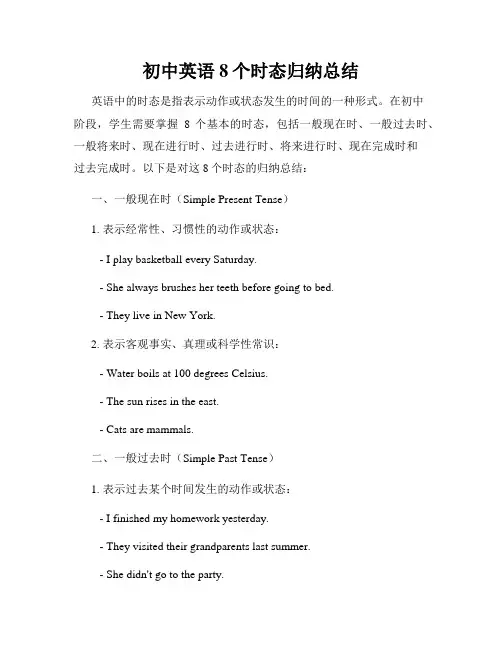
初中英语8个时态归纳总结英语中的时态是指表示动作或状态发生的时间的一种形式。
在初中阶段,学生需要掌握8个基本的时态,包括一般现在时、一般过去时、一般将来时、现在进行时、过去进行时、将来进行时、现在完成时和过去完成时。
以下是对这8个时态的归纳总结:一、一般现在时(Simple Present Tense)1. 表示经常性、习惯性的动作或状态:- I play basketball every Saturday.- She always brushes her teeth before going to bed.- They live in New York.2. 表示客观事实、真理或科学性常识:- Water boils at 100 degrees Celsius.- The sun rises in the east.- Cats are mammals.二、一般过去时(Simple Past Tense)1. 表示过去某个时间发生的动作或状态:- I finished my homework yesterday.- They visited their grandparents last summer.- She didn't go to the party.2. 表示过去的经历或习惯:- When I was young, I often went swimming. - He always ate breakfast at 8 o'clock.三、一般将来时(Simple Future Tense)1. 表示将来要发生的动作或事件:- I will go shopping tomorrow.- They are going to have a picnic next week. - She won't be late for the meeting.2. 表示将来的打算或意愿:- I am going to be a doctor when I grow up.- We will help you with your project.四、现在进行时(Present Continuous Tense)1. 表示现在正在进行的动作:- We are studying English at the moment.- He is playing soccer with his friends.- They aren't watching TV right now.2. 表示现阶段的趋势或变化:- The population is increasing rapidly.- More and more people are using smartphones.五、过去进行时(Past Continuous Tense)1. 表示过去某一时间段内正在进行的动作:- I was reading a book when the phone rang.- They were cooking dinner at 7 o'clock.2. 表示过去的同时发生的两个动作:- She was listening to music while doing her homework.六、将来进行时(Future Continuous Tense)1. 表示将来某一时间段内正在进行的动作:- Tomorrow, they will be flying to Paris.- I will be waiting for you at the station.2. 表示将来的预测或计划:- This time next month, I will be studying for my exams.七、现在完成时(Present Perfect Tense)1. 表示过去某一时间发生的动作对现在造成的影响或结果: - I have finished my homework, so I can watch TV now.- She has already eaten lunch.2. 表示过去某一时间内多次发生的动作:- We have visited that museum several times.八、过去完成时(Past Perfect Tense)1. 表示过去某一时间点之前已经完成的动作:- By the time they arrived, we had already left.- I had finished my work before the deadline.2. 表示过去的顺序或先后关系:- She realized that she had forgotten her keys after she locked the door.以上是初中英语的8个时态的归纳总结。
初中英语八种时态
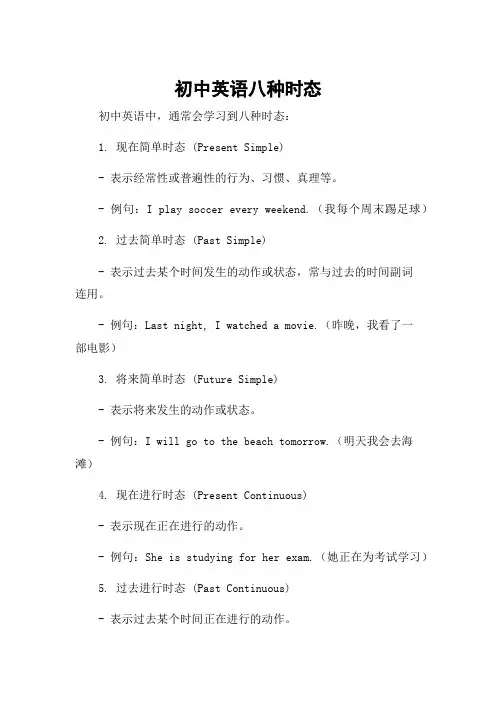
初中英语八种时态初中英语中,通常会学习到八种时态:1. 现在简单时态 (Present Simple)- 表示经常性或普遍性的行为、习惯、真理等。
- 例句:I play soccer every weekend.(我每个周末踢足球)2. 过去简单时态 (Past Simple)- 表示过去某个时间发生的动作或状态,常与过去的时间副词连用。
- 例句:Last night, I watched a movie.(昨晚,我看了一部电影)3. 将来简单时态 (Future Simple)- 表示将来发生的动作或状态。
- 例句:I will go to the beach tomorrow.(明天我会去海滩)4. 现在进行时态 (Present Continuous)- 表示现在正在进行的动作。
- 例句:She is studying for her exam.(她正在为考试学习)5. 过去进行时态 (Past Continuous)- 表示过去某个时间正在进行的动作。
- 例句:They were playing basketball when it started raining.(下雨时,他们正在打篮球)6. 将来进行时态 (Future Continuous)- 表示将来某个时间正在进行的动作。
- 例句:This time tomorrow, I will be flying to Paris.(明天这个时候,我将会在飞往巴黎的路上)7. 现在完成时态 (Present Perfect)- 表示过去发生的动作或经历的经验与现在的关系。
- 例句:I have visited Japan twice.(我去过日本两次)8. 过去完成时态 (Past Perfect)- 表示过去某个时间或动作之前已经发生的动作。
- 例句:She had finished her homework before I arrived.(我到之前,她已经完成作业了)这是初中英语中常用的八种时态。
初中英语八大时态结构

初中英语八大时态结构初中英语八大时态结构如下:1.一般现在时:基本结构是主语+动词原形(如主语为第三人称单数,动词上要改为第三人称单数形式)。
否定形式是主语+am / is / are+not+其他。
一般疑问句是把be动词放在句首,用助动词do 提问,如主语为第三人称单数,则用does,同时还原行为动词。
2.现在进行时:基本结构是主语+be+动词的ing形式。
否定形式是主语+be+not+动词的ing形式。
疑问句形式是把be动词放在句首,行为动词改为动词的ing形式。
3.现在完成时:基本结构是主语+have / has+动词的过去分词形式。
否定形式是主语+have / has+not+动词的过去分词形式。
疑问句形式是have / has放在句首,动词的过去分词形式还原。
4.现在完成进行时:基本结构是主语+have / has+be+动词的ing形式。
否定形式是主语+have / has+not+be+动词的ing形式。
疑问句形式是把have / has放在句首,be动词和动词的ing形式还原。
5.过去进行时:基本结构是主语+was/were+动词的ing形式。
否定形式是主语+was/were+not+动词的ing形式。
疑问句形式是把was/were放在句首,动词的ing形式还原。
6.过去完成时:基本结构是主语+had+动词的过去分词形式。
否定形式是主语+had+not+动词的过去分词形式。
疑问句形式是把had放在句首,动词的过去分词形式还原。
7.过去完成进行时:基本结构是主语+had+be+动词的ing形式。
否定形式是主语+had+not+be+动词的ing形式。
疑问句形式是把had 放在句首,be动词和动词的ing形式还原。
8.一般将来时:基本结构是主语+will/shall/be going to+动词原形。
否定形式是主语+will/shall/be going to+not+动词原形。
疑问句形式是把will/shall/be going to放在句首,动词原形还原。
初中英语8大时态

Was I/ he/ she/ it working?
I/ He/ She/ It Was I /he/ she /it
was not working.not working?或 或I/ he/ she/ it Wasn’t I/ he/ she wasn’t working./it working?
时间状语: always, usually, often, sometimes, every week (day, year, month…), once a week,
否定形式: ①am/is/are+not; ②谓语动词为行为动词,则在其前加don't, 如主语为第三人称单数,则用doesn't,加 动词原型。
e.g.We won’t go to the park if it rains tomorrow. 如果明天下雨,我们将不去公园。
When I grow up, I will go to America. 我长大后要去美国。
动词第三人称单数 形式变化规则
规则
例子
一般在词尾加-s,(清辅音 后读/s/,在浊辅音后读 /z/;在t后读/ts/,在d后读 /dz/。)
We/ You/ They
were teachers.
Were we/ We/ You/ They Were we/ you/ they not
you/ they were not/
teachers?或Weren’t we/
teachers?weren’t teachers.you/ they teacher?
3.基本结构 主语+was/were +doing +其他 4.否定形式: 主语+was/were + not +doing+其他 5.一般疑问句: 把was或were放于句首。(第 一个字母大写) 其句式变化仍然要在be上做文章。
初中英语八大时态
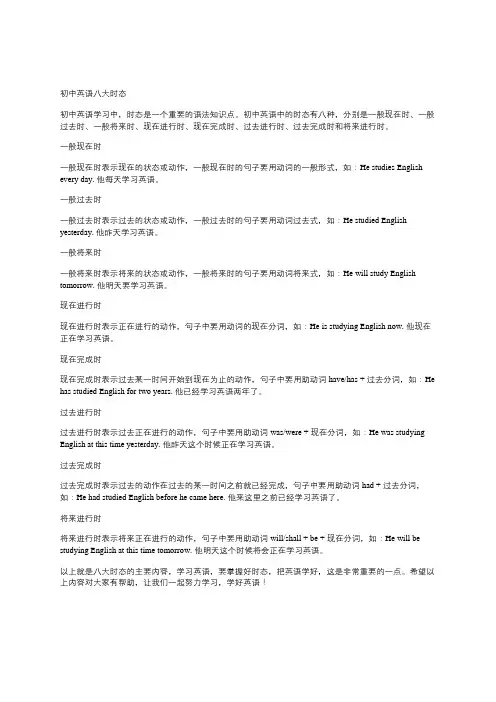
初中英语八大时态初中英语学习中,时态是一个重要的语法知识点。
初中英语中的时态有八种,分别是一般现在时、一般过去时、一般将来时、现在进行时、现在完成时、过去进行时、过去完成时和将来进行时。
一般现在时一般现在时表示现在的状态或动作,一般现在时的句子要用动词的一般形式,如:He studies English every day. 他每天学习英语。
一般过去时一般过去时表示过去的状态或动作,一般过去时的句子要用动词过去式,如:He studied English yesterday. 他昨天学习英语。
一般将来时一般将来时表示将来的状态或动作,一般将来时的句子要用动词将来式,如:He will study English tomorrow. 他明天要学习英语。
现在进行时现在进行时表示正在进行的动作,句子中要用动词的现在分词,如:He is studying English now. 他现在正在学习英语。
现在完成时现在完成时表示过去某一时间开始到现在为止的动作,句子中要用助动词have/has + 过去分词,如:He has studied English for two years. 他已经学习英语两年了。
过去进行时过去进行时表示过去正在进行的动作,句子中要用助动词was/were + 现在分词,如:He was studying English at this time yesterday. 他昨天这个时候正在学习英语。
过去完成时过去完成时表示过去的动作在过去的某一时间之前就已经完成,句子中要用助动词had + 过去分词,如:He had studied English before he came here. 他来这里之前已经学习英语了。
将来进行时将来进行时表示将来正在进行的动作,句子中要用助动词will/shall + be + 现在分词,如:He will be studying English at this time tomorrow. 他明天这个时候将会正在学习英语。
初中英语语法八大时态总结完整版
初中英语语法八大时态总结完整版一、一般现在时1.定义:表示经常性或习惯性的动作、状态或真理。
2.结构:主语+动词原形(+其他成分)。
3.例句:(1) I go to school every day.(2) He often plays basketball after school.(3) Water boils at 100 degrees Celsius.二、一般过去时1.定义:表示过去一些时间发生的动作或存在的状态。
2.结构:主语+动词的过去式(+其他成分)。
3.例句:(1) They visited their grandparents last weekend.(2) She lived in Beijing when she was young.(3) We studied English in middle school.三、一般将来时1.定义:表示将来一些时间将要发生的动作或存在的状态。
2. 结构:主语 + will + 动词原形(+ 其他成分)。
3.例句:(1) I will go to the park tomorrow.(3) We will have a party next week.四、现在进行时1.定义:表示现在正在进行的动作。
2. 结构:主语 + am/is/are + 动词-ing(+ 其他成分)。
3.例句:(1) She is reading a book right now.(2) They are playing soccer in the park.(3) We are having dinner at the moment.五、过去进行时1.定义:表示过去一些时间正在进行的动作。
2. 结构:主语 + was/were + 动词-ing(+ 其他成分)。
3.例句:(1) He was watching TV at 8 o'clock last night.(2) They were traveling in Europe during summer vacation.(3) We were studying when the phone rang.六、将来进行时1.定义:表示将来一些时间正在进行的动作。
初中英语语法八大时态总结
初中英语语法八大时态总结学校英语语法八大时态总结学校英语时态是英语学习中一个至关重要的内容,同学们在实际运用时,往往对时态总是倍感麻烦,为了让大家能更深刻地记住英语语法中的各种时态,下面是我为您收集整理的学校英语语法八大时态总结,供大家参考!学校英语语法八大时态总结一、一般现在时:概念:常常、反复发生的动作或行为及现在的某种状况。
时间状语:always,usually,often,sometimes,everyweek(day,year,month),onceaweek,onSundays,etc.基本结构:①be动词;②行为动词否定形式:①am/is/are+not;②此时态的谓语动词若为行为动词,则在其前加dont,如主语为第三人称单数,则用doesnt,同时还原行为动词。
一般疑问句:①把be动词放于句首;②用助动词do提问,如主语为第三人称单数,则用does,同时,还原行为动词。
二、一般过去时:概念:过去某个时间里发生的动作或状态;过去习惯性、常常性的动作、行为。
时间状语:ago,yesterday,thedaybeforeyesterday,lastweek(year,night,month),in1989,justnow,attheageof5,oneday,longlongago,onceuponatime,etc.基本结构:①be动词;②行为动词否定形式:①was/were+not;②在行为动词前加didnt,同时还原行为动词。
一般疑问句:①was或were放于句首;②用助动词do的过去式did提问,同时还原行为动词。
三、现在进行时:概念:表示现阶段或说话时正在进行的动作及行为。
时间状语:now,atthistime,thesedays,etc.基本结构:am/is/are+doing否定形式:am/is/are+not+doing.一般疑问句:把be动词放于句首。
四、过去进行时:概念:表示过去某段时间或某一时刻正在发生或进行的行为或动作。
初中英语语法八大时态总结(完整版)
初中英语语法八大时态一.一般现在时1.结构肯定句式:主语+动词原形/动词的第三人称单数+其他否定句式:主语+(助动词)don't/doesn't+动词原形+其他一般疑问句式:Do/Does+主语+动词原形+其他简略回答:(肯)Yes,主语+do/does(否)No,主语+do/does not缩写形式:don't=do not doesn't=does not例句:He often goes swimming in summer.I usually leave home for school at7every morning.2.用法1)表示经常的、习惯性的动作或存在的状态,常与表示频度的副词连用。
常用的频度副词有:always、often、usually、seldom、never、sometimes,every week(day,year, month…),once a week,on Sundays.频度副词在句中通常放在行为动词之前,系动词、助动词之后。
例如:He often goes swimming in summer.I usually leave home for school at7every morning.2)表示主语具备的性格、特征和能力等。
例如:All my family love football.My sister is always ready to help others.Ann writes good English but does not speak well.3)表示客观真理、客观存在、自然现象。
例如:The earth moves around the sun.Shanghai lies in the east of China.4)表示按计划或安排好的,或将要发生的动作,可用一般现在时表将来。
但只限于start,begin,leave,go,come,arrive,return,take place等。
初中英语语法八大时态总结完整版初中英语时态总结
初中英语语法八大时态总结完整版初中英语时态总结初中英语语法八大时态一.一般此刻时1.构造一定句式 : 主 +原形 /的第三人称数 +其余否认句式 : 主 +(助)don't/doesn't +原形 +其余一般疑句式 : Do/Does+主 +原形 +其余略回答 : (肯)Yes,主 +do/does(否 )No,主 +do/does not写形式 : don't = do not doesn't = does not例句: He often goes swimming in summer.I usually leave home for school at 7 every morning.2.用法1)表示常的、性的作或存在的状,常与表示度的副用。
常用的度副有: always、often、 usually、seldom、never、sometimes, every week (day, year, month ⋯), once a week, on Sundays. 度副在句中往常放内行从前,系、助以后。
比如 : He often goes swimming in summer.I usually leave home for school at 7 every morning.2)表示主具的性格、特点和能力等。
比如: All my family love football .My sister is always ready to help others .Ann writes good English but does not speak well.3)表示客真谛、客存在、自然象。
比如: The earth moves around the sun.Shanghai lies in the east of China.4)表示按划或安排好的,或将要生的作,可用一般在表未来。