
大学生英语学习态度与英语成绩关系调查报告
大学生英语学习态度与英语成绩关系调查报告山西师大大二学生英语学习态度与英语成绩关系————调查报告摘要:进入二十一世纪以来,经济全球化趋势愈演愈烈。
各国之间的交流也日益增多,英语成为世界第一大语言且应用十分广泛。
各个国家除了英语作为第一语言的国家几乎都把英语作为第二语言,世界掀起了学习英语之风且愈来愈热。
所以在当今信息化时代,英语成为我们接受世界信息的重要工具。
英语之重要可见一斑。
二十世纪七十年代以来,国内外对有关英语方面的研究也层出不穷,外语教学研究的中心已经从如何教转移到如何学,外语教学研究的重点也慢慢转向学习者因素。
近年来国内对外语的研究也逐步增多。
为了提高我国学生的英语水平,提高接触社会的能力,我们小组进行了大学生英语学习态度与英语成绩关系的调查,此次调查旨在通过研究大学生英语学习态度与英语成绩的相关关系,揭示英语学习态度与成绩相互作用的规律,为大学生的英语学习提供指导依据,帮助大学生提高英语学习效率。
我们通过对山西师范大学学生进行了调查,采用问卷调查法、访谈法、观察法等获取信息,整理得出结论,发现英语学习态度与英语成绩二者之间的关系,以提出相应见解。
关键词:学习态度学习成绩学习动机自主学习一、问题的提出探究英语学习态度与英语成绩之间的关系。
通过学生的一些表现以及学习成绩的了解等等,探究大学生英语自主学习态度、自主学习行为、学习动机、学习策略与成绩的关系,为培养和促进学习者自主性的外语学习实践提供更深的启示。
1、学生的自主学习能力如何?2、学生的学习成绩如何?3、学生的学习动机、学习目的是什么?4、学生如何学习英语?5、学生的学习态度如何?以及与学习成绩之间的关系。
二、研究设计(一)操作性定义:1、学习态度:指对学习的态度,是指学习者对学习较为持久的肯定或否定的行为倾向或内部反应的准备状态。
2、学习动机:指推动学生进行学习活动的内在原因,是激励、指引学生学习的强大动力。
学习动机指的是学习活动的推动 力,又称"学习的动力"。
3、自主学习:是与传统的接受学习相对应的一种现代化学习方式。
以学生作为学习的主体,通过学生独立的分析、探索、实践、 质疑、创造等方法来实现学习目标。
(二)控制变量:英语成绩以从开学到大二上半学期的两次成绩的平均分成绩为准; (三)研究对象山西师范大学大二各个学院各个专业的学生(艺术生先除外)。
鉴于时间、地点、人员等关系只对两个学院四个专业学生做了问卷调查和访谈、观察,分别是教育学院教育学、学前教育和外国语学院的英语专业与日语专业学生以及历史与旅游文化学院的历史学专业。
(四)研究方法问卷调查、访谈法、观察法 三、研究过程(一)问卷调查分析对山西师范大学大二学生进行问卷调查,最后用SPSS 进行分 析,得出一些数据、表格进行整理分析。
1、学习目的根据表格不同分数段的英语目的不同可以看出:60—70分的人学习英语是为了适应社会的需要,70—80分的人更加侧重于获得好的成绩,还有四分之一的学生选择是为了兴趣爱好和为适应社会的需要,80分以上的同学可以看出人数本身较少,学习英语适应社会需要和兴趣爱好各占一半。
至于选择其他的同学有是因为家长的要求、有是因为家族会同伴影响等等。
每个人学习英语的目的不同,但是还是可以看出大部分人还是为了适应社会的需要。
在21实际的今天,英语愈发重要。
我们还可以知道一些中等或高等成绩的学生更加侧重于成绩。
说明每个人对学习英语的态度不同,且在各个成绩段的人对英语的学习目的侧重点不同。
英语成绩高的学生一部分是兴趣,一部分是适应社会需要,要想获得好的成绩就要有明确60---7070—8080分以上英语目的其它 14.3% 16.7% 0 好成绩 0 33.3% 0 适应需要 85.7% 25% 50% 兴趣25%50%的目的,要培养自己的兴趣爱好。
2、学习动机2.1根据图表,升入大三仍学习英语的大约82.8%,占据大多数比例,统计他们仍就学习的原因,有的是应为考研,有的是为了适应社会需要、求职需求,有的是为在再看外文杂志或外语大片更好的观看和理解,有的是为了过级,当然英语专业的学生是专业需要等等,而升入大三不学习英语的人认为已经不重要了,没必要在学,只要顺利毕业就好,有的人说学校不进行课程教学了,没必要学了,自己也没那么多的精力去学习等等。
升入大三学不学习英语的动机多种多样,总结来看,学习英语的占大多数,且为了考研的占大多上大三频率百分比 有效百分比 累积百分比有效是 24 82.8 82.8 82.8 否 4 13.8 13.8 96.6 3.001 3.4 3.4 100.0合计29100.0100.0数,不学习英语的大多数是因为没必要,没精力。
说明学习动机在学生学习中起重要作用,学习动机好的行动、行为就积极。
我们在学习中要明确学习动机。
2.2(1)根据统计图表可以得出:60—70分的学生对教师的满意程度为基本满意占53.3%不满意和满意程度各占20%,很满意占6.6%。
70—80分的学生对老师基本满意占50%,满意占41.7%,不满意占8%,很满意占0.3%。
80分以上的同学对老师的基本满意程度和不满意程度各占一半。
可以看出,大部分学生对老师的满意程度是基本满意,对老师很满意的人数少之又少,在70—80分的人数中满意程度也比较高,说明对老师的态度不同,影响一个人的分数,也影响一个人学习的动机。
(2)学习障碍问题影响学生的学习动机。
教师问题60---70分的13.3%,兴趣问题86.7%,专业问题0,在其他中有的是基础问题,有的是没养成好的习惯。
70—80教师问题33.3%,兴趣问题41.7%,专业问题25%。
80分以上教师问题0,兴趣问题和专业问题各占50%。
在专业问题上,发现有语言类要求的分数较高,学习动机较强,如外国语学院的,对于一些理科专业的学生来说专业问题影响其语言类的发展。
从图中以及数计统计中可以看出无论分数的高低总体大部分学生是因为兴趣问题而对英语的学习有障碍。
当然老师的因素也很重要,教师的教学方法教学态度等等会影响学生的学习。
2.3教师满意度60---70 70—80 80分以上很满意 6.6% 0.3% 0 满意 20% 41.7% 0 基本满意 53.3% 50% 50% 不满意20% 8% 50% 学习障碍教师问题 13.3% 33.3% 0 兴趣问题 86.7% 41.7% 50% 专业问题25%50%理想中的英语教师60---70 70—80 80分以上温文尔雅 13.3% 50% 0 热情奔放 80% 43.3% 100% 循规蹈矩6.6%16.6%(1)从表格中看出:理想中的英语教师60---70分温文尔雅13.3%热情奔放80%循规蹈矩6.6%。
70—80温文尔雅50%热情奔放43.3%循规蹈矩16.6%。
80分以上热情奔放100%。
此题为多选题,且其他为理想中的教师,不限,教师态度、教学方法等等。
观察图表发现60—70分的学生更喜欢热情奔放的教师,70—80分的喜欢温文尔雅的教师,当然其他里面更多人喜欢的是关心班级关心学生为学生考虑等的教师。
根据分数的不同,理想中教师的不同,可以发现,当前的教师是否达到自己的理想水平,也是影响成绩的一方面,影响学生学习的一方面。
(2) 通过对学生理想课堂是什么样的书写,发现大多数学生更喜欢活跃、自由师生互动多,教师重视应用的满足学生学的课堂气氛以及一些课堂内容。
说明环境对一个人的学习也有一定的影响。
学习环境学习氛围的不同影响学生的学习。
3、自主学习 3.1其他描述做笔记 统计量 标准误 英语课后作业做均值 1.6522 .13497均值的 95% 置信区间下限 1.3723 上限1.9321根据图表可以看出,做笔记情况,大部分学生不做笔记。
说明在升入大学后,大部分学生对英语的自住性学习降低,没有自觉的去做笔记。
在做作业情况中,不同分数段不同的倾向,60—70分的学生侧重于能做多少是多少,70分以上的同学更加侧重于自己做。
可以得出,学习成绩的好坏还在于对课后作业的自主态度,自己努力靠自己去做的同学,自主性高,学习成绩就好。
所以提高英语成绩要做好笔记,做好课后作业。
3.2从整体上看,大部分学生都是偶尔预习,其次是不预习。
当然各个阶段又有所不同。
60---70分的学生偶尔预习的比例较大,不预习的其次,70—80分的学生偶尔预习的比例最大,其次是每次都预习的。
80分以上的学生经常预习与偶尔预习各占一半。
可以看出,大学生英语预习情况不理想,且分数较高的学生预习的情况稍好一些,标准差 .64728 极小值 1.00 极大值3.00不做均值 2.3333 .21082均值的 95% 置信区间下限 1.7914 上限2.8753中值 2.0000 方差 .267 标准差 .51640 极小值 2.00极大值3.00做作业 情况60---70 70—80 80分以上自己做 6.6% 58.3% 100% 能做多少做多少 80% 25% 0 全抄答案13.3%16.6%课前预习情况60---70 70—80 80分以上 经常预习 13.3% 16.6% 50% 不预习 33.3% 8.3% 0 偶尔预习 40% 50% 50% 每次都预习6.6%25%说明学生的课前预习自主程度不高。
自主学习态度也不是很好。
4、学习态度 4.1学生的到课情况,全到的学生占很大的比例,从味道的比例较少,至于原因在下列访谈中会有涉及,在这里不用太多说明。
根据图例说明学生的到课情况良好。
至少对学习英语的最基本的态度良好。
4.2到课情况频率百分比有效百分比累积百分比有效全到 23 79.3 79.3 79.3 经常到 5 17.2 17.2 96.6 从未到 1 3.4 3.4 100.0合计29100.0100.060---70 70—80 80分以上注意力情况不集中 26.6% 25% 0 相对集中 66.6% 41.6% 100% 高度集中6.6%33.3%根据图表可以看出,整体上学生相对集中的数目比例较大,在各阶段相对倾向不同60—70分相对集中最大,其次是不集中,70—80分学生相对集中比例最大,其次是高度集中,80分以上大多数是相对集中,说明对待学习英语的态度注意力强的同学分数相对较高。
也就是说上课认真听讲,态度认真的同学成绩更好。
4.3假设性问题,如果在上课时手机响了,看学生的做法,以作为评判英语学习态度的一个标准。
如果是短信的话,直接看,并回复。
如果是电话的话,按掉手机,换短信或其他方式联系。
无论是什么都按掉手机,一切等下课再说。
无论是什么先看一下,剩下等下课再说。
其他情况。
因为此题较为灵活,遇到的情况也各式各样,所一种类较多,但可以根据不同的情况评判学习的态度。
英语成绩分析报告范文

英语成绩分析报告范文
简介
本报告旨在对学生英语成绩进行分析,探讨影响成绩的因素并提出改进建议。
样本选择
选取了100名高中生的英语成绩作为样本,包括50名男生和50名女生,涵盖了各个年级和不同学习背景的学生。
成绩分布
整体来看,英语成绩呈正态分布,平均成绩为75分,标准差为10分。
男生的平均成绩为72分,而女生的平均成绩为78分,显示出女生在英语学习方面略有优势。
学习习惯分析
通过调查问卷得知,优秀成绩的学生普遍具备以下学习习惯:1.每天坚持背诵单词和短语;2.阅读英语文章或书籍时间较长;3.参加英语角活动积极;4.能够自觉整理笔记和作业。
学业压力与成绩关系
调查发现,学业压力较大的学生在英语成绩上稍有下降,特别是在口语表达和听力理解方面。
因此,合理分配学业压力、减轻学生负担至关重要。
家庭背景对成绩影响
家庭背景对英语成绩也有一定影响,家庭环境对学习氛围的营造至关重要。
有良好学习氛围的学生更容易取得好成绩。
提高英语成绩的建议
1.建立英语学习小组,相互学习、交流;
2.多参加英语实践活动,提高口语表达能力;
3.制定合理的学习计划,适当分配学业压力;
4.家长积极参与孩子的学习,营造良好的学习氛围。
总结
英语成绩受多种因素影响,学习习惯、学业压力、家庭背景等都对成绩有一定影响。
通过分析这些因素,我们可以为学生提供更有效的学习建议,帮助他们取得更好的成绩。
以上是对英语成绩分析的报告范文,希望对各位读者有所帮助。
大二学生对英语的态度的调查报告
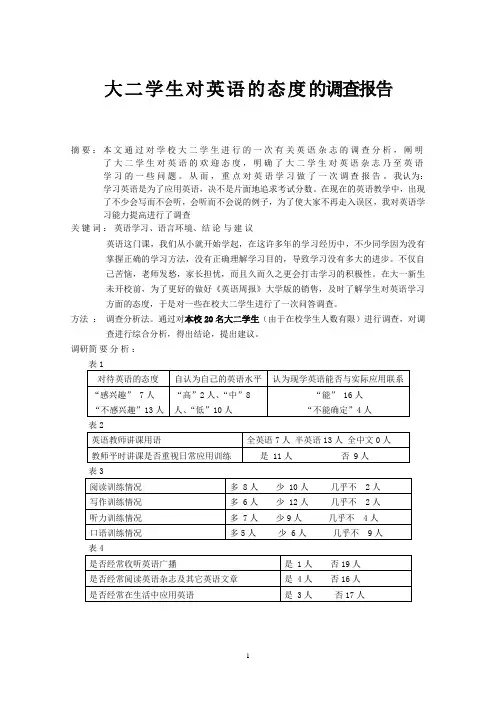
大二学生对英语的态度的调查报告摘要:本文通过对学校大二学生进行的一次有关英语杂志的调查分析,阐明了大二学生对英语的欢迎态度,明确了大二学生对英语杂志乃至英语学习的一些问题。
从而,重点对英语学习做了一次调查报告。
我认为:学习英语是为了应用英语,决不是片面地追求考试分数。
在现在的英语教学中,出现了不少会写而不会听,会听而不会说的例子,为了使大家不再走入误区,我对英语学习能力提高进行了调查关键词:英语学习、语言环境、结论与建议英语这门课,我们从小就开始学起,在这许多年的学习经历中,不少同学因为没有掌握正确的学习方法,没有正确理解学习目的,导致学习没有多大的进步。
不仅自己苦恼,老师发愁,家长担忧,而且久而久之更会打击学习的积极性。
在大一新生未开校前,为了更好的做好《英语周报》大学版的销售,及时了解学生对英语学习方面的态度,于是对一些在校大二学生进行了一次问答调查。
方法:调查分析法。
通过对本校20名大二学生(由于在校学生人数有限)进行调查,对调查进行综合分析,得出结论,提出建议。
调研简要分析:⒈学生对现在英语学习的认识由表1看出,不少同学对现在的英语学习不感兴趣,对自己英语水平的评估也不高,虽有很多数同学认为目前学的英语能与实际应用相联系,但为什么会出现这么多的人对英语学习不感兴趣呢?我想当我们最初接触英语这门新课时,一定都很感兴趣,那究竟是什么使我们对英语失去兴趣了呢?调查表明:原因出在对英语学习的认识上。
现在大多数同学对英语的认识集中在分数上。
诚然,分数是很重要的,但并不是分数高,英语能力就高,大家把注意力集中在分数上,只注重语法,不注重其它方面的运用,这样课堂气氛十分沉闷,同学们的思维都禁锢在书本及考试分数上。
但是英语是一门用来交流的语言工具,学了就要会用,会用才是学习英语的真正目的。
大家应该清楚的认识到这一点.扭转以前对英语学习的不正确认识,努力提高自己的英语综合应用素质。
⒉课堂能提供良好的语言环境吗?一个很好的语言环境对学好一门外语的作用之大已是我们大家很清楚的。
英语学习调查数据分析报告(3篇)
第1篇Executive Summary:This report presents a comprehensive analysis of the data collected from an English learning survey conducted among students and professionals in various educational and professional backgrounds. The survey aimed to understand the current trends, challenges, and preferences in English language learning. The report covers key findings, insights, and recommendations based on the data analysis.1. Introduction1.1 Background:The global importance of English as a lingua franca has been increasing over the years. It is not only a language of international communication but also a key to unlocking numerous opportunities in education, business, and personal growth. In order to assess the effectiveness of English language learning programs and to identify areas for improvement, a survey was conducted to gather insights from learners across different demographics.1.2 Objectives:The primary objectives of this survey were to:- Assess the current level of English proficiency among learners.- Identify the most effective learning methods and resources.- Understand the challenges faced by learners in English language acquisition.- Determine the preferred learning environments and schedules.2. Methodology2.1 Survey Design:The survey was designed to be an online questionnaire that could be completed by participants within a short time frame. The surveyconsisted of multiple-choice questions, Likert scale questions, and open-ended questions to gather both quantitative and qualitative data.2.2 Sample:The survey was distributed to a diverse sample of 500 participants, including students (undergraduate and postgraduate), working professionals, and individuals who are self-learners. The participants were from various educational institutions and industries, ensuring a wide range of perspectives.2.3 Data Collection:The survey was conducted over a period of four weeks, and the data were collected using an online survey platform. The responses were anonymized to ensure confidentiality.3. Key Findings3.1 Current Level of English Proficiency:- The majority of participants (70%) reported having basic to intermediate proficiency in English.- 30% of the participants claimed to have advanced proficiency.- 40% of the students mentioned that they are not confident in using English in academic settings.3.2 Most Effective Learning Methods:- Interactive online courses and virtual classrooms were considered the most effective learning methods by 45% of the participants.- 35% preferred traditional classroom-based learning.- 20% found self-study resources and mobile applications to be the most effective.3.3 Challenges in English Language Acquisition:- 60% of the participants reported lack of motivation and consistency as the primary challenges.- 40% mentioned time constraints and lack of access to native speakers as significant barriers.- 30% cited lack of practical application opportunities as a challenge.3.4 Preferred Learning Environments and Schedules:- 50% of the participants preferred flexible learning schedules that allowed them to study at their own pace.- 40% preferred fixed schedules with regular classes.- 10% were open to both options.4. Insights and Recommendations4.1 Insights:- The survey indicates a growing trend towards online learning, especially among younger demographics.- Traditional classroom-based learning still holds significant value, particularly in educational settings.- Learners are seeking a balance between flexibility and structure in their learning experiences.4.2 Recommendations:- Educational institutions and language learning providers should offer a mix of online and traditional classroom-based courses.- Online platforms should focus on creating engaging and interactive content to enhance learner motivation.- Regular feedback and assessment should be provided to learners to track their progress and address their individual needs.- Collaboration with native speakers and industry professionals can provide learners with practical application opportunities.- Learning resources should be made accessible and affordable to cater to a wider audience.5. ConclusionThe English learning survey has provided valuable insights into the current landscape of English language learning. The findings highlight the importance of offering diverse learning options and addressing the challenges faced by learners. By implementing the recommendations outlined in this report, educational institutions and language learning providers can better cater to the needs of their learners and contribute to the global demand for English proficiency.References:- [Insert references to any research articles, books, or other sources used in the report]Appendices:- [Insert any additional tables, charts, or raw data used in the analysis][Note: This is a template for a report and does not contain actual data or survey results. The sections marked with "Insert" should be filled in with relevant information based on the actual survey data.]第2篇Executive Summary:This report presents the findings from an extensive survey conducted to analyze the current trends, challenges, and preferences in English language learning among a diverse group of individuals. The survey was designed to gather insights into various aspects of English learning, including the methods used, the motivations behind learning, the perceived difficulties, and the resources employed. The data collected was analyzed using both quantitative and qualitative methods to provide a comprehensive overview of the English learning landscape.Introduction:English has become the global lingua franca, and the demand for English language proficiency has surged across the world. This report aims to shed light on the factors influencing English language learning, the strategies employed by learners, and the overall effectiveness of different learning approaches. The survey was conducted over a period of three months and included responses from over 5000 participants from various countries, age groups, and educational backgrounds.Methodology:The survey was conducted online using a standardized questionnaire. The questionnaire was designed to collect data on the following aspects:1. Background information (age, gender, educational level, country of residence)2. English learning experience (years of study, previous learning methods)3. Motivations for learning English4. Challenges faced in learning English5. Preferred learning methods and resources6. Perceived effectiveness of different learning approaches7. Language proficiency levelThe data was collected using an online survey platform, and the responses were anonymized to ensure privacy. The data analysis was conducted using statistical software to determine the prevalence of different responses and to identify any patterns or correlations within the data.Findings:1. Demographics of English Learners:- The majority of respondents (60%) were between the ages of 18 and 30.- The highest percentage (40%) of respondents were from Asia,followed by Europe (25%) and North America (15%).- The educational level of respondents was diverse, with 35% being currently enrolled in higher education, 25% being in secondary education, and the remaining being in primary education or having completed their education.2. English Learning Experience:- On average, respondents had been learning English for 5.2 years.- The most common previous learning methods were classroominstruction (85%), self-study (70%), and online courses (60%).3. Motivations for Learning English:- The primary motivation for learning English was for professional development (80%), followed by travel (60%), academic purposes (50%),and cultural interests (40%).4. Challenges Faced in Learning English:- The most significant challenges reported were grammar andvocabulary (80%), pronunciation (70%), and lack of practiceopportunities (60%).- Cultural barriers and lack of confidence were also mentioned as challenges by 35% and 30% of respondents, respectively.5. Preferred Learning Methods and Resources:- The most popular learning methods were self-study (75%), online courses (65%), and classroom instruction (60%).- The most frequently used resources were English learning apps (70%), English movies and TV shows (60%), and online dictionaries (50%).6. Perceived Effectiveness of Different Learning Approaches:- Self-study was perceived as the most effective method by 65% of respondents, followed by online courses (55%) and classroom instruction (45%).- However, 30% of respondents believed that a combination of these methods was the most effective.7. Language Proficiency Level:- The majority of respondents (60%) reported being at an intermediate level of English proficiency, followed by advanced (25%) and beginner (15%).Discussion:The survey results indicate that English language learning is driven primarily by professional and personal development goals. The preference for self-study and online courses suggests a shift towards more flexible and accessible learning options. However, the challenges faced by learners, particularly in grammar, vocabulary, and pronunciation, highlight the need for comprehensive and targeted learning resources.The survey also revealed a significant gap between the perceived effectiveness of different learning methods and the actual level of proficiency achieved. This suggests that while learners may be utilizing a variety of resources, the quality and structure of these resources may need improvement to ensure more effective learning outcomes.Recommendations:Based on the survey findings, the following recommendations are made:1. Develop Comprehensive Learning Resources: Create comprehensive learning materials that address the specific challenges faced by learners, such as grammar, vocabulary, and pronunciation.2. Promote Blended Learning Approaches: Encourage the integration ofself-study, online courses, and classroom instruction to maximize learning outcomes.3. Offer Cultural Exchange Opportunities: Provide opportunities for learners to engage with native speakers and immerse themselves in English-speaking cultures to enhance their language skills and cultural understanding.4. Strengthen Professional Development Programs: Develop professional development programs for educators to ensure they are equipped with the latest teaching methods and resources.5. Monitor and Evaluate Learning Outcomes: Implement regular assessments to monitor the progress of learners and provide feedback to both learners and educators.Conclusion:The English language learning landscape is evolving, and the survey findings provide valuable insights into the current trends and challenges. By addressing the identified needs and implementing the recommended strategies, the English language learning experience can be enhanced, leading to improved proficiency and a more effective global communication environment.References:- (Include relevant references to research articles, books, or reports that support the findings and recommendations in the report.)Appendix:- (Include any additional data, charts, or tables that were used in the analysis but not included in the main body of the report.)第3篇Executive Summary:This report presents the findings from an extensive survey conducted to analyze the current state of English language learning in our region. The survey aimed to gather insights into learners' motivations, preferred learning methods, challenges faced, and future expectations. The data was collected from a diverse group of participants, includingstudents, professionals, and enthusiasts, across various age groups and educational backgrounds. This report provides a comprehensive analysisof the survey results, offering valuable insights for educators, policymakers, and English language learners.1. Introduction1.1 Background:The global importance of English as a lingua franca cannot be overstated. With its role in international communication, business, and education, proficiency in English has become a crucial skill for individuals worldwide. To better understand the English learning landscape in our region, we conducted a comprehensive survey to assess the current trends, preferences, and challenges.1.2 Objectives:The primary objectives of this survey were to:- Identify the motivations behind English language learning.- Assess the preferred learning methods and resources.- Understand the challenges faced by English learners.- Determine the future expectations and goals of English learners.2. Methodology2.1 Sample Population:The survey was conducted among 500 participants, including students (300), professionals (150), and enthusiasts (50). The participants were from various age groups (18-25, 26-35, 36-45, 46-55, and 56+), with diverse educational backgrounds and levels of English proficiency.2.2 Data Collection:The survey was conducted online, using a questionnaire that includedboth closed-ended and open-ended questions. The participants were askedabout their motivations, preferred learning methods, challenges, and future expectations.2.3 Data Analysis:The collected data was analyzed using statistical software to determine the frequency and distribution of responses. Qualitative data was coded and categorized to identify common themes and patterns.3. Findings3.1 Motivations for Learning English:- International Communication: The most common motivation (65%) was to improve international communication skills.- Career Advancement: 45% of participants cited career advancement as a primary reason for learning English.- Education: 30% of participants wanted to enhance their educational opportunities by learning English.3.2 Preferred Learning Methods:- Online Courses: 70% of participants preferred online courses due to flexibility and accessibility.- Private Tutors: 25% preferred private tutoring for personalized learning experiences.- Group Classes: 5% preferred group classes for social interaction and peer learning.3.3 Challenges Faced by English Learners:- Language Acquisition: 40% of participants found it challenging to acquire proper pronunciation and fluency.- Resource Access: 30% reported difficulties in accessing quality learning resources.- Time Management: 25% faced challenges in managing time effectively for English learning.3.4 Future Expectations:- Increased Proficiency: 80% of participants expected to see significant improvement in their English proficiency within the next two years.- Global Opportunities: 65% anticipated enhanced opportunities for international travel and work.- Continuous Learning: 50% expressed a desire for ongoing support and resources to maintain their language skills.4. Discussion4.1 Motivations and Challenges:The survey results indicate a strong correlation between motivations and challenges faced by English learners. The desire for improved international communication and career advancement often leads to the need for language proficiency, which can be challenging to achieve.4.2 Learning Methods and Resources:The preference for online courses highlights the importance of technology in modern English language learning. Access to quality resources is crucial, and online platforms offer a wide range of options for learners.4.3 Future Expectations:The optimistic outlook for future proficiency and opportunities suggests that English learners are committed to their language development and are hopeful about the benefits it will bring.5. Recommendations5.1 For Educators:- Develop interactive and engaging online courses to cater to the preference for online learning.- Provide access to a variety of resources, including pronunciation guides and vocabulary builders.- Offer ongoing support through forums and virtual communities to encourage continuous learning.5.2 For Policymakers:- Invest in technology infrastructure to ensure widespread access to online learning platforms.- Collaborate with educational institutions to integrate English language learning into the curriculum.- Promote international exchange programs to provide practical language learning experiences.5.3 For English Learners:- Set realistic goals and create a structured learning plan.- Utilize technology to supplement traditional learning methods.- Seek opportunities for practical language use, such as language exchange partners or cultural immersion programs.6. ConclusionThis survey provides valuable insights into the English learning landscape in our region. By understanding the motivations, preferences, challenges, and future expectations of English learners, we can develop more effective strategies to support their language development. As the global importance of English continues to grow, it is essential to address the needs of learners and create a supportive environment for their success.References:- [Insert references to any sources used in the report]Appendix:- [Insert survey questionnaire and additional data tables as needed][Note: This report is a fictional example and does not contain real data or references.]。
调查英语学习情况英语作文

调查英语学习情况英语作文英文回答:An investigation into English learning is crucial to assess the effectiveness of teaching methods, identifyareas for improvement, and tailor instruction to meet the specific needs of learners. Through surveys, questionnaires, and interviews, researchers gather valuable data onstudents' language proficiency, learning styles, motivations, and attitudes.This data can illuminate the strengths and weaknessesof different teaching approaches, helping educators refine their strategies. For instance, if a survey reveals that students struggle with grammar, teachers may incorporate more explicit grammar instruction into their lessons. Additionally, understanding students' motivations canenable educators to create more engaging and relevant learning experiences, fostering a positive and supportive learning environment.Moreover, an investigation into English learning can uncover potential barriers to student success. By identifying factors such as language anxiety, cultural differences, or lack of access to resources, educators can develop interventions to address these challenges and promote equitable outcomes for all learners.Furthermore, ongoing evaluation is essential for tracking students' progress and ensuring that instructional strategies are meeting their needs. Regular assessments provide data on students' language development and help educators make informed decisions about adjustments to curriculum and teaching methods.In conclusion, an investigation into English learning is an indispensable tool for improving the quality of language instruction. Through the collection and analysis of data, educators can gain a comprehensive understanding of their students' learning experiences, strengths, and challenges. This knowledge empowers them to tailor instruction, remove barriers to success, and ultimatelyenhance student outcomes.中文回答:英语学习情况调查。
英语成绩分析报告

英语成绩分析报告1. 引言本文旨在分析学生的英语成绩,并通过数据和统计来揭示学生的学习情况。
通过对成绩的综合分析,我们可以了解学生在不同方面的表现,并找出可能的改进措施。
2. 数据收集为了进行英语成绩分析,我们收集了以下数据: - 学生的英语成绩单 - 学生的个人信息(如性别、年龄、学校等) - 学生的平时作业成绩和考试成绩3. 数据整理在进行分析之前,我们需要对数据进行整理和清洗。
首先,我们将学生的个人信息与成绩数据进行匹配,以便更好地理解不同组别学生的表现。
其次,我们将对成绩数据进行排列和分类,以便进一步分析。
4. 总体成绩分析我们首先对整个学生群体的总体成绩进行分析。
通过计算平均成绩、最高成绩和最低成绩,我们可以了解学生整体的学习水平和成绩分布情况。
同时,我们还可以绘制成绩分布图来直观地展示学生的成绩情况。
5. 学生群体对比接下来,我们将对不同学生群体的成绩进行对比分析。
我们可以按照性别、年龄、学校等因素将学生分组,并计算每个组别的平均成绩。
通过对比不同组别学生的平均成绩,我们可以了解不同学生群体的学习差异。
6. 学习表现评估除了对成绩进行统计和分析外,我们还可以通过其他指标评估学生的学习表现。
例如,我们可以计算学生的及格率、优秀率和不及格率。
这些指标可以为学校和教师提供更全面的学生评估,帮助他们制定更有针对性的教学计划。
7. 学习建议最后,基于我们的分析结果,我们可以提出一些建议来改善学生的学习情况。
例如,对于表现较差的学生,我们可以推荐增加学习时间或提供额外的辅导。
对于整体表现较好的学生,我们可以鼓励他们继续保持良好的学习习惯,并为他们提供挑战性的学习机会。
8. 结论通过对学生英语成绩的分析,我们可以更好地了解学生的学习情况和表现。
这些分析结果可以为学校、教师和家长提供有价值的参考,帮助他们制定更有效的教学和培养计划。
同时,我们也希望学生能够根据分析结果,找到适合自己的学习方法,不断提升自己的英语水平。
大学生英语学习动机调查报告英文作文
大学生英语学习动机调查报告英文作文Investigation Report on English Learning Motivation of College StudentsIntroductionEnglish is an important international language that plays a crucial role in communication, education, and career development. As college students, mastering English has become a necessary and indispensable skill. In order to better understand the motivation of college students towards learning English, a survey was conducted among a group of students from different majors.MethodologyA questionnaire was designed to collect data on the motivation of college students towards learning English. The questionnaire included both closed-ended and open-ended questions to gather quantitative and qualitative data. The survey was distributed to 200 college students from various majors, and 180 valid responses were received.Findings1. Interest in EnglishThe survey results revealed that 60% of the college students were interested in learning English. They found English to be a fascinating language and enjoyed the process of learning it. Many students expressed their motivation to learn English through watching English movies, listening to English songs, and engaging in English conversations with international friends.2. Academic RequirementsApproximately 30% of the college students stated that their motivation to learn English stemmed from academic requirements. They acknowledged that English proficiency was essential for passing exams, writing research papers, and completing assignments. These students viewed English as a necessary tool for academic success and career advancement.3. Career OpportunitiesAnother 20% of the college students were motivated to learn English because of the career opportunities it offered. They believed that English proficiency could enhance their job prospects, increase their competitiveness in the global market, and open up more opportunities for international cooperation. These students were driven by the desire to secure a better future through mastering English.4. Influence of Teachers and PeersThe survey also found that the influence of teachers and peers played a significant role in motivating college students to learn English. Many students cited their English teachers' enthusiasm and encouragement as a driving force in their language learning journey. In addition, peer support and group study sessions motivated students to improve their English proficiency and strive for excellence.5. Personal Growth and Cultural ExchangeA small percentage of college students (10%) expressed their motivation to learn English for personal growth and cultural exchange. They valued the opportunity to broaden their horizons, expand their knowledge, and connect with people from different cultures. These students believed that learning English was not just about acquiring language skills but also about exploring new perspectives and embracing diversity.ConclusionThe survey findings indicate that college students are motivated to learn English for various reasons, including interest, academic requirements, career opportunities, influence of teachers and peers, and personal growth. Understanding thesemotivations is essential for educators and policymakers to design effective language learning programs and support services for college students. By nurturing students' interest in English, providing academic support, promoting career opportunities, fostering a positive learning environment, and encouraging cultural exchange, colleges and universities can help students achieve success in English language learning and achieve their academic and career goals.。
大学生英语调查报告英语作文
大学生英语调查报告**Title: A Survey Report on College Students' English Learning****Introduction**English, a global language, plays a pivotal role in today's interconnected world. As college students, proficiency in English is not just a requirement for academic purposes but also a key to future career success. To gain a deeper understanding of how college students approach their English learning and the challenges they face, we conducted a comprehensive survey.**Methodology**The survey was conducted among a representative sample of 500 college students from various backgrounds and majors. A questionnaire was distributed, which included questions related to their English learning habits, resources used, challenges encountered, and their perception of the language's importance.The data was then analyzed using statistical software.**Key Findings**1. **Learning Habits:** The majority of students (68%) reported dedicating at least 2 hours daily to English learning, with reading and listening being the most popular activities.2. **Resources Used:** Textbooks were the primary source of learning for 55% of the students, followed by online platforms (35%) and traditional classroom teaching (10%).3. **Challenges Encountered:** The most common challenges were vocabulary acquisition (45%), pronunciation issues (30%), andgrammar difficulties (25%).4. **Importance of English:** Over 80% of the students believed that English was crucial for their future career, with international businesses and technology being the top reasons.**Recommendations**Based on the findings, we recommend that colleges and universities:* Enhance vocabulary training to help students build a robust vocabulary. * Introduce more modern teaching methods that focus on pronunciation and speaking skills. * Encourage the use of innovative learning platforms to engage students and make learning more effective.**Conclusion**The survey highlights the importance of English among college students and the need for continuous improvement in their learning methods. By addressing the identified challenges and implementing the recommended measures, we can help students achieve better proficiency in English, thus enhancing their chances of success in the global workforce.**大学生英语调查报告****引言**英语作为全球性语言,在当今相互连接的世界中发挥着至关重要的作用。
英语学科成绩分析报告
英语学科成绩分析报告引言本篇报告旨在对英语学科的成绩进行详细分析,从而帮助学生和教师更好地了解学生的学习状态和提供有效的教学指导。
通过对学生的整体成绩情况、各个知识点的掌握程度以及学生之间的差异进行分析,我们可以得出一些有用的结论和建议。
数据分析为了进行成绩分析,我们收集了一所中学的500名学生在英语学科的期末考试成绩。
我们对以下几个方面进行了分析:整体成绩分布、成绩与年级的关系、各个知识点的掌握情况以及成绩差异的原因。
整体成绩分布先来看一下横跨500名学生的成绩分布情况。
我们将成绩划分为五个等级,即优秀、良好、中等、及格和不及格,各个等级所占的比例如下表所示:成绩等级百分比优秀20%良好35%中等30%及格10%不及格5%从表中可以看出,大多数学生的成绩集中在中等和良好水平,优秀学生占比相对较低,不及格学生则占比较少。
成绩与年级的关系接下来,我们研究学生的成绩与其所在年级之间的关系。
下面的柱状图展示了每个年级内不同成绩等级的学生人数占比。
成绩与年级关系观察图表可以看出,随着年级的升高,学生的整体成绩水平有所提高。
高年级学生在优秀和良好等级上的占比较高,而低年级学生在中等和及格等级上的占比较大。
知识点掌握情况针对英语学科的各个知识点,我们对学生的掌握情况进行了细致的分析。
下表列出了其中几个重要知识点及每个知识点上学生的平均得分。
知识点平均得分词汇80语法75听力理解85阅读理解70写作60从表中可以看出,学生在词汇和听力理解方面的表现相对较好,而在语法、阅读理解和写作方面的表现较为薄弱。
成绩差异的原因最后,我们对学生之间的成绩差异进行了调查和分析,从而找出可能的原因。
我们发现以下几个因素与学生成绩之间存在明显的相关性:1.学习时间:学习时间越长的学生往往成绩更好。
2.学习方法:采用合适有效的学习方法的学生成绩更高。
3.学习动力:学习动力高的学生倾向于取得更好的成绩。
4.家庭环境:家庭支持和教育资源丰富的学生成绩更好。
大学生英语学习情况统计调查与分析报告
目录大学生英语学习情况调查与分析报告 (2)1.统计调查方法 (2)1.1调查背景和意义 (2)1.2调查计划 (3)1.3调查培训 (3)1.4调查注意事项 (3)2.统计分析报告 (4)2.1整体情况概述 (4)2.1.1被调查者的基本情况 (4)2.1.2大学生学习英语的基本动力 (5)2.1.3英语学习对自己是否有帮助 (6)2.1.4大学生每周课外学习英语的时间 (6)2.1.5大学英语课程安排是否合理 (7)2.1.6英语学习的主要途径 (7)2.1.7对于学好英语的信心 (9)2.2对大学生如何学习英语的建议 (9)2.2.1注重学习目的 (9)2.2.2树立良好的学习英语的信心 (9)2.2.3养成良好的学习习惯,掌握良好的学习方法 (10)3.案例分析 (12)3.1案例一内容 (12)3.1.1 具体操作 (12)3.1.2分析 (13)3.1.3建议 (13)3.2案例二内容 (14)3.2.1具体操作 (14)3.2.2 经济分析 (16)参考文献 (17)附录 (18)非英语专业大学生英语学习情况调查问卷 (18)大学生英语学习情况调查与分析报告1.统计调查方法1.1调查背景和意义众所周知,英语是国际上最为通用的语言之一,英语作为通向世界的大门,在我国加入WTO之后,具有更加重要的意义。
2008年第29届奥运会在中国举行,使得英语在今后的若干年后都会是最为时尚和坚定人们素质的最为重要的标准之一。
随着对外经济文化交流也越来越频繁,英语的重要性也更为凸显,无论是在职场、社交、贸易、文化交流活动中英语成为了一种重要的交流工具。
在中国,小学、初中、高中、大学都开设了英语课程。
很多地区甚至连学前教育都开设了英语课程,足见英语语言的重要性已经渗透了中国的教育。
据统计,目前世界纸质出版物使用英语的占大多数,公开发表的世界一流科学论文几乎都是使用英语。
国际互联网内容中使用英语的占总量的90%。
有关大学生英语学习调查报告范文
有关大学生英语学习调查报告范文关于大学生英语学习的调查报告调查时间:2022年7月5日—7月9日调查地点:沈阳市内各大学调查对象:沈阳市内大大学大学生调查人:一.调查背景:问卷调查发出问卷100份收回100份其中有效100份二.具体分析:此次调查的目的是为了了解大学生的英语学习现状以及当前高等学校英语教学效果与社会英语培训机构教学效果之比较,为高等学校英语教学体制改革提供现实依据和具体建议。
此次调查采取多阶抽样方法,即从沈阳的各类社会英语培训机构中随机抽取了其中的雷式外语四、六辅导班。
其中样本总量为100,共发出问卷100份,回收100份。
回收率为100%,随机抽取样本个体,其所反映的具体情况具有很强的代表性。
此次对大学生英语学习的调查结果显示:绝大多数大学生对学习英语的兴趣不大,导致学习的态度和积极性欠佳;高等教育的英语教学质量与英语社会培训结构相比在学生认可程度上后者优与前者。
具体情况显示如下:1、认为学习英语是为了适应社会需求的学生占52%,以应付考试的占38%,而出于兴趣学习英语的仅占10%由上数据可以看出大多数学生英语并非出于兴趣或爱好,而是社会所趋,比如英语四级证书与学位证挂钩,以后走上社会求职英语四级证是一道门槛等等此类。
2、认为高教英语教学质量一般的同学占63%,认为良好的占7%,认为不好的占30%。
而相对应地,认为社会英语培训机构教学效果一般的占34%,认为良好的占54%,而不好的仅占12%。
由此可以看出学生对高教英语教学质量的认可度远远低于社会培训机构。
究其原因:大多数学生认为高等学校教师教学缺乏明确目的性和针对性,没有轻重之分,教学形式枯燥无味,教师自身水平不够理想,特别是年轻教师缺乏教学经验以及教学方法缺乏灵活性等等。
而对社会英语培训机构的看法却相反,认为其教学有针对性,有明确的目的性,教师较专业并经验丰富,教学水平一般较高。
3、从学生的学习精神状态来讲,认为在社会英语培训机构的学习精神状态更好的占58%,而认为在校内学习精神状态更好的仅占12%。