
仁爱版九年级英语上册Unit3Topic2SectionC教案
Section C
Ⅰ. Material analysis
本课是九年级第三单元第二话题的第三课时。
主活动是1a。
通过学习1a,了解在中西方文化中相同的动植物被赋予的不同含义。
1b和1c是为检测学生是否理解1a而设计,2是针对语言知识而言的,3虽然是写作任务,但可以看做是继续探讨文化差异,只是让学生自己去完成介绍文化差异的任务。
了解文化差异,对于英语学习非常重要,只有知道有差异,才能更好地理解英语国家的文化。
通过本课的学习,让学生知道要学好英语,不只是会说、会听、会读、会写就够了,还要理解文字所承载的文化。
3的写作任务需要较多时间才能充分完成,故留作课后作业让学生独立完成,在第四课时可以让学生展示,但可以先处理3的词汇。
Ⅱ. Teaching aims
1. Knowledge aims:
掌握本课的重点词汇和短语,了解东西方文化的差异。
2. Skill aims:
能正确理解含有动植物的英语习语。
能恰当运用含有动植物的英语习语来表达地道的英语,避免中式英语。
3. Emotional aims: (optional)
让学生关爱身边的动植物,因为它们使得语言变得丰富多彩,从而使学生更加想学好这门语言。
4.Culture awareness: (optional)
知道一些常见的动植物在英语文化中的特殊含义。
Ⅲ. The key points and difficult points
1. Key points:
Words and phrases: differently, consider, honest, ancient, compare, courage, mistake, pride, wisdom, be regarded as, compare ...to..., make
mistakes, mistake ...for..., take pride in consider doing sth.
Sentences: In ancient times, dragons are regarded as...
The ancient emperors compared themselves to dragons.
Everybody makes mistakes at times.
2. Difficult points:
能理解在不同的国家,同一动植物的含义是有差异的。
在与英语本土人士交谈时,要注意这些差异,以免引起误会。
Ⅳ. Learning strategies
在遇到含有动植物的英语句子时,不能按照字面意思去理解。
在平常的学习中要多收集、整理与动植物相关的习语。
Ⅴ. Teaching aids
各种动植物的图片/录音机/小黑板/PPT/英语词典等。
Ⅵ. Teaching procedures
Ⅶ. Blackboard design。
Unit3Topic2SectionC教学设计九年级英语上册
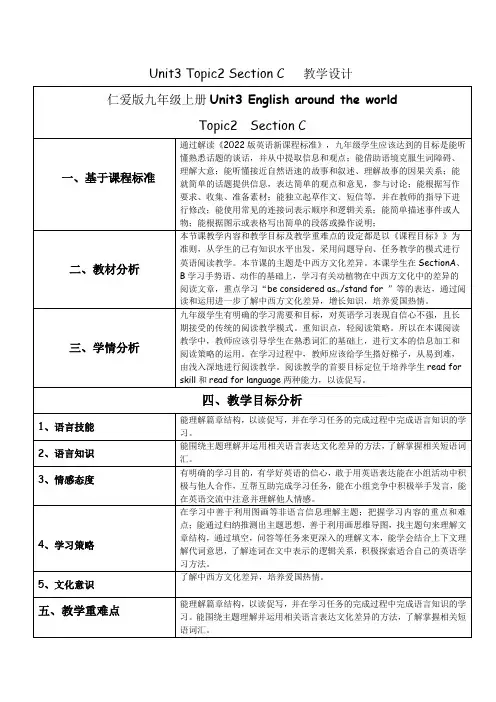
students will learn autonomously and cooperatively in different activities before during and after the class.
1).learn to predict the main idea by observing the title and pictures.
三、学情分析
九年级学生有明确的学习需要和目标,对英语学习表现自信心不强,且长期接受的传统的阅读教学模式。重知识点,轻阅读策略。所以在本课阅读教学中,教师应该引导学生在熟悉词汇的基础上,进行文本的信息加工和阅读策略的运用。在学习过程中,教师应该给学生搭好梯子,从易到难,由浅入深地进行阅读教学。阅读教学的首要目标定位于培养学生read for skill和read for language两种能力,以读促写。
2).understand the article deeply by finishing all tasks.
3).understand the structure by drawing the mind map.
5、Cultural awareness: raise Ss’cultural awareness and they will be ableto know the differences in different cultures.
七、教学评价
评价内容:
1.学生能够通过图片和题目,准确预测大意。
2.学生能够通过找主题句,分析文章结构,了解文章脉络。
3.学生能在各种学习任务中,更深入的理解文本。
4.学生能够在读后讨论完成思维导图并进行复述。
仁爱版九年级英语上册Unit3Topic2SectionC优秀教学案例
1.情境创设:通过丰富的多媒体教学资源,如图片、视频、音频等,我成功地为学生创设了真实的语言学习情境,让他们在轻松愉快的氛围中学习和掌握知识。这种情境创设不仅激发了学生的学习兴趣,还提高了他们的语言运用能力。
2.问题导向:在教学过程中,我设计了一系列的问题,引导学生进行思考和探究。这些问题涵盖了本节课的主要知识点,使学生在回答问题的过程中,自然地学习和运用语言。同时,问题导向的教学策略培养了学生的批判性思维能力和问题解决能力。
我会鼓励学生主动提出问题,培养他们的提问意识和问题解决能力。我会引导学生学会从问题中发现问题,从问题中寻找答案,培养他们的批判性思维能力。
(三)小组合作
在教学过程中,我会组织学生进行小组合作,让他们在合作中学习,在合作中交流。我会设计各种小组活动,如小组讨论、角色扮演、听力练习等,让学生在完成任务的过程中,自然地学习和运用语言。
我会鼓励学生积极参与小组活动,提出自己的观点和看法,并倾听和理解他人的意见。我会引导学生学会合作和协商,培养他们的团队意识和团队协作能力。
(四)反思与评价
在教学过程中,我会注重学生的反思与评价,让他们通过反思,来巩固和提高所学知识。我会设计各种反思活动,如自我评价、同伴评价、小组评Biblioteka 等,让学生在评价中认识自己,提高自己。
在教学设计上,我以学生为中心,充分调动他们的积极性,引导他们通过合作、探究和互动的方式,参与到课堂活动中来。在教学过程中,我注重培养学生的语言素养,引导他们运用语言进行思考和表达,并通过任务型教学法,让学生在完成任务的过程中,自然地学习和运用语言。
在教学评价上,我注重过程性评价和终结性评价相结合,既关注学生的语言知识掌握情况,也关注他们的语言运用能力和文化意识。通过这样的教学设计和评价方式,我相信学生能够在学习过程中,真正地提高自己的英语水平,并对西方节日有更深入的了解。
仁爱版初中英语九年级上Unit2Topic3SectionC教学设计
6.课后拓展:
a.布置与课程内容相关的课后作业,巩固所学知识。
b.鼓励学生参加课外活动,如英语角、演讲比赛等,提高学生的英语实际应用能力。
c.推荐与课程主题相关的阅读材料,拓宽学生的知识视野.引导学生关注一般过去时态的结构和用法,通过例句和练习,让学生掌握该时态。
b.教授与比赛、成功和失败相关的词汇和句型,让学生在课堂上进行实际操作,巩固所学知识。
c.设计各种实践活动,如小组讨论、情景剧等,让学生在实际运用中提高语言能力。
4.情感教育:在教学过程中,关注学生的情感需求,适时进行情感教育,引导学生正确看待成功和失败。
仁爱版初中英语九年级上Unit2Topic3SectionC教学设计
一、教学目标
(一)知识与技能
在本章节的学习中,学生将掌握仁爱版初中英语九年级上Unit2 Topic3 SectionC的核心知识点。具体包括:
1.词汇:学生能够熟练掌握并运用以下词汇:offer, comfort, confident, powerful, effort, defeat, victory, champion, audience, celebrate等。同时,能理解并运用与比赛、成功和失败相关的词汇。
2.教师提问:“Have you ever participated in a competition?”,让学生分享自己的比赛经历,为学习新课做好情感准备。
3.学生分享完毕后,教师引入本节课的主题:“Today, we will learn about a competition and the feelings of the participants. Let's explore the topic together!”
仁爱英语九年级上Unit 3 Topic 2 Section C
被当做/认为……
认为狗诚实
compare…to
a symbol of
……的象征
注意
stand for
pay attention to
代表
把……比喻成……
2 Complete the sentences with the correct forms of the given phrases.
pay attention to stand for at times regard as compare…to
3. In western countries, heroes killed dragons to protect people. This shows D . dragons are considered to be ____ A. brave B. strong C. lovely D. dangerous
In western cultures, dragons were dangerous animals.
Heroes killed them to protect people.
Some things have similar meanings in Chinese culture and western cultures.
Hale Waihona Puke bull 牛bully 欺负
If we pay more attention to the cultural meanings of words, we will understand them better.
1a Read and understand.
1b Read 1a and choose the correct answers.
仁爱版英语九年级上册9A_Unit3_Topic3_SectionC_教学设计
Unit3 Topic3 SectionC 教学设计Ⅰ. Material analysis本课是九年级第三单元第三话题的第三课时。
主活动是1a 和2。
1a 通过小组汇报分享学习英语的经验,老师补充总结,让学生从中获得学习英语的策略。
1b通过填充图表,培养学生获取信息的能力。
1c 是个对话活动,复述1b 里面所提到的各种学习策略。
2 重点在于巩固和运用1a 的重点用语。
3 要求学生学以致用,体现“在做中学”的理念。
学生在学习英语时大都会碰到相似的困难,因而本课对英语学习具有较好的借鉴意义。
本课还可以让学生知道分享学习经验也是一种快乐。
3 作为写作训练,需要学生整合所学知识,留作家庭作业,以便学生有充足的时间去完成。
Ⅱ. Teaching aims1. Knowledge aims:掌握本课的重点词汇和短语,继续学习“how / what ...+ to do sth.”。
2. Skill aims:继续运用构词法来猜测本课新词的含义,读出新词的发音。
学习运用scanning,来迅速找到所需要的信息。
3. Emotional aims: (optional)鼓励学生在学习英语时,要学会求助,学会分享。
4. Culture awareness: (optional)在学习英语时不能逐字逐句地翻译,要尽可能地按照英语的思维去理解句子,即要掌握特定的习语。
Ⅲ. The key points and difficult points1. Key points:Words and phrases: review, preview, translate, discussion, exactly, honor, achieve, aslong as, stick to (doing) sth., share...with ...., prefer doing sth.,advise sb.to do sth., agree with sb, as ...as possible, have(no)chance to do sth., practice doing sth.Sentences: I’m very glad to share our group’s opinions with you.It’s an honor to talk with all of you here.I’m sure that you’ll make great progress as long as you stick to them.1Thank you for listening!Grammar: how/what... + to do sth.2. Difficult points:在任务3 中,能够根据李明的“症状”,有针对性地“下药”。
仁爱版九年级上册英语优秀教学案例:Unit3Topic3SectionC

1.教师引导学生对一般过去时态疑问句和回答的用法进行总结,帮助学生巩固所学知识。
2.教师通过归纳和总结,强调一般过去时态疑问句和回答的重要性和实用性,激发学生运用语言的欲望。
3.教师提醒学生注意一般过去时态疑问句和回答在实际交际中的运用,如:与外国朋友交流、看英文电影等。
(五)作业小结
3.图片情境:展示一系列相关的图片,让学生根据图片内容用一般过去时态进行描述,培养学生的观察能力和语言表达能力。
4.角色扮演:学生分组扮演不同角色,模拟实际场景,用一般过去时态进行对话,提高学生的口语表达能力和交际能力。
(二)问题导向
1.设计具有启发性的问题,引导学生思考和探索一般过去时态的疑问句和回答的用法,如:“How do we ask about someone's past?”, “What is the difference between 'go' and 'went'?”等。
3.教师举例说明一般过去时态疑问句和回答的用法,并通过角色扮演的方式进行演示,让学生直观地理解和学习。
(三)学生小组讨论
1.学生分组进行讨论,共同完成任务,如:编写一段对话,使用一般过去时态描述过去发生的事情。
2.学生通过观察和分析例句,归纳和总结一般过去时态疑问句和回答的语法规则。
3.学生进行小组展示,分享自己的学习成果,并互相评价和反馈,培养学生的合作意识和批判性思维能力。
2.学生进行自我评价,评估自己在学习中的表现,如:口语表达能力、听力水平、写作能力等,培养学生的自我评价和自我调整能力。
3.教师对学生的学习成果进行评价,关注学生的知识掌握和技能运用情况,如:是否能正确使用一般过去时态的疑问句和回答,是否能流利地进行口语表达等。同时,教师要注重评价学生的情感态度和价值观,如:学习积极性、团队合作精神、跨文化交际意识等。
仁爱版九年级英语上Unit1Topic2SectionC教学设计
3.教师提出问题:“What can we do to protect the environment?”,引导学生进行头脑风暴,思考并列举保护环境的措施。
4.引入本节课的主题——Unit1 Topic2 SectionC,告诉学生将通过本节课的学习,了解环境保护的重要性,并学会用英语讨论相关话题。
(二)讲授新知(500字)
1.教师呈现本节课的新词汇,如responsibility, environment, protect, pollute, recycle等,通过例句、图片和实物展示等方式,帮助学生理解和记忆词汇。
2.讲解一般现在时和一般将来时的语法结构,并通过示例句子展示两种时态在句子中的应用。
在具体的教学过程中,教师应关注学生的学习需求,结合学科特点和课程内容,灵活运用多种教学方法和策略,使学生在轻松愉快的氛围中学习英语,提高语言运用能力,同时培养良好的情感态度和价值观。
二、学情分析
九年级学生在经过前两年的英语学习后,已经具备了一定的英语基础和语言运用能力。在此基础上,他们对本章节的学习有以下特点:
2.难点:
-学生的词汇记忆和运用能力,特别是词汇的准确拼写和在不同语境中的正确使用。
-语法结构的灵活运用,特别是时态的正确选择和使用。
-学生在讨论环境保护时,能够结合实际情况,提出合理的建议和行动计划。
(二)教学设想
1.教学方法:
-采用情境教学法,通过多媒体展示环境污染的图片和视频,让学生在具体情境中感受环境保护的紧迫性,激发学习兴趣。
3.教师引导学生结合新学的词汇和语法,进行简单的句子练习,如:“It is our responsibility to protect the environment.”、“We should take action to...”等。
仁爱版英语 Unit 2 Topic 3 Section C 教案
Topic 3 Whose cap is it?Section CⅠ.Teaching aims1.Words&phrases: new, classmate, clothes;2.Sentences: He has black hair and black eyes. Is this /Are these…? Yes. It’s /They’re…No. It’s /They are…; Whose …is this/ are these? I think it’s/ they are…Ⅱ. The key points and difficult points1. Key points正确使用be动词:is, are;2. Difficult points能够辨认名词的单复数;能够根据所提供的内容编写短文。
Teaching proceduresStep Ⅰ Greetings and Lead-in1.The teacher greets with students: Hello! Boys and girls. Nice to meet you.2.Walk to one student and ask: Is this your pen? Let the student answer the question; Then walk to next student and point out the same pen, then ask: Is this your pen?3.Point out one student’s object and ask: Whose … is this? Let students answer the question; Then point out some objects of one student and ask: Whose … are these? Let students answer the question.4.Play the tape of the chant and ask students to try to sing it; play the tape again and let students do the actions according to the chant.Step Ⅱ Presentation1.Show the picture of 1b and give students 1 minute to try to describe the two boys first in pairs; Choose some students to describe the two boys.2.Let students read the passage of 1a by themselves; Give students some time to explain the passage by themselves, then let students point out the new words in the passage; Then ask students to underline the description words in the passage; Choose some students to point out the words.3.Let students color the two boys according to the passage; Then read the passageagain by themselves.Step Ⅲ Consolidation1.Show the table of 1b, then let students fill in the table according to the passage of 1a; Choose one students to show the answers;Then give students 1 minute to make short dialogues according to the table; Choose some pairs to show their dialogues.2.Let students describe Kangkang and his classmate based on 1b by themselves; choose some students to describe them.Step Ⅳ Practice1.Show the pictures of Tom and Dick, then let students describe the two boys orally; Then ask students to correct the mistakes they make.2.Let students fill in the blanks and help check the answer. Read all the words.3.Give students 1 minute to read the sentences in 5b and pay attention to the underlined parts; choose some students to read the sentences and then play the tape and let students listen and repeat.Step Ⅴ Summary and Homework1.Let students mix the things together and find out the owners within 2 minutes. Choose some groups to show in front of the whole class.2. Assign homework:Review the words and expressions in Section C; Write a passage about Tom and Dick; Preview Section D—Grammar and Functions;Teaching reflection:语音的学习和应用是一个循序渐进的过程,学生只有靠平时的积累和应用才能掌握读音规则,因此,同学们要善于总结和积累知识,才能把它学好。
Unit 1 Topic 2 sectionC 教案仁爱版九年级英语上册
九年级上册Unit 1 Topic 2 The population in developing countries is growing faster.Section C【教学构思】一、教材分析:本课属于课标话题人与社会——“世界与环境(The world and the environment)”中人口(Population)项目,涉及课标功能意念表“比较(Comparison)”中差别比较(Comparative and superlative)项目和“逻辑关系(Logical relations)”中原因和结果(Cause and effect)项目,主要谈论中国由于人口过多带来的社会问题以及政府所采取的的措施。
主要教学活动为1a、2和3a,通过阅读1a语篇了解中国人口众多以及因此带来的社会问题和困难,通过多种形式的阅读活动培养基本的阅读技能,如预测、略读、理解大意等,提高学生“读”的语言能力。
阅读2语篇,用所给单词补全短文,进一步培养学生快速获取信息的能力。
3a学生通过小组讨论以及查询信息的方式,探讨解决3a中提出的社会问题的措施,并在3a讨论的基础上,写出一篇短文,提高学生“写”的语言能力。
二、设计说明:根据学情和本课的语法及话题,本节课的教学设计将读与写相结合,以1a阅读篇章为载体,立足话题,聚焦语法,通过读前预测,读中完成练习,读后复述等活动,培养学生“读”和“说”的语言能力;在语言生成阶段,循序渐进,从小组讨论到短文写作,进一步培养学生“说”和“写”的语言能力,鼓励学生讨论思考,培养他们的思维品质。
本课在重、难点突破的方法上有所创新,教师通过组织学生小组讨论一些社会问题,引导学生学会搜索信息,分析、讨论、概括、总结,在读和说的基础上进行写作,既提高学生的语言能力,又培养学生思维品质。
【教学目标】1. 能够根据不同的阅读目的运用阅读策略获取信息,培养“读”的语言能力;2. 通过阅读语篇,巩固现在完成时的用法,掌握thanks to...表达因果关系;3. 通过小组讨论,搜集准备写作素材,培养“说”和“写”的语言能力;4. 在语篇中了解中国的人口问题和解决措施,讨论一些社会问题,思考解决方案,培养独立思考和搜索信息的能力。
初中英语仁爱科普版九年级上 Unit 3 Topic 2 Section C 课件(共21张PPT)
Para 1. __C___ Para 2. __B___ Para 3. __A___ Para 4. __D___
While-reading Reading skill 2: Skim(略读) Task 2: The title of the passage may be _______.
Reading skill 4:Critical thinking (批判性思维)
Further-reading
Para 4: Complete the sentences with the given phrases.
a symbol of, similar, regard as, pay attention to, stand for
Your
Prereading
Whilereading
Post- own reading passage
Some things have different meanings in different cultures.
Writing time
Task 5: Write down your own passage in groups.
Pre-reading Chinese English
Reading skill 1:predict(预测) Can you guess their meanings?
negative
a running dog
cultua hroamelless dog
podsiitifveferea nluccky edosg