
新的船级符号 GreenPassport
GUIDE FOR THE CLASS NOTATION GREEN PASSPORT (GP)MAY 2008American Bureau of ShippingIncorporated by Act of Legislature ofthe State of New York 1862Copyright © 2008American Bureau of ShippingABS Plaza16855 Northchase DriveHouston, TX 77060 USAThis Page Intentionally Left BlankForewordNoting the on going efforts to enhance the protection of the marine environment, and the occupational health and safety related to the recycling of ships, IMO, with the assistance of industry organizations, has developed Guidelines on Ship Recycling.The stated objectives of the IMO promulgated guidelines are to:i) Encourage recycling as the best means to dispose of ships at the end of their operating lives.ii) Provide guidance in respect to the preparation of ships for recycling and minimizing the use of potentially hazardous materials and waste generation during a ship’s operating life.iii) Encourage all stakeholders to address the issue of ship recycling.Essential to successfully achieving these objectives and to enable a more comprehensive management of hazardous substances utilized in the construction of the ship, the operationally generated waste, and stores, through continued awareness throughout the ship’s operating life is the development and maintenance of a document referred to as a “Green Passport”.This Guide provides for the review, approval and issuance of the initial Green Passport for new construction, existing ships and for the maintenance, verification and endorsement of the issued Green Passport for a ship in service.The application of this Guide is optional. However, recognizing the ongoing efforts of the maritime community, designers, Owners and operators are encouraged to apply this Guide..2008 i ABS GUIDE FOR THE CLASS NOTATION GREEN PASSPORT (GP)This Page Intentionally Left BlankTable of ContentsGUIDE FOR THE CLASS NOTATIONGREEN PASSPORT (GP)CONTENTSSECTION 1 Introduction (1)1 General (1)2 Application (1)3 Scope (1)4 Notation (1)5 Definitions (2)FIGURE 1 Flow Diagram for Development of Part 1 of theInventory for Existing Ships (3)SECTION 2 General Guidance (5)1 Introduction (5)2 Format (5)Details (5)2.1 Ship2.2 Inventory (5)3 Survey (6)4 Maintenance (6)SECTION 3 New Construction Vessels (7)1 Introduction (7)Restricted Materials (7)or2 Prohibited3 Part 1 of the Green Passport’s Inventory (7)4 Vendor Supplied Equipment and Materials (8)TABLE 1 (7)SECTION 4 Existing Vessels (9)1 Introduction (9)2 Part 1 of the Green Passport’s Inventory (9)ofAvailable Documentation (9)2.1 Review2.2 Interview the Ship’s Crew (9)2.3 Development of a Survey/Sampling Plan (10).2008 iii ABS GUIDE FOR THE CLASS NOTATION GREEN PASSPORT (GP)ivABS GUIDE FOR THE CLASS NOTATION GREEN PASSPORT (GP) . 20082.4Sampling of Substances/Materials Potentially Containing Hazardous Materials by anExternal Specialist...........................................................10 2.5Declaration of Materials or Equipment as Likely to Contain Hazardous or Potentially HazardousSubstances......................................................................10 2.6Review and Incorporation of Recognized ExternalLaboratory Reports (10)2.7 Document Submission (10)SECTION 5 Certification, Maintenance and Survey (11)1 Introduction..........................................................................112 Certification..........................................................................11 3Maintenance of the Green Passport (11)4 Retentionof Green Passport (11)APPENDIX 1 Lists of Hazardous Wastes, Substances and Materials,and Chemical Substances (13)TABLE 1 List of Hazardous Wastes and Substances that are Relevant to Ship Recycling........................................13 TABLE 2 Potentially Hazardous Materials which may beOnboard Ships Delivered to Recycling Facilities.......15 TABLE 3Threshold Levels of Chemical Substances to beListed in the Inventory (17)APPENDIX 2 Standard Format of Inventory and Sample GreenPassport Form (19)Standard Format of the Inventory of Hazardous Materials (20)Part 1 Hazardous Materials Contained in the Ship’s Structure and Equipment................................................................20 Part 2 Operationally Generated Waste......................................21 Part 3Stores (22)Section 1: IntroductionS E C T I O N 1 Introduction1 GeneralThe importance of an inventory detailing the amount and location of hazardous materials which have been used in the construction and operations of ships is increasingly recognized as a means to enhance onboard safety and environmental awareness, both through-out the ships economic life and when the ship is being prepared for recycling.This Guide has been developed with the objective of assisting designers, equipment suppliers, builders and Owners in the practical and reasonable formulation and maintenance of this inventory.2 ApplicationThis Guide is applicable to new and existing ships for which the optional Green Passport notation GP has been requested. Obtaining this notation will assist in complying with Section 5 of IMO ResolutionA.962(23), “IMO Guidelines of Ship Recycling”, as amended by IMO Resolution A.980(24)“Amendments to the IMO Guidelines On Ship Recycling”.3ScopeThis Guide has been developed with the objective of promoting the industry’s ongoing commitment to providing for the safe working conditions of the ship’s crew, the marine environment and the in recognition of the maritime community efforts, as stake holder, to assist in the safe and environmentally sound recycling of ships. The Guide includes information on inventorying hazardous materials on new or existing vessels, conducting verification surveys, issuance of certificates and notations, as well as maintaining the inventory and retaining the Green Passport and Certifications.See Section 1, Figure 1.4 NotationShips which have had the ship details and Part 1 of the Inventory of their Green Passport (see Subsection 2/2 of this Guide) prepared and certified to the requirements of this Guide to the satisfaction of the Surveyors to the Bureau will be eligible to receive the ABS Notation GP(Green Passport). The requirements in this Guide for the purpose of securing the GP Notation are additional to all other relevant requirements of the ABS Rules and Guides..2008 1 ABS GUIDE FOR THE CLASS NOTATION GREEN PASSPORT (GP)Section 1 Introduction2 ABS GUIDE FOR THE CLASS NOTATION GREEN PASSPORT (GP) .20085 Definitionsi) Inventory– is an itemized listing, specifying the type, location and approximate quantity of hazardous materials used in the ship’s construction and equipment.ii) HazardousMaterials– are materials or substances that are known to have the potential to harm human health or the environment. These materials/substances are identified in theInternational Maritime Dangerous Goods (IMDG) Code, The Basel Convention and OtherInternational Instruments.iii) New Ship – means a ship contracted for construction on or after the first day of the month indicated on the cover of this Guide.iv) ExistingShip– means a ship which is not a new ship.v) Ship– means a ship of any type whatsoever operating in the marine environment and includes, but not limited to, hydrofoil boats, air-cushion vehicles, submersibles, floating craftand fixed or floating platforms.vi) Ship Owner – means the person or persons or company registered as the Owner of the ship or, in the absence of registration, the person or persons or company owning the ship. However, inthe case of a ship owned by a state and operated by a company which in the State is registeredas the ship’s operator, “Owner” shall mean such company.vii) Substances– means the physical matter of which a material or item is composed, e.g., lead (chemical element), lead oxide (compound).viii) Supplier– are those vendors which provide products, in support of the ship’s construction and outfitting. This group includes equipment manufacturers and material providers.ix)External Specialists – are those persons who possess the necessary training and equipment to evaluate and report on the materials used in ship construction and outfitting.F IG U R E 1 F l o w D i a g r a m f o r D e v e l o p m e n t o f P a r t 1 o f t h e I n v e n t o r y f o r E x i s t i n g S h i p s*1 : D o c u m e n t s i n c l u d e , a n d a r e n o t l i m i t e d t o , a n y c e r t i f i c a t e s , m a n u a l s ,s h i p 's p l a n s , d r a w i n g s , t e c h n i c a l s p e c i f i c a t i o n s a n d i n f o r m a t i o n f r o m s i s t e r a n d /o r s i m i l a r s h i p s .*2 : I n v e s t i g a t i o n s h o u l d c o v e r a l l m a t e r i a l s l i s t e d i n A p p e n d i x 1, T a b l e 1 o f t h i s G u i d e : t h e m a t e r i a l s i n a p p e n d i x 1, T a b l e 2 a r e e x e m p t e d f r o m b e i n g l i s t e d o b l i g a t o r i l y .I t i s d i f f i c u l t t o i n v e s t i g a t e a l l e q u i p m e n t a n d a r e a s i n c l u d i n g t h o s e w h i c h a r e a s s u m e d n o t t o c o n t a i n H a z a r d o u s M a t e r i a l s d e s c r i b e d a b o v e .T h r o u g h a n a l y s i s o f a v a i l a b l e d o c u m e n t s b a s e d o n k n o w l e d g e a n d e x p e r i e n c e , i t i s n e c e s s a r y t o m a k e c l e a r w h i c h e q u i p m e n t a n d /o r a r e a s s h o u l d b e p u t i n t o t h e s c o p e o f i n v e s t i g a t i o n .[e .g . A s b e s t o s i s o n l y i n c l u d e d i n a n o n -c o m b u s t i b l e m a t e r i a l o f A , B a n d C c l a s s d i v i s i o n , c o a t i n g , l a g g i n g , b r a k e s h o e l i n i n g , g a s k e t a n d p a c k i n g e x c e p t s p e i c a l c a s e .]*3 : E q u i p m e n t , s y s t e m a n d /o r a r e a w h i c h c a n n o t b e s p e c i f i e d r e g a r d i n g p r e s e n c e o f t h e m a t e r i a l s l i s t e d i n A p p e n d i x 1 o f t h i s G u i d e b y d o c u m e n t s c a n b e l i s t e d i n t h e L i s t o f e q u i p m e n t , s y s t e m a n d /o r a r e a c l a s s e d a s "P o t e n t i a l l y c o n t a i n i n g h a z a r d o u s m a t e r i a l " w i t h o u t t h e s a m p l i n g c h e c k .P r e r e q u i s i t e f o r t h i s c l a s s i f i c a t i o n i s a c o m p r e h e n s i b l e j u s t i f i c a t i o n o f t h e c o n c l u s i o n o r w h e n l i t t l e o r n o e f f e c t o n d i s a s s e m b l y a s a u n i t a n d l a t e r s h i p r e c y c l i n g a n d d i s p o s a l o p e r a t i o n s c a n b e a s s u m e d .*4 : S a m p l i n g C h e c k : S a m p l i n g C h e c k m e a n s t o t a k e s a m p l e s a n d i n d e n t i f i c a t i o n o f H a z a r d o u s M a t e r i a l c o n t a i n e d i n t h e e q u i p m e n t , s y s t e m s a n d /o r a r e a s , b y c h e m i c a l a n a l y s i s . S a m p l i n g C h e c k s h o u l d b e a p p l i e d w h e n p r e s e n c e o f P r o h i b i t e d a n d R e s t r i c t e d H a z a r d o u s M a t e r i a l i s a s s u m e d b u t c a n n o t b e r e c o g n i z e d w i t h a n a l y s i s o f a v a i l a b l e d o c u m e n t a t i o n .*5 : W h e n e q u i p m e n t , s y s t e m a n d /o r a r e a o f t h e v e s s e l c a n n o t b e a c c e s s i b l e f o r v i s u a l c h e c k o r s a m p l i n g c h e c k , t h i s e q u i p m e n t , s y s t e m a n d /o r a r e a i s c l a s s i f i e d a s "P o t e n t i a l l y c o n t a i n i n g h a z a r d o u s m a t e r i a l ".*6 : A n y e q u i p m e n t , s y s t e m a n d /o r a r e a c l a s s e d a s "P o t e n t i a l l y c o n t a i n i n g h a z a r d o u s m a t e r i a l " s h o u l d b e d i s p o s e d o r t r e a t e d a c c o r d i n g t o t h e r e q u i r e m e n t o f t h e C o n v e n t i o n a n d t h e G u i d e l i n e s .Section 1 IntroductionABS GUIDE FOR THE CLASS NOTATION GREEN PASSPORT (GP) . 20083This Page Intentionally Left BlankSection 2: General GuidanceS E C T I O N 2 General Guidance1 IntroductionThe identification, location and quantity of hazardous materials and potentially hazardous materials onboard ships is an essential ingredient in facilitating the protection of the ship’s crew when performing routine maintenance and repair, as well as workers at the recycling facility and the environment where the facility is located. Having this information readily available will enable the ship’s crew and the workers at the recycling facility to exercise the appropriate precautions if at risk of exposure to these materials.2 FormatThe Green Passport for ships is comprised of two components as follows.Details2.1 ShipThe first component of the Green Passport is referred to as the “Ship Details”, and includes the following:•The name of the ship•The ship’s IMO number•Builder, builder’s address and hull number•Type of ship•Principal dimensions (LOA, Breadth (molded) Depth (molded)).•Lightship displacement.•Flag state, port of registry, date of registry•Owner’s name and address•Classification Society(ies)See Subsection 5/4 for an acceptable equivalent to the above.2.2 InventoryThe second component of the Green Passport is the actual inventory of the hazardous and potentially hazardous materials, containing the location, the approximate quantity/volume of each identified material on board the ship. This inventory is divided into the following parts.•Part 1: Hazardous or potentially hazardous materials/substances utilized in the ship’s structure and equipment/systems.•Part 2: Operationally generated waste•Part 3: Stores.2008 5 ABS GUIDE FOR THE CLASS NOTATION GREEN PASSPORT (GP)Section 2 GeneralGuidance6 ABS GUIDE FOR THE CLASS NOTATION GREEN PASSPORT (GP) .2008Preparation of Part 1 is to be based on the listing of those materials/substances considered to be hazardous or potentially hazardous as found in Appendix 1. See Subsections 3/3 and 4/2 of this Guide.Part 2 – Operationally Generated Waste, and Part 3 Stores, are to be prepared by the ship Owner prior to or during the final voyage to the recycling facility. (References to Parts 2 and 3 of the Green Passport’s Inventory are intended for informational purposes only and are outside the scope of the class notation.) Appendix 2 of this Guide is a representative format for the inventory component of the Green Passport3 SurveyOnce an inventory for a vessel has been developed, an auditing survey by an ABS Surveyor is to be carried out to generally verify that the locations and the approximate quantity/volume of hazardous material detailed on the inventory reflect those found on the vessel. An annual survey is also to be conducted to confirm that the inventory reflects any modifications, repairs or changes to the vessel that involve the removal or addition of hazardous materials.4 MaintenanceThe Green Passport is to remain onboard the ship throughout it’s operating life and each Owner is to enact the necessary steps to maintain the accuracy of the Green Passport, which includes the incorporation of all relevant design and equipment changes. The final Owner of the ship when delivering the ship to the recycling facility is to present the Green Passport to the appropriate recycling facility personnel.S E C T I O N 3 New Construction Vessels1 IntroductionThroughout a ship’s design and construction, designers and builders are to exercise environmentaljudgment in the selection of all materials and substances to be incorporated into the ship’s structureand equipment. As a first step, the design and build team is to identify, based on Appendix 1, Tables1 and 2, any hazardous or potentially hazardous materials that are intended to be utilized and carefullyconsider using less environmentally hazardous materials. Simply stated, if the opportunity exists touse less hazardous materials in the construction, without compromising safety or operational efficiency,it should be considered by the design and build team or recommended to the ship Owner/operator asappropriate.2 Prohibited or Restricted MaterialsSubstances known to be hazardous which are prohibited or restricted by national regulation andvarious international agreements and conventions are not to be used in the construction. Examples ofthese substances and the corresponding statutory instruments are detailed in Section 3, Table 1 below:TABLE 1Substances Agreement/Convention Asbestos 1974 SOLAS – 2000 Amendments (Reg II-1/3-5)Organotin Compounds which act as biocides in anti-fouling systems (tributyltins (TBT’s), Triphenyltins (TET’s) and tributyltins Oxide (TBTO’s)) International Convention on the Control of Harmful Anti-Fouling Systems on Ships 2001Ozone Depleting Substances, Chlorofluorocarbons(CFC’s)MARPOL Annex VI Reg 12 & Montreal ProtocolPloychlorinated biphenyls (PCB’s) Stockholm Convention on Persistent OrganicPollutants (POP’s) (Part II)3 Part 1 of the Green Passport’s InventoryUpon completion of the material selection process, Part 1 of the Green Passport’s Inventory is to be prepared by the shipbuilder. Where the substances listed in Appendix 1, Tables 1 and 2 have been added to the vessel above the threshold levels specified in Appendix 1, Table 3, their identity, location and quantity are to be incorporated into Part 1 of the inventory.Documentation in the form of drawings or tables noting the use of hazardous materials, quantity, and location are to be submitted to the ABS Plan Review Office for review. At the ship builders option each drawing submitted is to be annotated in such a manner as to detail the use of hazardous or potentially hazardous materials thereon.ABS GUIDE FOR THE CLASS NOTATION GREEN PASSPORT (GP).2008 7Section 3 NewConstructionVessels8 ABS GUIDE FOR THE CLASS NOTATION GREEN PASSPORT (GP) .20084 Vendor Supplied Equipment and MaterialsShipbuilders are to work closely with all their suppliers such that all equipment provided is environmentally safe or specifically itemized on the inventory. These suppliers are to confirm that those substances identified in Section 3, Table 1 above have not been incorporated in the supplied equipment, machinery, or paints. In those instances where the suppliers provide equipment or materials containing hazardous or potentially hazardous substances listed in Appendix 1, Tables 1 and2 above the threshold values specified in Appendix 1, Table 3, a declaration detailing the specificsubstances including the system/item, the substance, amount of substance and the manufacturer is to be presented to the shipbuilder for the preparation of the Part 1 of the Inventory as referred to in Subsection 3/3 above.Section 4: Existing VesselsS E C T I O N 4 Existing Vessels1 IntroductionMany materials and substances which were previously assumed to be non hazardous and selected for installation onboard ships, , are no longer being utilized, or have since been identified as being hazardous. To assist in safeguarding the ship’s crew, and workers involved in ship recycling, as well as the marine environment, documenting the location and approximate volume/quantity of materials currently classified as hazardous or potentially hazardous is to be achieved to the greatest degree possible.It is recognized that it is often not possible to accurately define, identify or locate specific hazardous or potentially hazardous materials onboard existing ships due to their concealment or unknown locations.2 Part 1 of the Green Passport’s InventoryDevelopment of Part 1 of the Green Passport’s Inventory for an exiting vessel is the responsibility of the ship Owner.The development of the Inventory is to be viewed as a multi-phase process and may consist of any or all of the following steps, depending on the results achieved2.1 Review of Available DocumentationShip Owners are encouraged to review the ship’s files, including drawings, technical specifications and vendor supplied information/data with a view to locate if any hazardous or potentially hazardous materials/substances indicated in Appendix 1, Tables 1 and 2, above the threshold values in Appendix 1, Table 3, have been utilized in the construction or outfitting of the ship.This initial review should be used in the systematic development of a Survey/Sampling Plan to be employed in the practical implementation of completing the required inventory, see 4/2.3 below.Utilizing additional information sources, such as the shipyard files, sister ship files, ABS files or contacting equipment suppliers should also be considered.2.2 Interview the Ship’s CrewOften the ship’s crew can provide assistance as to the location of hazardous or potentially hazardous materials on board as a result of the in depth ship specific knowledge developed from carrying out or witnessing repairs and maintenance. Additionally the crew may provide valuable information associated with equipment replacement or modifications..2008 9 ABS GUIDE FOR THE CLASS NOTATION GREEN PASSPORT (GP)Section 4 ExistingVessels10 ABS GUIDE FOR THE CLASS NOTATION GREEN PASSPORT (GP) .20082.3 Development of a Survey/Sampling PlanTaking into consideration the information obtained from the documentation review and discussions with the ship’s crew a detailed survey and sampling plan is to be developed. The goal of the survey and sampling is to assist in determining where hazardous or potentially hazardous materials may be located.A copy of the survey/sampling plan is to be submitted to ABS for review and acknowledgement.2.4 Sampling of Substances/Materials Potentially Containing Hazardous Materialsby an External SpecialistConsideration may be given, by the ship Owner, to the use of sampling to identify substances/materials potentially containing hazardous materials to assist in the development of Part 1 of the Inventory. An external specialist having specific knowledge in the means of how to take material samples and preventative measures to be taken to avoid cross contamination may be retained by the ship Owner.Upon completion of the sampling process, the material/substances are to be forwarded for testing to a recognized testing laboratory.In those instances where there is uncertainty relative to the presence of hazardous or potentially hazardous materials, the material or substance is to be considered as a hazard and a sample is to be obtained in accordance with the typical sampling procedures.Upon completion of the sampling processes the materials or equipment from which the samples have been extracted, are to be sealed so as to reduce the possible risk of exposure to the crew and others.ABS Surveyors are not to risk themselves to possible exposure during the sampling or testing procedures.2.5 Declaration of Materials or Equipment as Likely to Contain Hazardous orPotentially Hazardous SubstancesThe ship Owner may at his or her discretion, with the concurrence of the attending Surveyor, classify various materials and equipment as “containing hazardous substances” without further investigating or testing.2.6 Review and Incorporation of Recognized External Laboratory ReportsAny reports issued by a recognized testing laboratory, utilized to complete Part 1 of the Inventory are to be retained onboard and to be presented to the attending surveyor to support the details annotated on Part 1 of the Inventory.2.7 DocumentSubmissionPart 1 of the Green Passport’s Inventory for existing ships prepared by the ship Owner, along with the supporting documentation including, the results of the Owner’s evaluation of the available information and any material/substance testing reports are to be presented to the attending Surveyor.Any limitations regarding the scope of laboratory reports or prepared inventory are to be stated.S E C T I O N 5 Certification, Maintenance andSurvey1 IntroductionThe inventory of hazardous and potentially hazardous materials for ships of new constriction and existing ships, are to be developed by the shipyard or ship Owner respectively, and submitted to ABS for review and acknowledgement.The hazardous or potentially hazardous materials/substances are to be suitably marked on board the ship to alert all parties of their presence and to facilitate random verification of the submitted documentation by an ABS Surveyor.2 CertificationUpon completion of the verification surveys, the initial Green Passport, consisting of the ship details and the Part 1 is accepted and a certificate issued. The GP Notation is then included in the ABS Record.3 Maintenance of the Green PassportPart 1 of the Green Passport’s Inventory is to be maintained throughout the ship’s life and placed on board the ship. The removal, replacement, or repair of existing equipment or substances previously detailed in Part 1 or the addition of relevant new equipment or substances is to be carefully tracked and is to be specified in the Inventory and suitably marked on board. Any changes to Part 1 of the inventory are to be recorded so as to provide the current information together with a history of the changes.An annual verification survey is to be carried out in the course of completing other periodical surveys.Any changes to the materials in the Green Passport’s inventory should be noted by the ship’s crew and verified by the attending Surveyor. Upon satisfactory review and verification, the Green Passport certificate will be endorsed.4 Retention of Green PassportThe Green Passport’s Inventory is to be retained on board the ship and is to be presented to each subsequent Owner, including those instances where the flag, or type of service changes. Any changes relating to the ship details are to be recorded and updated accordingly. The Continuous Synopsis Record, as detailed in SOLAS Reg XI-1/5, when combined with the Certificate of Build, as produced by the ship builder are considered as equivalent to the ship details section of the Green Passport, provided a copy is attached to the Inventory..2008 11 ABS GUIDE FOR THE CLASS NOTATION GREEN PASSPORT (GP)This Page Intentionally Left BlankABS GUIDE FOR THE CLASS NOTATION GREEN PASSPORT (GP) . 200813A P P E N D I X1 Lists of Hazardous Wastes,Substances and Materials, and Chemical SubstancesTABLE 1List of Hazardous Wastes and Substancesthat are Relevant to Ship RecyclingInventory No. MaterialsPart 1 Part 2Part 3A. Obligatory for New and Existing Ships (1) 1 AsbestosX 2 Polychlorinated Biphenyls (PCBs)XCFCs X Halons XOther fully halogenated CFCsX Carbon TetrachlorideX 1,1,1-Trichloroethane (Methyl Chloroform)XHydrochlorofluorocarbons X Hydrobromofluorocarbons XMethyl Bromide X 3Ozone DepletingSubstancesBromochloromethane XTributyl Tins X Triphenyl TinsX 4OrganotinCompoundsTributyl Tin Oxide (TBTO)X B. Obligatory for New Ships and New Installations; Voluntary for Existing Ships (1) 1 Cadmium and Cadmium CompoundsX 2 Hexavalent Chromium and Hexavalent Chromium Compounds X 3 Lead and Lead Compounds X 4 Mercury and Mercury Compounds X 5 Polybrominated Biphenyl (PBBs)X 6 Polybrominated Dephenyl Ethers (PBDEs)X 7 Polychloronaphthalanes (more than 3 chlorine atoms)X 8 Radioactive SubstancesX 9Certain Shortchain Chlorinated Paraffins (Alkanes, C10-C13, chloro)X。
77M三用工作船入级符号及附加标志
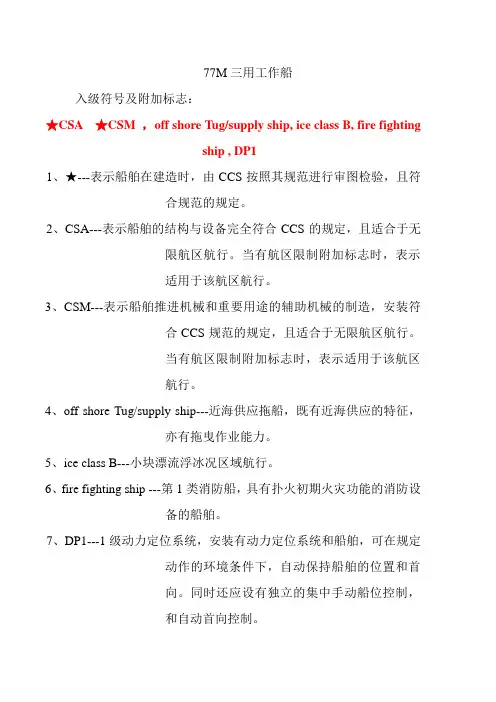
77M三用工作船入级符号及附加标志:★CSA ★CSM ,off shore Tug/supply ship, ice class B, fire fightingship , DP11、★---表示船舶在建造时,由CCS按照其规范进行审图检验,且符合规范的规定。
2、CSA---表示船舶的结构与设备完全符合CCS的规定,且适合于无限航区航行。
当有航区限制附加标志时,表示适用于该航区航行。
3、CSM---表示船舶推进机械和重要用途的辅助机械的制造,安装符合CCS规范的规定,且适合于无限航区航行。
当有航区限制附加标志时,表示适用于该航区航行。
4、off shore Tug/supply ship---近海供应拖船,既有近海供应的特征,亦有拖曳作业能力。
5、ice class B---小块漂流浮冰况区域航行。
6、fire fighting ship ---第1类消防船,具有扑火初期火灾功能的消防设备的船舶。
7、DP1---1级动力定位系统,安装有动力定位系统和船舶,可在规定动作的环境条件下,自动保持船舶的位置和首向。
同时还应设有独立的集中手动船位控制,和自动首向控制。
常用的还有CSR----共同结构规范。
ESP-----加强检验计划。
BWMP—压载水管理计划。
AUT-0-----机器处所周期无人值班。
推进装置由驾驶室控制遥控,机器处所包括机舱集控站周期无人值班。
MCC------机器处所集中控制。
船舶设置机舱集控站,并在机电设备正常运行时,机舱集控站连续有人值班。
BRC------驾驶室遥控。
主推进装置由驾驶定控制站遥控,机器处所连续有人值班。
意大利船级社的绿色船级标志
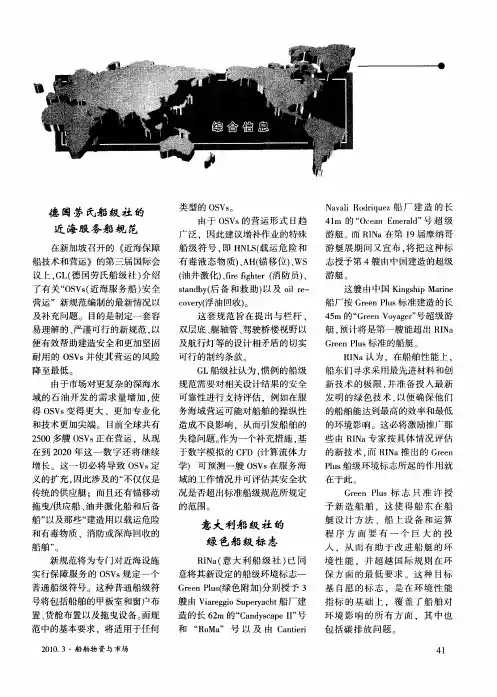
这 艘 由 中 国 K n si Maie ighp r n 船 厂按 G enPu 标 准建 造 的长 re ls
4 m 的“ re o ae” 超级 游 5 G enV yg r号
这 套规 范 旨在 提 出与 栏 杆 、 双层底 、 轴管 、 艉 驾驶 桥楼 视野 以 及 航行 灯等 的设计 相 矛盾 的切 实 可 行 的制约 条款 。 G L船级 社认 为 . 例 的船 级 惯
船 舶 ” 。
域 的工 作情 况并 可评估 其安 全状 况 是否 超 出标准船 级规 范所 规定
的范 围。
G e n Pu re ls标 志 只 准 许 授
予 新 造 船 舶 ,这 使 得 船 东 在 船 艇 设 计 方 法 、船 上 设 备 和 运 算
程 序 方 面 要 有 一 个 巨 大 的 投 入 ,从 而 有 助 于 改 进 船 艇 的 环 境 性 能 .并 超 越 国 际 规 则 在 环 保 方 面 的 最 低 要 求 。 这 种 目标
规 范需 要对 相关 设计 结果 的安 全
艇, 预计 将 是第 一艘 能 超 出 RN Ia G enPu 标 准 的船 艇 。 re ls
R N 认 为 ,在船 舶性 能 上 , Ia
便有效帮助建造安全和更加坚 固 耐用的 O V 并使其营运的风险 Ss 降 至最低 。 由于市场 对更 复杂 的深海 水
4 m 的 “ ca m rl” 超 级 1 O en E ea 号 d
广泛 ,因此 建议 增补 作业 的特 殊 船 级符 号 。 H L ( 运 危 险 和 即 N S载 有 毒液 态 物 质 )A 锚 移 位)WS 、 n( 、
中华人民共和国海事局关于启用新版海员证的公告

中华人民共和国海事局关于启用新版海员证的公告文章属性
•【制定机关】中华人民共和国海事局
•【公布日期】2019.11.19
•【文号】
•【施行日期】2019.12.20
•【效力等级】部门规范性文件
•【时效性】现行有效
•【主题分类】水运
正文
中华人民共和国海事局关于启用新版海员证的公告自2019年12月20日起,正式签发启用新版《中华人民共和国海员证》,不再签发旧版《中华人民共和国海员证》。
2019年12月20日前签发的旧版海员证在有效期内仍然有效。
特此公告。
Notice on issuing new version Seafarer's Passportof the People's Republic of China
Maritime Safety Administration of the People's Republic of China will commence to issue new version Seafarer's Passport of the People's Republic of China and cease the issuance of the old version from 20 December, 2019. The old version Seafarer's Passports issued before 20 December, 2019 will remain valid till their expiry dates.
中华人民共和国海事局
2019年11月19日。
绿色船舶扬帆中国
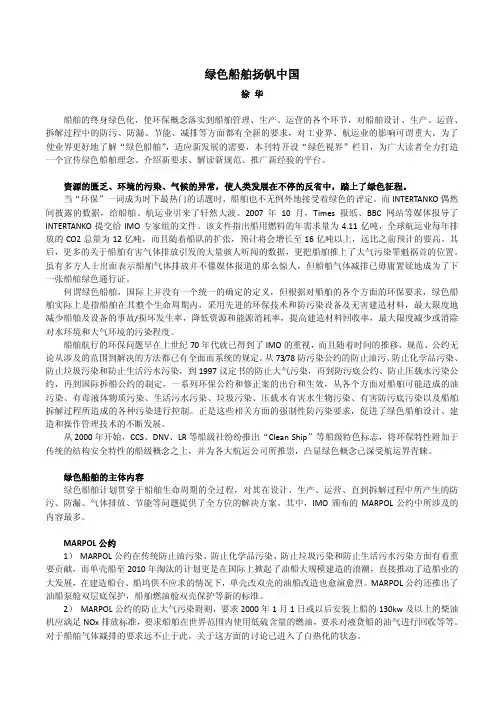
绿色船舶扬帆中国徐 华船舶的终身绿色化,使环保概念落实到船舶管理、生产、运营的各个环节,对船舶设计、生产、运营、拆解过程中的防污、防漏、节能、减排等方面都有全新的要求,对工业界、航运业的影响可谓重大。
为了使业界更好地了解“绿色船舶”,适应新发展的需要,本刊特开设“绿色视界”栏目,为广大读者全力打造一个宣传绿色船舶理念、介绍新要求、解读新规范、推广新经验的平台。
资源的匮乏、环境的污染、气候的异常,使人类发展在不停的反省中,踏上了绿色征程。
当“环保”一词成为时下最热门的话题时,船舶也不无例外地接受着绿色的评定。
而INTERTANKO偶然间披露的数据,给船舶、航运业引来了轩然大波。
2007年10月,Times报纸、BBC网站等媒体报导了INTERTANKO提交给IMO专家组的文件。
该文件指出船用燃料的年需求量为4.11亿吨,全球航运业每年排放的CO2总量为12亿吨,而且随着船队的扩张,预计将会增长至16亿吨以上,远比之前预计的要高。
其后,更多的关于船舶有害气体排放引发的大量骇人听闻的数据,更把船舶推上了大气污染罪魁祸首的位置。
虽有多方人士出面表示船舶气体排放并不像媒体报道的那么惊人,但船舶气体减排已毋庸置疑地成为了下一张船舶绿色通行证。
何谓绿色船舶,国际上并没有一个统一的确定的定义,但根据对船舶的各个方面的环保要求,绿色船舶实际上是指船舶在其整个生命周期内,采用先进的环保技术和防污染设备及无害建造材料,最大限度地减少船舶及设备的事故/损坏发生率,降低资源和能源消耗率,提高建造材料回收率,最大限度减少或消除对水环境和大气环境的污染程度。
船舶航行的环保问题早在上世纪70年代就已得到了IMO的重视,而且随着时间的推移,规范、公约无论从涉及的范围到解决的方法都已有全面而系统的规定。
从73/78防污染公约的防止油污、防止化学品污染、防止垃圾污染和防止生活污水污染,到1997议定书的防止大气污染,再到防污底公约、防止压载水污染公约,再到国际拆船公约的制定,一系列环保公约和修正案的出台和生效,从各个方面对船舶可能造成的油污染、有毒液体物质污染、生活污水污染、垃圾污染、压载水有害水生物污染、有害防污底污染以及船舶拆解过程所造成的各种污染进行控制。
ABS船级社入级符号释意解析

例如:我司即将建造的62M AHTS 入级符号为: ABS
综上所述,该符号旨在告知该船的类型,对于
船厂来说,就是告知我们,我们即将建造一条 什么样的船。
15
对于 十A1 (geographical limitations) 的解释
十 A 1 后的附加标志表示,该类船舶仅在该
限制区域工作,并且该船是在ABS现场验船师 的建造下完成的,其符合ABS的规范。具体章 节见:1-1-3/7 of the Rules for Conditions of Classification (Part 1)
南通润邦海洋工程装备有限公司
——我们努力成为全球一流的海工 制造基地
秉承专业 成就价值 励精图治 共赢未来
本次培训的目的及意义
本次培训目的旨在使设计部及营销部各级 人员对入级符号有一简单的理解,能识别入级 符号;能大致判断该入级符号对公司建造船舶 的影响;能根据ABS规范快速查询入级符号具 体要求(该能力自学,本课程不做展开)。使 质检部人员对入级符号有一个大致的认识。
1-1-3/1.9 of the Rules for Conditions of
Classification – Offshore Units and Structures (Part 1)
1-2-2/7.19 of the Rules for Conditions of
Classification – High-Speed Craft (Part 1)
3
该标志为ABS船级社入级符号,称之为 马耳他十字线,入级符号是船舶主要特性 的表述,具有强制性。船舶的船体(包括 设备)和轮机(包括电器设备)符合ABS规 范、指南或等效规定,ABS将授予相应的入 级符号和附加标志。
船级

著名船级
• • • • • • 英国劳埃德船级社 德国劳埃德船级社 挪威船级社 法国船级局 日本海事协会 美国航运局
船级符号
• 船级证书除了记载船舶的主要技术性能 外,还绘制出相应的船级符号。各国船级 社对船级符号的规定不同。 • 中国船级社的船级符号为*ZC。 • 英国劳埃德船级社的船级符号为LR, 标志100AI,100A表示该船的船体和机器设 备是根据劳氏规范和规定建造的。I表示船 舶的装备如船锚、锚链和绳索等处于良好 和有效的状态。
船级
• class of ship • 由船级社授予的表明船舶技术状况及安全 程度已达到船级社规范要求的船舶级别。 • 应用学科:
– 船舶工程(一级学科);船舶种类及船舶检验、 国际公约和证书(舶技术状态的一种指标。在国际航运界, 凡注册总吨在100吨以上的海运船舶,必须在某船级社或 船舶检验机构监督之下进行监造。在船舶开始建造之前, 船舶各部分的规格须经船级社或船舶检验机构批准。每艘 船建造完毕,由船级社或船舶检验局对船体、船上机器设 备、吃水标志等项目和性能进行鉴定,发给船级证书。证 书有效期一般为4年,期满后需重新予以鉴定。 • 船舶入级可保证船舶航行安全,有利于国家对船舶进 行技术监督,便于租船人和托运人选择适当的船只,以满 足进出口货物运输的需要,便于保险公司决定船、货的保 险费用。
美国船级社船级符号
11
民船研发中心
C S D C
附加船级符号(Additional class notations)
SEC(船舶安全符号)
该船级符号表示拖拽运动符合的安全要求。满足SOLAS XI-2, ISPS的A和B以及VSCG第33章的要求。
CCO-HR(TEMP)
船舶在设计建造和航行阶段满足低温环境的特殊要求。包括材料、 焊接、喷涂、船体结构和设备等方面。以及安全系统和设备操作 在低温环境下的运行。 CCO-HR(TEMP)+ 除以上要求外,还增加了满足在低温环境下对甲板机械和船员的 要求。
A1 AMS ACCU
4
民船研发中心
C S D C
主要符号(Main class notations)
RINA_附加入级标志——1
部分1自动的机舱[AUTUMS (Y)]总则1.1应用1.2免责1.3通信系统2文件编制2.1提交文件3火和水灾预防3.1防火措施3.2火警探测3.3消防3.4进水防护4机械控制4.1总则4.2柴油机推进装置4.3电气推进装置4.4轴,离合器,CPP ,齿轮4.5辅助系统4.6电气装置控制5警报系统5.1总则5.2警报系统设计5.3机器警报系统5.4驾驶桥楼警报系统6安全系统6.1总体调试7,测试7.1总则部分2 防止海水和空气污染方法[GREEN_STAR (Y)] 1总则1.1应用1.2必需的证书1.3定义1.4提交文件2海洋污染预防2.1含油废物2.2意外的卸油2.3污水2.4灰水2.5垃圾2.6防污系统2.7有害的水生生物和压舱水病原体传输3空气污染预防3.1臭氧物质3.2氮氧化物散放物(NOx )3.3硫散放物(SOx )3.4颗粒物质散发(PM )3.5焚烧炉4检查,测试和调查4.1建造期间检查和测试4.2初始考察4.3定期检验部分3船上舒适性[COMF (Y)]1总则1.11.21.31.41.51.62应用领域和专门的注释2.1应用领域2.2专门的注释3定义3.1游艇3.2公共区域3.3驾驶室3.4噪音3.5噪音水平(或者加权声压级)3.6声压级3.7振动4标准4.1测量条件4.2航行转运状况4.3航行环境条件4.4停泊处试验4.5噪音4.6空气噪声绝缘标志4.7振动5测量工序5.1噪音5.2振动部分4附加的安全要求(ASR)1总则1.1应用部分5水中调查方案[Inwatersurvey (Y)]1总则1.1应用1.2提交文件2结构设计原则部分6轴监视器[MonShaft (Y)]2.1轴监视器[MonShaft (Y)]1总则1.1轴监视器适用性(Y)注释2注释发行要求2.1布置2.2润滑油分析附件1可选择的要求(不必须遵循的绿色星号指定(Y)用户附加类别注释) 1应用2.设计要求2.1燃料箱2.2舱底污水预备柜2.3黑色/灰水系统2.4厨房烟囱3操作的要求3.1油水分离器Part F 附加船级注释章节1 附加船级注释指定部分1自动的机舱[AUTUMS (Y)]部分2防止海水和空气污染方法[GREEN_STAR (Y)]部分3在船上舒适性[COMF (Y)]部分4附加的安全要求(ASR )部分5水中调查方案[INWATERSURVEY (Y)]部分6轴监视器[MONSHAFT (Y)]附件1可选择的要求(不必须遵循的绿色星号指定(Y)附加船级注释)部分1自动的机舱[AUTUMS (Y)]1总则1.1申请1.1.1附加船级注释AUTUMS (Y)[6.2.1]依照Pt A,Ch 1,Sec 2,[6.4.2]分配至游艇,游艇装有的自装置能定期的进行机舱自动操作,要遵守本节要求。
船级社船级符号简表
★CSR
表示在本社检验下建造、安装和试验
★CSR
表示不在本社检验下建造、安装和试验,但经本社审查、检验和试验,认为可以接受
船级社船级符号简表
一些国外船级社船级符号简表
船级社
船级符号
船体
机械设备
无人机舱
冷藏装置
英国劳氏船级社LR
100A
LMC
UMS
RMC
德国劳氏船级社GL
100A4
MC
Aut-h/24
KAZ
美国船级社AB(MC
法国船级社BV
I
AUT
RMC
日本海事协会NK(K)
NS*
MNS
M0
RMC
挪威船级社DNV
1A1
MV
E0
RMC
中国船级社符号和附加标志
★
表示船体、轮机和特殊设备在本船级社检验下建造
★
表示船体、轮机和特殊设备不在本船级社检验下建造,但经本社检验
CSA5/5
表示船体完全符合本社规范的要求,且特别检验间隔期为5年
CSM
轮机(包括电气)完全符合本规范的要求
★CSM
轮机不在本社检验下进行建造、安装和试验,但经本社检验、试验认为可以接受
船体附加标志
船体附加标志有65种,如★CSA5/5 OT≦600,ESP,CHS,SMS,ICB3
ESP
表示加强检验
CHS
表示船体实行循环检验
SMS
表示船舶实行安全管理体系
ICB
表示轻度冰况的冰区加强
轮机附加标志
凡经本社批准入级的船舶机械,将根据其具体条件在其船级符号后加附加标志
AUT-0
由驾控,机舱处所集中控制站周期性无人值班
常用船级附加标志表格9
LPG Carrier
化学品液化船
Chemical Tanker
LNG运输船
LNG Carrier
表6-2航区或航线限制附加标志
附加标志
说明
R1
1类航区
R2
2类航区
R3
3类航区
××-××Service
在特定航线上航行,如Shanghai – Osaka Service
表6-3 特殊任务附加标志
ECM
船体循环检验
CHS
机械计划保养系统
PMS
轮机循环检验
CMS
表6-9 环境保护附加标志
名 称
附加标志
名称
附加标志
洁净
Clean
冷藏系统控制
RSC
燃油舱保护
FTP
防污底系统
AFS
NOx排放控制
NEC(Ⅱ) NEC(Ⅲ)
绿色护照
GPR
SOx排放控制
SEC(Ⅰ) SEC(Ⅱ) SEC(Ⅲ)
舒适性(噪音N)
PC 3
可全年在当年厚冰状况(可包括旧夹冰)下航行
PC4
可全年在中等厚度的当年冰龄状况(可包括旧夹冰旧夹冰)下航行
PC6
可夏季/秋季在当年薄冰状况(可包括旧夹冰)下航行
PC7
可在严重冰况下航行,不需破冰船辅助。
Ice Class B1*
可在严重冰况下航行,必要时需破冰船辅助。
Loading Computer
应急拖带装置
Emergency Towing
Arrangements
清洁压载舱
CBT
专用压载舱
SBT
原油洗舱系统
COW
惰性气体系统