
牛津译林版2019-2020学年六年级英语下册全册复习资料
6A知识点大纲Unit 1 The lion and the mouse 单词quietly 安静地sadly难过地,伤心地happily开心地,高兴得some day某一天loudly 大声地quickly迅速地,快地wake ... up吵醒,叫醒soon不久,很快large 大的weak弱的,软弱的strong强大的,强壮的cheer欢呼deep 深的sharp锋利的,尖的let ... go释放,放开just then就在那时mouse 老鼠walk by走过,路过from then on从那时起bite咬net 网pour ... into把……倒入hit打,击the next day第二天重点词组1. in the forest 在森林里2. walk by 走过;路过3. wake up 醒,醒来4. wake sb. up 把某人叫醒5. be angry with sb. 对某人生气6. the next day 第二天7. be angry at sth. 对某事生气8. want to do sth. 想要做某事9. want sb. to do sth. 要某人做某事10. some day 某一天11. say quietly 小声地说12. sit quietly 静静地坐着13. laugh loudly 大声地笑14. let sb. do sth. 让某人做某事15. catch the lion with a large net 用一口大网捉住狮子16. bite the net with sharp teeth 用锋利的牙齿咬网17. ask sadly 难过地问,伤心地问18. just then 就在那时19. say happily 开心地说20. from then on 从那时起21. become friends 成为朋友22. say excitedly 兴奋地说,激动地说23. make a study plan 制定学习计划24. It doesn’t matter. 没关系。
25. the boy over there 那边的那个男孩26. play table tennis happily开心地打乒乓球27. cheer for sb. loudly 大声地为某人欢呼28. be excited at / about…对……很兴奋/激动29. in the ground 在地下30. reach the apple 够得着那个苹果31. reach the park 到达公园32. have an idea 有一个主意33. bring some water quickly很快拿来水34. pour…into….把……倒入……35. Well done. 干得很好。
做的不错。
36. so many balls 如此多的球37. so much bread 如此多的面包38. take … to… 把…….带到…….39. become happy 变得很开心40. get out 出来,出去重点句型1. The lion was angry and wanted to eat the mouse.这只狮子很生气想要吃那只老鼠。
2. The lion bit the net with his sharp teeth.那只狮子用它的厉牙咬那个网。
3. From then on, the lion and the mouse become friends.从那以后,这只狮子和那只老鼠成了朋友。
4. The next day, two men caught the lion with a large net.第二天,两个男人用一张大网抓住了那只狮子。
5. The lion bit the net with his sharp teeth, but that did not help.那只狮子用他的厉牙咬网,但是那无济于事。
6. Here comes the lion.狮子来了。
7. One day, a mouse walked by and woke the lion up.一天,一只老鼠从狮子身边经过,弄醒了狮子。
8. The mouse said quietly. 老鼠小声地说。
9. “How can I get out ?” asked the lion sadly.“ 我怎么能出去呢?”狮子难过地问。
10. Soon, the mouse made a big hole in the net with his teeth.很快,老鼠用他的牙齿把网咬了一个大洞。
语法1、常见副词well: study well学习好 skate well滑冰好(注: well 若表示形容词,则意思为身体好)fast: run fast 跑得快 swim fast游泳快loudly: laugh loudly 大声得笑 speak loudly 大声地讲sadly: ask sadly 伤心地问 cry loudly 伤心地哭happily: sing happily 开心地唱 talk happily 开心的谈话carefully: listen carefully 认真地听 walk carefully 小心地走angrily: ask angrily 愤怒地问quietly: do one’s homework quietly安静地做作业sleep quietly 安静地睡quickly: bring some water quickly 迅速地拿些水来beautifully: dance beautifully 唱歌唱得美★系表结构: (注意不用副词)be, feel, look, sound, smell, become, keep + 形容词★fast ,hard ,high,early,late, 形容和副词同形2、一般过去式常用的时间状语ago / long long ago / yesterday / the day before yesterday in 2014 / just now(刚才) /at the age of 5(在五岁时) / once upon a time从前 / one day / last week, year, night, month, from then on3、speak ,talk,say,tell区别speak强调方式;say强调内容;tell后一定要加人或讲的内容; talk强调连续说Unit 2 Good habit单词late 迟,晚tidy干净的,整齐的bad不好的,坏的last night昨夜sleepy困的,困倦的finish完成go into走进,走入never从不fast 快地slowly慢速地badly差地,不好habit习惯put ... in order把……整理得井井有条重点词组1. many good habits 很多好习惯2. get up early 早起3. go to bed late 晚睡4. brush one’s teeth 刷牙5. put sth. in order 把东西摆放有序6. finish one’s homework完成家庭作业7. listen to the teacher 听老师的话 8. at school 在学校9. keep the room clean and tidy 保持房间干净整洁10. do well 干得好 11. some bad habits 一些坏习惯12. feel sleepy 感到困倦 13. know sb. well 对某人很了解14. walk fast 快速地走 15. Pick one! 选一个16. show sb. around sp. 带某人参观某地 17. go into 进入重点句型语法 副词的分类(1) 时间副词:常见的有now, then, soon, ago, lately, later, before, early, today, tomorrow, yesterday, tonight, suddenly, still, already, just 等。
(2) 地点副词:常见的有here, there, up, down, away, nearby, home, upstairs, downstairs 等。
(3) 方式副词:表示行为方式的副词大多以-ly 结尾,常见的有quietly, heavily, warmly, carefully, happily, angrily 等。
(4) 频度副词:常见的有always, usually, often, sometimes, never 等。
(5) 程度副词:常见的有very, much, too, greatly, really 等。
如:(6) 焦点副词:就是通过强调使之成为人们注意的焦点的副词,常见的有:only, also, just, especially, too,等。
(7) 疑问副词:就是用于引出特殊疑问句的when, where, why, how 等。
副词的顺序1. He has many good habits. 他有许多好习惯。
2. He gets up early in the morning and never goes to bed late.他早上早起,从不晚睡。
3. He brushes his teeth in the morning and before bedtime. 他早上和睡前刷牙。
4. At home, Wang Bing always puts his things in order.在家,王兵总是把他的东西摆放有序。
5. He usually finishes his homework before dinner. 他经常在晚餐前晚餐作业。
6. He listens to his teachers at school. 他在学校听老师们的话。
7. He also does well at home. 他在家也做得很好。
8. He keeps his room clean and tidy. 他保持他的房间干净和整洁。
9. He also helps his parents. 他也帮他的父母。
10. He often does his homework late at night and does not go to bed early. 他经常晚做作业,晚上不早睡。
牛津译林版英语 六年级下册 Unit 3 A healthy diet 知识点与练习
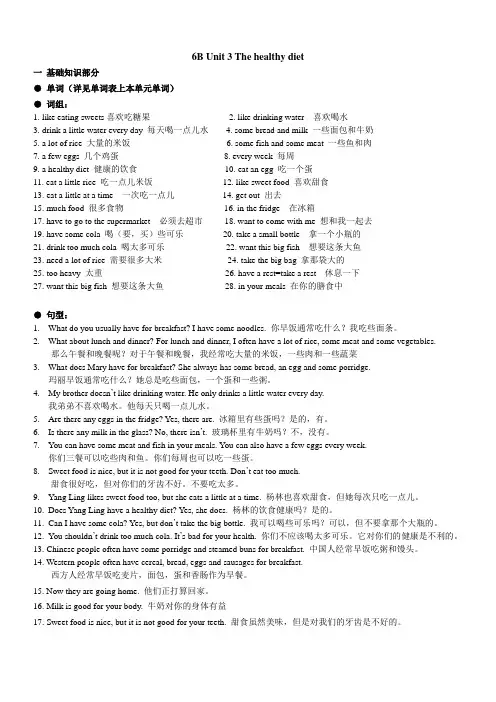
6B Unit 3 The healthy diet一基础知识部分●单词(详见单词表上本单元单词)●词组:1. like eating sweets喜欢吃糖果2. like drinking water 喜欢喝水3. drink a little water every day 每天喝一点儿水4. some bread and milk 一些面包和牛奶5. a lot of rice 大量的米饭6. some fish and some meat 一些鱼和肉7. a few eggs 几个鸡蛋8. every week 每周9. a healthy diet 健康的饮食10. eat an egg 吃一个蛋11. eat a little rice 吃一点儿米饭12. like sweet food 喜欢甜食13. eat a little at a time 一次吃一点儿14. get out 出去15. much food 很多食物16. in the fridge 在冰箱17. have to go to the supermarket 必须去超市18. want to come with me 想和我一起去19. have some cola 喝(要,买)些可乐20. take a small bottle 拿一个小瓶的21. drink too much cola 喝太多可乐22. want this big fish 想要这条大鱼23. need a lot of rice 需要很多大米24. take the big bag 拿那袋大的25. too heavy 太重26. have a rest=take a rest 休息一下27. want this big fish 想要这条大鱼28. in your meals 在你的膳食中●句型:1.What do you usually have for breakfast? I have some noodles. 你早饭通常吃什么?我吃些面条。
小学英语六年级下学期(牛津译林版)Unit 3-4复习资料
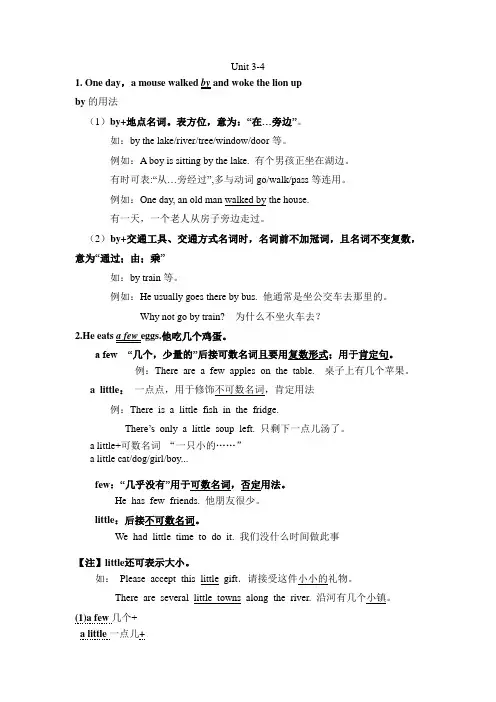
Unit 3-41. One day,a mouse walked by and woke the lion upby的用法(1)by+地点名词。
表方位,意为:“在…旁边”。
如:by the lake/river/tree/window/door等。
例如:A boy is sitting by the lake. 有个男孩正坐在湖边。
有时可表:“从…旁经过”,多与动词go/walk/pass等连用。
例如:One day, an old man walked by the house.有一天,一个老人从房子旁边走过。
(2)by+交通工具、交通方式名词时,名词前不加冠词,且名词不变复数,意为“通过;由;乘”如:by train等。
例如:He usually goes there by bus. 他通常是坐公交车去那里的。
Why not go by train? 为什么不坐火车去?2.He eats a few eggs.他吃几个鸡蛋。
a few “几个,少量的”后接可数名词且要用复数形式;用于肯定句。
例:There are a few apples on the table. 桌子上有几个苹果。
a little:一点点,用于修饰不可数名词,肯定用法例:There is a little fish in the fridge.There’s only a little soup left. 只剩下一点儿汤了。
a little+可数名词“一只小的……”a little cat/dog/girl/boy...few:“几乎没有”用于可数名词,否定用法。
He has few friends. 他朋友很少。
little:后接不可数名词。
We had little time to do it. 我们没什么时间做此事【注】little还可表示大小。
如:Please accept this little gift.请接受这件小小的礼物。
牛津译林版六年级下册英语单元+Unit 5 A party重难点精讲精练(含答案)
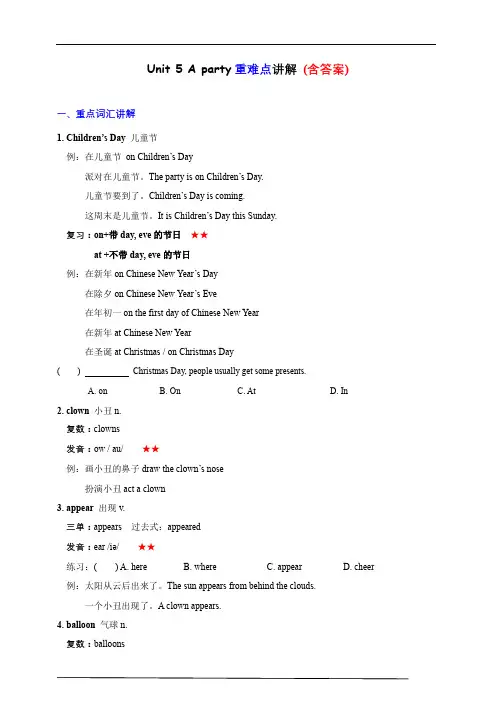
Unit 5 A party重难点讲解(含答案)一、重点词汇讲解1. Children’s Day 儿童节例:在儿童节on Children’s Day派对在儿童节。
The party is on Children’s Day.儿童节要到了。
Children’s Day is coming.这周末是儿童节。
It is Children’s Day this Sunday.复习:on+带day, eve的节日★★at +不带day, eve的节日例:在新年on Chinese New Year’s Day在除夕on Chinese New Year’s Eve在年初一on the first day of Chinese New Year在新年at Chinese New Year在圣诞at Christmas / on Christmas Day( ) Christmas Day, people usually get some presents.A. onB. OnC. AtD. In2. clown小丑n.复数:clowns发音:ow / au/ ★★例:画小丑的鼻子draw the clown’s nose扮演小丑act a clown3. appear 出现v.三单:appears 过去式:appeared发音:ear /iə/ ★★练习:( ) A. here B. where C. appear D. cheer 例:太阳从云后出来了。
The sun appears from behind the clouds.一个小丑出现了。
A clown appears.4. balloon气球n.复数:balloons发音:oo /u:/例:放一个气球fly a balloon买一些气球buy some balloons这儿有些气球给你们。
Here are some balloons for you.5. begin 开始v.三单:begin 过去式:began例:现在聚会开始。
最新译林版小学六年级下册英语教材M1U1-M2U1语言知识梳理

6、like doing /love doing /enjoy doing 这 三个结构意思相同,喜欢做某事。 like/ love/ enjoy doing表示动作在意义 上比较一般和抽象,时间观念不强,不 指某一次动作,偏重个人爱好。 like to do /love to do , to do则常指某 个具体的动作。enjoy 后不可接 to do
Unit 2 At the airport 四汇单词和词组(共18个):
airport address arrive at however have to before bring (brought, brought) passenger pack passport should space stay several worry flight dollar leave for
3、Mrs Wang and Grandma have not been to the USA before. 王太太和奶奶从来没有去过美国。 have been to 意为“去过;到过” have been to 表示去过某地,现在已经返回了 have gone to 表示“去了某地,现在可能在途中, 还没有返回”。
3、It’s north-east of Shanghai. north-east 注意在表达方位时中英文的差别,与汉语 表达的先后顺序正好相反。north-east of 表示 “在……的东北方”。
4、How far is it from Shanghai to Beijing?北京距离 上海有多远? 用How far…引导的特殊疑问句来询问距离的远近, 回答通常是It’s about…(大约是…… ) 不定代词It在这里指代“距离”,介词结构 From …to…表示“从……到……。”
牛津译林版英语六年级下册期末知识点复习(一般过去时和一般将来时)附练习含答案
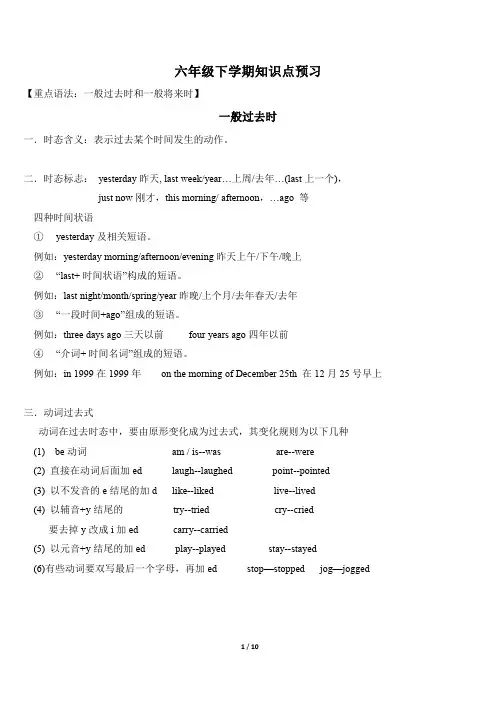
六年级下学期知识点预习【重点语法:一般过去时和一般将来时】一般过去时一.时态含义:表示过去某个时间发生的动作。
二.时态标志:yesterday昨天,last week/year…上周/去年…(last上一个),just now刚才,this morning/afternoon,…ago等四种时间状语①yesterday及相关短语。
例如:yesterday morning/afternoon/evening昨天上午/下午/晚上②“last+时间状语”构成的短语。
例如:last night/month/spring/year昨晚/上个月/去年春天/去年③“一段时间+ago”组成的短语。
例如:three days ago三天以前four years ago四年以前④“介词+时间名词”组成的短语。
例如:in1999在1999年on the morning of December25th在12月25号早上三.动词过去式动词在过去时态中,要由原形变化成为过去式,其变化规则为以下几种(1)be动词am/is--was are--were(2)直接在动词后面加ed laugh--laughed point--pointed(3)以不发音的e结尾的加d like--liked live--lived(4)以辅音+y结尾的try--tried cry--cried要去掉y改成i加ed carry--carried(5)以元音+y结尾的加ed play--played stay--stayed(6)有些动词要双写最后一个字母,再加ed stop—stopped jog—jogged(7)不规则变化(为过去时态中变化的难点,也是考试的重点)原形过去式原形过去式原形过去式do did go went say saidtell told can could get got have had give gave see saw become became fly flew bring brought eat ate take took find found lose lost stop stopped sing sang make made run ran swim swam hold held come came catch caught wear wore read read draw drew write wrote buy bought mean meant drink drank smell smelt keep kept put put throw threw slip slipped feel felt cut cut drive drove四.结构1.肯定句:主语+动词过去式2.一般疑问句:(1)句中含有be动词,将be动词提到句首,Was/Were+主语+……?Yes,…was/were./No,…wasn’t/weren’t.(2)句中无be动词,在句首加Did,动词变原形,Did+主语+动词原形……?Yes,…did./No,…didn’t.3.否定句的修改方法(1)句中含有be动词,直接在be动词后面加not,主语+wasn’t/weren’t…(2)句中无be动词,在动词前加didn’t,动词变原形,主语+didn’t+动词原形4.特殊疑问句:What did+主语+do?一般过去时练习一、请用正确动词形式填空。
牛津译林版英语六年级下册第三单元重点知识
牛津译林版英语六年级下册第三单元重点知识Unit 3 ___A ___ you like eating sweets。
___ to only eat them sometimes。
Instead。
drink water every day。
You can also have some bread。
rice。
fish。
meat。
eggs。
noodles。
___ breakfast。
you can have some porridge or ___ and dinner。
you can have cereal and sausages or other Western foods。
but also remember to add some vegetables to your plate.If you want to have sweet food。
eat a little at a time。
You can also have some fruit or eat some cakes。
but only a few at a time。
If you have a lot of rice。
eat a little at a time。
Chinese people often have some porridge and ___。
while Western people like to have cereal and sausages。
You can find these foods in the fridge or at the supermarket.In the story。
a little mouse lives in her house。
She likes to eat a few things at a time。
like a little cheese or a few crumbs of ___ for her too。
新牛津译林版英语六年级下册Unit3复习纸
Unit3 A healthy diet 一、词组1.a healthy diet健康的饮食2.like eating sweets喜欢吃糖果3.only drink a little water只喝一点水4.drink some milk every day每天喝牛奶5.have some bread for breakfast吃点面包当早餐6.eat a little rice吃一点米饭7.some fish and some meat一些鱼和肉8.have a few eggs every week每周吃几个鸡蛋9.a lot of noodles许多面条10.some vegetables and fruit一些蔬菜和水果11.eat an egg every morning每天早晨吃个鸡蛋12.like sweet food very much非常喜欢甜食13.my favourite food我特别喜欢的食物14.be good for your body对你的身体有益15.be bad for your health对你的健康有害16.potatoes and tomatoes土豆和番茄17.like mangoes喜欢芒果18.do not eat any cakes不吃任何蛋糕19.eat a little at a time一次吃一点20.drink much juice every evening每天晚上喝许多果汁21.Mrs Li shouts李太太大叫22.get out出去23.a little mouse一只小老鼠24.in her house在她屋里25.open your mouth张开嘴26.some porridge and steamed buns 一些粥和馒头27.Chinese people and western people中国人和西方人28.have cereal and sausages吃谷类食品和香肠29.much food in the fridge许多食物在冰箱里30.have to go to the supermarket必须去超市e with me跟我来32.see some drinks看见一些饮料33.a small bottle of cola一小瓶可乐34.need a lot of rice需要许多米35.take the big bag拿那个大袋子36.too heavy太重37.have a rest休息一下38.want that big fish 想要那条大鱼39.jump into the river跳进河里40.in your meals在你的膳食中二 .句子1.For lunch and dinner, he has a lot of rice, some fish and some meat.他吃许多米饭、一些鱼和肉当作午饭和晚饭2.She only eats a little rice.她只吃一点米饭。
六年级英语下册(牛津译林版)Unit3 A healthy diet 知识点归纳与练习题
Unit 3 A healthy diet【知识点】1. a healthy diet 一个健康的饮食习惯an unhealthy diet 一个不健康的饮食习惯health n. 健康healthy adj. 健康的keep healthy 保持健康diet dieted/ dieting on diet 减肥,节食【练习】 a healthy diet【health 和healthy的相互转化】(1)【易错】He shouldn’t drink socola , or he’ll beA. much;unhealthyB. a lot of ;healthyC. many;unhealthy(2)【易错】Everyone should keep.A.healthyB. healthilyC.health(3)【易错】Our(health) is the most important.(最重要)2. Mike has some bread and milk for breakfast. Mike早餐吃一些面包和牛奶。
have …. for breakfast/ lunch/ dinner 早/午/晚饭吃…..bread , milk 不可数名词drink water/milk 喝水/牛奶都可以用have来表示吃喝eat some fish and meat 吃一些鱼和肉【练习】like后用动名词likes eating sweets(1)【易错】Do you wanta glass of water?A. eatB. drinkC. haveD./(2)Mike doesn’t like(drink) water.三餐类前for的用法【for翻译成“当做”】(1)I eat a few noodles _______.A. in dinnerB. of dinnerC. for dinner(2)我爷爷每天早餐吃一些面包和土豆。
牛津译林版六年级英语下册Unit 2 Good habits--Eating habits
1.一般情况下,直接在动词后+s ,
collect →collects come →comes play →plays think →thinks
sound → sounds drop →drops say → says like →likes
2.以s, sh, ch, x, o 结尾的动词,在词尾+ es
She likes ___f_ru_it_s____ best. But she doesn’t like ___r_ic_e___ at all.
Bill’ Eating Habits
He is Bill. He is from the UK. He is 40 years old.
Bill’s Eating Habits
She likes _____ric_e_______ best. But she doesn’t like n_o_o_d_le_sat all. She prefers ____b_r_ea_d______ for breakfast. And _______m_e_a_t__________ for lunch.
watch → watches
teach →teaches
guess →guesses
wash → washes
fix → fixes
go → goes
•不习惯读书进修的人,常会自满于现状,觉得再没有什么事情需要学习,于是他们不进则退。经验丰富的人读书用两只眼睛,一只眼睛看到纸面上的话,另 一眼睛看到纸的背面。2022年3月30日星期三2022/3/302022/3/302022/3/30 •书籍是屹立在时间的汪洋大海中的灯塔。2022年3月2022/3/302022/3/302022/3/303/30/2022 •正确的略读可使人用很少的时间接触大量的文献,并挑选出有意义的部分。2022/3/302022/3/30March 30, 2022 •书籍是屹立在时间的汪洋大海中的灯塔。
牛津译林版六年级英语下册6B U1-U3单元重点知识总结
6B U1-U3单元重点知识总结Unit 1 Cinderella一、单词。
prince王子 because因为 before 在…以前 late迟的,晚的fairy 仙女 clothes 衣服 fit合适,合身 pick 摘,拾why 为什么 let让 mushroom 蘑菇 understand明白,理解二、词组。
1. at the prince’s house -在王子家2. come and help me -过来帮助我3. my gloves /trousers/T-shirt -我的手套/裤子/T恤衫4. go to the party -去参加聚会5. put on -穿上(衣服)6. try on -试穿7. take off -脱下8. be bad for… -对…有害9. take it off -脱下它10. put them on -穿上它们11. try on the shoe -试穿这只鞋12. try them on -试穿它们13. come back before 12 o’clock-十二点之前回来14. be sad /happy -伤心/开心15. have a good/great time -玩得开心16. at the party -在聚会上17. have to do sth. -不得不做某事18. have to come home -不得不回家19. visit every house -拜访每一户20. fit sb well -很适合某人21. at 12 o’clock -在十二点22. put on the English play -表演(演出)这个英语剧23. have a drink -喝饮料24. draw a dress for her friend -为她的朋友画一件连衣裙25. read stories -读故事26. have some snacks -有一些零食27. at a snack bar -在零食店28. thirsty and hungry Bobby -饥渴交加的波比29. in the forest -在森林里30. find some mushrooms -发现一些蘑菇31. under the tree -在树下32. pick a big red mushroom -摘了一个又大又红的蘑菇33. pick up the book =pick the book up-捡起这本书34. pick them up -把它们捡起来35. leave a shoe behind -把一只鞋子留下了36. don’t understand why -不明白为什么37. foot hurts -脚疼38. be bad /good for… -对…有坏处/好处39. have to -不得不,必须40. leave…behind -留下;丢下41. have some nice clothes and shoes -有些漂亮衣服和鞋子42. don’t have any nice clothes or shoes -没有漂亮衣服和鞋子43. put on the new clothes= put the new clothes on-穿上新衣服44. take off his white jacket=take his white jacket off -脱下他白色的夹克衫三、句型。