
中职英语unit6 weather
4. 两者都具有及物动词词性和不及物物动词词性。 如:What time do you begin/ start school? 你是 什么时候开始上学的? 5. begin/ start with 意为“从……开始”。如: Which lesson shall I begin / start with? 我应从哪 一课开始? 6. begin 和 start 均为终止性动词,因此不能与段时 间状语连用。如:电影开始 10 分钟了。 误: The film has begun/ started for ten minutes. 正: The film began ten minutes ago. 正: The film has been on for ten minutes. 正: It's ten minutes since the film began.
fine thin easy well high
finest finer ________ ________ thinner thinnest ________ ________ easiest ________ ________ easier better best ________ ________ higher highest ________ ________
形容词比较级最高级规则
1. 一般情况下加-er 或-est : young-yonger-yongest old –older -oldest tall-taller -tallest small-smaller -smallest 2. 以字母e结尾的形容词,加-r 或- st nice –nicer-nicest safe –safer -safest 3. 重读闭音节词只有一个辅音字母时,应先双写辅音字母, 再 加-er或-est. big—bigger -biggest fat—fatter-fattest
cold snow ice skate
begin和start的用法: 一 . 相同之处 1. 意为“开始;发生;发起”时,两者可互换。如: Then he began/ started a series of experiments. 然后他就开始做一系列的实验。 How did the accident begin/ start? 事故是怎样发 生的? 2. 表示开始某一动作时,后面跟不定式或动名词所 表达的意思是相同的。但当表示开始一项较长时间或经常 性的活动时,后接动名词的形式则更为常见。如: The child began crying/ to cry. 那小孩开始哭了。
1.-What’s the weather like today? -It’s_______.
fine cold cool hot warm sunny cloudy rainly snowy windy
warm green rain flower
hot rainy cloudy swim
cool fruit farmer leaf wind
famous 原级
more interesting
more famous 比较级 最高级
most interesting
most famous
good/well
bad/ill little far
better
worse less
best
worst
两好、
பைடு நூலகம்
两坏、
两多、 一少、 一老 、 一远.
To be continued
many/much more
most
least
old
older elder
oldest eldest
1. Write down the comparative degree form and superlative degree forms of the following adjectives and adverbs . smaller smallest small ________ ________
begin和start的用法: 一 . 相同之处 1. 意为“开始;发生;发起”时,两者可互换。 如: Then he began/ started a series of experiments. 然 后他就开始做一系列的实验。 How did the accident begin/ start? 事故是怎样发 生的? 2. 表示开始某一动作时,后面跟不定式或动名词 所表达的意思是相同的。但当表示开始一项较长时 间或经常性的活动时,后接动名词的形式则更为常 见。如: The child began crying/ to cry. 那小孩开始哭了。
Complete the following sentences with the correct form of the words or expressions in the box.
begin , bring, often , favorite , busy , be good for , from to , like , stay , because 1.She helps her mother do housework after from to school _____18:00 ______19:00 every day . because 2. We all like Mary ______________she is a hardworking student . begin 3.Hello,boys and girls! Let’s __________to read the text of Unit3 .
中职英语
Unit 6 Season
Objectives
1. 熟练掌握本单元出现的词汇、短语和句 型,并能用学过的短语、句型谈论天气。 2. 熟练掌握形容词和副词的用法。 3. 熟练掌握比较级和最高级的构成和用法。
Unit 6
weather
Warming up
Reading
Language Study
go to the seaside 5.I often ______________on vacation with my friends in summer. Autumn 6. __________is the harvest time in a year. very busy 7. Farmers are ___________in the fields in autumn. their good 8. Farmers are very happy with___________ harvest in autumn ___________________. 9.In winter, it a lot and we have a lot of interesting sports _________________.
warm green rain flower
3.be good for/at/with/to
1)be good at 意为“擅长……”,后接名词、代词 或ving形式。例如: I’m good at playing chess.我擅长下象棋。 2)be good with意为“灵巧的;与……相处得好”。 例如:She is good with her hands.她手很巧。 He is very good with the children. 他与这些孩子处得很好。 3)be good to意为“对……友好”。 例如: My friend was good to me when I was ill. 我生病时我的朋友对我关怀备至。 4)be good for意为 “对……有好处”。例如: Eating more vegetables is good for your health. 多吃蔬菜对你的健康有好处。
favorite 4.Swimming is my _________sport. stay 5.My parents want to ______ in a hotel near our school. is good for 6.Smoking ___not ________ your health. bring 7.Please _________ your new books here tomorrow. like 8.Not all of us _____ pop music . 9.Sorry , I can not help you do it now busy because I am too ________. often 10.We _________help the farmers plant new trees in spring.
turn/get/become /go
1. become 和 get 主要指一个人暂时性的身心变化或永久性 的自然变化或指天气的变化和社会的趋势 become / get angry, famous, fat, ill, old, deaf, strong, etc. 生气,成名,发胖,得病,变老,变聋,变强,等 It's becoming [getting] cold (dark, cloudy, etc.). 天渐冷了(黑了,多云了等)。 2. go 和 come 表示变化时,前者主要指一种由强到弱或 由好到坏的变化(可用于人或事物),后者则主要指向好的 方面变化: go bald (deaf, insane, etc.) 发秃,变聋,发疯等。 The meat's gone off (gone bad). 肉变味(变坏)了。 Her wish came true. 她的愿望实现了。 Everything came right. 一切顺利。 go 还可用于人或事物颜色的变色,与 turn 用法相同: She went [turned] blue with cold. 她冻得脸色发青了。
Unit6Weather(教案)闽教版英语四年级下册

Unit6 Weather (教案)闽教版英语四年级下册教学目标1. 让学生掌握关于天气的英语词汇,如:sunny, cloudy, rainy, windy等。
2. 培养学生运用英语描述天气的能力。
3. 增进学生对不同天气条件下活动的了解。
教学内容1. 关于天气的英语词汇:sunny, cloudy, rainy, windy, snowy 等。
2. 描述天气的句子结构,如:It is sunny today.3. 关于不同天气条件下的活动建议。
教学重点与难点1. 教学重点:掌握关于天气的英语词汇,能运用英语描述天气。
2. 教学难点:正确运用不同天气条件下的活动建议。
教具与学具准备1. 教具:多媒体设备,PPT,天气卡片。
2. 学具:英语课本,笔记本,彩色笔。
教学过程1. 引入:通过展示不同天气的图片,引导学生用中文描述这些天气。
2. 新课导入:介绍关于天气的英语词汇,让学生跟读并模仿。
3. 句子结构讲解:通过PPT展示句型"It is sunny today.",解释句子的构成。
4. 练习:让学生分组练习描述不同天气,教师巡回指导。
5. 活动建议:介绍不同天气条件下的活动建议,让学生讨论并分享。
板书设计1. Unit6 Weather2. 关于天气的英语词汇:sunny, cloudy, rainy, windy, snowy 等。
3. 句型:It is sunny today.4. 活动建议:在晴天可以出去玩耍,在雨天可以看书听音乐等。
作业设计1. 抄写关于天气的英语词汇。
2. 写一段关于今天天气的英语句子。
3. 列出三种不同天气条件下的活动建议。
课后反思1. 学生是否能熟练掌握关于天气的英语词汇。
2. 学生是否能正确运用句型描述天气。
3. 学生是否能根据不同天气条件提出合适的活动建议。
4. 对教学方法和教学过程的改进建议。
教学过程1. 引入利用多媒体展示不同天气的图片,如晴朗的天空、多云的天气、雨天的街道等,让学生用中文描述这些天气。
中职英语1 语文出版社unit6 Weather

B: Why not?(=I can go with you.)
Why not do sth.?= What/How about +
Why don’t you do sth.? doing/ n. 表建议去做某事
Sb.
表示询问某人的看法
stay at home
go skiing
A: It’s snowinWg._h_a_t__/__H_o__w___a_b_o__u_t__g_o__in__g_ B: Good idea. skiing?
picnic
A: The sun is shining.S__h_a_l_l_w__e__g__o__f_o_r__a___ picnic ?
A: How cold it is ! L_e__t_’__s_s__ta__y__a_t_____
B: Sure.
home .
take an umbrella
A: It is raining. _____W__h__y__n_o__t_t_a__k_e__a_n___
B: All right.
umbrella ?
Let’s stay at home .
我们呆在家里吧
What / How about going skiing?
去ቤተ መጻሕፍቲ ባይዱ雪怎么样?
Why not take an umbrella ?
为什么不带把雨伞呢?
Shall we go for a picnic ?
我们去野餐好吗?
对表示建议、提议的回答时,形式上是否定,实际 上是一种强调肯定的语气。例如:
B: Ok. Let’s go.
中职英语基础模块上册unit ppt课件

Kissing hands
吻手礼:吻手礼源于古代维京人用手向其日耳曼君 主递礼物的风俗,流行于欧美上层社会,是一种仅对贵 族已婚妇女实施的礼节。吻手礼一般在室内举行,并且 仅限于手腕以下部位,一般是指背。
cross one's
hands 双手合十:
这种礼仪多见于 信奉佛教的国家,比如说泰国。 泰国人见面时往往低头问候, 并将双手合十于胸前。小辈见 长辈双手举到前额高度,平辈 到鼻子高度,而长辈还礼则只 需到胸前即可。另外,泰国认 为头部是神圣的,不能随意摸 别人的头。
你呢
I'm fine,too.Tha
nk you! 我也是,谢谢
LOREM IPSUM DOLOR
Nice to meet you! 很高兴见到你 Nice to meet you,too! 也很高兴见到你
• Notes:
•
• 1. Introductions are important because a proper introduction will leave a good first impression upon others.
•.
Warm-up
Look at the picture and tick. Emily and Jenny meet each other for the first time. Tick what they would say.
( ) 1. Hi, Jenny! ( ) 2. Good morning Jenny. Nice to meet you. ( ) 3. Hello, I’m Emily. ( ) 4. Bye. See you later. ( ) 5. How do you do? ( ) 6. Thank you!
九年级义务教育2020年编四年级英语下册Unit6Weather单元综合测试卷闽教版三起
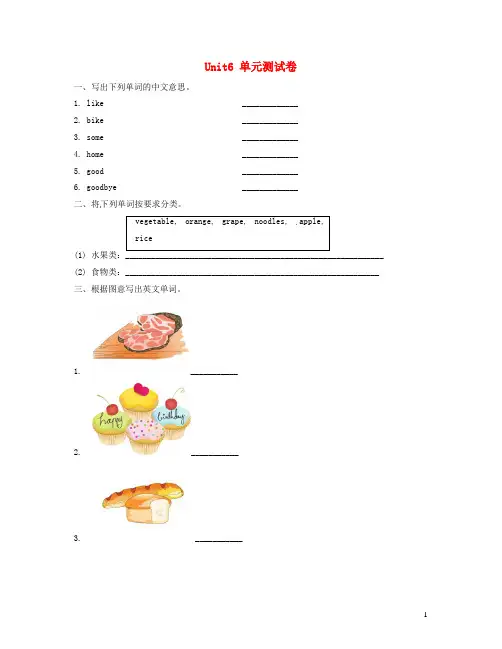
Unit6 单元测试卷一、写出下列单词的中文意思。
1. like _____________2. bike _____________3. some _____________4. home _____________5. good _____________6. goodbye _____________二、将下列单词按要求分类。
vegetable, orange, grape, noodles, apple,rice(1)(2) 食物类:___________________________________________________________三、根据图意写出英文单词。
1. ___________2. ___________3. ___________4. ___________四、选词填空,并写出句子的中文意思。
1.A. too B. please(1) Have some eggs, __________.(2) I want my breakfast, __________.2. A. tomatoes B. hamburger (1) A: Do you like _________?B: Yes, I do.(2) The __________ is nice.参考答案:一、1. 喜欢2. 自行车3. 一些4. 家5. 好6. 再见二、(1) 水果类:orange, grape, apple(2) 食物类:vegetable, noodles, rice三、2. A B赠送试卷五年级Module2T,不同F。
( )1.A. draw B. saw( )2.A.chair B.hair( )3.A.class B.pass( )4.A.teacher B.head( )5.A.why B.where二、单项选择。
( )1.She danced in a lot of _____.A.cityB.citysC.cities( )2.Did she learn any ____?A.foreign languagesB.foreign languageC.foreign English( )3.She is a ____ .A.danceB.dancerC.teach( )4.He ____ English last year.A.is learningB.learnC.learnt( )5.Ten years _____ , I was a child.A.agoB.beforeter( )6.Ms Smart learnt ___ .A.danceB.to danceC.dancing( )7.-- _______are they? --They’re my grandparents.A.WhoB.WhatC.Whose( )8. --What she yesterday? --She made a cake.A.do, didB.did, didC.did, do( )9.He ______English now.A.learningB.is learningC.learnt( ) 10.Five years ago, he _____ to school. Now he to school by bus.A.Walked, wentB.walks, goesC.walked, goes三、选答语。
中职英语 语文版高一上册《Unit 6 Weather》2024年同步练习卷

语文版高一上册《Unit 6 Weather》2024年同步练习卷根据前面的英语,写出汉语意思。
(答案在后面)1.change2.hope3. reply4.cloudy5. winter6.cold7. summer8.warm9.quite10. melon11.sunny12.rainy13. vacation14. on vacation16. snowy 17. fruit 18. sports 19.wind 20. world 21. spring 22. April 23.plant 24.hometown 25. grow 26.farmer 27.seafood 28. hotel 29. autumn32.turn 33. ski 34. windy 35. May 36. flower 37. Sydney 38. sea 39. be good for 40. short 41. start 42.sweet 43. seaside 44. March 45.near48. grape49. come out50. season51.green52. skate53. heavy54. snow55.harvest56.because of57.stay58.weather根据前面的汉语,写出对应的英语单词。
(答案在后面)59. adj 绿色的n.绿色60. n.冬天,冬季61. n.海产食品,海鲜62. n.悉尼(澳大利亚城市)63.度假64. adv.相当,十分65. n.&v.收获,收割66. n.风67. n.&v.雪,下雪68.出来,长出,出现69. n.假期70. n.&v.祝愿,希望71. n.&v.回答,答复72. v.游,游泳73. n.春天,春季74. n.水果75. n.三月76. v.溜冰78. n.瓜,甜瓜79. adj.多云的80. n.田地,场地81. v.生长82. n.天气83. n.&v.雨,下雨84. adj.海滨的n.海边85. n.旅馆86. v.带来87. n.葡萄88. adj.短的89. n.开始90. n.五月91. adj.有风的92. v.滑雪94.对……有好处,有益于95. n.&adj.寒冷的,冷的96. n.植物v.栽种97.因为98. n.世界99. n.季,季节100. n.故乡101. prep.在……附近,靠近102. adj.重的,大量的103. adj.暖和的,温暖的104. n.夏天,夏季105. n.秋天,秋季106.农民107. v.改变;更换n.零钱108. n.花110. adv.从不,绝不111. adj.阳光充足的112. n.海113. n.四月114. adj.多雪的,下雪的115. v.&n.停留,居住116. v.变成,转动,翻转。
语文版中职英语(基础模块 上册)Unit 6《Weather》word教案

语文版中职英语(基础模块上册)Unit 6《Weather》word教案Knowledge Aims:1.Students will learn and read the new words related to ___.Ability Aims:1.Students ___ and use the new words in ___.nal Aim:___ Points:1.Mastering ___.Teaching Difficult Points:1.___.___:1.Task-based learning and teaching.___:___:Step 1: ___ to the topic of weather.Step 2: ___ will read the words on their own and practice saying them aloud.Step 3: Using the new words in ___.Step 3: Warming-up and Lead-in1) Ask the students about the weather today and have them choose from ns such as fine。
cloudy。
cool。
hot。
rainy。
snowy。
or windy.2) Discuss ___.3) Ask which season is cool and windy.4) Ask ___.Step 4: PracticeStep 5: SummaryStep 6: Homework1) Have the students copy the new words.Step 7: Blackboard DesignUnit 6: ___d 1: New Words and Warming-upWhat's the weather like today?___Cool and windy season______the text "Seasons" and ask the students to find the main idea of the text.Step 3.Introduce the ___ in the text and explain their meanings.Step 4.Read the text again and let the students give their n about seasons。
《Weather》中职英语(基础模块 上册)Unit 6ppt课件3【语文版】
•
认真听讲的第一个阶段就是上课时间无条件地“往前看”,上课的时候看书往往很容易开小差。摒除杂念,将视线从摊在眼前的书上移开。老师讲课的时候只看前面,集中注意力听老师嘴里说出来的话,那才是认真听讲的态度。
•
低着头,心情就放松了,但那种放松对学习一点好处也没有,之所以会放松,就是因为觉得即便是自己开小差,老师也不知道。如果你往前看,不时地和老师眼神交会一下,注意力必然会集中起来。和老师眼神交汇的那种紧张感会让你注意力集中,并充
6. We stay in a small hotel near the sea and go swimming every day. 我们住在海边一家小旅馆里,每天去游泳。
stay in “住在......”
I am going to stay in a hotel in Beijing. 在北京,我将住在饭店里。
5. I ofen go to the seaside on vocation with my friends
in summer. 在夏天,我经常和我的朋友去海边度 假 。on vocation "度假”
on holiday have vacation / holiday.度假。
go on vacation / go on holiday 去度假
8.英语12个月份的名称:January; February; March; April; May; June; July; August; September; October; November; December.
英语一周七天的名称:Monday; Tuesday; Wednesday; Thursday; Friday; Saturday; Sunday.
unit6Weather中职基础模块教案
Unit6 WeatherPeriod1 New words and Warming-up1.Knowledge aims:1): Read and learn the new words.2): Useful expressions and the difficult sentences:——What’s the weather like today?——It’s_______.2. Ability aims:1): Get the students to learn about the new words2): Improve the Ss’ speaking ability.3. Emotional aim:Enable the Ss’ to talk about something about weather 4、Teaching key points:1. Master the .key words and useful expressions.2. Get the Ss’ to know how to say weather.5、Teaching difficult points:1. Read and recite the new words.2. Read and understand some information about seasons Part6、Teaching methods:1. Task- based teaching and learning.2. Reading and speakingPart7、Teaching aids:the multimedia computer and the general teaching tools. 8、Teaching steps:Step 1.GreetingsStep2.New words1)Let students read the new words by themselves.2)Read the new words before class.3)Let students read the new words after record.4)Let students read the new words after teacher.5)Let students read the new words again.Step3: Warming-up and lead-in1) ——What’s the weather like today?——It’s__fine/ cloudy/ cool/hot/ rainy/ snowy/ windy_____.2).How many seasons are there in a year?3).Which season is cool and windy?4).Which season is the hottest season?5).Which season is the harvest time?Step4 Practice——What’s the weather like today?——It’s__fine/ cloudy/ cool/hot/ rainy/ snowy/ windy_____. Step5 SummaryIn this lesson, we learn the new words of this lesson. We also knew something about weather .Step6 Homework1) Copy the new words2) Preview the next lessonStep7 Blackboard design:Unit 6 WeatherPeriod1 New words and Warming-u pStep8、Teaching Reflection(教学反思):Period2 -3 ReadingSeasonsKnowledge aims:1): Read the text seasons.2): Read and understand the text3) Find and understand the useful expressions and the difficult sentences.:2. Ability aims:1): Get the students to learn about the useful expressions and the difficult sentences.2):Improve the Ss’ reading ability.3. Emotional aim:Enable the Ss’ to know how to express their ideas about seasons4、Teaching key points:1. Master the .key phrases and useful expressions.2. Read the text and let students give their opinion about seasons.Part5、Teaching difficult points:1. How to improve the Ss’ speaking ability.2. Read and understand the text6、Teaching methods:1. Task- based teaching and learning.2. Reading and thinking.Part7、Teaching aids:the multimedia computer and the general teaching tools. Part8、Teaching steps:Step 1.Review what we have learnt in last lessonStep 2Fast-reading1) Read the text and finish the Reading Comprehension2) Read the text after the record3) Read the text and answer the questions of .the Reading Comprehension on Page46Step 3Carefully-reading:1) Read the text again and understand the text.Step 4Language points1.from…to…2.turn3.be good for4.on vacation5.stay in6.go swimming/ shopping/ skating/ skiing/7.be happy with…Step 5 SummaryIn this lesson, we learn some useful expressions and the difficult sentences of this lesson. We also knew how to express the ideas about seasons.Step6 Homework1)Do exercise about Useful words and expressions2) Preview the next lessonStep7 Blackboard design:Unit 6 Period2 -3 ReadingSeasonsStep8、Teaching Reflection(教学反思):Period 4 Grammar:Teaching aims:1.: Knowledge aim:1): Know degrees of adjectives and adverbs2. Ability aims:1): Get the students to learn about degrees of adjectives and adverbs2): Improve the Ss’ basic knowledge of English3. Emotional aim:Enable the Ss’to know something about degrees of adjectives and adverbs and inspire the Ss’ interest in learningEnglish.Part4、Teaching key points:1. Master the basic rules of degrees of adjectives and adverbs. Part5、Teaching difficult point:1. Know the usages of degrees of adjectives and adverbs Part6、Teaching methods:1. Task- based teaching and learning.2. Get some detailed information by thinking.Part7、Teaching aids:the multimedia computer and the general teaching tools. Part8、Teaching steps:Step 1. GreetingsStep 2 Lead-in1.Review what we have learnt in the previous lesson2.lead inStep3. ExplanationDegrees of adjectives and adverbs2. 少数不规则变化Good/well better bestBad/ill worse worstMany/much more mostLittle less leastStep4 PracticeDo the exercises on Page 30Step5 SummaryIn this lesson, we reviewed the numerals Step6 Homework1)Do exercise in Grammar Focus2) Preview the next lessonStep7 Blackboard design:Unit 6 Weather ----GrammarStep9 Teaching Reflection(教学反思)Period5----Speaking Knowledge aim:1): Talk about weather.2. Ability aims:1): Get the students to learn how to say weather2):Improve the Ss’ speaking ability.3. Emotional aim:Enable the Ss’ to talk about weather4、Teaching key points:1. Get the Ss’ to know about weatherPart5、Teaching difficult points:1. How to improve the Ss’ speaking ability.2. Make a dialogue about weather6、Teaching methods:1. Task- based teaching and learning.2. Reading and thinking.Part7、Teaching aids:the multimedia computer and the general teaching tools. Part8、Teaching steps:Step 1.GreetingsStep 2. Review what we have learnt in last lessonStep 3.SpeakingSome useful expressions:Step 4.PracticeMake some dialogues.Step 5. SummaryIn this lesson, we reviewed how to talk about weatherStep 7.Homework1) Preview the next lessonStep8 Blackboard design:Unit 5 Food ----SpeakingStep9 Teaching Reflection(教学反思)。
新课标中职《英语(基础模块)上》Unit 6-Health
Pronunciation
Letter Combinations ch, tch, th, sh, ck, ph, gh
字母组合 ph 的发音情况: /f/ phone phrase elephant nephew telephone
Listening and Speaking
COVID-19
Edwin: The disease spreads mainly from person to person through small droplets from the nose or mouth. This is why it is important to wash your hands regularly with soap and water or clean with alcohol-based hand rub.Avoid touching your eyes, mouth, or nose. Do not gather in groups. Ella: Alas! I’m looking forward to going to school and going out together with my friends. Edwin: Understandable, but not now. Our country has organized the inoculation of novel coronavirus vaccine. I believe the situation will be much better in the near future. Ella: I hope so.
英语基础模块unit6weather测试题上课讲义
英语基础模块u n i t6w e a t h e r测试题基础模块(上)Unit6 测试题I.语音知识:从A、B、C、D四个选项中找出其划线部分与所给单词划线部分读音相同的选项(15个15分)。
1. A. summer B. sunny C. farmer D. lovely2. A. Green B. windy C. swim D. winrer3. A. Flower B. snow C. cold D. go4. A. cloudy B. flowre C. about D. following5. A. rainy B. spring C. skate D. say6. A. sports B. cloud C. because D. short7. A. hotel B. hope C. cold D. world8. A. seaside B. quite C. field D. repiy9. A. weather B. March C. child D. reach10. A. season B. skate C. stay D. change11.A. sea B. swim C. heavy D. harvest12.A. sunny B. summer C. honey D. start13.A. plant B. sun C. harvest D. farmet14.A. seafood B. ski C. rainy D. sweet15.A. melon B. autumn C. snow D. vacationII.单项选择:(30个30分)从A、B、C、D中选择最佳答案16.Spring is ____ March ____ May in my hometown. A.back;to B.from;to C.to;for D.to;for17.There are ______ seasons in a year.A.oneB.twoC.threeD.four18.In the fileds,everything__________ to grow.A.beginB.beginsC.beginningD.began19.Trees turn green and flowers start to _____.e oute upe backe in20.Summer comes after spring.It’s __________ season in a year.A.the hottestB. the hotterC. hottestD. hotter21.Trees are ____ our world.A.bad forB.bad toC.good forD.good for22.The weather in winter ____ and the daysA.gets cooler;get shorterB.gets cooler;gets shorterC.get cooler; gets shorterD.get cooler; get shorter23.Farmers are very ____ with their good harvrst in autumn.A.pleasureB.happyC.crazyD.fond24. I often go to the seaside on vocation with my friends_______ summer。