
人教版新目标八年级下全册英语教案
Collect the Ss’ answers and say something about their predictions .
Step 2 Pre-task(任务前活动)
SB Page 2 ,1a .
1.Look at the picture :How will the world be different in the future ,100 years from
中学教案 课题
教 学 目 标
教学重点 教学难点 主要教法 教学媒体
___月____日至____月____日
Unit 1 Will people have robots ?
1、Words&phrases: robot, paper, less, fewer, simple, unpleasant, factory, seem,
Grammar Focus: 1.、Review the grammar box .Ss say the statements and responses . 2、Make summaries about “will” ,“fewer” and “less” . Homework(家庭作业)(家庭作业): 1、Make predictions about yourself in 10 years .Write down 5 sentences . 2、Go over the new words . 课后反思:
1、more , fewer , less 的用法。
2、How to make predictions .
创设情境、愉快教学
录音机、所学物品的图片。
教学过程
第一课时
教学重点:1、will 构成一般将来时态的句式。 2、There be 句型的一般将来时态。
教学难点:1、more , fewer , less 的用法。
SB Page 3 , 2a & 2b . 1、Read the predictions . 2、Read the instructions and point out the sample answer . 3、Play the tape twice .Ss circle the word they hear in each sentences: more , less , fewer . 4、Check the answers . 学生探究: less , fewer 的区别。 Step 4 Post-task(任务后活动) 1、Point to the example in the sample dialogue .Practice reading . 2、Look at activity 2b .Groupwork:Take turns to make conversations about the predictions .
SB Page 2 , 1c .
1、Pay attention to the dialogues .
2、Read the dialogues fluently . 3、Pairwork .Work in pairs to make predictions according to the sample . 4、Ask several pairs to share their conversations to the class .
1. Greetings .
2. Say yourselves :five years ago , today and in five years .
3. Check the Homework(家庭作业).
Step 2 Pre-task(任务前活动)
SB Page 5 , 1a .
1. Look at the form and read the headings to the class .Make sure the Ss know what they
etc . 2、will 构成的一般将来时态的陈述句、否定句、疑问句及回答. 3、There be 句型的一般将来时. 4、more , less , fewer 的用法. 5、学习一般将来时态的相关知识,学会对未来进行预测. 1、will 构成一般将来时态的句式。 2、There be 句型的一般将来时态。
2.通过三种时间的对比简略复习一般过去时与一般现在时。
Step 3 While-task(任务中活动)
SB Page 4 , 3a .
1.Point to the three picture and say :This is Sally .The first picture is Sally five years ago ,the
第二课时
教学重点:1、will 构成一般将来时态的句式。 2、There be 句型的一般将来时态。
教学难点:1、more , fewer , less 的用法。
2、How to make predictions .
教学媒体:录音机、所学物品的图片。
Step 1 Leading in(导入话题,激活背景知识) (导入)
3. Play the tape twice .Check the answers .
SB Page 5 , 2b .
This activity is easy ,I think .For we know the conversations are talking about Alexis 10 years
ago ,today and in 10 years .
1.Read the instructions .
2. Pay attention to the sentences and the verbs in the box .
3.Play the tape and correct the answers . Step 4 Post-task(任务后活动) 1. Read the instructions . 2. Pairwork. One is Alexis, one is Joe . 3. Point out the example in the sample dialogue .Read it to the Ss . 4. Talk about Joe’s life now , ten years ago and in ten years . 5. Ask some pairs of Ss to say their dialogues . Homework(家庭作业): 1. Go over the words . 2. 写一篇 50 个单词左右的小短文,预测与展望未来我们的学习和生活。 课后反思:
Do you enjoy your winter holiday ?(你喜欢你的寒假吗?)
Do you finish your Homework(家庭作业) ?(你完成你的假期作业了吗?)
Do you want to live on the moon ?(你想去月球吗?)
Can you guess what will happen in ten years ?(你能猜出十年后将会发生什么吗?)
第三课时
教学重点:1、will 构成一般将来时态的句式。 2、There be 句型的一般将来时态。
教学难点:1、more , fewer , less 的用法。
2、How to make predictions .
教学媒体:录音机、所学物品的图片。
Step 1 Leading in(导入话题,激活背景知识)
2. Groupwork: Think about what we learned before .Write some words in the chart
above .Divide the class into groups of four ,let them have a competition .
2、How to make predictions .
教学媒体:录音机、所学物品的图片。
Step 1 Leading in(导入话题,激活背景知识)(导入话题,激活背景知识)
1.Greetings: Welcome to school .
What’s the date today ? Who’s on duty today ?
mean .
2. Read the list of seven words .Explain the new words .
3. Write each word in the correct column .Check the answers.
SB Page 5 ,s already written on the chart .
2.Read the instructions to Ss .Circle the things you hear on the recording .
3.Play the tape twice .(放录音,两次)
4.Play the tape a third time .At the same time ,check the answers .
now ?We’re going to talk about sth in 100 years .
2.Read each predictions to the class .Explain the new vocabulary .
3.Read the instructions .Make sure Ss know what they should do .
1.Greetings and free talk .
2.Check their Homework(家庭作业) :Ask two or three Ss to speak out what they wrote
八年级英语下册全册教案人教版新目标收集
八年级英语下册全册教案人教版新目标收集教案内容:一、教学目标1. 知识目标:学生能够掌握本节课的重点单词和短语,理解课文内容,掌握语法知识。
2. 能力目标:学生能够运用所学知识进行日常交流,提高听、说、读、写的综合能力。
3. 情感目标:学生能够培养对英语学习的兴趣,增强自信心,积极参与课堂活动。
二、教学内容1. 单词短语:重点单词和短语的学习,如“collect”、“target”等。
2. 课文内容:学习课文中的对话或短文,理解文章大意,分析人物关系和情节发展。
3. 语法知识:本节课所涉及的语法知识,如时态、语态等。
三、教学步骤1. 热身活动:通过简单的口语交流,引导学生进入学习状态。
2. 新课导入:介绍本节课的重点单词和短语,引导学生学习课文。
3. 课堂讲解:讲解课文内容,分析人物关系和情节发展,讲解语法知识。
4. 实践活动:学生进行小组讨论或角色扮演,运用所学知识进行交流。
5. 巩固练习:布置相关的练习题,巩固所学知识。
四、作业布置1. 抄写本节课的重点单词和短语。
2. 完成课后练习题。
3. 预习下一节课的内容。
五、教学评价1. 课堂表现:观察学生在课堂上的参与程度、发言情况等。
2. 作业完成情况:检查学生作业的完成质量和对知识点的掌握程度。
3. 课后反馈:与学生家长沟通,了解学生的学习情况,及时调整教学方法。
六、教学策略1. 任务型教学法:通过设定具体的任务,让学生在完成任务的过程中运用所学知识,提高学生的实际应用能力。
2. 情境教学法:创造真实的语言环境,让学生在特定的情境中学习英语,提高学生的交际能力。
3. 合作学习法:鼓励学生进行小组合作,培养学生的团队协作能力和沟通能力。
七、教学资源1. 教材:使用人教版八年级英语下册教材,作为主要教学资源。
2. 多媒体课件:制作多媒体课件,辅助教学,增加课堂的趣味性。
3. 网络资源:利用网络资源,相关的教学素材,丰富教学内容。
八、教学进度安排1. 第1周:学习第1单元,掌握重点单词和短语,理解课文内容。
八年级英语下册全册教案人教版新目标收集
八年级英语下册全册教案人教版新目标收集一、教学目标1. 知识目标:(1)能够掌握本单元的重点词汇和短语。
(2)能够理解并运用本单元的主要句型和语法结构。
(3)能够听懂并会说本单元的交际用语。
2. 能力目标:(1)能够运用所学知识进行日常交流。
(2)能够独立完成阅读理解任务。
(3)能够通过合作学习提高自己的语言运用能力。
3. 情感目标:(1)培养学生的团队协作精神。
(2)提高学生对英语学习的兴趣。
二、教学内容1. 单词短语:列出本单元需要掌握的词汇和短语,如:important, success, flure 等。
2. 句型语法:介绍本单元的主要句型和语法结构,如:how do you bee? When did you know? 等。
3. 交际用语:展示本单元的交际场景和常用语,如:A: How do you bee a successful person? B: hard work and never giving up.三、教学步骤1. 导入:通过与本单元主题相关的歌曲、图片或故事,激发学生的学习兴趣。
2. 呈现:介绍本单元的主要词汇、短语、句型和语法结构。
3. 练习:通过听力、口语、阅读和写作等多种形式,让学生充分练习本单元的知识点。
4. 应用:设计真实的交际场景,让学生运用本单元的知识进行实际交流。
四、教学评价1. 课堂参与度:观察学生在课堂上的积极参与情况和合作程度。
2. 作业完成情况:检查学生课后作业的完成质量和速度。
3. 测验成绩:定期进行单元测验,评估学生的学习效果。
五、课后作业1. 抄写本单元的词汇和短语。
2. 造句运用本单元的句型和语法结构。
3. 编写一段对话或短文,运用本单元的交际用语。
4. 预习下一单元的内容。
六、教学资源1. 教材:八年级英语下册人教版新目标。
2. 辅助材料:多媒体课件、听力材料、练习题、单词卡片等。
3. 网络资源:相关视频、音频、文章等。
七、教学方法1. 任务型教学法:通过完成各种真实的任务,提高学生的语言运用能力。
人教版新目标八年级英语下册全册电子版教案
人教版新目标(新)八年级下册电子教案Unit 1What's the matter?第一课时Section A (1a-2d)1.重点单词:matter,back,sore,throat,stomachache,foot,neck,stomach,fever,lie,rest,cough,Xray,toothache,headache2.重点短语:have a sore throat,have a stomachache,have a cold,lie down,take one's temperature,have a fever,go to a doctor3.重点句式:—What's the matter?—She talked too much yesterday and didn't drink enough water.She has a very sore throat now.You should drink some hot tea with honey.It doesn't sound like you have a fever.You need to take breaks away from the computer.I think I sat in the same way for too long without moving.If your head and neck still hurt tomorrow,then go to a doctor.1.重点短语和句型2.询问对方身体状况的句型及答语询问对方身体状况的句型及答语一、预习课本P1-2新单词并背诵,完成下面的汉译英。
1.问题____________ 2.背部____________3.疼痛的____________ 4.嗓子____________5.胃痛____________ 6.脚____________7.脖子____________ 8.胃____________9.发烧____________ 10.平躺____________11.休息____________ 12.咳嗽____________13.X光____________ 14.牙疼____________15.头疼____________二、认真预习1a-2d找出下列短语和句型。
新目标人教版英语八年级下册教案(全册)
人教版八年英语下册教案Unit 1 What’s the matter?Teaching goals:1.词汇.让学生熟记这些单词,能够很熟练地指出表示身体部位的某些单词.2.能够用所学的单词谈论身体并且能给出中肯的建议.3.通过听力练习,争取能够提高学生的听力能力. Important points:1.words .2.Sentences:I have a headache. You should go to bed.He has a stomachache.He shouldn’t go to bed.She has a toothache.She should see a dentist.Difficulty points:How to talk about the health and give the advice .Period 1Teaching procedures:Step 1 Leading in1.sing a song and do some actions2.Play a game and revise some words we have learned.3.(Today we’ll learn some parts of the body .)Look at the picture and teach new words.Step 2 Pre-task1.Read the new words by the Ss first .2.Then check the Ss if they can read the new words by themselves correctly .if there is a mistakes ,correct .3.Practice reading the new words .Give them 6 minutes .4.Have a competition between boys and girls .Write the words you remembered just now on the blackboard .Page7, 1a.Do this part by the Ss first. Write the correct letter after the name of each body part on the list Play a game .All the Ss close your books ,we’ll have a instructor to say :Touch your nose /head /right ear … .Let’s see which student do it correctly and quickly .First all the Ss do this game .Then have competitions between boys and girls .5 boys and 5girls to the front to do what the instructor said .if you are wrong ,please go back to your seats ,the last one who stands at the front is the winner .Step 3 While-task1.Look at the picture and learn the main sentences.A: What’s the matter with you ?B: I have a cold.2. SB Page 7,1c Look at the pictures , work in pairsand act out.3. SB Page 7, 1b .(1) Listen and check the answers .(2) Listen and fill in the blanks.Step 4 Post-task同桌之间设计一个医生与病人之间的对话.Step 5. Exercises in classPeriod 2Teaching procedures :Step 1 Leading in1.Revise : Ask several pairs of students to the frontof the classroom to act out the dialogue:What’s the matter with you ?I have a sore throat.Then ask others : What’s the matter with him/her ?Help Ss answer : He has a sore throat. He should drink lots of water.2.look at pictures and practise the dialogue.Step 2 While-taskSB Page 8, 2a1.Point out the eight items in this activity .Read theitem to the class .Ss repeat .2.There are different conversations .Listen carefully .people are talking about health problems they have and getting advice .3.Match the problems with the advice .4.Check the answers .SB Page 8, 2b .Pay attention to the four pictures .1.Each of these pictures illustrates one of the conversations .2.Play the tape ,write the missing words on the blank lines .3.Play the tape again and check the answers .4.Pairwork. Practice reading the dialogues in the pictures .Take turns having the problem and giving the advice .5.Practice reading the dialogue in 2c ,and make their onw conversations .6.Act out the dialogue .SB Page 9, 3a .1.Point out the picture and ask Ss to describe it .(There is a boy sitting on a bench .He’s sick .A teacher is talking to him )2.Pay attention to the dialogue and the blanks in the dialogue .3.Fill in the blanks in the conversation .4.Go over the answers.5.Practice reading the dialogue with a student, then work in pairs .Step 3 Post-taskSB Page 9 , 3b .1.Look at the picture and make your own dialogues setting 3a as an example .2.Act out the dialogue .Ask some pairs to come to the front to act out their onw dialogues .SB Page 9, Part 4.1.Read the instructions and demonstrate what a “mime”is .2.Read the dialogue by the Ss .3.Ask a student to come to the front and mime anillness ,the other Ss guess what the illness is .4.Ask one student to give advice .5.Give several students an opportunity to come to the front and mime an illness .Step 4Exercises in classHomework1.When you had some problems. Please remember what the doctor said .Remember the new words .Period 3Teaching procedures :Step 1 Leading1.Play the game :One student mimes an illness , the other students guess the illness and give advice .What’s the matter? Do you have a sore throat ?2. Revise how to talk about health and give advice. Step 2 Pre-taskSB Page 10 ,1a .1.Look at the picture .Point out the four new words and expressions .Say each word and ask Ss to repeat .2.The first picture .Explain something about it using one of the four words and expressions .3.Match the words with the pictures by the Ss .4.Check the answers .5.Practice reading and make sure the Ss understand the meaning of the words .SB Page 10 ,1b1.Read the four sentences ,Ss practice reading .2.Look at the picture and match each picture with advice.3.Check the answerStep 3 While-taskSB Page 10 ,2a & 2b .1.First ,make sure the Ss understand what they will hear .2.Then read the four names3.Listen and write the problems on the bland lines .If possible ,write what each person “should” and “shouldn’t” do for their problem.4.Check the answers .Step 4 Post-taskSB Page 10,2c .1.Ask two students to read the conversation to the class .2.Pairwork .Make conversations with your partner .3.Act out the conversations for the class .4.Write two dialogues in the exercise book .5.Exercises in classPeriod 4Teaching procedures :Step 1 LeadingDiscussion: how to keep healthy.Step 2 While taskSB Page 11, 3a1.Read the article and fill in the form.2.Check the answers .3.Explanation4.ExercisesStep 3 Post taskSB Page 11, 3bLet the Ss read the paragraph and fill in the blanks .Check the answers .SB Page 11 ,Part 4.Play the gamePeriod 5Self checkSB Page 12 , Part 1 .1.Fill in the blanks on their own .2.Make your own sentences with the words .SB Page 12, Part 2.Read the letter .Make sure Ss can understand it .Step 6 Homework1.Remember the words in this unit .2. Do the exercises on Pages 6-8of the workbook .【课后反思】Unit 2 I’ll help clean up the cityparksUnit 2 Section A 1a-Grammar Focus【学习目标】1.重点词汇用法及短语动词用法。
人教版新目标八年级下册英语全册精品教学设计(119页)
人教版新目标八年级下册英语全册精品教学设计(119页)一. 教材分析人教版新目标八年级下册英语全册教材内容丰富,包括词汇、语法、阅读、写作等各个方面。
此教材以学生的生活经验为基础,以培养学生的综合语言运用能力为目标,通过各种生动有趣的活动,帮助学生提高英语水平。
本教学设计旨在通过深入分析教材内容,为学生提供高效、有趣的学习方式。
二. 学情分析八年级的学生已经掌握了基本的英语知识,具备一定的听、说、读、写能力。
但学生在学习过程中,对新知识接受程度不同,部分学生对英语学习兴趣不足,学习积极性有待提高。
因此,在教学过程中,需要关注学生的个体差异,激发学生的学习兴趣,调动学生的学习积极性。
三. 教学目标1.知识目标:学生能掌握本册书中的单词、短语、句型和语法知识。
2.能力目标:学生能听、说、读、写本册书中的内容,提高综合语言运用能力。
3.情感目标:学生能够积极参与课堂活动,增强学习英语的自信心,培养良好的学习习惯。
四. 教学重难点1.教学重点:单词、短语、句型的掌握和运用。
2.教学难点:语法知识和语言运用能力的培养。
五. 教学方法1.任务型教学法:通过完成各种任务,激发学生的学习兴趣,培养学生的合作精神。
2.情境教学法:创设真实、生动的情境,帮助学生理解和运用英语。
3.交际法:注重师生、生生之间的互动,提高学生的口语表达能力。
六. 教学准备1.教师准备:熟练掌握教材内容,了解学生的学习状况,设计合理的教学活动。
2.学生准备:预习新课内容,复习相关知识点。
3.教学资源:多媒体课件、教材、练习册等。
七. 教学过程1.导入(5分钟)通过与本课主题相关的歌曲、图片或故事,引导学生进入学习状态,激发学生的学习兴趣。
2.呈现(10分钟)教师展示本课的主要知识点,如单词、短语、句型等,并用生动有趣的方式呈现,帮助学生理解和记忆。
3.操练(15分钟)学生分组进行练习,运用所学知识点进行互动,教师巡回指导,纠正发音和语法错误。
人教版新目标八年级下全册英语教案
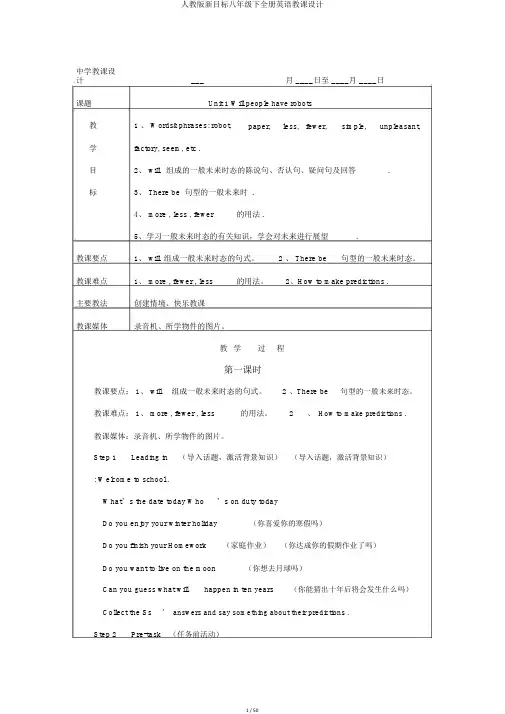
中学教课设计___ 月 ____日至 ____月 ____日课题Unit 1 Will people have robots教 1 、 Words&phrases: robot, paper, less, fewer, simple, unpleasant, 学factory, seem, etc .目2、 will 组成的一般未来时态的陈说句、否认句、疑问句及回答.标3、 There be 句型的一般未来时 .4、 more , less , fewer 的用法 .5、学习一般未来时态的有关知识,学会对未来进行展望.教课要点1、 will 组成一般未来时态的句式。
2 、 There be 句型的一般未来时态。
教课难点1、 more , fewer , less 的用法。
2、How to make predictions .主要教法创建情境、快乐教课教课媒体录音机、所学物件的图片。
教学过程第一课时教课要点: 1、 will组成一般未来时态的句式。
2 、There be句型的一般未来时态。
教课难点: 1、 more , fewer , less的用法。
2、How to make predictions .教课媒体:录音机、所学物件的图片。
Step 1Leading in(导入话题,激活背景知识)(导入话题,激活背景知识): Welcome to school .What’s the date today Who’s on duty todayDo you enjoy your winter holiday(你喜爱你的寒假吗)Do you finish your Homework(家庭作业)(你达成你的假期作业了吗)Do you want to live on the moon(你想去月球吗)Can you guess what will happen in ten years(你能猜出十年后将会发生什么吗)Collect the Ss’ answers and say something about their predictions .Step 2Pre-task(任务前活动)SB Page 2 ,1a .at the picture :How will the world be different in the future ,100 years from now We’re going to talk about sth in 100 years .each predictions to the class .Explain the new vocabulary .the instructions .Make sure Ss know what they should do .it by themselves .about the answers with the class .Explain :一般未来时态组成 : will / be going to +动词原形=Step 3While-task(任务中活动)SB Page 2 ,1b .reading the six predictions .the instructions to Ss .Circle the things you hear on the recording .the tape twice .(放录音,两次)the tape a third time .At the same time ,check the answers .SB Page 2 , 1c .1、 Pay attention to the dialogues .2、 Read the dialogues fluently .3、 Pairwork .Work in pairs to make predictions according to the sample .4、 Ask several pairs to share their conversations to the class .SB Page 3 , 2a & 2b .1、 Read the predictions .2、 Read the instructions and point out the sample answer .3、 Play the tape twice .Ss circle the word they hear in each sentences: more ,less , fewer .4、 Check the answers .学生研究 : less , fewer的差别。
八年级英语新目标下全册教案
Unit 1: Greetings and IntroductionsTopic: Greetings and IntroductionsAim: To introduce basic greetings and introduce oneselfLanguage Skills: Listening, Speaking, Reading, WritingObjectives:1. Students will be able to greet people in different ways.2. Students will be able to introduce themselves and others.3. Students will be able to ask and answer simple questions about personal information.4. Students will be able to write a short paragraph introducing themselves.Materials:- Teacher’s edition of New Target English 8A textbook- Student edition of New Target English 8A textbook- Audio recordings of greetings and introductions- Whiteboard and markers- Flashcards with vocabulary wordsProcedure:Warm-up Activity:1. Greet the students using different greetings, such as "Good morning," "Hello," and "How are you?" Have the students respond using the appropriate response.2. Write the different greetings on the board and ask students to match them with the correct response.Introduction:1. Show flashcards with pictures of different greetings and elicit their meanings from students.2. Play an audio recording of greetings and have students listen and repeat the greetings.3. Have students practice the greetings in pairs, taking turns greeting each other and responding.Listening Activity:1. Play an audio recording of a dialogue where two people introduce themselves to each other.2. Have students listen and fill in the missing information in the dialogue.3. Check the answers as a class.Speaking Activity:1. Have students work in pairs. One student will be StudentA and the other will be Student B.2. Give each pair a set of flashcards with different greetings and introductions.3. Student A will choose a flashcard and greet Student B using the greeting on the card.4. Student B will respond and introduce themselves using the introduction on the card.5. Students will switch roles and continue until they have used all the flashcards.Reading Activity:1. Distribute the New Target English 8A textbook to each student.2. Instruct students to read the dialogues on pages 10-11.。
八年级英语下册全册教案人教版新目标
八年级英语下册全册教案人教版新目标第一章:Unit 1 Could you please clean your room?1.1 教学目标知识目标:能听懂、会说、会读本单元的关键词汇和句型。
能运用情态动词could 提出请求并做出回应。
技能目标:能够运用本单元的句型和词汇进行日常交流。
能够正确使用情态动词could 提出请求并做出回应。
情感目标:培养学生学会尊重他人,关心家庭。
1.2 教学内容课文内容:学习课文,理解课文大意。
模仿朗读,提高口语表达能力。
词汇学习:学习本单元的关键词汇,如"tidy up"、"clean"、"make" 等。
学生通过小组活动,互相练习词汇的使用。
句型练习:学习本单元的句型"Could you please do sth?" 和"Yes, I could."、"No, I couldn't."。
学生通过角色扮演,运用句型进行实际交流。
1.3 教学步骤Step 1:热身活动(5分钟)教师与学生进行简单的对话,询问学生周末的安排。
学生用"I will" 或"I'm going to" 表达自己的计划。
Step 2:新课导入(10分钟)教师展示课文图片,引导学生预测课文内容。
学生听课文录音,跟读并模仿语音语调。
Step 3:词汇学习(10分钟)教师引导学生学习本单元的关键词汇,并用例句展示用法。
学生通过小组活动,互相练习词汇的使用。
Step 4:句型练习(10分钟)教师引导学生学习本单元的句型,并用例句展示用法。
学生通过角色扮演,运用句型进行实际交流。
Step 5:巩固练习(10分钟)教师设计练习题,学生分组进行比赛,巩固本节课所学内容。
Step 6:课堂小结(5分钟)学生提问,教师解答。
Step 7:作业布置(5分钟)教师布置作业,要求学生复习本节课的内容,并练习使用新学的词汇和句型。
新目标八年级英语下全册教案
教案一Teaching goals:2.To practice listening, speaking, reading and writing skills through various activities.Teaching key points:2. The formation and usage of the simple present tense.3. Using the interrogative form to ask for personal information.Teaching difficult points:1. Correctly using the simple present tense.2. Understanding and using the interrogative form in sentences.Teaching procedures:Step 1: Warm-up1. Greet the students and have a short conversation with them using questions like "How are you today? What's your name? How old are you?"2. Ask students to work in pairs and talk about their favorite subjects in school for a few minutes.Step 2: Presentation1. Show some pictures of people doing different activities and ask students to guess what they are doing.2. Introduce the key vocabulary and phrases related to the activities in the pictures. Write them on the blackboard and ask students to repeat after you.3. Present the formation and usage of the simple present tense. Write some example sentences on the blackboard and explain the rules.Step 3: Practice1. Play an audio recording of the conversations in Unit 1. Ask students to listen and write down the missing information.2. Provide students with a worksheet containing a dialogue between two people. Ask them to fill in the blanks with the correct form of the verb in the simple present tense.3. Divide the class into pairs and ask them to practice asking and answering questions with their partners using the simple present tense.Step 4: Listening and speaking1. Play an audio recording of a conversation between a student and a teacher. Ask students to listen and answer the questions related to the conversation.2. Provide students with another worksheet containing a dialogue between a student and a teacher. Ask them to work in pairs, taking turns playing the roles of the student and the teacher and practice the conversation.Step 5: Reading and writing2. Provide students with a writing task. Ask them to write a short paragraph about themselves using the simple present tense.Step 6: Summary and homework1. Review the new words, key phrases and grammar points.2. Assign homework: Ask students to write a conversation between two people, asking and answering questions about their personal information.教案二Teaching goals:2.To practice listening, speaking, reading and writingskills through various activities.Teaching key points:2. Describing family members using possessive adjectives.3. Using the correct form of "be" verb to describe family members.Teaching difficult points:1. Understanding and using possessive adjectives correctly.2. Using the correct form of "be" verb when describing family members.Teaching procedures:Step 1: Warm-up1. Greet the students and ask them about their family members. For example, "How many people are there in your family? Do you have any brothers or sisters?"Step 2: Presentation1. Show pictures of family members and introduce the key vocabulary and phrases related to family members. Write them on the blackboard and ask students to repeat after you.2. Teach students how to use possessive adjectives to describe family members. Write some example sentences on the blackboard and explain the rules.Step 3: Practice1. Play an audio recording of the conversations in Unit2. Ask students to listen and fill in the missing information.2. Provide students with a worksheet containing a conversation about a family. Ask them to read the conversation and fill in the blanks with the correct form of the verb "be" and the correct possessive adjective.3. Divide the class into small groups and ask them to createa dialogue about their own family using the vocabulary and grammar they have learned.Step 4: Listening and speaking1. Play an audio recording of a conversation between two friends talking about their family members. Ask students to listen and answer the questions related to the conversation.2. Provide students with another worksheet containing a dialogue. Ask them to work in pairs, taking turns playing the roles of the friends and practice the conversation.Step 5: Reading and writing2. Provide students with a writing task. Ask them to write a short paragraph about their family members using possessive adjectives and the correct form of the verb "be".Step 6: Summary and homework1. Review the new words, key phrases and grammar points.2. Assign homework: Ask students to write a description of their family members, using possessive adjectives and thecorrect form of the verb "be".。
八年级英语下册全册学案(人教版)
八年级英语下册全册学案(人教版)篇一:人教版新目标八年级英语下册全教案(2014)教学目标:1语言目标:描述健康问题的词汇,及如何根据别人的健康问题提建议。
2 技能目标:能听懂谈论健康问题的对话材料;能根据别人的健康问题提建议;能写出重点单词和重点句型,并能描述怎样对待健康问题。
3 情感目标:通过开展扮演病人等活动,培养学生关心他人身体健康的品质。
通过本课的阅读,培养学生处理紧急事件的基本能力,树立紧急事件时互相帮助的精神。
教学重点:短语: have a stomachache, have a cold, lie down, take one’s temperature,go to a doctor, get off, to one’s surprise, agree to do sth., get into trouble,fall down, be used to, run out (of), cut off , get out of, be in control of ,keep on (doing sth.), give up句子: 1 What’s the matter? I have a stomachache. Youshouldn’t eat so much next time. 2 What’s the matter with Ben?He hurt himself. He has a sore back.He should lie down and rest.3 Do you have a fever? Yes, I do. No, I don’t. I don’t know.4 Does he have a toothache? Yes, he does.He should see a dentist and get an X-ray.5 What should she do? She should take her temperature.6 Should I put some medicine on it? Yes, you should No, you shouldn’t.教学难点:掌握情态动词should \shouldn’t. 的用法;学习have的用法。