
高考英语语法 虚拟语气详解 练习精讲
虚拟语气陈述语气:表示动作或状态是现实的、确定的或符合事实的,用于陈述句、疑问句和某些感叹句。
如:0-0There are two sides to every question./ 0-1Were you busy all day yesterday?祈使语气:表示说话人对对方的请求或命令。
如:0-2Never be late again!/ 0-3Don’t forget to turn off the light.虚拟语气:表示动作或状态不是客观存在的事实,而是说话人的主观愿望、假设或推测等。
如:0-4If I were a bird, I could fly in the air.一真实条件与非现实条件真实条件表示现实情况中可能实现的情况而非真实条件表示与现实情况相反的假想。
1-1 If the working conditions are not too bad, I will accept the job.如果工作条件不太差,我会接受这项工作。
(真实条件)1-2 If the working conditions were not too bad, I would accept the job.如果工作条件不太差,我就接受这项工作了。
(非真实条件)(事实是The working conditions are too bad,、I won't accept the job)1-3 He said if he failed, he would have another try.他说他如果失败,他还会再试一次。
(真实条件)1-4 If he had failed, he would have had another try.如果他失败的话,他会再试一次的。
(非真实条件)(事实是He didn't fail and he didn't have another try.)二非真实条件句would所代替。
2.2 混合虚拟结构2.2.1不同时间的虚拟If he had listened to me, he would not be in trouble now.(从句与过去事实相反,主句与现在事实相反)If he had told me yesterday, I should know what to do now. (从句与过去事实相反,主句与现在事实相反)If I were you, I would have gone to her birthday party. (从句与现在事实相反,主句与过去事实相反)2.2.2 虚拟与陈述的混合He could have passed the exam, but he wasn’t careful enough.You should have come earlier. The bus left a moment ago.例题解析:The tree looked as if it ______ for a long time.A. hasn't wateredB. didn't waterC. hadn't bee wateredD. wasn't watered那棵树看上去好象很久没人给浇水了。
(答案是c)三含蓄条件句非真实条件句中的条件从句不出现if,假想条件只暗含在上下文中,这种句子叫做含蓄条件句。
What would I have done without you? 如没有你,我会怎么办呢?(条件暗含在分词短语without you中)It would be easier to do it this way. 这样做会比较容易。
(条件暗含在不定式短语to do it this way中)I would appreciate a little of your time. 谢谢你给我一点时间吧。
(可能暗含if you were so kind as to give me a little of yourtime)3.1 without/but for/in the absence of 表示“要不是”,“如果没有”(相当于if it were not for)表示条件时,句中一般用虚拟语气。
(也可用陈述语气)Without your help, I couldn' t finish my work on time.In the absence of water and air, nothing could live.But for your assistance, we could not accomplish it.要不是你的帮忙,我们是难有成就的。
3.2句中含有or, or else, otherwise, but等词语,暗示句子的某一部分(前句或后句)需用虚拟语气。
He was on business in Beijing at that ti me; otherwise he might have helped us。
Luckily Mary telephoned to inform me of the meeting, or would have been I absent。
I should have attended my friend’s wed ding ceremony, but I couldn’t afford the time。
四非真实条件句倒装省略连词if。
在书面语中,如果虚拟条件从句中有were,had 或should,可以把if省略,把这几个词放到主语之前,构成主谓倒装。
If he had seen you yesterday,he would have asked you about it. →Had he seen you yesterday,he would have asked you about it. If I were you,I would do it at once. →Were I you,I would do it at once.Should he come (If he should come), tell him to ring me up.Were I you (If I were you), I would not do it. 我要是你,就不做这事。
Had he had lunch (If he had had lunch), he would not have eaten so many cookies.五宾语从句中的虚拟语气5.1下列动词后的宾语从句中insist(坚持),urge (催促),order(命令),command(命令),request(请求,要求),demand(要求),require(要求,需要)suggest(建议),advise(建议),propose(建议) , recommend(建议,推荐) 用(should ) +动词原形He suggested that we (should) save money for the future.The undergraduate insisted that he (should) go to work in the south.注意:当suggest表示暗示,insist表示坚持观点,事实时,后接的宾语从句应当用真实语气。
His silence suggested that he agreed with my decision.He insists that doing morning exercises does well to people’s health.例题详解:(1) “Shall I come tomorrow?” “I’d rather you _________.”A. won’tB. didn’tC. don’tD. wouldn’t(2) “I’ve told him about it.” “But I’d rather you _________.”A. didn’tB. hadn’tC. don’tD. wouldn’t(3) “He will take you as well.” “But I’d rather he _________.”A. won’tB. didn’tC. doesn’tD. wouldn’tB5.2 wish后接that宾语从句表示一种假想情况,实现可能性较小5.2.1对现在情况的虚拟,假想的情况与主句主语的愿望同时发生:宾语从句动词用过去式,谓语be用were。
例:I wish I knew the answer to the question.我希望知道这个答案。
(事实上是不知道)I wish it were spring in my hometown all the year around. 但愿我的家乡四季如春。
(事实上不可能)Now that he is in China, he wishes he understood Chinese.(wishes,过去虚拟动词understood)现在他在中国,他希望能懂得中文。
(事实上并不懂)5.2.2假想的情况在主句主语愿望前发生:宾语从句的谓语用过去完成时,例:I wish I hadn't wasted so much time.我后悔不该浪费这么多时间。
(事实上已浪费了)He wishes he hadn't lost the chance.他真希望没有失去机会。
(其实已失去)We wished he had spoken to us. (事实上他并没同我们讲)例题分析:I wish I ______ longer this morning, but I had to get up and come to class.A. could have sleptB. sleptC. might have sleptD. have slept动词wish后面接从句,表达不可能实现或与事实相反的情况时,谓语动词要用虚拟语气,即用过去式(表示现在发生的动作)或过去完成式(表示过去发生的动作)。
本题后半句谓语动词have用的是过去时had to get up and come, 所以前面要用过去完成时表示过去发生的动作。
所以, 选项A)could have slept是答案5.2.3假想的情况在主句主语愿望之后发生:从句谓语动词用would+原形动词I wish it would stop raining. 我希望雨能停止I wish you would be quiet. 我希望你安静一些。
高考英语复习语法知识专题讲解10---虚拟语气(解析版)
引导的让步和方式状语从 as if/though
He looks as if he were an artist.
句
He talked about the accident as if he had seen it.
in order that, so that, in case, for fear that
提前,即 故填 were/should/had
Were/Should/Had I..., Were
4. have fallen 解析:句意:要是没有政府和科学家的合作,与艾滋病相关的死亡人数就不会从 2005 年的 最高值降下来。从句“Had...not worked together”是对过去情况的假设,所以主句谓语要用 wouldn't have done.
necessary, natural, strange, important,
等 用 于 句 型 surprising, vital
“It
中, 引导的主语从 is+adj.+that...” that
句中谓语动词常用“(should)do”形式
It is necessary that he(should)sort out the information for my reference.
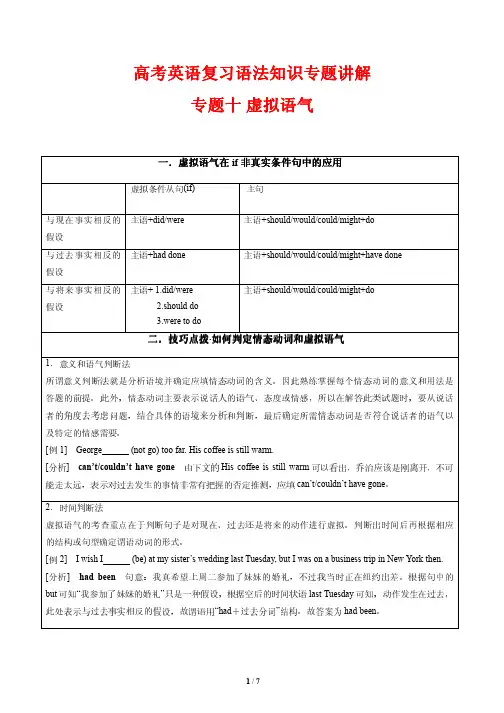
高考英语复习语法知识专题讲解 专题十 虚拟语气
一.虚拟语气在 if 非真实条件句中的应用
虚拟条件从句(if)
主句
与现在事实相反的 主语+did/were
假设
与过去事实相反的 主语+had done
假设
与将来事实相反的 主语+ 1.did/were
假设
2.should do
英语语法专项:虚拟语气用法详解及练习(附答案)
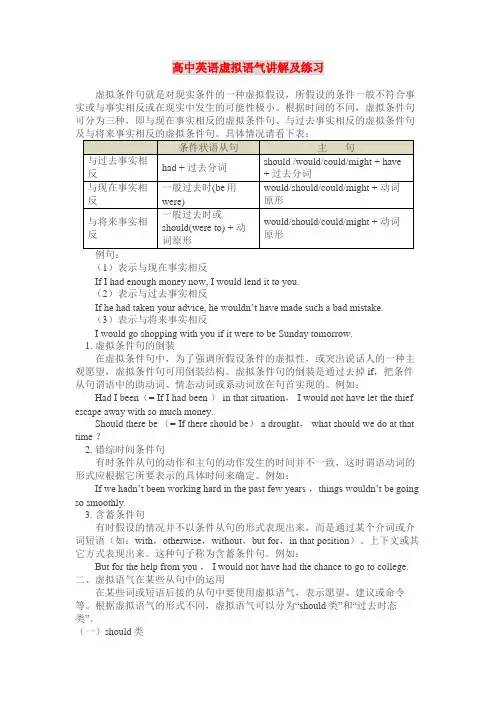
高中英语虚拟语气讲解及练习虚拟条件句就是对现实条件的一种虚拟假设,所假设的条件一般不符合事实或与事实相反或在现实中发生的可能性极小。
根据时间的不同,虚拟条件句可分为三种,即与现在事实相反的虚拟条件句、与过去事实相反的虚拟条件句(1)表示与现在事实相反If I had enough money now, I would lend it to you.(2)表示与过去事实相反If he had taken your advice, he wouldn’t have made such a bad mistake.(3)表示与将来事实相反I would go shopping with you if it were to be Sunday tomorrow.1. 虚拟条件句的倒装在虚拟条件句中,为了强调所假设条件的虚拟性,或突出说话人的一种主观愿望,虚拟条件句可用倒装结构。
虚拟条件句的倒装是通过去掉if,把条件从句谓语中的助动词、情态动词或系动词放在句首实现的。
例如:Had I been(= If I had been ) in that situation, I would not have let the thief escape away with so much money.Should there be (= If there should be) a drought, what should we do at that time ?2. 错综时间条件句有时条件从句的动作和主句的动作发生的时间并不一致,这时谓语动词的形式应根据它所要表示的具体时间来确定。
例如:If we hadn’t been working hard in the past few years ,thing s wouldn’t be going so smoothly.3. 含蓄条件句有时假设的情况并不以条件从句的形式表现出来,而是通过某个介词或介词短语(如:with,otherwise,without,but for,in that position)、上下文或其它方式表现出来。
高考英语(第八讲 情态动词和虚拟语气)语法精讲精练 学生版
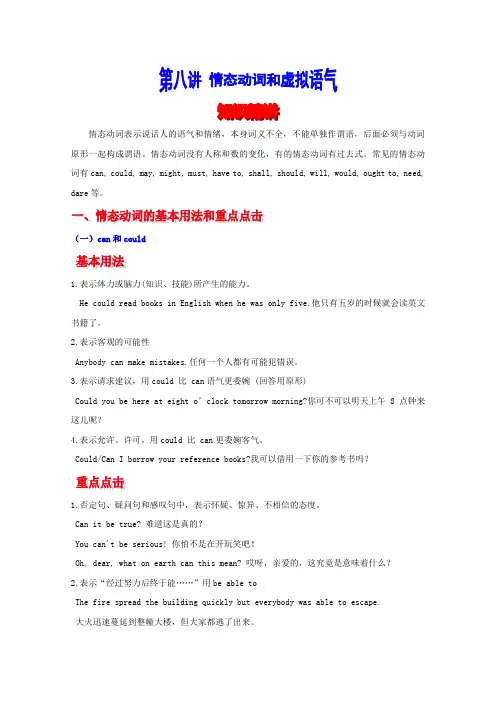
情态动词表示说话人的语气和情绪,本身词义不全,不能单独作谓语,后面必须与动词原形一起构成谓语。
情态动词没有人称和数的变化,有的情态动词有过去式。
常见的情态动词有can, could, may, might, must, have to, shall, should, will, would, ought to, need, dare等。
(一)can和could1.表示体力或脑力(知识、技能)所产生的能力。
He could read books in English when he was only five.他只有五岁的时候就会读英文书籍了。
2.表示客观的可能性Anybody can make mistakes.任何一个人都有可能犯错误。
3.表示请求建议,用could 比 can语气更委婉 (回答用原形)Could you be here at eight o’clock tomorrow morning?你可不可以明天上午8点钟来这儿呢?4.表示允许、许可,用could 比 can更委婉客气。
Could/Can I borrow your reference books?我可以借用一下你的参考书吗?1.否定句、疑问句和感叹句中,表示怀疑、惊异、不相信的态度。
Can it be true? 难道这是真的?You can't be serious! 你怕不是在开玩笑吧!Oh, dear, what on earth can this mean? 哎呀,亲爱的,这究竟是意味着什么?2.表示“经过努力后终于能……”用be able toThe fire spread the building quickly but everybody was able to escape.大火迅速蔓延到整幢大楼,但大家都逃了出来。
注意:be able to比can有更多的形式变化When he grows up, he will be able to support his family.他长大后就能养家了。
2025届高考英语虚拟语气知识点总结+课件
Homework
1. 完成高考汇编关于虚拟语气的练习题; 2. 用虚拟语气完成小诗。小诗的首句已给出。
If I were a bird, I would fly into the sky. ......
Thanks
为什么不用If I am a boy? 为什么不用If I was a boy?
虚拟语气是由句中的谓语动词的特殊形式表示出来的。
动词语气
1、虚拟语气:虚拟语气表示说话人的主观愿望、猜疑、建议或与事实不符 的假设等,而不表示客观存在的事实。 2、虚拟语气是由句中的谓语动词的特殊形式表示出来的。
你会辨认虚拟语气了吗?
对现在的虚拟条件从句
If there were no subjunctive(虚拟语气), English would be much easier.
从句
主句
If + 主语 + 过去式(were),主语 + should/would/could/might + 动词原形
来练一练
1. If there ____w__e_r_e____ (be) no air or water,there ____w_o_u__ld__b_e_____no living things on the earth.
如果我是个男孩 我想我能够明白 爱一个女孩是什么样的滋味 我发誓我会是一个好男人 我会倾听她, 因为我了解
When you loose the one you wanted 失去了你爱的人那有多痛苦
Cause he’s taken you for granted
因为他把你视作理所当然
And everything you had got destroyed! 你的一切都被毁
高中英语 虚拟语气讲解及练习(有答案)
高中英语虚拟语气讲解及练习虚拟条件句就是对现实条件的一种虚拟假设,所假设的条件一般不符合事实或与事实相反或在现实中发生的可能性极小。
根据时间的不同,虚拟条件句可分为三种,即与现在事实相反的虚拟条件句、与过去事实相反的虚拟条件句(1)表示与现在事实相反If I had enough money now, I would lend it to you.(2)表示与过去事实相反If he had taken your advice, he wouldn’t have made such a bad mistake.(3)表示与将来事实相反I would go shopping with you if it were to be Sunday tomorrow.1. 虚拟条件句的倒装在虚拟条件句中,为了强调所假设条件的虚拟性,或突出说话人的一种主观愿望,虚拟条件句可用倒装结构。
虚拟条件句的倒装是通过去掉if,把条件从句谓语中的助动词、情态动词或系动词放在句首实现的。
例如:Had I been(= If I had been ) in that situation, I would not have let the thief escape away with so much money.Should there be (= If there should be) a drought, what should we do at that time ?2. 错综时间条件句有时条件从句的动作和主句的动作发生的时间并不一致,这时谓语动词的形式应根据它所要表示的具体时间来确定。
例如:If we hadn’t been working hard in the past few years ,thing s wouldn’t be going so smoothly.3. 含蓄条件句有时假设的情况并不以条件从句的形式表现出来,而是通过某个介词或介词短语(如:with,otherwise,without,but for,in that position)、上下文或其它方式表现出来。
高考英语语法-虚拟语气详解-练习精讲
虚拟语气陈述语气:表示动作或状态是现实的、确定的或符合事实的,用于陈述句、疑问句和某些感叹句。
如:0-0There are twosid es to everyquestion./ 0-1Were youbusy all dayyesterday?祈使语气:表示说话人对对方的请求或命令。
如:0-2Never belateagain!/ 0-3Don’t forgetto turn off the light.虚拟语气:表示动作或状态不是客观存在的事实,而是说话人的主观愿望、假设或推测等。
如:0-4If I were abird,Icouldfly in theair.一真实条件与非现实条件真实条件表示现实情况中可能实现的情况而非真实条件表示与现实情况相反的假想。
1-1 Ifthe working conditionsare not too bad, I will accept the job.如果工作条件不太差,我会接受这项工作。
(真实条件)1-2 If the working conditions were nottoo bad, Iwould accept the job.如果工作条件不太差,我就接受这项工作了。
(非真实条件)(事实是The working conditions are too bad,、I won't accept the job)1-3He said ifhe failed, he would have another try.他说他如果失败,他还会再试一次。
(真实条件)1-4 Ifhe had failed,hewould have hadanother try.如果他失败的话,他会再试一次的。
(非真实条件)(事实是Hedidn't failand he didn'thave another try.)二非真实条件句被would所代替。
2.2 混合虚拟结构2.2.1不同时间的虚拟If he had listenedto me,he would not be in trouble now.(从句与过去事实相反,主句与现在事实相反)If he hadtoldme yesterday, I should know what to do now.(从句与过去事实相反,主句与现在事实相反)IfI were you,I would have gone toher birthdayparty.(从句与现在事实相反,主句与过去事实相反) 2.2.2虚拟与陈述的混合He could have passed the exam, but he wasn’t carefulenough.You should have come earlier.The busleft amoment ago.例题解析:Thetree looked asif it ______for a long time.A. hasn't watered B. didn't waterC. hadn't bee wateredﻩD.wasn't watered那棵树看上去好象很久没人给浇水了。
高中虚拟语气练习题及讲解
高中虚拟语气练习题及讲解1. 题目:假如你昨天没有忘记带手机,你就不会错过那个重要的电话。
答案:If you hadn't forgotten to bring your phone yesterday, you wouldn't have missed that important call.2. 题目:如果他没有生病,他就会参加我们的聚会。
答案:If he hadn't fallen ill, he would have joined our party.3. 题目:如果我有足够的钱,我就会买下那栋房子。
答案:If I had enough money, I would buy that house.4. 题目:如果她没有迟到,她就不会错过那趟火车。
答案:If she hadn't been late, she wouldn't have missedthe train.5. 题目:如果他们没有取消会议,我们就会讨论这个问题。
答案:If they hadn't canceled the meeting, we would have discussed this issue.6. 题目:假如我们昨天没有下雨,我们就去野餐了。
答案:If it hadn't rained yesterday, we would have gonefor a picnic.7. 题目:如果他没有努力学习,他就不会通过考试。
答案:If he hadn't studied hard, he wouldn't have passedthe exam.8. 题目:如果我没有收到你的邮件,我就不会知道这个消息。
答案:If I hadn't received your email, I wouldn't have known the news.9. 题目:假如我们提前出发,我们就不会迟到。
8.最新版高考英语语法——虚拟语气详解讲义和习题
一.语气英语中的三种语气, 语气是动词的一种形式, 用来说明我们对自己的话所采取的态度。
1.陈述语气(疑问, 否定, 肯定, 感叹)2.祈使语气(命令, 要求, 建议, 警告)3.虚拟语气:不可能发生的事, 愿望, 建议, 与事实相反的假设等.He is a boy. Is he a boy?Don’t forget he is a boy.If I were a boy, I would cry loudly.二.If引导的虚拟条件句1.If 的省略:可以把虚拟条件中的连词if省去, 而将had, should, were等助动词提到主语之前。
If she were younger, she, would do it. 去if:Were she younger, she would do it.If you had come earlier, you would have met him. 去if: Had you come earlier, you would have met him.If it should rain tomorrow, we would not go climbing. 去if: Should it rain tomorrow, we would not go climbing. 2.If 的错综时间条件句:主从句时间不一致的情况下的虚拟语气: 动作的形式应和它所表示的时间一致.If you had attended the lecture yesterday, yo u’d know how to do it now.If I had studied hard before, I would be in Peking University now.If he had not been eaten by the wolf then , he should be 8 years old now.3. If 的转化:含蓄条件句:有时虚拟条件句并没用if从句表示出来, 而是用介词短语(otherwise, or, without(“若不是”“要不是”), but for(“要不是......”))上下文或其他方式来表示。
2025届高考英语语法复习虚拟语气知识讲解讲义
高考英语语法复习虚拟语气知识讲解一、基础知识(一)什么是虚拟语气谓语动词的作用不仅可以表示动作的时间、状态、假设(情感),也是一种语气(mood)的表现形式,表明说话的目的和意图。
(语气包含陈述语气、祈使语气、虚拟语气、疑问语气)虚拟语气用于表示假设、愿望、建议、命令等非真实或虚拟的情况,即与真实相反。
上学的时候老师经常举的一个例子,"If I were you"因为我不可能是你,这是一种不可能存在的事实,所以这是个虚拟语句。
总而言之英语中的虚拟语气可以分为两大体系:一是表示与事实相反的,或者是假象的情形,通常由if引导,叫做虚拟条件句;另一个体系是在名词从句中使用虚拟语气,表示建议,命令或者要求等语气,类似于上述美剧常用的台词。
(二)虚拟语气的用法这一部分我们主要用虚拟语气在条件句中的用法作为讲解不同情况条件从句谓语主句谓语使用场景与过去事实相反If+主语+haddone主语+should/would/could/might+have done既然是过去了,那么谈到的一切情况都已既成事实,所以过去虚拟表达的是一个与过去事实相反的情形与现在事实相反If+主语+did(be动词用were)主语+should/would/could/might+do既可能是事实,也可能是假设条件。
因此,假设条件句和事实相反句适用于谈现在的情况与将来事实相反If+主语+ did(be动词用were)If+主语+ wereto + doIf+主语+should+ do主语+should/would/could/might+do对于将来时间的虚拟不可能以事实为基础,而只能是表达说话人的一个设想或愿望。
所以,对于将来的虚拟只适用于假设条件句,而不可能表达一个与事实相反的虚拟与现在事实相反:If I had a map, I would lend it to you.如果我有地图我就借给你。
(但我没有)与将来事实相反:If I were to do the job, I would do it in a different way. 要是我来做这工作,我会是另一种做法。
虚拟语气详细讲解及经典习题 附答案
虚拟语气一、考点聚焦1、虚拟语气用于条件状语从句中(1)表示与现在事实相反的假设,条件状语从句中的谓语动词用“过去式(be动词的过去式用were)”,而主句中的谓语动词用“would / should/ could / might + 动词原形”。
如:If I were a boy, I would join the army.If the had time, she should go with you.(2)表示与过去的事实相反,条件状语从句中的谓语动词用过去完成时,主句中的谓语动词则用“would / should / might / could + have +过去分词”。
如:If he had taken my advice, he would have succeeded in the competition.(3)表示与将来事实相反,条件状语从句中的谓语动词一般过去时或should(were to) + 动词原形,而主句中的谓语动词则用would / should/could might + 动词原形。
如;If it were to rain tomorrow, the football match would be put off.(4)当条件状语从句表示的行为和主句表示的行为所发生的时间不一致时,动词的形式要根据它所表示的时间作相应调整。
如:If they had worked hard, they would be very tired.(从句说的是过去,主句指的是现在)Were I a boy, I would join the army.Had he taken my advice, he would have succeeded.Were it not for the expense, I would go to Britain.2、虚拟语气用于名词性从句(1)虚拟语气在宾语从句中的运用。