
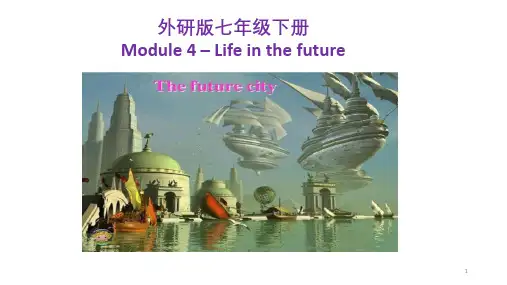
外研版七年级英语下册课件Module 4 Life in the future
2
Ms Li: Do you often think about the future? What will change
in 20 years? Will our lives be different? The weather? Our clothes? Our school? Lingling: Yes, everything will be different. We'll use computers, and they‟ll be very small and 1ight And we only need
1
Listening and vocabulary
Work in pairs. Look at the picture and describe it. Use the words in the box to help you. blackboard computer chalk email
eraser
paper pencil telephone
Internet
pee Lingling’s answers to the questions . carry change everything future life need will
1.Will our life be different in the future?
one book to carry to school!
Ms Li: Oh, good. Anybody else?!
3
Listen and read.
Ms Li:Will schools be different in the future,Daming?
Daming:Yes,they will! In twenty years‟ time❶, maybe❷ there won‟t be any schools! Ms Li:How will students learn then? Daming:Everyone will study at home . Students will use computers and get information on the Internet . They can ask❸ their teachers questions by❹ Internet,telephone or email .
Betty:Well,I‟m not sure . Yes,students will use 魔法 记忆 computers,but school is good fun,and you can make friends there . And teachers can check the students‟ level and will help them . Computers won‟t be able❺ to do that . Tony:Yes . Teachers won‟t use chalk on a blackboard and students won‟t use pens and paper,or erasers any more❻! Lingling:Great!Will students have a lot of homework to do? Tony:No,they won‟t. They‟ll have a lot of free❼time! Daming:That‟ll be great!
Everyday English 魔法 · Well,I‟m not sure . 记忆 · That‟ll be great! Now check(√)the students‟ ideas about the future . Ideas Daming Betty Tony Everyone will study at home in √ the future . Students will talk to their teachers √ on the Internet . School is good fun and you can √ make friends there . No one will use pens,paper or √ erasers .
Module 4 Life in the future
Unit 1 Everyone will study at home.
Compare the two pictures and imagine what our schools will be like in the future.
now
in the future
记忆 Yes,it will . /No,it won‟t .
Yes,it will. 4.Will students need computers at school? Yes,they will . /No,they won‟t . Yes,they will. 5.Will they carry lots of books to school? Yes,they will . /No,they won‟t . No,they won't.
Yes,it will . /No,it won‟t . Yes,it will. 2.Will our schools change? Yes,they will . /No,they won‟t . Yes,they will.
3. Will everything be different? 魔法
讲解来自《点拨》
知识点 1
in twenty years‟ time 20年后
考向一【重点】 twenty years‟ time也可以说成twenty years,此时后面不加time。“in+一段时间” 表示“一段时间之后”,常用在一般将来时中, 用how soon来提问。 eg:(山西中考)I will finish the poster for the party in two days . 两天后我将完成聚会用的海报。
合集下载
外研版七年级下Moduel 4 Life in the future课件

take a trip
(去旅行)
What will you do ? this weekend? take a trip. I will _______
go to the cinema
What will you do this evening?
I will go to the cinema.
What will you do?
Exercises
请根据句意选择正确的选项填空。
1. We’ll C ___ for you outside the school gate. A. waits B. waiting C. wait 2. Each of the students will ___ A a computer on their desk. A. have B. has C. having
Example
Everyone uses_______ to learn science.
Example
A few use_________ to lea______ to learn science.
A: Will it be small or big? B: It will be small.
Paragraph A Transport
Paragraph E Technology
Paragraph B Climate
Paragraph C Home
Paragraph D Jobs
一般将来时:will 如果表示的不是打算,意图或计划,而 是未来的事实或对将来的预测等,就要 用“will+动词原形”来表达。
this evening clean my room
What …? will you do this evening?
七年级英语下册-Module-4-Life-in-the-futureppt课件-(新版)外研版

4
模块语法聚焦四
4.标志性时间状语 (1)tomorrow ,tomorrow morning/afternoon/evening, the day after tomorrow等。 (2)next week/month/year/weekend/Saturday/summer等。 (3)in+一段时间(在…… 以后) (4)in the future (在将来), from now on (从今往后)等。 5 .will+动词原形和be going to 的区别 (1)“shall/will+动词原形”表示未事先考虑过,即表示说话时临 时做出的决定。
There _____won___'t__b_e_____ a table tennis match in our school
this afternoon.
13
模块语法聚焦四
3 .There will be a big school here next year. (改为一般疑问句,
并作肯定、否定回答)
19
模块主题写作四
思路点拨
引出话题 What do you think life in the future will be like?
具体描述
In the future there will be… Robots can help us do some things…
总结
Life in the future will be…
playground tomorrow. 5 .Tom often_g_o_e_s____ (go) to school on foot. But tomorrow
h il_l_ o_____ (go) to school by bike.
模块语法聚焦四
4.标志性时间状语 (1)tomorrow ,tomorrow morning/afternoon/evening, the day after tomorrow等。 (2)next week/month/year/weekend/Saturday/summer等。 (3)in+一段时间(在…… 以后) (4)in the future (在将来), from now on (从今往后)等。 5 .will+动词原形和be going to 的区别 (1)“shall/will+动词原形”表示未事先考虑过,即表示说话时临 时做出的决定。
There _____won___'t__b_e_____ a table tennis match in our school
this afternoon.
13
模块语法聚焦四
3 .There will be a big school here next year. (改为一般疑问句,
并作肯定、否定回答)
19
模块主题写作四
思路点拨
引出话题 What do you think life in the future will be like?
具体描述
In the future there will be… Robots can help us do some things…
总结
Life in the future will be…
playground tomorrow. 5 .Tom often_g_o_e_s____ (go) to school on foot. But tomorrow
h il_l_ o_____ (go) to school by bike.
外研版七年级下册 Unit 4 Life in the future PPT课件
9
语法讲解: 一般将来时 will+动词原形
思考如何翻译?
将来每个桌子上都会有一台电脑。
There will be a computer on every desk in the future.
将来每个桌子上不会有一台电脑。
There will not be a computer on every desk in the future.
A. is
B. is going to have
C. will have D. is going to be
5. ---Mom, when can I go out to play football?
---Finish your homework first, or I ___C_____let you go out.
D. is going to be
(2). Look at the dark clouds. It _________D_______ rain.
A. will
B. is going to be C. will be D. is going to
14
语法讲解: 一般将来时 will +动词原形
4. be going to+动词原形和 will+动词原形的辨析: (1). 纯粹的将来的客观事实,不表明计划打算,用will+动词原形。 (2). 有迹象表明将会发生某事,用be going to+动词原形。
20
词汇讲解 need: v. 需要 need sth: 需要某物 e.g. I need some money to buy snacks. need to do sth: 需要做某事 e.g. I need do my homework right now.
语法讲解: 一般将来时 will+动词原形
思考如何翻译?
将来每个桌子上都会有一台电脑。
There will be a computer on every desk in the future.
将来每个桌子上不会有一台电脑。
There will not be a computer on every desk in the future.
A. is
B. is going to have
C. will have D. is going to be
5. ---Mom, when can I go out to play football?
---Finish your homework first, or I ___C_____let you go out.
D. is going to be
(2). Look at the dark clouds. It _________D_______ rain.
A. will
B. is going to be C. will be D. is going to
14
语法讲解: 一般将来时 will +动词原形
4. be going to+动词原形和 will+动词原形的辨析: (1). 纯粹的将来的客观事实,不表明计划打算,用will+动词原形。 (2). 有迹象表明将会发生某事,用be going to+动词原形。
20
词汇讲解 need: v. 需要 need sth: 需要某物 e.g. I need some money to buy snacks. need to do sth: 需要做某事 e.g. I need do my homework right now.
Module 4《Life in the future》课件3(24页)(外研版七

1.Planes will be very large so flying will be very cheap.
2. It will be hot all year so the winter will be very short.
3. Coputers will be very small so they’ll be very light.
P23. 6
1.Planes will take a lot of people. 2.Summer will be short and cool. 3.It will be cheap to heat our homes. 4.Machines will do interesting jobs.
In the future, large machines will do all the difficult jobs.
Planes will be very large so flying will be very cheap.
Fuel will be expensive.
Everyone will have a small car.
The North Pole
bad weather
heavy rain
strong wind
use the sun t be very small, so they’ll be very light.
Machines will do the dull jobs No one will do heavy work.
Unit 2
comfortable uncomfortable
dull
interesting
cheap
Module 4 Life in the future课件 外研版英语七年级下册
v. carries — carrying
future
life need will (won’t)
v. needn’t don’t / doesn’t need
1目. W标i语ll o言ur运lif用e b:e different in the future? Yes, it will. / No, it won’t.
(进行提问)
They will not / won’t go camping this summer holiday.(变成一般疑问句)
Will they go camping this summer holiday ? (肯,否定回答)
Yes, they will. / No, they won’t.
What will he do ?
We will ccoollleeccttlitltiettrer in the park this Friday. (变成否定句)
(进行提问)
We will not / won’t collect litter in the park this Friday. (变成一般疑问句)
Daming
Everyone will study at home in the future.
√
Students will talk to their teachers on the Internet.
√
School is good fun and you can make friends there.
例句1: It is going to be a fantastic weekend. = It will be a fantastic weekend.
外研版七年级英语下册Module 4 Life in the future精品课件

2. –________ you ____D____ free tomorrow?
– No. I ________ free the day after tomorrow.
A. Are; going to; will B. Are; going to be; will
C. Are; going to; will be D. Are; going to be; will be
一般将来时的构成
一般将来时表示将来发生的动作或存在的状态 助动 词will + 动词原形
肯定式: 主语+will+动词原形+其他组卷网
否定式: 主语+will+not+动词原形+其他. 疑问式: Will+主语+动词原形+其他 简略回答: (肯) Yes,主语+will .
(否) No,主语+will+not .
▪ 11、一个好的教师,是一个懂得心理学和教育学的人。2021/7/292021/7/292021/7/29Jul-2129-Jul-21
▪ 12、要记住,你不仅是教课的教师,也是学生的教育者,生活的导师和道德的引路人。2021/7/292021/7/292021/7/29Thursday, July 29, 2021
Module 4 Life in the future
Unit 1 Everyone will study at home.
一般将来时 will
详见课本P94----95学组卷网
科网
(Simple Future Tense )
一般将来时表示将来某一时刻的动作或状态, 或将来某一段时间内经常的动作或状态。
外研版七年级英语下册 精品课件 Module 4 Life in the future(共110张PPT)
Tony writes a passage about the life in the future. Listen and answer these two questions. 1.What will the clothes be like in the future? 2.Who will do all the heavy and difficult jobs in the future?
句中的 “in + 一段时间”表示“一段时间 之后”,常用于将来时。可以用 how soon 来提问。例如: — How soon will you be back? 你多久回来? — In a week. 一个月之后。
They can ask their teachers questions by Internet, telephone or email. 他们可以通过互联网、电话或电子邮件 向老师提问。 句中的 “by”表示方式,意 思是“用……,靠……,通 过……”。 例如: Send it by air mail. 用航空邮件寄吧。 They want to travel by train. 他们想坐火车旅行。
重难点讲解
¤ Well, I’m not sure. 喔,我不确定。 ¤ That’ll be great! 那太棒了!
more 是形容词 many 和 much “多的” 的比较级。意为“更多的”,即: many — more 多的 更多的
much — more 多的 更多的
如: many books — more books much milk — more milk
Now Tony and his kids are talking about the future in class too. Listen and answer these two questions. 1.Where will students study in the future? 2.Will students have a lot of homework to do in the future?
英语:(外研版七年级下)Module 4 Life in the future全模块课件
Everyone uses_______
to learn science.
Example
A few use_________ to learn science.
Example
No one uses________ to learn science.
Listen and check( √
) the true sentences for Daming and Betty.
2.《新标准》英语采用归纳式语法 . 新标准》英语采用归纳式语法 学习法:呈现 提问---发现 总结, 呈现---提问 发现---总结 学习法 呈现 提问 发现 总结 培 养学生自主学习的能力。 养学生自主学习的能力。一般将来时 作个本学期一个重要的时态在上一个 单元中就已涉及Be +动词 单元中就已涉及Be going to +动词 原形,学生已有一定的概念, 原形,学生已有一定的概念,这只需要 老师很好地设计课堂教学活动作一定 的延伸就可以了。 的延伸就可以了。
五.突破途径
利用多媒体, 让学生在歌声中感受语言, 1. 利用多媒体 让学生在歌声中感受语言, 在轻松愉快的video欣赏中 输入语言。在合作 在轻松愉快的 欣赏中 输入语言。 学习、游戏、竞赛等活动中巩固语言。 学习、游戏、竞赛等活动中巩固语言。 2.整合教材 对教材的内容进行适当的补充、 整合教材, 对教材的内容进行适当的补充、 整合教材 删减、调序。以话题为核心,设计多种任务活 删减、调序。以话题为核心 设计多种任务活 把知识点化难为易。将知识不断滚动、 动,把知识点化难为易。将知识不断滚动、 内化和外延。 内化和外延。
Internet paper pen radio ruler satellite TV
外研版七下Module《Lifeinthefuture》Unit课件
了自主学习和终身学习的能力。学习过程中,对未来生活产生了浓厚的兴趣和好奇心,激发了
他们探究和创新的动力。同时,学生在合作学习中体验到了团队合作
的重要性,建立了良好的人际关系和合作意识。
THANKS
Lesson 2 教学设计
Lesson背景
Future life是外研版七年级下册Module 4 Unit 2的课文,主 要探讨未来生活可能会发生的变化,以及这些变化对人们生 活的影响。
通过对本单元的学习,学生可以了解未来可能出现的各种变 化,并能够就未来生活的主题进行简单的交流和讨论。
Lesson目标
01 02
知识与技能
掌握与未来生活相关的词汇和短语,如:spaceship, robot, hoverboard等;能够运用所学语法知识理解和描述未来可能发生的 变化。
过程与方法
通过小组合作、情境模拟、角色扮演等活动形式,让学生在活动中学 习,培养学生的合作意识和语言运用能力。
03
情感态度与价值观
通过学习本课内容,让学生对未来充满信心和憧憬,同时引导学生正
教师播放课文录音,让 学生听录音并阅读课文 ,理解课文内容;之后 教师引导学生进行对话 练习,通过对话练习让 学生掌握课文中的重点 句型和语法知识。
教师展示一些未来生活 的图片,让学生用所学 知识描述图片中的场景 和事物。
教师组织学生进行小组 讨论,谈论自己心目中 未来生活是什么样子的 ,培养学生的口语表达 能力和合作意识。
02
To help students use the language knowledge and skills to predict the future life.
03
To help students develop their imagination and creativity.
外研版英语课件七下:Module4Lifeinthefutureu1
/'levəl / /'eIbl/
be able to
水平 n. 能够…的 adj. 能够做…
level able
/mɔ:/
更加;更 adv. 更多的 adj.
more
not any more 不再… /fri:/ (时间)空闲的;空余的 adj. free
1 Work in pairs. Look at the picture and describe it. Use the words in the box to help you.
4. Will students need computers at school?
Yes, they will./ No, they won’t. 5. Will they carry lots of books to school?
Yes, they will./ No, they won’t.
1. Will our life be different in the future? Yes, it will./ No, it won’t.
2. Will our schools change? Yes, they will./ No, they won’t.
3. Will everything be different ? Yes, it will./ No, it won’t.
have a party
— What will you do at the weekend? 学科网 — I’ll …组卷网
do the housework have an English lesson
Teaching aims:
1. 掌握本节课的词汇及短语: