
牛津上海版科学七年级上册考点大全之欧阳家百创编
牛津上海版科学考点大全——七年级第一学期第八章 欧阳家百(2021.03.07)第九章《身边的溶液》 1.溶质在溶剂中溶解,形成溶液。
水是一种常用的溶剂。
2. 判断溶液的酸碱性,最简单的方法是利用酸碱指示剂。
常用的酸碱指示剂有紫色石蕊试液、无色酚酞试液和pH 试纸。
3. 酸碱指示剂变色情况:紫色石蕊试液——碱蓝酸红中性紫 无色酚酞试液——只有遇碱才变红。
pH 试纸——酸红黄色/ 碱深绿、蓝紫色/ 中性黄绿色。
4. 溶液的酸碱性的强弱可以用pH 值表示pH 的范围是由0至14。
pH 小于7的溶液呈酸性,pH 越小,酸性越强;pH 大于7的溶液呈碱性,pH 越大,碱性越强;当pH 等于7时溶液呈中性。
5. 在碱溶液中加入酸溶液后,溶液的碱性减弱;在酸溶液中加入碱溶液后,溶液的酸性减弱。
当酸碱正好中和时,溶液pH=7(中性)。
6. 正常的雨水呈弱酸性。
当雨水的pH 小于5.6时,称为酸雨。
酸雨中的主要成分是硫酸和硝酸,引起酸雨的物质是二氧化硫和氮氧化物,这些物质来源于燃料燃烧和汽车尾气。
7. 酸溶液和碱溶液都有一定的腐蚀性。
浓酸和浓碱溶液的腐蚀性0 1 2 3 4 56 7 8 9 10 11 12 13 14 中性酸性增强碱性增强更强。
我们在使用酸溶液或碱溶液时,必须格外小心。
实验后产生的酸性和碱性废料要进行处理,不能直接排放。
8.可以在水中溶解的物质称为可溶的物质;不可在水中溶解的物质称为不可溶的物质。
p29.溶解在液体中的物质称为溶质,而溶解溶质的液体则称为溶剂。
p2例:盐(溶质)+水(溶剂)→盐水(溶液)10.水是最常用的溶剂,但不是唯一的溶剂。
常用溶剂还有酒精、汽油等。
p411.碘可溶于酒精、丙酮;指甲油可溶于丙酮、乙酸乙酯。
p4,512.pH试纸是浸渍过多种酸碱指示剂的试纸。
p1013.用比色卡对比试纸所呈现的颜色,找出相对应的数字,即溶液的pH。
p1114.酸碱中和在日常生活中的运用:a)胃酸过多——服用碱性药片(胃舒宁);b)植物不适宜酸性环境——撒碱性的石灰,改善土质;c)被黄蜂蛰伤——用食用醋涂抹。
p1615.酸雨的危害: p19a)使植物死亡;b)腐蚀建筑石料和金属材料;c)使河川湖泊变成酸性,使水生生物不能生存;d)会直接影响人体健康,刺激皮肤,引起呼吸道疾病。
16.金属与酸的反应情况: p22a)镁:反应剧烈,释放大量氢气;b)锌:反应较快,释放大量氢气;c)铁:反应缓慢,释放少量氢气;d)铜:不发生反应。
氢气的检验--------点燃的木条,听到“扑”的一声或轻微爆鸣声17.白纸上滴浓硫酸后,白纸炭化、发黑、变焦。
p23第十章《电力与电信》1.在一个闭合电路中,必须有电源,才会产生电流。
2.容易让电流通过的物质,称为导体,不容易让电流通过的物质,称为绝缘体。
3.我们用开关接通或断开电路。
4.我们可以用电路图表示电路的连接。
5.电流表是一种用来测量电流的仪器。
电流的单位是安培(简称安)(A)。
6.测量电压的仪器称为电压表。
电压的单位是伏特(简称伏)(V)。
7.电流随着电压的增大而增大。
8.电流通过导体时,会使导体发热,这就是电流的热效应。
9.熔丝的作用是保护电器,避免受到过大电流的损害。
当过大的电流通过电路时,所产生的热量会首先将熔丝熔断。
熔丝上标注的单位是安培(简称安,A)。
10.大部分建筑物的电路均已采用断路器代替熔丝。
如果通过电路的电流过大,断路器便会自动切断电源。
只要再次接通断路器的开关,电路便可恢复使用。
11. 切勿在并联电路中增添过多支路。
过多支路会使电路负荷过重。
多用插座是以并联方式连接各种电器。
所以切勿利用多用插座接上过多的电器。
12. 家庭用电计算耗电量的单位是千瓦时(kW·h ),俗称度。
1千瓦时=1000瓦特的电器在1小时内所耗的电能13. 插座中的火线和零线、与插头相连的用电器可连接成完整的电路。
地线则可在漏电时把电流引走,以避免触电。
14. 导线通电后会使附近的小磁针转动,这就是电流的磁效应。
15. 变化的电流周围会产生电磁波。
16. 无线电广播和电视信号是通过电磁波传播的。
17. 光线能沿弯曲的光导纤维传播。
18. 串联电路:把用电器依次连接起来,然后连接在电路中的两点之间。
并联电路:把用电器并列连接在电路中的两点之间。
p34 p37,44,49 p38,39 19. 电路由电源、导线、开关、用电器四部分组成。
p39 20. 串联电路中电流只有一条通路。
在串联电路中添加灯泡会使其他灯泡亮度减弱,即电流强度减弱。
p41,4721. 在并联电路中,若其中一条支路断开,将不会影响其他支路。
p4222. 家庭电路常为并联电路。
p42电池导线电路元件 灯泡开关 电流表 电压表 - + AV 电路 断路 闭合电路 串联 并联 - + - +23.观察电流表: p45a)电流表从外表看有:刻度板、指针、3个接线柱、零点调整器和外壳。
b)接线柱分别标有:3、0.6、+c)刻度表有上下两行刻度,上面一行标有0~3A,每大格表示1A,每小格表示0.1A;下面一行标有0~0.6A,每大格表示0.2A,每小格表示0.02Ad)当导线接至标有0.6的接线柱,使用0~0.6A的量程挡时,应根据下面一行读数;当导线接至标有3的接线柱,使用0~3A的量程挡时,应根据上面一行读数;24.串联电路中,各处的电流强度相等。
p4725.当电池首尾连接时,它们的总电压等于每一节电池的电压和。
p5126.用电器不变的闭合电路中,电池数目越多,电压越大、电流越大。
p5327.导体中通过的电流越大,电流的热效应越明显。
p5428.并联电路中负载越多,总电流越大。
p5429.并联电路中,支路开关闭合的越多,接入的灯泡就越多,干路电流越大。
p5530.多用插座各组插孔之间是并联连接的。
p5831.插头插入插座前,要核对电器的额定电压与当地电网的电压是否一致。
p5932.用电器在单位时间里所转化的电能成为功率,功率的单位是瓦特(W)和千瓦(kW)。
进率为1kW=1000W p62,6433.电器上的额定功率表示这个用电器正常工作时在单位时间里所消耗的电能。
p6234.用电器的额定功率越大,每单位时间内用电器所消耗的电能也越多。
p6335.1千瓦时的电能俗称1度电。
p6436.磁铁能吸引铁、钴、镍等物质。
物质的这种性质叫做磁性。
p6637.将导线绕成线圈(成为螺线管),并在线圈中插入铁芯,这就成了电磁铁。
p6938.电磁门铃是利用电流的磁效应而工作的。
p7039.利用电流传播信号的通信设备有:电话、传真机;利用电磁波传播信号的通信设备有:收音机、对讲机、GPS、手机;其他大多数通信设备利用多种通信手段发送信号。
p72-74 40.用光缆传输信号,通信的速度快,通信的容量大,通信的质量高。
p75第十一章健康的身体1.我们需要适当的和适量的食物、足够的运动和休息,才可以保持身体的健康。
2.食物的主要营养成分及其作用如下:a)碳水化合物(淀粉和葡萄糖)——第一仓库,最主要的供能物质。
b)蛋白质——第三仓库,组成细胞的主要物质,构成肌肉等。
c)脂肪——第二仓库,储备的能源物质。
d)无机盐(也称矿物质)维持身体健康及帮助身体抵抗疾病。
e)维生素f)水——构成身体的主要成分,并是输送物质的媒介。
g) 食物纤维——促进肠道蠕动,防止便秘。
3.若要检验食物中含有的主要营养成分,可用以下方法:a)淀粉——遇碘液变成深蓝色。
b)葡萄糖——遇班氏试剂加热后有砖红色(或红黄色)沉淀。
c)蛋白质——使10%氢氧化钠溶液和3%硫酸铜溶液的混合液呈紫色。
d)脂肪—在滤纸上留下半透明亮点。
4.在消化的过程中,食物中的大分子物质会被分解成小分子物质。
食物经消化后才能透过小肠壁进入血液。
5.人体的消化过程是在消化管内进行,消化的过程如下:a)口腔——将食物嚼成小块。
唾液可使食物湿润,方便吞咽,也能把部分淀粉变为葡萄糖。
b)胃——胃的蠕动把食物变成糜团,同时胃液对部分的蛋白质进行初步的分解。
c)小肠—在肠内由胰分泌的胰液、肝脏(最大的消化腺)分泌的胆汁和肠腺分泌的肠液混合并帮助完成对食物的消化。
碳水化合物会被分解为葡萄糖,蛋白质会被分解为氨基酸,脂肪则被分解为甘油和脂肪酸。
这些食物粒子非常细小,可以透过小肠绒毛壁等进入血液。
d)大肠——吸收多余的水分,并将剩下的固体物质暂储在直肠中。
e)肛门——将暂储在直肠中的固体物质形成粪便,通过肛门排出体外。
6.人体中的循环系统的主要作用是把吸收进人血液的营养物质和氧气运送到身体细胞中,同时把细胞所产生的废物和二氧化碳从细胞中运走。
7.人体的循环系统由血液、心脏和血管(可分成动脉、静脉和毛细血管)组成。
8.全身血液循环的过程:a)来自各细胞的血液经上、下腔静脉进入心脏,心脏把血液泵至肺,血液在肺部通过扩散作用进行二氧化碳和氧的交换,从肺中得到氧。
b)含氧高的血流回心脏,心脏把血液泵进主动脉,经主动脉将血液送到身体各部分。
c)当主动脉把血液输送到分支的毛细血管时,营养物质和氧气便会从血液中扩散到细胞内,而血液同时收集细胞排出的二氧化碳和废物。
d)含二氧化碳浓度高的血液由上、下腔静脉流回心脏,再次循环。
9. 比例适中而又含有各种营养成分及食物纤维的饮食,称为均衡膳食。
每个人所需要的食物的量随着个人的性别、体重、年龄及工作性质等不同因素而不同。
10. 肾脏是人体内水份平衡的主要调节器官,其外形如蚕豆,结构见书P123页。
11. 健康包括:生理(身体)健康、心理(精神)健康、社会适应良好、道德健康四个方面的完美和谐。
p84 12. 心率指脉搏在1分钟内跳动的次数。
p8613. 肺活量指尽力吸气后再尽力呼气时呼出气体的体积。
p87 14. 通常情况下,做运动前应先要进行热身,运动完成时应慢慢松弛。
p8815. 脂肪提供的能量是相同质量的碳水化合物所提供的能量的两倍。
p9116. 蛋白质释放的能量等于同等质量的碳水化合物释放的能量。
p9217. 人体对维生素、无机盐等物质需求量不大,但又不可缺乏。
p9218. 维生素、无机盐对人体的作用 p9319. 消化系统包括消化道和消化腺两部分。
p9920. 牙齿由牙釉质、牙本质、牙髓腔组成。
p101 咀嚼食物 吸收营养的主要场所 吸收水分,形成残运送食物 咽、食道、 小肠、大肠、a)牙釉质:牙齿表面一层光亮的物质,是人体中最坚硬的物质。
主要起保护作用。
b)牙本质:近似骨骼结构的物质,是牙齿的主要物质。
c)牙髓腔:位于牙齿中间,腔内有血管和神经。
21.龋(qǔ)齿的预防 p103a)早、晚和饭后要刷牙,或利用牙线清洁牙垢b)少吃甜食。
牛津上海版科学七年级上册考点大全之欧阳家百创编
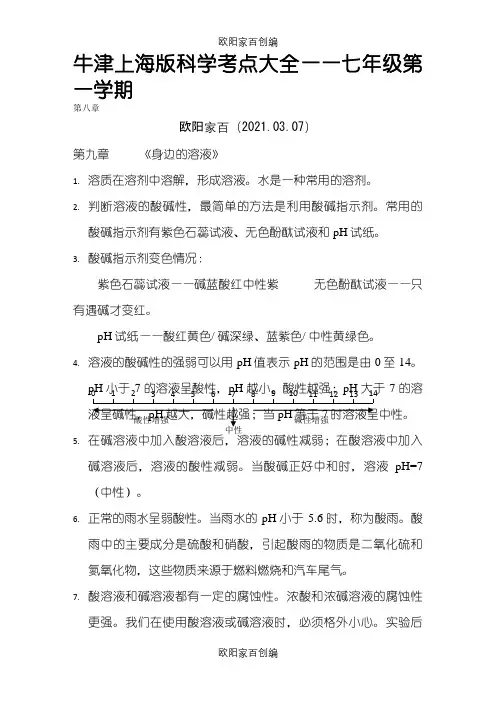
牛津上海版科学考点大全——七年级第一学期第八章欧阳家百(2021.03.07)第九章《身边的溶液》 1.溶质在溶剂中溶解,形成溶液。
水是一种常用的溶剂。
2. 判断溶液的酸碱性,最简单的方法是利用酸碱指示剂。
常用的酸碱指示剂有紫色石蕊试液、无色酚酞试液和pH 试纸。
3. 酸碱指示剂变色情况:紫色石蕊试液——碱蓝酸红中性紫 无色酚酞试液——只有遇碱才变红。
pH 试纸——酸红黄色/ 碱深绿、蓝紫色/ 中性黄绿色。
4. 溶液的酸碱性的强弱可以用pH 值表示pH 的范围是由0至14。
pH 小于7的溶液呈酸性,pH 越小,酸性越强;pH 大于7的溶液呈碱性,pH 越大,碱性越强;当pH 等于7时溶液呈中性。
5. 在碱溶液中加入酸溶液后,溶液的碱性减弱;在酸溶液中加入碱溶液后,溶液的酸性减弱。
当酸碱正好中和时,溶液pH=7(中性)。
6. 正常的雨水呈弱酸性。
当雨水的pH 小于5.6时,称为酸雨。
酸雨中的主要成分是硫酸和硝酸,引起酸雨的物质是二氧化硫和氮氧化物,这些物质来源于燃料燃烧和汽车尾气。
7. 酸溶液和碱溶液都有一定的腐蚀性。
浓酸和浓碱溶液的腐蚀性更强。
我们在使用酸溶液或碱溶液时,必须格外小心。
实验后0 1 2 3 4 56 7 8 9 10 11 12 13 14酸性增强碱性增强产生的酸性和碱性废料要进行处理,不能直接排放。
8.可以在水中溶解的物质称为可溶的物质;不可在水中溶解的物质称为不可溶的物质。
p29.溶解在液体中的物质称为溶质,而溶解溶质的液体则称为溶剂。
p2例:盐(溶质)+水(溶剂)→盐水(溶液)10.水是最常用的溶剂,但不是唯一的溶剂。
常用溶剂还有酒精、汽油等。
p411.碘可溶于酒精、丙酮;指甲油可溶于丙酮、乙酸乙酯。
p4,512.pH试纸是浸渍过多种酸碱指示剂的试纸。
p1013.用比色卡对比试纸所呈现的颜色,找出相对应的数字,即溶液的pH。
p1114.酸碱中和在日常生活中的运用:a)胃酸过多——服用碱性药片(胃舒宁);b)植物不适宜酸性环境——撒碱性的石灰,改善土质;c)被黄蜂蛰伤——用食用醋涂抹。
沪教牛津版七年级上册第三单元知识点归纳

沪教牛津版七年级上册第三单元知识点归纳一.重点单词及词组1. protect the Earth 保护地球We should do our best to protect the Earth.我们必须尽最大努力去保护地球。
2. protect sb./sth. from 保护某人/物My mother protects me from danger.我妈妈保护我让我免受危险。
The little boy protects the toy from water.那个小男孩保护玩具不受水的影响。
3. provide … with… 为……提供These people provide the kids with clothes.这些人为孩子们提供衣服。
4. be covered by… 被……覆盖The road is covered by the heavy snow.路被厚厚的积雪覆盖。
5. make energy 制造能源By reducing demand for petroleum, biofuels could make energy supply more secure. 通过降低石油的需求,生物燃料可以让能源供应更加安全。
6. put ?.into 把?..放入??Put the gift into the box.把礼物放进盒子里。
7. stop doing sth停止做某事He stops working and takes a rest.他停下工作休息了一下。
stop to do sth停下来去做某事He stops to do homework.他停下(打游戏等其他事情)去做家庭作业。
8. throw away 扔掉Don’t throw away the book.不要把书扔掉。
throw about 乱扔Don’t throw about the waste paper.不要乱扔废纸。
七年级牛津上册科学知识点
七年级牛津上册科学知识点七年级是初中阶段的重要年级,学生需要在这个年级中建立自己的科学基础,为将来接受更深入的科学教育打下坚实的基础。
本篇文章将介绍牛津上册七年级科学的主要知识点,帮助学生加强对科学概念的理解和巩固。
1. 生物学
生物学是研究生物体的科学。
在七年级上册的学习中,学生将学习关于细胞,组织和器官,生命过程,嗅觉和味觉等方面的知识。
2. 化学
化学是一门研究物质和它们之间相互转化的科学。
七年级上册的学习重点是原子和元素,化学反应,物质的测定和分类等。
3. 物理学
物理学是研究物质和能量之间相互作用的科学。
七年级上册的
学习将介绍运动的基本原理、摩擦和空气阻力、电学基本概念、
磁性等方面的知识点。
4. 地球科学
地球科学是一门研究地球自然环境的科学。
在七年级上册,学
生将学习有关地球的内部结构、板块运动、地形地貌、气候与气
象等方面的知识。
5. 天文学
天文学是一门研究宇宙、星球和其它星系的科学。
在七年级上册,学生将学习天体的基本知识、通用的天文现象、黑洞、行星
和卫星、天文观测等方面的知识点。
总体而言,牛津上册七年级科学的学习主要涵盖生物学、化学、物理学、地球科学和天文学。
学生将在这些领域中学会各种科学
理论和实践技能,通过实验和课堂讨论来学习科学概念。
通过加
强对这些知识点的理解和巩固,学生将迈向成功、成为对社会和环境有所贡献的未来科学家。
上海七年级上科学知识点

上海七年级上科学知识点上海七年级上学期科学课程主要涉及物理学、生物学和化学等方面的知识。
以下是对这些知识点的详细介绍。
物理学1. 运动学运动学是物理学的一个分支,主要研究物体在时间和空间上的运动规律。
在七年级上,学生将学习速度、加速度、力、作用力和反作用力等概念,了解物体的运动状态和变化,以及简单的力学公式和运动规律。
2. 声音声音是由物体振动产生的机械波。
在学习声音时,我们将学习声音的产生、传播、接收和应用。
学生将学习音量、音频、声音的传播速度以及声音如何被用于通信和左右心情等。
生物学3. 植物生长和发育在学习植物生长和发育时,学生将学习植物的根、茎和叶等不同部位的结构和功能。
学生将了解植物如何利用光能、水和二氧化碳进行光合作用,以及植物的生长和生殖过程等。
4. 动物行为和生活在学习动物行为和生活时,学生将学习动物的不同生境、习性和行为模式,了解动物如何适应不同的环境和生存需求。
学生也将学习不同动物之间的互动和相互依存,如食物链和食物网等。
化学5. 物质的性质和变化学习物质的性质和变化时,学生将了解物质的基本属性、分子结构、离子化和化学公式等。
学生将学习如何识别和分类不同的物质,以及不同物质在化学反应中的行为和变化。
6. 综合应用在综合应用中,学生将学习如何应用所学的物理、生物和化学知识来解决真实世界中的问题和挑战。
例如,学生将学习如何设计简单的电路,如何制作健康的饮食计划,以及如何预防水污染和空气污染等。
结论上海七年级上学期的科学课程涵盖了物理、生物和化学等方面的知识。
学生将学习如何使用科学语言和工具来探索自然规律和解决现实问题。
这些知识将为他们未来的学习和生活做好准备。
牛津上海版科学七年级上学期知识点

七年级第一学期第八章身边的溶液1、溶液由溶质和溶剂组成的。
水是常用的溶剂,此外酒精、丙酮、煤油等也可以作溶剂。
溶液=________+__________2、影响溶解快慢的因素(1)________________;(2)________________;(3)________________;3、溶液分类溶液分类________溶液(pH_____)________溶液(pH_____)________溶液(pH_____)3、可以使用______________辨别溶液的酸碱性。
常用的酸碱指示剂有紫色的_______试液、无色的_________试液、_________试纸。
酸性溶液中性溶液碱性溶液石蕊试液(紫色)酚酞试液(无色)4、溶液的pH值范围是___________;其中,pH值越大,_____性越强;pH值越小,_____性越强;5、酸碱溶液混合后,溶液的酸碱性会发生变化,即原酸性溶液的酸性会减弱,原碱性溶液的碱性也会减弱,混合溶液趋向于_________。
6、酸与部分金属反应释放________;酸与大理石反应释放__________。
7、pH < _______的降水,叫酸雨。
引起酸雨的物质是__________和__________,酸雨中含有的酸性物质是硫酸和硝酸。
◆酸雨的危害:(1)使森林枯死;(2)影响农作物和淡水生物,使之减产和死亡;(3)腐蚀建筑物及历史文物古迹等;(4)危害人体健康。
8、酸性溶液和碱性溶液都有一定的___________。
实验后要对酸性和碱性废料进行处理,不能直接排放入下水道。
第九章电力1、 ________、________、________、________是组成电路的基本元件。
2、电路元件符号:电源导线灯泡开关电流表电压表3、如下面所示电路,其中甲电路为________状态;乙电路为_________状态;丙电路为_________状态。
上海七年级科学上册知识点

上海七年级科学上册知识点上海七年级科学上册知识点:身边的溶液溶液是由溶质在溶剂中溶解而成的。
水是最常用的溶剂。
判断溶液的酸碱性,可以使用酸碱指示剂。
常用的酸碱指示剂有紫色石蕊试液、无色酚酞试液和pH试纸。
不同的酸碱指示剂在不同的酸碱环境下会呈现不同的颜色。
pH值可以用来表示溶液的酸碱性的强弱,pH的范围是由0至14.pH小于7的溶液呈酸性,pH越小,酸性越强;pH大于7的溶液呈碱性,pH越大,碱性越强;当pH等于7时溶液呈中性。
在碱溶液中加入酸溶液后,溶液的碱性减弱;在酸溶液中加入碱溶液后,溶液的酸性减弱。
当酸碱正好中和时,溶液pH=7(中性)。
正常的雨水呈弱酸性。
当雨水的pH小于5.6时,称为酸雨。
酸雨中的主要成分是硫酸和硝酸,引起酸雨的物质是二氧化硫和氮氧化物,这些物质来源于燃料燃烧和汽车尾气。
酸溶液和碱溶液都有一定的腐蚀性。
浓酸和浓碱溶液的腐蚀性更强。
在使用酸溶液或碱溶液时,必须格外小心。
实验后产生的酸性和碱性废料要进行处理,不能直接排放。
可溶的物质可以在水中溶解,而不可溶的物质则不能。
溶解在液体中的物质称为溶质,而溶解溶质的液体则称为溶剂。
除了水,还有其他常用的溶剂,例如酒精、汽油等。
不同的物质可以在不同的溶剂中溶解。
酸雨会对环境和人体健康造成危害,例如使植物死亡、腐蚀建筑和金属材料、使水生生物不能生存,以及引起呼吸道疾病。
金属与酸有不同的反应情况。
例如,镁会反应剧烈,释放大量氢气;锌反应较快,释放大量氢气;铁反应缓慢,释放少量氢气。
铜不会发生反应,可以用来制作导线。
要检验氢气,可以点燃一根木条,听到“扑”的一声或轻微爆鸣声。
如果在白纸上滴上浓硫酸,白纸会炭化、变黑、变焦。
在一个闭合电路中,必须有电源才能产生电流。
容易让电流通过的物质称为导体,不容易让电流通过的物质称为绝缘体。
我们可以用开关接通或断开电路,并用电路图表示电路的连接。
电流表是一种用来测量电流的仪器,电流的单位是安培(A)。
完整版)上海初中科学会考知识点汇总——七年级第一学期牛津版
完整版)上海初中科学会考知识点汇总——七年级第一学期牛津版1.当溶质溶解在溶剂中时,形成了溶液。
水是最常用的溶剂之一。
2.判断溶液的酸碱性最简单的方法是使用酸碱指示剂。
常用的酸碱指示剂有紫色石蕊试液和酚酞试液。
3.酸性溶液能使紫色石蕊试液变红色,但不会使酚酞试液变色。
碱性溶液能使紫色石蕊试液变蓝色,使酚酞试液变红色。
4.溶液的酸碱性强弱可以用pH值表示。
pH值的范围是从0至14.pH小于7的溶液呈酸性,pH越小,酸性越强;pH大于7的溶液呈碱性,pH越大,碱性越强;当pH等于7时溶液呈中性。
5.在碱溶液中加入酸溶液后,溶液的碱性减弱;在酸溶液中加入碱溶液后,溶液的酸性减弱。
6.正常的雨水呈弱酸性。
当雨水的pH小于5.6时,称为酸雨。
酸雨对我们是有害的,我们必须采取防治酸雨的措施。
7.酸溶液和碱溶液都有一定的腐蚀性。
浓酸和浓碱溶液的腐蚀性更强。
我们在使用酸溶液或碱溶液时,必须格外小心。
对实验后产生的酸性和碱性废料要进行处理,不能直接排放。
8.可溶的物质是指能够在水中溶解的物质,不可溶的物质则指不能在水中溶解的物质。
9.溶解在液体中的物质称为溶质,而溶解溶质的液体则称为溶剂。
10.水是最常用的溶剂,但不是唯一的溶剂。
常用的溶剂还有酒精、汽油等。
11.碘可以溶于酒精、丙酮;指甲油可以溶于丙酮、乙酸乙酯。
12.pH试纸是一种浸渍过多种酸碱指示剂的试纸。
13.使用比色卡对比试纸所呈现的颜色,找出相对应的数字,即可得到溶液的pH值。
14.酸碱中和在日常生活中的运用:a) 胃酸过多——服用碱性药片(胃舒宁);b) 植物不适宜酸性环境——撒碱性的石灰,改善土质;c) 被黄蜂蛰伤——用食用醋涂抹。
15.酸雨的成分十分复杂,但通常以硫酸和硝酸为主。
它们分别主要由二氧化碳和氮氧化物转化而成。
这是引起酸雨的主要物质。
16.酸雨会带来以下危害:a) 减少叶绿素,阻止光合作用,使植物死亡;b) 腐蚀建筑石料和金属材料;c) 使河川湖泊变成酸性,使水生生物不能生存;d) 直接影响人体健康,刺激皮肤,引起呼吸道疾病。
牛津深圳版七年级英语上册课文之欧阳体创编
Unit 1 Making friendsGrammar : learn how to ask and answer wh- questions.Learn when to use a or an before nouns.七年级英语教科书(上册)牛津深圳版Writing : complete an email to a new friendAnna’s blogHello everyone. Welcome to my blog.About meMy name is Anna. I’m from Germany. I’m 11 years old. I’m tall and thin. I have long hair. I live with my family in a house close to some mountains. My mum is an Art teacher. My dad is a doctor. I have anelder sister and an elder brother.About my school and my hobbiesEvery day, I go to school by school bus. My favourite subjects are Maths, Art and Science. I like my school because the teachers are all very friendly. My dream is to be an engineer.I like many sports. I’m good at swimming and playing basketball. These are my favourite hobbies.I want to make friends with young people from all over the world! Email me,please!Vocabulary1.Hello everyone.a all peopleb some people2.I live with my family in a house close to some mountains.a nearb far away from3.I like my school because the teachers are all very friendly.a happyb nice and kind4.These are my favourite hobbies.a things I must dob things I like doing in my free time5.I want to make friends with young people from all over the world.a some countries inb every country inUnit 2 Daily lifeGrammar : learn how to use the simple present tense.Learn how to use adverbs and adverbial phrases of frequency. Writing : complete an article about a girl’s daily life.A day at schoolI am a junior high school student. I love going to school.My school is close to my home, so I always go to school on foot. Classes start at 8 a.m., and I am seldom late. My favourite subject is Geography. I enjoy learning about different places in the world.In the morning, we usually study Chinese, Maths and English. We have our morning break at 9:50 a.m. When the bell rings, I run to the playground with my best friends Tom and Jack. We often play games. Break ends at 10:10 a.m. How short it is!Lunch is from 11:50 a.m. to 12:30 p.m. Afternoon classes end at 3:30 p.m. Then Tom, Jack and I take part in the school band practice. We make great music together.I always have a good time at school.Vocabulary1.Classes start at 8 a.m., and I am seldom late.a oftenb not often2.We have our morning break at 9:50 a.m.a a short time between lessonsb a short holiday3.When the bell rings, I run to the playground with my best friends Tom and Jack.a make a soundb is quiet4.Afternoon classes end at 3:30 p.m.a stopb begin5.We make great music together.a with each otherb every dayUnit 3 The EarthGrammar : learn how to use countable and uncountable nouns.Learn how to use the pattern there is / are......Writing : complete a report on protecting the Earth.Protect The EarthThe Earth is a beautiful place. There are forests and rivers, mountains and fields. Some places are very hot, and some are very cold.There are many different plants. Some are large. Some are small. All plants need light and water. There are different animals on Earth too. Some live on the land. Some fly in the sky. Some live under the water.There are also many people like you and me on Earth. The Earth provides us with air, water and food. It is our home.Today, there is a lot of pollution. We burn things to make energy. This pollutes the air. We put our rubbish into the sea and under the ground. This pollutes the Earth and kills animals and plants.We must stop doing these things. It is important for us to protect the Earth for our future.Vocabulary1.The Earth provides us with air, water and food.a givesb shows2.We burn things to make energy.a set.... on fireb make ... very strong3.This pollutes the air.a make ... cleanb makes ... dirty4.This pollutes the Earth and kills animals and plants.a cleans b makes (i)5.It is important for us to protect the Earth for our future.a keep ... safeb changeUnit 4 SeasonsGrammar :learn how to use adjectivesWriting :write about your favourite seasonThe four seasonsSpringIn spring, the weather starts to get warm. The wind blows gently. It often rains. Plants start to grow. Everything turns green. It is exciting to take a trip in spring.SummerThe weather is hot in summer. The sun shines brightly. Many people like to go to the beach and swim in the sea. It is nice to eat ice cream in the hot weather.AutumnIn autumn, everything changes. Leaves turn brown, red or yellow and start falling from the trees. It is nice to go on a picnic at this time of year because the weather is cool and dry.WinterWinter is often cold and snowy. Children love winter because they love to play in the snow. It is interesting to make snowmen. People usually spend time with their relatives during the Spring Festival. Vocabulary1 all the things -------- eveything2 sends out light -------- shine3 not wet --------- dry4 with a lot of snow -------- snowy5 use time to do something -------- spend6 people in the same family -------- relativesUnit 5 Visiting the MoonGrammar : learn how to use the simple future tense with will.Learn how to use the simple future tense with be going to Writing : write a plan for visiting the Space HotelA trip to space----- by Jerry10 October 2053I’m so happy! Tomorrow I’ll be one of the first students to travel into space. The spaceship will leave the Earth at 9 a.m. It’ll take us to the Moon. I can’t wait!The Moon is around 380,000 kilometres from the Earth, so it’ll take us about four days to get there. There’s no gravity in space, so we’ll all be able to float aroud in the spaceship. We’ll have to tie ourselves to our beds so that we won’t float away in our sleep! Without gravity, our bodies may get weak, so we’ll have to do exercises every day. When we arrive, I’m going to walk on the Moon. I’ll have to wear a spacesuit to help me breathe because there’s no air on the Moon. I’m going to take as many photos as I can, that is, if my camera still works up there...Vocabulary1.If you leave a place, you it.a go tob go away from2.If you have to do something, you do it.a canb must3.If you tie something, you .a hold two or more things together with a ropeb make something into a rope4.When you breathe, you .a keep yourself warmb take air into and send it out of your bodyUnit 6 Travelling around AsiaGrammar : learn how to use conditional sentencesWriting : make a travel guideVisiting ShanghaiShanghai is one of the largest cities in the world. If you like sightseeing, you will love it!People’s SquarePeople’s Square is in the centre of Shanghai. It is a large public area with green grass, fountains and birds. If you visit People’s Square, you can also see famous buildings around it, such as the Shanghai Grand Theatre and the Shanghai Museum.The BundThe Bund is where old Shanghai meets new Shanghai. If you walk along the Bund, you will see many old buildings. The Pudong New Area, just across the Huangpu River, has many modern buidlings. At night, these tall buildings light up the sky in every direction.Yu GardenYu Garden is a traditional garden. If you enjoy his history andnatural beauty, you will love this garden. There are many beautiful buildings, bridges and ponds. You can also buy different snacks just outside the garden.Vocabulary1 Sightseeing usually refers to .....2 The centre is.....3 A modern building is .....4 Examples of traditional food are ....5 the natural world means....Unit 7 school busGrammar : learn how to use the simple past tenseWriting : complete a poster for the Insect Club.The Clubs FairLinda and Leo are new students at Rosie Bridge School. Last month, they attended the Clubs Fair.First, Linda and Leo learnt about the Rocket Club.“ Our club will teach you how to build rockets. Then you can launch them into the sky,” a boy said, “ watch!”He took a rocket and lauched it. The rocket disappeared into the sky. Linda and Leo were very surprised.“Will it go all the way into space?” Linda asked.“ Of course it won’t,” a girl from another club shouted. “Our club isbetter. Come and join the Solar Power Club.”“ What do you do?” asked Leo.“ We make wonderful machines. They only use solar power. Look!”She took a toy car from the table and then used a remote control to drive it all around the playground.“ It uses power from the Sun,” said Linda. “ That’s amazing!”Linda and Leo learnt about many clubs. After the fair, they felt very excited.“ I want to join all the clubs,” said Linda.“ Me too!” said Leo.Vocabulary1 At a fair, people let you things.a takeb look at or buy2 When you attend a class, you it.a leaveb go to have3 When a mum teaches her child to make a cake, she .a shows him/ her how to do itb makes it for him/ her4 If something disappears, .a everyone can see itb no one can see it5 If something is amazing, it is very .a good and surprisingb bad and tiringUnit 8 Collecting thingsGrammar : learn how to use personal pronouns, possessive adjectives and possessive pronouns.Writing : write a short article about your collectionUnusual collectionsSam and Helen’s grandparents collect almost everything. There are eight doorbells on their front door.“ This silver doorbell is my favourite,” said Helen. She pushed it and soon Grandpa opened the door.“ Come in, my dear grandson and granddaughter!” he said.“ Who started collecting doorbells, Grandpa?” asked Sam.“ Your grandma, “he answered. “ She loves doorbells.”“ What do you like collecting, Grandpa?” asked Helen.“ I like collecting newspaper.”They went inside and saw newspaper everywhere.“ Hello children!” called Grandma. “ Let’s have some tea.”The children followed her into the living room and saw lots of toys there. There was hardly any space for the children to sit down.“ Whose toys are these?” asked Helen.“ They’re ours,” said Grandma. “ We both like collecting toys.”“ But remember,” said Grandpa, “ we have a lot of free time! You have your school work to do, so you shouldn’t spend too much time collecting things!”Vocabulary1.My friend will come to visit me in a short time from now. ---- soon2.There are tall buildings all over the area. ---- everywhere3.I walked behind my grandma to the kitchen. ---- followed4.I can almost not keep my eyes open. ---- hardly5.What do you do when you are not busy? ---- free。
牛津上海版(五四学制)科学七年级上册:9
你能根据 上面的电 路图,把 电路实物 用导线连 接起来吗 ?大家动 手连一连 吧!
按照电路图连接实物时的注意事项
• 连接电路过程中,开关应该始终处于断开状态,将连 接好的实际电路与电路图对照检查,确定无误后才可 以闭合开关。
• 各元件与导线的连接要可靠,多股铜丝应拧成一股, 接到接线柱上的导线应顺时针缠绕,避免旋紧螺丝帽 时导线被挤出来。
作。
电路元件符号
-+
这样就能简单明了地画出电路图啦!
+
把电路中的 元件实物画 出来是很麻 烦的。可以
利用电路图
来表示电路 中的各元件 的连接。
-
L1
L2
S
你能根据 上面的电 路实物图 画它们的 电路图吗 ?大家动 手画一画 吧!
根据实物图画出电路图 的方法,先要看清通路 ,分清干路、支路,得 出连接方法(串联/并联 ),然后再画出电路图
2.生活中还有哪些事例是串联或并联电路的?
3.几个用电器串联在电路中,如果一个用电器坏 了,其他的用电器还能继续工作吗?
小结(1)
定义:把元件逐个顺次连接起来组
成的电路,称为串联电路。
串 联 电 路
回忆一 下,这节 课我们学 习了什么 内容?
特点:电流路径唯一,开关位置任意。
小结(2)
定义: 把元件并列连接起来组成的电路。
L1
L1
L1
L2
L2
L2
甲[分析]
乙[分析]
丙[分析]
乙:电路中L2没有接入电路中, 造成L2部分断路。
2、找出下面电路连接图中的错误和不足。
L1
L1
L1
L2
L2
L2
甲[分析]
上海牛津七年级第一学期之欧阳家百创编
1.Relationships.欧阳家百(2021.03.07)Unit 1.Relatives in Beijing.Listening and speaking: Planning a trip to Beijing.Listen and say.Mr Li: Look, Ben. T've got a letterFrom Uncle Weiming.He lives in Beijing. He hasinvited us to stay with hisFamily in August.Ben: I haven't seen my cousinsbefore.Mr Li: Your uncle has sent us aphotograph. These areyour cousins, Simon and,Lucy.Ben: How old ore they?Mr Li: Simon is twelve and Lucy is ten.Ben: Are we going to travel to Beijing by plane?Mr Li: Perhaps, but plane tickets are very expensive.Ben: Let's go by train. It's cheaper and more interesting.Mr Li: That's a good idea. Let's talk to Mum and Kitty. l"m going to get somebrochures from the travel agent.Look, read and answer.Kitty is asking Ben some questions about the photograph.Here's a photograph fromUncle Weiming. We're goingto visit his family soon.Where does Uncle Weiming live?When are we going to visit him?What are the names of our cousins?How old are they?Sag and act.At the travel agent's.Good morning.Can I help you?Yes, we'd like to travel to Beijing byplane. How long does it take to travelfrom Garden Citu to Beijing bu plane?It takes about two anda half hours.How much does it cost?One thousand fivehundred yuan.That's expensive.Ask and answer.You are Mr Li and the travel agent. Talk about travelling to Bei]ing bg train.Mr Li: How long does it take to travel from to by ? Travel agent: l't takes about hours.Mr Li: How much does it cost?Travel agent: and yuan.Mr Li: That's cheap.Listen and say.When are we going to visit Beijing?We're going to visitBeijing on 16 August.How long are wegoing to stay there?We're going to stay there fortwo weeks. We're going tocome back at the end of August.How are we going to get there?We're going to getthere by plane.Can we travel by train?It's cheaper.The train is slower than the plane.It takes fifteen hours to travel fromGarden City to Beijing.Read and write.Complete Mr Li's letter to Uncle Weiming.(date)Dear WeimingThank you for your letter and your . We would like to visit you in Beijing.We are going to travel to Beijing on . We are going to stay withyou for weeks.We are going to travel by because the train is too slow. It takeshours to get to Beijing by train. The plane is more , but it is See you soon.love.David.Reading: Welcome to Beijing.Read.The Li family has arrived in Beijing. Simon and Lucy want to take Ben and Kittyto some interesting places.Hi, Simon. Hi, Lucy.Nice to meet your.Hi, Ben. Hi, Kitty. Nice to meet you.We've found some informationabout some interesting places.Welcome to Beijing.The Summer Palace.It is in the north-west of Beijing.Tourists can see a lot of oldbuildings and temples at thepalace. Kunming Lake is a beautifullake insidethe palace.Tourists cansee swansswimmingon the lake.The Great wall.It is north of Beijing. Tt is a longwall with towers on it. People builtit a long time ago with bricks andstones.Tourists cansee beautifulmountainsfrom thewall.Tian`anmen Square.It is in the centre of Beijing. [t is ahuge open area. Tt can hold morethan one million people. Everymorning, tourists can see soldiersraising theChinesenational flagin the square.The Palace MuseumIt is in the centre of Beijing. It is aplace with many ancient buildings.Tf tourists want to know the historyof China,they canvisit themuseum.Look and read.The children are planning to visit different places of interest in Beijing.Simon, which placeare we .qoinq to visit?We're going to visit theSummer Palace on 21 August.Where is it?Tt's in the north-westof Beijing.What can we see atthe Summer Palace?We can see a lot of old buildings and temples.We can see swans swimming on the lake.Look, write and sag.Look at the calendar below and page 5 again. Pretend you are Ben, Kitty,Simon and Lucy, and talk about your visits.Ben: Which place are we going to visit?Simon: We're going to visit (place) on (date).Kittu: Where is it?Lucy: It's of Beijing.in the centre ofKitty: What can we see at the Summer Palace?at the Palace Museum?at the Great Wall?at Tian anmen Square?Lucy: We can see ...Writing: Lucy's holiday plan.Look and read.The Li family has come back from Beijing. Kitty enjoyed the trip very much.She is writing a letter to her cousin, Lucy.7 September.Dear Lucy.We are back in Garden City now. Ben and T had a wonderful time in Beijing. Thank you very much. T have got some photos for you. They aregreat! Here is a photo of Simon and Ben. They are standing on the GreatWall. Another is a photo of you and me. We are standing in front of anancient building at the Palace Museum.We really enjoyed our holiday. Would you like to visit us in Garden Cityfor the Spring Festival?Love.Kitty.Write.You are Lucy. You want to write aletter to Kitty about your holiday planfor the Spring Festival. Write about:Who is going to travel toGarden City with you?When are you going to visit?How long are you going tostay?How are you going to travelto Garden City?Which place would you like tovisit?invite.expensive.talk to.brochure.agent.soon.at the end of (August).swan.raise.national.brick.stone.mountain.ancient.history.interest.holiday.wonderful.another.Unit 2.our animal friends.Listening and speaking: Visiting the SPCA.Listen and act.Mr Hu and the children are visiting the SPCA.1.Good morning, children. Welcometo the SPCA. T'm an SPCA officer.Do you know what the SPCA is?Tt is the Society for the Preventionof Crueltu to Animals.That's right!2.Someone left these puppies and their mother in the street.They had no food or water. Theu were hungru and thirsty.I found them and took them to the SPCA.3.Look, children. The puppies are lovely.Would you like to keep one as your pet?Which one do you like best?I prefer the black one.I prefer the yellowand brown one.I prefer the white one.Writing: Taking care of your new puppies.Read.peter, Jill and Joe all want to keep puppies as their pets. The SPCA officer hasIgiven them a booklet to read.How to take care of gour new puppg.Diet:5 weeks -6 months oldFeed him/her 3 - 4 times every day.Give him/her special dog food for puppies.Give him/her a bowl of water to drink.6 - 12 months oldFeed him/her 1 - 2 times every day.Give him/her dog food for bigger dogs.Give him/her hard dog biscuits to chew.Give him/her a basket to sleep in.Give him/her a blanket to keep him/her warm.Hold him/her carefully with both hands.Take him/her to a park or the countryside for a walk every day.Play with him/her.Write.Write the things Peter, ]iii and Joewill need for their puppies.We'll need to buy a lot ofthings for our puppies.Find out.Find a book in the library about kittens.Take notes. Make a booklet about howto take care of a kitten.Reading: Animals, our friends.Read.Every year, the SPCA saves manyanimals in Garden City. Sometimespeople are unkind to their pets. Theydo not look after their pets and leavethem in the street. SPCA officers saveanimals from danger and take them tothe SPCA.The SPCA also helps animals find newhomes. If people want a pet, they cango to the SPCA. However, they mustpromise to take care of their new pet.There are clinics for Sick animals in theSPCA. The vets in the clinics take careof them.Answer.Here's a quiz about the SPCA.A quiz.What do unkind people doto their pets?What do SPCA officers do tosave animals?What must people promiseto do when they get a petfrom the SPCA?How does the SPCA takecare of sick animals?Look, read and match.Mr Hu and his class have come back from the SPCA. He has askedthe studentsmake a display about dogs.Dogs are our best friends.Many, many years ago, people lived with dogs in caves. Dogs guarded the caves and kept people safe from danger.They can guard our homes and play with people. We should be kind to dogs. We should take care ofthem carefully.Dogs help blind people. They help blind people cross the road safely. Today, dogs help people in many different ways. They help the police catch thieves and find missing people.Dogs also helped people hunt animals for food. Dogs ate the meat, too.They help farmers on their farms. They can bring other animals, like sheep, to the farmer.Language.Which one do you like best?I prefer the one.Feed/Give/Hold/Play/Take ...What/How ...?officer.society.prevention.cruelty.someone.puppy.thirsty.lovely.as.prefer.care.take care of.booklet.special.chew.basket.blanket.unkind.clinic.vet.cave.guard.blind.safely.police.thief.missing.hunt.Unit 3.Friends from other countries.Reading: Foreigners in Garden City.Look and read.Garden City is a crowded city. Over six million people livein Garden City. Most of them are Chinese. Many peoplefrom other countries live in Garden City, too. For example,there are more than twenty-eight thousand people fromCanada in Garden City. There are also people from theUSA, Australia, Japan, the UK and India in Garden City.What do we callpeople from Canada?We call them Canadians.Read, ask land answer.Look at the table below. With a classmate, ask and answer the questions.S1: What do we callpeople from ?S2: We call them .S1: How many livein Garden City?S2: More than .listening and speaking: Penfriends from different countries.Listen and say.Nowadays we can visit countries near or far awayfrom China. We can also read about them inmagazines and newspapers. Which country haveyou visited or read about?I've visited Japan.It's near China.I've visited the UK. It's faraway from China.I've read about Canada.It's far away from China.I've read about India.It's near China.A survey.In groups, talk about the countries you have visited or read about. Complete the table.S1: Which country have you visited?S2: I've visitedIt's near/far away from China.S3: Which country have you read about?S4: I've read aboutIt's ...Listen and say.Would you like to write to a penfriend in another country?What would you like to know about your penfriend?I'd like to write to a girl. I'd like toknow her age and interests.I'd like to write to a boy. I'd liketo know his favourite food.I'd like to write to a boy. I'd like to knowhis favourite subjects at school.Read, write and say.Kitty has made a list. She wants to know some things about her penfriend.Tick the things you want to know about yours. With a classmate,ask and answer questions.S1: What would Kittylike to know abouther penfriend?S2: She'd like to know(about) his .S1: What would youlike to know aboutyour penfriend?S2: I'd like to know(about) his/her .Writing:A lettcr to your pcnfricnd.Read.Here's a list of penfriends fromPenfriends International. Whowould you like to write a letter to?I'd like to write a letterto Gary Brown. He's aboy from Canada.Read Kitty's letter to her penfriend.18 September .Dear GaryPenfriends International sent your name to my school. ! would like to beyour penfriend.[ am a girl from Garden City. ! am Chinese. ! am twelve years old. There are four people in my family. They are my mother; my father, mybrother, Ben, and me. We have a pet dog. His name is Sam.! go to Rose Garden School. [ am in Grade 7. My favourite subjectsare Maths and Music. [ like riding my bicycle, playing badminton andwatching TV.Here is a photo of my family. Please write soon and tell me about yourself.Yours.Kitty Li.Read and write.24 September.Dear Kitty.Thank you for your letter and your photograph. T would like to be yourpenfriend, too.1 am a from . I am . I am years old.There are people in my family. I have one . His name is Charles. I have one sister. Her name is Linda. We have a pet Her name is . I go to school. and are my favouritesubjects. I like playing and .Write soon.Yours.Gary.About you.Write a letter to yur penfriend.Language.people from (country)more thannear/far away fromhave visited/read aboutWhat would you like to know about your penfriend?I'd like to know/know about ...Word box.foreigner.crowded.example.for example.Canada.Canadian.Australia.Australian.India.Indian.Britain.British.Japanese.penfriend.magazine.know about.sex.nationality.international.yourself.mole.Toronto.junior.Now listen.Jane's penfriend.About Jane's penfriend:a from .years old.(name: Ivlomoko? Gigi? ivlatchi?).lives in the of Japan.Jane has not visited him before because it is too.to travel to Japan by.Garden City Japan by plane: more than.he is coming to Garden City during the Spring Festival and will stay for.Using English.Using your dictionary (I).The words in a dictionary are in alphabetical order. This helps you find themquickly and easily.Guide words are always at the top of the pages. The one at the top-left cornertells you the first word on the left page. The one at the top-right corner tellsyou the last word on the right page.The guide words can help you find the word quickly. For example, if you wantto find the word level in the dictionary above, the guide words tell you that itmust be on page 206 or 207. Then look at the first word on page 207. l't islever. Level comes before lever, so level must be on page 206.A. Write down the guide word on page 206 of the dictionary.B. Write down the guide word on page 207 of the dictionary.C. Write down the numbers of the pages on which you could find these words.1. library.2. less.3. licence.4. lesson.D. Would you find these words before or after pages 206 and 207?1. leg .2. lift.3. line.4. leaf.Relationships.。