
牛津译林版高中英语选修7Unit 1Living with technologygrammar and usage教案1
Grammar and UsageTeaching Aims:l To review the usage of some common prepositions to express time, place, and -movementl To learn that prepositions can be combined with verbs, nouns, and adjectives to form prepositional phrasesl To learn how to use some common prepositions and prepositional phrases in different situationsl To apply what they have learnt to practice by fulfilling some written tasksTeaching Key Points & Teaching Difficulties:²How to help them master the usage of common prepositions²How to apply the grammar rules to compete the related exercises correctlyTeaching Procedure:Step One: Leading-inT: (Greet the class as usual) Now boys and girls, please look at the screen. There are three sentences. Fix your eye on the words in bold and think about the following questions:The goats are the grasslandØ The little girl is in the kindergartenØ The man with black hair is LiuXiangThe mobile phone is for my sister1) What’s the part of speed of the words in bold?2) Where are they put, before a noun or after a noun?3) What are they used to express?Ss: …(It doesn’t matter whether they can give correct answers. This is used to draw their a ttention and recall their memory of the usage of common prepositions. Encourage them to think about how they are used.)Step Two: PrepositionsT: Good memory! Today we’ll focus on prepositions and preposition phrases. Now please turn your book to page 8 and read the guidelines just below the title prepositions carefully. And then tell me the general usage of prepositions.Ss: …Possible Answers:n Used before a noun or a noun phrasen Can express time, place, movement etc.n Used before a verb in the –ing formT: Wonderful! Next we’ll go through the three groups one by one to get a clear idea of the usage of prepositions. Please read the part 1 and tell me what prepositions can be used to express time. ²Prepositions of TimeSs: Prepositions like at, in, on, for, by and since can be used to express time. Others of time include during, after, before, between, from, until, etc.T: That’s right! Then please look at the following sample sentences and explain the usage of the preposition in each sentence.1. Regular public TV broadcasting began in 1928.2. The first record players only played a record for two minutes.3. By 1967, most TV broadcasts were in color.(Encourage the students to explain the use of these prepositions. Remind them to refer to the instructions in part 1. Ask more students to use the prepositions of time to make their own sentences if possible and make necessary corrections.)T: Very good! Now please look at the part 2 and tell me what prepositions can be used to express place.²Prepositions of PlaceSs: At, in and on can be used as prepositions of place. Other prepositions of place include above, against, behind, between, by, near, opposite, under, etc.T: Great! Now please read the sample sentences below carefully and explain how they are used in different situations.1) I’ll meet you at the department store.2) Wang Li is at a media and technology exhibition.3) This new type of TV can be hung on the wall.(Encourage the students to explain the use of these prepositions. Remind them to refer to the instructions in part 2. Show them a picture and ask them to describe the location of the objects in the picture.)T: Good! Next please go through the last group and tell me what prepositions can be used to express movement.²Prepositions of MovementSs: The preposition to is often used to show movement. Other prepositions of movement include across, along, down, into, off, over, out of, past, round, through, under, up, etc.T: Great! Now please read the sample sentences below carefully and explain how they are used in different situations.1) The invention of the transistor led to the development of cassette recorders.2) When autumn comes, many leaves fall off the tree.(Let them explain the usage of these prepositions first, and then ask them to make some sentences of their own using these prepositions.)Tips:T: Good! So far we have learnt the general rules of the use of common prepositions. Besides these, you should also pay attention to some exceptions. Now please have a look at the tips on the left and tell me what you can learnt from them.Ss: …1. We usually say ‘in the morning/afternoon/evening’, but when we talk about‘morning/afternoon/evening’ of a particular day, we use ‘on’ instead of ‘in’.2. We say ‘on a bus/train/plane’ but ‘in a car/taxi’.(Let them read the tips together. Later on, ask them go through the three groups of sentences again. If they have any questions, ask them to turn to T for help. Finally ask them to complete the exercise below)Practice:Suggested Answers:1. for2. at3. until4. by5. during6. toStep Three: Prepositional PhrasesT: Well done! Ok, now please look at the following phrases carefully and discuss them with your partner. Later, please tell me what words prepositions can be combined with.run into by hand concerned abouthear from in return different fromstand for in fact cautious aboutSs: …(Remind them to pay attention to the part of speech of these words. Give them enough time to go through them and help them put the phrases into three groups: prepositional phrases with nouns, prepositional phrases with adjectives, prepositional phrases with verbs.)T: Amazing! In the next part we will learn propositional phrases, which are made up ofprepositions with verbs, adjectives, and noun. Now let’s go through them one by one. summarize the following:²Prepositions with VerbsMany prepositions are combined with verbs to form prepositional verbs, e.g., agree with, look for, look into, head for and stand for, etc.1) The ship set sail and headed for Shanghai.2) MD stands for MiniDisc.²Prepositions with NounsPrepositions can also be combined with nouns, e.g., in time for, by means of, by accident/mistake, for/on sale, on the market, in that case and up to date, etc.1) When will the new model be on sale?2) This technology is quite up to date.²Prepositions with AdjectivesSome prepositions are also combined with adjectives, e.g., good at, capable of, fond of,satisfied/happy with, etc.1) The program is capable of calculating our budget for the year.2) I am fond of watching black-and-white films.(Ask the students to read the sample sentences and make up their own sentences using these prepositional phrases. Or ask them present more examples of prepositional phrases with verbs, nouns, and adjectives. At last let them complete the introduction to the digital camera on page 9.)Practice:Suggested Answers:1. on sale2. up to date3. capable4. stands for5. satisfied with6. on the market7. In that case8. in time for9. up to 10. agree with( After this, give the students a few minutes to ask for help if they have any questions.) Step Four: Language Points1. in this/that case 在这种/那种情况下in the case of … 至于…;就…来说in case 以便;以免;以防in case of … 如果…;万一…;以免…;以防…e.g. In the case of learning English, we must speak as much as possible.e.g. You’d better take an umbrella in case of rain.e.g. You’d better take an umbrella in case it rains.e.g. It is likely to rain today; you’d better take an umbrella in case.2. capable adj. 有能力的;有才能的;有技能的be capable of … 有…能力的;可以…;做得出…e.g. Some airplanes are capable of going 800 kilometers an hour.e.g. Tom is quite capable of neglecting his duty.3. accompany vt. 陪伴;伴随;与…同时发生或做事情e.g. His wife accompanied him on his trip to China.e.g. The pop singer was accompanied at the piano by the pianist.4. familiar adj. 熟悉的;亲近的sb be familiar with …… be familiar to sb 某人熟悉/精通…e.g. We haven’t met our neighbours yet so we are not familiar with them.e.g. We haven’t met our neighbours yet so they are not familiar to us.Step Six: Exercise1._______ hearing the message, the boy was wild________ joy.A. At ; inB. On ; withC. After ; byD. / ; over2.The team is made up ________ five students. And they are studyinghard to make up ______ the lost time .A. of ; ofB. for ; forC. of ; forD. for ; of3. Does Kate learn any other languages ________ Japanese.A. besideB. besidesC. butD. except4.Do you know that I have nothing to do ______ the matter?A. ofB. forC. withD. about5.The old man offered us his congratulations _______ winning thematch.A. forB. onC. ofD. at6.I know nothing about the woman ___________ she is a teacher.A. besidesB. exceptC. except forD. except that7.When the plane arrived safely , all the people ________were happy.A. by a planeB. on the boardC. on boardD. on plane8. Who is it up ______ decide when ______ start ?A. to ; toB. for ; forC. for ; toD. to ; /9. Jim , please give me a pen _____ write _______A. for ; toB. to ; ofC. to ; withD. to ; in10. The boy was ________the help of the doctors , and soon died.A. withB. forC. beyondD. in11. That man became very angry ________his arrival .A. inB. atC. onD. for12. --- What can a rose stand __________?--- Love.A. inB. byC. atD. for13. Jim gave Tom a book ,and Tom gave Jim a pen ____ return.A. ofB. forC. atD. in14.It hasn’t rained for years in the country. The people is _____need _________ rain.A. for ; ofB. in ; ofC. of ; inD. in ; in15.We finally arrived ____ a small village _____the morning of July 1st.A. in ; inB. on ; onC. at ; onD. on ; atHomework²To go over the use of prepositions after class²To do Part C2 and C2 on page 104 of the Workbook²To preview the task。
牛津译林版高中英语选修七Unit1Livingwithtechnology(words)

3. age 1.at the age of 年龄
2.the nuclear age/the modern age 现代/核子时代 (历史上的)时代,时期
3. I’ve waited for ages. 我等候很久了. =a long time
4.They have two children aged 6and 8. …岁
eg. I demanded that John go there at once.
他要求选举权给予每一位成年女性. He demanded that the right to vote (should) be given to every adult woman. meet/satisfy one’s demand 满足某人的要求
4. superior
eg. He is ~ to me in position. 超过
He is my immediate ~. 他是我的顶头上司
be inferior to 比…差
5. wind n. 风,气流, 打嗝 wind v.(winded, winded) 使(某人)气急,打嗝 windv. (wound, wound) 蜿蜒;缠绕,;上发条;卷起
wind down : 1) 钟表等慢下后停住 2) 放松;松弛 e.g. This year is rather busy for me---I need a
holiday to wind down.
6. apply apply to sb. for sth.
申请,请求
eg.The new technology was applied to farming.
使用,应用 apply the cream (乳霜)to your face
译林牛津版高中英语选修7课件 Unit 1 Living with technology Section Ⅰ课件1
· Manbutions to the
development of TV.
Early
history of TV
· Most early TV broadcasts were made with the 2. help of a system developed by John Logie Baird. · Philo Farnsworth made important breakthroughs
buying in the shop would be suitable for my uncle or aunt,
brother or sister. It was much easier than going to the call box outside and then running back inside the shop to buy things.
Can you imagine life without your cellphone now? It
makes you wonder how we managed to deal with things in the
past without a cellphone, doesn't it? When I was doing my Christmas shopping last month, I couldn't remember how many times I took out my cellphone and gave a quick call to a relative to see if a gift that I was
welcome source of entertainment in our busy lives.
牛津译林版高中英语选修七Unit 1《Living with technology》(Project2)教学设计

Unit1 Living with technology Project2教学设计单元:Unit1 Living with technology板块:Project 2Thoughts on design:这是Project板块的第二课时。
本板块的核心思想是让学生运用本单元所学的所有知识和技能,在课堂之外,独立或以小组形式开展项目研究。
它提供的这篇文章可以说有双重目的,一方面为学生即将开展的项目研究提供范本;另一方面它也是本单元中重要的语篇材料,含有丰富的语言知识可供学生学习。
第二课时侧重语言知识的学习和项目研究的前期准备,如分组、研究重点的确立、不同观点的讨论、小组成员任务分工等。
Teaching aims:1.students will be able to understand difficult sentences and learn some key words;2.students will be able to take up responsibilities in teamwork and learn to workcorporately with others.Teaching procedures:Step 1 Important phrases•the Amish—a Christian•Many people assume …•have religious reasons for•their conventional way of life•in truth•vote on whether•reject cars•they like having tight communities where everyone lives close•dislike dealing with•value seeing each other face- to- face•oppose having telephones in their houses• a telephone for emergencies.•have a valid point•someone accompanying you•other disadvantages to the telephone•no matter what the circumstances•be absorbed in a book•destroyi ng whatever peace you might have•More problems arises•interrupt the conversation to answer a call•for some reason•attach greater importance to•Most mobile phone calls regard rather small matters.•waste your precious time•Girls average 80 text messages a day.•at the time•focus on building relationships with•These relationships are quite shallow.•The use of technology for communication rather than talking face to face •Real relationships are often sacrificed. in general•have a higher degree of mental heal th•have very calm and stable lives•they value community and living in peace above all else•for good measure•rid ourselves of modern technologyStep 2 Key words1. reject (v.)1) to refuse to accept, believe in, or agree with somethingSarah rejected her brother's offer of help.reject sth. as sth.Gibson rejected the idea as 'absurd'.2) to not choose someone for a job, course of study etc.It's obvious why his application was rejected.3) to throw away something that has just be en made, because its quality is not good enoughIf inspectors find a defective can, the batch is rejected.4) to refuse to give someone any love or attentionChildren feel abandoned or rejected if they don't see their parents regularly.•Since the Amish value seeing each other face-to-face, they oppose having tel ephones in their houses.2. oppose (v.)1) to disagree w ith something such as a plan or idea and try to prevent it fromhappening or succeedingCongress is continuing to oppose the President's healthcare budget.2) to fight or compete against another person or group in a battle, competition,or electionHe is opposed by two other candidates.3. arise (vi.)1) if a problem or difficult situation arises, it begins to happenA crisis has arisen in the Foreign Office.More problems like those at the nuclear power plant are certain to arise.2) if something arises from or out of a situation, event etc, it is caused or startedby that situation etc.Several important legal questions arose in the contract negotiations.•arise from/out ofCan we begin by discussing matters arising from the last meeting?•when/if the need arises / should the need ariseShould the need arise for extra staff, we will contact you.•4. attach (v.)1) to fasten or connect one object to anotherattach sth. to sth.Attach a recent photograph to your application form.a small battery attached to a little loudspeakerPlease fill in and return the attached reply slip.2) to like someone or something very much, because you have known them or had themfor a long timebe attached to sb./sth.It’s easy to become attached to the children you work with.3) to believe that something is importantattach importance/significance etc to sth.People attach too much importance to economic forecasts.5. sacrifice (v.)to willingly stop having something you want or doing something you like in o rder to get something more importantsacrifice sth. for sth.A Labour government chose to sacrifice defence for welfare.sacrifice sth. to do sth.He sacrificed a promising career to look after his kids.sacrifice yourself (for sth)mothers who sacrifice themselves for their childrensacrifice (n.)•The workforce were willing to make sacrifices in order to preserve jobs.She brought three children up single-handedly, often at great personal sacrifice.•6. rid (vi.)•(rid, rid, ridding)•to take action so that a person, place etc is no longer affected by something bad or no longer has itrid sb. of sth.• a promise to rid the country of nuclear weaponsWill science finally rid us of this disease?rid yourself of sth.He struggled to rid himself of his fears.[Explanation]这是Project板块第二课时。
牛津译林版高中英语选修七Module 7 Unit 1 Living with technology .docx
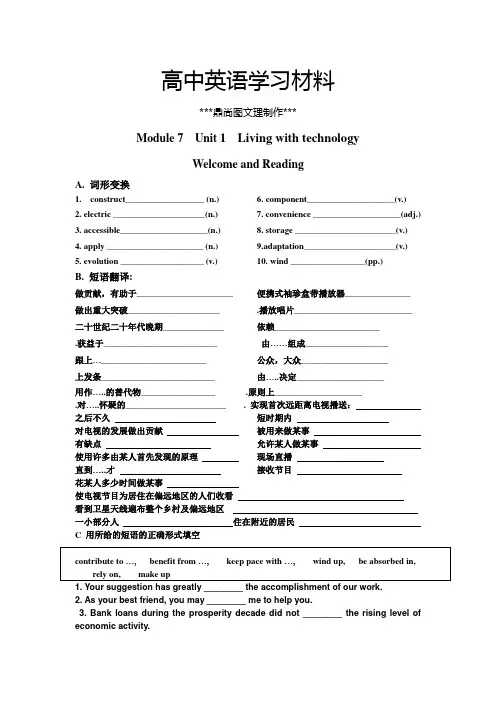
高中英语学习材料***鼎尚图文理制作***Module 7 Unit 1 Living with technologyWelcome and ReadingA. 词形变换1. construct__________________ (n.)2. electric _____________________(n.)3. accessible____________________(n.)4. apply ______________________ (n.)5. evolution ___________________ (v.)6. component____________________(v.)7. convenience ____________________(adj.)8. storage _______________________(v.)9.adaptation_____________________(v.)10. wind _________________(pp.)B. 短语翻译:做贡献,有助于______________________ 做出重大突破_____________________二十世纪二十年代晚期______________ .获益于__________________________跟上…________________________上发条__________________________ 便携式袖珍盒带播放器_______________ .播放唱片___________________________ 依赖________________________ 由……组成___________________公众,大众____________________ 由…..决定____________________用作…..的替代物_________________ .原则上____________________ .对…..怀疑的_______________________ .实现首次远距离电视播送:之后不久对电视的发展做出贡献有缺点使用许多由某人首先发现的原理直到…..才花某人多少时间做某事短时期内被用来做某事允许某人做某事现场直播接收节目使电视节目为居住在偏远地区的人们收看看到卫星天线遍布整个乡村及偏远地区一小部分人住在附近的居民C 用所给的短语的正确形式填空contribute to …, benefit from …, keep pace with …,wind up, be absorbed in, rely on, make up1. Your suggestion has greatly ________ the accomplishment of our work.2. As your best friend, you may ________ me to help you.3. Bank loans during the prosperity decade did not ________ the rising level of economic activity.4. Who is likely to ________ the new tax laws?5. Could you ________ the window ________, please?6 The girl sat quietly in the classroom, ________ in her book.7. Women ________ only a small percentage of the prison population.D.单项选择:1. The old clock needs ________ every day, otherwise it will stop workingA. to turn upB. to wind upC. winding upD. wind down2. The situation is hard to ________, because he isn’t a man easy to ________.A. be dealt, communicateB. be dealt with, be communicatedC. deal with, communicate withD. deal , be communicated with3 They ________ invited if there had been room.A. would have been allB. would have all beenC. all would have beenD. would all have been4..My elder brother wants to buy a _____ computer, so that he can carry it around when hetravels.A. removableB. portableC. possibleD. readable5. Who is it up _____ decide what to do next?A. toB. to toC. for toD. to for6. ---How is everything going on with you in Europe?---Quite well. Not so smoothly as I hoped,______.A. thoughB. insteadC.eitherD. too7. ---Why didn’t you tell him about the meeting?---He rushed out of the room_______ I could say a word.A. beforeB. untilC. whenD. after8. Ten ____ the students are absent.A. per cent ofB. percentage ofC. per centD. percentage9. They drove along with all the car windows ____.A. wound upB. winding onC. winded upD. wind up10. It was ______back home after the experiment .A.not until midnight did he go B.until midnight that he didn't goC.not until midnight that he went D.until midnight when he didn't go11.._____ though he was, even he couldn’t get into Harvard.A. A smart studentB. The smart studentC. Smart studentD. Smart students12.Try____ she might, she couldn’t get the door open.A. IfB. whenC. sinceD. as13. The Internet makes more and more violent games _______to children.A. accessibleB. avoidableC. acceptableD. adjustable14.It was_______he came back from Africa that year______ he met the girl he would like to marry.A.when; thenB. not; untilC. not until; that D only; when15 According to a UN report, one third of the world population have no ____to clean drinking water and health care.A. meansB. approachC. channelD. access16. It is more than ten years ___________he worked here.A that B. since C. before D. when17. They delayed ______ the sports meeting.A. to holdB. to haveC. holdingD. taking place18.. The river ______ its way between the two mountains.A. followsB. windsC. flowsD. gets21.Not until recent years ________ a popular means of communication.A.e —mail has become B.e—mail becameC.has e—mail become D.will e—mail become22.Tomorrow I will see myself _________by my family ,_________a delicious dinner.A. accompanying enjoyingB. accompanied enjoiedC.accompanied enjoying C. accompany enjoy23. Patience is ___________it takes to take good care of the naughty boys.A. whatB. whichC. thatD. where24.—The space technology will be ________ great benefit to us in the future.—Yes.Now we are benefiting more and more ________ it.A.of;of B.of;fromC.for;of D.for;fromE、用括号中所给的提示翻译句子。
牛津译林版高中英语选修七Unit 1《Living with technology》(Period Five)课件
Suppose you are listening to the announcement about a gather-together, what information is most important?
time, place, activity arrangement, attendance & other details
taking notes of requirements
If you want to buy an electronic dictionary for study, what should you pay special attention to? Would you talk to your parents or your friends and ask them for advice?
Unit 1 Living listen to your uncle’s requirements about buying an electronic dictionary and decide which information is the most important. Then, through listening and reading, you’ll get part of the information about it. By making telephone call to the company, you will get further information about the electronic dictionary. After gathering all the information you need and making comparison, you are able to write an email to your uncle to give your advice.
牛津译林版高中英语模块7 Unit 1 Living with technology Period
Development of dictionary
dictionary
electronic dictionary
Picture 4: How did people keep in touch in the past? ---by letter/telegraph/telephone How do people keep in touch now? ---mostly by mobile phone
How do you look up a word in a electronic dictionary? We key in the word we want to look up and click the button ‘Enter’. Then the word entry will appear on the screen.
such as mobile phones, may be harmful to people’s health. ●When people buy new electrical of electronic devices, they throw
away the old ones. This may generate large amount of waste,
What else can be stored in your electronic dictionary ? There can be a calendar, a list of addresses and phone numbers, memos or a clock. More recent electronic dictionaries have large memory space and some can be used as electronic books with hundreds of books stored inudio (音响) device
牛津译林版高中英语选修七Unit 1《Living with technology》(Reading2)教学设计
Unit1 Living with technology Reading2教学设计单元:Unit1 Living with technology板块:Reading 2Thoughts on design这是Readi ng 板块的第二课时。
由于Reading 板块的文章不仅为学生提供丰富的信息,同时又富含字、词、句等语言材料供学生学习,所以第二课时教学主要关注学生字词句等语言知识的学习和运用,如重要短语的理解和用法以及核心词汇的理解和用法等。
Teaching aims:Students will learn to use some important phrases and key words.Teaching procedures:Step 1 Important phrases•The evolution of video and sound devices•shortly afterwards•contributed to the development of TV•was very primitive and had many drawbacks•made important breakthroughs in the development of the TV•in the late 1920s and early 1930s•adopt many of the principles•constructed the first colour TV•regular colour TV broadcasts were delayed•within a short time•Satellites allow live TV programmes to be broadcast•over vast distances•make TV accessible to people who live far away from cities•throughout the countryside and the remote areas• a small percentage of people•benefit from satellite TV•broadcast the signals•made the first recording of a human voice•used round tubes to record on•used discs as alternative to tubes•be wound up by hand•Times sure have changed!•employed steel tape to record on•paper tape also tore easily•by the late1960s•Sound and video goes digital.•T he first CDs were made available.•with the adaptation of digital technology•make … things of the past•keep pace with•foresee what the future will bring[Explanation]建议备课时可以巧妙设计一些问题,学生口头回答问题时需要用到上述短语,能够准确回答也表明学生已经了解这些短语的含义,然后教师再做书面呈现并简要地讲解,并要求学生课后复习并记忆。
牛津译林版高二英语选修7Unit1Livingwithtechnology课件
51. __e_le_g_a_n_t___ adj. 雅致的,精美的;优雅的 → _e_l_e_g_a_n_c_e__ n. 优雅,典雅 52. _r_e_l_ig_i_o_u_s__ adj. 宗教的,宗教信仰的;
笃信宗教的,虔诚的
→___r_el_i_g_io_n_____ n. 宗教 53. __r_e_je_c_t___ adj. 拒绝;不予考虑 →__r_e_je_c_t_io_n___ n. 拒绝
蜿蜒,曲折
6. _e_v_e_n_t_u_a_ll_y_ adv. 最后,终于 7. __fo_r_e_s_e_e__ vt. 预感,预见,预知
8. __o_b_v_i_o_u_s__ adj. 显然的,显而易见的 9. ___v_o_t_e___ vi. & vt. 投票,选举,表决
n. 选票;选举,表决 10. __o_p_p_o_s_e___ vt. 反对,抵制,禁止;
April, 2009.
A. delay
B. effort
C. schedule D. consideration
2. distribute v. 使散布,分散; 分发,分配;分销
【归纳】 distribute sth. 分发某物 distribute sth. to/among sb.
把某物分发给某人 【拓展】distribution n. 分配,分发
② He _w__o_u_n_d__th_e__r_o_p_e_a_r_o_u_n_d__ a wheel. 他把绳子绕在一个轮子上。
③ My watch h_a_s__b_e_en__w__in_d_i_n_g_d__o_w_n_. XXX you please mend it for me? 我的表发条松了,你能不能帮我修修?
牛津译林版高中英语选修7Unit 1Living with technologyProject教案1
Unit 1 Living with technologyProject---教案Teaching aims:(1)help Ss learn and use english practically.(3)2Students are expected to complete a projectImportant points & difficult points:(1)Get students to make a list of advantages and disadvantages(2)Have students know how to cooperate.ProceduresStep1 Lead-inHow many of you have a mobile phone?2. Why do you use mobile phones?3. Can you list some functions of mobile phones?Show Ss some pictures about the function mobile phonesQuestions:Mobile phones have become part of people’s life and do bring us lots of advantages,but there have been an argument about the safety of using them for many years. What’s your idea on this issue? Do you think the use of mobile phones is dangerous or not? Why?Now let’s r ead a newspaper article about the possible negative effects of mobile phone use on people’s health.Step2 reading strategya newspaper article the title the first paragraphRead the title and the first paragraph carefully and answer the following questions.What might be the writer’s attitude towards mobile phone use? Why do you think so?He might be worried about the use of mobile phones because he says, ‘Scientists haverecently provide uswith some worrying findings.’Step3 list the advantages and disadvantagesMain point 1:Using a mobile phone doubles the risk of developing brain cancer.Supporting detailsThe report is based on the findings of research that was carried out in Sweden, comparing 1,617 patients found to have brain tumours between 1997 and 2003 with the same number of healthy people.Main point 2Digital mobile phones are an actual danger.Supporting details:The study, conducted with 200 mice, of which half were exposed to radiation while the other half did not receive any radiation, shows that the first half were found to have more than twice the cancer rate of the second half after eighteen months.Main point 3The reasons why there is no definite scientific evidence available now about the effects of mobile phones on people’s health.Supporting details:Enormous profit from the telecommunications industry prevents the bad results of findings frombeing exposed.Step4 language points1. The report is based on the findings of research that was carried out in Sweden. (P14)该报告是基于一项在瑞典进行的研究的发现写成的.base sth. on sth.The film is based on a short story by Thomas Mann.2. This study was conducted with 200 mice, half of which were exposed to radiation while the other half did not receive any radiation. (P14) 该研究的实验对象是200只老鼠,其中半树暴露在辐射环境下, 而另一半未受到任何辐射.n. [C]暴光Today's newspaper contains a searing expose of police corruption.v. [T] 暴露The plaster on the walls has been removed to expose the original bricks underneath.He damaged his leg so badly in the accident that the bone was exposed.This photograph was under-/over-exposed (= too little/too much light was allowed to reach the film).暴光The review exposed widespread corruption in the police force.The newspaper story exposed him as (= showed that he was) a liar.exposedadj.The house is in a very exposed position.expose sb. to sth.phrasal verb [usually passive] to make it likely that someone will experience sth. harmful or unpleasant:About 800, 000 children are exposed to poisons each year.It is feared that people living near the power station may have been exposed to radiation.3. Thus, the findings have not been made public, and the industry is saying that there is not enoughevidence to do so. (P15) 因此,一些研究结果一直未与公开, 而电信公司却说证据还不够充分。
牛津译林版高中英语选修七Unit1《Livingwithtechnology》教学设计
牛津译林版高中英语选修七Unit1《Livingwithtechnology》教学设计单元:Unit1 Living with technology板块:Grammar and usageThoughts on design:本板块是对“及物动词和不及物动词”的高度概括式介绍。
学生从开始学习英语就接触了动词,动词是英语中最活跃的词类,会涉及到时态和语态,动词短语,非谓语动词等重难点语法项目,专门需要指导学生进行重点关注。
本课时从引导学生关注差不多规律入手,将及物动词和不及物动词的不同用法和特点进行分类说明。
在教学中,指导学生通过阅读课本上精简的说明,自己得出一些结论,有助于提高阅读能力和自学能力。
由于学生对动词相对比较熟悉,教学中能够设计一些小练习,关心他们熟练运用。
课本上语篇形式的练习也专门好,语用的特点更加明显,建议好好地利用。
此外,这些语篇中的课标词汇的学习也要提醒学生注意。
Teaching aims:1.students will be able to review the usage of transitive and intransitive verbs;2.students will be able to read brief explanations of the grammar items and drawconclusions;3.students will b e able to learn how to use the m in different situations and byfulfilling some written tasks;4.students will be able to know how to accumulate their knowledge of the languageevery day and try to use what has been learnt as often as possible. Teaching procedures:Step 1 Lead inWhat’s the biggest difference between transitive and intransitive verbs?•An American, Phil o Farnsworth, made important br eakthroughs in the development of the TV in the late 1920s and early 1930s.•Times sure have changed!•Transitive verbs are verbs that take an object. Intransitive verb s do not take an object.Step 2 Discovering moreRead through P8 and try to find out more differences between them. [Explanation]指导学生自己阅读课本上的相关说明,了解及物动词和不及物动词的含义和特点。