
译林新版五年级上册英语全册教案
S: It’s a box.
T: Where is it?
S: It’s on the desk.
T: There is a box on the desk.
T: What are these?
S: They’re pencils
T: Where re they?
S: They’re in the pencil case.
操练教学法
教学步骤
教师活动
学生活动
Step1 Warming-up
T: There are some pencils in the pencil case.
Step2 Presentation
T: Look at the picture, who are they? They’re goldilocks and three bears.
Learn the words: goldilocks, bears
T: What are they doing?Let’s watch the cartoon.
Watch the cartoon
Ask some questions and show the forms:
Answer the questions and fill the forms
Name-Goldilocks-in the forest, in a house-hungry and thirsty-some soup-on the table-too hot, too cold, just right-tired-three beds-too hard, too soft, just right-afraid-three bears in front of her
2.Learn the sentences: There is/are….
教学方法
情境教学法
教学步骤
教师活动
学生活动
Step1 Warming-up
T: Boys and girls, welcome back to school.Nice to see you again!
S: Nice to see you, too. Thank you
教
学
目
标
1.learn thevocabulary: beside, between.
2.Learn thegrammarofsentences: There is/are….
3.Train Sscan use the sentences: There is/are…correctly
4.Reviewthe words about feelings
译林新版五年级上册英语全册教案
课
题
Unit1Goldilocks and three bears
教
学
目
标
1.learn thevocabulary: Goldilocks, forest, soup, just right,hard, soft, afraid, bears, in front of.
S:….
Step3 Practice
Read the new words.
Read the new words.
Listen to the tape and notice thepronunciationsand intonations
Listen to the tape and notice
Read after the tape.
Act the story.
Act the story.
Step4 Consolidation
Describe the classroom: There is/are…on/in/….
Describe the classroom
Step5 Homework
1.Copy the new words and sentences.
2.Learn the sentences: There is/are….
3.Train Ss enjoy the fun of this story.
教学
重点
难点
1.learn thevocabulary: Goldilocks, forest, soup, just right, hard, soft, afraid, bears, in front of.
2.Read, recite and act this story.
板
书
设
计
Unit1 Goldilocks and three bears
in the forest hungry and thirstysome souphot-cold just
in a house tiredthree beds hard-soft right
Read after the tape.
Try to read the text.
Try to read the text.
Read the text together.
Read the text together.
Choose one kind of reading and act it.
Choose and act it.
afraidthree bears in front of her
There is….on the table
There are….in the room
课
前
准
备
cards, pictures, tape, recorder
课
后
小
结
课
题
Unit1 Goldilocks and three bears
教学
重点Βιβλιοθήκη 难点1.learn thevocabulary: beside, between.
2.Learn thegrammarof sentences: There is/are….
3.Train Ss can use the sentences: There is/are…correctly
教学方法
Show the words: forest, soup, just right, afraid,hard, soft, in front of her and teach them
Learn the new words
T: What happened at the end?Please guess!
2024年译林版小学英语五年级上册教案全册
2024年译林版小学英语五年级上册教案全册一、教学目标1.让学生掌握本册所学单词、短语、句型,提高学生的英语口语表达能力。
2.培养学生的英语阅读理解能力,提高学生的阅读水平。
二、教学内容1.单词:本册共分为8个单元,每个单元都包含一定数量的生词。
2.课文:每个单元都有1-2篇课文,内容丰富,贴近学生生活。
3.语法:时态、语态、句型结构等。
三、教学重点与难点1.教学重点:单词、短语、句型的掌握,阅读理解能力的提高。
2.教学难点:语法知识的运用,长句子的理解。
Unit1What'syourname?课时:2课时教学目标:1.让学生掌握本课生词:name,friend,class,student,teacher 等。
2.让学生学会用"What'syourname?"和"Mynameis"进行自我介绍。
教学步骤:1.导入:教师与学生用中文自我介绍,引出本课主题。
2.新课内容:学习生词,讲解课文,让学生模仿课文进行自我介绍。
3.活动环节:学生分成小组,互相介绍,教师巡回指导。
Unit2I'mateacher课时:2课时教学目标:1.让学生掌握本课生词:teacher,doctor,worker,farmer等。
2.让学生学会用"I'ma"介绍自己的职业。
3.培养学生合作学习的能力,提高课堂互动性。
教学步骤:1.导入:教师用中文介绍自己的职业,引出本课主题。
2.新课内容:学习生词,讲解课文,让学生模仿课文介绍自己的职业。
3.活动环节:学生分成小组,互相介绍职业,教师巡回指导。
Unit3Whatdoyoudo?课时:2课时教学目标:1.让学生掌握本课生词:do,job,cook,driver,engineer等。
2.让学生学会用"Whatdoyoudo?"和"I'ma"询问和介绍职业。
译林版五年级上册英语全册教学设计

译林版五年级上册英语全册教学设计译林版五年级上册英语全册教学设计《英语》(五年级上册)Unit 1 Goldilocks and the three bearsStory timeTeaching aims and learning objectives 教学目标1. 在整体理解的基础上听懂、会说、会读故事中出现的词汇:bear, forest, there, soup, just right, hard, soft, afraid;2. 基于故事能够听懂、会说、会读和会写词汇:house, room, in front of, her;3. 基于故事听懂、会说、会读句型:There is … There are… 并理解句型的意思;4. 能够听懂、会说、会读日常用语:What a beautiful…! This … is too… Help!5. 能理解故事并有感情地朗读故事;6. 能和同学合作表演故事。
Focus of the lesson and predicted area of difficulty 教学重点和难点教学重点:1. 在听故事的过程中理解相关词汇及there be句型2. 能够从整体到局部理解内容;3. 能以正确的语音语调朗读故事,合作表演故事。
教学难点:1. 单词afraid,front的读音和拼写,教师可以通过TPR及直拼法教学进行教学2. there be 句型在本单元第一次出现,教师充分利用文本情景帮助学生理解3. 本课故事的结构由讲述和对话构成,建议在整体理解的基础上分场景进行详细分析和描述。
Teaching procedures 教学过程Step 1 Warm-up1.Free talkT: Welcome back to school! Nice to see you again! This is our first lesson of the new term. Today, I’ll tell you a story as a gift for your new term. Do you like stories?S: Yes, I do.T: Good. Now let’s read a story together.Step 2 Presentation出示故事背景图T: Look! What can you see in this picture?S: Trees.T: Yes, we can see a lot of trees. What place is it, do you know?S: (可以用中文回答)T: Good, it’s a forest. Now look, it’s very big and beautiful. There are many trees and flowers. There are some birds. Listen, they’re singing.(播放鸟叫的音频)Many animals live here. Maybe it’s their home. Look! What’s that in the forest?S: It’s a house. (预习得好的同学应该可以回答新授house)T: I think, it’s a beautiful house, do you think so?S: Yes.T: Great! There’s a house in the forest. Whose house is it? Oh! Here comes a girl. Her hair is gold. People call her Goldilocks. Is that her house? Maybe!And today, our story happened in this house.Step 3 New teaching1. Watch and answerT: Whose house is it? (播放视频)S: The three bears’. (教师根据学生回答新授bear)T: This is the bears’ house. What a beautiful house! (模仿录音)T: The house is so nice, and Goldilocks goes into the house.2. Read and find (分三个场景开展学习)T: What’s the matter with Goldilocks at first?S: She’s hungry and thirsty.T: What’s the matter with her then?S: She’s tired.3. Look and say (分场景学习)T: What can Goldilocks see in the house?S: She can see some soup (汤) on the table. There is some soup on the table.(教师新授soup)T: Goldilocks is very hungry and thirsty, so she tastes the soup. How is the soup? S: The soup is too cold/ hot.T: What about the third one? It’s just right. (新授just right) (1引导学生自读第一个场景并尝试表演2教师播放录音学生跟读模仿)b. T: Goldilocks is tired now. There are three beds in the room. (看图说) She is trying to sleep in bed now. How are the three beds?T: Look at the three beds. Are they the same?S: No, they aren’t.T: How is this bed? Listen. (教师敲击讲台,感觉疼的感觉) Ouch, it’s very hard.(新授hard) What about the second bed? Listen. (播放音频音效) Oh, it is soft. (新授soft)T: OK. Look at the picture on the right, if you were Goldilocks, what would you say?S1: This bed is…(学生回答结束后,全班跟读三句话)4. 学生跟读并尝试表演。
新译林英语五年级上全册教学设计
学
目
标
1.learn thevocabulary: beside, between.
2.Learn thegrammarofsentences: There is/are….
3.Train Sscan use the sentences: There is/are…correctly
4.Reviewthe words about feelings
板
书
设
计
Unit1 Goldilocks and three bears
There is….
beside
between
There are….
课
前
准
备
cards, pictures, tape, recorder
课
后
小
结
课
题
Unit1 Goldilocks and three bears
教
学
目
标
1. Learn theword:tool, doctor, says, put on,cannot,find, their, really.
Look at the words and sentences.
Try to say them.
Try to say them.
Check and write these sentences.
Check and write them.
Review the old words about feelings.
教学
重点
难点
1.learn thevocabulary: beside, between.
2.Learn thegrammarof sentences: There is/are….
译林新版五年级上册英语全册教案
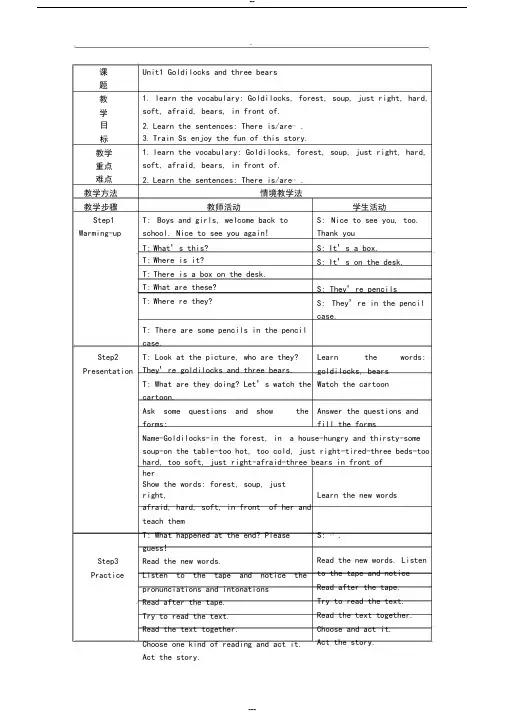
.课题教学目标教学重点难点Unit1 Goldilocks and three bears1. learn the vocabulary: Goldilocks, forest, soup, just right, hard, soft, afraid, bears, in front of.2.Learn the sentences: There is/are⋯.3.Train Ss enjoy the fun of this story.1.learn the vocabulary: Goldilocks, forest, soup, just right, hard, soft, afraid, bears, in front of.2.Learn the sentences: There is/are⋯.教学方法教学步骤Step1 Warming-up情境教学法教师活动T:Boys and girls, welcome back toschool. Nice to see you again!T:What’s this?T:Where is it?T:There is a box on the desk.T:What are these?T:Where re they?学生活动S:Nice to see you, too.Thank youS:It’s a box.S:It’s on the desk.S: They’re pencilsS:They’re in the pencilcase.T: There are some pencils in the pencilcase.Step2 T: Look at the picture, who are they? Learn the words: Presentation They’re goldilocks and three bears. goldilocks, bearsT: What are they doing? Let’s watch the Watch the cartooncartoon.Ask some questions and show the Answer the questions andforms: fill the formsName-Goldilocks-in the forest, in a house-hungry and thirsty-somesoup-on the table-too hot, too cold, just right-tired-three beds-toohard, too soft, just right-afraid-three bears in front ofherShow the words: forest, soup, justright, Learn the new wordsafraid, hard, soft, in front of her andteach themT: What happened at the end? Please S: ⋯.guess!Step3 Read the new words.Practice Listen to the tape and notice the pronunciations and intonationsRead after the tape.Try to read the text.Read the text together.Choose one kind of reading and act it.Act the story. Read the new words. Listen to the tape and notice Read after the tape.Try to read the text. Read the text together. Choose and act it.Act the story...Step4 Describe the classroom: There is/are ⋯ Describe the classroom Consolidation on/in/ ⋯ .Step5 1. Copy the new words and sentences.Homework 2. Read, recite and act thisstory.Unit1 Goldilocks and three bears板in the forest hungry and thirsty some soup hot-cold just 书in a house tired three beds hard-soft right 设afraid three bears in front of her 计There is ⋯ . on the tableThere are⋯. in the room课cards, pictures, tape, 课前recorder 后准小备结课题教学目标教学重点难点教学方法教学步骤Step1 Warming-upStep2 Presentation Unit1 Goldilocks and three bears1.learn the vocabulary: beside, between.2.Learn the grammar of sentences: There is/are⋯ .3.Train Ss can use the sentences: There is/are⋯ correctly4. Review the words about feelings1.learn the vocabulary: beside, between.2.Learn the grammar of sentences: There is/are⋯ .3.Train Ss can use the sentences: There is/are⋯ correctly操练教学法教师活动学生活动T: At first, let ’s read the story together. Read the story. T: Read this story in roles. Read this story in roles. T: Act this dialogue, please. Act this dialogue.Talk about the learning tip. Learn the tip.T: What’s this? S: It’s a bag.T:Where is it? You may say “It’s Learn the vocabulary.between the desks”.(Teach: between)T: What are these? S: They’re apples.T:Where are they? You may say Learn the vocabulary“They’re beside the bag. Teach: besideRead the new words. Read the new words.Look at these pictures. Look at these pictures. Talk about these pictures and repeat this Talk about these pictures story and repeat this story Check the answers.(b, c, f, d, a, e) Check the answers.Look and talk about the pictures. Look and talk about them. Try to say them: There’s a house in the Try to say them...forest. There’s some soup in the table.There are three beds in the room. Thereare three bears in front of me.Check and write these sentences. Check and write.Look at the picture. Look at the picture.Say the rules about it. Say the rules about it.Draw the picture. Draw the picture.Talk about one’s picture. Talk about one’s picture.Read and act the story again. Read and act the storyagain.Look at the words and sentences. Look at the words andsentences.Try to say them. Try to say them.Check and write these sentences. Check and write them.Review the old words about feelings. Review the old words.Step3 Describe my bedroom: There is/are ⋯ Describe the bedroom Consolidation on/in/ ⋯ .Step4 1. Copy the new sentences.Homework 2. Describe my bedroom by oneself..Unit1 Goldilocks and three bears板书设计课前准备课题教学目标教学重点难点教学方法教学步骤Step1 Warming-up There is ⋯ .besidebetweenThere are⋯.cards, pictures, tape, 课recorder 后小结Unit1 Goldilocks and three bears1.Learn the word: tool, doctor, says, put on, cannot, find, their, really.2.Learn the sentences: There aren’tany ⋯. Here are ⋯. XX can ⋯ .3.Learn the phonetic of the letter“c”.4.Enjoy this cartoon story.1.Learn the words: tool, doctor, say, put on, cannot, find, their, really.2.Learn the sentences: There aren’tany ⋯. Here are ⋯. XX can ⋯ .3.Learn the phonetic of the letter“c”.谈话教学法教师活动学生活动T: Let’s describe our classrooms or our Describe classrooms or schoolbags, OK? schoolbags...Read and recite the new words. Read and recite the newwords.Write some sentences about places. Write some sentences.Step2 T: Look at the picture, please. Look at the picture. Presentation Listen to the tape. Listen to the tape.Teach the new words: tool, doctor, says, Learn the new words.put onFind the sameletter“c”. Find the same letter“c”.Read the phonetic /k/. Read the phonetic /k/.Read the short text. Read the short text.Act the short text. Act the short text.Find the other words. Find the other words.Do some exercises. Do some exercises.T: Look at the picture, who are they? S: They’re Bobby andTina.T: What are they saying? Let’s watch Watch the cartoon.the cartoon, please.Ask and answer, then fill in the forms. Ask, answer and fillBobby-hungry-some cakes-in the kitchen, in the fridgeTeach the new words: cannot, find, Learn the new words.their, reallyTeach the new sentences:There aren’t Learn the new sentences.any ⋯. Here are ⋯.T: Read the new words and sentences, Read the new words andplease. sentences.Listen to the tape and read after it,then Listen and read, thennotice the pronunciations and notice the pronunciationsintonations. and intonations.Read it together. Read it together.Act the dialogue. Act the dialogue.Step3 Make some sentences: There Make some sentences. Consolidation isn’t/aren’t⋯. Here is/are ⋯.Step4 1. Copy the new sentences.Homework 2. Read, recite and act this cartoonstory.There isn’t⋯.Unit1 Goldilocks and three bears板书aren t’⋯ .设 C -/k/ cannot=can’t really find their 计Here is ⋯.are ⋯.课cards, pictures, tape, 课前recorder 后准小..备结课Unit1 Goldilocks and three bears题教 1. Review the vocabulary and patterns of this unit.学 2. Learn the different drinks culture in western countries and China.目 3. Learn how to describe the places correctly.标 4. Appraise the harvest about this unit.教学 1. Review the vocabulary and patterns of this unit.重点 2. Learn the different drinks culture in western countries and China.难点 3. Learn how to describe the places correctly.教学方法复习教学法教学步骤教师活动学生活动Step1 Greetings and free talk. Greetings and free talk.Warming-up Read, recite and act this cartoon story. Read, recite and actDo some exercises about the phonetic Do some exercises./k/Enjoy and act the cartoon story. Enjoy and act.Step2 T: What’s this? S: Coffee.Presentation T: What’s that? S: Tea.Guess: Who is it for? Guess.Ask and answer: Ask and answer.Coffee is popular in western countries. Tea is popular in China.Teach the new words: popular, western Learn the new words.countries, culture, ChinaRead the sentences. Read the sentences.Say the different drinks culture. Say the different drinksculture.Look at the picture. Look at the picture.T: Talk about the picture in groups, Talk about the picture inplease. groups.Check and write the sentences: Check and write.I ’m in the living room. There is a table. There are some books on thetable. There are some toy cars under the table. There is a chair besidethe table. There are three umbrellas in front of the window. Oh, thereis a bear on the chair.Look at the pictures. Look at the pictures.T: Talk about the pictures in groups, Talk about the pictures inplease. groups.Check and write the sentences: Check and write.There are some apples on the table. There is some orange juice in theglass. There is a bird in the tree. There are some sweets in the box.Review this unit. Review this unit..Appraise the harvest of this unit. Appraise the harvest.Step3 Total the stars. Total the stars. Consolidation Teach: There be⋯.(就近原则 ) Learn: There be ⋯.(就近原则 )Step4 Homework板书设计课前准备课题教学目标教学重点难点教学方法教学步骤Step1 Warming-upStep2 Presentation 1.Copy the new sentences.2.Read, recite and act this cartoon story.Unit1 Goldilocks and three bearsCoffee is popular in western countries.Tea is popular in China.There is ⋯ . 就近There are⋯. 原则cards, pictures, tape, 课recorder 后小结Unit2 A new student1.Learn the vocabulary: classroom, table tennis room, computer room, music room, on the first/second/third floor, show her around2.Learn the patterns: How many are there ⋯? Is/Are there any⋯? Yes, there is/are.Learn the vocabulary: classroom, table tennis room, computer room, music room, on the first/second/third floor, show her around and patterns: How many are there⋯? Is/Are there any⋯ ? Yes, there⋯.情境教学法教师活动学生活动Greetings and free talk. Greetings and free talk.T: What’s in our classroom? S: There is/are⋯ .Recite some vocabulary. Recite some vocabulary. Check the answers. Check the answers.T: Look, who are they? S: Yang Ling and Miss Li. T: This is Nancy Black. She’s Yang Learn: Nancy Black, a new Ling ’s friend. She’s a new student. studentT: Can you show her around? S: Yes!Teach: show her around Learn: show her aroundT:What happened? Let’s watch the Watch the cartoon.cartoon, please.Ask and answer the questions, then fill Ask, answer the questions the forms. and fill the forms. classrooms-24-our classroom-on the second floortwo computer rooms, a library-on the third floor.a music room, a table tennis room-on the first floorListen to the tape and notice the Listen and notice.pronunciations and intonations.Try to read the dialogue. Try to readRead the story together. Read the story together.Choose one kind of reading and read in Choose one kind ofgroups. reading and read in groups.Read this story in roles. Read this story in roles.Act the dialogue. Act the dialogue.Step3 Read the new words and sentences. Read the new words and Consolidation sentences.T: Is there a blackboard in our S: Yes.classroom?Step4 Homework板书设计课前准备课题教学目标教学重点难点教学方法教学步骤Step1 T: Are there any pencils in yourpencil case?Teach: Is/Are there⋯?Describe something: Is there ⋯? Yes,there is. Are there any ⋯? Yes, thereare.1.Copy the new vocabulary.2.Read, recite and act this story.Unit2 A new studentHow many ⋯? There are⋯ .Is there ⋯? Yes, there is. Are there any ⋯? Yes, there are our classroom on the second floora library and two computer rooms on the third floora music room, a table tennis room on the first floorcards, pictures, tape, 课recorder 后小结Unit2 A new student1.Learn the vocabulary: Art room, library, playground.2.Learn the patterns: How many are there ⋯? Is/Are there any⋯? Yes, there is/are.3.Train Ss can use the ordinal numbers and“Is/Are there ⋯ ?1.Learn the patterns: How many are there ⋯? Is/Are there any⋯? Yes, there is/are.2.Train Ss can use the ordinal numbers and“Is/Are there ⋯ ?操练教学法教师活动学生活动Greetings and free talk. Greetings and free talk.. S: YesLearn: Is/Are there ⋯? Describe something..Warming-up Read this story. Read this story.Recite some vocabulary. Recite some vocabulary.Act this story inroles. Act this story in roles.Step2 T: Look, what ’s this? You may say“Art Guess.Presentation room”⋯ . ⋯ .Teach: art room, playground, library Learn the new wordsLook at the pictures. Look at the pictures.Read the words. Read the words.Ask and answer: Where’s the ⋯? It’son Ask and answer.the ⋯ floor.Check and write the sentences. Check and write.There is/are⋯ in our school. It’s/They’re on the ⋯floor.Teach the new words: one-first, Learn the new wordstwo-second, three-thirdAsk and answer: Is/Are there ⋯ ? Ask and answer.Yes/No, ⋯ .Look at the sentences. Look at the sentences.Teach words: isn’t=is not, aren’t=are Learn the new words.not, It’s=It is, They’re=They areAsk and answer: How many ⋯ are Ask and answer.there? There is/are⋯ in our school.Read the sentences. Read the sentences.Complete the grammar of“there”. Complete the grammar.Look at the picture. Look at the picture.Talk about the picture, then ask and Talk about the picture,answer: How many ⋯ are there? Is/Are then ask and answer.there ⋯? It’s/They’re on the ⋯floor.Check the answers. Check the answers.Step3 Make some dialogues: This is our Make some dialogues. Consolidation school. There is/are ⋯ in our school.It ’s/They’re on the ⋯floor.Teach: Is/Are there ⋯? Yes/No, there Learn the sentencesis/isn’t/are/aren’t. “there”Step4 1. Copy the new vocabulary.Homework 2. Describe our school to parents and friends.Unit2 A new student板How many ⋯ are there⋯ ?书There is/are⋯ . It’s/They’re on the⋯ floor设Is there ⋯? Yes, there is./No, there isn’t.计Are there ⋯? Yes, there are./No, therearen’t.Art room library playground 课cards, pictures, tape, 课前recorder 后..准小备结课Unit2 A new student题教 1. Learn the vocabulary: sing and dance, then, go to the cinema, 学swing, push, heavy, high, stop目2. Learn the patterns: XX is/are too/so⋯ .标3. Learn the phonetics of the letter“c”.教学 1. Learn the vocabulary: sing and dance, then, go to the cinema, 重点swing, push, heavy, high, stop难点2. Learn the phonetics of the letter“c”.教学方法谈话教学法教学步骤教师活动学生活动Step1 Greetings and free talk. Greetings and free talk. Warming-up Listen and write some sentences. Listen and write.Describe our school. Describe our school.Step2 Look at the picture. Look at the picture. Presentation Listen to the tape. Listen to the tape.Find the same letter“c”. Find the same letter.Say the phonetic /s/ about“c”. Say the phonetic /s/.Teach the new words: sing and dance, Learn the new words.then, go to the cinemaRead the sentences. Read the sentences.Act the short text. Act the short text.Find the other words. Find the other words.Do some exercises. Do some exercises.Check the answers. Check the answers.T: Look, who are they? S: Sam and Bobby.T: Please watch the cartoon story. Watch the cartoon.Teach the new words: on the swing, Teach the new words.heavy, push, stopAsk and answer, then fill the forms: Ask, answer and fill.Sam and Bobby-on the swing, Sam-push-so heavy-happy,Bobby-stop-too high-afraidListen and read after the tape, notice the Listen, read after thetapepronunciations and intonations. and noticeTry to read this story. Try to read this story.Read this story together. Read this story together.Read in roles. Read in roles.Act this story. Act this story.T: What about this story? S: Great fun./⋯ .Enjoy this story again. Enjoy this story again. ..Step3Make some dialogues: This is our Make some dialogues Consolidation playground. There is/are ⋯.It ’s/They ’re so/too ⋯ . Push/Stop!Make some sentences:Is/Are there ⋯ ? Make some sentences.Yes/No, there is/isn ’t/are/aren ’t. Step41. Write the new sentences.Homework2. Read, recite and act this cartoon story.Unit2 A new student板 Sam in the playground on the swingBobby 书 Push Stop 设 so heavytoo high 计 happyc /s/afraid课 cards, pictures, tape,课 前 recorder 后准 小 备结课 Unit2 A new student 题教 1. Learn the vocabulary: UK, ground floor, US学 2. Learn the patterns: There is/are (not)⋯ in my school. 目 3. Learn the different floors in UK and in US. 标 4. Appraise the harvest of this unit.教学 1. Learn the vocabulary: UK, ground floor, US重点 2. Learn the patterns: There is/are (not)⋯ in my school. 难点 3. Learn the different floors in UK and in US.教学方法复习教学法教学步骤教师活动学生活动Step1 Greetings and free talk. Greetings and free talk. Warming-up Read the cartoon story. Read the cartoon story. Act the cartoon story in roles. Act in roles. Do some exercises about the letter “c ”. Do some exercises.Check the answers. Check the answers. Step2 Look at the picture.Look at the picture. Presentation Listen to the tape.Listen to the tape. Teach the new words: UK, ground floor, Learn the new words. USRead the sentences.Read the sentences.Act the sentences.Act the sentences.Say the differentfloors in UK and in Say the different floorsinUS.UK and in US.Show the learning tip.Learn the tip...Look at the picture. Look at the picture.Talk about the picture. Talk about the picture.Think and write the sentences. Think and write.Check the answers. Check the answers.This is my school. There are thirty-one classrooms in my school. There is/are⋯ in my school. There is/are not⋯ in my school.Read and write the sentences. Read and write thesentences.Look at the pictures. Look at the pictures.Talk about the pictures. Talk about the pictures. Listen and number. Listen and number.Check the answers. Check the answers.Read and say the sentences. Read and say.Review the vocabulary and patterns of Review the vocabulary and this unit. patterns of this unit. Say the rules of it. Say the rules of it. Appraise the harvest of this unit. Appraise the harvest.Total the stars. Total the stars.Step3 Describe and write my school: There Describe and write my Consolidation is/are ⋯ in my school. school.Step4 1. Write some sentences.Homework 2. Finish the workbooks.Unit2 A new student板In the UK, this is the ground floor.书In the US, this is the first floor.设计There is/are⋯ in my school.There is/are not⋯ in my school.课cards, pictures, tape, 课前recorder 后准小备结课Unit3 Our animal friends题教1. Learn the vocabulary: animal, leg, body, arm, other, tail, wing.学2. Learn the patterns: I have animal friends. It ’s/They’re ⋯. It/They目can .... It has/They have⋯.标3. Train Ss can feel the great fun of the animal friends.教学1. Learn the vocabulary: animal, leg, body, arm, other, tail, wing.重点2. Learn the patterns: I have animal friends. It ’s/They’re ⋯. It/They难点can .... It has/They have⋯.教学方法情境教学法..教学步骤教师活动学生活动Step1 Greetings and free talk. Greetings and free talk. Warming-up Describe the classroom and our school Describe the classroom correctly. and our school correctly.Listen and write some sentences. Listen and write.Check the answers. Check the answers.Step2 T: Look at me, what’s this? S: It’s a mouth.Presentation T: This is my body, these are my arms.Teach the new words: body, arms Learn the new words.T: Please introduce your body and arms. Introduce bodies and arms.Teach the other words by the same way: Learn the other words byleg-legs, tail, wing-wings the same way.T: Please introduce yourself each other. Introduce each other.T: Let’s watch the cartoon, please. Watch the cartoon.Ask and answer, then fill the forms: Ask, answer and fill.⑴ Nancy-red, black-big eyes and bodies-no legs or arms-bigtails-swim⑵Mike-white-four legs, a short tail-big ears-run and jump⑶ Liu Tao-white-red eyes, long ears-four legs, a short tail-ru n⑷Su Hai-yellow and green-two legs and wings-a big mouth, a long tail-talkand flyListen to the tape and notice the Listen and notice.pronunciations and intonations.Read after the tape. Read after the tape.Try to read this story. Try to read this story.Choose one kind of reading and read in Choose one kind ofgroups. reading and read in groups.Read this story together. Read this story together.Read this story in roles. Read this story in roles.Act this story. Act this story.Step3 Teach the words about the singular and Learn the words about theConsolidation plural variants: arm-arms, leg-legs, singular and plural variantstail-tails, wing-wings, body-bodies( ☆)Teach the verb tense forms: I/They Learn the verb tense formshave ⋯. It has ⋯. (notice: have-has) (notice: have-has)Make some dialogues: I have ⋯ animal Make some dialogues.friend(s). They ⋯. It ⋯.Step4 1. Write the new vocabulary.Homework 2. Read, recite and act this story, then introduce the animal friends.Unit3 Our animal friends板I have ⋯书They have ⋯.设It has ⋯. ..计课前准备课题教学目标教学重点难点教学方法教学步骤Step1 Warming-upStep2 Presentationbody arm leg tail wingbodies arms legs tails wingscards, pictures, tape, 课recorder 后小结Unit3 Our animal friends1.Learn the vocabulary: foot-feet, have-has, doesn’t=does not, rabbit.2.Learn the patterns: Do ⋯ have ⋯? Yes, ⋯ do./No, ⋯ don’t.Does he/she have⋯ ? Yes, he/she does./No, he/she doesn’t.3.Train Ss notice the verb tense forms.1.Learn the patterns: Do ⋯ have ⋯? Yes, ⋯ do./No, ⋯ don’t.Does he/she have⋯ ? Yes, he/she does./No, he/she doesn’t.2.Train Ss notice the verb tense forms.操练教学法教师活动学生活动Greetings and free talk. Greetings and free talk.Listen and write the vocabulary. Listen and write.Check the answers. Check the answers.Read ,act and teach the learning tip Read, act and learn.Look at the pictures. Look at the pictures.Talk about the pictures. Talk about the pictures.T:What animal friends do they have? Have a match.Let’s have a match.Check the answers. Check the answers.Teach the word: rabbit, foot-feet Learn the word.Repeat this story. Repeat this story.Look at the sentences. Look at the sentences.Talk about the sentences. Talk about the sentences. Think and write. Think and write.Check the answers: Check the answers.Nancy’s fish have big eyes, bodies and tails. Mike’sdog has big ears and a short tail. Liu Tao’s rabbit has long ears and a short tail. Su Hai’sparrot has a big mouth, a long tail and two legs/wings.Read and write the sentences. Read and write.Read these sentences. Read these sentences.Teach the new words: have-has, Learn the new words.don’t=do not, doesn’t=does notTeach the grammar of the verb tense Teach the grammar of the forms. verb tense forms...Step3 ConsolidationStep4 Homework板书设计课前准备课题教学目标教学重点难点教学方法教学步骤Step1 Warming-upStep2 Presentation Do some exercises. Do some exercises.Check the answers. Check the answers.Look at the pictures. Look at the pictures.Talk about the pictures. Talk about the pictures. Ask and answer. Ask and answer.Fill in the blanks. Fill in the blanks.Check the answers. Check the answers.Read and write some new sentences. Read and write.Teach: have对应的是: I, you, we they, Learn: have 对应的词 , has has对应的是: it, he, she 对应的词1. Write the some sentences.2. Describe your animal friends.Unit3 Our animal friendsDo ⋯? Yes, ⋯ do.No, ⋯ don’t.rabbit foot-feetDoes ⋯? Yes, ⋯ does.No, ⋯ doesn’t.cards, pictures, tape, 课recorder 后小结Unit3 Our animal friends1. Learn the vocabulary: rain, sunny weather, come out, carry, give, finger, its.2.Learn the phonetic of the letter“u”.3.Train Ss enjoy the great fun of this cartoon story.1.Learn the vocabulary: rain, sunny weather, come out, carry, give, finger, its.2.Learn the phonetic of the letter“u”.谈话教学法教师活动学生活动Greetings and free talk. Greetings and free talk. Listen and write some sentences. Listen and write.Check the answers. Check the answers.Look at the pictures. Look at the pictures. Listen to the tape. Listen to the tape.Find the same letter“u”. Find the same letter“u”. Say the phonetic Λ/ / of the letter “u”. Say the phonetic Λ//. Teach the new words: rain, sunny Learn the new words. weather, come out, carry..Read the sentences. Read the sentences. Act the sentences. Act the sentences. Find the other words. Find the other words. Do some exercises. Do some exercises. Check the answers. Check the answers. T: Look at the pictures, who are they? S: Bobby, Sam and⋯. T: What are they doing? Please watch Watch the cartoon. the cartoon.Ask and answer, then fill in the forms: Ask, answer and fill.Bobby and Sam’s new friends-ten legs-eight legs, two arms-it’safraid-a big and hard body.Teach the new words: give, finger, its. Learn the new words.Listen to the tape and notice the Listen to the tape andpronunciations and intonations. notice.Read after the tape. Read after the tape.Choose one kind of reading and read in Choose one kind ofgroups. reading and read in groups.Read this cartoon story together. Read this cartoon storytogether.Read in roles. Read in roles.Act the dialogue. Act the dialogue.T: What about this cartoon story? S: ⋯.Step3 Make some dialogues: Do ⋯? Yes, ⋯Make some dialogues. Consolidation do./No, ⋯ don’t. Does ⋯? Yes, ⋯does./No, ⋯ doesn’t.Step4 1. Copy the new vocabulary.Homework 2. Read, recite and act this cartoonstory.It ’s⋯.Unit3 Our animal friends板书It has ⋯.设rain sunny weather come out carry-carries计u-/Λ/give finger its课cards, pictures, tape, 课前recorder 后准小备结课Unit3 Our animal friends题教 1. Learn the vocabulary: bald eagle, polar bear, Canada, kangaroo, 学Australia.目2. Learn the different animals in different countries...标 3. Appraise the harvest of this unit.教学 1. Learn the vocabulary: bald eagle, polar bear, Canada, kangaroo, 重点Australia.难点2. Learn the different animals in different countries.教学方法复习教学法教学步骤教师活动学生活动Step1 Greetings and free talk. Greetings and free talk. Warming-up Listen and write the sentences. Listen and write.Check the answers. Check the answers.Read and act the cartoon story in roles. Read and act the cartoon.Step2 Look at the pictures. Look at the pictures. Presentation Talk about the pictures. Talk about the pictures.Teach the new words: bald eagle, polar Learn the new words.bear, Canada, kangaroo, Australia.Read the sentences. Read the sentences.Act the sentences. Act the sentences.Teach the different animals in different Learn the different animalscountries. in different countries.Talk about the other animals. Talk about the otheranimals.Look at the pictures. Look at the pictures.Talk about the pictures. Talk about the pictures.Ask and answer, then fill the forms: Ask and answer, then fillthe forms.There is/are⋯ on the farm. It has/They have⋯.Describe the animals on the farm. Describe the animals onthe farm.Look at the picture. Look at the picture.Talk about the sentences. Talk about the sentences. Draw and write. Draw and write.Check the answers: Check the answers.This is my animal friend. It is ⋯. It has ⋯. Itcan ⋯.Read and write the sentences. Read and write.Review the vocabulary and patterns of Review the vocabulary andthis unit. patterns of this unit.Say the rules of it. Say the rules of it.Appraise the harvest of this unit. Appraise the harvest.Total the stars. Total the stars.Step3 Describe the animal friends. Describe the animal Consolidation friends.Step4 1. Describe and write the animal friends.。
译林版小学英语五年级上册教案全册
2.例题讲解是帮助学生巩固知识、突破难点的关键。
补充说明:在讲解例题时,教师应注重以下几点:
a.例题要具有代表性,涵盖本节课的重点和难点。
b.讲解过程中要注重思路的引导,而非直接给出答案。
c.鼓励学生主动思考、提问,提高他们的思维能力和解决问题的能力。
4.例题讲解:针对教学难点,进行例题讲解,巩固所学知识。
5.随堂练习:设计针对性的练习题,让学生巩固所学。
6.总结:对本节课的内容进行总结,强调重点、难点。
六、板书设计
1.标题:五年级上册英语教案
2.内容:各单元主题、重点词汇、句型和语法点。
七、作业设计
1.作业题目:
-听力练习:听录音,回答问题。
-口语练习:与家长进行对话,运用所学句型。
a.推荐适合学生的英语学习资源,如英语绘本、动画片等。
b.组织课后英语活动,如英语角、演讲比赛等,提高学生的实践能力。
c.引导学生进行自主学习,培养他们的学习兴趣和自主学习能力。
本节课程教学技巧和窍门
一、语言语调
1.在讲解重点和难点时,注意语速放慢,语调起伏,以增强语音的感染力。
2.运用不同的语调表达疑问、惊喜、鼓励等情感,提高学生的注意力。
二、时间分配
1.合理安排教学环节的时间,确保每个环节都有充足的时间进行。
2.在实践情景和例题讲解环节,适当增加时间,让学生充分参与和思考。
三、课堂提问
1.提问时注意问题的针对性和层次性,引导学生逐步深入思考。
2.鼓励学生主动提问,培养他们的问题意识。
四、情景导入
1.利用多媒体手段,如视频、图片等,创设生动、有趣的情景,吸引学生注意力。
最新整理译林版小学英语五年级上册教案全册教学设计全
最新整理译林版小学英语五年级上册教案全册教学设计全一、教学目标1. 听:能听懂并理解老师用英语进行简单的日常问候和介绍。
2. 说:能用简单的句子进行日常问候和介绍。
3. 读:能准确朗读并理解课文中的单词和简短的句子。
4. 写:能够正确书写并运用词汇和句型进行简单的书面表达。
二、教学重点1. 掌握课文中的单词和句型,能够正确运用。
2. 培养学生的听、说、读、写能力,提高语言表达能力。
三、教学准备教学课本、课件、图片、挂图、卡片等。
四、教学过程1. 热身活动- 利用图片引导学生进行简单的问候和自我介绍,例如:Hi, I'm Tom. What's your name?- 听音乐,让学生跟着音乐进行简单的动作操练。
2. 新课呈现- 利用图片教授新的单词和句型,并让学生模仿跟读。
- 通过Flash卡片练词汇,强化学生对单词的记忆。
3. 听、说训练- 老师用英语进行简单的问候和介绍,学生听懂并模仿回答。
- 学生两人一组,进行问候和介绍的练,老师巡回指导。
4. 读、写训练- 学生分角色朗读课文对话,并进行小组竞赛。
- 让学生自由发挥,利用所学句型进行书面表达。
5. 拓展活动- 分组进行角色扮演,模拟实际情景进行对话表演。
- 制作小手抄报,学生自由选择图片和文字进行设计和表达。
6. 总结与评价- 老师与学生一起总结当天的研究内容,并进行简单的小结评价。
- 鼓励学生根据自己的表现和进步,制定下节课的研究目标。
五、教学反思本节课通过多种教学方法和活动,培养了学生的听、说、读、写能力。
学生在浸入式的英语环境中,通过模仿、实践和交流,逐步掌握了课文中的单词和句型。
拓展活动加深了学生对知识的理解和运用,提高了学生的综合语言表达能力。
在教学过程中,学生积极参与,气氛活跃,取得了良好的学习效果。
译林小学英语五年级上册全册教案
译林小学英语五年级上册全册教案第一单元Lesson 1 - Greetings and Introductions教学目标:- 学生能够用英语打招呼和进行自我介绍。
教学内容:1. 学生应该学会问候问好的常用表达。
2. 学生应该学会用简单的句子进行自我介绍。
教学步骤:1. 引入课程,通过展示卡片和实际示范,介绍英文问候表达,例如:Hi, Hello, How are you?2. 学生模仿老师的表达方式,练问候。
3. 教师演示自我介绍的范例,学生跟读。
4. 学生之间进行互相问候和自我介绍的练,教师引导和纠正。
5. 小组活动:学生分成小组,进行对话练,互相问候和介绍。
扩展活动:1. 学生可以在家庭成员、朋友等的帮助下记录简单自我介绍的视频,分享给全班同学。
2. 学生可以设计海报或小册子,用英文介绍自己,展示给同学和老师。
Lesson 2 - Numbers and Colors教学目标:- 学生能够认识并用英语表达数字和颜色。
- 学生能够运用所学数字和颜色进行简单的对话。
教学内容:1. 学生应该掌握基本的数目词汇,如1-10。
2. 学生应该学会用英语表达并辨认常见的颜色。
教学步骤:1. 引入课程,通过卡片和实物展示数字1-10以及常见颜色,例如:red, blue, yellow。
2. 学生模仿老师的读音和展示方式,研究数字和颜色的表达。
3. 学生之间进行数字和颜色的问答,巩固所学内容。
4. 教师使用教具、游戏等互动方式,帮助学生更好地理解并运用所学的数字和颜色。
扩展活动:1. 学生可以制作数字和颜色的卡片,用来进行自我复和游戏。
2. 学生可以进行数字和颜色的找图游戏,提高对英文数字和颜色的辨认能力。
第二单元Lesson 3 - Everyday Activities教学目标:- 学生能够用英语描述日常活动。
- 学生能够理解并运用与日常活动相关的词汇。
教学内容:1. 学生应该学会用英语表达和辨认常见的日常活动,如:get up, eat breakfast, go to school。
译林新版五年级上册英语全册教案(完美版)
附送教师精彩课堂用语(不需要可自行删除)(听说读问写)☆☆☆☆☆☆☆☆☆☆听☆☆☆☆☆☆☆☆☆☆1、谢谢大家听得这么专心。
2、大家对这些内容这么感兴趣,真让我高兴。
3、你们专注听讲的表情,使我快乐,给我鼓励。
4、我从你们的姿态上感觉到,你们听明白了。
5、我不知道我这样说是否合适。
6、不知我说清了没有,说明白了没有。
7、我的解释不知是否令你们满意,课后让我们大家再去找有关的书来读读。
8、你们的眼神告诉我,你们还是没有明白,想不想让我再讲一遍?9、会“听”也是会学习的表现。
我希望大家认真听好我下面要说的一段话。
10、从听课的情况反映出,我们是一个素质良好的集体。
☆☆☆☆☆☆☆☆☆☆说☆☆☆☆☆☆☆☆☆☆1、谢谢你,你说的很正确,很清楚。
2、虽然你说的不完全正确,但我还是要感谢你的勇气。
3、你很有创见,这非常可贵。
请再响亮地说一遍。
4、××说得还不完全,请哪一位再补充。
5、老师知道你心里已经明白,但是嘴上说不出,我把你的意思转述出来,然后再请你学说一遍。
6、说,是用嘴来写,无论是一句话,还是一段话,首先要说清楚,想好了再说,把自己要说的话在心里整理一下就能说清楚。
7、对!说得很好,我很高兴你有这样的认识,很高兴你能说得这么好!8、我们今天的讨论很热烈,参与的人数也多,说得很有质量,我为你们感到骄傲。
9、说话,是把自己心里的想法表达出来,与别人交流。
说时要想想,别人听得明白吗?10、说话,是与别人交流,所以要注意仪态,身要正,不扭动,眼要正视对方。
对!就是这样!人在小时候容易纠正不良习惯,经常注意哦。
☆☆☆☆☆☆☆☆☆☆读☆☆☆☆☆☆☆☆☆☆1、“读”是我们学习语文最基本的方法之一,古人说,读书时应该做到“眼到,口到,心到”。
我看,你们今天达到了这个要求。
2、大家自由读书的这段时间里,教室里只听见琅琅书声,大家专注的神情让我感受到什么叫“求知若渴”,我很感动。
3、经过这么一读,这一段文字的意思就明白了,不需要再说明什么了。
译林版小学英语五年级上册教案全册
译林版小学英语五年级上册教案全册一、教学内容Unit 1: Goldilocks and the three bearsUnit 2: A new studentUnit 3: Our animal friendsUnit 4: HobbiesUnit 5: Cartoon timeUnit 6: A festival详细内容涵盖各单元的词汇、语法、会话、阅读、写作和文化部分。
二、教学目标1. 掌握各单元的生词和短语,并能熟练运用。
2. 掌握一般现在时、一般过去时等基本语法结构,并能在实际情境中运用。
三、教学难点与重点1. 教学难点:时态的运用、词汇的扩展运用、阅读理解。
2. 教学重点:词汇学习、语法结构、会话练习。
四、教具与学具准备1. 教具:PPT、磁带、卡片、挂图等。
2. 学具:课本、练习册、词汇卡片、彩色笔等。
五、教学过程1. 导入:通过图片、歌曲、故事等形式,引入新课内容,激发学生的学习兴趣。
2. 新课内容展示:呈现新课的词汇、语法、会话等,引导学生进行学习。
3. 例题讲解:针对重点和难点,进行详细的讲解和示范。
4. 随堂练习:设计有针对性的练习,巩固所学知识。
5. 小组活动:分组进行角色扮演、讨论等活动,提高学生的实践运用能力。
六、板书设计1. 新课和主题。
2. 重点词汇和短语。
3. 语法结构。
4. 会话示例。
5. 练习题目。
七、作业设计1. 作业题目:复习词汇,用单词造句。
根据所给情景,编写一段对话。
阅读短文,回答问题。
答案:词汇造句答案略。
对话示例:略。
阅读理解答案:略。
八、课后反思及拓展延伸1. 教学反思:针对本节课的教学效果,分析优点和不足,以便进行改进。
2. 拓展延伸:鼓励学生进行课后阅读、观看英语动画片等,提高英语素养。
同时,教师可提供相关的学习资料和活动建议,供学生选择使用。
重点和难点解析1. 教学内容的针对性2. 教学目标的具体化3. 教学难点与重点的突出4. 教学过程的实践情景引入5. 板书设计的逻辑结构6. 作业设计的针对性与拓展性一、教学内容的针对性教学内容应紧密结合学生实际,关注学生的兴趣点和需求。
2024年译林版小学英语五年级上册教案 全册
2024年译林版小学英语五年级上册教案全册一、教学目标1.让学生掌握本册所学单词、短语和句型,提高学生的英语听说读写能力。
2.培养学生的英语思维能力和跨文化交际意识。
二、教学内容1.词汇:本册共12个单元,每个单元包含10-15个单词,共计150个左右单词。
2.语法:一般现在时、一般过去时、一般将来时、现在进行时等。
3.话题:日常生活、兴趣爱好、季节与节日、动植物、交通工具等。
三、教学重点与难点1.教学重点:掌握本册所学单词、短语和句型;培养学生的英语听说读写能力;培养学生的英语思维能力和跨文化交际意识。
2.教学难点:一般现在时、一般过去时、一般将来时、现在进行时等语法点的运用;对话和短文的理解和分析。
四、教学安排1.第一阶段(1-4周):学习第1-4单元,每周学习一个单元,重点掌握单词、短语和句型,进行听说读写训练。
2.第二阶段(5-8周):学习第5-8单元,每周学习一个单元,巩固语法知识,提高学生的英语思维能力。
3.第三阶段(9-12周):学习第9-12单元,每周学习一个单元,进行综合训练,提高学生的英语实际运用能力。
Unit1What'sthis?课时安排:2课时第1课时教学目标:1.让学生掌握本课时所学单词:pen,pencil,ruler,eraser,book,bag等。
2.让学生掌握句型"What'sthis?"和"It'sa/an"。
3.培养学生的听说能力。
教学步骤:1.导入:利用图片引入本课时所学单词,让学生猜猜是什么。
2.新课内容:讲解单词和句型,让学生模仿跟读。
3.练习:让学生两两对话,练习使用"What'sthis?"和"It'sa/an"句型。
4.小组活动:让学生用所学单词和句型描述自己的学习用品。
第2课时教学目标:1.巩固本课时所学单词和句型。
2.培养学生的书写能力。