
(人教版)中考英语总复习语法:专题6-动词(88页)
(3)及物动词也可跟“复合宾语”(宾语和宾语补足 语)。 I found a little boy cry in the corner yesterday. 昨天我发现一个小男孩在角落里哭。 注:带省略to的不定式或现在分词作宾语补足语 的动词有:make,let,have,see,watch,notice, hear等。
专题六
动
词
考点一
动词的分类
动词按含义及它们在句中的作用分为四类:实义 (行为)动词、连系动词、助动词和情态动词。 1.实义(行为)动词 实义动词意义完整,能够独立作谓语。按其句法 作用,又可细分为及物动词和不及物动词。
(1)及物动词(vt.)需要跟宾语。 I learn English every day.(English是learn的宾语) 我每天都学英语。
考查动词词义辨析。 cost“花费”,
物作主语; spend“花费”, 人作主语; pay for“付款”, 人作主语。由句意可知选 A 项。
4 . The roof of the house needs repairing. It's raining now; you'd better get something to ________ rain drops. A.control B.cover C.carry D.catch 【解析】D 考 查 动 词 词 义 辨 析 。 catch rain drops“接住/装雨水”,符合语境。故选 D。
易混提醒:(1)比较can和be able to 两者表示能力时用法相同,但can只有现在式can 和过去式could两种形式,be able to有现在、过去和将 来时等多种形式。另外,be able to常常有做成了某件 事的意味。
(2)can't和mustn't can't表示否定推测,意为“不可能”;mustn't是 “禁止,不允许”的意思,不能用来表推测,而 must 用在肯定句中表示较有把握的推测,意为“一定”。 He must be working in his office. 他一定在办公室工作。 Mike can't have found his car, for he came to work by bus this morning. 迈克一定还没有找回他的车,因 为早上他是坐公共汽车来上班的。
(2)及物动词可以跟 宾语)。
“双宾语”(直接宾语和间接
In England,people usually call me Jim for short. 在英国,人们通常简称我Jim。 I gave my father a book for his birthday. 我给父亲一本书作为他的生日礼物。 注:带双宾语的动词有:give, bring, buy, get, leave, lend, make, offer, pass, teach, tell, write, read, return等。
【解析】B 考查动词短语辨析。get away“离开, 逃跑”; take away“带走, 外带”; send away“派遣, 解雇”; throw away“扔掉”。根据题意,选择 take away,表示食物需要外带。
2. (2014· 北京)—Must I hand in my homework now, Mr. Smith? —No, you ________. A.can't C.wouldn't B.shouldn't D.needn't
3.动词+副词+介词 这类动词一律用作及物动词,如look down upon“看不起”,look forward to“盼望”。此种结 构中,宾语要放在介词之后。 The boy gets on well with his classmates. 这个男孩与同学们相处得很融洽。
4.动词+名词+介词 这类动词也只能用作及物动词,如take care of“照顾”,make use of“利用”。此种结构中,宾 语放在介词之后。 We'll take part in the meeting tomorrow. 明天我们都将参加会议。
3.助动词 助动词本身无词汇意义或意义不完全,不能单独 用作谓语。助动词在句中与实义动词连用,帮助构成 各种时态、语态以及否定和疑问结构。常用的助动词 有be, have, has, do, does, did, will, shall等。
(1)助动词be(am, is, are, was, were) 助动词be的功能有两个:(1)“助动词be+现在分 词”构成各种进行时;(2)“助动词be+过去分词”构 成各种被动语态。 We are playing basketball.我们正在打篮球。 Annie was invited to the party. She had a wonderful time with us. 安妮被邀请去参加聚会,她和 我们在一起玩得很开心。
(3)must 的用法: ①表示“必须”。 There's only one day to go. You must finish your schoolwork by tomorrow. 只剩一天时间了,到明天为止 你必须完成你的学校作业。
②表示推测, “一定”。 must 表示推测时一般用于 肯定句。在疑问句和否定句中一般应用 can,否定句中 也用 may, 但 may not 表示“可能不”, 而 can't 表示“不 It's raining hard. The road must be wet. 雨下得很大,路一定很湿。
(4)助动词will(would)和shall(should)用于构成一般 将来时和过去将来时态。will(would)可用于一切人 称,shall(should)用于第一人称,较正式,现今多代之 以will(would)。 I shall/will be eighteen next year.明年我就18岁 了。
【解析】D 考查情态动词。以 Must 开头的一般 疑问句作否定回答时应用“No,... needn't.”
3.—How much is the ticket to Central Park? —A oneway ticket________ $40, can________ another $20 for a roundtrip. A.costs; pay C.pay; spend 【解析】A B.cost; spend D.spends; pay and you
4.情态动词 情态动词本身虽有意义,但不完整。它们表示说 话人的能力、语气或情态等,如“可能;应当”。它 们不能单独作谓语,只能和主要动词一起构成谓语。 情态动词多数没有人称和数的变化。主要有: can/could,may/might,must,need,dare, will/would,shall/should等。
(2)“助动词have(has, had)+过去分词”构成各种 完成时态。 Miss Smith has taught us English since five years ago.史密斯小姐从5年前就教我们英语。
(3)助动词do(does, did)用于构成疑问句、倒装句、 否定句,加强语气及代替前面刚出现的动词等。 Do you live in Beijing?你住在北京吗? I don't like fish. 我不喜欢鱼。 Not only does she speak English, she is also good with computers. 她不仅会说英语,还精通计算机。 Anna works harder than David does. 安娜工作比戴维努力。 Do be careful. 一定要小心。
Please put on your coat.请穿上你的外套。 Let's think it over.咱们再仔细考虑一下。
2.动词+介词 相当于一个及物动词。无论宾语是名词还是代 词,都应放在介词之后。 You'll look after her at home.你要在家照料她。 I'm looking for my ruler.我正在找我的尺子。
(2)may 的用法: ①表示请求、许可,意为“可以”。 May I come in? 我可以进来吗? ②表示猜测,意为“可能;也许”等。can 与 may 均可用来征求意见或允许,意为“可以”,一般可互换 使用。 He may come tomorrow.明天他可能会来。
③以may开头的一般疑问句,其肯定回答应用 may,而其否定回答则多用mustn't,而不用may not。
考点二
短语动词
英语中有许多动词可以加上介词、副词等构成短 语动词。短语动词像动词一样有及物和不及物之分。 它们尽管由几个词构成,但可以作为一个整体看待, 同实义动词一样使用。
常用的构成方式主要有以下五种: 1.动词+副词 可用作及物或不及物动词,如“小心”(用作不及物动 词)。如果用作及物短语动词应注意宾语位置的不同: 宾语如果是名词,可以放在副词后面,也可以放 在动词与副词之间;宾语如果是代词,则必须放在动 词和副词之间。
(4)不及物动词后面不能直接跟宾语。 We arrived at London at noon. 我们中午到达伦敦。
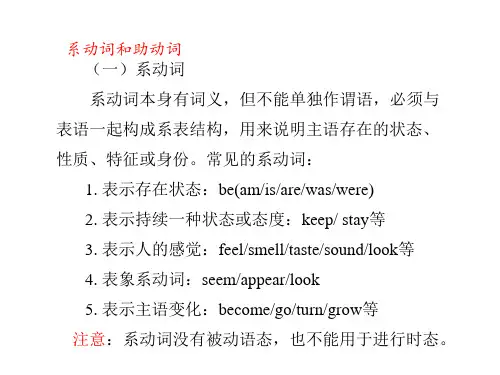
2.连系动词 连系动词本身有词义,但不能单独作谓语,必须 和表语一起构成谓语,说明主语的状态、性质、特征 或身份。 She is very young.她很年轻。
常见的连系动词有:be,become(变成),get(成 为;变得),look(看上去),seem(似乎;好像), turn(变得),sound(听起来),smell(闻起来),taste(尝 起来),feel(感觉),keep(保持)。这些词没有被动语态 形式,也不用于进行时态。
2024年人教版中考英语复习之动词和动词短语课件
情态动词 must
用法
例子
The notebook must be Li
用于肯定句,表示非常有把握的 Ming's.His name is on the first 推测,意为“一定,肯定” page.这个笔记本一定是李明 的。他的名字在第一页。
表推测的可能性大小为:must>can(疑问句)>could>may>might>can't
系动词
be动词
五感官:look(看起来), smell(闻起来), taste(尝起来),sound(听起来), feel(感觉)
例子
My brother is very tall.
①The mountain looks so beautiful. ②The dish smells good and tastes
①You must arrive here before 10 o'clock tomorrow.你必须明
天十点之前到这里。
②I missed the last bus, so I had to walk home.我错过了最后一
班公交车,所以我得走回家 了。
need
意为“需要”,作情态动词时常 You needn't come tomorrow.明
情态动词
表示说话人的情感与态度,不能单独作谓语,只能和实义动词原形 一起构成谓语,一般无人称和数的变化。 1.常用情态动词一览表:
情态动词 can/could
用法
例子
①My best friend can speak
(1)表能力,意为“能;会”, can用于一般现在时,could用于一
般过去时
(2)表请求或许可,意为“可以”, 在疑问句中,could比can语气更委
2025年人教版中考英语复习--动词+课件

remain, stay 等
(真)
类别
用法
示例
表示主语对外界事物 I feel a little nervous. 我感觉有点紧
感觉 特 征 或 状 态 的 感 觉 。 张。(真)
性系 常 见 的 此 类 动 词 有 : The leaves taste rather bitter.
动词 seem, appear, look, feel, 这些叶子尝起来相当苦。(典)
构大多为“名词/形容词/ sleepwalk 梦游
副词 + 动词”
blacklist 将……列入黑 名单
短语 动词
由两个或, 结 构 after 照顾
大多为“动词
+
介词/副词”take off up 抚养
起飞
look bring
动词的用法
本部分将重点讲解按句法作用划分的四类动 词的用法,即实义动词、连系动词、助动词 和情态动词的用法。 实义动词的用法
性系 常 见 的 此 类 动 词 有 : The leaves taste rather bitter.
动词 seem, appear, look, feel, 这些叶子尝起来相当苦。(典)
taste 等
英语中,所有连系动词均不能用于被动语态。 例如:
Tea tastes better with milk. 加了牛奶的 茶尝起来口感更好。(真)
按词的构成划分
按照词的构成,英语动词可分为单词动词、复合 动词和短语动词。
类别
概念
示例
单词 由一个单词构成的动词
动词
decide 决定 drink 喝 hope 希望 jump 跳跃 protect 保 护 teach 讲授
中考英语中考英语总复习动词短语知识点梳理及经典练习(超详细)

人教版中考英语中考英语总复习动词短语知识点梳理及经典练习(超详细)一、动词1.— Tina, breakfast is ready. Dad cooked it for us.— It can't be father. He ______ early on Sundays.A. always gets upB. often got upC. had got upD. never gets up【答案】 D【解析】【分析】always gets up总是起床;often got up经常起床;had got up已经起床;never gets up从来不起床。
句意:蒂娜,早饭已经准备好了。
爸爸给我们做的。
——不可能是父亲。
他在周日从来不起床。
故选D。
【点评】考查短语辨析2.—Who reached the station on time?—I ! In fact, I arrived there 5 minutes earlier.A. wasB. reachedC. didD. do【答案】 C【解析】【分析】问句的谓语动词为行为动词reach的过去式,故在作简短回答时,需要借助助动词did.故选C。
句意是:—谁按时到达了车站?—我!实际上我提前五分钟就到了那里。
【点评】本题考查助动词的使用。
3.Thomas Edison was such a great person who never that he made so many great inventions all his life.A. took upB. thought upC. made upD. gave up【答案】 D【解析】【分析】。
句意:爱迪生是如此伟大的人物, 一生中他从来不放弃他做的这么多的发明。
A. took up接收;B. thought up想出;C. made up编造;D. gave up放弃。
根据语意故答案选D。
中考英语语法全方位复习——动词 (共21张PPT)

may和might
1.都表示“可能,可以,请求,许可,祝愿”, might的语气较为委婉。 对may开头的问句,肯定回答用Yes,you may.或Yes, please. 否定回答用No,you mustn’t./No,you can’t. Your homework. -May I use your pen? -Yes, you may./No, you mustn't/can’t. May you be happy.
动词+副词 宾语是名词,可置于副词后面,亦可置于动词和副词之间。 宾语是人称代词和反身代词,只能置于动词和副词之间。如: wake up, put down, turn on, turn down, pick up, work out, threw away, think over, find out, give up, put on, take off, look up, bring up, set up等He walked out the math problem. = He walked the mast problem out. Don't wake me up. (不说Don't wake up with me. )
考点3 情态动词
情态动词表示讲话人的情感、态度和语气。本身具有 一定的意义,但不能独立作谓语,没有人称和数的变 化,且后面必须跟动词原形。
can和be able to
1.两者都表示“能,可能,可以”。be able to可以 用于各种时态,can没有将来时和完成时。 can和它的过去式could还可表示请求和猜测。 He will be able to tell you the news soon. -Could I have the TV on? -Yes, you can./No, you can't. He couldn't be a bad man.
最新人教版九年级英语中考复习课件:动词 (共19张PPT)
2.“助动词 have/has/had+过去分词”构成完 成时。 He has lived in Beijingn since he was born.
自他出生以来,他一直住在北京。
3.助动词do或其相关形式 助动词do 或其相关形式用于构成疑问句,倒装 句、否定句、加强说话的语气及代替前面出现的动
They asked me what l was doing all afternoon.他们 问我整个下午一直在干什么。 (2)“助动词be+过去分词”构成被动语态。 The baby was put in bed by his mother.这个婴儿被
他妈妈放在床上。
The invitation was received yesterday.昨天收到了 请帖。
A. taste B. smell C. sound D. look
2.(2017年天津) When you break rules, you should _______ to A your teacher.
A. apologise
B. introduce
C. expect
D. compare
A 3(2017年孝感)For our safety, we must ______ traffic rules on the way to school. A.follow B.change C.make D.break
D —No, it'll be _______ till next week because of th ebad weather.
A. put out B. put on C. put away D. put off
1. (2017年重庆A卷)There are so many fish swiming in the D pool. They ______ very happy.
人教版九年级英语中考专题复习课件--动词
中考复习与训练英语 ·配人教版
考点二 情态动词
情态动词有一定的词义,但词义不完整,不能独立作谓语,必须和动词原形连
用,表示说话人对某一动作或状态的态度和看法。情态动词没有人称和数的变化。
情态动词
用法
表示能力,意为“能、 会”
例句
She can swim fast,but I can't.她能游得快,但我不 能。
人教版九年级英语中考专题复习课件--动词
专题八 动词的分类
中考复习与训练英语 ·配人教版
透析中考
考点一 动词词义辨析
1.行为动词辨析
行为动词(或称实义动词)分为及物动词和不及物动词,表示动作或状态,在句
中能独立作谓语。
动词
例词
及物动词 不及物动词
remind, notice,allow, promise, buy,catch,eat,find,give,hear, love,write
can
表示请求、允许,意为 “可以”
You can borrow my dictionary.你可以借我的字典。
表示推测,意为“可 能”,用于否定句和疑 问句
Can the news be true?这个消息是真的吗? He can't have gone there alone.他不可能独自去那 里。
When I was a child,I would go swimming with other children in summer.小时候,在夏天我总 会同别的孩子一块儿去游泳。
表示对未来的想象 表示建议,意为“最好”
I would have two wings and then fly to the moon.我想有一对翅膀,然后飞到月球上去。
2023年中考英语语法---动词及动词短语专题复习及练习题(含答案)
2023年中考英语语法---动词及动词短语专题复习及练习题(含答案)一、动词的基本框架动词包括实义动词、系动词、助动词和情态动词。
(一)实义动词实义动词是能独立作谓语的动词。
按其句法功能可分为及物动词和不及物动词;按其持续性可分为延续性动词和非延续性动词。
1.及物动词:及物动词本身意义不完整,需要接宾语才能使其意思完整。
(1)动词+宾语I like this book very much.我非常喜欢这本书。
(2)动词+宾语+宾补We call the bird Polly.我们叫这只鸟Polly。
I saw the children play in the park yesterday.昨天我看见孩子们在公园玩。
注意:用省略to的不定式或现在分词作宾补的动词有:have,see,watch,notice,hear等。
(3)动词+间接宾语+直接宾语Please pass me the salt.请把盐递给我。
常见的带双宾语的动词有:give,bring,buy,get,leave,lend,make,offer,pass,teach,tell等。
2.不及物动词不及物动词自身意思完整,不用接宾语。
Horses run fast.马跑得快。
(1)有些动词既可作及物动词又可作不及物动词。
We study English.我们学习英语。
(及物动词)We study hard.我们努力学习。
(不及物动词)(2)有些不及物动词与一些别的词搭配在一起构成动词短语,它的作用相当于一个及物动词。
①动词+介词Listen to the teacher carefully.仔细听老师讲。
此类动词短语后面的宾语无论是名词还是代词,都只能放在介词后面,不能放在动词和介词之间。
②动词+副词+介词Let’s go on with our work!让我们继续我们的工作吧!He gets along well with his classmates.他与他的同学们相处得很好。
中考英语动词专项复习 人教版最新精品复习资料
中考英语动词专项复习一、一般用法1.+ing 1).finish / enjoy / be busy / be worth / keep / spend / feel like/ prefer doing to doingmind/2)介词后+ doing:be good at / how about / what about / thank you forbe afraid of3).动词作主语Eg 1.That old man enjoys (讲)stories to children.2.He stayed in England for two years, but he isn’t good at 说English.3.I don’t feel like 吃anything.4. —It's too hot. Would you mind_______ the door?—______.Please do it. now.A. to open, OKB. opening, Certainly notC. opening, Of courseD. to open, Good idea2.+ to do1).ask sb. to do want sb. to do tell sb. to doallow sb. to do encourage sb. to do teach sb. to do2).would like to do3).It’s adj to do ;It’s best to do sth;I t’s time to do It takes sb.时段to doThere’s no time to do sth too…to do sth enough…to do sth 4).It is adj. for sb. to do It’s nice (kind) of you. to do sth.5). not to do6). 疑问词+ to do how to do it / what to doEg. 1. It’s necessary 服medicine on time.2.I t’s not easy so much homework in one day.A. for him to doB. of him to doC. for him doingD. of him doing3. It’s you to catch the thief.A. bad forB. nice ofC. easy ofD. nice for4. It’s very cold outside. Please tell the boy the coat.A. don’t take offB. take offC. don’t put onD. not take off5. We were poor then we had no room .A. to liveB. living inC. to live inD. to stay6. I can’t drive the car, can you show me first.A. what to doB. how to doC. where to goD. what do I do7.There is a room (居住)8. ---Mum,I think I’m ______ to get back to school.一Not really, my dear. You’d better stay at home for another day or two.A. so wellB. so goodC. well enoughD. good enough9. My teacher asked me _______ late for school again.A.not to be B.not be C.to be not10. Tell him be late for schoolA. not to B doesn't C. to not3.do (原动)1) let\make\listen to\hear\look at\watch\have\feel (主动不to,被动to)2) had better (not) do sth.3)would you please do4)why not do sth.= why don’t you do sth5)助动词+ do sth.6)情态动词(can, may, must, would, should, could)+ doEg.1. Tom wanted to make his brother (哭),but this time he is made (哭)by his brother.2. Finish your homework first, or I won’t let you .A.to go outB.go outC. going outD. will go out3 .It’s too noisy. You’d better the radio or others will be unhappy.A.to turn downB. turn onC. turn upD. turn down4. I’m very tired today. –Why a rest . A.don’t take B. not to take C. not take D. take5.do 看见某人做某事二、常见考点:(1)see / hear sb.(在主动中)doing 看见某人正在做某事to do sth.(在被动中)sb. be seen / hearddoing1.That day I saw some parents ________ at the back of the classroom,_______ to the teacher.A. sitting,listenedB. sat,listenedC. sitting,listeningD. sat,listening2. ---Do you still remember ______ me somewhere in Shanghai?---Yes,of course. Two years ago.A. to seeB. seeC. seeingD. saw形容词(2 ) make sb. (被动中)be made to do sthdo(3) 让某人做某事让别人做某事make makehave sb. + do have sth. donelet getget sb. to do sth1.---Did you have anyone ______ the trees? ---Yes,I had the trees _______.A. to water,waterB. to water,wateredC. water,to be wateredD. water,watered(4)keep doing ---- be kept to do find sb doing1.It kept for 3 days. A. on raining B to rain C. rained情态动词:+do(5)need实义动词:+to do1.You ______ to the meeting this afternoon if you have something important to do.A. needn’t to comeB. don’t need comeC. don’t need comingD. needn’t come(6) to do sth 停下来要做某事to do sth 记得/忘记要去做某事stop doing sth 停止做某事remember/forgetfrom doing sth 阻止做某事doing sth记得/忘记已做过某事1. At last the child stopped .and listened to the music.A. to cry B crying C cry(7)原形—过去式—过去分词相同的cost – cost – cost cut – cut – cut hit – hit – hit hurt – hurt – hurtlet – let – let put - put - put set - set – set read- read- readEg. 1.His sister read the picture-book three times yesterday.A. so she didB. she did soC. so did sheD. so did he2. Your father put on his clothes and went out, ?3. The boy (fall) off his bike and hurt himself.(8) 一感:feel, 二听:listen, hear,三让:have, make, let, 四看:see, watch, notice主动:+原形被动:+to do。
人教版中考英语复习专题动词基本形式X知识点总结及经典习题(含答案)
人教版中考英语复习专题动词基本形式X知识点总结及经典习题(含答案)一、动词基本形式1.— Mom, you look so tired. Let me ________ your some tea.—Thank you very much.A. takeB. fetchC. carry【答案】B【解析】【分析】句意:---妈妈,你看起来太累了,让我去给你弄点茶来吧。
---非常感谢。
take带走;fetch去取来;carry携带;手提肩挑,无方向性。
根据句意,故答案为B。
【点评】考查动词辨析。
熟记单词的意思,根据句子语境确定答案。
2.Mei Ping eats a lot every day. She has ___________ five pounds these days.A. put upB. turned onC. put onD. washed away【答案】 C【解析】【分析】句意:梅萍每天吃很多。
她这些天已经增长了五英镑。
put on weight:增长体重,put up: 搭起,turn on:打开,wash away: 冲走,根据语境,故选C。
【点评】考查动词短语。
熟记这四个短语的意思。
3.What me most is its sights.A. interested; interestedB. interested; interestingC. interesting; interestingD. interesting; interested【答案】 B【解析】【分析】根据选项可知句意为:最使我感兴趣的是它有趣的风景。
第一空应填动词,使......感兴趣interest,过去式为interested,故排除C和D。
第二空应填形容词修饰sights风景,应填ing形容词。
故选B。
4.The child doesn't need any help. He is old enough to himself.A. put onB. wearC. dressD. take care【答案】C【解析】【分析】句意:这个孩子不需要任何帮助,他足够大去自己穿衣服。
(人教版)中考英语总复习语法:专题8-动词的时态、语态(101页)
(2)过去完成时与现在完成时的主要区别是时间参 照点不同: 过去完成时的时间参照点是某个“过去的” 时间;现在完成时的时间参照点是“现在”。因此现在 完成时中的很多规则,也适用于过去完成时。 When I got to the cinema, the film had been on. 当我到达电影院时,电影已经开始了。
以辅音字母+y结尾的动词, 把y变为i再加-ed
以一个元音字母加一个辅音 字母结尾的重读闭音节词, 双写结尾字母再加-ed
study→studied carry→carried stop→stopped drop→dropped prefer→preferred
3.一般将来时 (1)表示将来某个时间要发生的动作或存在的状 态,其构成形式:“will/shall+动词原形”。常与表 示将来的时间状语tomorrow,next week,in+一段时 间等连用。 当主语是第一人称I或we时,问句中一般用shall。
③表单纯性的将来,与人的主观愿望和判断无关 时。 If it's made of wood, it will float on water. 这要是木材做的,它能浮在水面上。 (4)当主句为一般将来时态时,在if,as soon as, until, when等引导的状语从句中用一般现在时代替一 般将来时。 I will call you as soon as I get there. 我一到那儿就给你打电话。
特殊情况:have→has,am/are→is 考查热点:如果主句为一般将来时,if,unless等 引导的条件状语从句和when,until,as soon as等引导 的时间状语从句常用一般现在时表示将来。 What about going climbing if it doesn't rain tomorrow? 如果明天不下雨,去爬山怎么样?