
人教版初中英语七年级上册Unit6基础知识评析
人教版初中英语七年级上册Unit6基础知识评析Unit6 Do you like bananas?1.tomatoes西红柿(P.31)释:tomatoes是tomato的复数形式,tomato是可数名词,意为“西红柿”。
例如:There are three tomatoes on the table.桌子上有3个西红柿。
【助记】以o结尾的需加-es构成复数形式的名词:黑人(Negro)英雄(hero)爱吃土豆(potato)和西红柿(tomato)。
2.Do you like bananas?你喜欢香蕉吗?(P.31)释:①这是关于行为动词like一般现在时的一般疑问句及其回答。
询问某人的喜好,通常用一般疑问句“Do/Does+主语+like+其他?”。
肯定回答用:Yes, 主语+do/does.否定回答: No, 主语+do/doesn‘t.其中do和does为助动词。
例如:——Do you like the sweater?——Yes,I do. ——Does he like the pen?——No,he doesn’t. ②含有实义动词(行为动词)的一般现在时的肯定句,在改为疑问句和否定句时,主语是第三人称单数,要借助于助动词does;主语不是第三人称单数,要借助于助动词do。
例如:I like English very much. →I don’t like English very much.→ Do you like English?She likes English very much. →She doesn’t like English very much.→Does she like English?③like 1)行为动词,意为“喜欢”,其反义词是dislike. 例如:She likes his flowers.2)介词,意为“象……一样”,其反义词是unlike. 例如:He looks like his father.他与他父亲长得一样。
3.Do you like salad?你喜欢沙拉吗?(P.31)释:①salad,名词,意为“沙拉”,它是音译而来的。
Salad是西餐中一道经典的凉拌菜。
传统的沙拉是将洗净、切成块状或片状的生蔬菜(通常包括生菜、黄瓜和西红柿等)与沙拉酱混合,均匀搅拌即可。
沙拉也有水果沙拉(fruit salad)、土豆沙拉(potato salad)、海鲜沙拉(seafood salad)等多个品种。
例如:Do you like fruit salad?你喜欢水果沙拉吗?I like potato salad.我喜欢土豆沙拉。
【拓展】谐音记忆各种“外来食品”:hamburger汉堡包salad沙拉Coca-Coca 可口可乐sandwich三明治②do有两种词性:1)行为动词,意为“做”,如:Let’s do our homework.咱们做作业吧。
2)助动词,常用于一般现在时,无词义,用于否定句和疑问句中。
例如:—Do you like bananas?你喜欢吃香蕉吗?—Yes,I do.—是的,我喜欢。
4Hey,John’s birthday dinner is next week.嗨,约翰的生日晚宴在下周。
(P.32)释:①birthday名词,意为“生日”。
与birthday相关的短语有:birthday dinner 生日晚宴birthday party生日聚会birthday cake生日蛋糕②dinner名词,意为“正餐,晚餐”。
与supper意思不完全相同。
Supper在英文中指晚餐。
Dinner一词常用来表示一天中的正餐(main meal),它既可以是晚餐,也可以是午餐。
说英语的国家,晚餐一般是一天中最为丰富的一餐,因此,dinner常用来指晚餐。
此外,dinner一词比较正式,邀请朋友赴晚餐常用它。
例如:We’ll have dinner together in the evening.晚上我们要一起聚餐。
【拓展】①一日三餐分别表达为breakfast(早餐),lunch(午餐),dinner/supper(晚餐)。
②与三餐相关的常用短语:at breakfast/lunch/dinner在吃早/午/晚餐,before breakfast/lunch/supper/dinner在早/午/晚饭之前,after breakfast/lunch/supper/dinner在早/午/晚饭之后,in the middle of breakfast/lunch/supper/dinner在早/午/晚饭中,have breakfast/lunch/dinner吃早/午/晚餐have sth.for breakfast/lunch/dinner早/午/晚餐吃某物。
(【拓展】a.“have+食品+for+三餐(breakfast/lunch/supper/dinner)表示“三餐吃……”,for表示“对……而言(来说)”。
如:She often has eggs,bananas and apples for breakfast.她早餐经常吃鸡蛋、香蕉和苹果。
For breakfast,Tom likes eggs,oranges,and bananas.早餐时,汤姆喜欢吃鸡蛋、桔子和香蕉。
for breakfast表示“就早餐而言”,for在此处介词,表示“对于,就……而言”,后面常跟名词或代词。
例如:For dinner,my mother likes salad and bread.晚餐,我妈妈喜欢吃沙拉和面包。
b. eat 与 have 这两个词均跟“吃”有关,但用法不同。
eat指把固体食物放在嘴里吃。
have意为“吃、喝”,常用在三餐名词之前,或meal之前,也可作“抽”、“吸”讲。
如: We eat these things.我们吃这些东西。
We have three eggs for breakfast.早餐我们吃了三个鸡蛋。
)③next week意为“下周”。
例如:Teachers’day is next week.We’ll go to the zoo next week.5.Let’s think about the food.我们考虑一下食物吧。
(P.32)释:①think about意为“考虑;思考”,think为不及物动词,常与介词about 连用,其后可跟名词、代词或v.ing形式。
例如:Let me thing about it.让我考虑考虑(这件事)。
I’m thinking about going to Beijing.我正在考虑着去北京呢。
②food 名词,意为“食品,食物”。
例如:I’m hungry.I need some food.我饿了。
我需要一些食物。
6.Sure.当然可以。
(P.32)释:sure副词,意为“当然;肯定;一定”,其同义词为certainly。
例如:——Can you give me some milk?你能给我一些牛奶吗?——Sure。
当然可以了。
7.How about burgers,vegetables salad,and some fruit?汉堡包、蔬菜沙拉和一些水果怎么样?(P.32)释:①How about…?意为“……怎么样?”,用于提出建议或请求,相当于“What about……?”,其中about为介词,其后可接名词、代词或v.ing形式。
例如:How about him?How about having some bread?【拓展】英语中,常用于提建议的句型,还有:①Let’s…意为“让我们……吧”。
例如:Let’s have some apples.让我们吃些苹果吧。
②Why not…?意为“为什么不……呢?”。
例如:Why not ask our teacher? ③fruit名词,意为“水果”。
表示水果的总称时,无复数形式,但表示种类时有复数形式。
例如:Do you have much fruit?你吃很多水果吗?There are many(kinds of)fruits in the basket.篮子里有很多(各种各样的)水果。
8.Yes,you’re right.是的,你是对的。
(P.32)释:right形容词,意为“正确的;适当的”,在句中作表语或定语。
例如:Is he right?他是正确的吗?It’s a right answer.这是一个正确的答案。
9.Let’s have strawberries ande apples then.那么我们就吃草莓和苹果吧。
(P.32)释:①have此处用作及物动词,意为“吃”,相当于eat。
如果have后的名词表示饮料,have则意为“喝”,相当于drink。
例如:She has two bananas.她吃了两个香蕉。
I have some milk in the morning.早晨我喝了一些牛奶。
②strawberries 是可数名词strawberry的复数形式,其变化是将词尾的y变为i,再加es.类似的单词还有:family家庭,party聚会(宴会)。
例如:I like strawberries very much.③then副词,意为“那么”,可位于句首或句尾。
例如:Then,let’s go.那么,我们走吧。
10.chicken鸡肉。
(P.33)释:chicken作不可数名词,意为“鸡肉”。
例如:I like eating fish and chicken.我喜欢吃鱼和鸡肉。
【拓展】chicken作可数名词时,意为“小鸡;鸡”。
例如:My grandmother has many chickens.我奶奶养了许多小鸡。
11.So,let’s get salad.那么,我们拿沙拉吧。
(P.33)释:so作连词,此处意为“那么”。
例如:So,let’s meet next week.那么,让我们下周见吧。
【拓展】so作连词,还可意为“因此,所以”。
例如:I’m ill today,so I can’t go to school.今天我病了,所以我不能去上学了。
12.Sports Star Eats Well.体育明星吃得好。
(P.35)释:①star可数名词,意为“明星”。
例如:He’s a movie star.他是一位电影明星。
【拓展】star作可数名词,还可意为“星星”。
例如:There are many stars in the sky.天空中有许多星星。
②eat动词,意为“吃”。
Have也可以表示“吃”或“喝”。
英语中的一日三餐为breakfast,lunch,supper,习惯上用have来表示吃早饭、午饭或晚饭。
人教版初中英语七年级上册Unit6基础知识例解
人教版初中英语七年级上册Unit6基础知识例解Unit6 Do you like bananas?()1.There are three _______ in my family.A. peopleB. personC. peoplesD. child分析:A 本题考查名词单复数形式的运用。
people的单复数同形;person的复数形式应是 persons;child的复数形式为children。
故答案为:A。
()2.There are few _____ in the fridge.Let's go and buy some potatoes, carrots and peppers.A. eggsB. meatC. vegetablesD. fruit分析:C。
本题考查名词单复数形式的运用。
由题干few(几乎没有)提示,后接可数名词,故排除B、D项。
根据下文,去买一些洋芋、红萝卜和辣椒。
可知冰箱里没有蔬菜了。
故选C。
()3.My grandfather often reads newspapers _________ breakfast.A. onB. inC. atD. of分析:C。
本题考查三餐前介词的用法。
依据题意:爷爷经常在早餐时看报纸。
表示每天进餐的时间。
其表示法为:at breakfast/lunch/supper/dinner等。
故选C。
( )4. —Does Lucy look like Lily? —Yes, she ____. They ____ the same.A. does; looksB. does; lookC. do; looksD. do; look分析:B 回答部分用she作主语, 是第三人称单数用does回答;they作主语时谓语动词用原形,故选B。
( )5. —What does Yang Ping look like? —____A.He is a student.B. He is in China.C. He is twelve.D. He has a big head.分析:D 本题考查固定句型的回答。
人教版七年级上册英语 Unit 6 知识点总结
人教版七年级上册英语Unit 6 知识点总结1.名词分类(1)可数名词:是可以计数的名词;可数名词前可以用 a, an 限定,表一个…...也可以用 one, two, three…限定;可数名词有复数形式。
(2)不可数名词:指不能计数的名词;不可数名词前不可以用 a, an 限定,表一个…...也不可以用 one, two, three…限定;不可数名词没有复数形式。
(3)既可数又不可数名词:定义:在某些情况下能计数,在某些情况下不能计数的名词。
既可数又不可数的名词有:chicken,fish,salad,ice-cream,orange……eg:a chicken 一只鸡chicken 鸡肉a salad 一碟沙拉salad 沙拉(指成份)2. . How about burgers, vegetable salad…?How about…?相当于 What about …? 意为“……怎么样?”是一个用来征询别人的意见、向别人提建议的交际用语。
about是介词,后跟名词、代词或动词-ing形式。
eg:How about nine o’clock? 9点钟怎么样?What about having hamburgers? 吃汉堡包怎么样?3.Let’s have strawberries and apples then.(1)Let’s have …让我们吃/喝……吧——let sb. do sth.让某人做某事;let sb. not do sth.让某人不做某事(2)have是多义词,归纳如下:1) 有,拥有; I have a new watch.2) 吃,喝; Let’s have some milk and some bread.3) 构成固定短语: have a look 看一看4. Let’s think about the food.(1)think about 思考,思索(一般是短时间的较仔细的考虑)e.g. :What do you think about that?你认为怎么样?I’ll have to think about it. 我得想一想。
人教版七年级英语上册 Unit 6 知识归纳(含答案)
人教版七年级英语上册 Unit 6 知识归纳(含答案)汉译英1.生日聚餐_______________2.体育明星_______________3.饮食习惯_______________4.健康食品_______________5.最后一个问题_______________6.作为早餐_______________7.晚餐后_______________8.下周_______________9.思考;思索_______________10.询问我关于午餐的事情_______________11.想变胖_______________12.买沙拉_______________【参考答案】1. birthday dinner2. sports star3. eating habit4. healthy food5. one last question6. for breakfast7. after dinner8. next week9. think about10. ask me about lunch11. want to be fat12. get salad汉译英1. Cindy认为她妹妹喜欢冰激凌。
____________________________________ 2.那么咱们喝牛奶吧!____________________________________ 3. Jack喜欢什么蔬菜?____________________________________ 4.——咱们早饭吃什么?——水果沙拉怎么样?____________________________________ ____________________________________ 5.——Tom喜欢梨吗?——不,他不喜欢。
____________________________________ ____________________________________ 6.——你们午饭后吃草莓吗?——是的,我们吃。
人教新目标英语七年级上册unit6单元知识点归纳总结

人教新目标英语七年级上册Unit 6Do you like bananas?知识点一重点短语Section A 重点短语1.think about 思考;思索2.birthday dinner 生日晚宴3.next week 下周4.How/What about…?提出建议…怎么样?5.vegetable salad 蔬菜沙拉6.have strawberries 吃草莓Section B 重点短语1.sports star 体育明星2.eat well 吃得好3.eating habit 饮食习惯4.for breakfast/lunch/dinner 早饭/午饭/晚饭5.one last question 最后一个问题6.after dinner 晚饭后7.healthy food 健康食物二词形变换1.tomato(名词)西红柿→(名词复数) tomatoes2.good (形容词)好的→(副词) well好3.healthy (形容词)健康的→(名词) health健康4.real (形容词)真的→(副词) really真正地三必记句型1.—Do you like bananas?你喜欢香蕉吗?—Yes,I do./No,I don't.是,我喜欢。
/不,我不喜欢。
2.—Does she like tomatoes?她喜欢西红柿吗?—Yes,she does./No,she doesn't.是的,她喜欢。
/不,她不喜欢。
3.He likes bananas,but he doesn't like oranges.他喜欢香蕉,但不喜欢橘子。
4.—How about burgers, vegetable salad, and some fruit?汉堡包、蔬菜沙拉还有水果怎么样?—Sounds good.听起来不错。
5.What do you like for breakfast ?你早饭喜欢吃什么? 6. What fruit do you like ?你喜欢吃什么水果? 7.Do you eat ice -cream after dinner ? 晚饭后你吃冰激凌吗?8.I don't want to be fat.我不想变胖 四可数名词和不可数名词的用法常用的不可数名词可分为以下几类: ⑴固体的物质或原料。
最新人教版七年级上册英语知识点全第六单元unit6知识点.docx
人教版七年级上册英语知识点全第六单元unit 6知识点教学重、难点1、掌握本节重点词汇; 2 、掌握可数名词的构成, 辨析分类可数与不可数名词;3、运用本节所学能够灵活地询问别人对食物的喜恶.1、重点词汇:banana, hamburger, tomato, ice-cream, salad, strawberry, pear, milk, bread,birthday ,dinner, week, burger, vegetable, fruit, right, apple, then, egg, carrot, chicken, breakfast,lunch, star, eat, well, habit, healthy, really, question, want, be, fat2、可数名词和不可数名词:1)food n.仅仅指“食物, 食品”时 , 是不可数名词;强调食物的种类时就是可数名词.可数名词不可数名词可数与不可数名词hamburger,egg, orange, banana,milk, bread, rice food, fruit, ice-cream,salad, apple, pear, carrot, vegetable,chickentomato, strawberries.e.g. I’ m hungry. I need some food.(不可数)/ There are all kings of foods onthe table.(可数)2)fruit n.水果.表示水果总称时, 无复数形式 , 但表示种类时有复数形式.Do you have much fruit? / There are many fruits in the basket.Fruit水果3)ice-cream, salad, chicken总称不可数名词much fruit许多水果种类可数名词kinds of fruits这几个名词 , 当表示物质的时候是不可数名词, 但当表示个体的时候是可数的.e.g. Let ’ s have some ice-cream.中ice-cream是泛指,强调“冰激凌”这类物质, 而非它的数量 .How many ice-creams do you want?中是要询问对方想要的数量 , 即几份 . 可以回答an ice-cream或two ice-creams.3、短语归纳:John’ s birthday dinner约翰的生日晚餐next week下周think about思考,考虑how about怎么样some fruit一些水果his birthday他的生日sport star体育明星eating habits饮食习惯for breakfast作早餐for dinner作晚餐one last question最后一个healthy food健康的食品3、 tomato可数n.“西柿”复数形式:tomatoes似的以o 尾的名 , 需加– es 构成复数形式的有potato, hero 但 photo 等而是以加—s 构成复数形式的.可以:有生命的名, 复数尾加-es,e.g. potato,hero;无生命的尾加-s,e.g. photo.4、某人的喜好, 通常用一般疑句:Do/does +主+ like +⋯?句型.肯定回答用: Yes, 主 + do/does.否定回答用: No, 主 + don ’ t /doesn’ t.(其中,do/does助).----Do you like the sweater ?----Yes, I do.----Does he like the pen ?----No, he doesn’ t.5、 Do you like bananas?1)bananas是banana的复数形式,表示一事物;在英中, 常用复数形式表示一事物 , 其前不用定冠the.2)like sb./sth.喜某人或某物 e.g. I like this ruler?/I like them.like to do sth.喜做某事(表示一次性的或不常的喜) e.g. She likes to play with her little sister.like doing sth.喜做某事(常性的喜) e.g. He likes playing the guitar.5、 Hey, John ’ s birthday dinner is next week翰的生日宴会在下周.1)John’ s birthday dinner翰的生日宴会.John ’s 是名所有格形式, 用于表示所属关系 .e.g. This is Jim’ s sister./It is Tom’s pen.2)next week下周e.g. Teacher’ s Day is next week.6、 think about考e.g. Let’ s think about the eggs./ Let’ s think about the food.7、 Howabout ⋯?====What about ⋯ ?⋯⋯怎么?, 用于提出建或求. 其中 about 是介, 后接 n./ pron./v-ing.e.g. How about him? / How about having some bread?展:英中常用于提建的句型有:1)Let’ s⋯ .我⋯⋯吧. e.g. Let’ s have some apples.2) Why not⋯?什么不⋯⋯呢? e.g. Why not ask our teacher?8、some “一些” , 用于修饰可数名词, 也可用来修饰不可数名词 . 一般用于肯定句中 . 但当表示建议或请求 , 并希望对方给予肯定回答时 , 句中也用 some, 而不用 any.any 一般用于否定句疑问句中.e.g. I have some apples./He has some milk./Would you like some orange juice?I don’t have any pears./Do you have any milk?9、 Let ’ s have strawberries and apples then.1)strawberries是可数名词strawberry的复数形式,其变化是将词尾y 变为 I, 再加 es.2)have v. “有 , 吃、喝” . 英语中 , 习惯上用have breakfast/lunch/supper/dinner来表示吃早饭、午饭、晚饭. 表示吃具体食物时, 可与 eat 替换 .e.g. Let’ s have /eat some apples.10、 so 连词 , “因此 , 所以”不可与because 同时出现在一个句子中 .e.g. I’ m ill today, so I can’t go to school.11、 well adv“好” , 在课文中是修饰动词eat.】辨析 well和 good两者都意为“好” ,但其用法不同 .形容词放在连系动词后 , 表达“健康的”意思I ’ m very well.我很好 .well副词修饰动词We eat well. 我们吃的很好 .good形容词放在名词前作定语 , 或放在连系动词后She is a good girl.作表语12、 for prep.“为 , 替 , 给”可以表示用途、对象、目的、愿望, 等 .e.g. Let’s get a new light for the bedroom./ let’s go out for a walk./Good luck for you.( )Mary often has eggs and bread _____breakfast.A. with B. for C. on13、 really adv.“事实上 , 真正地” , 用于加强语气 , 表示程度 , 放在动词前 .real adj. “真的”e.g. I really don’ t know./Hi, Joe, is it really you?That is not her real name.14、 after dinner用餐后dinner n.“正餐 , 晚餐”常用来表示一天中的正餐( main meal ) , 英语国家晚餐一般是一天中最丰富的一餐, 因此 dinner常用来指晚餐 . 而 supper 只指晚餐 . 此外 ,dinner 一词比较正式 , 邀请朋友赴宴常用它 .e.g. We ’ ll have dinner together in the evening.15、 want v.“想”1 ) want sth.想要某物 e.g. I want an apple.2)want to do sth.想要去做某事 e.g. I want to eat an apple.3)want sb. to do sth.想要某人做某事 e.g. I want you to help me.。
Unit6单元知识点归纳总结人教版七年级英语上册
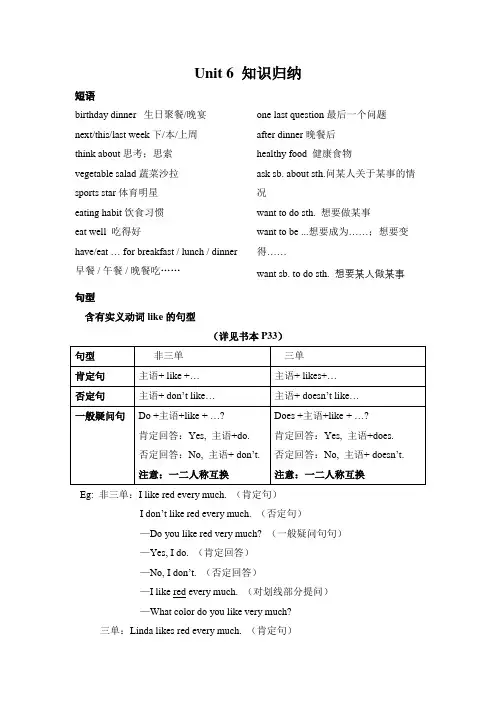
Unit 6 知识归纳短语birthday dinner 生日聚餐/晚宴next/this/last week 下/本/上周think about 思考;思索vegetable salad 蔬菜沙拉sports star 体育明星eating habit 饮食习惯eat well 吃得好have/eat … for breakfast / lunch / dinner 早餐 / 午餐 / 晚餐吃……one last question 最后一个问题after dinner 晚餐后healthy food 健康食物ask sb. about sth.问某人关于某事的情况want to do sth. 想要做某事want to be ...想要成为……;想要变得……want sb. to do sth. 想要某人做某事句型含有实义动词like的句型(详见书本P33)Eg: 非三单:I like red every much. (肯定句)I don’t like red every much. (否定句)—Do you like red very much? (一般疑问句句)—Yes, I do. (肯定回答)—No, I don’t. (否定回答)—I like red every much. (对划线部分提问)—What color do you like very much?三单:Linda likes red every much. (肯定句)Linda doesn’t like red every much. (否定句)—Does Linda like red very much? (一般疑问句句)—Yes, she does. (肯定回答)—No, she doesn’t. (否定回答)—Linda likes red every much.(对划线部分提问)—What color does Linda like very much?语法知识:名词可数名词:分为单数名词和复数名词(1)是可以计数的名词。
人教七年级英语上u6知识点
人教七年级英语上u6知识点Unit 6 主要知识点:What are you doing?本单元的主题是“What are you doing?”我们将学习现在进行时,会谈论正在进行的动作,学会用一些生动有趣的表述方式,从而更好地表达自己的思想,理解他人的意图。
以下是本单元的重点知识点:一、现在进行时的构成现在进行时指表示现在正在进行或发生的动作,具体构成如下:主语+am/is/are+doing例如:1. She is reading a book now. (她现在正在看书。
)2. They are having lunch at home. (他们正在家里吃午饭。
)注意:am、is、are是be动词的三种基本形式,因此,现在进行时的句子中必须含有be动词。
二、现在进行时的用法(一)表示现在正在进行的动作1. What are you doing now, Tom? (汤姆,你现在在干什么?)2. Alex is watching TV at this moment. (亚历克斯此刻正在看电视。
)(二)表示将来的安排1. I am playing basketball with my friends this afternoon. (今天下午我将和朋友们打篮球。
)2. What are you doing this weekend? (你这个周末打算干什么?)(三)与always、constantly连用,表示经常性的动作1. She is always talking in class. (她上课总爱说话。
)2. They are constantly fighting all the time. (他们总是打打闹闹。
)三、现在进行时的时间状语1. now (现在)2. at the moment (此刻)3. just (刚刚)4. currently (现阶段)5. still (仍然)例句:1. I am just taking a shower. (我刚刚冲了个澡。
人教版七年级上册Unit 6 知识点总结
Unit 6知识点总结一、重点短语John's birthday dinner next week think about sounds good sports star eat well eating habits for breakfast/lunch/dinner after dinner one last questionhealthy foodbe fatbe rightask sb. about sth. want to do sth.want to be...let sb. do sth.think about二、重点语法1. 可数名词①可数名词前可以用a, an 修饰限定,表“一个……”。
an apple ②可数名词前可以用one, two, three ……等数词限定。
three oranges③可数名词有复数形式。
可以用they 代替。
I like sports, but I don’t play them.2. 不可数名词(1) 本学期所学不可数名词有:milk,fruit,salad,chicken,food,bread,rice,ice -cream(2) 不可数名词的用法:①不可数名词前不可以用a, an 限定。
②不可数名词没有复数形式, 其前可以加some, any 等词修饰。
③可以用代词it 代替不可数名词。
I have some fruit,but I don’t like it.可数名词复数/不可数名词 一、用括号内所给单词的适当形式填空1. Cindy ______(like) chicken,but she________(not like) carrots.2. ______(do) your brother ______(like) rice?3. Tom’s parents_______(not like) bread for dinner.4. My sister and I _____(like) ____________(vegetable).5.David ______(ask) a volleyball star about her eating habits.6.I ______(real) like fruit and vegetables.7.His grandparents______(play)_______(sport) every day.8.Fruit is ________(healthy) food.9.She ______(want)________(have) a big dog.二、用名词的适当形式填空1.I have four______(tomato),she has some_______(box),he has 3____(watch), and they have two English_____(class).2.I like _________(strawberry),she have five birthday_______(party),3.Here are two_________(library) in our school. There are some______(dictionary) in our school library.4.I like________(salad), and I like some______(fruit) for dinner.5.She likes________(bread).And she has some______(milk) for breakfast.6.I lost a set of_____(key), a pair of______(sock) and some______(photo).三、单项选择1.My mother ______oranges or pears.A.don’t likeB.don’t likesC.doesn’t likeD.doesn’t likes2.I like fruit and_______.I always eat_______and tomatoes for dinner.A.vegetables;orangesB.vegetable;orangeC.vegetables;orangeD.vegetables;oranges3.--Can you tell(告诉)me your name?--_______. I’m Jim.A.SorryB.RightC.SureD.Thank you4.--What do you always have for_____breakfast?--Some bread and _____egg.A.a;anB./;theC.a;theD./;an5.______breakfast,Jack likes some___________.A.For; strawberrys and tomatoesB.For; bread and milkC.To; rices and breadD.To; carrot and milk6.Linda has a ________eating habit. She eats___________.A.good;goodB.well;goodC.well;goodD.good;well7.--Let’s ________chicken.--I don’t like_______.A.to eat;itB.have;itC.to have;themD.eat;them8.Our English teacher wants______some chicken.A.eatB.eatingC.to eat四、根据汉语意思完成句子1.My mother often ________ _________ ________(问我关于...)my school.2.I like hamburgers________ ______________(作为早餐).3.My ________ __________(饮食习惯)is good.4.I don’t know the________ ________(体育明星).5.The girls don’t want ______ ______ ________(变胖).五、根据要求完成句子1.My friend likes tomatoes.(改为一般疑问句,并作肯定回答)2.My friend is Mike.(改为一般疑问句,并作否定回答)3.Tommy and Helen like strawberries.(改为否定句)4.Their favorite fruit is bananas.(改为否定句)5.I have milk for breakfast.(对划线部分提问)6.My favorite food is milk.(对划线部分提问)7.Tony likes salad. He doesn’t like fruit.(合并为一句)8.这些是草莓,你喜欢吗?(翻译)_____________________________________________________________________ 9.早餐吃牛奶和面包吗?_____________________________________________________________________ 10.Jane喜欢橘子,那苹果呢?____________________________________________________________________ 11.他喜欢牛奶,但是不喜欢面包。
人教版初一英语上册第六单元解析
人教版七年级英语上册Unit 6 Do you like bananas?1. like 喜欢1)like sb. / sth.喜欢某人/某物2) like to do sth.喜欢/想要做某事(表一次性或特指的某一具体的动作)3) like doing sth喜欢做某事(表习惯性的动作或爱好)①我喜欢每天打篮球。
I like playing basketball every day.②今天很冷,我喜欢呆在家里。
Today is cold, I like to stay at home.2. 名词的分类1)名词分为“专有名词”和“普通名词”两大类。
专有名词是个别的人、事物、地点等专有的名称,如:Gina, China。
专有名词的第一个字母要大写。
2)普通名词又可分为下面四类:①个体名词:表示某类人或东西中的个体。
如pen, student, apple。
②集体名词:表示若干个体组成的集合体。
如family, class。
③物质名词:表示无法分为个体的物质。
如water, broccoli等。
④抽象名词:表示动作、状态、品质、情感等。
如work, happiness等。
个体名词和集体名词都是可数名词,物质名词和抽象名词都是不可数名词。
3)有些名词既可作可数名词又可作不可数名词,但意义不同,要注意区分。
①glass C. 杯子U 玻璃orange C 橘子U. 橘汁②还有表示动物类的名词,表示动物时是可数名词,作为菜肴时是不可数名词。
chicken C 小鸡U 鸡肉fish C.鱼U. 鱼肉③salad, ice cream, food, fruit 作总称讲是不可数名词,作种类讲是可数名词She likes hamburgers, salad and apples.a salad of tomato3. good / well1) good adj “好的”,常用来修饰名词。
a good student一位好学生That sounds good.(表语)2)well ①adj “好的”,“健康的”(指身体好)He doesn’t feel well.他感觉不舒服。
最新人教版七年级上Unit 6 知识重难点
Unit 6 知识重难点词汇:banana [bə'nɑ:nə] n.香蕉hamburger ['hæmbə:gə] n.汉堡包tomato [tə'mɑ:təu] n.西红柿ice-cream n.冰激凌salad ['sæləd] n.沙拉strawberry ['strɔ:bəri] n.草莓pear [pɛə] n.梨milk [milk] n.牛奶bread [bred] n.面包birthday ['bə:θdi]n.生日dinner ['dinə] n.正餐week [wi:k] n.周;星期think about 思考;思索food [fu:d] n.食物sure [ʃuə] adv.当然;肯定;一定How about...? (提出建议)…怎么样?burger ['bə:gə] n.(=hamburger)汉堡包vegetable ['vedʒitəbl] n.蔬菜fruit [fru:t] n.水果right [rait] adj.正确的;适当的apple ['æpl] n.苹果then [ðen] adv.那么egg [eg] n.蛋;鸡蛋carrot ['kærət] n.胡萝卜rice [rais] n.大米;米饭chicken ['tʃikin] n.鸡肉so [səu] conj.那么breakfast ['brekfəst] n.早餐;早饭lunch [lʌntʃ] n.午餐star [stɑ:]n.明星;星星eat [i:t] v.吃well [wel] adv.好;令人满意的habit ['hæbit] n.习惯healthy ['helθi]adj.健康的really ['riəli] adv.真正地question ['kwestʃən] n.问题want [wɔnt] v.需要;想要be [bi:] v.变成fat [fæt] adj.肥的;肥胖的n.脂肪;肥肉短语:1.John’s birthday dinner 约翰的生日晚餐2.next week 下周3.think about 思考、考虑4.how about 怎么样5.some fruit 一些水果6.his birthday 他的生日7.sport star 体育明星8.eating habits 饮食习惯9.for breakfast 作为早餐10.for dinner 作为晚餐11.one last question 最后一个问题12.healthy food 健康的食品典句必背1. I like hamburgers. 我喜欢汉堡包。