
人教版高中英语必修二unit1 reading
Frederick
WilliamⅠ
Catherintion
I. Draw a chart to show the remove of the Amber Room.
Prussia Russia Konigsberg German city on the Baltic Sea the winter palace in St Petersburg
3. This was a time when the two countries were at war. 这正是两国交战时期。 4. There is no doubt that the boxes were then put on a train for Konigsberg. 毫无疑问,这些箱子后来被装上火车 运住哥尼斯保。
were removed from the Amber Room
by the Russians in wartime, but some of
Nazis stole the room itself . the _______
Para 5 The rebuilding of the amber room
?
the summer palace in St Petersburg
Cracking hard points
1. Frederick WilliamⅠ, the King of Prussia, could never have imagined that his greatest gift to the Russian people would have such a strange history. 普鲁士国王威廉一世绝不可能想到他送给俄罗斯 人的最伟大的礼物会有这样一段离奇的历史。 2. Later, Catherine II had the Amber Room moved to the palace outside St Petersburg where she spent her summers. 后来叶卡捷琳娜二世派人把琥珀屋搬到了圣· 彼得 堡郊外她避暑的宫殿中。
Para 4
The missing of the Amber Room
1941
the Nazi and Russia
at war , and the were _________
Amber Room was missing.
1941
Some __________ small art objects furniture and _______________
3 4 5 1 2
How did the Amber Room become one of the wonders of the world? How did the Amber Room get lost? How was a new Amber room built? How was the Amber Room made? Why did the King of Prussia give the Amber Room to the Czar of Russia as a gift?
Ming Dynasty vase
china
Taj Mahal
The most beautiful tomb in the world
Ivory dragon boat
Dragon Boat Festival
Mogao Caves
Art treasure for Buddhism
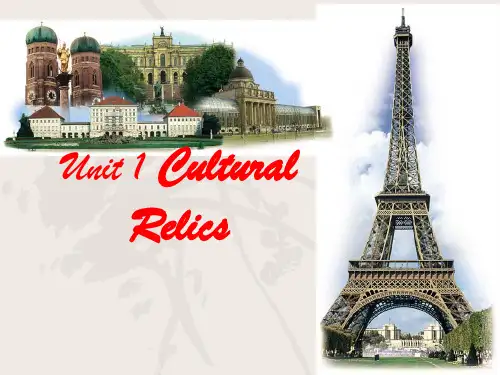
Unit 1 Cultural relics
important visitors.
1770 years
The Amber Room was completed the way ____________ Catherine Ⅱ wanted.
Catherine Ⅱadded more details to the Amber ________ room.
1. It was built
by ____________________________ the Russians and Germans . 2. Following ____________ old photos of the
former one, it has been made to
look much like __________. the old one
________ years 10
gold and _______ jewels
Para 2-3 The history of the Amber Room
Join the correct parts of the sentences together.
Frederick I A. sent a troop of his best
Peter the Great Given to ______________ 1716 by Frederick William Ⅰand
years
became part of the Czar’s
winter palace ____________.As a small ______________ reception hall for
The following five questions summarize the main idea of the Five paragraphs in the passage. Put the paragraph numbers in the boxes. Then Answer the questions.
Raw
Can you imagine what a room made of amber looks like?
amber
A picture of the Amber Room Do you know what picture this is? in St Petersburg in Russia
Unit 1 Cultural relics
Step 1
Lead-in
What is a cultural relic?
A cultural relic is something famous that has survived for a long time. It can tell the history of the past time. It is the symbol of a country and its culture.
Reading
In Search of the Amber Room
Reading---- Skimming Read and get the main idea. • It tells us the strange history of the _____________, Amber Room a cultural relic of two countries: Germany and _________. Russia _________
soldiers to the King of Frederick William I
Prussia. B. had the Amber Room made Peter the Great C. had it moved outside St Petersburg. Catherine II
D. gave it to the Czar as a gift
3. A new Amber Room was ___________ ready / built
for the people of St Petersburg when they
___________ celebrated the 300th birthday of their city.
Nazi
Reading--Careful reading
Para 1 The Amber Room and its design
Color Birthplace Design Material Time of building it Decorations
yellow-brown Prussia fancy In the ___________ style amber (several tons) ________
What characteristics does the amber have? It has a beautiful yellow-brown color. It feels as hard as stone. It easily melt when heated. Once it is heated, it can be made into any shape.
Read the text quickly again, and try to find out the main idea for each paragraph.
Paragraph 1: The Amber Room and its________ design Paragraph 2-3: The ___________ history of the Amber Room Paragraph 4: _____________ The missing of the Amber Room Paragraph 5: ________________ The rebuilding of the Amber Room
Reading
Have you ever seen a piece of amber? What do you know about it?
Amber
Have you ever seen anything made of amber?
2019人教版高中英语必修二Unit 1 Reading课件

give way to 让步、屈服 preserve\protect ……from…… 保护……免受……伤害 move towards the future 迈向未来 keep balance 保持平衡 keep a balance between A and B
当该项目于1980年完工时, 它被认为是巨大的成功。 这些国家不仅找到了一条 不以牺牲古迹为代价的未 来发展之路,而且明白了 多个国家合作共创美好未 来的可能性。
The spirit of the Aswan Dam project is still alive today. Perhaps the best example is shown by UNESCO, which runs a programme that prevents world cultural heritage sites around the world from disappearing. If a problem seems too difficult for a single nation, the global community can sometimes provide a solution.
Here comes the bus.
① 时间(now\then)、地点(here\there)、方位 (away\down\out)副词位于句首,② 谓语是表示位移的动 词(go\come\run\fly\rush等),③主语是名词时,句子要 用完全倒装(把谓语提到主语前面)。
• Away flew the birds.
When the project ended in 1980, it was considered a great success. Not only had the countries found a path to the future that did not run over the relics of the past, but they had also learnt that it was possible for countries to work together to build a better tomorrow.
人教版高中英语必修二unit1 reading课件(共19张)
_ for important visitors.
Time : __19_4_1
Russia
(the Russians)
at war
Nazi Germany
(the Nazis)
were only able to remove furniture a. nd small art objects
stole the Amber .Room
Gold and jewels.
3. What was the amber room first made for? It was first made for the palace(寝宫)of Frederick I. 4.Who gave the Amber Room to Peter the Great?
In search of the Amber Room
Fast Reading
Para. 1 Para. 2 Para.3 Para. 4
Para. 5
a. The changes of the Amber Room
b. A new Amber Room c. A gift to Peter the Great
• A cultural relic is something that is ....... • --very old, survived for a long time; • --should have some value; • --manmade, created by our ancestors(祖先); • --tell people about the past.
B. The history of the Amber Room
C. Nazi German army should be responsible for the missing Amber Room
英语人教版高中选择性必修二教案Unit 1 Reading and Thinking
Unit 1 Science and ScientistsReading and Thinking教材分析本文是一篇按照时间顺序记述事件发展过程的叙事性文本,时间线索是明线,而科学研究的步骤是文章叙述的暗线。
教材通过引导学生分析约翰·斯诺探究霍乱病源、切断感染源,并最终阻止霍乱流行的过程与方法,促使他们思考和梳理科学研究的基本步骤和常见方法,理解质疑精神在科学研究中的重要作用。
教学目标在本课学习结束时,学生能够:1. 了解利用地图和数据分析研究结果的方法;2. 依据时间明线和科学研究步骤暗线梳理语篇结构,找准主题词汇;3.运用发问的阅读策略积极主动探究答案,深化对文章主题和内涵的理解;4. 理解质疑精神在科学探究中的重要作用,谈论斯诺身上体现的科学精神。
教学重难点【教学重点】1. 正确理解主题图,理解创新与想象对于科学的意义;2. 引导学生读懂课文插图和霍乱病例地图;3. 结合活动主题梳理斯诺研究霍乱的流程;4. 理解质疑精神和科学素养,思考科学研究对人类的影响。
【教学难点】梳理科学研究步骤和方法,在阅读中通过自主发问来深度挖掘文本内涵。
教学过程Step 1 Warming-up1. Look at the theme picture and discuss the following questions.1) How would you describe the photo?2) What scientific equipment can you see in a science laboratory?3) Would you like to work in such a field in the future? Why or why not?4) What qualities do you need to be a scientist?2. Learn about the scientific equipment in a science laboratory.3. How do you understand the quote on the opening page?4. Appreciate other quotes.设计意图:通过讨论主题图和名人名言,引出话题,同时铺垫并呈现话题词汇。
人教课标版英语必修二Unit1 Reading 课程教学设计
Unit1 Reading 优教教学设计(一)教学设计(一)设计意图This is the second teaching period of this unit, aiming to help students get a thorough understanding of the reading material in this unit. The emphasis of this period is mainly placed on the main idea, some key details and the structure of the passage. While teaching, teachers should also focus on some difficult expressions and sentences in order that students can really understand the passage thoroughly. At the same time, teachers should help students get acquaintance with some reading skills about narrative writing.教学重点1. Learn some detailed information about the Amber Room.2. Improve students’ reading ability.3. Train students’ ability to grasp key information while listening.4. Train students’ speaking ability.教学难点1. Let students master the reading skills such as skimming, scanning and getting the main idea of a paragraph or passage.2. Get students to understand the structures and meanings of some difficult sentences.(l) Frederick William I, the King of Prussia, could never have imagined that his greatest gift to the Russian people would have such an amazing history.(2) Later, Catherine Ⅱhad the Amber Room moved to a palace outside St Petersburg where she spent her summers.(3) This was a time when the two countries were at war.(4) There is no doubt that the boxes were then put on a train for Konigsberg ...教学过程Step 1 Lead-inT: Hello, everybody! As you know, we can usually get some information from pictures. Please look at the pictures and use the words in Unit 1 to describe them. (Students give their answers.)Can you imagine building a room using amber? Today we will get to know a mysterious amber room. Now watch a short VCR to get some brief information.Step 2 Reading1. SkimmingT: Read the text quickly, trying to get the main idea about the text.It tells us the strange history of the ,a cultural relic of two countries: and .T: Have you finished? If you find the answer, please put up your hand. Now let’s check up the answer.S1: Amber Room, Germany and Russia.T: Excellent. OK, class, just now you found out some simple facts about the text. Read the pas-sage quickly and. find out the main idea of each paragraph.Para.1: The Amber Room and itsParagraphs 2~3: of the Amber RoomPara.4: of the Amber RoomPara.5: of the Amber RoomT: Have you got the answers?Ss: Yes.T: All right. Tell me your answers.Ss: Para. 1: designParagraphs 2~3: The historyPara.4: The missingPara.5: The rebuilding2. ScanningA. Read through the text and decide whether the following statements are true or false.1. The Amber Room, which was a great work of art, was originally (起初) made to be a gift to the Russian people. ( )2. Frederick William Ⅰgave the Amber Room to Peter the Great. ( )3. Peter the Great had the Amber Room moved outside St Petersburg. ( )4. The Amber Room was one of the wonders of the world, but no one knows where it is. ( )5. We don’t know what happened to the Amber Room during World WarⅠ. ( )6. In recent years, a new Amber Room has been made in St Petersburg, and it looks like the old one. ( )T: Have you finished? OK, let’s have a check.S1: FS2: TS3: FS4: TS5: FS6: T3. Careful readingA. Read through Para. 1 and fill in the blanks.Suggested answers: 1. yellow-brown 2. Prussia 3. fancy style 4. amber (several tons) , gold and jewels 5. 10 yearsB. Read through Paragraphs 2~3 carefully and then join the correct parts of the sentences together.T: Are you ready? Shall we check the answers?Ss: Yes.Suggested answers: 1. B 2.D 3.A 4.CC. Read through Para. 4 and do the following exercises.1. The Russians didn’t hide the Amber Room becauseA. they were at warB. the couldn’t find a placeC. the German soldiers arrived too soonD. no train could take it away2. In 1941, Konigsber was a city in .A. GermanyB. RussiaC. SwedenD. FranceSuggested answers: 1.C 2. AD. Read through Para. 5 and fill in the blanks about the rebuilding of the Amber Room.Suggested answers:(l) the Russians and Germans(2) old photos of the former one; the old one(3) the 300th birthdayStep 3 Cracking the difficult pointsT: As you know, there are always some sentences either complex or special in a text. By grasping their meanings you can understand the text better. Do you think so? Well, please underline the sentences below in your text and observe them carefully.Then have a discussion in pairs. Try to understand the structures and meanings of the sentences according to the context.(l) Frederick WilliamⅠ, the King of Prussia, could never have imagined that his greatest gift to the Russian people would have such a amazing history,(2) Later, Catherine Ⅱhad the Amber Room moved to a palace outside St Petersburg where she spent her summers.(3) This was a time when the two countries were at war.(4) There is no doubt that the boxes were then put on a train for Konigsberg...Let students work in pairs: One reads the sentences and the other translates the sentences into Chinese.S1 and 2: …S3 and 4: …S5 and 6: …S7 and 8: …Suggested answers:(1) 普鲁士国王腓特烈.威廉一世绝不可能想到他送给俄罗斯人民的厚礼会有这样一段令人惊讶的历史。
高二英语人教版 选择性必修二 Unit 1 Reading and Thinking
Stage 5: Analyze the results
Snow began by marking on a map the exact places where all those who died had lived.
There were multiple deaths near the water pump in Broad Street (especially house
John Snow Defeats “King Cholera”
Who?
How?
What?
1. Who is John Snow? 2. What is “King Cholera”? 3. How did John Snow defeat “King Cholera”?
While-reading
Main idea: The process of scientific research
Stage 7: Draw a conclusion
Para 4: The truth was that the water from the Broad Street pump had been infected by waste. Moreover, Snow was later able to show a link between other cases of cholera and the different water companies in London. Some companies sold water from the River Thames that was polluted by raw waste. The people who drank this water were much more likely to get cholera than those who drank pure or boiled water.
新人教高中英语必修二Unit1Readingforwriting-writeanews report
Homework
Write a news report about the Nanhai No.1 on textbook page 65.
Task 3 Organization and Language
Read the text again and marked the 7 parts in the passage.
A.lead sentence导语 B. Direct quote 直接引用语 C. Paraphrase 解释 D. Background information背景信息 E. Reporting verbs引述动词 F. Words to show comparison/contrast 表示比较
Protectors of the Past, Wuhu • Protect old houses • Help repair buildings • Look for cultural relics • Show cultural relics to the public • Raise money • Repair temples and cultural relics
feedbacks on each other's draft. □ Is there a title? □ Does the lead sentence tell the reader about the situation? □ Has the writer included details and explanations? □ Are there quotes and paraphrases? □ Does the writer use relative clauses to identify people, places, things, times, etc.? □ Does the writer end with a short summary? □ Are there any grammar or spelling mistakes?
新人教版高中英语必修二U1CulturalHeritage-ReadingforWriting课件
the beginning paragraphs deliver the most important or relevant information of
a news report include six elements, which are what, when, who,
where, why and how
新人教版高中英语必修二 Unit1 Cultural Heritage
Reading for Writing
Lead in
Mogao Caves are magnificant art treasures. Mogao Caves, or the Caves of the Thousand Buddhas(千佛洞), are located in Dunhuang, Gansu Province, on the ancient Silk Road. The murals (壁画)and Buddha figures (佛像)in these caves are world-famous. The area was listed as a world cultural heritage by UNESCO in 1987.
Activity 1 Read the news report and answer the questions.
3.What do you think of the researcher's opinion in the last paragraph? I agree with the researcher’s opinion. Understanding our own and other cultures is a great way to understand ourselves and others.
Unit 1 Reading and thinking(课件)高中英语人教版(2019)选择性必修二
Para. 3
Snow's contributions.
Para. 4
John Snow desired to destroy cholera.
Para. 5
Truth of the infection of cholera.
Activity 3 careful-reading 1.Which of the following did John Snow believe in?
1. What are the two theories? Which theory did John Snow think was reasonable? 2. What did John Snow investigate when another outbreak hit London in 1854?
Who ? How ? What ? The text is mainly about __J_o_h_n__S_n_o_w__ and __h_o_w___ he defeated king cholera.
scientific research
Stages of Scientific Research
While reading
Activity 1: Read the whole text quickly and match the main idea
Para. 1
Snow began his study by marking on the map.
Para. 2
John Snow decided to prove the second theory.
Besides coronavirus, what other kinds of epidemics (流行病)do you konw?
最新版人教版高中英语必修二Unit 1 Cutural heritage Reading and thingking 原文和习题
最新版人教版高中英语必修二Unit 1 Cultural HeritageReading and Thinking原文和习题原文:FROM PROBLEMS TO SOLUTIONSEconormic development is necessary if we want to improve society. There comes a time when the old must give way to the new, and it is not possible to preserve everything from our past as we move towards the future. Finding and keeping the right balance between progress and the protection ofcultural sites can be a big challenge.Big challenges, however, can sometimes lead to great solutions. In the 1950s, the Egyptian government wanted to build a new dam acrossthe Nile in order to control floods, produce electricity, and supply water to more farmers in the area. But the proposal led to protests. Water from the dam would likely darmage a number of temples and destroy cultural relics that were an important part of Egypt's cultural heritage. Afterlistening to the scientists who had studied the problem, and citizens who lived near the dam, the government turned to the United Nations for helpin 1959.A committee was established to limit damage to the Egyptian buildings and prevent the loss of cultural relics. The group asked for contributions from dfferent departments and raised funds withinthe international community. Experts investigated the issue, conducted several tests, and then made a proposal for how the buildings could be saved. Finally, a document was signed, and the work began in 1960.The project brought together governments and environmentalists from around the world. Temples and other cultural sites were taken down piece by piece, and then moved and put back together again in a place where they were safe from the water. In 1961,Germa engineers moved the first temple. Over the next 20 years, thousands of engineers and workers rescued22 temples and countless cultural relics. Fifty countries donated nearly $80 million to the project.When the project ended in 1980, it was considered a great success. Not only had the countriesfound a path to the future that did not run overthe relics of the past, but they had also learntthat it was possible for countries to work togetherto build a better tomorrow.The spirit of the Aswan Dam project is still alive today. Perhaps the best exampleis shown by UNESCO, which runs a programme that prevents world cultural heritage sites around theworld from disappearing. If a problem seems toodifficult for a single nation, the global communitycan sometimes provide a solution.Questions:1、Read the title an look at the photos. What do you think the text is about?2、Scan the text for numbers. Circle the numbers and guess what they mean.3、Read the text again and answer the questions.Why did the Egyptian government want to attempt the buildingof the dam?How were the temples and other cultural sites saved?How long did it take to complete the project?4、Complete the timeline with the information from the text.A. The project starts.B. The temples and cultural relics are being rescued.C. The project is completed.D. The first temple is moved.E. The government askes the UN for help.5、Disscuss one or more of the questions below in groups. What were the solutions to the problem of building the Aswan Dam?A lot of money was spent to protect the temples. Do you think it was worthwhile? Why or why not?Why do you think so many countries contributed funds and offered help to the Egyptian project?。
最新版人教版高中英语必修二Unit 1 Cutural heritage Reading and thingking 原文和习题
最新版人教版高中英语必修二Unit 1 Cultural HeritageReading and Thinking原文和习题原文:FROM PROBLEMS TO SOLUTIONSEconormic development is necessary if we want to improve society. There comes a time when the old must give way to the new, and it is not possible to preserve everything from our past as we move towards the future. Finding and keeping the right balance between progress and the protection ofcultural sites can be a big challenge.Big challenges, however, can sometimes lead to great solutions. In the 1950s, the Egyptian government wanted to build a new dam acrossthe Nile in order to control floods, produce electricity, and supply water to more farmers in the area. But the proposal led to protests. Water from the dam would likely darmage a number of temples and destroy cultural relics that were an important part of Egypt's cultural heritage. Afterlistening to the scientists who had studied the problem, and citizens who lived near the dam, the government turned to the United Nations for helpin 1959.A committee was established to limit damage to the Egyptian buildings and prevent the loss of cultural relics. The group asked for contributions from dfferent departments and raised funds withinthe international community. Experts investigated the issue, conducted several tests, and then made a proposal for how the buildings could be saved. Finally, a document was signed, and the work began in 1960.The project brought together governments and environmentalists from around the world. Temples and other cultural sites were taken down piece by piece, and then moved and put back together again in a place where they were safe from the water. In 1961,Germa engineers moved the first temple. Over the next 20 years, thousands of engineers and workers rescued22 temples and countless cultural relics. Fifty countries donated nearly $80 million to the project.When the project ended in 1980, it was considered a great success. Not only had the countriesfound a path to the future that did not run overthe relics of the past, but they had also learntthat it was possible for countries to work togetherto build a better tomorrow.The spirit of the Aswan Dam project is still alive today. Perhaps the best exampleis shown by UNESCO, which runs a programme that prevents world cultural heritage sites around theworld from disappearing. If a problem seems toodifficult for a single nation, the global communitycan sometimes provide a solution.Questions:1、Read the title an look at the photos. What do you think the text is about?2、Scan the text for numbers. Circle the numbers and guess what they mean.3、Read the text again and answer the questions.Why did the Egyptian government want to attempt the buildingof the dam?How were the temples and other cultural sites saved?How long did it take to complete the project?4、Complete the timeline with the information from the text.A. The project starts.B. The temples and cultural relics are being rescued.C. The project is completed.D. The first temple is moved.E. The government askes the UN for help.5、Disscuss one or more of the questions below in groups. What were the solutions to the problem of building the Aswan Dam?A lot of money was spent to protect the temples. Do you think it was worthwhile? Why or why not?Why do you think so many countries contributed funds and offered help to the Egyptian project?。