
苏教版 四下英语精选各单元知识点
Unit 1 Our school subjects1. Nice to see you.和Nice to meet you. 见到你很高兴。
但用法上有区别。
Nice to meet you.用于初次见面时打招呼,应答也是Nice to meet you.而Nice to see you.用于两个认识的人见面打招呼,应答也是Nice to see you.2. subject 和lesson的区别subject 是指学科,课程。
而lesson指的是具体的一节课。
它们的区别还在于lesson可接在具体科目名称后面,如 a Maths lesson一节数学课an English lesson一节英语课。
而subject一般不与科目名称一起出现。
3.学科类的单词第一个字母要大写,如English, Chinese, Maths, Art, PE, Music, Science等。
还有一些其他的用法如:He’s an English boy. 他是一个英国男孩。
We’re Chinese. 我们是中国人。
I like listening to music.我喜欢听音乐。
4. It’s time fo r...... 到干什么的时间了。
后面跟名词。
It’s time for sth. = It’s time to do sth. 意思都是干什么的时间了,但是用法上有区别。
It’s time for +名词= It’s time to+动词如:It’s time for PE= It’s time to have a PE lesson. It’s time for class.=It’s time to have class.Unit 2 After school1.表示一周七天的单词完整形式和缩写形式。
西方国家把Sunday定位一周的第一天,而不是Monday对星期几进行提问,用“What day is it today?”回答:“It’s …”或是直接回答星期几。
2.表示时间的介词的用法:(1) on表示“在具体某一天或某天的上、下午”①表示在星期几,如:on Sunday. on Monday.②表示在某天的上、下午或晚上,如:on Sunday morning③表示节日,如:on New Year’s Day, on Children’s Day④表示日期,如:on May 27th,on the 12th of March(2) at表示“在某一时刻,某一时点”①在几点钟介词用at ,如at five o’clock②at noon在中午;at night在夜间;at Christmas在圣诞节期间;(3) in表示“在某世纪、年、季度、月、周”以及泛指的上下午、晚上①在某世纪,如:in the 20th century 在20世纪;②在某年,如:in 2016 在2016年;③在某月,如:in September 在九月;④在某个季节,如:in winter在冬季⑤在早晨,中午,晚上, 如in the morning, in the afternoon, in the evening.3. have和has的用法(1) have, has意为“有”,强调所属关系第一、二人称和复数用have (I, You, We, They, The boys)第三人称单数用has (He, She, It, Mike, my father)例如:I have a football match. She has a swimming lesson.(2) 陈述句:以句号结尾,句中没有not。
例如:I have Chinese. He has English.否定句:以句号结尾,句中有not或no。
例如:I don’t have Chinese. He doesn’t have English.一般疑问句:以问号结尾,do或does在句首。
例如:Do you have Chinese? Does he have English?肯定回答:Yes,I do. Yes, he does.否定回答:No, I don’t. No, he doesn’t.特殊疑问句:以问号结尾,句首为疑问词。
例如:What lessons do you have? What lessons does he have?回答:I have Chinese. He has English.(3)句型转换肯定句变否定句:肯定句:I have some lessons on Saturday.否定句:I don’t have any lessons on Saturday.肯定句:She has some lessons on Saturday.否定句:She doesn’t have any lessons on Saturday.肯定句变一般疑问句:肯定句:I have some lessons on Saturday.一般疑问句:Do you have some lessons on Saturday?肯定句:She has some lessons on Saturday.一般疑问句:Does she have any lessons on Saturday?肯定句变特殊疑问句:肯定句:I have some lessons on Saturday.特殊疑问句:What lessons do you have on Saturday?肯定句:She has some lessons on Saturday.特殊疑问句:What lessons does she have on Saturday?Unit 3 My day1. 表示时间的方式(1)整点:“点数+ o’clock”,可以和o’clock一起用得最大数字是12.例如:1:00 one o’clock, 12:00twelve o’clock(2)用“小时+分钟”:例如:6:10 six ten 10:32 ten thirty-two7:58 seven fifty-eight 9:20 nine twenty(3)表示时间在半小时内,用“分钟+past+小时”例如:4:20 twenty past four12: 25 twenty five past twelve(4)表示时间恰好为半小时,用“half+past+小时”例如:4:30 half past four, thirty past four(5)表示时间在半小时外,用“(相差的)分钟+to+(下一)小时”例如:5:50 ten to six 9:49 eleven to ten询问几点钟的方式有两种What time is it?= What’s the time?(6)表示“零几分”:可以说零用字母O表示,如:4:08 four o eight2. at表示“在某一时刻,某一时点”①在几点钟介词用at ,如在5:00 at five o’clock或at five在7:35 at seven thirty-five②at noon在中午;at night在夜间;at Christmas在圣诞节期间;3.like意为“喜欢”(1)直接加名词复数例如:I like pandas.(2) 喜欢做(某事)like doing (sth.)例如:I like watching TV.我喜欢看电视。
She likes reading.她喜欢阅读。
4. watch常见的词义有两种:一是“手表”,I have a new watch. 我有块新手表。
二是“观看”,如我们文中的watch TV就是看电视,还可以用在watch a football match 观看一场足球赛等词句中。
5、表示时间的句式(1) I get up at six.我六点起床。
(英语句子中,时间表达放在句末。
)(2)I go to bed at nine on Friday. 我星期五九点睡觉。
(一句话中如果有两个时间,小时间放在大时间之前。
)Unit 4 Drawing in the park 1、“看”的表达方式(1) see 看见,看到,强调看的结果Can you see a cake over there? 你能看见那里的蛋糕吗?(2) look 通常用来引起对方的注意,强调看的动作。
Look! That’s my father!看!那是我父亲。
(3) 如果表示看人或物时,则用look atLook at the boy.瞧那男孩。
Look at the blackboard, please.请看黑板。
(4) watch强调专注地看,意思是观看、注视,通常用来指看电视球赛或戏剧等移动着的画面或物体。
I usually watch TV at seven.我通常七点看电视。
Let’s go and watch the football match after school.放学后我们去看足球赛吧。
2、in the river在河里(水里)指鱼、人等在河里eg. I can swim in the river.我会在河里游泳。
on the river在河面上,在河上,指船只、鸭子等在水面上eg. I can see a boat on the river.我看到一只在河上的船。
3、in the tree指鸟、猴子、猫、人等在树上on the tree指水果、树叶等长在树上4、情态动词can(1)、情态动词,表示“能够、可能”,后面必须加动词原型eg:I can swim very well.(2)、I/ You/ He/ She/ It / We/ You/ They所有人称都用can,不分单复数(3)、陈述句:以句号结尾,句中没有not。
例如:I can see a tree.否定句:以句号结尾,句中有not或no。
例如:I can not see a tree. I cannot see a tree. 一般疑问句:以问号结尾,can在句首。
例如:Can you see a tree.?肯定回答:Yes,I can. 否定回答:No, I can’t.特殊疑问句:以问号结尾,句首为疑问词。
例如:What can you see? 回答:I can see a tree.Unit5 Seasons1. 如何表达天气:(1)表示气温不同,用:It’s cold / cool / warm / hot.天气寒冷/ 凉爽/ 暖和/ 炎热。
(2)表示天气好,可以说:It’s a fine / nice / lovely / beautiful day. (3)表示各类天气,用:It’s sunny / cloudy / windy / rainy / snowy / foggy today. 今天晴朗/ 多云;阴/ 有风/ 有雨/ 有雪/ 有雾。
苏教版四年级英语下知识点总结

苏教版四年级英语下知识点总结第一篇:苏教版四年级英语下知识点总结Unit oneour school subjects我们的学校课程一.词汇预览School /sku:l/学校go to school去上学student学生See /si:/看见,看到seed种子同音词sea海洋I see a bird我看见一只鸟Timetable time(时间)+table(表格)=timetable(时间表;课程表)Chinese [ˌtʃaɪˈni:z]语文;中国人;中国的I like chinese我喜欢语文Maths [mæθs/数学I have Maths today.我今天有数学课 Art 美术draw pictures 画画 PE=physical education 体育 Music 音乐song歌曲 Science 科学Subject 课程;主题Fun 有趣的;乐趣sun太阳This game is fun这个游戏很有趣Go to 去....go to Beijing去北京Playground 操场on the playground在操场上Lesson课;教训I have four lessons today我今天有四节课.Monday [ˈmʌndeɪ]周一,星期一缩写MONon Monday在星期一二.句型语法1.表示欢迎回到某地的句型 Welcome back to.....Welcome back to school, class欢迎回到学校,同学们 welcome back to+地点表示欢迎回到......Welcome back to China欢迎回到中国不接back 直接welcome to+地点表示欢迎来到....Welcome to my house欢迎到我家来welcome to my farm欢迎来到农场2.询问对方喜欢什么课程的句型及其回答A: What subjects do you like?What subjects什么课程B: I/we like+课程名What subjects do you like, Mike? 迈克,你喜欢什么课程?I like Chinese and Maths.我喜欢语文和数学.3.询问某个时间我们有什么课程的句型及回答 What lessons do we have+时间......? We have+课程名What lessons do we have today? We have Chinese,Maths,PE and Art.Unit TwoAfter school放学后一.词汇预览Go 去第三人称单数goes 对应词come来Go to school去上学go to bed去睡觉go shopping去购物Let’s go to school together.让我们一起去上学吧Match比赛;火柴a football match一场足球比赛 Get up 起床bed床I get up at six.我六点起床 Every每个 I run every day.我每天跑步After school放学后play table tennis 打乒乓球a football match一场足球比赛a swimming lesson一节游泳课 Every day每天Today 今天tomorrow明天巧记:to(向)+day(白天)=today今天Monday=Mon星期一Tuesday=Tue星期二Wednesday =Wed星期三Thursday=Thur星期四Friday=Fri星期五Saturday=Sat星期六 Sunday=Sun星期天在星期几用介词onon Saturday在星期六根据《圣经创世纪》,上帝是星期一到星期六创造了世界,星期日休息,所以犹太教和基督教星期日要做礼拜,这一天他们叫做“礼拜日”,而一周七天称“一个礼拜”。
苏教版四年级下册英语重难点知识汇总
Unit1Ourschoolsubjects.和Nicetomeetyou.见到你很高兴。
但用法上有区别。
Nicetomeetyou.用于初次见面时打招呼,应答也是Nicetomeetyou.而Nicetoseeyou.用于两个认识的人见面打招呼,应答也是Nicetoseeyou.和lesson的区别subject是指学科,课程。
而lesson指的是具体的一节课。
它们的区别还在于lesson可接在具体科目名称后面,如aMathslesson一节数学课anEnglishlesson一节英语课。
而subject一般不与科目名称一起出现。
3.学科类的单词第一个字母要大写,如English,Chinese,Maths,Art,PE,Music,Science等。
还有一些其他的用法如:He’sanEnglishboy.他是一个英国男孩。
We’reChinese.我们是中国人。
Ilikelisteningtomusic.我喜欢听音乐。
’stimefor......到干什么的时间了。
后面跟名词。
It’stimeforsth.=It’stimetodosth.意思都是干什么的时间了,但是用法上有区别。
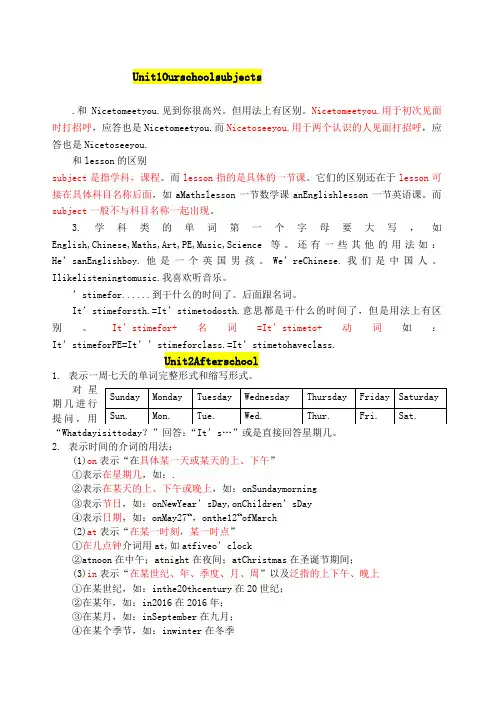
It’stimefor+名词=It’stimeto+动词如:It’stimeforPE=It’’stimeforclass.=It’stimetohaveclass.Unit2Afterschool1.表示一周七天的单词完整形式和缩写形式。
对星Array期几进行提问,用“Whatdayisittoday?”回答:“It’s…”或是直接回答星期几。
2.表示时间的介词的用法:(1)on表示“在具体某一天或某天的上、下午”①表示在星期几,如:.②表示在某天的上、下午或晚上,如:onSundaymorning③表示节日,如:onNewYear’sDay,onChildren’sDay④表示日期,如:onMay27th,onthe12th ofMarch(2)at表示“在某一时刻,某一时点”①在几点钟介词用at,如atfive o’clock②atnoon在中午;atnight在夜间;atChristmas在圣诞节期间;(3)in表示“在某世纪、年、季度、月、周”以及泛指的上下午、晚上①在某世纪,如:inthe20thcentury在20世纪;②在某年,如:in2016在2016年;③在某月,如:inSeptember在九月;④在某个季节,如:inwinter在冬季⑤在早晨,中午,晚上,如inthemorning,intheafternoon,intheevening.和has的用法(1)have,has意为“有”,强调所属关系第一、二人称和复数用have(I,You,We,They,Theboys)第三人称单数用has(He,She,It,Mike,myfather)例如:.(2)陈述句:以句号结尾,句中没有not。
2023最新苏教版小学英语四年级下知识点

2023最新苏教版小学英语四年级下知识点本文档是关于2023年最新苏教版小学英语四年级下学期的知识点。
Unit 1: Daily Routines- Vocabulary: words and phrases related to daily routines- Grammar: present tense verbs, adverbs of frequency, and time expressions- Sentence structure: I/She/He + verb + (s/es), adverb of frequency + verbUnit 2: Weather and Seasons- Vocabulary: weather conditions, seasons, months, and days of the week- Grammar: present tense verbs with weather expressions and time expressions- Sentence structure: It is + adjective + weather expressionUnit 3: Family- Vocabulary: family members and relationships, possessive pronouns- Grammar: possessive pronouns and adjectives- Sentence structure: pronoun + be verb (am/is/are) + possessive pronoun + nounUnit 4: Food- Vocabulary: food and drink items, counting using "some" and "any"- Grammar: countable and uncountable nouns, "some" and "any"- Sentence structure: I have some + countable/uncountable nounUnit 5: Animals- Vocabulary: animal names and characteristics- Grammar: questions with "Can" and "Do/Does"- Sentence structure: Can + subject + verb? / Do/Does + subject + verb?Unit 6: Sports- Vocabulary: sports and equipment- Grammar: present continuous tense- Sentence structure: subject + am/is/are + verb-ingUnit 7: Places in the City- Vocabulary: places in the city, directionsUnit 8: Daily Life- Vocabulary: daily activities and routines- Grammar: adverbs of frequency, time expressions- Sentence structure: subject + adverb of frequency + verb以上是2023年苏教版小学英语四年级下学期的主要知识点。
新编苏教版四年级英语下册各单元知识点汇总
苏教版四年级英语下册各单元的知识点汇总Unit 1 Our school subjects词汇:subject学科Chinese语文Maths数学English英语Science科学PE体育Music音乐Art美术句型:What subjects do you like?你喜欢什么学科?I like...我喜欢......We have...我们有......Unit 2 After school词汇:after school放学后go去today今天what day星期几match比赛swimming游泳Wednesday星期三Saturday星期六Sunday星期日句型:What day is it today?今天星期几?It's...今天是......Let's go and...让我们去......Unit 3 My day词汇:usually通常go to school去上学in the morning在上午have lunch吃午饭in the afternoon在下午play football踢足球go home回家homework家庭作业have dinner吃晚饭watch TV看电视go to bed睡觉句型:When do you...?你什么时候...... I...at...我在......(时间)......Unit 4 Drawing in the park词汇:draw画park公园flower花them他们;她们;它们boat小船river河;江lake湖hill小山;山丘句型:Let's draw...让我们画......What can you see?你能看见什么?I can see...我能看见......Unit 5 Seasons词汇:season季节spring春天warm温暖的summer夏天hot热的autumn秋天cool凉爽的winter冬天cold冷的句型:Which season do you like?你喜欢哪个季节?I like...我喜欢......Unit 6 Whose dress is this?词汇:dress连衣裙too太trousers裤子party聚会glove手套so如此;这么coat外套shirt衬衫sweater毛衣句型:Whose...is this/are these?这/这些是谁的......?It's/They're...它/它们是......Unit 7 What's the matter?词汇:matter事情tired累的;疲劳的hungry饿的thirsty渴的ill生病的dear亲爱的句型:What's the matter?怎么了?I'm...我......Unit 8 How are you?词汇:may可以come to school来学校cold感冒;伤风fever发烧cough咳嗽headache头疼;头痛句型:How are you?你好吗?I'm fine,thank you.我很好,谢谢。
(完整word版)苏教版四年级英语下册英语知识点复习,推荐文档

2.我们喜欢春天/夏天/秋天/冬天。
3.这是你的夹克衫。(穿上你的夹克衫)
4.嘿,这是你的包吗?
5.这是谁的包?
6.是我的包。她拿了我的包。
Unit6 Whose dress is this?
单词:
1.连衣裙2.太,过于3.裤子4.聚会,派对
5.手套6.如此,这么7.外衣,外套(男式)衬衫
我们有/我有....(课)
10.他们喜欢音乐课。
Unit2 After school
单词:
1.在……后面2.去3.天4.星期三(WED)5.比赛
6.今天7.遗憾8.星期六(SAT)9.星期日(SUN)
10.星期二(TUE)11.星期四(THUR)12.星期五(FRI)13.什么时候
14.每个16.一星期;周17.星期一(MON)
词组:
1.来学校2.今天不能来学校
3.感冒又发烧4.保重
5.明天见6.头疼
9.不太好10.咳嗽
11.在学校,在上学12.在盒子里的热狗
*13.去看吴医生14.放学后再见
15.咳嗽又头疼16.谈论一些疾病
*17.打个电话18.狐狸的午餐
句子:
1.你好吗?你现在怎样了?
回答:我很好,谢谢。不太好,我生病了。我得了重感冒。
1.你什么时候起床/上学/吃午饭...?
在...(几点)
2.你看看那边是什么?
3.多么大的一块蛋糕啊!
4.我喜欢蛋糕。
U3中主要的词组句子都在书上P18-19,多记多写。
Unit4 Drawing in the park
单词:
1.g画画2.公园3.画4.主意,想法
5.花,花朵6.树7.他们,她们,它们8.容易的,简单的
苏教版英语四下知识点归纳复习精修订

苏教版英语四下知识点归纳复习GE GROUP system office room 【GEIHUA16H-GEIHUA GEIHUA8Q8-英语四下知识点复习1. 介词at, in, on的用法at 表示在“某时刻或某个时间点”,如at one o’clock at three fifteenin 表示在“某段时间内”,如在早晨in the morning ,在下午in the afternoon在晚上in the evening,但是在夜里at night一年四季用介词 in 如:in spring, in summeron 表示“具体某一天、某天上午、下午或者晚上”, 记住星期前面都用 on如on Sunday, on my birthday, on Monday evening2. some一般用于肯定句和征求别人意见的疑问句中,如:(1)I can see some cakes on the table.(2)Can I have some cakes(3)Would you like some cakesany一般用于疑问句和否定句中,如:(1)Do you have any cakes(2)Can you see any flowers under the tree(3)We don’t have any lessons on Saturday.3. 星期日至星期六Sunday Monday Tuesday Wednesday Thursday Friday Saturday注意每周的第一天是星期日,最后一天是星期六The first day of a week is Sunday. 一周的第一天是星期天。
The last day of a week is Saturday. 一周的最后一天是星期六。
书写的时候注意首字母要大写,注意区分周二Tuesday和周四Thursday,易考易混淆4. 学科类单词Chinese, Maths, English, Music, Art, Science, PE表示学科类的单词首字母都要大写5. 区分(必考点) subject和lessonsubject指的是某一门课程,学科,例: What subjects do you like 你喜欢什么课程?回答: I like English and Maths. 我喜欢英语和数学。
苏教版英语四下单词 词组 知识点
Unit 1 Our school subjects知识点一、单词:school学校;subject课程;see看见,看到;timetable课程表,时间表;Chinese语文;Maths数学;Art美术;PE体育;Music音乐;Science科学;fun乐趣;playground操场;Monday星期一;afternoon 下午;don’t=do not不二、词组:1、Welcome back to (school)欢迎回到(学校)2、our new timetable我们的新课程表3、what subjects什么学科(指学科)4、go to the playground去操场5、What lessons什么课(指课)6、this afternoon今天下午7、make a cake做蛋糕8、this morning今天上午9、this evening今天晚上三、句型:1、What subjects do you like?你喜欢什么学科?回答:I like …我喜欢…2、What lessons do you have this morning?你今天上午有什么课?回答:I have…我有…3、Welcome back to school欢迎回到学校。
回答:Thank you4、I like Maths,but I don’t like Chinese。
我喜欢数学,但是我不喜欢语文5、It’s time for PE。
该上体育课了!It’s time for+名词=It’s time to +动词原形(该…了)6、Nice to see you见到你很高兴。
= Nice to meet you 回答都可以加too四、课文翻译:第一幅图:同学们,欢迎回到学校。
见到你很高兴,李老师。
见到你们也很高兴。
第二幅图:这是我们的新课程表。
我们有英语,语文,数学,美术,体育,音乐和科学。
第三幅图:王兵你喜欢什么学科?我喜欢语文和数学。
苏教版四年级下册英语单元知识
苏教版四年级下册英语单元知识四下Unit 4Drawing in the park 单元知识点四会单词1. park公园2. flower花3. draw画4. them它(他她)5. boat船6. river河7. lake湖8. tree三会单词1. drawing 画画2. easy的3. difficult的4. try5. hill小山6. again再一次词组1. draw some pictures画一些画2. Good idea!好想法!3. draw some flowers画一些花4. draw it画它5. draw them画它6. on the river在河面上7. on the lake在湖面上8. five small boats五只小船9. many trees and flowers多和花10. go to the park去公园11. try again再一次12.well done干得好13. a monkey in the tree在上的猴子14.It ’s difficult.它很。
15. draw in the park在公园里画画16.It ’s easy. 它很简单。
17. ten to ten九点五十18. before ten十点前四会三会句型1.Let ’s draw some pictures here.我在里画画吧。
2.Good idea !好想法!3.What can you see over there你能在那看什么4.I can see a tree and some flowers.我能看一和一些花。
5.Can you draw them你会画它6.It’s easy.很简单。
7.It’s difficult, but I can try.很,但我能够。
8.Can you see the boat on the river你能看河面上的船9.This is the⋯and these are the⋯是⋯些是⋯10.Is this⋯ Yes, it is./ No, it isn’t.是⋯是的,它是。
苏教版四年级下英语各单元知识点
不是Monday对星期几进行提问,用“What day is it today?”回答:“It’s …”或是直接回答星期几。
2.表示时间的介词的用法:(1) on表示“在具体某一天或某天的上、下午”①表示在星期几,如:on Sunday. on Monday.②表示在某天的上、下午或晚上,如: on Sunday morning③表示节日,如:on New Year’s Day, on Children’s Day④表示日期,如:on May 27th, on the 12th of March(2) at表示“在某一时刻,某一时点”①在几点钟介词用at ,如at five o’clock② at noon在中午;at night在夜间;at Christmas在圣诞节期间;(3) in表示“在某世纪、年、季度、月、周”以及泛指的上下午、晚上①在某世纪,如:in the 20th century 在20世纪;②在某年,如:in 2016 在2016年;③在某月,如:in September 在九月;④在某个季节,如:in winter在冬季⑤在早晨,中午,晚上, 如 in the morning, in the afternoon, in the evening.3. have和has的用法(1) have, has意为“有”,强调所属关系第一、二人称和复数用have (I, You, We, They, The boys)第三人称单数用has (He, She, It, Mike, my father)例如: I have a football match. She has a swimming lesson.(2) 陈述句:以句号结尾,句中没有not。
例如:I have Chinese. He has English.否定句:以句号结尾,句中有not或no。
例如:I don’t have Chinese. He doesn’t have English.一般疑问句:以问号结尾,do或does在句首。
2022—2023新苏教版四年级英语下册全册知识点
2022—2023新苏教版四年级英语下册全册知识点这份文档旨在概览2022—2023新苏教版四年级英语下册全册的知识点。
以下是主要内容:Unit 1- Lesson 1: Greetings and introductions- Lesson 2: Classroom objects- Lesson 3: Numbers 1-10Unit 2- Lesson 1: Colors- Lesson 2: Clothes- Lesson 3: WeatherUnit 3- Lesson 1: Family members- Lesson 2: Occupations- Lesson 3: Daily routinesUnit 4- Lesson 1: Animals- Lesson 2: Food and drinks- Lesson 3: Fruits and vegetablesUnit 5- Lesson 1: Parts of the body- Lesson 2: Health and sickness- Lesson 3: Actions and activitiesUnit 6- Lesson 1: Festivals and celebrations - Lesson 2: Days, months, and dates - Lesson 3: TimeUnit 7- Lesson 1: Places in the city- Lesson 2: Directions- Lesson 3: TransportationUnit 8- Lesson 1: Sports and hobbies- Lesson 2: Musical instruments- Lesson 3: Likes and dislikesUnit 9- Lesson 1: Insects and bugs- Lesson 2: Plants and flowers- Lesson 3: Nature and the environment这些知识点将在学生的四年级英语下册教材中涵盖。