
人教版八年级上册英语Unit7 Section A-2d【精编】
1
Whatever Will be Will Be
不论未来会是怎么样
When I was just a little girl I asked my mother what will I be Will I be pretty, will I be rich Here's what she said to me
17
4. What’s your prediction about the future? 你对未来有什么预测?
prediction 是predict 的名词形式。有“预言、 预料、预测之意。 例如:
Sales were five percent flowerer than predicted. 销售额比预计的低5%。 Newspapers predicted that Davis would be re-elected. 报纸预测戴维斯将再次当选。
22
Ⅱ用括号中所给词语的适当形式填空。
1.I hear a great ___sc_i_e_n_ti_s_t__ (science) will give us a talk tomorrow.
2. I think I can do all the housework by ___m_y_s_e_lf____ (I).
否定式:shall not = shan’t
缩略形式 'll
will常用于第二、三人称,但在口语中各 will 种人称都可以用will。
否定式:will not = won’t 7
时态:一般将来时 The Simple Future Tense 5、练习翻译:
⑴五天后,Jim就15岁了。 Jim will be fifteen years old in five days.
Que sera, sera Whatever will be, will be The future's not ours to see Que sera, sera What will be, will be
2
Que sera, sera
Ask and answer:
1) What’s the weather like today? 2)What was the weather like yesterday?=How was the weather? 3)What will the weather be like tomorrow? =How will the weather be tomorrow? It will be sunny/windy/cloudy.
2、结构:助动词 shall / will + V原形 4
时态:一般将来时
The Simple Future Tense
3、基本句型:
肯定句
S. + shall / will +V原形
否定句
S. + shall / will +not + V原形
一般疑问句 shall / will + s. + V原形?
Will you be free tomorrow morning? 你明天早上有空吗?
15
2. Will people use money in 100 years? 一百年后人们还会使用钱吗? 这里的 in 100 years “在...期间;在...以后”后 接一段时间表示在将来某段时间之后。
⑵明天我爷爷不会去钓鱼。
My grandfather won’t go fishing tomorrow. ⑶你下个月将会来长沙吗?
Will you come to Changsha next month? ⑷我们什么时候再见面? When shall we meet again?
8
Fill in the blanks with the right form of the given verbs. 1. What w_i_ll__ you ___d_o (do) this Sunday? There ___w_il_l _b_e__(be) a football match. ___W_il_l _you _g_o_______(go) with us? 2. I ___w_i_ll__g_o____(go) to see your father as soon as I get to Beijing. 3. I think it ____w_i_ll__b_e____ (be) rainy tomorrow. 4. My father __w_i_ll_s_e_n_d ___ (send) me a new bike when I am tall enough.
e.g. He'll come back in a week. 他将于一周之后回来。
I’ll call you in two hours. 我两个小时后给你打电话。
16
3. Everything will be free. 任何东西都是免费的。 be free 在这里表示“免费的”。另外“ be free” 还有“ 空闲的” 意思。 e.g. Admission is free for children under 9. 九岁以下儿童免费入场。 I’ll be free next week. 我下周有空。
next year 明天
soon 不久
the day after tomorrow 后天
the year after next 后年
the week after next 下下周
6
时态:一般将来时 The Simple Future Tense shall与will的区别:
shall常用于第一人称。 shall
8. I want to know if he ____w_i_ll__b_e___ (be) back tomorrow.
10
Language Goal: Make predictions
11
Let’s make predictions What will our life be like in 20 years? What will school be like in100 years? Will there be teachers?
1.People won’t use money. Everything will be free. 人们不使用钱,任何东西都是免费的。 be free 免费的, 除此意思外,be free 还 有“ 有空的,空闲的之意。
e.g. Many Spaniards believe that music and movies should be free. 许多西班牙人认为 音乐和电影应该是免费的。
Que sera, sera Whatever will be, will be The future's not ours to see Que sera, sera What will be, will be
Sing a song
Whatever will be, will be The future's not ours to see Que sera, sera What will be, will be
3
时态:一般将来时
Grammar
Focus
The Simple Future Tense
1、概念:
⑴表示将要发生的动作或存在的状态。
我们明天去看他。
We shall go to see him tomorrow.
⑵表示将来经常或反复发生的动作。
从现在起我将每天来。
From now on I shall come every day.
She plays an active part in teaching these
poor children. 她积极参加对这些贫穷孩子的教学工作。
He didn’t play a part in making this decision. 他并没有参与做出此决定。
20
Ⅰ根据括号内所给的汉语提示填空。
polluted. There will be fewer trees and the environment will be in great danger.
13
Nick: That sounds bad! Will we have to move to other planets?
Jill: Maybe. But I want to live on the earth.
12
2d Role-play the conversation. Nick: What are you reading, Jill? Jill: It’s a book about the future. Nick: Sounds cool. So what will the
future be like? Jill: Well, cities will be more crowded and
3. That baby is able to __d_r_e_s_s _____ (穿衣) himself now.
21
4. What _fu_t_u_r_e (在将来)?
5. __I_t_s_ee_m__s___ (好像) they have known our new address.
Now I have children of my own They asked their mother what will I be Will I be handsome, will I be rich I tell them tenderly
人教版八年级英语上册unit 7Section A(1a--2d)(含答案)
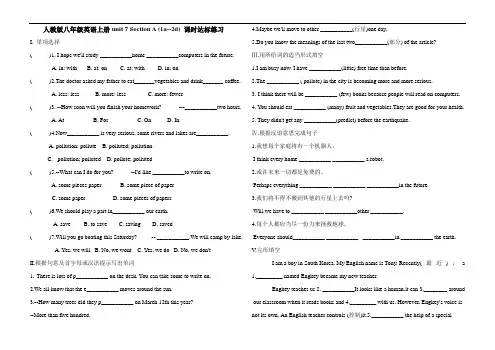
人教版八年级英语上册unit 7 Section A (1a--2d) 课时达标练习I.单项选择( )1. I hope we'll study ___________home ___________computers in the future.A. in: withB. at: onC. at: withD. in; on( )2.The doctor asked my father to eat_______vegetables and drink_______ coffee.A. less: lessB. more: lessC. more: fewer( )3. --How soon will you finish your homework? ---___________two hours.A. AtB. ForC. OnD. In( )4.Now___________ is very serious, some rivers and lakes are___________.A. pollution; polluteB. polluted; pollutionC. pollution; pollutedD. pollute; polluted( )5.--What can I do for you? --I'd like ___________to write on.A. some pieces paperB. some piece of paperC. some paperD. some pieces of papers( )6.We should play a part in___________ our earth.A. saveB. to saveC. savingD. saved( )7.Will you go boating this Saturday? -- ___________.We will camp by lake.A. Yes, we willB. No, we wontC. Yes, we doD. No, we don'tII.根据句意及首字母或汉语提示写出单词1.There is lots of p___________ on the desk. You can take some to write on.2.We all know that the e___________ moves around the sun.3.--How many trees did they p___________ on March 12th this year?--More than five hundred. 4.Maybe we'll move to other ___________(行星)one day.5.Do you know the meanings of the last two___________(部分) of the article?Ⅲ.用所给词的适当形式填空1.I am busy now. I have ___________(little) free time than before.2.The ___________ ( pollute) in the city is becoming more and more serious.3. I think there will be ___________ (few) books because people will read on computers.4. You should eat ___________ (many) fruit and vegetables.They are good for your health.5. They didn't get any ___________(predict) before the earthquake.Ⅳ.根据汉语意思完成句子1.我想每个家庭将有一个机器人。
Unit7SectionA2d课件人教版英语八年级上册
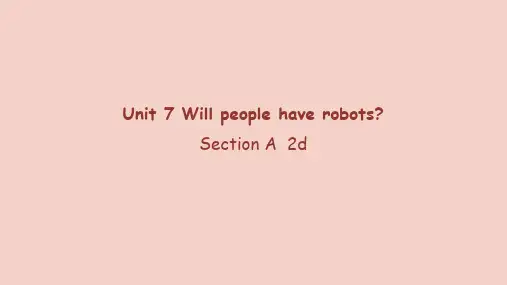
Jill: Maybe. But I want to live on the earth.
Nick: Me, too. Then what can we do?
Jill: We can use less water and plant more trees.
听读
朗读
Everyone should play a part in saving the earth.
听读
_m_o_v_e__to__o_th_e_r_p_l_a_n_e_ts_.
朗读
Task 1 Task 2
训练 点拨
2d Listen and follow, pay attention to your pronunciation and intonation. Nick: What are you reading, Jill?
Nick: Me, too. Then _w__h_at__ca_n__w_e__d_o_?
Jill: We can use less water and plant more trees. __E_v_e_ry_o_n_e__sh_o_u_l_d__p_la_y_a__p_a_rt_
听读
_i_n_s_a_v_in_g__t_h_e_e_a_rt_h_.
Cities will be __m_o_r_e_c_r_o_w_d_e_d___ and
__p_o_ll_u_te_d__. There will be _f_e_w_e_r_t_re_e_s_
and the environment will _b_e__in__g_re_a_t__
_d_a_n_g_e_r_. Maybe people will have to
2013人教版新目标八年级英语上Unit_7_Will_people_have_robots_Section_A_2a-2d

I 修饰不可数名词 will hope, believe, guess, am Boy1: I predict that there be less free time. I don’t think so. afraid not/ Woman: I hope not. Girl 2: Well, I think there will be fewer cars. Woman: You do? Girl 2: Yes,修饰可数名词use the people will subways more.
1. What will the future be like in the book? Cities will be more crowed and polluted. There will be fewer trees and environment will be in great danger.
1.Will people use money in 100 years? 【例句】 莉萨半个小时之后到。 ____________________________ Lisa will arrive in half an hour. 【辨析】 (1) in用于含一般将来时的句子中,表示 以现在为起点一段时间以后,是一个表 示未来的概念。
3. plant v. 种植;n. 植物
e.g. They want to plant trees around the lake. 他们想在湖边种树。
4. play a part in… 是一个固定短语,表示 “参与……;在……中尽自己的一份力 量” e.g. He didn’t play a part in making this decision. 他并没参与做出此决定。
人教版英语八年级上册Unit7 SectionA(1a-2d)课件
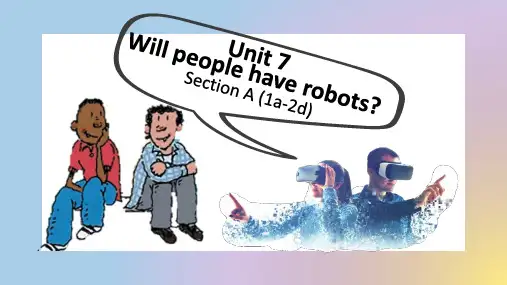
Nick
Joe
After reading the newspaper, Nick made 3 predictions in 2012 and it was published in the newspaper.
In 2012, a boy called Nick made three predictions. 1. Kids won’t go to school. They will
pollution
environment
buildings trees
…
buildings
cars
If the future city is better, try our best to make it the best! If the future city is worse, think solutions to make it better! After all, everyone should play a part in protecting and saving the future city.
Will people…..? Yes, they will. No, they won’t. Will there be……? Yes, there will be. No, there won’t.
Will people never eat
fast food?
life
predictions
Will people live under the sea?
_fe_w__e_r__buildings _fe_w__e_r__people
_m_o_r_e___trees _le_s_s____pollution
八年级-人教版-英语-上册-Unit 7 Section A (1a-2d)
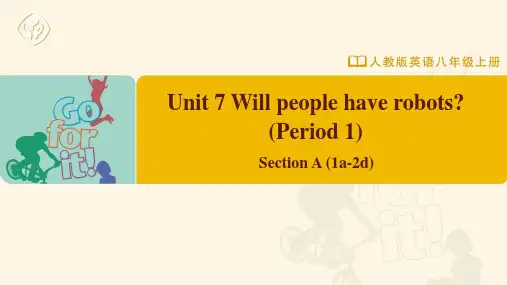
1a How will the world be different 100 years from now? Read these predictions. Check ( √ ) A for agree or D for disagree.
__A __D 1.People will have robots in their homes. __A __D 2.People won’t use money. Everything will be free. __A __D 3.Books will only be on computers, not on paper. __A __D 4.Kids won’t go to school. They’ll study at home on computers. __A __D 5.There will be only one country. __A __D 6.People will live to be 200 years old.
Read and think.
1.There will be more people. 2.There will be less free time. 3.There will be fewer cars. 4.There will be less pollution. 5.There will be fewer trees.
pollution n. 污染;污染物
plant n. ቤተ መጻሕፍቲ ባይዱ物 v. 种植
Look and say.
earth n. 地球;世界
planet n. 行星
prediction future pollute environment part play a part
英语人教版八年级上册 Unit7_SectionA(1a-2d)同步课件

Listen to 1b. The main idea of the conversation is that _C____.
A. People will have robots in their homes.
B. Kids will study at home on computers.
C. How our world will be different 100 years from now.
谢谢观看
测未来
SSttuuddeennttss swtiulldystautdyhoamte.home. SSttuuddeennttss wstiluldsytoundycoomnpcuotemrpsu.ters. PPeeooppllee whailvl ehraovbeotrsobinottshienirtheoimrehso.mes. People wreialldrbeoaodksbonokcsoomnpuctoemrps.uters. PGeroapnldepwa’isll glrivaendtpoa bise 128000 yyeeaarrss oolldd..
fewer修饰 __可__数_名_词__复_数___ less修饰 ___不__可_数_名__词___
1、可以用助动词__w_i_ll____加动词 ___原__形_____谈论将来的事情。
2、可以用__T__h_e_re__w_i_ll_b_e__+_名__词___ 句型表示“将会有……”。
3、 _T_h_e_r_e_w__il_l_b_e_m__o_r_e_+_名__词______ 表示“将会有更多的……”。
1. There will be more/less/fewer people. 2. There will be more/less/fewer free time. 3. There will be more/less/fewer cars. 4. There will be more/less/fewer pollution. 5. There will be more/less/fewer trees.
Unit7SectionA2d-3c课件人教版八年级英语上册
more/fewer tall buildings more /fewer cars
more people and more crowded
less/more free time less /more pollution fewer/more trees
green environment fresh air many plants (trees and grasses) relaxing and enjoyable
修饰不__可__数___名词
Exercises
否定句: 一般疑问句: 肯定及否定回答:
Yes, they will. No, they won’t.
3a Fill in the blanks with more, less or fewer.
1. In the future, there will be ___m__o_r_e fresh water because there will be __l_e_ss__ pollution in the sea.
polluted epnovlliurtoendmaeirnt no plants traffic jam terrible and unhappy
2d Read the conversation and answer the questions. 1. What will the future be like in the book?
plant pollution
driverless plane flying car
transportation
others
health money country
...
According to the pictures on the right and retell the conversation with your own words.
人教版八年级英语上册Unit7SectionA(2d3c)教学设计
3. **口语表达**:
-创设情境,如模拟旅行经历分享,让学生在实际情境中练习口语表达。
-鼓励学生相互评价,提供正向反馈,增强学生的自信心。
4. **阅读理解**:
-引导学生运用预测、扫读、精读等策略,提高阅读效率。
-设计问题链,帮助学生逐步深入理解文章内容,培养批判性思维。
-对于学习能力强、表现积极的学生,提供拓展性学习材料和更高难度的挑战,以满足他们的学习需求。
-利用信息技术,如在线学习平台和移动应用,为学生提供个性化的学习资源和学习跟踪服务。
四、教学内容与过程
(一)导入新课
在本环节中,我将采用以下方法引导学生进入新课的学习状态:
1.利用图片展示:展示与本课主题相关的图片,如探险家的照片、探险地点的风景等,激发学生的好奇心和兴趣。
5. **团队合作**:
-设计需要团队协作的活动,如小组讨论、角色扮演等,培养学生的团队意识和沟通技巧。
-引导学生进行自我反思,了解自己在团队合作中的优点和不足,促进个人成长。
此外,针对不同学生的学习需求,我还将采取以下个性化教学措施:
-对于基础薄弱的学生,提供额外的辅导和练习,确保他们能够跟上教学进度。
(二)讲授新知
在本环节中,我将系统地讲授以下新知识:
1.一般过去时态:通过实例句型,讲解一般过去时态的构成和用法,让学生了解并掌握如何描述过去发生的事情。
2.新词汇和短语:讲解本节课的新词汇和短语,如"adventure", "society", "achieve", "opportunity"等,通过例句和情境,帮助学生理解其含义和用法。
人教版八年级上册英语Unit7Section A-2.ppt
2. 基本句型
肯定句 主语 + will +V原形
否定句 主语 + will +not + V原形
一般疑问句 Will +主语 + V原形
特殊疑问句 特殊疑问词 + 一般疑问句
简略回答
Yes, I will.
No, I won’t. (注意缩写形式)
Will 句式总结
肯定
否定
一般疑问句
回答
I will have many I won’t have many
3. People now usually live to be about 70-80 years old, but in the future_____________ __P_e_o_p_le__w_i_ll_l_iv_e__to__b_e_2_0_0__y_e_a_r_s_p_l_d_. _____
3) the city people 城里人 people指“平民、百姓、居民”
辨析: people, person, folks和 human.
1) people意思为“人们”时, 着重指全体
①“人”包括men, women,
√ 2) person
②chipldeorepnle的单数形式
one people one person
4. Families usually spend time together on weekends, but maybe in 200 years______ _E_v_e_r_y_d_a_y__c_a_n_b_e__w_e_e_k_e_n_d_,_b_e_c_a_u_s_e_____ __th_e_y__h_a_v_e_r_o_b_o_t_s_t_o_d_o__e_v_e_r_y_th_i_n_g_._____
八年级上册英语Unit7SectionA1a-2d
Unit 7 Will people have robots?第一课时(Section A 1a-2c) (听说课)【学习目标】1. 会读、写下列词汇:future,will ,robot,won’t ,everything,paper ,tree,pollution2.熟练运用以下句型 (1)In the future,people will do..(2)A:Will people do... ? B:Yes,they will.learning process 学习过程Learningmethods 【学法指导】一、Leading-in(4分钟)回忆be going to的用法,根据所给提示词汇,填空练习。
1. There ______ _ a class meeting on Monday from now on . ( be )2. I __ ______ here soon. (not work )3. ___ there a dolphin show in the zoo tomorrow evening ? ( be )4. Her mother ____ her a beautiful hat on her next birthday. ( give )5.They__ ___ back in three days.( come )我们也可以用will 代替以上句子中的be going to ,否定句在它后面加not,缩略为won ’t , 问句将它放在主语前。
这就是本模块的语法,一般将来时: will/shall + V原形的用法。
be going to 是"一般将来时"的一种表现形式,表示将来某个时间将要发生的动作或存在的状态,意思为"打算,将要"。
其中"be"会根据主语的人称变化成"is,am,are"等形式。