
外研版英语课件4上Module 7 Unit 2 Did you see it?-Did you 句型 课件
四年级上册英语Module 7 Unit 2 Did you see it

No, I didn’t.
与你的同桌一起完成下面的对话吧!
Yes, I did.
Yes, I did.
No, I didn’t.
Summary
单词和短语:
matter, lost, look for
句型:
Did you see it? No, I didn’t.
his milk away .
Presentation
What’s the matter?
( ) Mum didn’t find her bag.
( √ ) Mum didn’t find her key.
Did Daming see it?
( ) Yes, he did.
( √ ) No, he didn’t.
Module 7 Unit 2
Unit 2 Did you see it?
四年级 | 上册
Let’s chant
Football, football, did you play? Did you play football yesterday? Did you pass? Did you run? Did you play football? Fun, fun, fun!
Choose and write
mil the little pig took a bottle of milk to school. But, he did not find his milk. And then, He asked the cat, but the cat didn’t see his milk . Oh! Pig finally knew(知道) who took
Did Mum look for it in her bag?
外研版九年级英语上册课件:Module 7 Unit 2 (共37张PPT)
要点思维导图1 拓展
举例
Do you know why they were surprised to meet their teacher in the museum? 你知道为什 么他们对在博物馆遇见他们的老师感到很惊讶吗?
You will be surprised at his progress. 你 会惊讶于他的进步。
教材例句 It is written in everyday English … 它是用日常 英语写的……(教材第58页)
要点思维导图
举例 Cooking is an everyday job. 做饭是一项日常工作。 We have breakfast every day. 我们每天都吃早饭。
应用 用everyday或every day填空 1.We should practise ___e_v_e_r_y_d_a_y__ English __e_v_e_r_y__d_a_y__. 2.This is an __e_v_e__r_y_d_a_y__ dress. I wear it __e_v_e_r_y__d_a_y__.
用法 pay for在此意为“为……付出代价;受惩罚”。
拓展 pay与for搭配还可以表示“花费;为……付钱”,与 之易混的动词有cost, spend, take,它们的用法如下:
举例
You'll have to pay for your crime. 你得为你 的罪行付出代价。
I paid a very high price for the house. 我 付了很高的价钱买下了这房子。
13、He who seize the right moment, is the right man.谁把握机遇,谁就心想事成。2021/9/82021/9/82021/9/82021/9/89/8/2021 •14、谁要是自己还没有发展培养和教育好,他就不能发展培养和教育别人。2021年9月8日星期三2021/9/82021/9/82021/9/8 •15、一年之计,莫如树谷;十年之计,莫如树木;终身之计,莫如树人。2021年9月2021/9/82021/9/82021/9/89/8/2021 •16、教学的目的是培养学生自己学习,自己研究,用自己的头脑来想,用自己的眼睛看,用自己的手来做这种精神。2021/9/82021/9/8September 8, 2021 •17、儿童是中心,教育的措施便围绕他们而组织起来。2021/9/82021/9/82021/9/82021/9/8
2019-2020学年外研版(三起)英语六年级下册Module7Unit2
2019-2020学年外研版(三起)英语六年级下册Module 7 Unit2 She couldn’t see or hear. 练习卷学校:___________姓名:___________班级:___________考号:___________一、汉译英:整句1.汉译英。
1. 出生于________________________2. 去世界旅行________________________3. 学说话________________________4. 写书________________________5. 一个模范________________________6. 去农场________________________二、按要求填空2.He ________(be)born in 1980.3.Helen _________(can)talk.4.As a baby, she ________(become)blind and deaf.5.His father _________(teach)him Chinese last year.6.Helen ________(write)a book about herself.三、单选题7.________ a small boy, he became blind and deaf. ()A.Because B.As C.But8.He ________ a book about himself. ()A.wrote B.write C.writes9.Helen is _________ for us.A.role B.model C.a role model 10.Helen Keller was born _____ the U.S. _______ 1880. ()A.in; at B.on; in C.in; in11.We planned _________ a baseball game. ()12.He can’t hear everything. He is _________. ()A.deaf B.blind C.sad 13.Helen couldn’t see _________ hear. ()A.and B.but C.or 14.Helen’s teacher taught her _________. ()A.spell B.spells C.to spell 15.Helen lived _________ eighty-seven. ()A.to B.be C.to be 16.Where did you ______? ()A.go B.went C.going四、句子匹配17.从方框中选择正确的答语。
2017年秋七年级英语上册 Module 4 Unit 7 School clubs课件 牛津深圳版

He gave his mother a big surprise. 他给了他妈妈一个大惊喜。
I was surprised at the news. 这个消息令我感到惊讶。
To my surprise, she made it at last. 使我惊讶的是,她最终成
功了。
【应用】
(1) ( C ) Mary is surprised __________ the plot(情节) of
We were amazed at the news. 我们对这个消息感到大为 惊奇。 【应用】 (1)我得到了一份令人惊奇的工作。(根据汉语意思补 全句子) I got ____a_n_____ __a_m__a_z_in_g__ job. (2)她感到如此惊奇以至于跑过去看看发生了什么事情。 (根据汉语意思补全句子) She was so __a_m__a_z_e_d__ that she ran to see what happened.
【应用】
( C ) —Shall we meet at 9 o'clock tomorrow morning?
—Sorry, let's make it ______ time.
A. other's
B. the other
C. another
【思维导图】
要点 7 amazing
【举例】Where are those amazing photos taken from? 那 些神奇的照片是在哪里拍的?
the film.
A. to
B. in
C. at
(2) To his __s_u_r_p_r_is_e__ (surprised), Tom finished it himself.
Module7 Unit 2 She was thinking about her cat课件
2S.Whehuesruealdlyidspshenedlsanmdu?ch time together with his pet cat.
HSehr ecalatnisdehderonclossoemferidernydsle. aves.
3H.WerhcaattwgaasveAhliecre cdoouirnaggWe(勇hi气le)s. he was falling?
The soil is too dry for planting. 土太干了,不能种东 西。
dry adj. 干的;干燥的
Pre-reading 1 Look at the picture and say what you think is strange.
The rabbit can run with two back legs!
sit… with… read a book have nothing to do
Once or twice… look into ...
Suddenly…. run by
hear…say take…out of
get up
see... go down
run after…across go down after it
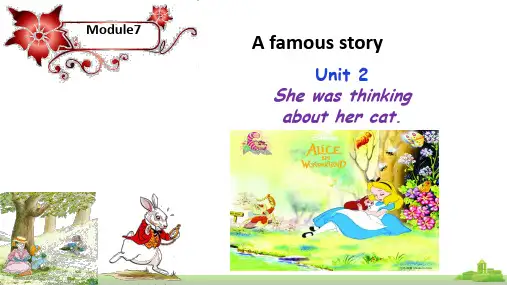
She was thinking about her cat.
Look back to the story
Scene l
sit… with… read a book have nothing to do
Once or twice… look into ...
Suddenly…. run by
Scene 2 The field
3 Read the passage and match the headings with the
外研版(三起)-英语-六年级下册--外研版三起Module 7 Unit 2教材同步讲解
Unit 2:She couldn't see or hear.(第二单元:她看不到也听不到。
)(教材41~43页)1.Listen and chant.听一听并跟着唱。
(教材第41页)课文英汉互译Helen couldn't see.海伦看不见。
But she could read但她可以阅读。
Helen couldn't hear.海伦听不见。
But she could talk.但她可以说话。
重难点精析could的用法Helen couldn’t see.But could read.海伦看不见。
但她可以阅读。
【点拨】.could用来表示过去的能力、可能性或允许。
例如:I could run faster then.那时我能跑得更快。
could还可与表示感知的动词,如see,hear,smell,taste,feel,understand等连用,表示特定的能力。
例如:He said he could see me next week.他说他下周能见我。
【知识拓展】(1)could意为“允许”时,表示委婉地提出问题或陈述看法。
例如:-Could I use your bike?我可以用你的自行车吗?-Yes,you can.是的,你可以。
(2) could还可表示过去的可能或许可。
例如:Father said I could swim in the river.爸爸说我可以在河里游泳。
【即学即用】连词成句borrow,pen,l,could,your(?)答案速查Could I borrow your pen?2.Listen and read.听一听并读一读。
(教材第41页)课文英汉互译Helen Keller was born① in the US in 1880.As② a baby,she became③ blind and deaf.She couldn't see or hear.海伦·凯勒于1880年出生在美国。
外研版七年级英语上册教学课件Unit 2 Lesson 4 Reading for writing
A bit lonely.
2.Why did Emma feel that way? Because she was new at this school. And there were no old classmates there.
Read paragraph 3&4&5, then answer the following question.
3 Share your paragraph with the class.
此外,leave还有以下几种用法: (1)leave sb./sth.+adj. 让某人/某物处于某种状态。
Leave the door open, please. (2)leave sth.+地点状语. 把某物遗忘在某地。
I left my bag on the bus.
Writing
Free talk
Unit 2 More than fun
Reading for writing
Learning Objectives
In this lesson you will: 1. know and retell Emma’s adventure story; 2. analyse Emma’s feelings through action words in the passage; 3. write a paragraph about making friends through sharing a
I can share my ideas and new stories with more people. I can make friends by writing.
Read the title. What’s the meaning of “adventure”?
四年级上册英语教案-Module7Unit2Didyouseeit|外研社(一起)
四年级上册英语教案Module 7 Unit 2 Did you see it|外研社(一起)教学目标本节课的教学目标主要是通过学习Module 7 Unit 2的内容,让学生能够理解和运用一般过去时态,掌握询问过去发生事情的句型"Did you see it?",并能用过去时态描述过去发生的事情。
同时,通过学习,培养学生的观察能力、表达能力和合作能力。
教学内容Module 7 Unit 2的内容主要是一段关于一个孩子和他的朋友们在公园里玩耍的对话。
对话中,孩子们互相询问对方是否看到了一只在空中飞行的风筝。
教学内容包括理解对话内容,学习一般过去时态的用法,掌握"Did you see it?"这个句型,并能用过去时态描述过去发生的事情。
教学重点与难点本节课的教学重点是让学生理解和掌握一般过去时态的用法,学会用"Did you see it?"这个句型询问过去发生的事情。
教学难点是如何让学生在实际情境中正确运用一般过去时态,以及如何用过去时态描述过去发生的事情。
教具与学具准备为了更好地进行教学,教师需要准备一些教具,如图片、卡片、多媒体课件等。
学生需要准备的学习用品包括课本、笔记本、文具等。
教学过程第一阶段:导入教师可以通过展示一些关于公园玩耍的图片,引起学生的兴趣,然后引导学生进入本节课的学习内容。
第二阶段:新知识学习教师通过展示多媒体课件,讲解一般过去时态的用法,让学生理解"Did you see it?"这个句型的含义和用法。
然后,教师可以通过一些实例,让学生进一步理解和掌握这个句型。
第三阶段:实践与应用教师可以设计一些实践活动,如角色扮演、小组讨论等,让学生在实际情境中运用"Did you see it?"这个句型,用过去时态描述过去发生的事情。
板书设计Module 7 Unit 2"Did you see it?"句型一般过去时态的用法重要的词汇和短语作业设计作业设计应注重实践性和创新性,让学生在实际情境中运用所学知识。
外研版(三起)-英语-六年级下册--外研版三起Module7Unit2教材同步讲解
外研版(三起)-英语-六年级下册--外研版三起Module7Unit2教材同步讲解Unit 2:She couldn't see or hear.(第⼆单元:她看不到也听不到。
)(教材41~43页)1.Listen and chant.听⼀听并跟着唱。
(教材第41页)课⽂英汉互译Helen couldn't see.海伦看不见。
But she could read但她可以阅读。
Helen couldn't hear.海伦听不见。
But she could talk.但她可以说话。
重难点精析could的⽤法Helen couldn’t see.But could read.海伦看不见。
但她可以阅读。
【点拨】.could⽤来表⽰过去的能⼒、可能性或允许。
例如:I could run faster then.那时我能跑得更快。
could还可与表⽰感知的动词,如see,hear,smell,taste,feel,understand等连⽤,表⽰特定的能⼒。
例如:He said he could see me next week.他说他下周能见我。
【知识拓展】(1)could意为“允许”时,表⽰委婉地提出问题或陈述看法。
例如:-Could I use your bike?我可以⽤你的⾃⾏车吗?-Yes,you can.是的,你可以。
(2) could还可表⽰过去的可能或许可。
例如:Father said I could swim in the river.爸爸说我可以在河⾥游泳。
【即学即⽤】连词成句borrow,pen,l,could,your(?)答案速查Could I borrow your pen?2.Listen and read.听⼀听并读⼀读。
(教材第41页)课⽂英汉互译Helen Keller was born① in the US in 1880.As② a baby,she became③ blind and deaf.She couldn't see or hear.海伦·凯勒于1880年出⽣在美国。
外研版三起英语六年级下册Module7 Unit2Shecouldn't see or hear课件
海伦笔直坐在一座旧的石墙上, 正在读放在膝头上一本盲文书。
Let's learn the text. (课文学习)
1.Listen and chant.(41页)
Helen couldn’t see. 海伦看不见。 But she could read. 但是她能阅读。 Helen couldn’t hear. 海伦听不见。 But she could talk. 但是她能说话。
Helen had a teacher. She drew letters in Helen's hand and taught her to spell.
drew (draw的过去式)画 taught(teach的过去式)教 teach sb. to do sth. 教某人做某事
海伦有一位老师。她在海伦的手上画字母, 并教她拼写。
Module 7 Unit 2
She couldn't see or hear.
1880年6月27日—1968年6月1日
Learn more about Helen Keller 海伦·凯勒
了解海伦.凯勒
She is a very famous lady. She is from America. She couldn’t see or hear. But she could learn and work. She wrote ight”.
What can you learn from Helen Keller?
Where there is a will , there is a way. 有志者,事竟成。 Never give up. 永不放弃。
Keep your face to the sunshine, and you cannot see the shadow. 永远面对阳光,阴影自然会落在你后面。