
药品注册英文教案资料
Glossary(术语):
Regulatory Affairs (RA):药政事务
drug authority:药政当局
investigation and research before project approval:立项前的调研Market Authorization (MA):上市许可
post-approval commitment study:上市后的承诺研究
post-approval variation application:补充申请
life cycle:生命周期
Chemistry, Manufacturing, and Controls (CMC):药品的化学、生产和控制
cross-functional teams:公司内部各部门
look at the big picture:从大局考虑
think strategically:进行战略性思考
risks and benefits:风险和获益
Food and Drug Administration (FDA):美国食品药品监督管理局European Medicines Agency (EMA):欧洲药品管理局International Multi-center Clinical Trial (IMCT):国际多中心临床试验
Bioequivalence study (BE study):生物等效性试验
generic drug:仿制药
Center for Drug Evaluation (CDE):SFDA下属的药品审评中心Quality by Design (QbD):质量源于设计
CMC Pilot Program:FDA在业内开展的关于QbD的试点研究
early launch:早日上市
design space:设计空间
Business Development (BD):业务发展部门
Imported Drug License (IDL):进口药品注册证
Manufacturing License (ML):生产许可证
Clinical Trial Permission (CTP):临床试验批件
Active Pharmaceutical Ingredient (API):原料药
Orange Book:橙皮书
business value:商业价值
the Pharmacopoeia of the People's Republic of China(ChP):中国药典the United States Pharmacopoeia (USP):美国药典
the European Pharmacopoeia (Ph. Eur.或EP):欧洲药典
List of Essential Drugs (EDL):基本药物目录
Reimbursement Drug List (RDL):医保目录)
typing error:打印错误
slip of the pen:笔误
Drug Master File (DMF):药物主文件
Certificate of Analysis (CoA):检验报告
Marketing (MKT):市场部
market share:市场占有率
sales volume:销量
investigator brochure (IB):研究者手册
protocol:临床试验方案
priority:优先度
package insert (PI):说明书
labeling:包装标签
Patient Information Leaflet (PIL):患者使用的说明书
Summary of Product Characteristics (SmPC,SPC):产品特性摘要foil:铝箔
carton:装药品的小盒
shipping label:运输包装标签
Medical:医学部
provincial drug administration (PDA):省级药监局,包括省、自治区和直辖市药品监督管理部门
Institute for Food and Drug Control:药检所
National Institute for the Control of Pharmaceutical and Biological Products (NICPBP):中国药品生物制品检定所,简称“中检所”supplementary dossier:补充资料
approval letter:注册批件
out of specification (OOS):超出标准、不合格
adverse effect (AE):不良事件
trial waiver:减免临床试验
Clinical:临床部门
Commercial:商业部门
new chemical entity (NCE):新化学实体
key opinion leader (KOL):关键意见领袖
off-label use:标签外使用
patient pool:患者库
deadline:最后期限
global trial:全球性的临床试验,即国际多中心临床试验regional trial:区域性的临床试验
TPD 加拿大卫生部治疗产品局
adverse drug reaction, ADR 药物不良反应pharmacokinetics (PK ) 药物代谢动力学。
《英文药品说明书》课件模板
solution 溶液
tablets 片剂
derivative 衍生物
colo(u)rless 无色的 tasteless 无味的 liquid 液体
sterile 无菌的
powder 粉末
solid 固体
soluble 可溶的 molecular weight 分子量
常见的句型
例1.Folic acid is a yellowish to orange, crystalline powder; odourless or almost odourless. 叶酸是淡黄色至橙色结晶粉末,无臭或几乎无臭。
例 4 Nebcin is indicated for the treatment of the following infections caused by susceptible microorganisms. 乃柏欣适用于治疗下列由敏感细菌引 起的感染:
课后作业
丙磺舒(Benemid)被推荐用于治疗痛风及 在抗感染治疗时增加并延长青霉素类 (penicillins)的血浆浓度;
常见句型举例
例3. 已发现制霉菌素(Nystain)在肠道内可 抑制酵母菌(yeast)的生长。 Nystain has been found to inhibit the growth of yeast in the intestinal tract.
例4. 熊去氧胆酸的生物半衰期时3.5-5.8天 the biological half-life of ursodeoxycholic
be associated with in association with be combined with in combination with be compatible with in conjunction with concomitant with together with
药品注册管理办法 in English
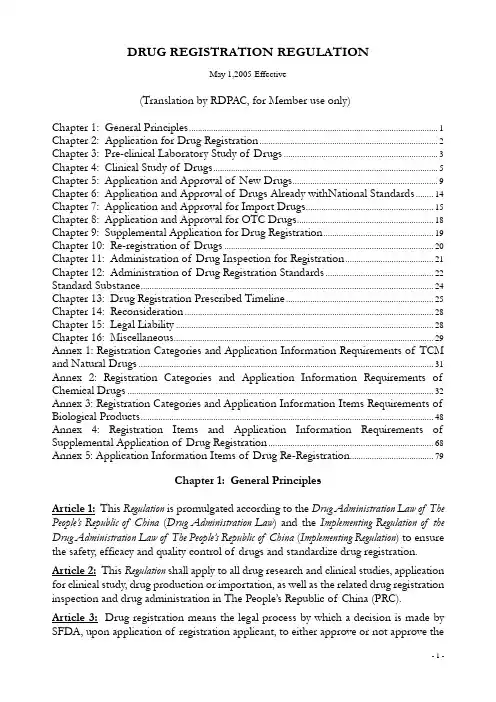
DRUG REGISTRATION REGULATIONMay 1,2005-Effective(Translation by RDPAC, for Member use only)Chapter 1: General Principles (1)Chapter 2: Application for Drug Registration (2)Chapter 3: Pre-clinical Laboratory Study of Drugs (3)Chapter 4: Clinical Study of Drugs (5)Chapter 5: Application and Approval of New Drugs (9)Chapter 6: Application and Approval of Drugs Already withNational Standards (14)Chapter 7: Application and Approval for Import Drugs (15)Chapter 8: Application and Approval for OTC Drugs (18)Chapter 9: Supplemental Application for Drug Registration (19)Chapter 10: Re-registration of Drugs (20)Chapter 11: Administration of Drug Inspection for Registration (21)Chapter 12: Administration of Drug Registration Standards (22)Standard Substance (24)Chapter 13: Drug Registration Prescribed Timeline (25)Chapter 14: Reconsideration (28)Chapter 15: Legal Liability (28)Chapter 16: Miscellaneous (29)Annex 1: Registration Categories and Application Information Requirements of TCM and Natural Drugs (31)Annex 2: Registration Categories and Application Information Requirements of Chemical Drugs (32)Annex 3: Registration Categories and Application Information Items Requirements of Biological Products (48)Annex 4: Registration Items and Application Information Requirements of Supplemental Application of Drug Registration (68)Annex 5: Application Information Items of Drug Re-Registration (79)Chapter 1: General PrinciplesArticle 1: This Regulation is promulgated according to the Drug Administration Law of The People’s Republic of China (Drug Administration Law) and the Implementing Regulation of the Drug Administration Law of T he People’s Republic of China (Implementing Regulation) to ensure the safety, efficacy and quality control of drugs and standardize drug registration. Article 2: This Regulation shall apply to all drug research and clinical studies, application for clinical study, drug production or importation, as well as the related drug registration inspection and drug administration in The People’s Republic of China (PRC).Article 3: Drug registration means the legal process by which a decision is made by SFDA, upon application of registration applicant, to either approve or not approve theconducting of a drug clinical trial, production or importation of a drug to be marketed, based on a systematic evaluation of the safety, efficacy and quality control of the drug. Article 4:The State shall encourage research and development of new drugs and exercise fast track approval for innovative new drugs, those for difficult to treat and life threatening diseases, and drugs needed for emergency use.Article 5: The State Food and Drug Administration (SFDA) is the competent national authority for drug registration, responsible for the review and approval of clinical studies, production and importation of drugs.Provincial Drug Authorities (PDA) shall be authorized by SFDA to examine the completeness, standardization and authenticity of an application dossier, and organize inspection of the pilot manufactured drugs.Article 6: A drug registration applicant (applicant) means an institution which makes application for and assumes corresponding liability for drug registration, and holds the drug approval certificate after approval has been obtained.A local applicant shall be a legally registered institution in China and be competent to independently assume legal liability. A foreign applicant shall be a legally established pharmaceutical company outside of China. In making application for an import drug registration, the foreign applicant shall use its office in China, or authorize an agent in China to handle the application.The person(s) handling the drug registration application shall have technical expertise, and be familiar with drug administration laws, regulations and technical requirements.Chapter 2: Application for Drug RegistrationArticle 7: Drug registration application includes application for new drug, application for a drug already with national standards, and application for import drug as well supplemental application. A local applicant shall make application according to new drug or a drug already with national standards; a foreign applicant shall make application according to import drug.Article 8: A new drug application means a registration application for a drug that has not been marketed in China. A drug that has been marketed in China for which an application is made for a change in dosage form, or route of administration, add new indication shall be treated as a new drug applicationApplication for a drug already with national standards means application for production of a drug for which SFDA has already issued formal standards.Application for import drug means application for a drug produced outside China to be marketed in China.Supplemental application means an application for the change, addition, or cancellation of any item or contents in the existing registration approval of a new drug, drug already with national standards, or import drug.Article 9:Application for registration shall be made to PDA with submission of relevant documents and drug samples. However, application for import drug shall be made to SFDA.Applicant should assume the liability for the truthfulness of all the application dossier.. Article 10:If two or more institutions jointly apply for new drug registration, the application shall be made to the PDA where the drug manufacturer is located. If all the applicants are manufacturers, the application shall be made to the PDA where the drug manufacturer of the preparation is located. If none of the applicants is a drug manufacturer, the application shall be made to the PDA where the drug sample is pilot manufactured.Article 11: Regarding the drug or its formulation, manufacture processing, indication etc. the applicant shall submit documents explaining the China patent status and ownership rights. If other party holds patent in China, the applicant shall submit a letter of guarantee stating that the drug will not infringe on the patent rights of others and that the applicant assumes liability for any possible infringement.Article 12:If an infringement dispute occurs after completion of registration, the parties shall try to negotiate a resolution, or resolve the matter according to relevant laws, regulations, or rules through judicial organs or patent administration institutions. Once there is a final rule from the Patent Administration or an enforcement judgment from People’ Court to determine the fact of infringement, Patent holder may apply at SFDA for cancellation of drug approval number of infringing party. SFDA shall based on the facts, cancel the certified drug approval of infringing party.Article 13: For a drug that has obtained patent protection in China, another applicant may apply for registration within two years prior to the patent expiration. SFDA shall review the application according to this Regulation and, after expiration of the patent, approve production or import for an application that meets requirements.Article 14: For a period of 6 years from the date of the original applicant's approval, SFDA shall not approve a subsequent application that used, without the express consent of the original applicant, the undisclosed R&D data and other data generated by the original applicant for submission of application of manufacturing or marketing of a drug containing new chemical ingredients unless the submitted data is generated by the subsequent applicant itself.Chapter 3: Pre-clinical Laboratory Study of DrugsArticle 15: The scope of pre-clinical laboratory study (pre-clinical study) of a drug for registration includes synthetic process, extraction methods, physical-chemical properties and purity, dosage form selection, screening of formulas, preparation process, inspection methods, specification, stability, pharmacology, toxicology and pharmacokinetic study. For TCM preparations, information such as the source and theprocessing of raw materials should also be included. For biological products, information such as specification, storage condition, genetic stability and immunology study of strain, cell strain as well as biological tissue should also be included.Article 16: Pre-clinical study of a drug shall be conducted in accordance with relevant regulations; the drug safety evaluation shall be conducted in accordance with Good Laboratory Practice for Pre-Clinical Laboratory Studies (GLP).Article 17:Institutions engaged in drug research and development shall have the necessary personnel, facility, equipment, instruments, conditions and management system needed corresponding to the research project. The animals, reagents and raw materials used for experiments shall comply with relevant national regulations and requirements. The authenticity of all data and materials shall be ensured.Article 18: When an application is only made for registration of preparation, the raw materials of the investigative drug substance used for this preparation shall have a Drug Approval Number, Import Drug Certificate or Pharmaceutical Product Certificate, and the raw materials shall have been obtained from legal channels. Relevant certified documents should be provided if the drug substances registered by other party or still pending the approval process have been used. Any investigative drug substance which does not have a Drug Approval Number, Import Drug Certificate or Pharmaceutical Product Certificate shall go through SFDA approval process.Article 19: If an applicant authorizes another institution to conduct the study of drugs, or any single experiment, inspection or pilot production and manufacture, the applicant shall sign a contract with the authorized party and maintain responsibility for the authenticity of study data.Article 20: If an applicant uses the pre-clinical study documents from a foreign drug research institution as supporting materials for a drug registration application, an explanation for the items referencing the page numbers shall be provided by the institution and notarized certificate of the institution's legal overseas registration shall be attached. Only after the documents are authenticated by SFDA may they be included in the registration documents. SFDA may send people to conduct on-site inspections, if necessary.Article 21: When there is a need to audit and inspect drug studies, SFDA and PDA may request the applicant or the drug research institute which conducted the experiments to repeat an experiment for any items by using the methods and data listed in the application dossier, and SFDA and PDA may send people to conduct on-site inspections of the experiment process. SFDA may also designate other drug control institutes or drug research institutions to repeat the experiments.Article 22:The pre-clinical study of drugs shall be conducted in accordance with relevant technical guidelines issued by SFDA. If the applicant conducts the experiments according to other methods and techniques, the applicant shall provide information to evidence that the methods and techniques are scientific.Chapter 4: Clinical Study of DrugsSection 1: Basic RequirementsArticle 23: Clinical study of drugs includes clinical trials and bioequivalence trials. Only after approval from SFDA may a clinical trial study be conducted, and it shall be conducted in accordance with Good Clinical Practice (GCP).Article 24: Clinical trials shall be conducted for the registration of a new drug. Clinical trials are divided into Phase I, Phase II, Phase III and Phase IV. Clinical trials of Phase I, Phase II and Phase III are needed for a new drug application. In some cases only Phase II and Phase III clinical trials or, only Phase III clinical trials, are needed for a new drug application.Phase I: Basic clinical pharmacology and human safety evaluation studies. To observe tolerance in human bodies and pharmacokinetics, providing a basis for a drug administration program.Phase II: A preliminary exploration on the therapeutic efficacy. The purpose is to evaluate the safety and efficacy of a new drug on patients within the target indication of the drugs, and providing the basis to devise Phase III Clinical Trial and to determine a drug administration program. Phase II Clinical Trial may be conducted in many ways including randomized blind controlled clinical trial in accordance with the purpose of the study.Phase III: The phase to confirm the therapeutic efficacy. The purpose is to further verify the safety and efficacy of a new drug for patients with targeted indication, to evaluate the benefit and risks relationship, and finally to provide sufficient data to support the registration approval of the drug. The trials usually are randomized, blind and controlled clinical trial with a large number of sample subjects.Phase IV: A new drug post-marketing study, conducted by the applicant. The objective is to investigate the efficacy and adverse reactions under the conditions of wide use, and to evaluate the benefit and risk relationship when used by ordinary and special groups of patients and to improve dosage of the drug.Article 25: Generally there is no need for clinical studies for the registration of a drug already with national standards. If clinical studies are needed, for a chemical drug only bioequivalence trials may be required. If the drug quality has to be controlled through the production processes and standards, clinical trials shall be conducted. For a supplemental application for a drug already marketed, clinical studies shall be conducted for an additional indication, or a significant change in the production process, or for any additional indication of TCM.Bioequivalence Trials refers to the human trials of Bioequivalence study, where statistical difference of absorption degree and speed of active components, in term of parameter of pharmacokinetics, will be determined by comparison the same or different dosage form of the preparation at the same test conditions,Article 26: The number of cases in the clinical study of a drug should be decided in accordance with the objective of the clinical trials and shall meet both the statistical requirements and the minimal cases required by this Regulation for a clinical study. For a drug used for the treatment of rare and special diseases or other special circumstances, any reduction in the number of cases in the clinical study or exemption must be approved by SFDA.Article 27: For a vaccine and other special drugs prepared during the strains selection stage, if there is neither suitable animal experimental model nor a way to evaluate the efficacy of the drugs in laboratory study, application of clinical trials may made to SFDA, provided that safety of the subjects can be ensured.Section 2: Requirements Before ImplementationArticle 28:After approval of a clinical study, the applicant shall select qualified institutions to conduct the clinical study, negotiate and determine leading institution, principal investigator and participating institutions.Article 29: The applicant shall sign a Clinical Trial Agreement with the leading and the participating institutes selected for the clinical study, and then provide the draft Informed Consent Form and Investigator’s Brochure, jointly improve the clinical trial protocol with reference to technical guidelines.The applicant shall request the Ethics Committee of the institutions to review the clinical trial protocol.Article 30: The applicant shall provide the institutions with the investigational drugs and comparator drugs (expect for Phase IV clinical trials) together with COA of drug samples, at no charge. The applicant shall bear the costs related to conducting the clinical study.Article 31: The investigational drugs shall be produced in a workshop which meets GMP requirements and the production process shall be strictly in accordance with the requirements of GMP.SFDA or the authorized PDA may conduct on-site audit, as necessary.Article 32: The applicant may inspect the investigational drug itself in accordance with the drug's standards approved by SFDA, or authorize a drug control institute designated by Article 147 and Article 148 of this Regulation to conduct the quality test. The drug may not be used for Clinical Trails before it has passed the inspection. SFDA may designate a drug control institute to conduct a random inspection for the investigational drug.Vaccine, blood products and other bio-products designated by SFDA as well as investigational drugs produced overseas must be inspected by a drug control institute designated by SFDA. The drug may not be used before it has passed the inspection. The applicant assumes all responsibility for the quality of the investigational drug.Article 33: Before conducting the clinical study, the applicant shall file with SFDAinformation such as the clinical study protocol, name of the principle investigator of the leading institution, participating institutions and investigators, approval letter from ethics committee, and the sample of the Informed Consent Form, also providing a copy to the PDA where the institutions are located.Section 3: Administration of a Clinical StudyArticle 34: During the clinical study, the applicant shall designate inspectors to monitor the implementation of GCP.Article 35: If an applicant discovers that an institution conducting clinical study is in violation of relevant regulations, or is not following the clinical study protocol, the applicant shall try to correct the situation. For serious violation, the applicant may request to suspend or stop the clinical study and shall submit a written report to SFDA and the relevant PDA.Article 36: Upon the completion of each phase of the clinical study, the applicant shall submit a clinical study and statistical analysis report to SFDA and relevant PDA.If the duration of clinical study exceeds 1 year, the applicant shall submit an annual clinical study progress report to SFDA and relevant PDA from the date of the approval of the study.Article 37: A clinical study shall start within 2 years of approval. Otherwise the approval certificate shall automatically become null and void. A re-application shall be submitted to resume the study.Article 38: The institutions and personnel participating in the clinical study shall be familiar with the characteristics, therapeutic activities, efficacy and safety of the investigational drugs and clearly understand their responsibility and liabilities, obtain Informed Consent Form s signed voluntarily by the subjects, keep accurate and true clinical study records.Article 39: If an applicant violates GCP or requests to change the data and conclusions of clinical study, the participating institutions and personnel shall report the circumstances to PDA and SFDA.Article 40: The institutions and investigators participating in the clinical study shall be responsible for taking all necessary measures to ensure the safety of the subjects. During the clinical study the investigator shall carefully watch for the occurrence of adverse events, adopt appropriate measures, and keep a record.The institutions shall report a serious adverse event to PDA and SFDA within 24 hours of occurrence, and immediately report to the Ethics Committee.Article 41: SFDA and PDA shall conduct inspection or data audits for the approved clinical study.Article 42:SFDA may request the applicant to amend the clinical study protocol, suspend or stop the clinical study in any of the following circumstances:the Ethics Committee has failed to perform its duty; or;the safety of the subjects cannot be effectively ensured;serious adverse event was not timely reported;the clinical study progress report was not timely submitted,the completion of the clinical study is more than 2 years behind the original completion date and there are still no results which can be evaluated;evidence that the investigative drug is not effective;quality problems in the drug used for clinical trials;fraud in the clinical study;other circumstances violating GCP.Article 43:The applicant or institutions shall implement the decision regarding amendment of the clinical study protocol, or suspension or cessation of the clinical study made by SFDAArticle 44:During the clinical study, in case a large range or unexpected adverse reaction or serious adverse event occurs, or there is evidence to prove that the investigational drug has significant quality problems, SFDA or PDA may adopt emergency mandatory administrative measures to suspend or stop the clinical study, and the applicant and institutions must immediately stop the study.Article 45: The investigators shall be responsible for use of the investigational drug and ensure the investigational drug is only used by the subjects of the study and the dosage and usage of the drug are in accordance to the clinical study protocol. The investigators shall not give the drug to any person not participating in the clinical study. The investigational drug shall not be sold.Article 46: A foreign applicant who wants to conduct an international multi–center clinical study shall apply at SFDA in accordance with the following provisions:The drug used for an international multi–center clinical study shall be one already registered in a foreign country or in phase II or phase III clinical trials. An application for an international multi–center clinical study of new preventive vaccine from a foreign applicant still not registered outside China shall not be accepted.In approving an international multi–center clinical study in China, SFDA may first request the applicant to firstly conduct the Phase I clinical trials in China, if needed. During a study conducted in China, the Applicant shall, in accordance with the relevant regulations, report to SFDA any serious adverse events or unexpected adverse events which occur in any countries.Upon the completion of the study, the Applicant shall submit the complete clinical study report to SFDA.Data generated from an international multi–center clinical trial used for drug registration in China, shall be in accordance with the relevant provision of this Regulation, and the applicant shall submit the complete research information of the study.Chapter 5: Application and Approval of New DrugsSection 1: Basic RequirementsArticle 47:The application dossier submitted for new drug registration shall be complete and standardized with authentic and reliable data. In citing literature and materials, the name of the work(s) and journal(s) as well as volume, issue and page number shall be provided. For unpublished literature and materials, an authorization letter from the owner must be provided. For any foreign language materials a Chinese translation should be provided in accordance with relevant requirements.Article 48: SFDA may use fast track approval process for the following new drug: New active ingredients and its preparation extracted from TCM, natural drugs, or preparation made of material from plant, animal and minerals, which have not been marketed in China and;drug raw material and its preparations, and biological product that have not been marketed domestically or outside China;new antiviral drug for AIDS and drug used for diagnosis and prevention of AIDS, cancer and orphan drug;new drugs which treat diseases for which there is no effective therapy.Drugs needed for emergency.Article 49: After receipt of an application for a drug described in Article 48 of this Regulation, PDA shall examine and made recommendations as to whether the application meets the requirements for fast track approval. Upon receipt of PDA recommendations, SFDA shall then decide whether to use fast track approval for the drug application. Article 50: When a new drug is jointly developed, the application shall be made by one of the parties, and other parties shall not apply. When a joint application needs to be made, the application shall be signed by all the parties. Except for a drug described in Article 48.1 and 48.2, after approval, the new drug shall only be manufactured by one party. Different strengths of one drug shall not be manufactured by different parties. No one should attempt to make different applicant to apply for registration for the same technology of new drug, or make repeat application in any way. SFDA and PDA will organize the related inspection, if any needs. Once the foresaid fact is confirmed, the application will not be accepted, and the application will be returned if already accepted. Article 51: During review process of new drug, even if the marketing approval of other domestic drug of the same active substance is approved overseas, the registration category and technical requirements of the drug shall remain unchanged in the review process in China.During the review process of new drug, even when the marketing approval of other domestic drug of the same active substance is approved in China, the registration category and technical requirements of the same kind of drug shall remain unchanged in the review process in China.Section 2: Approval of Clinical Study for New DrugsArticle 52: Upon the completion of the pre-clinical study, the applicant shall complete the Application Form for Registration of New Drugs, and submit the authentic materials and sample drugs to PDA.Article 53: PDA shall examine for form the application dossier, and if the requirement are met, the application will be accepted with issuing of acceptance notification of drug registration application. If the requirements are not met, the application will not be accepted with issuing of non-acceptance notification of drug registration application, with explanation of reasons.PDA shall, within 5 days upon acceptance of the application, organize and conduct on-site inspection for production and research of the drug, take sample drugs of 1-3 batches, and notify the drug control institute for inspection. PDA shall, within the prescribed time limit, submit recommendations, inspection report and application dossier to SFDA, and notify the applicant.Article 54: The drug control institute shall conduct drug inspections and drug standard inspection upon receiving notification, and submit the inspection reports to SFDA within the described time, notify the PDA which requested the inspection, and notify the applicant.Article 55:Upon receipt of the application dossier, SFDA shall organizes the pharmaceutical, medicals and other technical people to conduct technical review of the new drug, and SFDA may request the applicant to provide supplemental information and drug sample. When SFDA consider the requirements are met, Approval for Drug Clinical Study will be issued. When SFDA does not consider the requirements are met, Notification of Approval Opinion will be issued with explanation.Article 56: Upon receipt of verification recommendation, if the drug control institute concludes that the quality cannot be controlled by the drug standards, the applicant may withdraw the new drug application. If the applicant did not withdraw the new drug application, when SFDA proves the quality indeed cannot be controlled by the drug standards through a technical review, the application shall be returned.Article 57: After inspection, if the drug sample does not meet the submitted drug standards, after verification, SFDA shall return the application of new drug.Article 58:During SFDA's drug application review process, except for new information related to the innovative drug ingredients or drug safety, or the supplemental information required by SFDA, the applicant shall not submit supplemental technical material to SFDA. If new technical materials must be added, the applicant shall withdraw the application, and re-apply according to the original application procedures.Article 59: For those withdrawn or returned application, after further studies, if the requirements of the Regulation are met and there is no new drug of the same kind enter into monitoring period, the original applicant may resubmit the application according to。
药品注册英文

药品注册英文公司标准化编码 [QQX96QT-XQQB89Q8-NQQJ6Q8-MQM9N]Glossary(术语):Regulatory Affairs (RA):药政事务drug authority:药政当局investigation and research before project approval:立项前的调研Market Authorization (MA):上市许可post-approval commitment study:上市后的承诺研究post-approval variation application:补充申请life cycle:生命周期Chemistry, Manufacturing, and Controls (CMC):药品的化学、生产和控制cross-functional teams:公司内部各部门look at the big picture:从大局考虑think strategically:进行战略性思考risks and benefits:风险和获益Food and Drug Administration (FDA):美国食品药品监督管理局European Medicines Agency (EMA):欧洲药品管理局International Multi-center Clinical Trial (IMCT):国际多中心临床试验Bioequivalence study (BE study):生物等效性试验generic drug:仿制药Center for Drug Evaluation (CDE):SFDA下属的药品审评中心Quality by Design (QbD):质量源于设计CMC Pilot Program:FDA在业内开展的关于QbD的试点研究early launch:早日上市design space:设计空间Business Development (BD):业务发展部门Imported Drug License (IDL):进口药品注册证Manufacturing License (ML):生产许可证Clinical Trial Permission (CTP):临床试验批件Active Pharmaceutical Ingredient (API):原料药Orange Book:橙皮书business value:商业价值the Pharmacopoeia of the People's Republic of China (ChP):中国药典the United States Pharmacopoeia (USP):美国药典the European Pharmacopoeia (Ph. Eur.或EP):欧洲药典List of Essential Drugs (EDL):基本药物目录Reimbursement Drug List (RDL):医保目录)typing error:打印错误slip of the pen:笔误Drug Master File (DMF):药物主文件Certificate of Analysis (CoA):检验报告Marketing (MKT):市场部market share:市场占有率sales volume:销量investigator brochure (IB):研究者手册protocol:临床试验方案priority:优先度package insert (PI):说明书labeling:包装标签Patient Information Leaflet (PIL):患者使用的说明书Summary of Product Characteristics (SmPC,SPC):产品特性摘要foil:铝箔carton:装药品的小盒shipping label:运输包装标签Medical:医学部provincial drug administration (PDA):省级药监局,包括省、自治区和直辖市药品监督管理部门Institute for Food and Drug Control:药检所National Institute for the Control of Pharmaceutical and Biological Products (NICPBP):中国药品生物制品检定所,简称“中检所”supplementary dossier:补充资料approval letter:注册批件out of specification (OOS):超出标准、不合格adverse effect (AE):不良事件trial waiver:减免临床试验Clinical:临床部门Commercial:商业部门new chemical entity (NCE):新化学实体key opinion leader (KOL):关键意见领袖off-label use:标签外使用patient pool:患者库deadline:最后期限global trial:全球性的临床试验,即国际多中心临床试验regional trial:区域性的临床试验TPD 加拿大卫生部治疗产品局adverse drug reaction, ADR 药物不良反应pharmacokinetics (PK ) 药物代谢动力学。
药品注册英文

Glossary(术语):Regulatory Affairs (RA):药政事务drug authority:药政当局investigation and research before project approval:立项前的调研Market Authorization ( MA ):上市许可post-approval commitment study:上市后的承诺研究post-approval variation application:补充申请life cycle :生命周期Chemistry, Manufacturing, and Controls ( CMC):药品的化学、生产和控制cross-functional teams:公司内部各部门look at the big picture:从大局考虑think strategically:进行战略性思考risks and benefits:风险和获益Food and Drug Administration (FDA):美国食品药品监督管理局European Medicines Agency (EMA ):欧洲药品管理局International Multi-center Clinical Trial (IMCT ):国际多中心临床试验Bioequivalence study ( BE study):生物等效性试验generic drug:仿制药Center for Drug Evaluation (CDE):SFDA 下属的药品审评中心Quality by Design (QbD):质量源于设计CMC Pilot Program:FDA 在业内开展的关于QbD 的试点研究early launch:早日上市design space:设计空间Business Development (BD):业务发展部门Imported Drug License (IDL ):进口药品注册证Manufacturing License ( ML ):生产许可证Clinical Trial Permission (CTP):临床试验批件Active Pharmaceutical Ingredient (API ):原料药Orange Book:橙皮书business value:商业价值the Pharmacopoeia of the People's Republic of China(ChP):中国药典the United States Pharmacopoeia(USP):美国药典the European Pharmacopoeia(Ph. Eur.或 EP):欧洲药典List of Essential Drugs (EDL ):基本药物目录Reimbursement Drug List (RDL):医保目录)typing error:打印错误slip of the pen:笔误Drug Master File (DMF ):药物主文件Certificate of Analysis (CoA ):检验报告Marketing (MKT ):市场部market share:市场占有率sales volume:销量investigator brochure (IB ):研究者手册protocol:临床试验方案priority :优先度package insert (PI):说明书labeling:包装标签Patient Information Leaflet (PIL ):患者使用的说明书Summary of Product Characteristics (SmPC,SPC):产品特性摘要foil :铝箔carton:装药品的小盒shipping label:运输包装标签Medical:医学部provincial drug administration (PDA):省级药监局,包括省、自治区和直辖市药品监督管理部门Institute for Food and Drug Control:药检所National Institute for the Control of Pharmaceutical and Biological Products (NICPBP):中国药品生物制品检定所,简称“中检所”supplementary dossier:补充资料approval letter:注册批件out of specification (OOS):超出标准、不合格adverse effect (AE):不良事件trial waiver :减免临床试验Clinical :临床部门Commercial:商业部门new chemical entity (NCE):新化学实体key opinion leader (KOL ):关键意见领袖off-label use:标签外使用patient pool:患者库deadline:最后期限global trial :全球性的临床试验,即国际多中心临床试验regional trial:区域性的临床试验TPD 加拿大卫生部治疗产品局adverse drug reaction, ADR 药物不良反应pharmacokinetics (PK ) 药物代谢动力学他们继续往前走。
大学药学英语教案

课程名称:药学英语授课对象:药学专业本科学生课时:2课时教学目标:1. 学生能够掌握药学英语的基本词汇和常用短语。
2. 学生能够阅读和理解药学相关的英文文献和资料。
3. 学生能够进行药学英语的简单对话和交流。
4. 培养学生的跨文化交际能力和学术写作能力。
教学内容:1. 药学英语基本词汇和短语2. 药学文献阅读技巧3. 药学英语口语对话4. 药学英语学术写作教学过程:第一课时一、导入1. 引导学生回顾药学专业基础知识,引出药学英语的重要性。
2. 介绍本节课的学习目标和内容。
二、药学英语基本词汇和短语1. 教师展示药学专业词汇表,引导学生认识并记忆常用词汇。
2. 通过游戏和互动,让学生运用所学词汇进行组词造句。
3. 教师总结并讲解常用短语,如:disease, medicine, treatment, side effect 等。
三、药学文献阅读技巧1. 介绍药学文献的基本结构和特点。
2. 讲解如何快速识别文献中的关键信息,如:研究目的、方法、结果和结论。
3. 学生练习阅读一篇药学英文文献,教师点评并指导。
四、药学英语口语对话1. 教师设置情景,引导学生进行药学英语口语对话。
2. 学生分组进行角色扮演,教师巡回指导。
3. 学生展示对话,教师点评并纠正错误。
第二课时一、复习1. 回顾上一节课所学内容,巩固药学英语基本词汇和短语。
2. 学生进行药学文献阅读练习,教师点评。
二、药学英语学术写作1. 讲解药学英语学术写作的基本要求和规范。
2. 学生练习撰写一篇药学英语摘要,教师点评并指导。
3. 学生展示写作成果,教师点评并总结。
三、课堂小结1. 教师总结本节课所学内容,强调重点和难点。
2. 学生分享学习心得,提出疑问。
四、作业布置1. 学生阅读一篇药学英文文献,撰写一篇阅读报告。
2. 学生练习药学英语口语对话,准备下一节课的展示。
教学评价:1. 学生对药学英语基本词汇和短语的掌握程度。
2. 学生阅读药学文献的能力。
药品注册英文

Glossary(术语):RegulatoryAffairs(RA):药政事务drugauthority:药政当局investigationandresearchbeforeprojectapproval:立项前的调研FoodandDrugAdministration(FDA):美国食品药品监督管理局EuropeanMedicinesAgency(EMA):欧洲药品管理局InternationalMulti-centerClinicalTrial(IMCT):国际多中心临床试验Bioequivalencestudy(BEstudy):生物等效性试验genericdrug:仿制药CenterforDrugEvaluation(CDE):SFDA下属的药品审评中心QualitybyDesign(QbD):质量源于设计businessvalue:商业价值thePharmacopoeiaofthePeople'sRepublicofChina(ChP):中国药典theUnitedStatesPharmacopoeia(USP):美国药典theEuropeanPharmacopoeia(Ph.Eur.或EP):欧洲药典ListofEssentialDrugs(EDL):基本药物目录ReimbursementDrugList(RDL):医保目录)typingerror:打印错误slipofthepen:笔误labeling:包装标签PatientInformationLeaflet(PIL):患者使用的说明书SummaryofProductCharacteristics(SmPC,SPC):产品特性摘要foil:铝箔carton:装药品的小盒shippinglabel:运输包装标签Medical:医学部provincialdrugadministration(PDA):省级药监局,包括省、自治区和直辖市药(Commercial:商业部门newchemicalentity(NCE):新化学实体keyopinionleader(KOL):关键意见领袖off-labeluse:标签外使用patientpool:患者库deadline:最后期限globaltrial:全球性的临床试验,即国际多中心临床试验。
医疗药品管理药品注册用英语
(医疗药品管理)药品注册用英语药品注册用英语当下做注册资料经常会涉及英语表达,为了使我们写注册资料时的英语更纯正,希望各位达人能积极勇跃提供经常涉及的英语表达,使我们的注册水平更上壹层楼。
我先抛砖引玉CEP:欧洲药典适应性证书certificateofsuitabilitytomonographofEuropeanPharmacopoeia。
是欧洲药典所收载的原料药的壹种认证程序,用以确定原料药的质量能够用欧洲药典的方法加以控制。
这壹程序适用于生产的和提取的有机或无机物质以及发酵生产的非直接基因产品。
DMF:DrugmasterFile美国药物主文件档案。
是指提交给FDA的用于提供关于人用药品的生产设备、工艺或生产、工艺处理、包装和储存中使用的物料的详细的和保密的信息。
分为五种类型:I:生产地点、设备、操作程序和人员II:原料药、原料药中间体、生产原料药和中间体使用的物料和药品III:包装材料IV:赋形剂、色素、调味剂、香料或生产这些物质所用的物料V:FDA接受的参考信息EDMF:EuropeanDrugMasterFile欧洲药物主文件档案。
是指欧洲制剂申请中有关原料药信息的文件,又称原料药主文件档案(ASMF)。
EDMF只有于制剂申请的支持下才能提交。
EDMF分为俩部分:1.申请人部分(AP):供制剂申请人使用的非保密信息;2.限制部分(RP):EDMF持有人认为是保密的信息。
EDMF的使用范围:1.新原料药2.已知的但欧洲药典或其成员国药典没有收载的原料药3.欧洲药典或成员国药典已收载的原料药ANDA:AbbreviatedNewDrugApplication美国简略新药申请。
是FDA规定的仿制药申请程序。
Generic:仿制的,非特殊的API:ActivePharmaceuticalIngredient原料药Dossier:文档,档案。
TSE:TransmittinganimalSpongiformEncephalopathyagent传播性动物海绵状脑病体Q7A:ICH(国际协调会议)原料药GMP指南。
药品注册外语
注册、市场、法规、行政1906 Pure Food and Drugs Act 美国的《1906年食品和药品法》Abbreviated New Drug Application (ANDA) 简化新药申请。
是FDA规定的仿制药申请程序Abstract 文摘acceptance notification 受理通知书accommodate remarks and explanations 补充注释Acquisition 收购active ingredient 主成分Active Pharmaceutical Ingredient (API)(or Drug Substance) 活性药用成分(原料药)active pharmaceutical ingredient (API), active ingredient (AI), drug substance, bulk drugs 原料药Active Pharmaceutical Ingredients (API) 活性药物成分研发机构APIAcute Toxicity 急性毒性试验additional sheets 附页administrative protection 行政保护adulterated 伪劣的adverse drug reaction reporting 药品不良反应报告affix the official seal 加盖公章after examination 经审查aging country 老龄化国家Aktiengesellschaft (A.G.) 德语,为”股份公司“。
公司名称中包括AG的主要是德国和瑞士,S.A.则主要出现在法国、瑞士、比利时、卢森堡、意大利、西班牙、葡萄牙、巴拿马、阿根廷、墨西哥和智利。
aktieselskab (丹麦文), aktieselskab(挪威文) (A/S) 股份有限公司。
企业名称中出现A/S,一般可以定其为丹麦或挪威。
国际药品注册(美国和欧洲)-PPT
1、对照研究 2、盲法设计 3、随机 4、有足够的试验人群
大家好
(五)GCP(药品临床试验质量管理规范) 制定GCP的主要内容有二个:制定确保临床试验数据质量、完整的程序;尽可能保护受试者的权益。GCP从本质上说就是规定了临床试验各方的职责1、伦理委员会(IRB) 一个临床研究计划要获得IRB的批准就必须符合以下标准(1)受试人风险最小化 (2)受试人的风险必须与预期的收益效果相符合(3)受试人的筛选必须公平 (4)知情同意书必须是受试人自己签署或合法的授权委托人代签 (5)知情同意书必须采用书面形式 (6)试验方案必须包括对于数据的监测规定以确保受试人的安全 (7)必要时,试验方案应有规定保护受试人的隐私和保护数据的机密性2、知情同意书 (GCP规定受试者在参与试验之前必须被通知一下一些信息:)(1)所进行研究的描述(2)任何合理预见的危险或不适 (3)任何合理预见能获得的好处 (4)如果发生对受试者不利状况,可选用的合适程序 (5)有关受试者记录的保密程度,并批准FDA能够检查这些记录 (6)一旦伤害出现,是否有任何补偿以及医学治疗以及联系方式 (7)说明该研究为自愿,拒绝、停止参与临床研究不会受到相应的惩罚,或失去本应有的好处
大家好
一、欧盟药品上市的变革二、集中程序三、非集中程序四、快速上市机制
大家好
一、欧盟药品上市的变革
大家好
最有效率、最快捷但是
大家好
大家好
欧共体裁决审评程序是指当一个药品通过互认可程序审批可能会给公众健康带来风险,换而言之,即在成员国对某个药品上市许可的申请是否批准不能形成统一的审评结论时,可以将这个有争议的案例委托给欧共体进行裁决该审批程序由欧共体CHMP组织对申请的药品重新进行科学审评后,形成一个对有关成员国有约束力的决议
英文药品说明书的写培训课件
英文药品说明书的写
15
二、本项中的常用词及短语举例
有效的
(be) related to 与……有关的
(be) sensitive to 对……敏感的
resistant to …… 有耐药性的 average
平均的
英文药品说明m书的i写nimum 最低(小)的
11
maximum 最高(大)的
normal 正常的
➢ 3、名词
ability 能力 activity 活性 distribution 分布 excretion 排泄 action 作用 clearance 廓清率 effect on 对…的作用 function 功能,作用 half life 半衰期
➢ Indications 适应症 Indications and Usage 适应症与用途 Major (Principal) Indications 主要适应症 Uses 用途 Action and Use 作用与用途
英文药品说明书的写
13
一、常见句型
➢ 1、不完全句结构.仅列出疾病或微生物的名称.例如: Angina pectoris, Prinzmetal’s angina, hypertension 心绞痛,变异性心绞痛,高血压。
indicate 表明 maintain 维持 produce 产生 protect (from) 保护(不变) reach 达到 show 显示,表明