
九年级英语上册 Unit1 Topic1 ABCD学案(无答案)仁爱版
九年级英语上册 Unit1 Topic1 ABCD学案(无答案)仁爱版意思properly---_________( ) disable---__________( ) description---__________( ) educate---_________( )support---__________( ) labor---___________( ) development---_________( ) lucky---___________( )main---________( ) organize---________( ) consideration---________( ) communicate---_________( )写出下面动词的过去式---过去分词awake---_________---_________ _be---_____________---________ __ bear---___________---__________beat---___________---__________become---________---__________begin---_________---__________bet---___________---_________ _blow---__________---_________ _break---_________---_________ _ bring---_________---__________build---_________---__________burn---_________---__________buy---__________---___________Unit 1Section A一. 读1a,完成1b的表格所缺的地点二. 在文中找到,划出并背诵下面的短语和句子1.变化的世界________________________________2.长假过后__________________________________3.度过一个愉快的暑假________________________4.从…回来__________________________________5.巨大的变化_________________6.发生____________7.越来越漂亮________________________________8.如此(那么)多的人___________________________9.一个合适的地方________________10.拍照________ 11.提高我的英语水平__________________________12.顺便问一下___________13.根据1a的内容________14.孩子们的假期经历__________________________15.查出…和…的不同__________________________16.填空_____________________17.感觉舒服________18.患感冒______________19.很长时间_____________三. 语法重点导入--- (根据句意在横线上填入谓语动词的适当形式)1. He ______________ (play) soccer on the playground now.2. He ______________ (play) soccer on the playground yesterday.3. He ______________ (play) soccer on the playground when I saw him yesterday.4. He ______________ (play) soccer on the playground every day.5. He ______________ (play) soccer on the playground tomorrow afternoon.6. He ______________ (play) soccer on the playground for a long time.注意(6)句中的时间状语,看P118现在完成时讲解, 总结现在完成时用法总结:(1) 现在完成时中谓语动词的形式是---________________________ 看P140-142过去分词表,做P3---1b(2) 经常搭配的时间副词有: just, already, yet, ever, never, before…(3) 现在完成时句型转换写出(6)句的否定句:___________________________________________________________________写出(6)句的一般疑问句并肯定回答:_____________________________________________________写出(6)句的划线提问句:_______________________________________________________________写出(6)句的反意疑问句:_______________________(4) 观察1a中出现的现在完成时的句子并翻译理解1. You have just come back from your hometown.译:_________________________________________________2. Great changes have taken place there.译:_________________________________________________________3. My hometown has become more and more beautiful.译:_____________________________________________4. Where have you been? I have been to Mount Huang with my parents.译:________________________________5. Where’s Maria? She has gone to Cuba to be a volunteer.译:___________________________________________(5) 现在完成时考点:have / has been to --- have / has gone to练习:参看P118现在完成时讲解,完成P2(2)区别:have / has been to表示曾经______________,现在_____________;have / has gone to表示已经______________,现在______________.四.在文中划出下面的句子并分析1. Great changes have taken place there. 注意: taken是take的______________形式点拨:change有名词/动词两种词性,名词词意是_________/__________等; 动词词意是_________take place --- 发生、举办,指非偶然性事件的“发生”,即这种事件的发生一定有某种原因或事先的安排区别:happen --- 发生、碰巧,一般用于偶然或突发性事件注意:take the place of…--- 取代某人的位置练习:a. Jason ___________________________ Miss Li to teach us French next term.b. The Olympic Games of 2008 ________________________ successfully in Beijing.c. What ___________________________ to you yesterday?2. But there were so many people that I couldn’t find a proper place to take photos.思考:so…that…意思是__________,引导_______状语从句区别:so that…意思是_______,引导_______状语从句练习:a.为了拍照,他爬得很高。
____________________________________________________________________ b.他他爬得那么高,以至于能拍照。
____________________________________________________________3. There goes the bell.译:_____________________________ 思考:这是个there提前引起的__________句回忆:副词here, there 提前到句首要引起主谓倒装,但是当主语为人称代词时不倒装。
练习:a. Here comes the No.31 Bus. 译:________________________b. There they are. 译:___________________c. Jim跑过来了。
译:___________________________d.他跑过来了。
译:____________________________ 拓展:看课本P105注解写出(3)句的同义句a.__________________________ b.____________________________Section B一. 读1a,回答下面的问题1. Has Maria taken part in some volunteer activities during the summer holidays? __________________________2. What has she done? _____________________________________________________________________________3. What does she think of it? ________________________________________________________________________二. 读2a, 完成2b三. 在文中找到并划出下面的短语1.参加…_______________________2.志愿者活动________________________________3.在暑假期间________________________________4.残疾儿童__________________________________5.为…打扫房间______________________________6.喂他们吃饭____________7.为他们做饭___________8.一段美好的经历_______________________________9.从…学到很多_________________________________10.the different forms of the verbs___________________11.做一个关于…的调查__________________________12.make conversations_____________13.跳绳______________14.网上聊天_______________15.暑假补课_________________________16.做农活___________________________17.一篇有关青少年的文章________________________18.世界各地__________________19.过去___________20.过着艰苦的生活______________________________21.详细地描述…__________________________22.支付他们孩子的教育经费______________________23.度过他们的童年______________________________24.为了…__________25.support their families________26.做童工_________________________27.日日夜夜_______________________28.足够的吃的__________________________________29.现在的青少年________________________________30.飞速地发展__________________________________31.为贫困家庭提供帮助__________________________32.受到很好的教育______________________________33.随着中国的发展______________________________ 34.leisure activity___________35.a balanced diet______36.play musical instruments_____________37.some other training__________________四.在文中划出下面的句子并分析1. You have taken part in some volunteer activities during the summer holidays, haven’t you? 译:___________________________________________________________________思考:haven’t you? 构成了句子的_____________部分练习:根据时间状语的变化写出谓语动词的不同形式并完成后面的反意疑问句a. He ____________(take) part in some volunteer activities during the last summer holidays, ________________?b. He ____________(take) part in some volunteer activities during the next summer holidays, ______________?c. He ___________(take) part in some volunteer activities during the summer holidays every year, ________________?d. He must ________(take) part in some volunteer activities during the summer holidays every year, ______________?2. What a wonderful experience! 译:________________________ 同义句:How _______________________ 感叹句转换练习:(根据P5---1a的图下提示词用what和how写感叹句)a. 多么狭窄的公路啊!What______________________________! / How___________________________________!b. 多么艰苦的生活条件啊!What___________________________! / How__________________________________!注意:如果对行为动词感叹,只能用How引导!c. 看!他跑得是多么快啊!_________________________________!3. Though I had no time to travel, I still felt very happy.译:_______________________________________________思考:你能将上句改为用but的形式吗?______________________________________________________________ 看课本P105注解并总结:though和__________引导______________从句,语气较弱,不与__________连用;___________________和___________________也用于引导______________从句,带有强调的意味,语气较强。
仁爱英语九年级上册Unit1Topic1SectionB教学设计

5.情感态度与价值观方面,学生对环保问题的认识较为模糊,需要通过本章节的学习,引导他们关注现实生活中的环境问题,培养环保意识。
三、教学重难点和教学设想
(一)教学重难点
1.词汇:本章节的重点词汇和短语如global warming、pollution、solve、environmental protection等,是学生在讨论环境问题时必须掌握的基础知识。
(三)学生小组讨论
在讲授新知识后,我会组织学生进行小组讨论。每个小组选择一个环境问题,如global warming、pollution等,讨论以下问题:“What causes this problem? How can we solve it?”各小组成员需要分工合作,搜集资料、整理观点,并在规定时间内进行汇报。
在此过程中,我会巡回指导,解答学生在讨论过程中遇到的问题,引导他们运用所学知识进行思考和表达。通过小组讨论,学生不仅能巩固所学知识,还能培养团队协作和解决问题的能力。
(四)课堂练习
为了检验学生对本节课知识的掌握程度,我会设计以下课堂练习:
1.完成一篇关于环保的阅读理解,让学生在阅读中巩固词汇和语法知识。
接着,我会播放一段关于环保的视频,让学生了解全球各地在环保面所做的努力和取得的成果。观看完毕后,我会组织学生进行简短的讨论,分享他们的观后感和对环保的看法。这样,既为新课的学习奠定了情感基础,又激发了学生的学习兴趣。
(二)讲授新知
在这一环节,我将系统地讲授本节课的新知识。首先,我会带领学生学习本节课的核心词汇和短语,如global warming、pollution、solve、environmental protection等。通过例句、同义词和反义词的对比,帮助学生更好地理解和记忆这些词汇。
仁爱版九年级上册Unit1 topic1 Section D 导学案设计(中英对照)(无答案)
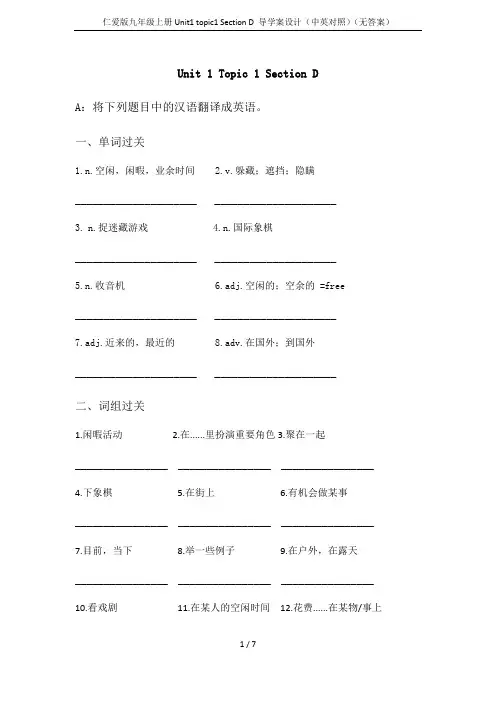
Unit 1 Topic 1 Section DA:将下列题目中的汉语翻译成英语。
一、单词过关1.n.空闲,闲暇,业余时间2.v.躲藏;遮挡;隐瞒_____________________ _____________________3.n.捉迷藏游戏4.n.国际象棋_____________________ _____________________5.n.收音机6.adj.空闲的;空余的 =free_____________________ _____________________7.adj.近来的,最近的 8.adv.在国外;到国外_____________________ _____________________二、词组过关1.闲暇活动2.在......里扮演重要角色3.聚在一起________________________________________________ 4.下象棋 5.在街上 6.有机会做某事________________________________________________ 7.目前,当下8.举一些例子9.在户外,在露天________________________________________________ 10.看戏剧11.在某人的空闲时间12.花费......在某物/事上________________________________________________13.网上聊天14.近年来15.团队运动________________________________________________16.待在家17.出国旅游18.休息________________________________________________19.放飞纸飞机20.滚铁圈21.去滑旱冰________________________________________________三、句子过关1.闲暇活动是指人们在不上班不上学的时候用来自我放松和享受的事情。
九年级英语上册 Unit1 Topic2 ABCD学案(无答案)仁爱版

Unit 1 Topic 2probable---_________( ) Europe---__________( ) recently---__________( )relative---____________( )either---__________( ) million---___________( ) difficult---_________( ) transport---___________( )写出下面动词的过去式---过去分词catch---_________---_________ _choose---________---_________ _come---___________---________ __cost---___________---________ __cut---________---__________ deal---_________---__________dig---___________---__________do---__________---__________draw---_________---__________dream---_________---__________drink---_________---__________drive---_________---__________eat---__________---___________fall---_________---__________feed---__________---___________Section A一. 读1a,回答1b的问题二. 读3a,找出3b中句子的同义句三. 在文中找到并划出下面的短语1.最多的人口___________________________________2.一家购物中心_________________________________3.不再_________________________________________4.迷路,走散_______________5.倒霉_______________6.给他打个电话_________________________________7.这么个地方___________________________________8.欧洲的一些国家_______________________________9.这么美丽的国家_______________________________使增加 如果不,除非 人口,人数 量 数词政策,方针 形容词 十亿增加,增强 欧洲的 词组困难,费力 近来的 打电话,号召 措施,方法 新生的 因为,由于… 百分之… 极好的 短缺夫妇 副词 到目前为止 集市 还,仍然 采取措施做某事 运输 很可能,大概一些几个关系,亲属 (两者一个)也不赶上跟上动词 连词 属于10.在那个时候(1)_______________________________11.在(两个中)另一张照片上_____________________12.我爸爸的家庭照片___________________________13.至少三四个孩子_____________________________14.在那个时候(2)_______________________________ 15.发生______________16.近年来_________________17.很大的发展__________________________________18.因为计划生育政策___________________________19.过去常常…___________________20.对某人要求严格_____________________________四.在文中划出下面的句子并分析1. I have just call ed you, but you weren’t in. 译:__________________________________________________ 点拨:call --- 给…打电话 链接:给…打电话还可以说:____________ /____________/_____________in --- 在家 = _________ 链接:不在家--- _________练习:昨天他给我打电话时我不在家。
仁爱版英语九上1(Unit1 Topic1)全英文教案
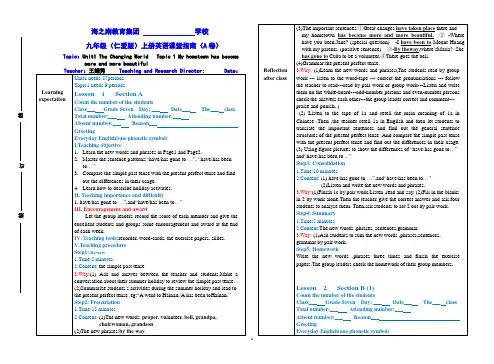
海之南教育集团 学校九年级(仁爱版)上册英语课堂指南(A 卷)Topic :Unit1 The Changing World Topic 1 My hometown has becomemore and more beautifulTeacher :王娟秀 Teaching and Research Director: Date :Learning expectationUnit1 needs 27periods Topic1 needs 9 periods Lesson 1 Section A Count the number of the studentsClass ___ Grade Seven Day: ___ Date ___ The ___ classTotal number:___ Attending number:___Absent number:___ Reason ___GreetingEveryday English(one phonetic symbol)I.Teaching objective1. Learn the new words and phrases in Page1 and Page2.2. Master the sentence patterns:“have/has gone to …”, “have/has beento …”3. Compare the simple past tense with the present perfect tense and findout the differences in their usage.4. Learn how to describe holiday activities.II. Teaching importance and difficulty1. have/has gone to …”,and “have/has been to …”III. Encouragement and awardLet the group leaders record the score of each member and give theexcellent students and groups some encouragement and award at the endof each week.IV. Teaching tools:recorder, word-cards, the exercise papers, slides.V.Teaching procedureStep1: Review1.Time:5 minutes2.Content: the simple past tense3.Way:(1) Ask and answer between the teacher and students.Make aconversation about their summer holiday to review the simple past tense.(2)Summarize students ’s activities during the summer holiday and lead tothe present perfect tense .eg:“A went to Hainan./A has been toHainan.”Step2: Presentation1.Time:15 minutes2.Content: (1)The new words: proper , volunteer, bell, grandpa,chairwoman, grandson(2)The new phrases:by the wayReflection after class(3)The important sentences:①Great changes have taken place there and my hometown has become more and more beautiful. ② -Where have you been,Jane? (special question) -I have been to Mount Huang with my parents. (positive sentence) ③-By theway ,where ’sMaria?–She has gone to Cuba to be a volunteer.④There goes the bell. (4)Grammar:the present perfect tense.3.Way: (1)Learn the new words and phrases(The students read by group work --- listen to the word-tape --- correct the pronunciations --- follow the teacher to read---read by pair work or group work---Listen and write them on the white-board---odd-number persons and even-number persons check the answers each other---the group leader correct and comment--- praise and punish. )(2) Listen to the tape of 1a and retell the main meaning of 1a in Chinese .Then ,the teacher retell 1a in English and then let students to translate the important sentences and find out the general sentence structures of the present perfect tense .And compare the simple past tensewith the present perfect tense and find out the differences in their usage. (3) Using figure pictures to show the differences of “have/has gone to …” and “have/has been to …” Step3: Consolidation 1.Time:10 minutes2.Content: (1) have/has gone to …”,and “have/has been to …”(2)Listen and write the new words and phrases.3.Way:(1)Finish 1c by pair work.Listen ,read and say. (2)Fill in the blanks in 2 by work alone.Then the teacher give the correct answer and ask four students to analyse them. Then,ask students to act 2 out by pair work. Step4: Summary 1.Time:5 minutes2.Content:The new words ,phrases, sentences,grammar.3.Way: (1)Ask students to sum the new words ,phrases,sentences, grammar by pair work. Step5: HomeworkWrite the new words ,phrases three times and finish the exercise papers.The group leaders check the homework of their group members.Lesson 2 Section B (1)Count the number of the studentsClass ___ Grade Seven Day: ___ Date ___ The ___ class Total number:___ Attending number:___Absent number:___ Reason ___ GreetingEveryday English(one phonetic symbol)装订线I.Teaching objective1. Learn the new words and phrases in Page3 and part ones in Page4.2. Go on learning the usage of the present perfect tenseII. Teaching importance and difficulty1.past participle2.-Have/Has +sb+pp.+…?-Yes ,sb.have/has.-No, sb.haven’t/hasn’t. ”III. Encouragement and awardLet the group leaders record the score of each member and give the excellent students and groups some encouragement and award at the end of each week.IV. Teaching tools:recorder, word-cards, the exercise papers, slides.V.Teaching procedureStep1: Review1.Time:5 minutes2.Content: (1)The present perfect tense (2)The important words and phrases learnt last lesson.3.Way:(1) Check the work after class. (2)Review The present perfect tense.(3) dictation.Step2: Presentation1.Time:15 minutes2.Content: (1)The new words: disabled, ever, shut, rope, online, teenager, granny, describe(2)The new phrases:in detail(3)The important sentences:①Have you cleaned rooms for the disabled for the disabled children?(general question) –Yes, I have.②-Have you ever fed them? –No, I haven’t. But I have cooked for them. ③-ThoughI had no time to travel, I still felt very happy.(4)Grammar:the present perfect tense.3.Way: (1)Learn the new words and phrases(The students read by group work --- listen to the word-tape --- correct the pronunciations --- follow the teacher to read---read by pair work or group work---Listen and write them on the white-board---odd-number persons and even-number persons check the answers each other---the group leader correct and comment--- praise and punish. )(2) Show some pictures of disabled children.Make a dialogue with students to know whether they have helped disabled children and lead to 1a.(3) Listen to the tape of 1a and retell the main meaning of 1a in Chinese .Then ,the teacher retell 1a in English and then let students to translate the important sentences and find out the general sentence structures of the present perfect tense . (4) Analyse the important sentences and then practise orally.Step3:Consolidation1.Time:10 minutes2.Content: (1)Review past tense and past participle of verbs .(2)Practise general questions of the present perfect tense in1b3.Way:(1) Review past tense and past participle of verbs by work alone and then, ask several students to sum up the rules. (2) Practise general questions of the present perfect tense in1b by pair work orally and ask some pairs to PK.Step4: Summary1.Time:5 minutes2.Content:The new words ,phrases, sentences,grammar.3.Way:①Ask students to sum the new words ,phrases,sentences, grammar by pair work.Step5: HomeworkWrite the new words ,phrases three times and finish the exercise papers.The group leaders check the homework of their group members. Lesson 3 Section B (2)Count the number of the studentsClass___ Grade Seven Day: ___ Date___ The___ class Total number:___ Attending number:___Absent number:___ Reason___GreetingEveryday English(one phonetic symbol)I.Teaching objective1. Learn the new words and phrase left in Page4.2. Go on learning the usage of the present perfect tense3. Compare the teenagers’ life in the past with that nowadays and lead students to cherish the happy life at present.II. Teaching importance and difficulty1. The new words and phrase2.The present perfect tense.III. Encouragement and awardLet the group leaders record the score of each member and give the excellent students and groups some encouragement and award at the end of each week.IV. Teaching tools:recorder, word-cards, the exercise papers, slides.V.Teaching procedureStep1: Review1.Time:5 minutes2.Content: (1)The present perfect tense. (2)The important words andTeacher’s workis finished. phrases learnt last lesson.3.Way:(1) Check the work after class.(2)Review the present perfect tense (3) dictation.Step2: Presentation1.Time:15 minutes2.Content: (1)The new words: education, childhood, support, laborer,develope, rapidly, luckily, development.(afford)(2)The phrases: a hard life ,in order to ,give support to, a good education,day and night(3)The important sentences:①Can you describe it in detail. ②Parentscouldn’t afford an education for their children. ③In order to help supporttheir families, they had to be child labores. ④Now our country hasdeveloped rapidly.⑤The government gives support to poor families, sochildren can get a good education.(4)Grammar:The present perfect tense.3.Way: (1)Learn the new words and phrases(The students read by groupwork --- listen to the word-tape --- correct the pronunciations --- followthe teacher to read---read by pair work or group work---Listen and writethem on the white-board---odd-number persons and even-number personscheck the answers each other---the group leader correct and comment---praise and punish. )(2) Show some pictures of the life of teenagers in the past. Make adialogue with students to talk about the differences between the life ofteenagers in the past and nowdays lead to 2a.(3) Listen to the tape of 2a and retell the main meaning of 2a inChinese .Then ,the teacher retell 2a in English and then let students totranslate the important sentences and find out the general sentencestructures of the present perfect tense . (4) Analyse the importantsentences and then practise orally.Step3:Consolidation1.Time:10 minutes2.Content: (1)Review past tense and past participle of verbs .(2)Practise general questions of the present perfect tense in1b3.Way:(1) Review past tense and past participle of verbs by work aloneand then, ask several students to sum up the rules. (2) Practise generalquestions of the present perfect tense in1b by pair work orally and asksome pairs to PK.Step4: Summary1.Time:5 minutes2.Content:The new words ,phrases, sentences,grammar.3.Way:①Ask students to sum the new words ,phrases,sentences,grammar by pair work.Step5: HomeworkWrite the new words ,phrases three times and finish the exercisepapers.The group leaders check the homework of their group members.Lesson 4 Section C (1)Count the number of the studentsClass___ Grade Seven Day: ___ Date___ The___ classTotal number:___ Attending number:___Absent number:___ Reason___GreetingEveryday English(one phonetic symbol)I.Teaching objective1. Learn the new words and phrase in Page5 and Page6.II. Teaching importance and difficultyThe usage of the new words and phrase.III. Encouragement and awardLet the group leaders record the score of each member and give theexcellent students and groups some encouragement and award at the endof each week.IV. Teaching tools:recorder, word-cards, the exercise papers, slides.V.Teaching procedureStep1: Review1.Time:5 minutes2.Content: (1)The present perfect tense.(2)The important words andphrases in Page4.3.Way:(1) Check the work after class. (2)Review The present perfecttense (3) dictation.Step2: Presentation1.Time:15 minutes2.Content: (1)The new words: narrow,communication, quick, leisure,relative, mainly, telegram,sort,fax,rapid,progress,already,succeed.(2)The phrases: keep in touch with ,far away ,reform andopening-up,make progress.(ring roads,living conditions)3.Way: (1) Show some pictures of Beijing in the past and at present andask the students to discuss the differences between them lead to the newwords and phrases in 1a.(2)Learn the new words and phrases(The students read by group work ---listen to the word-tape --- correct the pronunciations --- follow the teacherto read---read by pair work or group work---Listen and write them on thewhite-board---odd-number persons and even-number persons check theanswers each other---the group leader correct and comment---praise and punish. )Step3:Consolidation1.Time:15 minutes2.Content: (1)The new words and phrases.3.Way:(1) Practise how to use the new words and phrases by doing the exercise papers. (2) Give the standard answers and ask several students to analyse the questions in their paper.(3) The group leaders correct and supplement some opionions.(4)The teacher comment.Step5: HomeworkWrite the new words ,phrases three times and finish the exercises in the workbooks.The group leaders check the homework of their group members.Lesson 5 Section C (2)Count the number of the studentsClass___ Grade Seven Day: ___ Date___ The___ class Total number:___ Attending number:___Absent number:___ Reason___GreetingEveryday English(one phonetic symbol)I.Teaching objective1.Go on learning the usage of the present perfect tense3. Compare the past Beijing with the present Beijing and learn the great changes in China.4.Inspire students to cherish the happy life at present and to cultivate their patriotism.II. Teaching importance and difficulty1. The present perfect tense.2. Some sentences.III. Encouragement and awardLet the group leaders record the score of each member and give the excellent students and groups some encouragement and award at the end of each week.IV. Teaching tools:recorder, the exercise papers, pictures.V.Teaching procedureStep1: Review1.Time:5 minutes2.Content: (1)The present perfect tense. (2)The words and phrases learnt last lesson.3.Way:(1) Check the work after class.(2)Review the present perfect tense (3) dictation.Step2: Presentation1.Time:15 minutes2.Content:(1)The important sentences:①My granny has lived in Beijing for more than forty yeas.②People kept in touch with their friends and relatives far away mainly by letter or telegram. ③Beijing has made rapid progress and it has already succeeded in hosting the 2008 Olympic Games.3.Way: (1)Let the students look at the pictures in 1a and disscuss the differences in English using the simple past tense and the present perfect tense. (2) Listen to the tape of 1a and retell the main meaning of 1a in Chinese .Then ,the teacher retell 2a in English and then let students to translate the important sentences analyse the important sentences and then practise orally. (3) Let students finish 1b by work alone.Then,check the answers.Step3:Consolidation1.Time:10 minutes2.Content: (1)The important sentences and the present perfect tense.3.Way:(1) Fnish 1c by pair work.Step4: Extension1.Time:5 minutes2.Content: The changes in our hometown.3.Way:①Discuss the changes in our hometown by group work.Step5: HomeworkWrite the important sentences and finish the exercise papers.The group leaders check the homework of their group members.Lesson 6 Section DCount the number of the studentsClass___ Grade Seven Day: ___ Date___ The___ class Total number:___ Attending number:___Absent number:___ Reason___GreetingEveryday English(one phonetic symbol)I.Teaching objective(1)The new words:organization,composition,note,consider, tool. (2)Thephrases: draw up, thanks to (3)Review and sum up the importantwords, phrases,sentences and the present perfect tenseII. Teaching importance and difficulty1.The dictation and usage of the important words,phrases,sentences and the present perfect tenseIII. Encouragement and awardLet the group leaders record the score of each member and give the excellent students and groups some encouragement and award.IV. Teaching tools: word-cards.V.Teaching procedureStep1: Learn new words and phrases1.Time:10 minutes2.Content:The new words:organization, composition, note, consider, tool.(2)The phrases: draw up, thanks to3.Way: (1)Learn the new words and phrases(The students read by group work --- listen to the word-tape --- correct the pronunciations --- follow the teacher to read---read by pair work or group work---Listen and write them on the white-board---odd-number persons and even-number persons check the answers each other---the group leader correct and comment--- praise and punish. )Step2: Review1.Time:15 minutes2.Content: (1) the important words,phrases,sentences and the present perfect tense3.Way:(1) ①Divide the students into four groups.Then,let the students go to the white-board to write down the important words or phrases or sentences or grammars.②The group leaders record the results and hand them in.Step3: Comment and supplement.1.Time:10 minutes3.Way: (1)The teacher comment the students’show and supplement some points.(2) Give the groups and persons praise and award that are of the first three places.Lesson 7 (Composition)Count the number of the studentsClass___ Grade Seven Day: ___ Date:___ The___ class Total number:___ Attending number:___Absent number:___ Reason___GreetingEveryday English(one phonetic symbol)I.Teaching objectiveLearn the basic steps of writing a composition.II. Teaching importance and difficulty1.How to write a composition to the pictures.III. Encouragement and award(1)Praise students writes well point out the advantages and disadvantages of the students’ compositions.IV.Teaching procedureStep1 Discussion1.Time:10 minutes2.Content:The basic steps of writing a composition3.Way: (1)Discuss how to write the composition in 4 of Section D. (2)The teacher sum up the basic steps.Step2 Writing1.Time:20 minutes2.Content: (1) A composition about the changes in Li Ming’s hometown according to the pictures in 4.3.Way:(1) Write a composition by work alone. (2) Read over and give remarks by pair work..Step3 Comment1.Time:10 minutes2.Content:The compositions of each students.3.Way: (1)The group leaders skim through their members’compositions and remarks and sum up the advantages and disadvantages and pink out the best compositions to give them to the teacher .(2 Let two students to read two best compositions and let all the students to find out the advantages and disadvantages and discuss how to revise the disadvantages.(3)The teacher comments,summarizes and praise.Lesson 8 (practice)Count the number of the studentsClass___ Grade Seven Day: ___ Date:___ The___ class Total number:___ Attending number:___Absent number:___ Reason___GreetingEveryday English(one phonetic symbol)I.Teaching objectivePractice and consolidate the important knowledge in Topic1 of Unit 1.II.Teaching procedureStep1 the students finish Paper B1.Time:40 minutes2.Content:Paper B3.Way: Finish Paper B at one lesson .Lesson 9 (The assessment of Paper B)Count the number of the studentsClass___ Grade Seven Day: ___ Date:___ The___ class Total number:___ Attending number:___Absent number:___ Reason___GreetingEveryday English(one phonetic symbol)I.Teaching objectivePractice and consolidate the important knowledge in Topic1 of Unit 1.II.Encouragement and award:Praise the persons and groups which do well .III.Teaching procedureStep1Check Paper B1.Time:10 minutes2.Content:Paper B3.Way: Check Paper B by pair work,Then, the group leaders sum up the problems which are done badly.Step2 Analyse and assess Paper B1..Content:Paper B2..Way: (1)Analyse and assess it by some students and then the group leaders.(2)The teacher gives them some help if there is need.(3) The teacher comments and praise the persons and groups which do well .。
九年级英语上册 Unit1 Topic2 ABCD学案(无答案)仁爱版

Unit 1 Topic 2relative---____________( )either---__________( ) million---___________( ) difficult---_________( ) transport---___________( )写出下面动词的过去式---过去分词catch---_________---_________ _choose---________---_________ _come---___________---________ __cost---___________---________ __cut---________---__________ deal---_________---__________dig---___________---__________do---__________---__________draw---_________---__________dream---_________---__________drink---_________---__________drive---_________---__________eat---__________---___________fall---_________---__________feed---__________---___________Section A一. 读1a,回答1b的问题二. 读3a,找出3b中句子的同义句三. 在文中找到并划出下面的短语1.最多的人口___________________________________2.一家购物中心_________________________________3.不再_________________________________________4.迷路,走散_______________5.倒霉_______________6.给他打个电话_________________________________7.这么个地方___________________________________8.欧洲的一些国家_______________________________9.这么美丽的国家_______________________________10.在那个时候(1)_______________________________11.在(两个中)另一张照片上_____________________12.我爸爸的家庭照片___________________________13.至少三四个孩子_____________________________14.在那个时候(2)_______________________________15.发生______________16.近年来_________________ 17.很大的发展__________________________________18.因为计划生育政策___________________________19.过去常常…___________________20.对某人要求严格_____________________________四.在文中划出下面的句子并分析1. I have just call ed you, but you weren’t in.译:__________________________________________________ 点拨:call --- 给…打电话链接:给…打电话还可以说:____________ /____________/_____________in --- 在家 = _________ 链接:不在家--- _________练习:昨天他给我打电话时我不在家。
仁爱版英语九年级上册Unit1 Topic1 SectionD 精品学案

Unit1 Topic1 SectionD 精品学案学习目标:1.复习并总结现在完成时。
2.复习写作的基本方法。
3.了解家乡变化,激发学生热爱家乡的感情。
教学重难点:1.现在完成时的句子表达。
2.短语、词组的用法:see sth. oneself; more than; have the chance to do sth.等等。
课前预习:1.复习Grammar and Functions 部分,掌握现在完成时态的用法及功能性语言。
2.阅读1a, 找出下列单词和词组并熟记它们:hide-and-seek___________ play chess and cards.____________ in one’s spare time________various kinds of ________________ leisure activities.______________ enjoy oneself_________ in recent years______________3.Read 1a and finish 1b: Answer the questions in 1b.4.Read 1a again and finish the tasks below 1a.Teaching procedureⅠ.预习展示:1.Get the students to read aloud the sentences in Grammar and Functions.2.Translate the phrases in part 2 in Pre-Learning part .Ⅱ.合作学习展示:1.Get the students to read 1a aloud in groups and act it out, dealing with the language points in thepassage.2.Get the students to learn each other, asking and answering questions about the passage by themselves. Ⅲ.巩固落实:1.和同伴讨论过去和现在的课外活动有什么不同?完成表格.sure activities2. 总结:Ⅳ.当堂检测:1.单项选择:( ) 1. Both his parents look sad. Maybe they ______ what’s happened to him.A. knew B. have known C. must know D. will know( ) 2. —Our country ______ a lot so far . —Yes. I hope it will be even ______ .A. has changed ; well B. changed ; goodC. has changed ; better D. changed ; better( ) 3. —These farmers have been to the United States.—Really ? When ______ there?A. will they go B. did they go C. do they go D. have they gone( ) 4. Miss Green isn't in the office . she ______ to the library.A. has gone B. Went C.will go D. has been2.根据句意及中文提示,写出单词:1) I want to ________(藏) his present from him until his birthday.2) Many people in my hometown like to play _______(象棋) under the tree after supper.3).Fewer and fewer people listen to the __________(广播) nowadays.4)The hospital has no _______(剩余的)bed for the patient.5)Lily’s father often go _________(到国外) on business.3.句型转换:1)The students have learned many English songs this term.(改为一般疑问句) ______________________________________________________________2)Has he gone to the bus station?(作否定回答)。
仁爱版九年级上册英语练习试题Unit 1 Topic1 (无答案)
仁爱版九年级英语练习题Unit 1 Topic 1 Section A一.用所给词的适当形式填空。
1. _ Where have you (be)?_ I have been to some places of interest.2. Maria has just (come) back from her hometown.3. Look! Some boys (play) basketball on the playground.4. Jimmy (do) his homework at 7:00 yesterday evening.5. My mother (go) to the shop to buy some food and she will come back in one hour.6. She is lonely because she has no friends (talk) with.7. It’s important (keep) our classroom clean.8. My father always (read) newspaper after breakfast.9. The students (finish) doing their homework just now.10. (watch) TV too much is bad for your eyes.11. We should do something (protect) our earth.12. She has gone to China (visit) the Great Wall.13. I have been to an English summer school(improve) my English.14. We’d better wash our hands before(have) meals.15. He often watches TV after (finish)his homework.16. Now (come) your turn.17. There (go) the bell.18. Here (come) the bus.19. My father is happy (meet) my uncle20. _Where’s Lily? _ She has (be) to the library.21. Would you like something (eat).22. He has something important (tell) you.二.句型转换1. The Greens had supper very late yesterday.(改为一般疑问句)2. I got up at 7:00 last Friday. (改为否定句)3. I have been to Mount Huang. (提问)4. Take these books to the office. (改为否定句)5. We had a good time at the party. (改为同义句)6. There goes the bell. (改为同义句)7. My sister is too young to go to school. (改为同义句)8. It is so interesting a book that everyone likes it very much. (改为同义句)9. The passage is too difficult for her to understand. (改为同义句)10. The book is so easy that everyone can understand it. (改为同义句)三.选择题( ) 1. _ Have you ever been to the Summer Palace?_ Yes , we have._ When you there?_ Last month.A. have, goneB. did, goC. will, goD. is, going( ) 2. _ Where is your mother?_ She the supermarket.A. has gone toB. has beenC. has been toD. has gone( ) 3. _ Have you ever been to the Beijing Zoo?_ No, . I’ll go there this weekend.A. I’ve never been thereB. I haveC. I’ve been thereD. I don’t4. _ I didn’t see you the whole summer holiday._ I Yuannan on August 2nd. I there for two weeks.A. went to, have beenB. have gone, have goneC. went to, wasD. have gone, have been5. I saw her on the street yesterday morning.A. runB. to runC. runsD. running6. Great changes have in my country these years.A. taken placeB. happenedC. comeD. be7. Let’s make our school .A. more beautiful and more beautifulB. beautiful and beautifulC. more and more beautifulD. more beautiful and beautiful8. the way, where did you buy this dress?A. InB. withC. AtD. By9. Kate isn’t at home now. She another city.A. has been toB. has gone toC. have been toD. have gone to10. Zhang Hua won the game. His classmates are to hear this news.A. happyB. sadC. worriedD. disappointed四.根据句意及首字母提示完成句子1. _ Would you like to be a v to help thepoor children?_ Yes, I’d love to2. The pages aren’t in p order.3. Listen! The b is ringing. Let’s go to the classroom.4. The c is very busy today. She is havinga meeting now.5. My name is Li Ming. Li Haiyun is my gAnd I’m his g .6.We all had a good time in the summer h7. I’m not good at English. I don’t know how to i my English.8. _ Did you enjoy your t to Yunnan?_ Yes. It’s really a beautiful place to visit.9. We have just (回来) from Beijing.10. My best friend lives in Hong Kong now. I haven’t seen him (很长时间)11. It’s so late. It isn’t (合适的)to telephone your teacher now.12. (顺便问一下),what time will the soccer match begin?五.从A栏中找出B栏相对应的答语A( ) 1. Where did you go?( ) 2. When will your father be back?( ) 3. Where have you been?( ) 4. I spent the whole holiday helping the farmers do farm work.( ) 5. Have you ever cleaned your room?Ba.I have been to West Lakeb.No, I haven’tc.I went to the zood.Next Fridaye.Wow, you’re great.Section B一.句型转换1.Our country has developed rapidly. (改为一般疑问句)2.She has been a volunteer in a disabledChildren’s home.(改为反意疑问句)3.The children have a happy life now. (改为同义句)4.Jim gets up early in order to get to schoolon time. (改为同义句)5.Mike’s father doesn’t enough money tobuy a new coat for him. (改为同义句)6.I have taken part in some volunteeractivities during the summer holidays. (改为同义句)7.Though he is poor, he is happy. (改为同义句)8.Because he was ill, he didn’t go to school.(改为同义句)9.How wonderful the experience is! (改为同义句)10.She is poor, she can’t afford the newhouse for her son. (改为同义句)11.I’m so poor that I can’t afford a big house.(改为同义句)12.Tom got up early in order to catch theearly bus. (改为同义句)二.根据句意及首字母提示完成句子1. The poor children had no time , because they had to support their families.2. _ he found his bike?_ No. He feels upset.1.There are too many things. I want to tie them with a r .2. We should help the d people when they are in trouble.3. He fell off his bike. L , he didn’t hurt himself.4. _ It’s a little cold now. Would you pleases the window?_ OK.5. In my c , I like playing with toys.6. With the d of China, Chinese live a happy life now.7. In the old days, many children couldn’t get an e .8. Many t like playing computer games in the Net Bar.三.选择题( ) 1. You have come back from your hometown, ?A. have youB. haven’t youC. do youD. don’t you( ) 2. The man is very poor. We shouldn’t laugh at him.A. ableB. abledC. disableD. disabled( ) 3. I’m so busy that I have no time .A. go shoppingB. going shoppingC. to go shoppingD. gone shopping( ) 4. The young man works hard to his family.A. supportB. developC. buyD. get( ) 5. _ I helped a disabled man yesterday._ wonderful experience!A. WhatB. What aC. HowD. How a( ) 6. it rains heavily, the farmers are still working in the fields.A. Though, butB. Though, howeverC. Though, /D. Although, but( ) 7. I sat in front of the classroom hear clearly.A. so thatB. in order toC. in order thatD. for( ) 8. _ This morning I saw Han Fang._ It can’t be her. She Hainan.A. has been toB. has gone toC. went toD. will go to( ) 9. In the past, the poor to buy a house to live in.A. can affordB. can’t affordC. Can’t affordD. couldn’t afford( ) 10. Life was very hard for these .A. Children laborersB. child laborerC. child laborersD. children’s laborers( ) 11. What’s more, some of them to work and money to help their families.A. had, make, supportB. has, make, supportC. have, made, supportedD. having, makes, support( ) 12. In the past, children had food to eat and clothes to wear.A. little, many warmB. few, some warmC. much, no warmD. little, no warm( ) 13. _ Sorry, I didn’t bring bag._ It doesn’t matter. You can use mine.A. big enoughB. enough bigC. an enough bigD. a big enough( ) 14. _ We’ll have a day off._ A. Is that so? B. Thanks a lotC. With pleasureD. Is that all( ) 15. _ Have you the door?_ No, I haven’t.A. shutB. shutsC. to shutD. shutting四.从方框内选择适当的短语完成句子,并注意其正确形式。
仁爱版英语九年级上册Unit 1 Topic 1 Section D 教案
通过学习P7—8的生词,让学生并能熟练说出、写出P7—8的生词,并能进行英汉互译。
学习目标
教学活动
评价要点
要点归纳
目标2、精读1a ,找出重点词组,并能够英汉互译
学习内容:短文中的词组
学习方法:读短文找出词组
学习要求:划出词组同桌讨论
2、教材分析:
本节课为该话题的第四节课,建议用1-2课时上完。主要复习现在完成时。是本话题的语法重点。在1a,谈论Changing leisure activities谈论考查,学习现在完成时的用法及过去式的区别。
3、中招考点:
现在完成时及过去式的区别的用法,是学生必须掌握的知识要点,所以一定要让学生弄明白现在完成时的用法。
5. Kids often got together to ______.
6. Why do Chinese people do all kinds of leisure activities now?
自学评价:
让学生同桌讨论,找出重点信息和短语,完成8页表格和1b,并能根据图片和重点短语,能够复述课文。
基于“课程标准、中招视野、两类结构”
九(上)Unit1 Topic1Section D教案设计
(新授课)
制作学校:城关乡二中
修订人:张秀华
一、学习目标确定的依据:
1、课程标准相关要求:《英语课程标准》(2011年版)要求学生能够会读会写知汉意的单词和短语
单词:leisure, hide, hide-and-seek, chess, radio, spare,
4、学情分析:
本班学生英语学科基础较差,部分学生学习兴趣不是很足,而现在完成时的用法十分重要,鉴于这一点,上课前应当充分备足课,知识点应让学生一点一点地归纳出来,努力提高学生的学习兴趣。
原创新仁爱英语九上Unit1Topic1SectionD教案
九年级上英语Unit1Topic1SectionCⅠ. Material analysis这是九年级第一单元第一话题的第三课时,本课的容量适中,主活动是1a。
1a通过对“Changes in Beijing”这篇文章的学习,进一步训练学生的阅读能力。
1a部分还对学生的阅读策略进行了指导:通过图片和语境来猜测生词。
通过完成1b,培养学生用英语学英语的意识。
1c主要是培养学生寻找段落中心句和归纳文章内容的能力。
2和3是紧密相连的两个任务。
2引导学生就家乡的变化进行交谈,训练学生的口语表达能力,并为3的写作训练做好准备。
3则以2的交流为依托,提高学生的写作能力。
本课通过对北京和家乡今昔的对比,引导学生了解过去,珍惜现在和展望未来,培养学生积极向上的生活态度和爱家爱国的情怀。
Ⅱ.Teaching aimsaims:掌握本课的重点词汇和短语,继续学习现在完成时。
aims:培养学生的阅读能力和阅读技巧。
提高学生的口语表达能力和写作能力。
能通过图片和语境猜测词义,减轻学习过程中的压力。
了解Topic sentence的含义并初步学习如何在口语表达和书面表达中进行运用。
aims: (optional)引导学生了解过去,珍惜现在和展望未来,培养学生热爱生活的积极态度。
awareness: (optional)通过对北京今昔变化的对比,引导学生关注自己身边社会的变化,培养他们热爱家乡热爱祖国的情怀。
Ⅲ. The key points and difficult points1. Key points:Words and phrases: communication, report, relative, develop, since, satisfy, medical, machine, rapid, progress, already, be crowded into, receive agood education, keep in touch with, what’s more, make progress,succeed in doing sth.Grammar: Present Perfect2. Difficult points:如何通过语境,猜测生词、短语的意思。
仁爱英语九年级Unit1 Topic 1学案教案
仁爱版九年级学案Unit1 Topic 1一、知识目标【重要短语】have a good summer holiday 过愉快的暑假come back from…从……回来work for …为……工作feel sorry for…对……深表同情a disabled children’s home残疾儿童养育院the whole holiday 整个假期tell stories to kids 给小孩讲故事learn…from 从……当中学习feed a child 喂小孩do farm work 干农活go to summer classes 上暑期班write an article about…写篇有关…的文章have a hard life 过着艰苦的的生活in the past/ future 在过去/ 在将来in detail 详细地at sunrise 在日出时have no chance to do sth. 没有机会做某事afford ( to do) sth 担负得起(做)某事give support to sb. 给某人帮助/支持get a good education 获得良好的教育search…for…为了……搜索……have little food to eat 吃不饱dress warmly 穿得暖with the development of…随着……的发展have a balanced diet 饮食均衡play musical instruments 演奏乐器sleep in the open air 在户外睡觉study/ go abroad 在国外学习/ 出国win/ lose a competition 赢得/ 输掉比赛enjoy Beijing Opera 欣赏京剧used to do sth. 过去常做某事at sunrise 在日出时go hungry 变饿了fall ill 得病/ 患病divide …into…把……分成……feel satisfied with…对……感到满足see …. oneself 亲眼看见……make progress 取得进步thanks to 多亏; 幸亏;由于stand for 代表with the help of…在……的帮助下draw up an outline 拟定提纲【重点句型】1.You have just come back from your hometown. 你刚刚从你的家乡返回。