
九年级新目标英语Unit6 When was it invented Section A-1
A: I think … was invented before … B: Well, I think … was invented after ….
The telephone was invented before the computer.
To learn to understand and use passive voice To listen and speak about the history of inventions using passive voice To listen and speak about what inventions were used for using passive voice
3. Think about how often it’s used in our daily lives.
想想看,在我们的日常生活中它被使用得多么频繁。
(1) daily (happening, done or produced every day) 形容词,意为“每日的;曰常的”。 ► Don’t you read the daily news in today’s newspaper? 你(们)没有读今天报纸上的每日新闻吗? (2)daily (every day)副词,意为“每日;每天‖ ► The milkman comes daily to our house, 送奶人每天都到我们家来送奶。
____ d 1876 ____ a 1885 ____ c 1927 ____ b 1971
1c Student B, cover the dates. Student A,
ask Student B when the things in the picture in 1b were invented. Then change roles and practice again.
A: I think the TV was invented before the car. B: Well, I think the TV was invented after the car.
4
2
1
3
1b Listen and match the inventions with the years.
2d Role-play the conversation.
Paul: Hey Roy, the subject for my school project is ―Small inventions that changed the world.‖ Can you help me think of an invention? Roy: My pleasure! Let me think ... hmm ... I know! The zipper! Paul: The zipper? Is it really such a great invention? Roy: Think about how often it’s used in our
3
2 1
2b Listen again and match the items with their inventors and uses.
Invention
shoes with special heels shoes with lights
What is it/are they used for? _________ the style of changing the shoes in the dark seeing _____________
pleasure. / With pleasure. / It’s a pleasure.
形容词,“高兴的”,短语 be pleased to do sth.“乐于做某事”;be pleased with ― 对……满意”,句子的主语通常为人 语,修饰物
pleased
pleasant 形容词,“令人愉快的”,可作定 语、表 ►I am pleased with the painting.我对这幅画很满意。 ►Wish you a pleasant journey! 祝你旅途愉快!
名词,意为“高兴;愉快”。
► He takes no pleasure in his work.
他从工作中得不到丝毫的乐趣。
► —Thanks for helping me.
谢谢你帮助了我。
—My pleasure. / It s a pleasure. 别客气。
pleasure 名词,“高兴;愉快”。常用短语 My
A: When was the telephone invented?
B: I think it was invented in 1876.
c
When was the computer invented?
1879
Let me see…
1971 1876
1885 1927
2a Listen and number the inventions [1–3] in the order you hear them.
list用作名词,意为“名单;清单”。
► I did not see his name on the list. 我在名单上没有看到他的名字。
6. For example, it mentioned that the zipper was invented by Whitcomb Judson in 1893. 例如, 它提到拉链是在1893年由惠特科姆.贾德 森发明的。 mention动词,意为“提到,说到”其后可接 that 引导的宾语从句。 ► He mentioned that the food was invented by a Chinese. 他提到这种食物是由一个中国人发明的。
1a Look at the things below. In what order do you think they were invented? Discuss them with your group. Then number them [1–4] (1 = first, 4 = last).
have a point固定短语,意为“有道理”
► You have a point — It would be better to
wait till tomorrow. 你说的有道理,还是等到明天比较好。
5. The pioneers of different inventions were listed there. 各种发明的先驱者们被列到了上面。 (1) pioneer (a person who does something first)
印刷术
What’s this called in English?
car
television telephone microwave
oven
calculator light bulb computer
battery
Look at the things. In what order do you think they were invented?
Hey Roy…
Explanations
1.the style of the shoes 鞋子的款式 (1) style名词,意为“样式;款式”。 其常用短语 in style意为“时髦的”, 其反义短语为out of style, 意为“过时的”。 ►This year's style in dresses is different from last year’s. 今年的服装样式与去年的不同。 ► Her clothes are always in style. 她的衣服总是很时髦。
A: I think the calculator was invented before the computer. B: Well, I think the calculator was invented after the computer.
A: I think … was invented before … B: Well, I think … was invented after ….
hot ice-cream scoop ________ serving really cold icecream
2c Make conversations using the information in 2b. A: What are they used for? B: They’re used for seeing in the dark.
daily adj.每日的, 日常的 adv.每日;每天 weekly adj. 每周的 adv. 一周一次 adv.一月一次
monthly adj.每月的
yearly
adj.每年的
adv.一年一次
4. Well, you do seem to have a point ...
嗯,看来你说的确实有道理……
可数名词,意为“先锋;先驱”。
China Young Pioneers意为“中国少年先锋队”。
► He is a computer pioneer.
他是计算机方面的先驱。
(2) list动词,意为“列表;列清单”。 ► List them and you will never forget 把它们列出来你就不会忘记了。
daily lives. You can see zippers on dresses, trousers, shoes, bags ... almost everywhere! Paul: Well, you do seem to have a point ... Roy: Of course! I thought about it because I saw a website last week. The pioneers of different inventions were listed there. For example, it mentioned that the zipper was invented by Whitcomb Judson in 1893. But at that time, it wasn’t used widely. Paul: Really? So when did it become popular? Roy: Around 1917.
2014新目标九年级unit6When_was_it_invented_sectin_B2b-3b
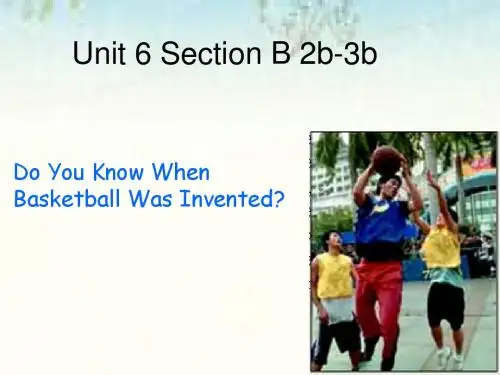
●played
inside on a floor hard _______ ● teams ● get the ball into two
other team’s basket ________
Popularity
●played by more than 100 million people
▲include,included,including ①include用作及物动词,意思是“包括,包
含”.That can include the happiness of our children ②included用作形容词, 用在名词或代词后,意思是“包括在内”. ③including用作介词,意思是“包 括在内”. Everyone laughed,me included.每个人都笑了,包括我在内. Everyone laughed,including me.
2d Use the mind map to summarize what you and your partner remember about the development of basketball. Use the following questions to help you. 1. Who invented basketball and how is it played? Dr. James Naismith. There are two teams and players on the same team must work together to get the ball into the other team’s basket. 2. When was the first basketball game in history played? On December 21,1891. 3. Why were the Berlin Olympics important for basketball? Because basketball became an Olympic event then. 4. What are the professional basketball groups in America and China? NBA and CBA. 5. How popular is basketball? Basketball is played by more than 100 million people in over 200 countries.
新目标九年级英语Unit6SectionA(1a-2d)习题含答案

新目标九年级英语Unit6SectionA(1a-2d)习题含答案Unit 6 When was it inventedSection B (1a—2b)Ⅰ. 根据句意及所给首字母提示,补全句中所缺单词。
1. Paul was very brave. We all regarded him asa h .2. Laura added too much salt to the soup. Now it tastestoo s .3. The potato chips are thin and c . Please havea try.4. Many people use cloth bags and bamboo b to do their shopping.5. Oranges taste sweet and a bit s and they are full of vitaminC.6. The main purpose of the advertisement ismaking c spend money.7. Norman Bethune was a C doctor. He waswell-known for helping Chinese people in the war.Ⅱ. 根据汉语意思及括号内所给英文提示语,将下列句子翻译成英语。
1. 乔(Joe)梦想去欧洲。
(dream of)____________________________________________2. 我们应该阻止吉尔(Jill)离开。
(stop ... from ...)____________________________________________3. 刚才贝姬(Becky)无意中拿了我的手机。
(by mistake)____________________________________________4. 大部分年轻人仰慕体育明星和歌星。
人教版新目标英语九年级 Unit6When was it inventedSectionA3a 3
人教版新目标英语九年级《Unit6.When was it 教学设计SectionA3a---3cinvented?》一、教学设计思路教师首先要让学生明白本节课的学习任务和学习内容,让他们有方向性进行学习。
课堂上首先利用几张图片导入新课,充分调动学生学习兴趣。
通过检查学生的预习情况,让他们找出课文中的新单词,在基本认识新单词的基础上初步了解这篇文章。
然后让学生快读文章,找出每段中心句。
让学生细读文章,初步回答阅读前提出的几个问题。
精读文章,找出被动语态句子,然后完成3c,同时能让学生更能理解这篇文章。
通过这篇文章,让学生之间相互讨论在实际生活中有哪些常用的小发明,同时可以锻炼学生的口语能力。
最后布置家庭作业,根据5个问题写一篇小作文,文中应用被动语态书写。
二、教学背景分析(一)教学内容分析:SectionA3a-3c是九年级第6单元的第三课时,在前2课时中已经详细地分析和应用被动语态,同时对语态也进行了系统复习,为本节课学生理解课文内容奠定了基础。
本节课的短文以茶和神农为背景素材,能激发学生的学习兴趣。
而书中活动3c“groupwork”主要巩固学生刚学的被动语态。
书中3b问题更能理解课文和提高学生阅读能力。
本单元的主要教学内容是让学生会运用一般过去时态的被动语态,本课时的学习对被动语态起了强化巩固作用,同时也提高学生的阅读能力,是本单元的重点之一,所以本课时内容是本单元中必不可少的。
(二)学生情况分析:我所教的这个班学生的基础不是很好,经过摸底发现,通过初中两年的英语学习,部分学生具备一定的听、说、读、写的能力,有了一定的词汇量,学了一些基本句型和两种语态,这些基础知识对本单元学习新词汇、学习过去被动态有着密切的联系。
本班学生英语成绩两极分化较为严重,所以学生的阅读能力和写作能力有待加强。
三、教学目标分析(一)知识与技能1、浏览文章,让学生会读课文中新单词。
2、让学生带着问题自读文章1遍。
、让学生能用文中的新单词复述文中的句子。
九年级新目标英语Unit6-When-was-it-invented-Section-A-1解读
2d Role-play the conversation.
Paul: Hey Roy, the subject for my school project is “Small inventions that changed the world.” Can you help me think of an invention?
► He takes no pleasure in his work.
► —Thanks for helping me.
—My pleasure. / It s a pleasure. 别客气。
pleasur 名词,“高兴;愉快”。常用短语 My
e
pleasure. / With pleasure. / It’s a
pleasure.
形容词,“高兴的”,短语 be
pleased
pleased to do sth.“乐于做某事”;be pleased with “对……满意”,句子的
主语通常为人
pleasan 形容词,“令人愉快的”,可作定 语
►It am pleas、ed表w语ith,t修he饰pa物inting.我对这幅画很满意。
The car was invented before the TV set.
A: I think … was invented before … B: Well, I think … was invented after ….
The telephone was invented before the TV set.
九年级新目标英语Unit6_When_was_it_invented_Section_A(3a-3c)

• Saint n.(名词) 圣徒, 圣人,圣者 ,
• Only a saint can put up with her children. 只有圣人才能容忍她的孩子们。
national形容词,意为“国家的;全国的”。 其名
词形式为nation“国家; nationality “ 国
籍”。
►The British national flag is red, white and
3b Read the passage again and answer the questions.
1.When was tea first drunk?
It was first drunk nearly 5,000 years ago.
2.How was tea invented?
While Shen Nong boiling drinking water
他几乎没说什么值得听的东西。
• ruler名词,意为“统治者;支配者” • ► A king is a ruler. 国王是统治者
boil v.
boil
[bɔɪl] ( boils; boiled; boiling ) v.沸腾;煮沸 Out in the sun all day, the blood starts to boil. 整天在太阳底下,血液都开始沸腾了。;
九年级英语全册 Unit 6 When was it invented?知识点总结 (新版)人教新目标版
Unit 6 When was it invented? 【重点单词】1. project n. 项目,工程;2. pleasure n. 高兴,愉快;3. daily adj. 日常的,每日的;4. mention v. 提到,说到;5. nearly adv.几乎,差不多;6. boil v. 煮沸,烧开;7. remain v. 保持不变;剩余;8. national adj.国家的,民族的;9. low adj.低的,矮的;10. translate v.翻译;11. lock v.锁上;n. 锁;12. sudden adj. 突然的13. crispy adj. 脆的;酥脆的;14. salty adj.咸的;15. sour adj.酸的,有酸味的;16. customer n.顾客。
17. Canadian 加拿大的,18. divide v.分开,分散;19. hero n英雄,男主角;20. professional adj. 职业的,专业的;【重点词组】1. shoes with special heels 特殊后跟的鞋子2. hot ice cream scoop 热的冰其淋勺子3. run on electricity 电动的4. be used for 被用作5. the subject for my school project 学校项目的课题6. our daily lives 我们的日常生活7. have a point 有点道理8. by accident 偶然,意外地9. over the open fire 在火堆上10. fall into the water 落入水中11. take place 发生12. without doubt 毫无疑问13. at a low price 以一个很低的价格14. translate the book into different language 把书翻译成不同种的语言15. all of sudden 突然16. by mistake 错误地17. a much-loved and active sport 一个深受喜爱并且积极的运动18. divide…into 把…分开19. stop sb from doing sth 阻止某人做某事20. look up to 钦佩,仰慕21. the professional basketball groups 职业篮球机构22. use someone else’s idea 借用其他人的想法【重点句式】1. I think the TV was invented before the car. 我认为电视是在轿车之前发明的。
九年级英语全册 Unit 6 When was it invented重点总结(短语+句型+作文)素材 (新版)人教新目标版
Unit 6 When was it invented?一.重点短语1.by accident偶然;意外地by mistake 错误地;无意中2.divide …into把…分成…3.take place发生happen发生(没有被动形式)4. change the world改变世界5.all of a sudden=suddenly 突然;猛地6. My pleasure乐意效劳7. It is said that…据说……It is believe that…人们相信……;人们认为……8. drinking water 饮用水9. fall into掉入,掉进,fall off从……摔下来(fell fallen)10. produce a nice smell 散发出一种清香11. without doubt 毫无疑问;12. at a low / high price 低/ 高价13. translate…into…把……译成14. in the end=at last=finally最后15. at the same time同时16. stop /keep/ prevent…from doing sth 阻止……做某事17. look up to 仰慕18. encourage sb. to do sth. 鼓励某人做某事19. dream of 梦想;梦见…20. achieve one‟s dream / 实现梦想one‟s dream comes true21. have a point 有道理22. not only…but also…不但……而且……23. the Olympics 奥林匹克运动会24. come up with 想出25. nearly / almost low/ high pleasure (n.)/ pleasant (adj.)/ pleasedmusic / musical / musician salt / salty custom / customer hero/ heroe s popular /popularity profession /professional accident /accidental Cana da/ Canadian二.重点语法1. 辨析invent; find; find out; discoverinvent“发明”,指通过劳动运用聪明才智“发明/创造”出以前从未存在过的新事物例:Who invented the telephone?He invented a new teaching method.find“找到、发现”,指找到或发现自己所需要的东西或丢失的东西,着重指找到的结果。
九年级英语全册Unit6Whenwasitinvented知识点归纳总结(精华版)(带答案)
九年级英语全册Unit6Whenwasitinvented知识点归纳总结(精华版)单选题1、The fish you bought yesterday smells ________. You’d better throw it away. A.goodB.badC.wellD.badly答案:B句意:你昨天买的鱼闻起来坏了,你最好把它扔掉。
good意为“好”,是形容词, bad 意为“坏的”,是形容词,well意为“好”,是副词,badly意为“坏地”,是副词。
smells意为“闻起来”,是系动词,后接形容词作表语。
根据You’d better throw it away.可知,故选B项。
2、Another bridge over the Jialing River________last year.A.buildsB.builtC.is builtD.was built答案:D句意:去年在嘉陵江上又建了一座桥。
考查动词的时态和被动语态。
builds动词第三人称单数形式,修建;built是build的过去式或过去分词形式;is built是一般现在时的被动语态;was built是一般过去时的被动语态。
根据句意可知,该句的主语Another bridge与动词构成被动关系,应用被动语态,排除A和B;再由句中的时间last year可知,应用一般过去时。
故选D。
3、Last year Huai'an Flyover(高架) _________. Now it brings much convenience to people. A.finishedB.finishesC.is finishingD.was finished答案:D句意:去年淮安高架建成。
现在它给人们带来了很多便利。
考查动词的时态。
finished完成,动词的过去式;finishes动词的一般现在时的第三人称单数;is finishing动词的现在进行时;was finished动词的一般过去时态的被动。
《九年级英语 Unit 6 When was it invented 教学设计》
《九年级英语Unit6When was it invented?教学设计》
一、教学目标
1.掌握被动语态的一般过去时。
2.了解一些重要发明的历史和影响。
3.培养学生的创新意识和科学精神。
二、教学重难点
1.重点:被动语态的一般过去时和发明相关词汇。
2.难点:正确运用被动语态描述发明的历史。
三、教学方法
历史故事法、语法讲解法、小组合作法。
四、教学过程
1.导入
播放一段关于重要发明的视频,引出话题。
2.词汇学习
教授与发明相关的词汇,如:invent,invention,inventor等。
3.语法讲解
讲解被动语态的一般过去时的结构和用法,通过例句和练习巩固。
4.历史故事分享
学生分享自己知道的一个重要发明的历史故事,运用被动语态进行描述。
5.阅读教学
阅读一篇关于发明对人类生活影响的文章,回答问题并分析文章。
6.小组讨论
学生分组讨论未来可能的发明及其影响。
7.总结归纳
总结被动语态的一般过去时和发明的相关表达。
8.作业布置
(1)复习本单元词汇和语法。
(2)写一篇关于自己想象中的发明的短文,描述其功能和影响。
人教版新目标九年级英语Unit-6-when-was-it--invented-Section-A-3a-3c
• 《茶经》,是中国乃至 世界现存最早、最完整、 最全面介绍茶的第一部 专著,被誉为“茶叶百 科全书”,由中国茶道 的奠基人陆羽所著。此 书是一部关于茶叶生产 的历史、源流、现状、 生产技术以及饮茶技艺、 茶道原理的综合性论著, 是一部划时代的茶学专 著。它是中国古代专门 论述茶叶的一部重要著 作,推动了中国汉族茶 文化的发展。
Lu Yu and Cha Jing
• 5. When was tea brought to other countries?
Tea was brought to Korea and Japan during the 6th and 7th centuries. In England, tea didn’t appear until
• by accident • 偶然;无意中: • I met Jacob by accident in the cinema. • 我偶然在电影院遇到了雅各布。 • He found his bag by accident. • 他意外地找到了自己的包。
短语
• traffic accident 交通事故 • by accident 偶然;意外地 • car accident 车祸;交通事故
What is tea used for?
It is used for drinking.\
It is used as a drink.
Read the 3rd passage and fill in the country and time to England to Korea The year of 1660 . to Japan tea to Western During the 6th countries and 7th centurie 19th century . 5000 discovered in China nearly years ago .