
中国著名建筑师贝聿铭全英文介绍Ieoh-Ming-Pei
Achievement in Architecture
1994 New York State Governor's Arts Award
1996 Premio Internazionale Novecento La Rosa d'Oro
1981 La Grande Médaille d'Or The Mayor's Award of Honor for Art and Culture
1981 Gold Medal of Honor
1983 Pritzker Architecture Prize
1989 Japesen Praemium Imperiale in honor of prince taeamarsu
Pei wanted the open
spaces and buildings of
L‘Enfant Plaza to be
“functionally and visually related” to one
another.
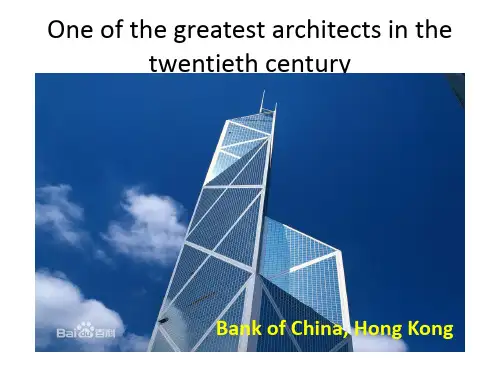
Pei felt that his design for the Bank of China Tower in Hong Kong needed to reflect "the aspirations of the Chinese people"
•During World War Ⅱ, he served on the National defense Research Commission at Princeton, and from 1945 to 1948, taught at Harvard. In 1948 he accepted the newly created post of director of Architecture at Webb & Knapp, Inc., the real estate development firm, and this association resulted in major architectural and planning projects in Chicago, Philadelphia, Washington, Pittsburgh and other cities. In 1958, he formed the partnership of I. M. Pei & Associates, which became I. M. Pei & Parteners in 1966.
2003 Nationalቤተ መጻሕፍቲ ባይዱDesign Award: Lifetime Achievement Award)
2003 Henry C. Turner Prize(for Innovation in Construction Technology)
2006 Orient und Okzident Preis 2009 英国RIBA皇家金质奖章
1978 Elsie de Wolfe Award
1978 Elsie de Wolfe Award
1979 The Gold Medal for Architecture of the American Academy of Arts and Letters
1979 AIA Gold Medal
Award
1961 The Arnold Brunner Award
1963 The Medal of Honor
1970 Golden Door Award
1976 The Thomas Jefferson Memorial Medal for distinguished contribution to the field of architecture
1990 University of California at Los Angeles 「UCLA奖」
1991 First Award for Excellence
1994 Bezalel Academy of Art and Design
Jerusalem Prize for Arts and Letters
1996 Jacqueline Kennedy Onassis Medal
1997 Independent Award
1998 Edward MacDowell Medal
1999 Cultural Laureate
2001 The Thomas Jefferson Medal for Distinguished Achievement in the Arts,Humanities,and Social Sciences
Study & Work
• He came to the United States in 1935 to study architecture at the Massachusetts Institute of Technology (B. Arch. 1940) and the Harvard Graduate School of Design (M. Arch. 1946).
Ieoh Ming Pei
——famous architect
Class:
Name:
Outline
• Brief introduction • Study & Work • Award • Well-known works
Brief introduction
• Ieoh Ming Pei (born April 26, 1917), commonly known as I. M. Pei, is a Chinese American architect, often called a master of modern architecture. Born in Canton, China and raised in Hong Kong and Shanghai, Pei drew inspiration at an early age from the gardens at Suzhou.
介绍贝聿铭的金字塔的英文作文

贝聿铭的金字塔:现代建筑与传统元素的完美融合In the vast landscape of architecture, Ieoh Ming Pei's Pyramid stands as a beacon of modernity and tradition merged into a singular masterpiece. The pyramid, a symbol of ancient Egyptian civilization, is transformed by Pei's ingenious hands into a contemporary icon, embodying the essence of both the past and the future.Born in China and educated in the West, Pei's architectural philosophy is a harmonious blend of Eastern and Western aesthetics. His pyramid, a striking feature of the Louvre Museum in Paris, is a testament to this philosophy. The structure, while seemingly simple, is actually a complex interplay of lines, angles, and spaces that create a dynamic and arresting visual experience.The pyramid's exterior is composed of glass and steel, materials that are both modern and durable. The transparent glass allows natural light to flood the interior, creating a warm and inviting atmosphere. The steel framework, on the other hand, provides the necessary structural support while also adding a touch of industrial elegance.Inside, the pyramid houses the museum's main entrance and elevators, connecting the underground lobby with the upper floors. The design is both functional and aesthetic, with every detail carefully considered to enhance the visitor's experience. The pyramid's interior is as impressive as its exterior, with sleek lines and open spaces that encourage exploration and discovery.Pei's pyramid is not just a building; it is a work of art that challenges the conventions of architecture. It stands as a reminder of the power of creativity and innovation, even in the face of historical and cultural constraints. The pyramid's ability to blend the ancient with the modern, the traditional with the contemporary, is a testament to Pei's exceptional talent and vision.Moreover, the pyramid serves as a bridge between the Louvre's rich historical collections and the modern world. It welcomes visitors from all over the world, inviting them to embark on a journey through time and culture. In this way, Pei's pyramid not only enhances the Louvre's identity but also contributes to its global significance.In conclusion, Ieoh Ming Pei's pyramid is a masterpiece of modern architecture that successfully incorporates traditional elements. It is a symbol of Pei's unique vision and his ability to create structures that are both visually stunning and functionally efficient. The pyramid stands asa testament to the power of architecture to connect thepast with the future, the traditional with the modern, andto inspire us all to see the world in a new and exciting way.**贝聿铭的金字塔:现代建筑与传统元素的完美融合** 在建筑学的广阔天地中,贝聿铭的金字塔作为现代与传统完美融合的杰出作品,熠熠生辉。
贝聿铭及其建筑设计【英文】 Ieoh Ming Pei

His projects
Luce Memorial Chapel (1963) Dallas, Texas City Hall (1972) John Hancock Tower, in Boston (1976) East Building, National Gallery of Art (1979) Bank of China Tower (1982-1990) Pyramids of the Louvre (1989)
Accomplishments
the Gold Medal for Architecture from the American Academy of Arts and Letters and the Gold Medal of the American Institute of Architects the Gold Medal from Alpha Rho Chi (the national professional fraternity of architects) the Grande Médaille d'Or from the French Académie d'Architecture the Pritzker Architecture Prize
introduction
In 1977 the AIA presented Cobb with a National Honor Award for the John Hancock Tower As of 2005, it is the tallest building in New England, the 43rd tallest building in the United States, and the 112th tallest building in the world achievement in minimalist, modernist skyscraper design no spandrels between the floors and the mullions are minimal glass is tinted blue -transplanted sky in day time
贝聿铭

貝聿銘建築大師 貝聿銘貝聿貝聿ㄩˋ 銘貝聿銘(英文名: 貝聿銘(英文名:Ieoh MingPeiMingPei , ,1917 1917年 年4 4月 月2626日-),美籍華 人建築師,祖籍蘇州,生於廣州,其父是中國銀行創始人之一貝祖怡。
怡。
10 10歲隨父親來到上海, 歲隨父親來到上海,1818歲 到美國。
先後在麻省理工學院和哈佛大學學習建築。
於 佛大學學習建築。
於19551955年建立 建築事務所。
建築事務所。
19901990年退休。
作為最後一個現代主義建築「大師」,他被人描述成為一個注重於抽象形式的建築師抽象形式的建築師。
他喜好的材料 包括 包括石材 石材、 、混凝土 混凝土、 、玻璃 玻璃和 和鋼 鋼。
。
簡介簡介 貝聿銘 貝聿銘1917 1917年 年4 4月 月26 26日生於廣州。
日生於廣州。
19181918年其父親出任中國銀行香港分 行總經理,貝氏在香港度過他的童年,入讀聖保羅書院。
行總經理,貝氏在香港度過他的童年,入讀聖保羅書院。
1927 1927年父親調 職舉家搬至上海,住在有名的蘇州園林獅子林當中。
初中就讀上海青年 會中學,高中畢業自聖約翰大學附屬中學,後來赴賓州大學攻讀,因為 認為自己沒有畫圖的天賦而轉讀劍橋市的麻省理工學院,貝氏埋首於圖 書館,努力吸收歐洲近代建築相關的資訊, 書館,努力吸收歐洲近代建築相關的資訊,柯比意柯比意的作品是他最醉心的 , ,日後貝氏作品所呈現的雕塑性 ,就是深受柯比意的影響 ,就是深受柯比意的影響。
。
1939 1939年畢 業。
在 在貝氏早期的作品有密斯的影子 貝氏早期的作品有密斯的影子,不過,不過他不像密斯以坡璃為主要建 材,貝氏採用混凝土 材,貝氏採用混凝土,如 ,如紐約富蘭克林國家銀行 紐約富蘭克林國家銀行, ,鎮心廣場住宅區 鎮心廣場住宅區, ,夏 威夷東西文化中心。
威夷東西文化中心。
↑夏威夷東西文化中心→鎮心廣場住宅區 →鎮心廣場住宅區到了中期,歷練累積了多年的經驗,貝氏充分掌握了混凝土的性質,作品趨向於 了混凝土的性質,作品趨向於柯比意式的雕塑感柯比意式的雕塑感, 其中當以 其中當以全國大氣研究中心全國大氣研究中心,達拉斯市政廳,等皆 屬此方面的經典之作。
介绍贝聿铭 英文作文

介绍贝聿铭英文作文Beijing-born architect Ieoh Ming Pei, commonly known as I.M. Pei, is a legendary figure in the world of architecture. With a career spanning over six decades, Pei has left an indelible mark on the global architectural landscape. His work is characterized by a harmonious blendof modernist principles and traditional elements, creating timeless and iconic structures.Pei's most famous creation is undoubtedly the Louvre Pyramid in Paris. Completed in 1989, the glass and metal pyramid stands as a striking contrast to the classical architecture of the Louvre Museum. Its geometric form and transparent materials symbolize a modern approach to design, while also paying homage to the historical context of the site. The pyramid has become an internationally recognized symbol of both the Louvre and Pei's innovative style.Another notable work by Pei is the Bank of China Towerin Hong Kong. Completed in 1990, the tower's distinctivetriangular shape and sharp angles make it a standout feature in the city's skyline. The building's design reflects Pei's belief in the importance of creating structures that respond to their surroundings andcontribute to the urban fabric. The Bank of China Tower is a testament to Pei's ability to combine functionality with aesthetic appeal.Pei's architectural prowess extends beyond individual buildings. He has also made significant contributions to urban planning. One of his notable urban projects is the revitalization of the historic area of Suzhou, China. Pei's master plan for the city focused on preserving its cultural heritage while introducing modern amenities and infrastructure. His vision for Suzhou demonstrates his commitment to creating sustainable and livable cities that honor the past and embrace the future.Throughout his career, Pei has received numerous accolades for his contributions to architecture. He was awarded the Pritzker Architecture Prize in 1983, the highest honor in the field. His work has also beenrecognized with the American Institute of Architects Gold Medal and the Royal Gold Medal from the Royal Institute of British Architects. These awards are a testament to Pei's enduring impact on the architectural profession.In conclusion, I.M. Pei is a visionary architect who has left an indelible mark on the world of architecture. His innovative designs, such as the Louvre Pyramid and the Bank of China Tower, showcase his ability to seamlessly blend modernist principles with traditional elements. Pei's contributions extend beyond individual buildings, as he has also made significant contributions to urban planning. His numerous accolades and awards are a testament to hislasting legacy in the field of architecture.。
贝聿铭
About Mr.Pei
I want to be an architect.
About Mr.Pei
• • • • Education: University of Pennsylvania Massachusetts Institute of Technology Harvard University
• The design that Pei developed for the Bank of China Tower was not only unique in appearance, but also sound enough to pass the city‘s rigorous standards for wind-resistance. • The tower was planned around a visible truss(束、捆) structure, which distributed stress to the four corners of the base(to make it stable) • Using the reflective glass that had become something of a trademark for him, Pei organized the facade(表 面) around a series of X shapes. At the top, he designed the roofs at sloping angles to match the rising aesthetic of the building.
Honor
Honor
• One of the great achievements in his career: In 1983 he was awarded the Pritzker Prize, sometimes called theNobel Prize of architecture. • "His magnificent designs have challenged engineers to devise innovative structural solutions, and his exacting expectations for construction quality have encouraged contractors to achieve high standards."
介绍贝聿铭 英文作文

介绍贝聿铭英文作文英文:I would like to introduce Ieoh Ming Pei, commonly known as I.M. Pei, who was a renowned Chinese-American architect. He was born in Guangzhou, China in 1917 and later moved to the United States to study architecture at the Massachusetts Institute of Technology. Throughout his career, I.M. Pei designed numerous iconic buildings around the world, leaving a lasting impact on the architectural landscape.One of his most famous works is the Louvre Pyramid in Paris, which serves as the main entrance to the Louvre Museum. The pyramid is a stunning combination of modern and classical architecture, and it has become a symbol of the museum itself. I had the chance to visit the Louvre and witness the grandeur of the pyramid firsthand. It was truly a breathtaking experience to see how I.M. Pei's design seamlessly integrated with the historical surroundings.Another remarkable project of I.M. Pei is the Bank of China Tower in Hong Kong. This skyscraper is a masterpiece of structural engineering and architectural innovation. Its sharp angles and sleek design make it a standout in the Hong Kong skyline. I remember standing at the base of the tower, looking up and feeling a sense of awe at the sheer magnitude of the building.In addition to his architectural achievements, I.M. Pei was also known for his ability to blend Eastern and Western influences in his designs. This cultural fusion is evident in the Suzhou Museum in China, where traditional Chinese elements are combined with modern architectural principles.I had the opportunity to explore the museum and was impressed by how I.M. Pei seamlessly integrated the old and the new, creating a space that pays homage to the rich history of Suzhou.Overall, I.M. Pei's impact on the world of architecture is undeniable. His ability to create timeless and iconic structures has left a lasting legacy for future generationsto admire and appreciate.中文:我想介绍一下贝聿铭,他是一位著名的华裔美国建筑师。
介绍贝聿铭的英语作文
The Genius of I. M. Pei: Architecture's EternalLegacyIn the annals of architecture, few names resonate with such grandeur and influence as I. M. Pei. Born in China in 1917, Pei's journey to becoming one of the most renowned architects of the 20th century was anything but conventional. His story is a tapestry of hard work, perseverance, and an unwavering dedication to his craft.Pei's early life was marked by a profound interest in art and design. His parents, both accomplished scholars, encouraged him to pursue his passions, and he soon found himself immersed in the world of architecture. After graduating from Shanghai's Jiao Tong University with a degree in engineering, Pei immigrated to the United States, where he further honed his skills at the University of Pennsylvania's School of Design.It was during this time that Pei's unique architectural philosophy began to take shape. He was deeply influenced by the principles of modernism, which emphasized simplicity, functionality, and harmony with the natural world. Pei believed that architecture should not just be about formand function, but also about creating spaces that were both beautiful and meaningful.Pei's career was marked by a series of groundbreaking projects that showcased his exceptional talent and vision. One of his earliest and most famous works is the Louvre Pyramid in Paris. Commissioned by the French government in 1983, the project was a controversial one, as Pei's design departed significantly from the Louvre's classical facade. However, the Pyramid's successful integration into the Parisian landscape and its ability to draw in millions of visitors every year have since vindicated Pei's vision.Another notable project is the John F. Kennedy Libraryin Boston. Completed in 1979, the library's design is a testament to Pei's mastery of both form and function. The building's bold geometry and use of reflective glass notonly complement its surrounding landscape but also create a serene and contemplative space that honors Kennedy's legacy. Pei's legacy is not just about his individual projects, however. His influence extends to the next generation of architects and designers, who have been inspired by his dedication to his craft and his belief in thetransformative power of architecture. His work has also been recognized with numerous awards and accolades, including the Pritzker Architecture Prize, which is considered the Nobel Prize of architecture.In conclusion, I. M. Pei's life and work are a testament to the power of vision, perseverance, and dedication. His legacy will forever be etched in the annals of architecture, serving as a beacon of inspiration for generations of designers and architects who come after him. His belief in the transformative power of architecture and his commitment to creating spaces that are both beautiful and meaningful have left an indelible mark on the world, and his influence will undoubtedly continue to resonate for centuries to come.**贝聿铭:建筑界的永恒传奇**在建筑史上,鲜有人的名字能如贝聿铭(I. M. Pei)般散发出如此宏伟与深远的影响。
贝聿铭 英文
Thanks!
• The architectural work of Ieoh Ming Pei is truly phenomenal to behold.. • Pei’s work can be seen all over the world, and experiencing his staggering and sometimes controversial works first-hand is a must. You may only get to see one or two of his inspirational designs, but for architectural enthusiasts, all inclusive holidays such as a Pei-themed round the world trip could provide the travel experience of a lifetime.
Design concept(设计理念)
People generally think that architecture architectures architectural design has three features: one is the architecture model and environment natural melting. The second is the treatment of space show originality. The third is building materials fastidious and building interior design is exquisite. These features in the "east house" design has been fully embodied. The general architectures works, he is since industrial revolution of modern urban added light, can say with The Times lockstep. In 1988, bei yuming decided not to accept the large-scale construction engineering, but to deliberately choose small buildings, his design of the building height also more and more low. That is more and more close to the horizon, I think this is the natural regression. Beauty show art gallery more clearly shows the old age to Oriental artistic architectures, especially the hometown the distant scenery - China landscape ideal landscape Jing grip. Japan's critics speak well, this work marks in the long architectures construction career a new milestone.
Ieoh Ming Pei
Ieoh Ming PeiIeoh Ming Pei was born in China in 1917, the son of a prominent banker. At age seventeen he came to the United States to study architecture, and received a Bachelor of Architecture degree from MIT in 1940. Upon graduation, he was awarded the Alpha Rho Chi Medal, the MIT Traveling Fellowship, and the AIA Gold Medal. In 1942, Pei enrolled in the Harvard Graduate School of Design, where he studied under Walter Gropius; six months later, he volunteered his services to the National Defense Research Committee in Princeton. Pei returned to Harvard in 1944 and completed his M.Arch in 1946, simultaneously teaching on the faculty as an assistant professor (1945–48). Awarded the Wheelwright Traveling Fellowship by Harvard in 1951, he traveled extensively in England, France, Italy, and Greece. I. M. Pei became a naturalized citizen of the United States in 1954.In 1948, William Zeckendorf invited Mr. Pei to accept the newly created post of Director of Architecture at Webb & Knapp, a real estate development corporation, resulting in many large-scale architectural and planning projects across the country. In 1955 he formed the partnership of I. M. Pei & Associates, which became I. M. Pei & Partners in 1966, and Pei Cobb Freed & Partners in 1989. The partnership received the 1968 Architectural Firm Award of the American Institute of Architects.Mr. Pei's personal architectural style blossomed with his design for the National Center for Atmospheric Research in Boulder, Colorado (1961–67). He subsequently gained broad national attention with the East Building of the National Gallery of Art in Washington (1968–78) and the John F. Kennedy Library in Boston (1965–79)—two of some thirty institutional projects executed by Mr. Pei, including church, hospital, and municipal buildings, as well as schools, libraries, and over a dozen museums. His most recent works include the Miho Museum in Shiga, Japan, the Grand Louvre in Paris, the Morton H. Meyerson Symphony Center in Dallas, and the Schauhaus at the German Historical Museum in Berlin. Among Mr. Pei's skyscraper designs are the 72-story Bank of China in Hong Kong and the Four Seasons Hotel in midtown Manhattan. Other hotels by Mr. Pei include Raffles City in Singapore and FragrantHill Hotel in Beijing (1982), which was designed to graft advanced technology onto the roots of indigenous building and thereby sow the seed of a new, distinctly Chinese, form of modern architecture.Mr. Pei's deep interest in the arts and education is evidenced by his numerous memberships on Visiting Committees at Harvard and MIT, as well as on several governmental panels. He has also served on the AIA Task Force on the West Front of the U.S. Capitol. A member of the AIA National Urban Policy Task Force and of the Urban Design Council of the City of New York, he was appointed to the National Council on the Humanities by President Lyndon Johnson in 1966, and to the National Council on the Arts by President Jimmy Carter in 1980. In 1983, Mr. Pei was chosen the Laureate of the Pritzker Architecture Prize; he used the $100,000 award to establish a scholarship fund for Chinese students to study architecture in the United States (with the strict proviso that they return to China to practice their profession). Among the many academic awards bestowed on Mr. Pei are honorary doctorates from Harvard University, the University of Pennsylvania, Columbia University, New York University, Brown University, the University of Colorado, the Chinese University of Hong Kong, and the American University of Paris,. Most recently he was awarded the Laura Honoris Causa by the University of Rome, in 2004.Mr. Pei is a Fellow of the American Institute of Architects and a Corporate Member of the Royal Institute of British Architects, and has also been elected to the American Academy of Arts and Sciences, the National Academy of Design, and the American Academy and Institute of Arts and Letters. In 1975 he was elected to the American Academy itself, which is restricted to a lifetime membership of fifty. Three years later he became Chancellor of the Academy, the first architect to hold that position, and served until 1980. Mr. Pei was inducted as a "Membre de l'Institut de France" in 1984, and decorated by the French government as a Commandeur in the "Ordre des Arts et des Lettres" in 1985. On July 4, 1986, he was one of twelve naturalized American citizens to receive the Medal of Liberty from President Ronald Reagan. Two years later, President François Mitterrand inducted I. M. Pei as a Chevalier in the Légion d'Honneur, and in November 1993 he was raised to Officier.Also in 1993 he was elected an Honorary Academician of the Royal Academy of Arts in London. In 1997 the Académie d'Architecture de France elected him Foreign Member.Among Mr. Pei's many professional honors are The Arnold Brunner Award of the National Institute of Arts and Letters (1963); The Medal of Honor of the New York Chapter of The American Institute of Architects (1963); The Thomas Jefferson Memorial Medal "for distinguished contribution to the field of architecture" (1976); The Gold Medal for Architecture of the American Academy of Arts and Letters (1979); The Mayor's Award of Honor for Art and Culture (New York City, 1981); and The Gold Medal of Alpha Rho Chi, the national professional fraternity of architects (1981). In 1979, I. M. Pei received The AIA Gold Medal—the highest architectural honor in the United States. Three years later he received the Grande Médaille d'Or from the Académie d'Architecture de France. In 1989, the Japan Art Association awarded him the Praemium Imperiale for lifetime achievement in architecture, and in the following year UCLA bestowed the University's Gold Medal. In 1991, Mr. Pei received the Excellence 2000 Award and the Colbert Foundation's First Award for Excellence. Most recently he was awarded the Medal of Freedom by President George H. W. Bush (1993); the Medal of Arts by the National Endowment for the Arts (1994); the Jerusalem Prize for Arts & Letters by the Bezalel Academy of Arts & Design of Jerusalem (1994); and the Jacqueline Kennedy Onassis Medal by the Municipal Art Society of New York City (1996). Of the many honors extended, Mr. Pei has accepted the Independent Award of Brown University (1997), the Edward MacDowell Medal of the MacDowell Colony (1998), and the American Philosophical Society's Thomas Jefferson Medal for distinguished achievement in the arts (2001). In 2003, Mr. Pei received the Henry C. Turner Prize for Innovation in Construction Technology awarded by the National Building Museum, and in the same year received the Lifetime Achievement Award (one of the National Design Awards) from the Smithsonian Institution's Cooper-Hewitt, National Design Museum.。
著名建筑师贝聿铭Ieoh_Ming_Pei
1983 Pritzker Architecture Prize 1989 Japesen Praemium Imperiale in honor of prince taeamarsu 1990 University of California at Los Angeles 「UCLA奖」 1991 First Award for Excellence 1994 Bezalel Academy of Art and Design Jerusalem Prize for Arts and Letters 1994 Gold Medal for Outstanding
The third one is the glassand-steel pyramid for the Louvre museum . It was completed in1989 in Paris .Pei decided that the
pyramid was the most compatible with the other structures at the Louvre, complementing their roofs' faceted planes.
Thank You
贝聿铭 (Ieoh Ming Pei )
Class: 1005
21 24
Name:X.X.Dong Z.Z.Jing
Brief introduction Study & Work Award Well-known works
Brief introduction
Ieoh Ming Pei (born April 26, 1917), commonly known as I. M. Pei, is a Chinese American architect, often called a master of modern architecture. Born in guang zhou, China and grew up in Hong Kong and Shanghai, Pei drew inspiration at an early age from the gardens at Suzhou.